658 résultats
1st edition. Original boards. 8vo. 247 pages. 21 cm. In Yiddish. Title translates to Songs of my Field: Memories of my Exhausted life. Title on title page verso: Espigas de mi campo. Dujowich (1873-1951). SUBJECTS: Jews -- Russia -- Biography. OCLC lists 16 copies worldwide (OCLC: 12385305). Wear to boards. Pages browning. Otherwise Good Condition. (YID-40-96-L-'x)
1st edition. Original Cloth, 8vo, 380 pages. In Yiddish. The chronicle of Bialystok: basic material for the history of the Jews in Bialystok until the period after the First World War. Very Good Condition(YIZ-10-1A)
8vo; 424 pages; 1st edition. Original Blue CLoth21 cm. . In Yiddish. Special issue to "Unser Weg". "The extermination of the Jews of Kowno (Kaunas) " on copyright page. Includes index, portraits, music and 18 pages of photo plates. The US Holocaust Memorial Museum keeps their copy in their Rare Book Collection. Pages tanned. Very Good condition (YIZ-3-11)
1st edition. Original cloth in dust jacket. 8vo. 231 pages. Illustrated. In Yiddish. SUBJECT (S) : Jews Lithuania history; Haskalah Lithuania history. SERIES: Dos Poylishe Yidntum ; ; bd. 70; Variation: Poylishe Yidntum ; ; bd. 70. Born in Warsaw, Shatzky [1893-1956] received his doctorate in 1922 for a dissertation on 19th-century Polish-Jewish history. During World War I he served as an officer in the Polish Legion. From 1913 on he wrote Polish articles and reviews on Jewish literary and historical subjects. He came to write mainly in Yiddish after 1922, the year he settled in the U. S. Where he was one of the founders of the U. S. Section of YIVO. From 1929 until his death he was librarian of the New York State Psychiatric Institute. Shatzky's range was extraordinarily wide: Spinoza, psychiatry, theater, music, folklore, literature, language, and other areas. His principal field, however, was Eastern European Jewish history, and his major work was his history of Warsaw Jewry. He was an indefatigable and often querulous reviewer of scholarly works; the quality and accuracy of his own historical scholarship has often been questioned. (Prager, EJ) Has tanned dust jacket and sewn in ribbon bookmark. Very good condition in very good jacket. A gorgeous copy (YIZ-8-5) x
1st edition. Original publisher's cloth, 4to; 342 pages; In Yiddish. With lots of illustrations and detailed index. Light wear, Overall Very Good Condition. (YIZ-5-8)xx
8vo; 262 pages; 1st edition. Original publisher's cloth. 8vo, 262 pages. 24 cm. Includes added title page in English: "The Jews in the Ukraine, from the earliest times through 1648-1649." Only 2000 copies printed. Very Good Condition. (YIZ-6-7)
8vo; 238 pages; 24 cm. 1st edition. In Yiddish. Personal narrative of life in the Ghetto, including the authors' role as a leader in the resistance. 11 photo plates. The US Holocaust Memorial Museum keeps their copy of this book in their Rare Book Collection. Chip to corner of of front cover, no text affected, otherwise Good Condition. (YIZ-3-5A)
1st edition. Original paper wrappers 4to (magazine size) , 32, 128 pages. In Yiddish (128 pages) and English (32 pages). 3 Volumes were issued (1946, 1947, 1948) Includes many photos. 24 cm. SUBJECT(S) : Jews, East European -- United States -- Periodicals. : Jews -- Bessarabia (Moldova and Ukraine) OCLC lists 19 copies worldwide.. Spine crudely repaired with black tape, but covers are otherwise good, and internal paper and binding remain good and strong as well. Good condition thus. (GH-3-10A-ALX-o)
1st edition, original paper wrappers. 12mo, 24 pages. In Yiddish. honors the 10ter Literarisher Konkurs far Yugntlekhe A"N fun Shmerke Katsherginski. This may be the final volume? (SUBJECT(S) : Yiddish literature Argentina periodicals. OCLC: 33634165. Stamp on Spanish (rear) cover. Very Good condition. (MX-20-4A-+-l)
1st edition, original paper wrappers. 16mo, 54 pages. In Yiddish. honors the 10ter Literarisher Konkurs far Yugntlekhe A"N fun Shmerke Katsherginski. The series lasted at least 15 volumes into the 1960s (SUBJECT(S) : Yiddish literature Argentina periodicals. OCLC: 33634165. Good condition. (MX-20-4-+-l)
Good Solid condition.; 8vo; 387 pages; In Yiddish. Not in Robinson & Friedman nor Wolff. Jewish partisan's memoirs of resistance against the Nazis in Poland. Illustrated with many photographs throughout. Inscribed by Kaczerginski in year of publication. Kaczerginski (19081954) was a Yiddish writer and cultural activist. Born in Vilna to a poor family and educated at that citys Talmud Torah, Shmerke (Pol., Szmerke) Kaczerginski lost both his parents during World War I. As a youth, he was involved with outlawed Communist groups and was arrested several times, serving a lengthy prison term. In the 1930s, two of his revolutionary poems became popular in Poland. He wrote short stories with a radical bent and was a correspondent and reporter for literary publications, including the semilegal leftist press in Poland and the New York Communist daily Morgn-frayhayt. Kaczerginski played a key role in shaping the writers and artists group Yung-Vilne; he organized its evening events and was the de facto publisher of its three miscellanies between 1934 and 1936. During the period of Soviet control over Lithuania in 19401941, he was even more active in the field of Yiddish culture, but at the same time experienced his first disappointments with the attitude of the Soviet regime toward Jewish culture. During the first period of Nazi occupation, Kaczerginski wandered through villages and towns posing as a deaf mute; after many difficulties, he ended up in the Vilna ghetto. Kaczerginski was very involved in the ghettos cultural activities. As a leader of its youth club, he wrote its Yugnt-himen (Youth Hymn), a song that immediately became popular. In 1943, he wrote the song Shtiler, shtiler in memory of the mass murders committed at Ponar. Set to music that Aleksander Volkoviski (later known as Aleksander Tamir) had submitted to a contest organized by the ghetto, the song was first heard at an evening performance there and over the years became one of the best-known songs of the Holocaust. With Avrom Sutzkever and others, Kaczerginski became part of a group of forced laborers whom the Germans designated to sort Jewish cultural treasures at YIVO and other locations. Known as the Papir-brigade (Paper Brigade), the groups members risked their lives to hide the most significant items, smuggling them back into the ghetto or entrusting them to non-Jewish acquaintances. Kaczerginski was a member of the Fareynikte Partizaner Organizatsye (United Partisans Organization; FPO), and, since YIVOs building was located outside the ghetto walls, he took part in smuggling weapons into the ghetto. In September 1943, Kaczerginski, along with Avrom and Freydke Sutzkever and other members of the FPO, escaped from the Vilna ghetto as part of an organized group of fighters just before its liquidation. They joined a Soviet partisan unit in the Naroch Forests, where Kaczerginski fought as a partisan until liberation in July 1944. Kaczerginskis books describe the destruction of Vilna, the partisan struggle, and his own experiences during the Holocaust period: Khurbn Vilne (The Destruction of Vilna; 1947), Partizaner geyen (Partisans on the Move; 1947), and Ikh bin geven a partizan (I Was a Partisan; 1952) (YIVO, 2010). Wear to cover and edges, very good condition. (HOLO2-87-3A)
New York, No Publisher (United Hebrew Trades) , 1928. Paper Wrappers, Large 4to, 160 pages. 30 cm. In Yiddish. Includes beautiful cover art and period ads and portrait photos. Feinstone (1878-1945),was born in Warsaw and trained as a woodcarver there. "After completing school he emigrated to England where he became president of a woodcarvers' union in London (1895). Later in Birmingham he was active in the beginnings of the British Labour Party. In 1910 Feinstone emigrated to the U.S. where he found employment in various skilled trades, securing permanent work in the umbrella industry. He soon became an official of the Umbrella Handle and Stick Makers' Union and an important figure in the United Hebrew Trades, an organization which sheltered the smaller and weaker American Jewish trade unions. Feinstone was a close associate of the organization's outstanding leader, Max Pine, whom he succeeded as United Hebrew Trades' secretary in 1928. Feinstone continued Pine's policy of supporting the socialist labor sector in Jewish Palestine through the Histadrut. He also represented the United Hebrew Trades on the executive board of the Central Trades and Labor Council of Greater New York, wrote articles in the New York Call and the Yiddish Jewish Daily Forward endorsing socialism and labor Zionism, and worked for the establishment of an independent labor party. With the advent of the New Deal, Feinstone's socialist teachings were incorporated by the American Labor Party, which satisfied his desire for a working class political organization. Thereafter, until his death he concentrated on obtaining support for Jewish labor in Palestine" (Melvyn Dubofsky in EJ). SUBJECT(S):Jewish labor unions -- United States. Jewish socialists -- United States. OCLC lists 3 copies worldwide (Harvard, Florida, NYPL), none west of New York. Tears to front cover, lacks rear cover, otherwise Good Condition. (Y-18C)
New York, N. Y. : American Representation of the General Jewish Workers' Union of Poland, No Date (1956? ) . Paper Wrappers, 8vo, 39 pages. Yiddish Monthly of the Bund in America, originally beginning in Feb 1941. 25 cm. In Yiddish. Light wear, Good Condition (Y-21-C)
8vo; 1st edition. Cloth, Small octavo, 334 pages. In Yiddish. Section headings include "The Jews in Amsterdam", The Theological Storm", and "Leibnitz". Includes bibliographical references (pages 319-334).SUBJECT(S): Spinoza, Benedictus de, 1632-1677. "Jacob Shatzky (also: Yaakov, or Yankev Shatski; in Polish: Szacki) (18931956) was a distinguished Jewish historian.Shatzky was born in Warsaw. He received a traditional Jewish education and went on to study at universities in Lwów, Vienna, Berlin and Warsaw. He earned his Ph.D. from the University of Warsaw in 1922 with a thesis on 'The Jewish Question in the Kingdom of Poland During the Paskiewicz Era.' Historians who studied under Shatzky include Lucy Dawidowicz.Shatzky enlisted in Pilsudski's Legion and fought with distinction in the First World War; he was promoted to the rank of lieutenant. He was sent by the Polish Foreign Ministry in 1918 to report on a pogrom in Vilna. He resigned from his post when it became clear that the government would not act to punish the perpetrators of the pogroms.Shatzky emigrated to the United States in 1923. He served as Chief Librarian of the New York State Psychiatric Institute from 1930 to 1956. He acquired the personal library of Sigmund Freud for the collection" (Wikipedia). OCLC: 19308492. Some wear, Good Condition. (YID-42-43-EL-'x)
Small folio, 17, 33pages. First Edition. With an introductory essay by Abraham Joshua Heschel. A most moving depiction of vibrant Jewish life before the Holocaust. 31 black and white photographs, many now iconic images of Eastern European Jewish life. Original boards, with most of jacket present (as often found). No marks except for a faint damp stain in the upper right blank margin corner of the text page introduction (it also has a former owner's attractive bookplate). It has a jacket showing the dramatic photo on the cover--but the border area, starting at the left side of the photo through the spine, is missing. About Very Good in damaged but attractive Jacket. (EE-3-20) xx
Paper wrappers, 8vo, 40 pages (uncut) , in Yiddish, Publisher specialized in Yiddish drama. SUBJECT(S) : Yiddish -- Drama -- Operetta. OCLC lists 1 copy worldwide (National Library of Israel) Inscription on cover page. Edge wear to all pages, no text loss. Spine repaired. Good condition. (YID-20-1)
192936164Vilne: Vilner Farlag B. Kletskin 1929. Hardcover. g. Quarto. Vol. 2: 8 516 XXVII. Black buckram with gold lettering on front. Blind stamp borders on spine with red text boxes. Blind stamp symbol and lettering on back boards. Brown decorative endpapers b/w photographic facsimile plates and cuts throughout. Includes articles about the history of Yiddish theater Slavic influences on Yiddish burial customs early German thief jargon and Yiddish surnames in Ukraine. Additional title pages and summaries in English. Slight wearing on edges and ends. Top of spine torn. Slight age toning. Binding and interior in good condition. Text in Yiddish. Vilner Farlag B. Kletskin hardcover
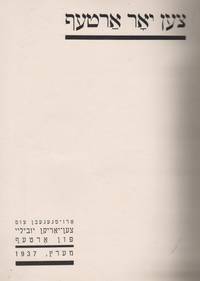
193735363New York; Posy-Shoulson Press 1937. 1st edition. Original Wraps. 4to. 4 171 2 23 pages. 28 cm. In Yiddish with English section and title page: Ten years Artef; published for the tenth anniversary of the Artef March 1937. <br> Extensively illustrated publication for the tenth year anniversary of the radical Yiddish theatre company Artef:<br> "the radical Yiddish dramatic troupe based in New York during the heyday of the Yiddish theater in America. Begun in the mid-1920s as a study group of amateur worker-actors at one time there were nine separate studios with over 120 students in the 1930s the troupe went professional putting on at least two and often three new plays per season. With such plays as Jacob Mostel 's Strike Shmuel Godiner 's Jim Kooperkop Avrum Vevioka 's Diamonds and Maxim Gorky 's Egor Bulychev and Dostigaev and Others Artef spread propaganda to the masses. Ideologically Artef was far left; its hope was a Communist society here in America. As a troupe its role was 'agit-prop' to agitate and propagandize to serve as the cultural representative of radical workers. In fact most of its tickets were pre-sold through worker unions and at least in its early years Artef gave presentations at political events.<br> Its first large-scale production was Mass Play and Ballet of the Russian Revolution which appeared at the Lenin memorial celebration in Madison Square Garden on January 21 1928. <br> Artef 's greatest artistic and commercial successes were connected with the talented productions of director Benno Schneider. Schneider who had been active in the Zionist Habima troupe in Moscow wed aesthetic excellence to revolutionary ideology with his interpretation of Aristocrats an adaptation of Sholem Aleichem 's Mentshn. Incidentally Schneider earned such a positive reputation with Artef that he received offers to direct on Broadway a promotion that cost the radical Yiddish theater dearly. <br> The end of the Artef was gradual and its causes were closely associated with the reduced role of Yiddish in American life. But there were bright lights before the darkness. During the 'days of the Popular Front ' when the Communists formed associations with less radical leftist parties the Artef attracted a larger audience which led to an optimistic expansion that later was responsible for huge financial losses. The darkness occurred at the end of the thirties when the number of Yiddish speakers began to diminish. The last performance of the Artef was on July 7 1941." Review by Dr. Brian Horowitz of 'Yiddish Proletarian Theatre: The Art and Politics of the Artef 1925–1940 ' written by Edna Nahshon. <br> Many of the actors and directors in Artef went on to establish solid careers on Broadway Hollywood and for those blacklisted overseas. <br> Bound in brown velour wraps with gilt title. Heavily illustrated. <br> Subjects: Arbeiter theatre verband New York. Jewish theater. Theater - New York State - New York. Artef - Anniversaries etc. <br> OCLC: 19310798. <br> Light wear to edges of wraps otherwise clean and fresh. Good condition. B YID-22-9-LEBWW. New York; Posy-Shoulson Press unknown
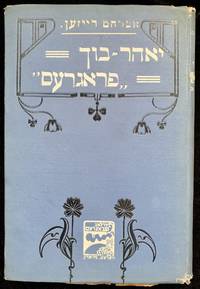
190443110Varsha Warsaw: Ferlag "Progress 1904. First edition. Original illustrated printed boards 8vo 162 32 pages plus 7 unnumbered leaves of plates with illustrations. 22 cm. In Yiddish. Title translates as “Yearbook ‘Progress’: A Journal for Literature Science and Criticism.â€<br> “Abraham Reisen was a Yiddish poet short-story writer playwright and editor…While he was still a teenager his talent was recognized by Shalom Aleichem and I.L. Peretz who arranged for the publication of his earliest poems. After some years in Minsk Warsaw Krakow and Berlin he settled permanently in New York in 1914. Influenced by Heinrich Heine whom he translated into Yiddish he was one of the first Yiddish poets to make use of folksong material. His poetry though mostly written in conventional quatrains is suffused by a refined sensibility that adumbrates the writing of Di Yunge.†Jewish Virtual Library<br> â€In 1900 Yakov Lidski founded "Progress" publishing house. Its name clearly communicated its goal. This publishing company considered to be the first to deal with modern Yiddish literature published a series of original and translated popular science books along with translated European literature and original Yiddish literature. The first editor of the publishing house was poet Avrom Reyzen.†Wikipedia. <br> SUBJECTS: Yiddish literature. Jews -- Poland -- Periodicals. OCLC: 21651882<br> Wear to spine some page separation toning and markings. About Good Condition. YID-46-28-GGLEX-’cc. Varsha [Warsaw]: Ferlag "Progress unknown
19461116373New York: Jewish Encyclopedic Handbooks Central Yiddish Culture Organization CYCO. Fine maroon leatherbound 2 volume set gilt all edges Volume 1 has 430 pp with B/W illustrations; Volume 2 has 430 pp with B/W illustrations. . Fine. Leather Bound. 1946. Jewish Encyclopedic Handbooks Central Yiddish Culture Organization (CYCO hardcover
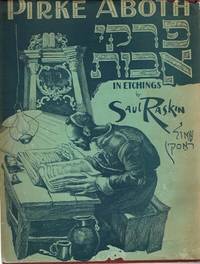
19387471NY: Academy Photo Offset Inc. Very Good in Good dust jacket. 1938. First Edition Thus. 1. Hard Cover. Publisher's full burgundy cloth Hebrew lettering gilt on cover. title page in color. Illustrated with fine etchings by Saul Raskin Text in English and Hebrew. Covers very lightly soiled Hebrew inscriptions on ffep very mildly shelf-worn else fine. The dust jacket now in Mylar is moderately chipped with some loss at the head of the spine. All of the etchings are in bright clean condition. VERY GOOD/VERY GOOD. . Etchings. 4to 11" - 13" tall. 124 2 pp . Academy Photo Offset, Inc. hardcover
First edition. Original wrappers featuring a beautiful illustration of Judah Maccabi. 8vo. 24 pages; text is partially vocalized. 23 cm. In Yiddish. Title translates to Judah The Maccabi: A Historical Operetta in Two Acts. SUBJECTS: Judas, Maccabeus, -161 B. C. -- Drama. OCLC lists 8 copies worldwide. Binding repaired. Overall Very Good Condition. (YID-27-41)
1st edition. Period boards with original illustrated cover mounted on front, 12mo, 138 + [5] pages ; 22 cm. In Yiddish. Complete Yiddish texts printed after each song. Contents: [1]. Folk? S-lider -- [2.] 80 Folk? S-lider. Yiddish folk songs for (medium) solo voice. Menahem Kipnis was "born in Ushomir, Ukraine in 1878. He was a singer, folklore collector, writer and photographer. From 1912 to 1932 he toured Poland, Germany and France, appearing in concerts with his wife Zimra Seligfeld in combined lecture - performances of the Jewish folk songs which he had collected and studied. He published collections of folk songs and songs for children, and was active in the Polish cantors' organization. He submitted a number of his photographs to the Forverts which were published in that newspaper in the 1920's. He died in 1942 in the Warsaw Ghetto. " (Guide to the Yivo Archives) . SUBJECT(S) : Folk songs, Yiddish. OCLC lists 10 copies worldwide. Paper browning and fragile as expected. Rear hinge starting, but very usable. About Good- condition. (music-7-2).
1st edition. Original boards. 8vo. 32, 32, 64 pages. 24 cm. In Yiddish with some English. Title translates to The Jewish Workers Voice. Published by one of the two Jewish organizations making up the Farband. The NJWA was founded in 1912 as a Jewish mutual aid program. Its official organ was the Yidishe Kempfer or Jewish Fighter, edited by Baruch Zuckerman (Wikipedia, 2018) . SUBJECTS: Periodicals - Socialism. OCLC lists 6 copies worldwide (OCLC: 36938329) . Light wear to boards. Binding is starting. Contents very good. Original wrappers are bound in. Overall Very Good Condition. (YID-41-12)
1st edition. original cloth, 8vo. 303 pages. Inscribed by author in year of publication on front end paper. Illustrated. In Yiddish. Unusual design where illustrated "cover" is instead mounted as front pastedown, as issued. SUBJECT (S) : Jews South Africa Johannesburg history; Johannesburg (South Africa) ethnic relations. lightly bumped corners, Very Good condition. (YIZ-8-4)