Yiddish Scientific InstituteMareMagnum

658 résultats
First edition. Original paper wrappers. 8vo, 172 pages. 23 cm. SUBJECTS: Yiddish language -- Congresses. Yidisher visnshaftlekher institut -- Congresses. Browning to cover and pages. Very good condition. (AC-1-16)
1st edition. Original paper wrappers in protective cardboard binder. 8vo. 16 pages, 21 cm. In Yiddish with some Russian on title page. Title translates to A Little Chrestomathy. Chrestomathy refers to the selection of literary passages from a foreign language assembled for studying the language. Features passages by Y.L. Perets, Mendele Mokher Sefarim, and Avrom Reizen. SUBJECTS: Yiddish language study. OCLC: 233376695/58407193. OCLC lists three copies worldwide (NLI, YIVO, Harvard). Pages browning. Very good condition. Scarce. (YID-33-4-+)
1st edition. Original boards. 8vo. 364 pages, 22 cm. Features illustrations and portrait of Shvartsbard. In Yiddish. Title translates to In the Course of Years. Shalom-Shmuel Schwarzbard (1886-1938) was a Russian-born French Yiddish poet of Jewish descent. He served in the French and Soviet military, was a bolshevik, and is known for his assassination of the Ukrainian national leader Symon Petliura while in Paris. His trial was highly publicized and he claimed to have killed Petliura in retribution for the pogroms in Ukraine. He was eventually acquitted (Wikipedia, 2018) . He was viewed as a hero by many; this work is published by the Shalom Shvartsbard Committee in Chicago. SUBJECTS: Jews -- Ukraine -- Biography. Ex-library with usual markings. Very good Condition. (YID-40-91-X-'fl)
Title translates as Mendele Anthology: Published for the 100th Birthday of MMS. A nazi-era Yiddish language study book on Mendele Mokher Sefarim, produced by the children's publishers Grinke Beymelekh ("Green Saplings"). Mendele Mokher Seforim (1835-1917) is revered as the grandfather of Yiddish literature for his innovations in laying a new literary framework for Yiddish. His work realistically portrayed Jewish life with honesty and without judgment and depicted the world of the shtetl [village] with all its poverty and decay; all its joy and poetry. Mendele was born in Belorussia (Belarus) and came from a comfortable family of Lithuanian rabbis. He initially wrote in Hebrew and was a proponent of the Haskalah, but started writing writing in Yiddish in the 1860s (Stevens, 2019). SUBJECTS: Yiddish-language study. OCLC Number:234575366. OCLC lists 5 copies worldwide (NLI, YIVO, Harvard, NYBC, HUC). Spine rebacked with tape, paper toning, a bit fragile at the edges with some light damp stains. Pages and wrappers are edge worn with no loss to contents. About Good- Condition. Scarce. (YID-33-63-'elx)
Period Wrappers. 8vo, 32 pages, 19 cm. In Hebrew with Judeo-German commentary underneath. Yaari, 779. OCLC lists one copy worldwide (Harvard) . Pages are foxing and occasionally edgeworn. Overall good condition. (Hag-18-17)
Nyu york [New York]: Idisher sotsyalistisher federatsye in Amerika, 1914. Paper Wrappers, 8vo, 110 pages. Annual. Includes illustrations. 23 cm. In Yiddish. Periodical lasted until 1918 issue; Vols II (1915) and later are titled "Idishe yohrbukh. " "In 1908 a Jewish Agitation Bureau was established [by the Socialist Party of America] in order to spread socialism among Yiddish-speaking Jews. Stimulated by immigrants with experience in the East European Bund, the Bureau developed into the Jewish Socialist Federation (J. S. F. ) from 1912, over strong opposition from Abe Cahan and other Yiddish-speaking stalwarts opposed to such "separatism. " Actually the J. S. F. Disavowed any distinct Jewish purpose and attempted only to spread socialism, while it vigorously combated Zionism. Its membership was drawn mainly from immigrants of Bundist background" (Schneier Levenberg in EJ) . SUBJECT(S) : Socialism -- Periodicals. Jews -- New York (State) -- New York -- Periodicals. OCLC lists 6 holdings. Edgewear, rear cover detached. Otherwise good condition with good paper. (AMR-56-14X)
Nyu york [New York]: Idisher sotsyalistisher federatsye in Amerika, 1914. CLoth, 8vo, 110 pages. Annual. Includes illustrations. 23 cm. In Yiddish. Periodical lasted until 1918 issue; Vols II (1915) and later are titled "Idishe yohrbukh. " "In 1908 a Jewish Agitation Bureau was established [by the Socialist Party of America] in order to spread socialism among Yiddish-speaking Jews. Stimulated by immigrants with experience in the East European Bund, the Bureau developed into the Jewish Socialist Federation (J. S. F. ) from 1912, over strong opposition from Abe Cahan and other Yiddish-speaking stalwarts opposed to such "separatism. " Actually the J. S. F. Disavowed any distinct Jewish purpose and attempted only to spread socialism, while it vigorously combated Zionism. Its membership was drawn mainly from immigrants of Bundist background" (Schneier Levenberg in EJ) . SUBJECT(S) : Socialism -- Periodicals. Jews -- New York (State) -- New York -- Periodicals. OCLC lists 6 holdings. Hinges starting, but still good and solid. Good Condition. (AMR-56-14X)
Small 8vo; First Edition. Paper Wrappers, 4to (Large), 36 pages. One of 8000 issued. In Yiddish with English Cover, table of contents, & photo captions. Important journal lasting 10 issues which written & published by Jewish DPs themselves to document crimes and survival in the Holocaust. The publisher's decision to include the English table of contents, probably in part to insure the journal's use in future war crimes trials, makes these first hand accounts especially user-friendly today, almost 60 years later. Robinson & Friedman #1247: "The Historical Commission [was] established in 1945 under the auspices of the Central Committee of Liberated Jews in the U. S. Zone. [It] Ceased operations early in 1949. Details of the activities of the Munich center can be found in No. 1247 [Fun Letsten Churbn]..." Hagit Lavsky notes in the Encyclopedia of the Holocaust (Gutman, ed., 1990, p. 383) that, "Commemoration and documentation projects [by Jewish DPs] included the work of the Tsentraler Historisher Komisiye (Central Historical Commission), established in December 1945 by the Central Committee in Munich, to assist in bringing Nazi criminals to trial. A network of regional committees was set up under the commission's auspices whose task it was to take evidence and collect documentary material, including material on DPs. In August 1946, the commission published the first issue of the monthly FUN LETZTEN HURBAN." Published under DP-Publications License US-E-3 OMGB, Information Control Division. This first issue is the only large magazine-size issue published, and remains the scarcest of the set. This copy fragile, with original blue detached edgeworn wrappers mounted on attached later paper for stabilization. Paper is somewhat fragile, but complete and usable. Fair condition, complete. (HOLO2-122-51G)
Original illustrated cover wrappers with distinctive modernist typeface and design. Chidlrens literature. Printed on quality glossy paper. Includes 6 illustrations by Gudelman and photo of author. Aron Gudelman (1890 - 1978) was a sculptor, illustrator, etcher, lecturer, and teacher. Born in Russia, he immigrated to New York in 1905 at the time of pogroms in Russia. After attending the Cooper Union and the National Academy of Design, in 1914 he studied with Jean-Antoine Injalbert at the Ecole des Beaux-Arts in Paris. Supporting himself as a machinist in the 1920s, Goodelman became a communist. His concerns about social and economic conditions were expressed in his art. He participated in exhibitions at the John Reed Club in the early 1930s. After World War II, Goodelman created artworks related to the Holocaust. He taught at City College of New York in the 1960s (National Museum of American Art, 1996) . Blue cover Variant. Shul Pinkas Chcago Nr. 203 . Light wear to cover, Very Good Condition, (Yid-24-7)
Original publishers cloth in dramatic modernist color illustrated dust jacket designed by Zuni Maud with illustrations on front and rear; 8vo, 243 pages. 23 cm. In Yiddish. SUBJECT (S) : Yiddish literature -- 20th century. Illustrator Zuni Maud (born 1905) was an Artist, cartoonist, puppeteer, playwright, writer and poet. [He] Studied at the Cooper Union Art School, Baron de Hirsch Art School and National Academy of Art, New York. [and] Did illustrations for *Der kibitser* and stage and costume design for productions by Maurice Schwartz in the Yiddish Art Theater. Contributed articles to Der kundes (N. Y. ) , Jewish Daily Forward (N. Y. ) , Di tsayt (N. Y. ) , Kinderland (N. Y. ) , Kinder zshurnal (N. Y. ) , Frayhayt (N. Y. ) . [He was the] Illustrator of a number of books. In 1925, together with Yosel Cutler, [he] founded the Modicot marionette theater. [He] Wrote plays, children's stories and poems (YIVO, 2018) . Author Yitzchak Rayz (1885-1943) , better known by his pen name Moyshe Nadir was an American Yiddish language writer and satirist . In 1898, at the age of 13, Rayz immigrated to New York and adopted the Americanized name Isaac Reiss. Within a few years his work was published widely in the New York Yiddish press, under a variety of pseudonyms, including Rinnalde Rinaldine, Dilensee Mirkarosh, Der Royzenkavalir, Doctor Hotzikl, and, finally, Moishe Nadir. The name Nadir is a Yiddish expression meaning here you are or that's for you, but can also mean take this and choke on it. As a teenager, he wrote for Der Groyser Kundes (The Big Prankster) and later co-edited Der Yiddisher Gazlon (The Yiddish Bandit) with Jacob Adler. He wrote for an assortment of Communist Yiddish publications including the Frayhayt (Freedom) newspaper and its successor Morgn Frayhayt (Morning Freedom) and the magazines Der Signal (The Signal) and Der Hammer (The Hammer) . When his sharp-tongued theater reviews caused him to be banned from theatrical productions, he resorted to attending plays in disguise. His own plays were performed by Maurice Schwartzs Yiddish Art Theater, Zuni Maude and Yosl Cutlers Modicut puppet theater, Artef (Arbeter Teater Faraband, Workers Theater Alliance) and the Federal Theater Project. Among his better known poems are the erotic Vilde Royzen (Wild Roses, 1915) and his 1932 Rivington Strit (Rivington Street) . After a long association with the Frayhayt and the Morgn Frayhayt, Rayz began to distance himself from the Communist cause with the onset of the show trials in the Soviet Union and publicly broke with the Morgn Frayhayt in the wake of the Molotiv-Ribbentrop Pact. He set out his reasons in Di, vos blayben mit der Morgn Frayhayt (Those who stay with the Morgn Frayhayt) in response to Morgn Frayhayt editor Moissaye Olgins Di vos gayen avek (Those who leave) . Rayz discusses his relationship to the Communist Party in his posthumous Moyde Ani (Wikipedia, 2019) . Very Good Condition in dust jacket which shows some edgewear affecting some letters on the spine. Very Good in Good Jacket. (yid-41-92)
1st Yiddish Edition. Original illustrated photographic paper wrappers. 8vo. 46 pages, 22 cm. In Yiddish. Holocaust stageplay. Title translates to The Medem Sanitorium. Translated into Yiddish by Mosheh Lokiec. Zygmunt Turkow (18961970) was a Polish actor, director, playwright and director of Jewish origin from Warsaw, who became famous for roles in the pre-war Jewish films and stage plays in Yiddish. His brother, Jonas Turkow, was also a noted actor and stage manager. Shortly after German invasion of Poland in 1939 he left Poland together with his second wife. In 1940 he settled in Brazil. In 1952 he moved to Israel (Wikipedia, 2019). SUBJECTS: Holocaust, Jewish (1939-1945) -- Drama. OCLC 122833421, OCLC lists 6 copies worldwide (NYPL, YIVO, UIllinois, NYBC, Toronto, McGill). Crease through enter of pamphlet. Otherwise very good condition. Scarce. (YID-33-55-'elx)
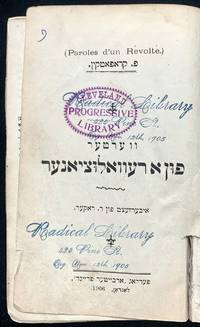
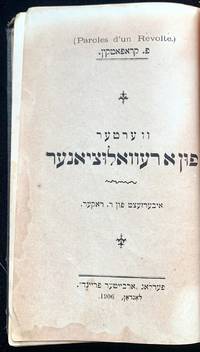
190643217London: "Arbayter fraynd 1906. First Yiddish edition. Period boards 8vo xiii 426 pages 19 cm. In Yiddish. Title translates as “Words from a Revolutionary.â€<br> Translation of “Paroles d'un re´volte´.†Includes translation of the forewords by the author and Elise´e Reclus. Includes bibliographical references.<br> “During his long exile Kropotkin wrote a series of influential works the most important being ‘Paroles d’un révolté’ 1885; “Words of a Rebelâ€.Kropotkin’s aim as he often remarked was to provide anarchism with a scientific basis. In Mutual Aid which is widely regarded as his masterpiece he argued that despite the Darwinian concept of the survival of the fittest cooperation rather than conflict is the chief factor in the evolution of species. Providing abundant examples he showed that sociability is a dominant feature at every level of the animal world. <br> Among humans too he found that mutual aid has been the rule rather than the exception. He traced the evolution of voluntary cooperation from the primitive tribe peasant village and medieval commune to a variety of modern associations—trade unions learned societies the Red Cross—that have continued to practice mutual support despite the rise of the coercive bureaucratic state. The trend of modern history he believed was pointing back toward decentralized nonpolitical cooperative societies in which people could develop their creative faculties without interference from rulers clerics or soldiers.â€<br> SUBJECTS: Anarchism. OCLC: 19303211.<br> Ex-library with early 19th Century left-wing library markings see photos. Good- Condition YID-48-41-LXCCGG-’e. London: "Arbayter fraynd unknown
190643219London: "Arbayter fraynd 1906. First Yiddish edition. Period boards 8vo xiii 426 pages 19 cm. In Yiddish. Title translates as “Words from a Revolutionary.â€<br> Translation of “Paroles d'un re´volte´.†Includes translation of the forewords by the author and Elise´e Reclus. Includes bibliographical references.<br> “During his long exile Kropotkin wrote a series of influential works the most important being ‘Paroles d’un révolté’ 1885; “Words of a Rebelâ€.Kropotkin’s aim as he often remarked was to provide anarchism with a scientific basis. In Mutual Aid which is widely regarded as his masterpiece he argued that despite the Darwinian concept of the survival of the fittest cooperation rather than conflict is the chief factor in the evolution of species. Providing abundant examples he showed that sociability is a dominant feature at every level of the animal world. <br> Among humans too he found that mutual aid has been the rule rather than the exception. He traced the evolution of voluntary cooperation from the primitive tribe peasant village and medieval commune to a variety of modern associations—trade unions learned societies the Red Cross—that have continued to practice mutual support despite the rise of the coercive bureaucratic state. The trend of modern history he believed was pointing back toward decentralized nonpolitical cooperative societies in which people could develop their creative faculties without interference from rulers clerics or soldiers.â€<br> SUBJECTS: Anarchism. OCLC: 19303211.<br> Spine is taped.Tight binding but text block is clean and intact. Good Condition YID-48-40-LXCCGG-’e. London: "Arbayter fraynd unknown
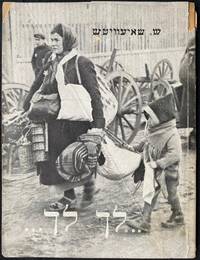
194643433Lodzsh: Tsentraler Yidisher Historisher Komisye baym Tsentral-Komitet fun Poylishe Yidn 1946. 1st edition. Original dramatic photgraphic covers 8vo 70 1 page 1 leaf. Includes facsimiles. 21 cm. In Yiddish. Poems. "Oysgabes fun Der Tsentraler Yidisher Historisher Komisye baym Tsentral-Komitet fun Poylishe Yidn. Serye yidishe literatur 1." <br> "Published by a commission The Central Jewish Historical Commission dedicated to recording the fate of Polish Jews published this book length poem by Simkhah Szajewics. Written in the Lodz Ghetto it appeared immediately after the war in 1946; Szajewicz perished in a concentration camp in 1944" from an exhibit at the National Yiddish Book Center which houses their copy in their Rare Book Collection. <br> The book includes two long poems: "Lekh-lekha" and "Friling 702 " as well as letters and other related material. <br> See David Roskies' interesting reflection on this work and it's stunning photographic cover at <br> jtsa.edu/torah/go-forth-the-grammar-of-remembrance. <br> For more about the author-poet see Chava rosenfarb's essay on Shayevitch in Tablet Magazine at <br> tabletmag.com/sections/arts-letters/articles/the-last-poet-of-lodz. <br> SUBJECTS: Jews -- Persecutions -- Poland -- Lódz. Holocaust Jewish 1939-1945 -- Poetry. Jews -- Correspondence. Crease and wear to wrapper and foot and crown of spine see photo better condition than usually found attractive. Good Condition. B HOLO2-110-36A-CCALX-'emm H-40-10. Lodzsh: Tsentraler Yidisher Historisher Komisye baym Tsentral-Komitet fun Poylishe Yidn unknown
TEXT IN YIDDISH, with table headings, captions and contents pages (Inhalts-Verzeichnis) IN GERMAN. RARE FOUR VOLUMES (No.1 through 4 BOUND TOGETHER) of a journal of Jewish demographics founded by the World Jewish Congress in order to better learn about, and thus better help the impoverished Jewish communities. Published from 1923 to 1924, and collected in one volume in 1924, the journal contains data on the Jews of the European countries, the USA, North and South Africa, Australia and New-Zealand, Palestine, Syria and India. Among other data, the journal contains statistical information on the geographical distribution of Jews, distribution of income, ages and family size, along with data such as the fate of Jewish assets that were seized during the pogroms of the late 1910s. 300x230mm. 292 pages. Maroon cloth Hardcover with gilt front cover and spine. Gilt lettering and decorations partly peeled. Cover curved. Cover and spine rubbed and stained. Cover corners and bottom edge bumped. Spine edges bumped and tattered/peeling. Front whitepages coming loose from binding. Binding visible on front inner cover and between front whitepage and title-page. Front whitepage fore edge slightly torn. Pages 289-292 and rear whitepage detached from binding. Library stamp on pre-title and title-pages, and page 292. Small ink inscriptions on title-page and page 292. Pages yellowing/browning. [SUMMARY]: This valuable collection of hard data on Jewish life prior to the Holocaust is otherwise in good condition.
65779, Brepols, 2020 Hardback, 924 pages, Size:156 x 234 mm, Illustrations:4 tables b/w., Language: French. ISBN 9782503569741.
IN HEBREW AND YIDDISH. Contains photos in b&w. 220x275 mm. Gilt hardcover. Cover stained and slightly bumped. Pages yellowing. Else in good condition.
Leipzig: F. A. Brockhaus, 1882. Disbound; 8vo. Xii, 587 pages. Marbled endpapers. In German. Bibliographical citations. Max Grünbaum was a distinguished Munich Orientalist. A Chrestomathy is an aid, by means of prose passages, in learning a language. Contains Medieval Yiddish translations of the Bible. SUBJECT (S) : Yiddish language -- Translating into German. Ex-library with minimal markings. Some age staining. Corners of a few pages chipped. Although cover not present, binding is tight. Text in good condition. (GR-07-8)
New York: Yiddish Scientific Institute [YIVO], American Branch [Yidisher visnshaftlekher institut.; Amerikaner sektsie], 1927-29. Original Wraps, Large 8vo. In Yiddish. Four loose issues. This periodical survived only 2 volumes, ending with vol. 2, Nr. 1 in 1929. A quarterly devoted to the study of Yiddish literature, language, folklore and bibliography. SUBJECT(S): Yiddish philology -- Periodicals. Yiddish language -- Periodicals. OCLC: 122810294. OCLC lists 20 holdings worldwide. Not in Shunami. Binding repaired, good solid copy of this important Yiddish literary and linguistic journal. (CT-15-2A)
1st edition. Original boards. 8vo. 122 pages, 21 cm. In Yiddish. Title translates to Around Me. Includes 10 beautiful Art Nouveau illustrations by Zuni Maud, which are repeated throughout the text. Kaluschiner (1893-1968) , also known as Joseph Leiser, was a Yiddish poet who released five books of Yiddish poetry. OCLC lists 29 copies worldwide (OCLC 40822983) . SUBJECTS: Yiddish poetry - literature. Author inscription from 1922 to the previous owner. Wear to boards. Some damp stains in bottom left of leaves. Overall Good Condition. (YID-40-71-L)
1st edition, original wrappers, 62 pages. In Yiddish, back cover in English. Title translates as, Zionism and Yiddishkayt in Soviet Russia: A Trip Across the Soviet Union in 1940.Holocaust-era Zionist eye-witness account of Jewry in the USSR during 1940, with an introduction by Rabbi Meyer Berlin, or Meir Bar-Ilan. Meir Berlin, later Hebraized to Meir Bar-Ilan, was an Orthodox rabbi and leader of Religious Zionism, the Mizrachi movement in the United States and the British Mandate of Palestine. He inspired the founding of Bar Ilan University in Israel which is named for him. (wikipedia 2018) Heri Karp Ondenk Bibliotek Populere Broshurn-Num. 4-5. SUBJECT(S) : Zionism. Travel. Zionism. Soviet Union -- Description and travel. OCLC: 1011223445, OCLC lists 6 copies worldwide. Cover is wavy from moisture, rubbed and has some pencil markings, ex library sticker inside cover and blind stamp on title page. Internally very good. Good Condition overall. (HOLO2-141-32)
8vo; 424 pages; 21 cm. . In Yiddish. Special issue to "Unser Weg". Errata slip inserted. "The extermination of the Jews of Kowno (Kaunas) " on copyright page. Includes index, portraits, music and 18 pages of photo plates. The US Holocaust Memorial Museum keeps their copy in their Rare Book Collection. Missing front cover. Small tears and pieces missing to back cover. Ex-library with label on spine and bookplate in back. Edgewar to title page, small tears to first 8 pages. Pages tanned. INSCRIBED BY THE AUTHOR. Backstrip missing pieces. Corner of back cover torn off, no text affected. Pages lightly tanned. Good condition. (YIZ-3-10)
pages; 1st edition. Original publisher's cloth, large 8vo 566 pages. In Yiddish. Yizkor book to murdered teachers in Poland. Very Good Condition. (yiz-20-13) xx
Later Cloth. 12mo. 88 [i. E. 176]; 131 [i. E. 262] pages. 18 cm. Two volumes in one. In Hebrew. Running title: Tikun lel Shavu? Ot. With: Seder Tikun lel Hosha? Na raba. Zultsbakh: Z. Arnshtain, 1830. Printed in Sulzbach at the press of Arnstein & Sons, begun by Seckel Arnstein in 1751 after his ancestor Ahron Fraenkel in 1645, who established a printing press business in 1699. Seckel Arnstein continued the business of printing of Hebrew bibles, which became famous all over Central and Eastern Europe under the name S. Arnstein & Sons. Bound in later cloth; printed on fine ragpaper. Subjects: Hoshana Rabba - Liturgy - Texts. Judaism - Liturgy - Texts. Hoshana Rabba - Liturgy. Judaism - Liturgy. Shavuot - Liturgy - Texts. Liturgy and ritual. Hosha'nah Rabbah readings. 1830. Shavuot readings. 1830. One listing for the 1830 edition (Univ Michigan) on OCLC; five other holdings for editions from 1827-1835. Light foxing to pages; otherwise fresh and clean. Very good condition. (GER-43-51)
1st Edition, Original Printed Paper Wrappers, 54 pages. Includes portrait of the author; 19 cm. Grigory Andreyevich Gershuni (18701908) was born in Kaunas, in the Kovno Governorate of the Russian Empire (present-day Lithuania) , to a petty bourgeois family of Lithuanian Jews . In 1898, his parents were killed in a pogrom . Gershuni was a socialist and a founding member of the Workers' Party for the Political Liberation of Russia. This led to his arrest in 1900 by the Okhrana (secret police. After his release he joined with fellow revolutionaries including Catherine Breshkovsky, Victor Chernov, Alexander Kerensky and Yevno Azef to establish the Socialist-Revolutionary Party in 1901. Gershuni also founded the SR Combat Organization in 1902, which planned and executed the assassination of Dmitry Sipyagin, the Minister of Interior, in April 1902 and of N. M. Bogdanovich, the Governor of Ufa, in May 1903. They failed to assassinate Prince Ivan Mikhailovich Obolensky, the Governor of Kharkov, in July 1902. Gershuni was unaware that Yevno Azef, his deputy, was working as an Okhrana spy. In May 1903, Gershuni was arrested in Kiev. In February 1904, Gershuni was tried by a military court in Saint Petersburg and received a death sentence, which later was reduced to life imprisonment at a hard labour camp by Tsar Nicholas II of Russia. In 1906, he hid in a barrel of sauerkraut and escaped from the Akatuy katorga to China. From China he traveled to Japan and the United States, giving speeches from San Francisco to New York City in support of the socialist-revolutionary causes. In Chicago he met Jane Addams. He returned to Europe in February 1907 in time for the Second Extraordinary Party conference of the Socialist-Revolutionary Party. There he continued to argue for a campaign of terror to overthrow the Tsarist Empire in Russia (Wikipedia) . SUBJECT(S) : Political prisoners -- Russia (Federation) -- Siberia -- Biography. Exiles -- Revolutionaries. OCLC: 13419225 OCLC lists 18 copies worldwide. (KH-8-72 BLOR)