63 résultats
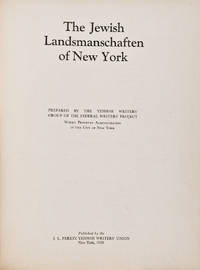
193828020New York: I. L. Peretz Yiddish Writers' Union 1938. First edition. Hardcover. g. Quarto. 397 3pp. Rebacked with blue library tape over original cloth with Yiddish lettering on front cover. Title pages in Yiddish and English. Scarce work being a survey of immigrant societies in New York. Includes essays on landsmanshaft history and activities as well as survey results in Yiddish; also contains the Directory of Organizations in English. Age-wear on binding with original spine replaced by library blue tape and heavy rubbing along edges. Previous owner's stamps on both endpapers. Age-toning along paper margin. Text in Yiddish with some English. Binding in overall fair interior in good condition. I. L. Peretz Yiddish Writers' Union hardcover
1974500528New York: Hebrew Union College Press and Ktav Publishing House 1974. Book. Very Good. Hardcover. 4to. An excellent ex-synagogue-library copy with lean to spine and suggestion of foxing to top edge only. Text clean and bright. Binding tight. Montreal Books rating system: 1. Fine 2. Near Fine 3. Very Good 4. Good 5. Fair . Hebrew Union College Press and Ktav Publishing House Hardcover
64208974McGill-Queen's University Press pp. xxv 362 . Hardback. New. McGill-Queen's University Press hardcover
KSX-1YD-LOOFine. Visually Inspected by Owner: Paperback as pictured no marks in text and binding solid. 3rd edition 2003. Old and New Testament. Bible was not used a couple of very minor minor small crease on a couple of pages from storing. We ship M-F at 4pm and Sat. at 12 pm with tracking info. paperback
63424743University of Wisconsin Press pp. 408 Maps . Papeback. New. University of Wisconsin Press unknown
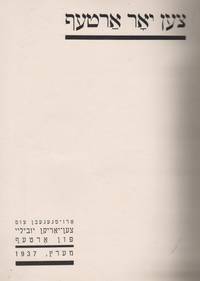
193735363New York; Posy-Shoulson Press 1937. 1st edition. Original Wraps. 4to. 4 171 2 23 pages. 28 cm. In Yiddish with English section and title page: Ten years Artef; published for the tenth anniversary of the Artef March 1937. <br> Extensively illustrated publication for the tenth year anniversary of the radical Yiddish theatre company Artef:<br> "the radical Yiddish dramatic troupe based in New York during the heyday of the Yiddish theater in America. Begun in the mid-1920s as a study group of amateur worker-actors at one time there were nine separate studios with over 120 students in the 1930s the troupe went professional putting on at least two and often three new plays per season. With such plays as Jacob Mostel 's Strike Shmuel Godiner 's Jim Kooperkop Avrum Vevioka 's Diamonds and Maxim Gorky 's Egor Bulychev and Dostigaev and Others Artef spread propaganda to the masses. Ideologically Artef was far left; its hope was a Communist society here in America. As a troupe its role was 'agit-prop' to agitate and propagandize to serve as the cultural representative of radical workers. In fact most of its tickets were pre-sold through worker unions and at least in its early years Artef gave presentations at political events.<br> Its first large-scale production was Mass Play and Ballet of the Russian Revolution which appeared at the Lenin memorial celebration in Madison Square Garden on January 21 1928. <br> Artef 's greatest artistic and commercial successes were connected with the talented productions of director Benno Schneider. Schneider who had been active in the Zionist Habima troupe in Moscow wed aesthetic excellence to revolutionary ideology with his interpretation of Aristocrats an adaptation of Sholem Aleichem 's Mentshn. Incidentally Schneider earned such a positive reputation with Artef that he received offers to direct on Broadway a promotion that cost the radical Yiddish theater dearly. <br> The end of the Artef was gradual and its causes were closely associated with the reduced role of Yiddish in American life. But there were bright lights before the darkness. During the 'days of the Popular Front ' when the Communists formed associations with less radical leftist parties the Artef attracted a larger audience which led to an optimistic expansion that later was responsible for huge financial losses. The darkness occurred at the end of the thirties when the number of Yiddish speakers began to diminish. The last performance of the Artef was on July 7 1941." Review by Dr. Brian Horowitz of 'Yiddish Proletarian Theatre: The Art and Politics of the Artef 1925–1940 ' written by Edna Nahshon. <br> Many of the actors and directors in Artef went on to establish solid careers on Broadway Hollywood and for those blacklisted overseas. <br> Bound in brown velour wraps with gilt title. Heavily illustrated. <br> Subjects: Arbeiter theatre verband New York. Jewish theater. Theater - New York State - New York. Artef - Anniversaries etc. <br> OCLC: 19310798. <br> Light wear to edges of wraps otherwise clean and fresh. Good condition. B YID-22-9-LEBWW. New York; Posy-Shoulson Press unknown
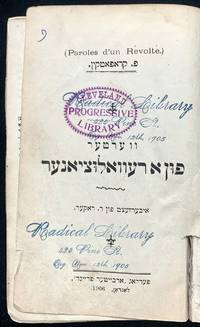
190643217London: "Arbayter fraynd 1906. First Yiddish edition. Period boards 8vo xiii 426 pages 19 cm. In Yiddish. Title translates as “Words from a Revolutionary.â€<br> Translation of “Paroles d'un re´volte´.†Includes translation of the forewords by the author and Elise´e Reclus. Includes bibliographical references.<br> “During his long exile Kropotkin wrote a series of influential works the most important being ‘Paroles d’un révolté’ 1885; “Words of a Rebelâ€.Kropotkin’s aim as he often remarked was to provide anarchism with a scientific basis. In Mutual Aid which is widely regarded as his masterpiece he argued that despite the Darwinian concept of the survival of the fittest cooperation rather than conflict is the chief factor in the evolution of species. Providing abundant examples he showed that sociability is a dominant feature at every level of the animal world. <br> Among humans too he found that mutual aid has been the rule rather than the exception. He traced the evolution of voluntary cooperation from the primitive tribe peasant village and medieval commune to a variety of modern associations—trade unions learned societies the Red Cross—that have continued to practice mutual support despite the rise of the coercive bureaucratic state. The trend of modern history he believed was pointing back toward decentralized nonpolitical cooperative societies in which people could develop their creative faculties without interference from rulers clerics or soldiers.â€<br> SUBJECTS: Anarchism. OCLC: 19303211.<br> Ex-library with early 19th Century left-wing library markings see photos. Good- Condition YID-48-41-LXCCGG-’e. London: "Arbayter fraynd unknown
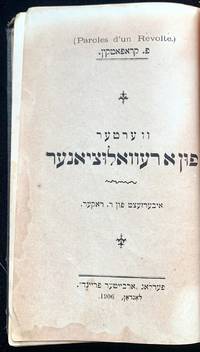
190643219London: "Arbayter fraynd 1906. First Yiddish edition. Period boards 8vo xiii 426 pages 19 cm. In Yiddish. Title translates as “Words from a Revolutionary.â€<br> Translation of “Paroles d'un re´volte´.†Includes translation of the forewords by the author and Elise´e Reclus. Includes bibliographical references.<br> “During his long exile Kropotkin wrote a series of influential works the most important being ‘Paroles d’un révolté’ 1885; “Words of a Rebelâ€.Kropotkin’s aim as he often remarked was to provide anarchism with a scientific basis. In Mutual Aid which is widely regarded as his masterpiece he argued that despite the Darwinian concept of the survival of the fittest cooperation rather than conflict is the chief factor in the evolution of species. Providing abundant examples he showed that sociability is a dominant feature at every level of the animal world. <br> Among humans too he found that mutual aid has been the rule rather than the exception. He traced the evolution of voluntary cooperation from the primitive tribe peasant village and medieval commune to a variety of modern associations—trade unions learned societies the Red Cross—that have continued to practice mutual support despite the rise of the coercive bureaucratic state. The trend of modern history he believed was pointing back toward decentralized nonpolitical cooperative societies in which people could develop their creative faculties without interference from rulers clerics or soldiers.â€<br> SUBJECTS: Anarchism. OCLC: 19303211.<br> Spine is taped.Tight binding but text block is clean and intact. Good Condition YID-48-40-LXCCGG-’e. London: "Arbayter fraynd unknown
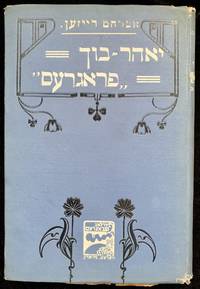
190443110Varsha Warsaw: Ferlag "Progress 1904. First edition. Original illustrated printed boards 8vo 162 32 pages plus 7 unnumbered leaves of plates with illustrations. 22 cm. In Yiddish. Title translates as “Yearbook ‘Progress’: A Journal for Literature Science and Criticism.â€<br> “Abraham Reisen was a Yiddish poet short-story writer playwright and editor…While he was still a teenager his talent was recognized by Shalom Aleichem and I.L. Peretz who arranged for the publication of his earliest poems. After some years in Minsk Warsaw Krakow and Berlin he settled permanently in New York in 1914. Influenced by Heinrich Heine whom he translated into Yiddish he was one of the first Yiddish poets to make use of folksong material. His poetry though mostly written in conventional quatrains is suffused by a refined sensibility that adumbrates the writing of Di Yunge.†Jewish Virtual Library<br> â€In 1900 Yakov Lidski founded "Progress" publishing house. Its name clearly communicated its goal. This publishing company considered to be the first to deal with modern Yiddish literature published a series of original and translated popular science books along with translated European literature and original Yiddish literature. The first editor of the publishing house was poet Avrom Reyzen.†Wikipedia. <br> SUBJECTS: Yiddish literature. Jews -- Poland -- Periodicals. OCLC: 21651882<br> Wear to spine some page separation toning and markings. About Good Condition. YID-46-28-GGLEX-’cc. Varsha [Warsaw]: Ferlag "Progress unknown
196528615New York: Harper & Row 1965. First Edition; First Printing. Hardcover. Very Good in a Very Good dust jacket edges taped. Harper & Row hardcover
67203E-363. Very Good. Hardcover. Hardcover. 8vo. Published by Harper & Row New York 1966. Xi 90 pgs. Illustrated. First Edition/First Printing. DJ has light shelf-wear present to the DJ extremities lower right corner of the DJ is clipped but price is still present to the top of the front flap. Bound in decorated cloth boards with titles present to the spine and front board. Boards have light shelf-wear present to the extremities. No ownership marks present. Text is clean and free of marks. Binding tight and solid. Nobel laureate Isaac Bashevis Singer introduces readers to the village of Chelm in this Newbery Honor Book. Chelm is a village of fools. The most famous foolsthe oldest and the greatestare the seven Elders. But there are lesser fools too: a silly irresponsible bridegroom; four sisters who mix up their feed in bed one night; a young man who imagines himself dead. Here are seven magical folktales spun by a master storyteller that speak of fools devils schlemiels and even heroeslike Zlateh the goat. ; 8vo 8" - 9" tall . hardcover
74096E-091. Hardcover. Very Good. Hardcover. 8vo. Published by Harper & Row New York 1966. Xi 90 pgs. Illustrated. First Edition/First Printing. DJ has light shelf-wear present to the DJ extremities lower right corner of the DJ is clipped but price is still present to the top of the front flap. Bound in decorated cloth boards with titles present to the spine and front board. Boards have light shelf-wear present to the extremities. No ownership marks present. Text is clean and free of marks. Binding tight and solid. Nobel laureate Isaac Bashevis Singer introduces readers to the village of Chelm in this Newbery Honor Book. Chelm is a village of fools. The most famous fools—the oldest and the greatest—are the seven Elders. But there are lesser fools too: a silly irresponsible bridegroom; four sisters who mix up their feed in bed one night; a young man who imagines himself dead. Here are seven magical folktales spun by a master storyteller that speak of fools devils schlemiels and even heroes—like Zlateh the goat.; 8vo 8" - 9" tall . hardcover
194613981Lodzsh: Tsentraler Yidisher Historisher Komisye baym Tsentral-Komitet fun Poylishe Yidn 1946. 1st edition. Later cloth with original dramatic photgraphic cover mounted on front 8vo 70 1 pages 1 l. includes facsimiles. 21 cm. Poems. "Oysgabes fun Der Tsentraler Yidisher Historisher Komisye baym Tsentral-Komitet fun Poylishe Yidn. Serye yidishe literatur 1." <br> A committee dedicated to recording the fate of Polish Jews published this book length poem by Simkhah Szajewics. Written in the Lodz Ghetto it appeared immediately after the war in 1946; Szajewicz perished in a concentration camp in 1944" from the permanent exhibit at the National Yiddish Book Center which houses their copy in their Rare Book Collection. <br> The book actually includes two long poems: "Lekh-lekha" and "Friling 702 " as well as letters and other related material. <br> See David Roskies interesting reflection on this work and it's stunning photographic cover at jtsa.edu/torah/go-forth-the-grammar-of-remembrance. <br> For more about the author-poet see Chava rosenfarb's essay on Shayevitch in Tablet Magazine at tabletmag.com/sections/arts-letters/articles/the-last-poet-of-lodz. SUBJECTS: Jews -- Persecutions -- Poland -- Lódz. Holocaust Jewish 1939-1945 -- Poetry. Jews -- Correspondence. Expertly rebound in attractive black cloth with the original photographic front cover mounted on the front. Very Good Condition. B HOLO2-110-36-CCALX-'emm H-40-10. Lodzsh: Tsentraler Yidisher Historisher Komisye baym Tsentral-Komitet fun Poylishe Yidn unknown