658 résultats
CONTAINS A VINYL. CONTAINS NOTES. 26.5x19.5cm. 193 pages. Hardcover. In good condition.
SIGNED BY AUTHOR. 26x19 pages. 193 pages. Hardcover. Cover and spine slightly stained. Else in good condition.
1st edition. Period full leather with spine label, 8vo, viii, 9-408 pages. Singerman 322; Rosenbach 209. The tipped in recommendation slip sign "Ph. Milledolar, " as noted by BAL, is present. President John Adams wrote of this literary anthology that it was "worthy to be presented by every father to every child, and deserve a place in every family. " Gomez's Jewish affiliation resonates in the book with his decision to include a selection from The History of Pope Pius V, which is the source for the "pound of flesh" incident in Shakespeare's Merchant of Venice. As opposed to Shakespeare's telling, in the History of Pope Pius V, it is the Jew who is the victim and the Christian who threatens him. Gomez prefaced the selection by writing: "The following subject shows that Shakespeare altered the character of Shylock, making him to be of the Jewish nation, when in reality he was not. " As Louis Harap notes (The Image of the Jew in American Literature, p. 260) , "Gomez was obviously trying to combat the effects of the Shylock stereotype. " Isaac Gomez (1768-1831) , whose great-grandfather had fled from Portugal to New York in 1703, was active in New York's Jewish community. The few early literary contributions by American Jews "was anything but impressive, but Gomez's book is worth remembering as one of American Jewry's earliest literary efforts⦠Gomez, both a devotee of the humanities and a committed Jew, lived comfortably ensconced in the two worlds of the Jew and the cultured American" (J. R. Marcus, United States Jewry, vol. 3, page 455) . See also Blau and Baron, The Jews of the United States, 1790-1840, Vol. II, pages 440-2. The last copy to appear at auction in the US, in 2013, sold for over $1800 (with commissions) . Foxing as expected. All endpapers present, and original period binding remains very handsome. A very good copy in outstanding period binding. (AMR-57-12)
1st edition. Original publisher's cloth, large 8vo, 652 pages. Includes illustrations, facsimiless, portraits; 25 cm. In Yiddish. SUBJECT (S) : Jews -- Poland -- Luków (Siedlce) Holocaust, Jewish (1939-1945) . Added title page: "Sefer Lukow. " Partly also in Hebrew. Includes bibliographical references (p. 56-57) . OCLC lists 11 copies worldwide. Inside hinges repaired Good Condition. (YIZ-6-11) xx
1st edition. Original publisher's cloth, large 8vo, 652 pages. Includes illustrations, facsimiless, portraits; 25 cm. In Yiddish. SUBJECT (S) : Jews -- Poland -- Luków (Siedlce) Holocaust, Jewish (1939-1945) . Added title page: "Sefer Lukow. " Partly also in Hebrew. Includes bibliographical references (p. 56-57) . OCLC lists 11 copies worldwide. wear and some discoloration to boards, Good Condition. (YIZ-6-12) xx
Contains 12 b&w plates. 350X250 mm. No pagination. Softcover portfolio. Plate 3 missing. Portfolio yellowing and age stained. Pages slightly yellowing. Pages corners slightly wrinkled. Else in good condition.
IN ENGLISH AND HEBREW. 28.5x22cm. 182 pages. Gilt hardcover. Spine edges slightly bumped. Else in good condition. PLEASE NOTE: This item is overweight. We may ask for extra shipping costs.
1st edition. Original paper wrappers. 8vo. 63, 47, 48 , 133 pages, 27 cm. In Yiddish. Title translates to Chicago: A Literary Monthly Journal. SUBJECTS: Yiddish - periodicals. OCLC lists 9 copies worldwide (OCLC: 34385123) . Light edge wear to wrappers and some chipping. Front wrapper repaired for May 1932 issue. Some pencil markings. Pages browning. Overall Very Good Condition. (YID-40-80)
5575 (1815) 1st edition. Later Paper Wrappers, 8vo, 10, 10, 2, 2, 56, 56, [1], 6 pages [143 pages total]. Includes the often missing 6-page list of subscribers. The Introduction states that the book was undertaken at the behest of the Rabbi of the Aschkenazic community of London, Solomon Hirschell, together with Raphael di Meldola, Rabbi of the Sephardic community. It also includes the approbation of di Meldola as well as that of Rabbi Solomon ben Zevi Hirsch, the purpose of the work being to protect Jewish children from the inroads of Christian missionaries.The author indicates that the lack of understanding of Judaism among youth is the principle reason why he composed this work. Yet it was intended not just for Jews: Prof. David Ruderman has noted that, "except for its denunciation of Christian missionaries, Cohen's catechism with its English translation, seems to be nothing more than an innocent, uncontroversial presentation of the Jewish faith meant for both Jewish and Christian eyes" (D. B. Ruderman, Jewish Enlightenment in an English Key: Anglo-Jewry's Construction of Modern Jewish Thought, p. 250). Cohen's work was indeed shared with American non-Jews. The Jewish merchant David Isaacs, in his correspondence with Thomas Jefferson, sent the President a copy of the book [see University of Virginia exhibit (2001), To Seek the Peace of the City: Early Jewish Settlement in Charlottesville]. In 1818 Rebecca Gratz offered a copy to her friend Maria Fenno Hoffman, wife of the Attorney General of New York, Ogden Hoffman [see E. Wolf & M. Whiteman, The History of the Jews of Philadelphia, p. 304]. Jacob Marcus Rader lists Cohen's work as one of the Jewish educational books available to Rebecca Gratz when she began operating her Sunday School in Philadelphia [see United States Jewry, 1776-1985, 1-2, p. 393]. A review of this book was printed by Rabbi Yom Tov Benet in his book Tene Bekorim (1767). Shalom ben Jacob Cohen (17721845) himself was a Hebrew writer, poet, and editor. Born in Mezhirech, Poland, he studied German and read the new Hebrew literature, particularly Ha-Me'assef. His first book, Mishlei Agur (1799), was a collection of Hebrew fables in rhyme, with German translation, aimed at teaching Jewish children simple and clear Hebrew. Cohen went to Berlin in 1789 and taught in the Hinnukh Ne'arim school and in private homes. After the publication of several works he renewed the publication of Ha-Me'assef and served as its editor (180911). In 1813 Cohen left Germany, spent a short period in Amsterdam, and moved to London where he tried unsuccessfully to establish a Jewish school. From London, Cohen moved to Hamburg (1816 or 1817), where he spent three controversy-laden years. In a posthumously published poem he attacked the hypocrisy of the "reformists" for their lack of religious belief and national feelings and considered the establishment of the Reform temple in Hamburg an act of blasphemy. However, he refrained from public intervention on this controversy. In 1820 Cohen was invited by Anton Schmid to serve as head proofreader in the Hebrew section of his printing press in Vienna where he remained for 16 years. In 1821 Cohen established the annual Bikkurei ha-Ittim, three issues of which appeared under his editorship. In 1834 he published his poetic work, Nir David, a description of the life of King David, one of the first romantic works in Hebrew literature. In 1836 Cohen returned to Hamburg, where he lived until his death. His last extensive work was Kore ha-Dorot, a history of the Jewish people (1838). His other works include: Mattaei Kedem al Admat Zafon (1807), poetry; Amal ve-Tirzah (1812), an allegorical and utopian drama, a sequel to M.H. Luzzatto's La-Yesharim Tehillah; and Ketav Yosher (1820), a literary miscellany. Roth, Magna Bibliotheca Anglo-Judaica, p. 428, no. 2. Vinograd London 205. Roest 283. BE shin 2421; EJ; CD-EPI 0140837. SUBJECT(S): Judaism -- Juvenile literature. Juvenile works. OCLC: 44005964. OCLC lists 17 copies worldwide, High quality 18th Century paper and internal binding are in exceptionally good condition a very nice copy. (BR-4-2-B-xr)
Traduzione: Biondi Mario dall'inglese . Edizione: Prima traduzione italiana . Pagine: 222 . Illustrazioni: Coperina di Luciano Mereghetti . Formato: 8° . Rilegatura: Brossura originale . Stato: Ottimo . Collana: I narratori n°6 .
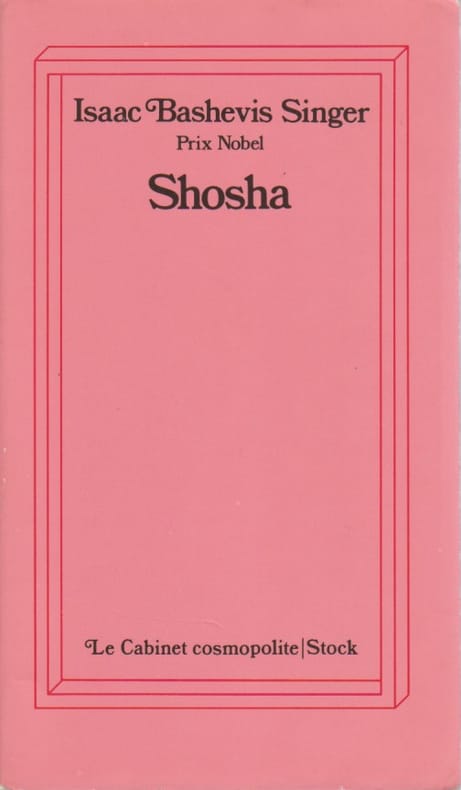
40079Stock, Le Cabinet Cosmopolite, 1994, 384 pp., broché, légères traces d'usage, plis de lecture sur le dos, état satisfaisant.
Milano, CDE, 1978, 16mo cartonato con sovraccopertina illustrata a colori, pp. 260.
Milano, CdE, 1979, 8vo tutta tela editoriale con sovraccopertina illustrata a colori, pp. XIV-260.
Milano, CdE, 1979, 8vo tutta tela editoriale con sovraccopertina illustrata a colori, pp. 260.
Original Wraps. 8vo. 126 pages. 25 cm. First edition. Inscribed by the author. Title on title page verso: Heure de la poe´sie; Chou fun lid. Hour for Song; Songs and Poems, by Chaim Leib Fox (Fuks/Fuchs; 18971984) , Yiddish author and journalist. Born in Lodz, Fox was at the center of its Yiddish literary life, which he described in a number of essays (e. G. , Dos Yidishe Literarishe Lodzh (Yiddish Literary Lodz) , in: Fun Noentn Over, 3 (1957) , 189284) and in his monograph Lodzh shel Mayle (Heavenly Lodz, 1972) . During World War I Fox was a labor conscript in Germany. After a brief period in the Bund, he joined the Labor Zionist movement and, in Palestine (193638) , the Haganah. During World War II he was in the Soviet Union (194046) and thereafter lived in Lodz, Paris (194853) , and New York. He wrote for many periodicals and contributed over 3, 000 articles to the Leksikon fun der Nayer Yidisher Literatur. A poet of intense religious and national feeling, he published seven volumes of poetry (192682) and wrote the historical novel Gyoras Letster Veg (Giora's Final Road, 1939) and 100 Yor Yidishe un Hebreishe Prese in Kanade (100 Years of Yiddish and Hebrew Press in Canada, 1980) . Subjects: Yiddish Poetry. OCLC lists 22 copies. Light soiling to wraps, light tear to top and bottom of backstrip, otherwise fresh. Good condition. (YID-18-2)
Buenos Ayres [Buenos Aires]: Farlag Perl, 1942. Paper Wrappers, 8vo, 80 pages. Yiddish Monthly. Anthology of articles on ancient and modern Judaism. Continued on into at least 1971 (we located an issue Nr. 343) SUBJECT(S) : Judaism -- Periodicals. Jews -- Periodicals. OCLC lists 7 holdings worldwide. Paper browning at edges, otherwise Very Good Condition. (Y-44)
IN YIDDISH. 235X155mm. 232 pages. Hardcover. Cover slightly curved. Cover rubbed and stained. Cover edges and corners worn. Spine worn. Whitepage torn. Pages slightly yellowing. Else in good condition.
Original Wraps. 4to. 24 pages. 29 cm. First edition. In Yiddish, with some English at rear. Shtraln, published for the first graduation of the Workmens Circle School in Buffalo, New York, June, 1940. With three photographs. With commemorative essays for the celebration of the first graduating class, and various students essays on Emigration, Eugene Debs, Abraham Reizen, and Yiddish education. Rear contains advertisements in Yiddish and English, with various local branches of the workmens circle in Buffalo represented. Includes English advertisement requesting parents to enroll their children in the Yiddish school. Marked Printed in Canada on back wrap. Subjects: Jews - Education - Buffalo (N. Y. ) . Workmen's Circle (U. S. ) . Schools. No copies listed on OCLC. Light wear to wraps, very fresh and clean. Very good + condition. (YID-18-39)
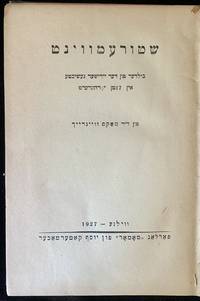
192743261Vilne: Tamar 1927. First edition. Original boards. 8vo 220 pages 21 cm. In Yiddish. Title translates as “Storm Winds: Images from Yiddish History in the 17th Century.â€<br> Max Weinreich’s historical work on Jews in Europe in the 17th Century focusing on the Chmelnitski pogroms.<br> “While Weinreich was first and foremost a linguist other topics he wrote about included psychology he translated Freud into Yiddish sociology economics theater studies literary history education ethnography and philosophy. He had a second career as a writer of popular articles in the Yiddish Forward frequently under the unlikely pseudonym Sore Brener. His linguistic interests included the history of linguistics orthography grammar he coauthored an early Yiddish grammar etymology and the etymological components of Yiddish dialectology stylistics and the influence of traditional Jewish culture in all its facets on the development of the Yiddish language.<br> In 1925 on the initiative of the linguist Nokhem Shtif the Yidisher Visnshaftlekher Institut Yiddish Research Institute; YIVO was founded in Berlin and began its work in Vilna; its first headquarters was located in a room in Weinreich’s apartment. Weinreich quickly became the driving force behind the new institute which was originally to have been known as an academy but Weinreich insisted on institute. Although YIVO may not have been Weinreich’s brainchild it was his child in every other way even after it acquired its own building on Wiwulski Street in Vilna.†<br> SUBJECTS: Jews -- Poland -- History -- Persecutions. Chmelnicki massacres. Blood accusation -- Lithuania -- Vilnius. Blood accusation. Jews -- Persecutions. History. OCLC: 649090568. OCLC lists 8 copies worldwide AJHS SUNY- Albany YIVO AJU Stanford Harvard NYBC Penn<br> Spine separation and some markings but text block is in good condition. Good Condition. Important and somewhat scarce. YID-48-62-BX'L-’emccgg. Vilne: Tamar unknown
1st edition. Original boards. 8vo. 297 pages. 25 cm. In Yiddish. Title translates to Thresholds: A Trilogy. Levadi (1898 - 1973) was Russian writer. He served in the Turkish army during WWI and was stationed in Palestine. He moved to America in 1921 where his literary career blossomed. In this volume, Levadi designed the title page and included a glossary of Hebrew, Arabic, and Turkish words that the author used in the trilogy. (Yiddish Leksikon, 2017) . SUBJECTS: Autobiographical fiction. Yiddish fiction. Very light soiling to cloth. Very Good Condition. (YID-40-56-CLX)
Original paper wrappers. 8vo. 15 pages, 23 cm. In Yiddish. Title translates to Simplon and Children of Parma. A Naiz-era Yiddish language studybook focusing on Maksim Gorky. Gorky (1868-1936) was a Soviet Russian writer and pioneer of the Socialist realism genre. Nice illustrated ad on rear for children's publishers Grinke Beymelekh ("Green Saplings") with a shouting capped newsboy hocking papers. SUBJECTS: Short stories, Yiddish. Selections. OCLC Number: 20069016. OCLC lists 3 copies worldwide (Harvard, FAU, NLI), none in New York and none west of Florida. Light edge wear and browning to wrappers. Overall good condition. Scarce (YID-33-64-L'ex)
254 p. Inked Christmas wishes. 8vo. Original full purple cloth binding. Original dust jacket, top edges chipped. Price clipped. Hardbound. JUDAICA BOX 4
IN HEBREW AND YIDDISH. INCLUDES A CD. 19x2.5 cm. 210 pages. Hardcover. Slight wrinkles on front cover. Sticker mark on first white page. Else in good condition.
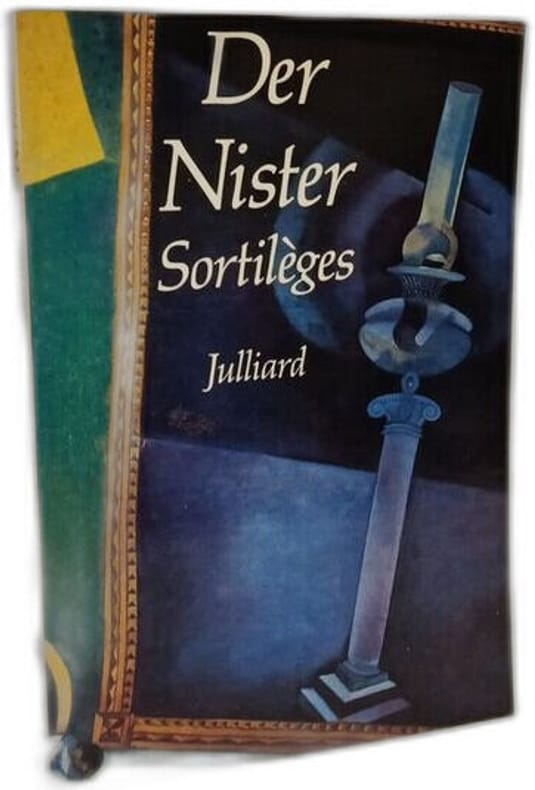
1992100147316Julliard 1992 188 pages in8. 1992. Broché. 188 pages.
8vo; 1st edition. Cloth, Small octavo, 334 pages. In Yiddish. Section headings include "The Jews in Amsterdam", The Theological Storm", and "Leibnitz". Includes bibliographical references (pages 319-334).SUBJECT(S): Spinoza, Benedictus de, 1632-1677. "Jacob Shatzky (also: Yaakov, or Yankev Shatski; in Polish: Szacki) (18931956) was a distinguished Jewish historian.Shatzky was born in Warsaw. He received a traditional Jewish education and went on to study at universities in Lwów, Vienna, Berlin and Warsaw. He earned his Ph.D. from the University of Warsaw in 1922 with a thesis on 'The Jewish Question in the Kingdom of Poland During the Paskiewicz Era.' Historians who studied under Shatzky include Lucy Dawidowicz.Shatzky enlisted in Pilsudski's Legion and fought with distinction in the First World War; he was promoted to the rank of lieutenant. He was sent by the Polish Foreign Ministry in 1918 to report on a pogrom in Vilna. He resigned from his post when it became clear that the government would not act to punish the perpetrators of the pogroms.Shatzky emigrated to the United States in 1923. He served as Chief Librarian of the New York State Psychiatric Institute from 1930 to 1956. He acquired the personal library of Sigmund Freud for the collection" (Wikipedia). OCLC: 19308492. Some wear, Good Condition. (YID-42-43-EL-'x)