3 889 résultats
189560208Ernest Leroux | Paris 1895 | 16 x 25 cm | broché
1855RO40251155Carolus Tauchnitz, Lipsiae. 1855. In-8. Relié cuir dos-coins. Etat d'usage, Couv. légèrement passée, Mors fendus, Intérieur acceptable. VIII + 529 pages (texte en arabe, sens de lecture droite-gauche). Texte encadré (filets rouges). Titre, filets et roulettes dorés sur le dos. Etiquette de code sur la couverture. Quelques tampons de bibliothèque. Epidermures sur le dos. Plats légèrement frottés. Annotations au crayon dans les marges (numérotations).. . . . Classification Dewey : 492.7-Arabe
Carolus Tauchnitz, Lipsiae. 1855. In-8 Carré. Relié cuir dos-coins. Etat d'usage. Couv. légèrement passée. Mors fendus. Intérieur acceptable. VIII + 529 pages (texte en arabe, sens de lecture droite-gauche). Texte encadré (filets rouges). Titre, filets et roulettes dorés sur le dos. Etiquette de code sur la couverture. Quelques tampons de bibliothèque. Epidermures sur le dos. Plats légèrement frottés. Annotations au crayon dans les marges (numérotations). Curavit Gustavus Mauritius REDSLOB. Editio Stereotypa, Novis Chartis Impressa.
FIRST AND ONLY EDITION of this important early work on Arabic grammar and comparative philology. 4, 140 pp. COPIOUS USE OF ELEGANT ARABIC TYPES THROUGHOUT. Printed with huge margins on fine laid paper. 4to. ENTIRELY UNCUT in recent unprinted wraps. Fore-edges of first and last leaves a bit dusty, otherwise internally clean. A pristine copy of a rare and important book.
Very Good Turkish Original fine photograph. 55x54 cm. Framed. Signed by Kortan Tümerdem and Emine Öztekin on verso, on a card.
180923469Imprimerie Impériale | Paris 1809-1829 | 70 x 51.50 cm | une feuille
43319Le Caire.1939.Année 252.In-folio demi-reliure éditeur avec photo contre-collée.207 p.LXXVIII planches. BE.
43314Musée National de l'Art Arabe.Le Caire.1936.Année 272.In-folio,cartonnage éditeur avec photo contre-collée.194 p.XLIX planches. BE.Couv.un peu insolée.Coins émoussés.
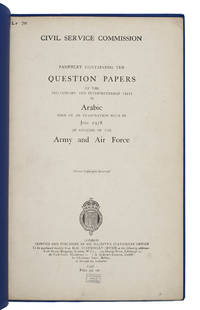
1938ABC_46033London: printed and published at Her Majesty's Stationary Office 1938. Original publisher's printed paper wrappers in later blue paper wrappers. Folio. Printed in English and Arabic. British government publication of an interpretership examination for Arabic translation. It provides the examination questions that officers in the Army and Air Force had to answer correctly to pass as an interpreter of Arabic. The work contains several questions that include translating Arabic texts printed in Arabic type.Library stamp on foot of front cover title-page and pp. 8 and 9: "Liverpool Public Libraries". In good condition.l Consolidated List of Government Publications 1936 p.147; WorldCat 1 copy: British Library. printed and published at Her Majesty's Stationary Office, unknown
1996DL1002London & New York:: Routledge 1996. 1996. Three volumes. 8vo. xiv 330; vii 331-750; vii 751-1105 pp. Indexes; some former marks erased minor. Original printed boards; minor rubbing on head of vol. III joint. Ownership ink signatures of David C. Lindberg. First Printing. This is a contributor's copy that of Lindberg who contributed the paper "The Western reception of Arabic optics" pp.716-729. Three major sections: Astronomy-theoretical and applied; Mathematics and the Physical Sciences; Technology Alchemy and Life Sciences. ISBN: 0415020638 Routledge, (1996). hardcover books
Very Good English Original autograph letter signed (ALS) by Percy Smythe Strangford, (1825-1869), about Heinrich Julius Klaproth's manuscript, saying it was translated from a Russian book, "officially confided to him when at Turkestan in 1805 or thereabouts". 18x11,5 cm. In English. 30 lines in 2 p. Letterhead in Persian beneath a coronet, dated 19 November 1868. Heinrich Julius Klaproth, (1783-1835), was a German linguist, historian, ethnographer, author, orientalist, and explorer. As a scholar, he is credited along with Jean-Pierre Abel-Rémusat, with being instrumental in turning East Asian Studies into scientific disciplines with critical methods. Percy Ellen Algernon Frederick William Sydney Smythe, 8th Viscount Strangford, (1825-1869), was a British nobleman and man of letters. He was born in St. Petersburg, Russia, the son of the 6th Viscount Strangford, the British Ambassador, Ottoman Turkey, Sweden, and Portugal. During all his earlier years Percy Smythe was nearly blind, in consequence, it was believed, of his mother having suffered very great hardships on a journey up the Baltic Sea in wintry weather shortly before his birth. His education began at Harrow School, whence he went to Merton College, Oxford. He excelled as a linguist and was nominated by the vice-chancellor of Oxford in 1845 a student-attache at Constantinople. While at Constantinople, where he served under Lord Stratford de Redcliffe, Smythe gained a mastery not only of Turkish and its dialects but of almost every form of modern Greek, from the language of the literati of Athens to the least Hellenized Romaic. He had already a large knowledge both of Persian and Arabic before going east, but until his duties led him to study the past, present, and future of the sultan's empire he had given no attention to the tongues which he well described as those of the international rabble in and around the Balkan peninsula. On succeeding his brother as Viscount Strangford in 1857 he continued to live in Constantinople, immersed in cultural studies. At length, however, he returned to England and wrote a good deal, sometimes in the Saturday Review, sometimes in the Quarterly Review, and much in the Pall Mall Gazette. A rather severe review in the first of these organs of the Egyptian Sepulchres and Syrian Shrines of Emily Anne Beaufort (1826-1887) led to a result not very usual, the marriage of the reviewer and the author. Percy Smythe was president of the Royal Asiatic Society in 1861-64 and 1867-69.
Very Good Turkish, Ottoman (1500-1928) Original leather bdg. Missing last two pages of index. Large demy 8vo. (23 x 15 cm). In Ottoman script. 818 p. Nakd üt-tevârih. The chronological history of Rifat Efendi, from the Hidkat-i Adem Aleyhisselâm (Prophet Adam), to the end of the Hijri period of 1295 year. First and Only Edition. Özege 15019. Extremely rare.
- Imprimerie Impériale, Paris 1809-1829, 71x54cm, une feuille. - Original, unshaved, full-page etching from the "Imperial edition" of the Description de l'Égypte, or 'Recueil des observations et recherches faites en Égypte pendant l'expédition française, publié par les ordres de Sa Majesté l'Empereur Napoléon le Grand [A Collection of the observations and research carried out in Egypt during the French expedition, published on the orders of his Majesty the Emperor Napoleon the Great]'. Produced between February 1802 and 1830 on the orders of Naopleon Bonaparte and published between 1809 and 1828, 1,000 copies were printed and distributed to institutions, on vergé paper with an 'Égypte ancienne et moderne' watermark, visible when held up to the light. Light marginal spotting not touching image, otherwise in very fresh, fine condition. An engraving from the Description de l'Egypte, one of the masterpieces of French printing and the birth of a new field: Egyptology. A gigantic survey of Egypt at the time of Bonaparte's conquests in 1798 and 1799, the work is divided into 13 volumes of engravings making up 892 plates, of which 72 colored, as well as presenting the splendors of the Egypt of the Pharaohs in 9 volumes. The other volumes discuss natural history and present a fascinating portrait of Coptic and Islamic Egypt as it was seen by Bonaparte's Eastern Armies. The 'Egyptian campaign', militarily a disaster, demonstrates, through the engravings of the Description d'Egypte, the scientific success it nonetheless became thanks to the 167 expert members of the Commission of the Sciences and Arts of the Institut d'Egypte [Egyptian Institute] who followed Napoleon's army. The Institut gathered together in Egypt the mathematician Monge, the chemist Berthollet, the naturalist Geoffroy Saint-Hilaire as well as numerous artists, engineers, architects and doctors. They were tasked with re-discovering modern and ancient Egypt and displaying its natural treasures as well as the know-how of its inhabitants. This edition, the so-called "Imperial" edition of the plates for the Description de l'Egypte was printed in four large formats, two of which were specially created for it and christened "Moyen-Egypte" and "Grand-Egypte". A special press was built to print it, the process extending over 20 years, from 1809 to 1829. The "Imperial" edition proved so popular that a second edition, this time in black and white and without the "Egypte ancienne et moderne" watermark - known as the "Royal Edition" - was published during the Restoration by the printing house of C.-L.-F. Panckoucke (Paris). The engravings of the Description d'Egypte owe a great deal to Baron Dominique-Vivant Denon, illustrator, diplomat, collector and later Director of the Musée Napoléon (the Louvre). His exploration of the South of Egypt gave Bonaparte the idea of sending the experts of the Institut there, thus creating a faithful and complete portrait of the area. This was the research gathered together from 1802 in the mammoth Description de L'Egypte. Denon embarked on this story of archeological exploration at the age of 51, reaching first Alexandria and then Cairo before exploring Upper Egypt. Along with the members of the Institut d'Egypte, the Natural History Museum's painter H.J. Redouté (brother of Pierre-Joseph Redouté, author of Roses), the mineralogist Dolomiue, and the draughtsman Joly, Denon then explored the Nile Delta and Lower Egypt. When, however, he joined the 21st Light Infantry Regiment as it marched across Upper Egypt in pursuit of the retreating Mameluks in November 1798, he found himself the only civilian. In the very midst of the battle itself, he reeled off sketches of the works of art that peppered his path right up to the threshold of the Sudan. He said that he had crossed "a country that is, apart from its name, entirely unknown to Europeans, and therefore everything was worth describing" (Voyages dans la Basse et la Haute Egypte pendant le
- Imprimerie Impériale, Paris 1809-1829, 53,5x71cm, une feuille. - Original, unshaved, full-page etching from the "Imperial edition" of the Description de l'Égypte, or 'Recueil des observations et recherches faites en Égypte pendant l'expédition française, publié par les ordres de Sa Majesté l'Empereur Napoléon le Grand [A Collection of the observations and research carried out in Egypt during the French expedition, published on the orders of his Majesty the Emperor Napoleon the Great]'. Produced between February 1802 and 1830 on the orders of Naopleon Bonaparte and published between 1809 and 1828, 1,000 copies were printed and distributed to institutions, on vergé paper with an 'Égypte ancienne et moderne' watermark, visible when held up to the light. Light marginal spotting not touching image, otherwise in very fresh, fine condition. An engraving from the Description de l'Egypte, one of the masterpieces of French printing and the birth of a new field: Egyptology. A gigantic survey of Egypt at the time of Bonaparte's conquests in 1798 and 1799, the work is divided into 13 volumes of engravings making up 892 plates, of which 72 colored, as well as presenting the splendors of the Egypt of the Pharaohs in 9 volumes. The other volumes discuss natural history and present a fascinating portrait of Coptic and Islamic Egypt as it was seen by Bonaparte's Eastern Armies. The 'Egyptian campaign', militarily a disaster, demonstrates, through the engravings of the Description d'Egypte, the scientific success it nonetheless became thanks to the 167 expert members of the Commission of the Sciences and Arts of the Institut d'Egypte [Egyptian Institute] who followed Napoleon's army. The Institut gathered together in Egypt the mathematician Monge, the chemist Berthollet, the naturalist Geoffroy Saint-Hilaire as well as numerous artists, engineers, architects and doctors. They were tasked with re-discovering modern and ancient Egypt and displaying its natural treasures as well as the know-how of its inhabitants. This edition, the so-called "Imperial" edition of the plates for the Description de l'Egypte was printed in four large formats, two of which were specially created for it and christened "Moyen-Egypte" and "Grand-Egypte". A special press was built to print it, the process extending over 20 years, from 1809 to 1829. The "Imperial" edition proved so popular that a second edition, this time in black and white and without the "Egypte ancienne et moderne" watermark - known as the "Royal Edition" - was published during the Restoration by the printing house of C.-L.-F. Panckoucke (Paris). The engravings of the Description d'Egypte owe a great deal to Baron Dominique-Vivant Denon, illustrator, diplomat, collector and later Director of the Musée Napoléon (the Louvre). His exploration of the South of Egypt gave Bonaparte the idea of sending the experts of the Institut there, thus creating a faithful and complete portrait of the area. This was the research gathered together from 1802 in the mammoth Description de L'Egypte. Denon embarked on this story of archeological exploration at the age of 51, reaching first Alexandria and then Cairo before exploring Upper Egypt. Along with the members of the Institut d'Egypte, the Natural History Museum's painter H.J. Redouté (brother of Pierre-Joseph Redouté, author of Roses), the mineralogist Dolomiue, and the draughtsman Joly, Denon then explored the Nile Delta and Lower Egypt. When, however, he joined the 21st Light Infantry Regiment as it marched across Upper Egypt in pursuit of the retreating Mameluks in November 1798, he found himself the only civilian. In the very midst of the battle itself, he reeled off sketches of the works of art that peppered his path right up to the threshold of the Sudan. He said that he had crossed "a country that is, apart from its name, entirely unknown to Europeans, and therefore everything was worth describing" (Voyages dans la Basse et la Haute Egypte pendant
- Imprimerie Impériale, Paris 1809-1829, 71x54cm, une feuille. - Original, unshaved, full-page etching from the "Imperial edition" of the Description de l'Égypte, or 'Recueil des observations et recherches faites en Égypte pendant l'expédition française, publié par les ordres de Sa Majesté l'Empereur Napoléon le Grand [A Collection of the observations and research carried out in Egypt during the French expedition, published on the orders of his Majesty the Emperor Napoleon the Great]'. Produced between February 1802 and 1830 on the orders of Naopleon Bonaparte and published between 1809 and 1828, 1,000 copies were printed and distributed to institutions, on vergé paper with an 'Égypte ancienne et moderne' watermark, visible when held up to the light. Light marginal spotting not touching image, otherwise in very fresh, fine condition. An engraving from the Description de l'Egypte, one of the masterpieces of French printing and the birth of a new field: Egyptology. A gigantic survey of Egypt at the time of Bonaparte's conquests in 1798 and 1799, the work is divided into 13 volumes of engravings making up 892 plates, of which 72 colored, as well as presenting the splendors of the Egypt of the Pharaohs in 9 volumes. The other volumes discuss natural history and present a fascinating portrait of Coptic and Islamic Egypt as it was seen by Bonaparte's Eastern Armies. The 'Egyptian campaign', militarily a disaster, demonstrates, through the engravings of the Description d'Egypte, the scientific success it nonetheless became thanks to the 167 expert members of the Commission of the Sciences and Arts of the Institut d'Egypte [Egyptian Institute] who followed Napoleon's army. The Institut gathered together in Egypt the mathematician Monge, the chemist Berthollet, the naturalist Geoffroy Saint-Hilaire as well as numerous artists, engineers, architects and doctors. They were tasked with re-discovering modern and ancient Egypt and displaying its natural treasures as well as the know-how of its inhabitants. This edition, the so-called "Imperial" edition of the plates for the Description de l'Egypte was printed in four large formats, two of which were specially created for it and christened "Moyen-Egypte" and "Grand-Egypte". A special press was built to print it, the process extending over 20 years, from 1809 to 1829. The "Imperial" edition proved so popular that a second edition, this time in black and white and without the "Egypte ancienne et moderne" watermark - known as the "Royal Edition" - was published during the Restoration by the printing house of C.-L.-F. Panckoucke (Paris). The engravings of the Description d'Egypte owe a great deal to Baron Dominique-Vivant Denon, illustrator, diplomat, collector and later Director of the Musée Napoléon (the Louvre). His exploration of the South of Egypt gave Bonaparte the idea of sending the experts of the Institut there, thus creating a faithful and complete portrait of the area. This was the research gathered together from 1802 in the mammoth Description de L'Egypte. Denon embarked on this story of archeological exploration at the age of 51, reaching first Alexandria and then Cairo before exploring Upper Egypt. Along with the members of the Institut d'Egypte, the Natural History Museum's painter H.J. Redouté (brother of Pierre-Joseph Redouté, author of Roses), the mineralogist Dolomiue, and the draughtsman Joly, Denon then explored the Nile Delta and Lower Egypt. When, however, he joined the 21st Light Infantry Regiment as it marched across Upper Egypt in pursuit of the retreating Mameluks in November 1798, he found himself the only civilian. In the very midst of the battle itself, he reeled off sketches of the works of art that peppered his path right up to the threshold of the Sudan. He said that he had crossed "a country that is, apart from its name, entirely unknown to Europeans, and therefore everything was worth describing" (Voyages dans la Basse et la Haute Egypte pendant le
- Imprimerie Impériale, Paris 1809-1829, 53,5x71cm, une feuille. - Original, unshaved, full-page etching from the "Imperial edition" of the Description de l'Égypte, or 'Recueil des observations et recherches faites en Égypte pendant l'expédition française, publié par les ordres de Sa Majesté l'Empereur Napoléon le Grand [A Collection of the observations and research carried out in Egypt during the French expedition, published on the orders of his Majesty the Emperor Napoleon the Great]'. Produced between February 1802 and 1830 on the orders of Naopleon Bonaparte and published between 1809 and 1828, 1,000 copies were printed and distributed to institutions, on vergé paper with an 'Égypte ancienne et moderne' watermark, visible when held up to the light. Light marginal spotting not touching image, otherwise in very fresh, fine condition. An engraving from the Description de l'Egypte, one of the masterpieces of French printing and the birth of a new field: Egyptology. A gigantic survey of Egypt at the time of Bonaparte's conquests in 1798 and 1799, the work is divided into 13 volumes of engravings making up 892 plates, of which 72 colored, as well as presenting the splendors of the Egypt of the Pharaohs in 9 volumes. The other volumes discuss natural history and present a fascinating portrait of Coptic and Islamic Egypt as it was seen by Bonaparte's Eastern Armies. The 'Egyptian campaign', militarily a disaster, demonstrates, through the engravings of the Description d'Egypte, the scientific success it nonetheless became thanks to the 167 expert members of the Commission of the Sciences and Arts of the Institut d'Egypte [Egyptian Institute] who followed Napoleon's army. The Institut gathered together in Egypt the mathematician Monge, the chemist Berthollet, the naturalist Geoffroy Saint-Hilaire as well as numerous artists, engineers, architects and doctors. They were tasked with re-discovering modern and ancient Egypt and displaying its natural treasures as well as the know-how of its inhabitants. This edition, the so-called "Imperial" edition of the plates for the Description de l'Egypte was printed in four large formats, two of which were specially created for it and christened "Moyen-Egypte" and "Grand-Egypte". A special press was built to print it, the process extending over 20 years, from 1809 to 1829. The "Imperial" edition proved so popular that a second edition, this time in black and white and without the "Egypte ancienne et moderne" watermark - known as the "Royal Edition" - was published during the Restoration by the printing house of C.-L.-F. Panckoucke (Paris). The engravings of the Description d'Egypte owe a great deal to Baron Dominique-Vivant Denon, illustrator, diplomat, collector and later Director of the Musée Napoléon (the Louvre). His exploration of the South of Egypt gave Bonaparte the idea of sending the experts of the Institut there, thus creating a faithful and complete portrait of the area. This was the research gathered together from 1802 in the mammoth Description de L'Egypte. Denon embarked on this story of archeological exploration at the age of 51, reaching first Alexandria and then Cairo before exploring Upper Egypt. Along with the members of the Institut d'Egypte, the Natural History Museum's painter H.J. Redouté (brother of Pierre-Joseph Redouté, author of Roses), the mineralogist Dolomiue, and the draughtsman Joly, Denon then explored the Nile Delta and Lower Egypt. When, however, he joined the 21st Light Infantry Regiment as it marched across Upper Egypt in pursuit of the retreating Mameluks in November 1798, he found himself the only civilian. In the very midst of the battle itself, he reeled off sketches of the works of art that peppered his path right up to the threshold of the Sudan. He said that he had crossed "a country that is, apart from its name, entirely unknown to Europeans, and therefore everything was worth describing" (Voyages dans la Basse et la Haute Egypte pendant
- J. Pougeois, Paris 1868, 15,5x24cm, relié. - Edition originale. Reliure en plein chagrin aubergine, dos à quatre fins nerfs sertis de filets dorés orné de triples caissons dorés agrémentés de motifs typographiques dorés, un petit manque en tête de la coiffe supérieure, encadrement d'un filet dorés sur les plats ornementés d'arabesques romantiques estampées à froid, gardes et contreplats de papier à la cuve, tranches dorées, liserés dorés en tête et en pieds des coupes, élégante reliure romantique de l'époque. Etiquette de distribution de prix encollée sur un contreplat, rousseurs éparses affectant principalement les feuillets en tête. Exemplaire complet de sa carte dépliante in-fine. [ENGLISH DESCRIPTION ON DEMAND]
60842Paris, Union Latine d'Editions, 1981, 8 volumes reliés pleine peau bleue richement décorée sur les dos et les plats d'un décor arabisant, têtes dorées, grand in 8° (reliure de l'éditeur).
190790131Lucien Dorbon | Paris 1907 | 14.2 x 22.7 cm | Broché
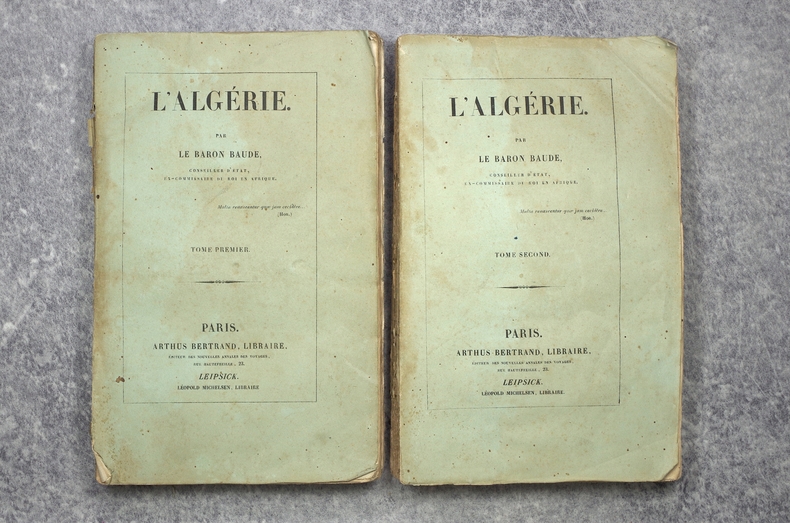
1841264PARIS. ARTHUS BERTRAND, LIBRAIRE. 1841. 2 VOLUMES IN-8 BROCHES (14,5 X 22,5 X 6,5 CENTIMETRES ENVIRON) DE (4) + XXVIII + 404 ET (4) + 492 PAGES, COUVERTURE BLEU VERT, TITRE IMPRIME EN NOIR. ILLUSTRE DE 3 CARTES REPLIEES. RARE. UN DES PLUS IMPORTANTS OUVRAGES PARUS SUR L’ALGERIE. (BRUNET. 28410). PETITES TRACES D’HUMIDITE ANCIENNE SANS GRAVITE SUR CERTAINES PAGES, QUELQUES DEFAUTS EXTERIEURS, DONT MANQUES DE PAPIER AU DOS, DEBOITES, SINON BON EXEMPLAIRE QUI MERITERAIT D’ETRE RELIE.
184884439Chez H. Morel | Paris 1848 | 15 x 24 cm | 3 volumes reliés
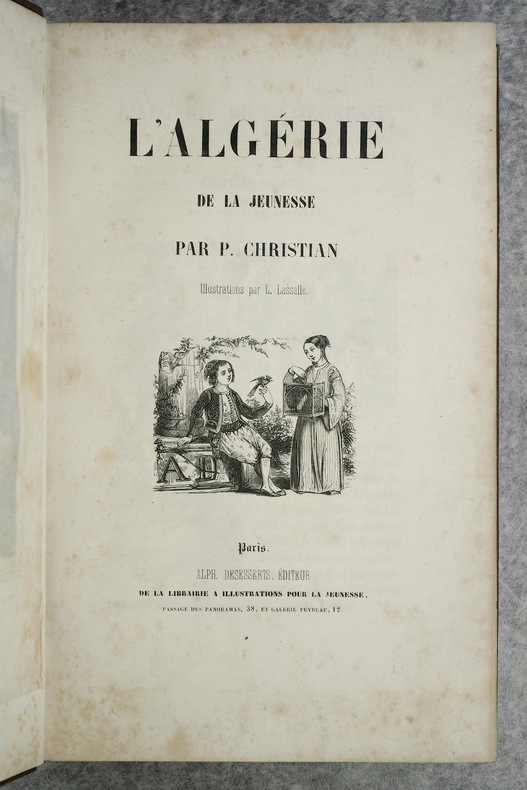
18473145PARIS. ALPH. DESESSERTS, EDITEUR. DE LA LIBRAIRIE A L'ILLUSTRATION POUR LA JEUNESSE. SANS DATE. (1847). IN-8 (16 X 24,5 X 3 CENTIMETRES ENVIRON) DE (4) + 362 ET (1) PAGES, RELIURE DE L'EDITEUR PLEINE PERCALINE MARRON, PLATS ET DOS ORNES DE COMPOSITIONS DOREES PAR HEROU, TITRE ET TRANCHES DORES. ILLUSTRE DE QUELQUES GRAVURES EN NOIR ET DE 14 BELLES PLANCHES HORS TEXTE SOUS SERPENTE, LITHOGRAPHIEES, COLORIEES ET GOMMEES, DONT 12 DE TYPES ET COSTUMES. (L'HISTOIRE DE L'ALGERIE ET DE LA COLONISATION FRANCAISE, A TRAVERS LES AVENTURES D'UN JEUNE BRETON EMBARQUE POUR L'ALGERIE, FAIT PRISONNIER PAR LES ARABES ET DEVENU UN FAMILIER D'ABD-EL-KADER). PREMIER TIRAGE POUR CE BEAU CARTONNAGE ROMANTIQUE. ROUSSEURS SUR CERTAINES PAGES DE TEXTE, PETITES TRACES D'USURE EXTERIEURE SANS GRAVITE, SINON BON EXEMPLAIRE.
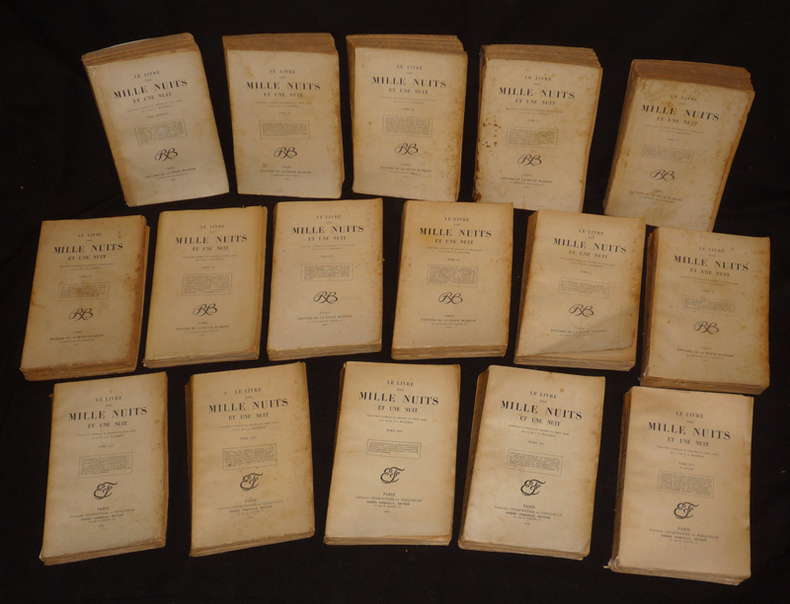
1899mn1216Editions de la revue blanche Broché 1899 Seize volumes in-8 (14,3 x 22,7 cm), brochés, imprimés entre 1899 et 1904, édité par La Revue Blanche jusqu'au Tome 11 puis par Eugène Fasquelle, édition originale de la traduction de Mardrus, complet ; Tome 1 : 345 pp. // Tome 2 : 366 pp. // Tome 3 : 315 pp. // Tome 4 : 335 pp. // Tome 5 : 297 pp. // Tome 6 : 304 pp. // Tome 7 : 276 pp. // Tome 8 : 349 pp. // Tome 9 : 332 pp. // Tome 10 : 321 pp. // Tome 11 : 346 pp. // Tome 12 : 320 pp. // Tome 13 : 328 pp. // Tome 14 : 330 pp. // Tome 15 : 332 pp. // Tome 16 : 290 pp. ; pliures aux dos, coiffes usées, rousseurs sur les couvertures, mouillure et petit manque au quatrième plat du tome 1, taches brunes au dos du tome 4, pliure au premier plat du tome 10, par ailleurs assez bon état général. Livraison a domicile (La Poste) ou en Mondial Relay sur simple demande.