3 889 résultats
- Imprimerie Impériale, Paris 1809-1829, 70x51,5cm, une feuille. - Original, unshaved, full-page etching from the "Imperial edition" of the Description de l'Égypte, or 'Recueil des observations et recherches faites en Égypte pendant l'expédition française, publié par les ordres de Sa Majesté l'Empereur Napoléon le Grand [A Collection of the observations and research carried out in Egypt during the French expedition, published on the orders of his Majesty the Emperor Napoleon the Great]'. Produced between February 1802 and 1830 on the orders of Naopleon Bonaparte and published between 1809 and 1828, 1,000 copies were printed and distributed to institutions, on vergé paper with an 'Égypte ancienne et moderne' watermark, visible when held up to the light. Light marginal spotting not touching image, otherwise in very fresh, fine condition. An engraving from the Description de l'Egypte, one of the masterpieces of French printing and the birth of a new field: Egyptology. A gigantic survey of Egypt at the time of Bonaparte's conquests in 1798 and 1799, the work is divided into 13 volumes of engravings making up 892 plates, of which 72 colored, as well as presenting the splendors of the Egypt of the Pharaohs in 9 volumes. The other volumes discuss natural history and present a fascinating portrait of Coptic and Islamic Egypt as it was seen by Bonaparte's Eastern Armies. The 'Egyptian campaign', militarily a disaster, demonstrates, through the engravings of the Description d'Egypte, the scientific success it nonetheless became thanks to the 167 expert members of the Commission of the Sciences and Arts of the Institut d'Egypte [Egyptian Institute] who followed Napoleon's army. The Institut gathered together in Egypt the mathematician Monge, the chemist Berthollet, the naturalist Geoffroy Saint-Hilaire as well as numerous artists, engineers, architects and doctors. They were tasked with re-discovering modern and ancient Egypt and displaying its natural treasures as well as the know-how of its inhabitants. This edition, the so-called "Imperial" edition of the plates for the Description de l'Egypte was printed in four large formats, two of which were specially created for it and christened "Moyen-Egypte" and "Grand-Egypte". A special press was built to print it, the process extending over 20 years, from 1809 to 1829. The "Imperial" edition proved so popular that a second edition, this time in black and white and without the "Egypte ancienne et moderne" watermark - known as the "Royal Edition" - was published during the Restoration by the printing house of C.-L.-F. Panckoucke (Paris). The engravings of the Description d'Egypte owe a great deal to Baron Dominique-Vivant Denon, illustrator, diplomat, collector and later Director of the Musée Napoléon (the Louvre). His exploration of the South of Egypt gave Bonaparte the idea of sending the experts of the Institut there, thus creating a faithful and complete portrait of the area. This was the research gathered together from 1802 in the mammoth Description de L'Egypte. Denon embarked on this story of archeological exploration at the age of 51, reaching first Alexandria and then Cairo before exploring Upper Egypt. Along with the members of the Institut d'Egypte, the Natural History Museum's painter H.J. Redouté (brother of Pierre-Joseph Redouté, author of Roses), the mineralogist Dolomiue, and the draughtsman Joly, Denon then explored the Nile Delta and Lower Egypt. When, however, he joined the 21st Light Infantry Regiment as it marched across Upper Egypt in pursuit of the retreating Mameluks in November 1798, he found himself the only civilian. In the very midst of the battle itself, he reeled off sketches of the works of art that peppered his path right up to the threshold of the Sudan. He said that he had crossed "a country that is, apart from its name, entirely unknown to Europeans, and therefore everything was worth describing" (Voyages dans la Basse et la Haute Egypte pendant
- Librairie de Guillaumin, Paris 1983, 13x21,5cm, relié. - Edition originale. Reliure de l'éditeur en plein cartonnage noir, dos lisse orné de filets et de caissons à froid, encadrement de filets à froid sur les plats, gardes et contreplats de papier jaune, toutes tranches dorées. Quelques rousseurs, il semblerait que le cartonnage était initialement prévu pour un autre ouvrage dont le nom a été proprement gratté, avant réemploi pour notre exemplaire, au milieu du premier plat. [ENGLISH DESCRIPTION ON DEMAND]
- Louis Desessart, Paris 1840, 13,5x22cm, 2 volumes reliés. - Edition originale. Reliures en plein chagrin aubergine, dos lisses décolorés et éclaircis ornés d'arabesques romantiques dorées, filets dorés en têtes et en queues des dos, roulettes dorées sur les coiffes, encadrement d'un filet doré sur les plats ornementés d'arabesques romantiques estampées à froid, premiers plats frappés en leurs centres de feuilles de laurier dorées entourant la mention dorée "Pension Membré à Versailles", gardes et contreplats de papier à la cuve, tranches marbrées, liserés dorés en tête et en pieds des coupes, trois coins émoussés, élégantes reliures romantiques de l'époque. Quelques rousseurs, mention manuscrite à l'encre par un ancien propriétaire en tête d'une garde. Notre exemplaire est incomplet de sa carte. [ENGLISH DESCRIPTION ON DEMAND]
- Alfred Mame & fils, Tours 1896, In-4 (26x35,5cm), 288pp., relié. - Edition originale illustrée de 4 aquarelles, 19 photographies et 70 bois gravés dont 17 à pleines pages. Reliure en cartonnage de l'éditeur. Demi veau maroquiné crème. Plats de papier à décor orientalisant or et crème. Les 2 coins du haut émoussés. Très bel exemplaire, au papier immaculé d'une lumineuse blancheur, sur papier couché épais. Récit de voyage du dessinateur, voyageur et ethnographe Gaston Vuillier. [ENGLISH DESCRIPTION ON DEMAND]
195815776New York NY: Pantheon 1958. First of this edition. Hardcover. Very Good/Good . NY: Pantheon Books 1958. First of the first complete edition in English translated from the Arabic. Written in 1377 by Arabic scholar Ibn Kahldun. In 3 volumes boxed. Very good in good unclipped jackets with light chipping and staining. A very good set overall. No former owner marks. Slipcase is also very good. "The concept of "ʿasabiyyah" Arabic: "tribalism clanism communitarism" or in a modern context "group feeling" "social cohesion" "solidarity" or even "nationalism" is one of the best known aspects of the Muqaddimah. As this ʿasabiyyah declines another more compelling 'asabiyyah may take its place; thus civilizations rise and fall. History describes these cycles of ʿasabiyyah as they play out. Ibn Khaldun argues that each dynasty has within itself the seeds of its own downfall. He explains that ruling houses tend to emerge on the peripheries of great empires and use the unity presented by those areas to their advantage in order to bring about a change in leadership" Wiki. No priority shipping. International shipping will require additional postage. Pantheon hardcover
Very Good Turkish, Ottoman (1500-1928) First and Only Ottoman Turkish translation and compilation (also in any Turkish / Turkic language) of 12th-century mystic Arab poet Ibn al-Farid [or Fariz] poems, with Mevlevi poet Nazim Pasha's annotations. This rare book includes Yaiyyah, Mimiyyah, and Raiyyah qasidahs styles of classical Arabic verse. Paperback. Cr. 8vo. (19 x 13 cm). In Ottoman script (Turkish with Arabic letters). 159 p. Ibn Farid was born in Cairo of Ayyubid Egypt to parents from Hama in Syria, lived for some time in Mecca, and died in Cairo. His poetry is entirely Sufic and he was esteemed as the greatest mystic poet of the Arabs. Some of his poems are said to have been written in ecstasies. The poetry of Shaykh Umar Ibn al-Farid is considered by many to be the pinnacle of Arabic mystical verse, though surprisingly he is not widely known in the West. Ibn al-Farid's two masterpieces are The Wine Ode, a beautiful meditation on the "wine" of divine bliss, and "The Poem of the Sufi Way", a profound exploration of spiritual experience along the Sufi Path and perhaps the longest mystical poem composed in Arabic. Both poems have inspired in-depth spiritual commentaries throughout the centuries, and they are still reverently memorized by Sufis and other devout Muslims today. Ibn al-Farid claimed to see many things happen that could be considered to be out of this world. He wrote of a lion kneeling down to him and asking him to ride. He also wrote of seeing a man descending a mountain, floating without using his feet. He claimed that a "great green bird" came down at the funeral of the greengrocer and "gobbled up his corpse". He also claimed to have conversed with Muhammad in a dream. Ibn al-Farid's son Kamal al-Din Muhammad described his ecstasies or trances as sometimes lasting ten consecutive days without eating, drinking, moving, speaking, or hearing outside noises. He would alternately stand, sit, lie on his side, and "throw himself down on his side." When he came to, his first words would be a dictation of the verse God had given him. Mehmed Nazim Pasha, (1840-1926) was an Ottoman statesman, governor of Thessaloniki [i.e. Salonica] poet, and translator. He was a Mevlevi. He wrote his mystic poems and he was the grandfather of famous Turkish leftist poet Nazim Hikmet Ran, (1902-1963). Only three copies in OCLC (German and Hungarian libraries, not in the US): 165173565 / 1132595242.; Özege 8358.
Very Good Turkish, Ottoman (1500-1928) Original cloth bdg. with extra new full leather wrapper in the Ottoman style. Faded on cloth. Some slight stains on several pages. Avery good copy. Roy. 8vo. (24 x 17 cm). In Ottoman script. 11, 18, 228, 4 [...] p., 48 numerous b/w full paged plates. Ihsan Abidin, who completed the "Askerî BaytarMektebi" [I.e. Military Veterinary School] in 1904, was brought to the health and zootechnical professor of this school upon the merger of the Istanbul Military and Civilian Baytar Schools under the name of "Baytar Mekteb-i Alisi". He served as the Undersecretary of the Ministry of Agriculture (1927-1931) and had important services in the field of zootechnics. Ihsan Abidin Bey played an important role in the establishment of Higher Agricultural Institutes, studlands and warehouses. He has signed many articles and more than fifteen books published domestically and in Europe. His the most important book is 'Osmanli atlari' [i.e. The Ottoman horse and horse breeding] including 48 numerous plates and text in 279 pages. In his book, Akinci gives examples from Europe and Africa; He extends to the remotest corners of Asia and talks about the care, feeding, characteristics of horse breeds and emphasizes the importance of horse breeding. Only two copies located in OCLC 984405354.; Not in the Arabian horse bibliography of Boyd & Paul.; TBTK 2831.; Özege 15856.; Not in Kazancigil & Solok (Veterinary bibl.). First and Only Edition.
- Imprimerie Impériale, Paris 1809-1829, 70x51,5cm, une feuille. - Original, unshaved, full-page etching from the "Imperial edition" of the Description de l'Égypte, or 'Recueil des observations et recherches faites en Égypte pendant l'expédition française, publié par les ordres de Sa Majesté l'Empereur Napoléon le Grand [A Collection of the observations and research carried out in Egypt during the French expedition, published on the orders of his Majesty the Emperor Napoleon the Great]'. Produced between February 1802 and 1830 on the orders of Naopleon Bonaparte and published between 1809 and 1828, 1,000 copies were printed and distributed to institutions, on vergé paper with an 'Égypte ancienne et moderne' watermark, visible when held up to the light. Light marginal spotting not touching image, otherwise in very fresh, fine condition. An engraving from the Description de l'Egypte, one of the masterpieces of French printing and the birth of a new field: Egyptology. A gigantic survey of Egypt at the time of Bonaparte's conquests in 1798 and 1799, the work is divided into 13 volumes of engravings making up 892 plates, of which 72 colored, as well as presenting the splendors of the Egypt of the Pharaohs in 9 volumes. The other volumes discuss natural history and present a fascinating portrait of Coptic and Islamic Egypt as it was seen by Bonaparte's Eastern Armies. The 'Egyptian campaign', militarily a disaster, demonstrates, through the engravings of the Description d'Egypte, the scientific success it nonetheless became thanks to the 167 expert members of the Commission of the Sciences and Arts of the Institut d'Egypte [Egyptian Institute] who followed Napoleon's army. The Institut gathered together in Egypt the mathematician Monge, the chemist Berthollet, the naturalist Geoffroy Saint-Hilaire as well as numerous artists, engineers, architects and doctors. They were tasked with re-discovering modern and ancient Egypt and displaying its natural treasures as well as the know-how of its inhabitants. This edition, the so-called "Imperial" edition of the plates for the Description de l'Egypte was printed in four large formats, two of which were specially created for it and christened "Moyen-Egypte" and "Grand-Egypte". A special press was built to print it, the process extending over 20 years, from 1809 to 1829. The "Imperial" edition proved so popular that a second edition, this time in black and white and without the "Egypte ancienne et moderne" watermark - known as the "Royal Edition" - was published during the Restoration by the printing house of C.-L.-F. Panckoucke (Paris). The engravings of the Description d'Egypte owe a great deal to Baron Dominique-Vivant Denon, illustrator, diplomat, collector and later Director of the Musée Napoléon (the Louvre). His exploration of the South of Egypt gave Bonaparte the idea of sending the experts of the Institut there, thus creating a faithful and complete portrait of the area. This was the research gathered together from 1802 in the mammoth Description de L'Egypte. Denon embarked on this story of archeological exploration at the age of 51, reaching first Alexandria and then Cairo before exploring Upper Egypt. Along with the members of the Institut d'Egypte, the Natural History Museum's painter H.J. Redouté (brother of Pierre-Joseph Redouté, author of Roses), the mineralogist Dolomiue, and the draughtsman Joly, Denon then explored the Nile Delta and Lower Egypt. When, however, he joined the 21st Light Infantry Regiment as it marched across Upper Egypt in pursuit of the retreating Mameluks in November 1798, he found himself the only civilian. In the very midst of the battle itself, he reeled off sketches of the works of art that peppered his path right up to the threshold of the Sudan. He said that he had crossed "a country that is, apart from its name, entirely unknown to Europeans, and therefore everything was worth describing" (Voyages dans la Basse et la Haute Egypte pendant
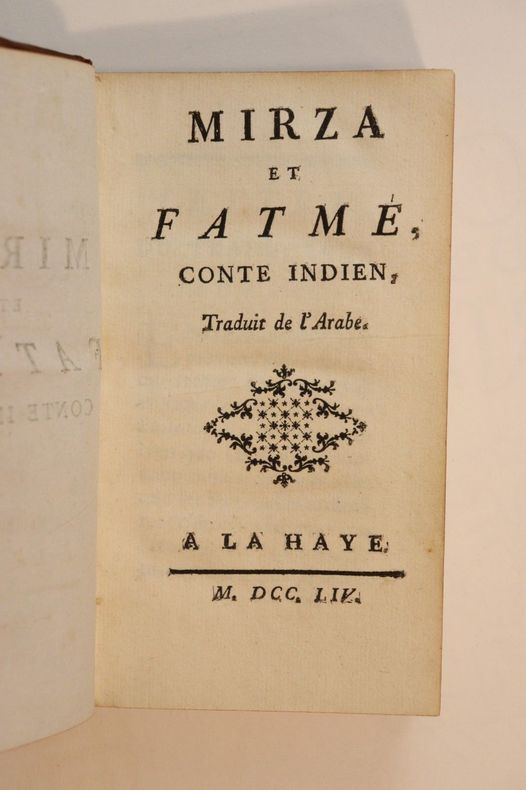
1754AMO-2337A La Haye, 1754 2 parties en 1 volume in-12 (16 x 10 cm) de (2)-322-(6) pages. Reliure de l'époque pleine basane marbrée, dos à nerfs orné, tranches rouges. Usures aux coins et aux coiffes. Petits travaux de vers à la reliure, sans gravité. Intérieur frais avec de légères salissures à quelques feuillets. Complet. Édition originale. "J'ai eu l'honneur de vous parler d'un petit roman, Mirza et Fatmé, à qui la malignité du public a donné une sorte de vogue. Ce roman est encore dans le goût de ceux du comte d'Hamilton et de Crébillon : des fées, des génies, des enchantements, des allégories ; il y a très-longtemps qu'on est excédé de toutes ces choses-là. Cependant les applications très-satiriques qu'on n'a pas manqué de trouver dans plusieurs endroits de ce roman, lui ont fait une espèce de réputation qu'il ne mérite pas ; il n'est pas absolument mal écrit, mais on n'y trouve ni plan, ni conduite, ni intérêt. Je ne sais si j'ai tort d'être tant dégoûté des allégories que je le suis. Ce genre est si froid, si puéril, si insipide. Qu'est-ce que c'est, par exemple, que cette éducation de Mirza, que la fée du malheur a élevée dans l'île des Amis ? Peut-on se résoudre à travestir aussi puérilement une idée qui, quoique commune, ne laisse pas que d'être philosophique : voilà cependant une des plus ingénieuses allégories de ce roman ; ce n'est pas ainsi que nos maîtres en l'art d'écrire avaient de l'esprit. Voici quelques traits qui ont fait le plus de bruit : Le sultan est un prince imbécile, et par conséquent tyran, qui mesure le bonheur de son peuple au poids de son individu, qui veut un ministre qui le fasse rire, et qui prend dans ses titres de qualité de toujours gai, quoi qu'il soit le plus triste des sultans." (Correspondance de Grimm, janvier 1754). La Nouvelle Bibliothèque Universelle des Romans souligne le style vif et pur, et le but vraiment utile de cet ouvrage, puisqu'il tend à démontrer que le malheur est la plus utile des écoles pour tous les hommes, et surtout pour les souverains. Ce qui caractérise particulièrement cet ouvrage intéressant, est-il écrit, c'est la multitude des allégories ingénieuses, sous lesquelles l'auteur peint successivement le malheur, le despotisme, la superstition, le fanatisme, la volupté, l'avarice, l'amour, le désespoir, l'espérance, la terreur, l'amitié, la cour, le peuple, et la philosophie. Il n'est personne de sensé qui ne souscrive aux justes éloges qu'il prodigue à la dernière. "Au commencement du troisième [jour] il se trouve vis-à-vis d'un palais brillant. Le prince approcha, et lut fur le frontispice en gros caractère de diamant : Palais de l'espérance. Il avait été bâti par la Fée de l'Imagination ; on y était introduit par le Génie du Désir : on y attendait tous les jours l'Amour et la Fidélité pour les marier ensemble : le prince, après avoir traversé plusieurs cours, entra par un vestibule de marbre vert, dans un salon tout couvert de glaces de diamant, encadrées dans des bordures d'émeraude : il y avait au milieu un trône de même matière, sur lequel une jeune Fée était assise. [...]" (extrait, pp. 137-138. Où il est question de fées, d'enchanteurs, d'anneaux d'invisibilité ... L'auteur, Bernard-Joseph Saurin (1706-1781), tour à tour avocat, poète et chansonnier, était le fils du mathématicien Jospeh Saurin. Ses tragédies sont oubliées tout autant que ses comédies. S'il ne fallait retenir qu'une seule production de cet auteur ce serait certainement ce conte indien. Bon exemplaire de cet ouvrage peu commun.
1899_202401103Paris, Éditions de la Revue Blanche, puis Eugène Fasquelle, Éditeur, 1899-1904 ; in-8 (148 x 234 mm), XXIV-[4°]-352 + 372 + [4]-320 + 336 + 304 + 306 + 276 + 356 + 336 + 328 + 348 + 324 + 332 + 336 + 332 + 292 pp., cartonnages d'éditeur, papier simili-toile, coloris vert clair, dos lisses, pièces de titre vert foncé, têtes rognées. Les 16 volumes. Éditions de la Revue Blanche (de 1899 à 1901) – [1902 ?] – Eugène Fasquelle, Éditeur (de 1903 à 1904). Traduction littérale et complète du texte arabe, par le Dr J.-C. MARDRUS.
- Imprimerie Impériale, Paris 1809-1829, 71x53,5cm, une feuille. - Original, unshaved, full-page etching from the "Imperial edition" of the Description de l'Égypte, or 'Recueil des observations et recherches faites en Égypte pendant l'expédition française, publié par les ordres de Sa Majesté l'Empereur Napoléon le Grand [A Collection of the observations and research carried out in Egypt during the French expedition, published on the orders of his Majesty the Emperor Napoleon the Great]'. Produced between February 1802 and 1830 on the orders of Naopleon Bonaparte and published between 1809 and 1828, 1,000 copies were printed and distributed to institutions, on vergé paper with an 'Égypte ancienne et moderne' watermark, visible when held up to the light. Light marginal spotting not touching image, otherwise in very fresh, fine condition. An engraving from the Description de l'Egypte, one of the masterpieces of French printing and the birth of a new field: Egyptology. A gigantic survey of Egypt at the time of Bonaparte's conquests in 1798 and 1799, the work is divided into 13 volumes of engravings making up 892 plates, of which 72 colored, as well as presenting the splendors of the Egypt of the Pharaohs in 9 volumes. The other volumes discuss natural history and present a fascinating portrait of Coptic and Islamic Egypt as it was seen by Bonaparte's Eastern Armies. The 'Egyptian campaign', militarily a disaster, demonstrates, through the engravings of the Description d'Egypte, the scientific success it nonetheless became thanks to the 167 expert members of the Commission of the Sciences and Arts of the Institut d'Egypte [Egyptian Institute] who followed Napoleon's army. The Institut gathered together in Egypt the mathematician Monge, the chemist Berthollet, the naturalist Geoffroy Saint-Hilaire as well as numerous artists, engineers, architects and doctors. They were tasked with re-discovering modern and ancient Egypt and displaying its natural treasures as well as the know-how of its inhabitants. This edition, the so-called "Imperial" edition of the plates for the Description de l'Egypte was printed in four large formats, two of which were specially created for it and christened "Moyen-Egypte" and "Grand-Egypte". A special press was built to print it, the process extending over 20 years, from 1809 to 1829. The "Imperial" edition proved so popular that a second edition, this time in black and white and without the "Egypte ancienne et moderne" watermark - known as the "Royal Edition" - was published during the Restoration by the printing house of C.-L.-F. Panckoucke (Paris). The engravings of the Description d'Egypte owe a great deal to Baron Dominique-Vivant Denon, illustrator, diplomat, collector and later Director of the Musée Napoléon (the Louvre). His exploration of the South of Egypt gave Bonaparte the idea of sending the experts of the Institut there, thus creating a faithful and complete portrait of the area. This was the research gathered together from 1802 in the mammoth Description de L'Egypte. Denon embarked on this story of archeological exploration at the age of 51, reaching first Alexandria and then Cairo before exploring Upper Egypt. Along with the members of the Institut d'Egypte, the Natural History Museum's painter H.J. Redouté (brother of Pierre-Joseph Redouté, author of Roses), the mineralogist Dolomiue, and the draughtsman Joly, Denon then explored the Nile Delta and Lower Egypt. When, however, he joined the 21st Light Infantry Regiment as it marched across Upper Egypt in pursuit of the retreating Mameluks in November 1798, he found himself the only civilian. In the very midst of the battle itself, he reeled off sketches of the works of art that peppered his path right up to the threshold of the Sudan. He said that he had crossed "a country that is, apart from its name, entirely unknown to Europeans, and therefore everything was worth describing" (Voyages dans la Basse et la Haute Egypte pendant
- Imprimerie Impériale, Paris 1809-1829, 71x53,5cm, une feuille. - Original, unshaved, full-page etching from the "Imperial edition" of the Description de l'Égypte, or 'Recueil des observations et recherches faites en Égypte pendant l'expédition française, publié par les ordres de Sa Majesté l'Empereur Napoléon le Grand [A Collection of the observations and research carried out in Egypt during the French expedition, published on the orders of his Majesty the Emperor Napoleon the Great]'. Produced between February 1802 and 1830 on the orders of Naopleon Bonaparte and published between 1809 and 1828, 1,000 copies were printed and distributed to institutions, on vergé paper with an 'Égypte ancienne et moderne' watermark, visible when held up to the light. Light marginal spotting not touching image, otherwise in very fresh, fine condition. An engraving from the Description de l'Egypte, one of the masterpieces of French printing and the birth of a new field: Egyptology. A gigantic survey of Egypt at the time of Bonaparte's conquests in 1798 and 1799, the work is divided into 13 volumes of engravings making up 892 plates, of which 72 colored, as well as presenting the splendors of the Egypt of the Pharaohs in 9 volumes. The other volumes discuss natural history and present a fascinating portrait of Coptic and Islamic Egypt as it was seen by Bonaparte's Eastern Armies. The 'Egyptian campaign', militarily a disaster, demonstrates, through the engravings of the Description d'Egypte, the scientific success it nonetheless became thanks to the 167 expert members of the Commission of the Sciences and Arts of the Institut d'Egypte [Egyptian Institute] who followed Napoleon's army. The Institut gathered together in Egypt the mathematician Monge, the chemist Berthollet, the naturalist Geoffroy Saint-Hilaire as well as numerous artists, engineers, architects and doctors. They were tasked with re-discovering modern and ancient Egypt and displaying its natural treasures as well as the know-how of its inhabitants. This edition, the so-called "Imperial" edition of the plates for the Description de l'Egypte was printed in four large formats, two of which were specially created for it and christened "Moyen-Egypte" and "Grand-Egypte". A special press was built to print it, the process extending over 20 years, from 1809 to 1829. The "Imperial" edition proved so popular that a second edition, this time in black and white and without the "Egypte ancienne et moderne" watermark - known as the "Royal Edition" - was published during the Restoration by the printing house of C.-L.-F. Panckoucke (Paris). The engravings of the Description d'Egypte owe a great deal to Baron Dominique-Vivant Denon, illustrator, diplomat, collector and later Director of the Musée Napoléon (the Louvre). His exploration of the South of Egypt gave Bonaparte the idea of sending the experts of the Institut there, thus creating a faithful and complete portrait of the area. This was the research gathered together from 1802 in the mammoth Description de L'Egypte. Denon embarked on this story of archeological exploration at the age of 51, reaching first Alexandria and then Cairo before exploring Upper Egypt. Along with the members of the Institut d'Egypte, the Natural History Museum's painter H.J. Redouté (brother of Pierre-Joseph Redouté, author of Roses), the mineralogist Dolomiue, and the draughtsman Joly, Denon then explored the Nile Delta and Lower Egypt. When, however, he joined the 21st Light Infantry Regiment as it marched across Upper Egypt in pursuit of the retreating Mameluks in November 1798, he found himself the only civilian. In the very midst of the battle itself, he reeled off sketches of the works of art that peppered his path right up to the threshold of the Sudan. He said that he had crossed "a country that is, apart from its name, entirely unknown to Europeans, and therefore everything was worth describing" (Voyages dans la Basse et la Haute Egypte pendant
- Imprimerie Impériale, Paris 1809-1829, 71x53,5cm, une feuille. - Original, unshaved, full-page etching from the "Imperial edition" of the Description de l'Égypte, or 'Recueil des observations et recherches faites en Égypte pendant l'expédition française, publié par les ordres de Sa Majesté l'Empereur Napoléon le Grand [A Collection of the observations and research carried out in Egypt during the French expedition, published on the orders of his Majesty the Emperor Napoleon the Great]'. Produced between February 1802 and 1830 on the orders of Naopleon Bonaparte and published between 1809 and 1828, 1,000 copies were printed and distributed to institutions, on vergé paper with an 'Égypte ancienne et moderne' watermark, visible when held up to the light. Light marginal spotting not touching image, otherwise in very fresh, fine condition. An engraving from the Description de l'Egypte, one of the masterpieces of French printing and the birth of a new field: Egyptology. A gigantic survey of Egypt at the time of Bonaparte's conquests in 1798 and 1799, the work is divided into 13 volumes of engravings making up 892 plates, of which 72 colored, as well as presenting the splendors of the Egypt of the Pharaohs in 9 volumes. The other volumes discuss natural history and present a fascinating portrait of Coptic and Islamic Egypt as it was seen by Bonaparte's Eastern Armies. The 'Egyptian campaign', militarily a disaster, demonstrates, through the engravings of the Description d'Egypte, the scientific success it nonetheless became thanks to the 167 expert members of the Commission of the Sciences and Arts of the Institut d'Egypte [Egyptian Institute] who followed Napoleon's army. The Institut gathered together in Egypt the mathematician Monge, the chemist Berthollet, the naturalist Geoffroy Saint-Hilaire as well as numerous artists, engineers, architects and doctors. They were tasked with re-discovering modern and ancient Egypt and displaying its natural treasures as well as the know-how of its inhabitants. This edition, the so-called "Imperial" edition of the plates for the Description de l'Egypte was printed in four large formats, two of which were specially created for it and christened "Moyen-Egypte" and "Grand-Egypte". A special press was built to print it, the process extending over 20 years, from 1809 to 1829. The "Imperial" edition proved so popular that a second edition, this time in black and white and without the "Egypte ancienne et moderne" watermark - known as the "Royal Edition" - was published during the Restoration by the printing house of C.-L.-F. Panckoucke (Paris). The engravings of the Description d'Egypte owe a great deal to Baron Dominique-Vivant Denon, illustrator, diplomat, collector and later Director of the Musée Napoléon (the Louvre). His exploration of the South of Egypt gave Bonaparte the idea of sending the experts of the Institut there, thus creating a faithful and complete portrait of the area. This was the research gathered together from 1802 in the mammoth Description de L'Egypte. Denon embarked on this story of archeological exploration at the age of 51, reaching first Alexandria and then Cairo before exploring Upper Egypt. Along with the members of the Institut d'Egypte, the Natural History Museum's painter H.J. Redouté (brother of Pierre-Joseph Redouté, author of Roses), the mineralogist Dolomiue, and the draughtsman Joly, Denon then explored the Nile Delta and Lower Egypt. When, however, he joined the 21st Light Infantry Regiment as it marched across Upper Egypt in pursuit of the retreating Mameluks in November 1798, he found himself the only civilian. In the very midst of the battle itself, he reeled off sketches of the works of art that peppered his path right up to the threshold of the Sudan. He said that he had crossed "a country that is, apart from its name, entirely unknown to Europeans, and therefore everything was worth describing" (Voyages dans la Basse et la Haute Egypte pendant
- Editions Privat, Toulouse 1979, 16,5x24cm, agrafé. - Edition originale de ce tiré à part. Rare et émouvant envoi autographe daté et signé de Germaine Tillion sous son pseudonyme de résistante, Kouri, à son amie la résistante Denise Vernay, surnommée Myarka dans la Résistance, avec qui elle fut internée en camp de concentration : "Pour Myarka, le premier exemplaire en priorité. Kouri." Agréable exemplaire malgré une trace de pliure angulaire en tête du premier plat. [ENGLISH DESCRIPTION ON DEMAND]
23541My translator says the year 1797 appears in the script. I am obliged to a multi-lingual friend for the information I give. Eight pages pages 7/8 blank not paginated12mo unbound stains on title and its verso not affecting text. See images. Titled "This is the creed of sheikh al-Dardiri". Al-Dardiri was born in 1715 AD in Asyoot in Egypt. He's one of the imams of the Sunni Islam of Maliki school of thought. This document was written by Mohamed Ahmed Ibin Alhaj Mohamed Ahmed Abu Qaseesah in 1797. It discusses the twenty attributes in Sunni Islam that are obligatory for God Almighty according to Al-Dardiri. [My translator says the year 1797 appears in the script.] unknown
Fine French Original wrappers. Roy. 8vo. (24 x 17 cm). In French. 10 p., 2 unnumbered b/w plates. Extremely rare early brief French edition of "Kitâb tu?fat al-zâ'ir fî târîkh al-Jazâ'ir wa-al-Amir 'Abd al-Qâdir" by Amir Abd al-Qadir's eldest son Mohammad Pasha, originally in Arabic in 1903 in 2 volumes, published for "the benefit of the national subscription of the Ottoman Fleet", including a brief biography of Abd al-Qadir, was an Algerian religious and military leader who led a struggle against the French colonial invasion of Algiers in the early 19th century. This pamphlet including Amir Abd al-Qadir's biography written by his eldest son Mohammad Pasha has two b/w plates showing a photograph of al-Qadir and his medal that the municipality of Paris had struck in 1862, in memory of the banquet offered on behalf of the Parisian population to the Emir Abd-el-Kader. Abd al-Qadir al-Jazairi (1808-1883), known as the Emir Abdelkader, Abdelkader ibn Muhieddine or Abdelkader El Hassani El Djazairi, was an Algerian religious and military leader who led a struggle against the French colonial invasion of Algiers in the early 19th century. As an Islamic scholar and Sufi who unexpectedly found himself leading a military campaign, he built up a collection of Algerian tribesmen that for many years successfully held out against one of the most advanced armies in Europe. His consistent regard for what would now be called "human rights", especially as regards his Christian opponents, drew widespread admiration, and a crucial intervention to save the Christian community of Damascus from a massacre in 1860 brought honors and awards from around the world. Within Algeria, his efforts to unite the country against French invaders saw him hailed as the "modern Jugurtha", and his ability to combine religious and political authority has led to his being acclaimed as the "Saint among the Princes, the Prince among the Saints". Amir Abd al-Qadir (Emir Abdelkader or Abdelkader El Hassani El Djazairi), (1808-1883), was a venerated Algerian Islamic scholar and a military leader who led a collective resistance against the mid-nineteenth century French colonial invasion of Algeria. He is remembered today as one of the nineteenth century's most inspiring leaders for his humane treatment of Christian opponents during Algeria's anti-colonial struggle and for leading an intervention to rescue the Christian community in Damascus from certain massacres in the midst of sectarian riots in 1860. Raised in his father's zawiya, he excelled as a student, memorizing the Qur'an by the age of 14, and studying the Islamic religious sciences as well as subjects such as philosophy, medicine, and mathematics. He was especially known as a gifted orator who outshone his peers in the recitation of poetry and in delivering religious talks. His father, a notable spiritual leader affiliated with the Qadiriyya order, recognized his son's precociousness and cast a leadership role upon him shortly after the invasion of Algeria by France in 1830. After his father, citing his old age, declined to lead a tribal campaign against the French in 1832, Abd al-Qadir found himself elected Emir, or Commander of the Faithful, to organize a resistance that, within a year under his leadership, would unite Algeria's western tribes. Emir Abd al-Qadir commenced a fifteen-year military struggle during which he often kept the French forces-which boasted one of the world's most advanced armies-at bay through skillful guerilla tactics, strategic negotiation and treaties, and visionary state-building. All the while, he demonstrated chivalry and compassion toward his opponents and allies alike, taking care, for instance, to respect the individual religious beliefs of his prisoners of war and also purposefully integrating Jews and Christians into his new state. At one point, he released his French prisoners because he did not have the means to feed them adequately. But, by 1847, partly due to ruthless scor
Very Good Turkish, Ottoman (1500-1928) ?Original decorative leather bdg. with five and four raised bands to spine. Seconds have lettering gilt. Traditional decorations on spines. Roy. 8vo. (23 x 16 cm). In Ottoman script (Old Turkish with Arabic letters). 2 volumes set: ([vi], 353 p.; [5], 361 p.). A well-preserved set. First Ottoman edition of the famous Khallikan's biographical dictionary, is a valuable source for his contemporaries and contains excerpts from earlier Middle Eastern biographies no longer extant, translated by Mehmed [or Muhammed] Rodosîzâde (?-1701), who was an Ottoman scholar from Ayasulug of Smyrna, and son of an Ottoman statesman from Rhodes. Muslim judge and author of a classic Arabic biographical dictionary. Ibn Khallikân studied in Irbîl, Aleppo, and Damascus. Ibn Khallikan was an assistant to the chief judge of Egypt until 1261 when he became "qâdî al-qudât" (i.e. chief judge) of Damascus. He adhered to the Shâfi'î branch of Muslim law, and for the first years had deputy judges of the other three main branches. In 1271 he was dismissed. He taught in Cairo until he regained his judgeship and returned to Damascus in 1278. Ibn Khallikân's fame rests on his biographical dictionary Wafayât al-a'yân wa-anbâ' abnâ' az-zamaân ('Deaths of Eminent Men and History of the Sons of the Epoch'; trans. by Baron de Slane, Ibn Khallikan's Biographical Dictionary, 1842-74). He began arranging material for it in 1256 and worked on it until 1274, continuing to improve it with marginal notes. He excluded the Prophet Muhammad, the caliphs, and other subjects about whom adequate information already existed. Ibn Khallikân selected factual material for his biographies with intelligence and scholarship and rounded them out with poetry and anecdotes. (Source: Encyclopediæ Britannica). Hegira: 1280. Gregorian: 1864. Not located in OCLC libraries outside Turkey.; Özege 20691.
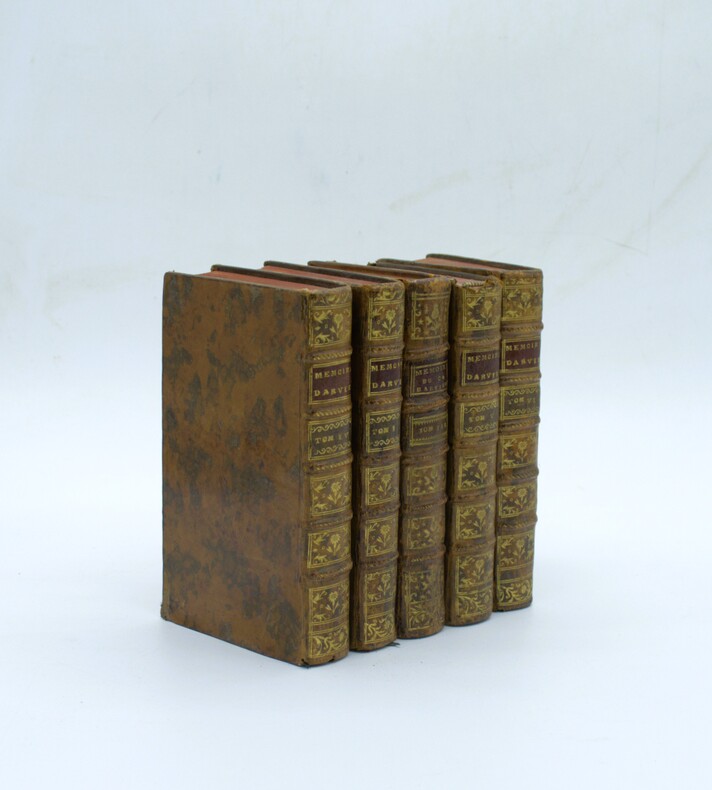
1735PHO-2306Paris, Charles J.-B. Delespine fils, 1735. 5 (6) volumes in-12 (17,5x9,5cm), T1(4), xvi, (2), 470 pp., (22). T3(6), 558 pp., (17). T4(6), 572 pp., (16). T5 (5), 613 pp., (15). T6 (4) 615 pp., (17), veau marbré, dos à nerfs orné avec pièce de titre et tomaison, tranches rouges (Reliure de l'époque), différence de fleurons au tome 3, coins usés, coiffe abimée T5, manque le tome 2
180923467Imprimerie Impériale | Paris 1809-1829 | 70 x 51.50 cm | une feuille
180923425Imprimerie Impériale | Paris 1809-1829 | 70 x 51.50 cm | une feuille
1977PHO-979Paris , Maisonneuve , 1977, 4 volumes in-4 , brochage éditeur , xxv-682pp-649pp-700pp-viii,676pp. , bon état
189669877Alfred Mame & fils | Tours 1896 | 26 x 35.50 cm | relié
43321Le Caire.1932.In-folio,cartonnage éditeur avec photo contre-collée.248 p.LXV planches. BE.Coins émoussés.Reliure usagée.
196179463Les Editions de Minuit | Paris 1961 | 14 x 22.50 cm | broché
184062125Louis Desessart | Paris 1840 | 13.50 x 22 cm | 2 volumes reliés