Bible in HebrewBiblio.com
HEBREW BIBLEBiblio.com
Biblia Hebraica secundum ultimam editionem Jos. Athiae a Johanne Leusden denuo recognitam recensita variisque notis Latinis illustrata ab Everardo van der Hooght V.D.M. Editio prima Americana sine punctis Masorethicis
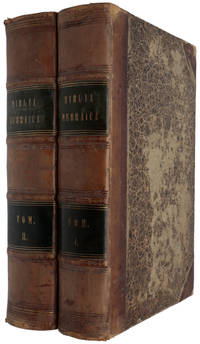
18146255Philadelphia: Printed by William Fry for Thomas Dobson 1814. First edition. <p>First edition of the first Hebrew Bible printed in America - this copy with the extremely rare inserted publisher's notice of February 1814 explaining the genesis of the edition a leaf that Goldman's bibliography of American Hebrew printing records in the Jewish Theological Seminary copy alone. Proposed in 1812 by Jonathan Horwitz an émigré newly arrived from Amsterdam with a font of Hebrew type the project passed early in 1813 to the publisher Thomas Dobson - already famous for the first American encyclopaedia - and the printer William Fry. The text reprints the great Amsterdam tradition of Athias Leusden and Van der Hooght whose 1705 edition was the received Hebrew text of the age printed here without vowel points and aimed at the Christian Hebraists of Harvard and Andover; American Jews continued to import pointed Bibles. It remained the only Hebrew Bible printed in America until Leeser's pointed edition of 1848. Bookseller's ticket of Talbot Watts New York dated March 1847.</p>. The Hebrew Bible Comes to America. <p>First edition of the first Hebrew Bible printed in America - the editio prima Americana of the sacred tongue of major importance in the field of American Judaica - this copy preserving the publisher's inserted notice of February 1814 recounting the genesis of the edition a leaf so rarely retained that Goldman's standard bibliography of American Hebrew printing records it in the Jewish Theological Seminary copy alone and omits it from the collation of the edition. Until these two octavo volumes left William Fry's Philadelphia press no complete biblical text in Hebrew had ever issued from an American press: congregations and colleges alike read from Bibles carried or ordered across the Atlantic. Their publication was the most ambitious Hebrew typesetting yet attempted in the United States and a measure of the standing Hebrew learning held in the early republic - a symbolic weight out of all proportion to the number of its readers. Abraham Karp surveying the Judaic treasures of the Library of Congress singled out the inserted notice as the key document of the edition's history found 'in some of the first copies of the first volume off the press'; the present set is one of the very few in which that first-state leaf escaped the binder's discard. Only one other copy described with the notice has been traced in auction records Philadelphia 2024.</p> <br /> <p>The notice itself dated February 1814 and printed on a single inserted leaf compresses the whole story of the enterprise into four paragraphs. In 1812 Jonathan Horwitz had proposed an edition of the Hebrew Bible 'the first proposal of the kind ever offered in the United States'; clergymen of standing endorsed the undertaking and subscriptions were gathered. Early in 1813 Horwitz transferred his rights and his subscriber list to Thomas Dobson who now reported the first volume published and the second well advanced. The publisher then turned his readers into proof-correctors: gentlemen of learning into whose hands the volume might come were entreated to note typographical errors and transmit their lists to Dobson in Philadelphia so that an accurate table of errata might be printed at the close of the work - a table which the collations of recorded copies suggest was never executed. A final line explains both the leaf's function and its disappearance: the title pages and preface would be furnished with the second volume. The earliest purchasers therefore received volume one as a bare text block this notice standing in for the missing preliminaries; when the second volume appeared with the title leaves and Van der Hooght's preface binders bound the proper preliminaries in and discarded the now-superfluous notice. The variable placement of those preliminaries among recorded copies - the four preface leaves stand at the front of the second volume in another documented set at the front of the first in the present one - is itself a fossil of this two-stage issue. The notice's survival here bound after the first title with the prefatory selections following marks the present set as one assembled from the first copies issued and fixes a terminus for its earliest American owner.</p> <br /> <p>Behind the notice lies a publishing race conducted in the newspapers of two cities. Jonathan Horwitz d. 1852 a Jewish émigré recently arrived from Amsterdam brought with him a font of Hebrew type and the conviction that the United States was ready for its own Hebrew Bible. He was nearly right and nearly first: the New York theological booksellers Whiting & Watson announced a rival Hebrew Bible under the patronage of the Theological Seminary at Andover; the missionary leaders John M. Mason and James McFarlane stood ready to enter the field; and in London Joseph Samuel C. F. Frey - the converted president of the London Society for Promoting Christianity Amongst the Jews - had in 1812 already published the first volume of a vocalized Hebrew Bible for the English-speaking world with rumours that he would cross the Atlantic to distribute it. Horwitz counter-attacked in the New York Evening Post of 16 January 1813 declaring that Harvard College and the Andover Theological Institution patronised his edition and had subscribed for forty copies each. Within weeks however he chose security over glory: he sold his Hebrew type to the printer William Fry made over his publication rights and subscriber list to Dobson and enrolled in the medical department of the University of Pennsylvania taking his M.D. in 1815. He practised medicine for the rest of his life marrying into the family of Haym Salomon the Jewish financier of the Revolution; his son Phineas rose to head the United States Navy's Bureau of Medicine. The Whiting & Watson Bible never appeared.</p> <br /> <p>The men who carried the project to completion were two of the most substantial figures in the Philadelphia book trade. Thomas Dobson 1751-1823 Scottish-born and Philadelphia-established from 1785 had already accomplished the most audacious publishing feat of the young republic: Dobson's Encyclopaedia 1789-1798 the first encyclopaedia published in the United States eighteen quarto volumes re-edited from the third Encyclopaedia Britannica with George Washington among the subscribers. His shop at 41 South Second Street was known simply as the Stone House and the Bible's title page Latinises the address into the imprint: edita ex aedibus lapideis. William Fry a printer praised for the accuracy of his presswork - his former partnership of Fry & Kammerer had printed the elegant 1809 specimen of Binny & Ronaldson the first permanent type foundry in the United States - executed the Hebrew text with the font acquired from Horwitz. Horwitz's prospectus had promised a new pica Hebrew to be cast for the purpose at the Binny & Ronaldson foundry but the type Fry actually employed appears to have been the Amsterdam font Horwitz had carried across the Atlantic: the foundry's surviving papers record only the freight on a parcel of Hebrew type shipped into Philadelphia in 1813 and every contemporary account of the project has Horwitz selling his own font to Fry. The Hebrew of the first American Bible was thus fittingly Dutch metal - cast in the same typographic culture that had produced the very editions the text reproduces. The choice of so compact a programme - the bare consonantal text without the apparatus of points and accents - kept the undertaking within the powers of a shop that had never before set a Hebrew book and the result is remarkably clean: the printer allowed himself a single flourish closing the first volume with the note Placuit Typographo has Deo agere gratias in fine hujus Tomi ex Jes. 40:29 - it pleased the typographer to give thanks to God at the end of the volume in the words of Isaiah.</p> <br /> <p>The text the Philadelphians chose was the most authoritative available anywhere: the Amsterdam tradition running from Joseph Athias through Everardus van der Hooght. Athias c. 1635-1700 the great Sephardic printer of Amsterdam produced in 1659-61 the first Hebrew Bible with numbered verses its proofs read by Johannes Leusden professor of Hebrew at Utrecht; on its completion Athias was admitted to the Amsterdam printers' guild an unprecedented honour for a Jew and the improved second edition of 1667 won him a gold chain and medal from the States General of the Dutch Republic. Long regarded as the most accurate Hebrew text in print the Athias-Leusden Bible became the foundation of virtually all subsequent editions. Everardus van der Hooght 1642-1716 a Dutch Reformed minister - the V.D.M. of the title page - corrected it once more for his Amsterdam and Utrecht edition of 1705 working not from manuscripts but from the printed tradition checked against the Masorah and prized above all for the exceptional clarity of its type. Van der Hooght's became the de facto received text of the Hebrew Bible for a century and a half: Houbigant Kennicott Hahn and Letteris all took it as their base as did the Bible Society editions of the nineteenth century. The 1814 Philadelphia edition declares this lineage on its title page and retains the essentials of Van der Hooght's apparatus in selection: four preliminary leaves headed Everardi van der Hooght ex praefatione selectae in hac editione retentae the Latin marginal annotations keyed to the text and the Masoretic verse-count summaries at the close of each biblical book with their mnemonic signs expounded in Latin notes.</p> <br /> <p>The two volumes carry the traditional tripartite Bible whole. The retained preface opens by expounding the division the volumes follow: the Torah or Law in its five books; the Prophets former and latter from Joshua to the Twelve; and the Hagiographa Psalms to Chronicles with the five scrolls read publicly at the festivals of the synagogue year. Divisional titles in Hebrew and Latin mark the great sections - Prophetae Posteriores announces Isaiah Jeremiah Ezekiel and the Twelve on a separate leaf - and each book runs under bilingual headlines the chapters numbered in roman and in Hebrew letters the text set in single column with Van der Hooght's Latin apparatus in the margins. At the end of each book the Masoretic colophons are reproduced and explicated: the close of Kings gives the count of 1534 verses with its mnemonic the close of Chronicles - and of the whole Bible - the count of 1656 each Hebrew letter-numeral resolved into figures in the Latin notes. These terminal apparatus pages easy to mistake for printer's ornament are in fact the working machinery of textual integrity that the Masoretes had built and Van der Hooght transmitted: a self-auditing text carried intact into the New World.</p> <br /> <p>One deliberate omission defined the edition's audience and its fate. As the title page announces the text is printed sine punctis Masorethicis - without the vowel points and cantillation marks of the Masoretic apparatus. Pointed Hebrew composition in which every consonant carries superimposed and subjacent sorts was beyond the capacity and the budget of the project; the unpointed text halved the difficulty of the typesetting at the cost of presupposing readers who could vocalise Hebrew for themselves - for the points are not ornament but the entire vocalisation tradition of the text fixed by the Masoretes of Tiberias and a bare consonantal page demands that the reader supply from memory what the apparatus would otherwise dictate. The practical consequence was that the first American Hebrew Bible was of limited use to American Jews: a text without points cannot serve the synagogue lectern or the elementary schoolroom and Jewish communities continued to import pointed Bibles from Europe. The book was aimed instead at the Gentile scholars ministers and seminarians whose institutions had subscribed for it - the constituency of the great religious revival then transforming American Protestantism which had made the recovery of the biblical languages an urgent devotional project. The edition thus occupies a curious position in Jewish book history: a Hebrew Bible produced in a land of Jewish refuge initiated by a Jewish immigrant and yet calculated for Christian use - a precise mirror of the state of Hebrew learning in the early republic.</p> <br /> <p>American Hebraism had deep roots but before 1814 almost no Hebrew press to show for it. Judah Monis's Grammar of the Hebrew Tongue Boston 1735 the first book printed in America with substantial Hebrew text had required type procured from London; Monis taught Hebrew at Harvard for nearly forty years and his grammar served as the College's required text. Hebrew figured in commencement exercises at Harvard Yale and Columbia; Ezra Stiles president of Yale made it a personal devotion. The founding of the Theological Seminary at Andover in 1808 institutionalised the revival of biblical philology and in 1813 the year Horwitz surrendered his project Andover's Moses Stuart published the first Hebrew grammar of the independent United States - finding no compositor equal to the task he set much of the Hebrew himself. A legend that the revolutionary generation had considered replacing English with Hebrew as the national language - traced by Shalom Goldman to a passing remark of the Marquis de Chastellux inflated by mocking British reviewers - has no documentary basis but its long circulation testifies to the symbolic standing the sacred tongue enjoyed in a republic that read itself as a new Israel. It was this climate - colleges teaching Hebrew seminaries multiplying a reading clergy hungry for the text in its original - that made a two-volume Hebrew Bible a plausible commercial venture in a country of perhaps three thousand Jews.</p> <br /> <p>Contemporary reception bore out both the promise and the irony. Karp observed that the appearance of a Hebrew work bearing the approbation of leading Christian clergymen and leading Jews alike marked the beginning of a friendlier intellectual discourse between the two communities - a discourse conducted warily since several of the divines most active in promoting Hebrew study were also active missionaries and Frey's conversionist society stood behind the rival London Bible. The standing of the edition among Jewish readers is caught a generation later in the letter of Rabbi Sabato Morais of Philadelphia printed by John Wright in Early Bibles of America: the edition was good the annotations helpful and copious. The endorsement carries its own quiet symmetry - Morais Leeser's successor at Mikveh Israel was a founder of the Jewish Theological Seminary the institution in whose library the one leaf-bearing copy recorded by Goldman now rests. The political setting sharpens the point: at the time of printing fewer than half of the original states extended full political equality to their Jewish citizens. The first Hebrew Bible printed in America thus appeared into a republic that honoured the language of Israel while still hedging the rights of Israelites - and the book itself passing between Jewish projector and Gentile publisher between seminary subscribers and synagogue importers embodies that unresolved moment.</p> <br /> <p>The edition kept its primacy for a generation. No second printing followed; Fry's Hebrew font surfaced only in smaller Philadelphia work; and the next complete Hebrew Bible printed in America - the first with vowel points - came only in 1848 when Isaac Leeser hazzan of Mikveh Israel in Philadelphia and the dominant figure of antebellum American Jewish letters produced his pointed Biblia Hebraica with the Episcopalian Hebraist Joseph Jaquett its Latin introduction dated September of that year. For thirty-four years the Dobson-Fry edition stood alone the only Hebrew Bible printed in America; every American who studied the Scriptures in their original from an American-printed book studied it from these sheets. Bibliographically the edition is anchored in every standard apparatus of the field - Rosenbach's pioneering American Jewish Bibliography Singerman's Judaica Americana Goldman's Hebrew Printing in America Darlow & Moule's catalogue of printed Scripture - and it is one of the few American books of its decade to have earned a separate bibliographical study Vaxer's account in the Journal of Jewish Bibliography for 1940.</p> <br /> <p>Sets of the Bible itself though held by the major Judaica collections - the Library of Congress and the Jewish Theological Seminary among them - appear on the market only at intervals: a recent cataloguer could count just five sets at auction in the preceding decade. The February 1814 notice is of another order of rarity altogether. The leaf was ephemeral by design superseded by the very preliminaries it promised and the bibliographers' collations treat it as a supernumerary survival rather than a constituent of the edition: Goldman's census-level note - locating the leaf in the Jewish Theological Seminary's Karp copy alone among the copies he recorded - remains the standard statement of its scarcity and the single auction copy described with the notice together with the present set brings the number of traceable examples to a small handful. For a collector of American Judaica the distinction is decisive: with the notice the set is not merely the first Hebrew Bible printed in America but a first-state copy carrying the edition's own birth certificate - the document from which every account of the book's genesis from Wright in 1894 to Karp in 1991 ultimately derives.</p> <br /> <p>An early trace of the set's American life survives on the front pastedown of the first volume: the printed ticket of Talbot Watts 'The Cheapest Store in the World' for books prints and oil paintings at 102 Nassau Street New York dated March 1847. Doggett's city directory for 1846-47 lists Watts as an agent for books and paintings at that address in the heart of the Nassau Street quarter that was already New York's second-hand book row; his ticket places the volumes in the New York trade barely a generation after publication circulating among the city's collectors and curiosity buyers while Leeser's pointed Bible was still in preparation.</p> <br /> <p>The two volumes close a circle in the history of the Hebrew book: a text perfected in seventeenth-century Amsterdam by Athias and Van der Hooght carried across the Atlantic in a font of type by an Amsterdam Jew and reborn in Philadelphia as the young republic's first Scripture printed in the original tongue. The line they opened runs forward through Leeser's pointed Biblia Hebraica of 1848 to the whole subsequent tradition of American Jewish Bible publishing and backward to Monis's lonely Harvard grammar of 1735 - the two poles between which this edition stands as the decisive event. Few books document so compactly the moment the Hebrew Bible came to America: the race of projectors fought out in the newspapers the immigrant's font of Dutch type the Stone House imprint rendered into Latin and in the copies issued first a printed leaf asking the learned gentlemen of a young republic to help perfect the word.</p> <br /> <br /> References:<br /> Goldman Hebrew Printing in America 4 - Rosenbach An American Jewish Bibliography 171 - Singerman Judaica Americana 236 - Darlow & Moule 5168a - Shaw & Shoemaker 30857 - O'Callaghan American Bibles 1814:8 - Wright Early Bibles of America 3rd ed. 1894 pp. 122-24 - Wolf & Whiteman The History of the Jews of Philadelphia p. 306 - M. Vaxer 'The First Hebrew Bible Printed in America' Journal of Jewish Bibliography II 1940 pp. 20-26 - A.J. Karp From the Ends of the Earth: Judaic Treasures of the Library of Congress Washington 1991 pp. 291-92 - S. Goldman God's Sacred Tongue: Hebrew and the American Imagination Chapel Hill 2004 - R.D. Arner Dobson's Encyclopaedia Philadelphia 1991.<br /> <br/> <br/> <p>Two vols. 8vo 221 × 139 mm ff. 6 296; 2 312 titles to both volumes dated 1814; the first volume with the inserted publisher's notice dated February 1814 and the four leaves of selections from Van der Hooght's Latin preface bound after the title. Contemporary American half calf over marbled boards smooth spines ruled in gilt with black lettering-pieces 'Biblia Hebraica' 'Tom. I'/'Tom. II'; binding moderately rubbed with loss of leather at the corners and some chipping at the spine ends; scattered foxing and some marginal staining the text generally clean. Printed ticket of Talbot Watts bookseller 102 Nassau Street New York dated March 1847 on the front pastedown of vol. I. Preserved in a custom cloth case with gilt-lettered morocco back.</p> . Printed by William Fry for Thomas Dobson unknown
SOPHIA RARE BOOKS · Danemark18 000,00 $US≈ 15 229,80 €