2 965 résultats
Non précisé. Non daté. In-8 Carré. Relié. Etat d'usage. Couv. convenable. Mors fendus. Intérieur acceptable. Paginé de 992 à 1384. Texte en hébreu, sens de lecture droite-gauche. Couverture muette. Etiquette de code sur la couverture. Quelques tampons et annotations de bibliothèque. Des Psaumes (Psalmi) aux Livres des Chroniques (Chronica, I, II).
RO40251158Non précisé. Non daté. In-8. Relié demi-cuir. Etat passable, Plats abîmés, Dos abîmé, Mouillures. Paginé de 994 à 1392 + env. 20 pages. Texte en hébreu (sens de lecture droite-gauche). Tranche rouge. Dos manquant. Plats frottés. Quelques tampons de bibliothèque. Quelques annotations dans le texte .. . . . Classification Dewey : 492.4-Hébreu
Non précisé. Non daté. In-8 Carré. Relié demi-cuir. Etat passable. Couv. légèrement passée. Dos abîmé. Quelques rousseurs. Paginé de 994 à 1392 + env. 20 pages. Texte en hébreu (sens de lecture droite-gauche). Tranche rouge. Dos manquant. Plats frottés. Quelques tampons de bibliothèque. Quelques annotations dans le texte. Psalmi. Proverbia. Iob. Cant. Cantic. Ruth. Threni. Ecclesiastes. Esther. Daniel. Ezra. Nehemia. Chronica.
IN HEBREW WITH ENGLISH FOREWORD. THREE VOLUME SET. [ALL VOLUMES]: 24.5x17 cm. [439+IX]+[477]+[538] pages. Hardcover. Ex-Library copy with the usual marks. Pages slightly yellowing. Else in good condition. PLEASE NOTE: This item is overweight. We may ask for extra shipping costs.
IN HEBREW. 23.5x16 cm. 12+334 pages. Hardcover. In good condition.
Vol. 2-3. In Hebrew. Gilt hardcover. Cover slightly faded and stained. Cover corners and edges slightly bumped. Spine slightly bumped and worn. Spine edges slightly bumped. Else in good condition.
IN HEBREW. 5 VOLUMES IN THREE BOOKS [VOLUMES 2-3; 4-5 BOUND TOGETHER]. SIGNED BY EDITOR. 175x245 mm. [156]+[327]+[376] pages. [ALL VOLUMES]: Gilt hardcover. [VOL. I]: Cover corners bumped. Spine edges bumped. Spine edges bumped. Sticker on first white page. [VOL.IV-V]: Cover corners and edges bumped. [SUMMARY]: Else all volumes in good condition.
8vo. 80 pages. In Hebrew. SUBJECT (S) : Poetry, Hebrew. Feinstein (1895-1986) was an American Orthodox rabbi. He was born in Belorussia and was a rabbi there until he emigrated to the U. S. In 1937. In New York he headed the successful Metivta Tiferet Jerusalem yeshiva. After WWII, and the death of Aaron Kotler, Feinstein became the leader of American Orthodoxy. "While he did address broader, communal issues throughout his lifetime, his major impact was in the realm of Halakhah. His reputation grew rapidly to the point that his rulings were accepted as authoritative by Orthodox Jews throughout the world. " When he died in 1986, more than 150.000 people attended his funeral. (EJ, 2007) Has tanned dust jacket. Gilt title on front and spine. Very good condition. (HebLit-6-7)
Original blue boards and blue dust jacket. 8vo. 324 pages. Title page in Hebrew on verso. Inscription in Hebrew. In Hebrew. This book, written in Hebrew, consists of studies and documents relating to the writings and scholarship of various American pioneers in the creation of Hebrew literature, including Zeev Wolf Schorr and Gerson Rosenzweig, among others. Authors, Hebrew -- United States. Named Person: Sobel, Jacob Zevi. Gersoni, Henry, 1844-1897. Schur, William, 1839-1910. Rosenzweig, Gershon, 1861-1914. Rabinowitz, Isaac, 1846-1900. Title on added title page. : Pioneers of American Hebrew literature. Includes bibliographical references and index. Minimal edgewear to dust jacket. Slight toning. Very minimal markings. Very good condition. (AM-4-1)
EXTREMELY RARE TWO VOLUME SET of a lexicon for the language of the Talmud, Targums and other Rabbinic literature, based on the famous 12th century compilation by R. Nathan of Rome, with supplement volume of additions not found in Rabbi Nathan's and other similar compilations. [BOTH VOLUMES]: 648 pages. Text block edges dyed blue. Ex-library copy. Pages yellowing and wavy. [MAIN VOLUME]: 205x140mm. [114]+[116] double pages (altogether 460 pages). Black cloth rebound Hardcover. Silver pen writing on spine. Stamps on title pages. Pen marks on title page of the lexicon's second part. [SUPPLEMENT VOLUME]: 192x127mm. [78]+[16] double pages (altogether 188 pages). Marbled board Hardcover. Cover rubbed and worn. Cover edges and corners bumped and worn/peeling. Spine mostly missing (binding is intact). 2 small stickers on front cover upper corner near spine. Rear cover corners near spine peeling. Front cover bottom edge detached from binding. Inner cover, first and last page stained. Pen writing on front whitepage upper corner and German title page bottom corner. Blue pencil writing and stamp on German title page verso. Small stamp on Hebrew title page and last page. Small stain on edge of two pages - no damage to text. [SUMMARY]: This extremely rare 2 volume lexicon of Rabbinic literature has suffered some damage to the supplementary volume's cover (the main volume is in good condition), but otherwise is in good condition.
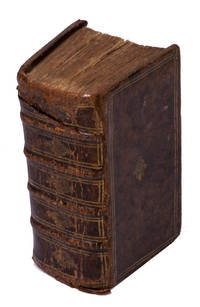
161018174Leiden 1610. 24mo in 8s 11 x 6 cm. Franciscus II Raphelengius Gold-tooled mottled calf ca. 1720 sewn on 4 cords each board with a small central flower ornament and a frame of double fillets the spine with a lozenge ornament in each of the 5 compartments a roll on each raised band and at the head and foot and further double fillets gold-tooled board edges mottled edges. With 4 letterpress title-pages for the Pentateuch early prophets major and minor prophets and Psalms etc. and decorations built up from arabesque typographic ornaments. Set in sephardic meruba Hebrew types unpointed with the imprints in semi-cursive rabbinical but the place of publication in meruba. 4 volumes bound as 1. 264; 227 1 blank; 238 2 blank; 287 1 blank pp. vols. 1-2 with arabic numerals 3-4 with Hebrew. A pocket-sized edition of the Hebrew Old Testament in four volumes volume 1 containing the Pentateuch or Torah volume 2 the early prophets Joshua Judges Samuel Kings volume 3 the later major Isaiah Jeremiah Ezekiel and minor prophets and volume 4 the Psalms Job Song of songs Ruth Lamentations Ecclesiastes Esther Daniel Ezra and Chronicles. It was produced by Franciscus II Raphelengius grandson of Christoffel Plantin and son of one of Europe's first great Hebrew scholars Plantin's son-in-law Franciscus I Raphelengius 1539-1597 who helped prepare Plantin's magnificent 1572 Polyglot Bible succeeded to the Leiden branch of Plantin's printing office and became professor of Hebrew at Leiden University. Plantin himself had produced the Dutch Republic's first Hebrew book there in 1585 and Raphelengius produced many more beginning in 1588.With occasional very minor foxing or faint discolouration but otherwise in very good condition. The spine and joints are worn with superficial cracks a repair at the head and a small tear at the foot and the sewing is slightly loose. A charming little Hebrew Bible from the first Dutch printing office to produce Hebrew books.l aleph.nli.org.il 001366023 4 copies; Darlow & Moule 5114; Fuks 25 2 copies; Steinschneider 386; WorldCat 8 or 9 copies. ABE CAT Bibles Sermons & Psalmbooks unknown
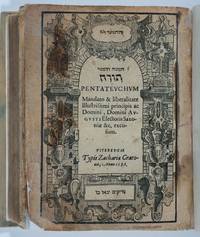
158653478Wittenberg: Zacharias Crato Krafft 1586. First edition. Hardcover. Very Good. Four parts quarto published between 1586 and 1587. Register continuous through parts 1 and 2; separate registers for parts 3 and 4. Collation in 4s: 1-65 blank 33.4; 1-30 lacks blank 30.4; 1-32 lacks 32.4 colophon. 506 leaves. Title within elaborate woodcut borders. Single-column text in vocalized Hebrew with cantillation; printed side-glosses. Separate Hebrew half-titles within woodcut borders for the latter three parts Former Prophets; Later Prophets; Hagiographa; names of the biblical books set in large font within woodcut cartouches. Later vellum. Title and following three leaves with marginal reinforcement slight text loss. Occasional mild embrowning else very good with bright half-titles. <br /> <br /> First Wittenberg edition of the complete Hebrew Scriptures with a concluding list of Haftaroth readings noting the Ashkenazi and Sefardi variations. Our copy is the variant with Hebrew and Latin title. A majority of the few surviving copies are bound with a Hebrew title and the publisher's information is taken from the colophon which provides a Jewish calendar date of 5347 = 1587. Vinograd notes that individual books and sections of the Hebrew Bible had been printed at Wittenberg since a quarto edition of the prophet Obadiah appeared in 1521. The title-page designs were re-used in the Hebrew bible published at Frankfurt am Oder in 1595. Each book closes with the Masora Finales printed in square type.<br /> <br /> Andreas Masch notes in his revised edition of Le Long's Bibliotheca Sacra 1778: "This edition of the Hebrew Bible is so rare and infrequent that it was omitted in the earlier edition of Le Long's work at Paris but it is known to Wolffius Bibliotheca Hebraea not in its entirety but only in respect of certain parts." One can speculate as to why the edition is rare but it may be worth noting that "when Hans and Friedrich Hartmann decided to start producing Hebraica in an effort to become the official printer for the univeristy of Frankfurt/Oder they were able to do so relatively quickly by hiring away five experienced workmen from Zacharias Croto's Wittenberg firm which was having financial difficulties" Burnett.<br /> <br /> Masch continues: "At the colophon is noted the year and the name of those at whose expense this Hebrew Bible was published: colophon info in Heb. and Latin The above example is therefore attributed to the liberality of the prince and to the expense of the two citizens of Wittenberg But the Rühilii brothers were not correctors of the work but citizens and senators of Witteberg whose name is quite famous in the history of the Germanic Bibles. The work came from the workshop of Zacharias Craton otherwise known as Kraft to whom we owe several editions of German Bibles. The title in both copies represents a gate in which above and below Ps. 118 com. 20. is printed. In accordance with the first Plantin edition the text was printed so as to match nearly page-for-page. It is composed of four parts with the five festival books added to the Pentateuch; but each part is decorated with a special title." Full title: חמשה חומשי תורה Pentateuchum mandato & liberalitate illustrissimi principis ac Domini Domini Augusti Electoris Saxoniae. Vitebergae: Typis Zacharia Cratonis Anno 1586. alternate Hebrew title: חמשה חומשי תורה × ×“×¤×¡ ×¢× ×¨×‘ העיון על ידי זכריה כר×טו.<br /> <br /> References: Benzing Buchdrucker 16/17 p. 471; Le Long/Masch I 1778 pp. 33-34; Steinschneider 277; VD16 ZV 29818 quarto; Vinograd 21. Not in: Adams; Darlow & Moule; Delaveau & Hillard. Cf. Burnett Christian Hebraism in the Reformation Era p. 204. Zacharias Crato [Krafft] hardcover
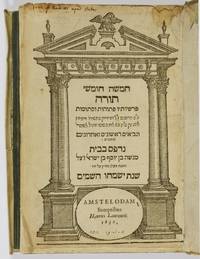
163155459Amsterdam: printed by Menasseh ben Israel for Henricus Laurentius 1631. First edition. Hardcover. Very good-. Octavo 16.8 by 11.4 cm. Collation: aleph-lamed-zayin8 = 296 leaves. 612 i.e. 592 pp: p. 464 erroneously numbered 484 465 as 485 and so on throughout. Two column text in unvocalized Hebrew; every fifth verse numbered in the margin. Title within architectural border; half titles with letterpress ornamentation for the Former and Latter Prophets. Contemporary vellumwith exposed thongs edges stained blue; yapp fore-edges; front joint cracked but holding strong. Intermittent light toning to text outmost leaves a bit more darkened; very occasional small stains. Title-page slighltly trimmed 4 mm at bottom edge; expert marginal repairs at bottom corners of 2 leaves; 1 leaf re-margined at fore-edge with no loss of text else a very good copy with crisp clean text.<br /> <br /> First Hebrew Bible published in Amsterdam printed by the rabbi diplomat publisher and religious thinker Menasseh ben Israel 1604-1657 one of the most distinguished members of the Portuguese Jewish community of Amsterdam and the first Jewish printer in the Northern Netherlands. The Amsterdam printer and publisher Hendrick Laurensz Lauretius provided the financing for this edition along with two other Bible editions and two editions of the Hebrew Psalms printed by Menasseh between 1631 and 1646. "These publications were not only made for the local market but mainly for international trade. Thanks to this financial help Menasseh was able to organize his printing office in a more professional way" Fuks hiring a Jewish compositor Judah Leb ben Mordecai Gimple from Posen and a gentile compositor Bartholomeus Laurensz. <br /> <br /> The printing activity of Menasseh was especially important in the steadily growing productions of the Hebrew press in the Northern Netherlands. Fulfilling the needs of the Sephardic community for Jewish ritual texts eliminated the need for expensive imports from Venice and Poland. Menasseh undersood that the relatively cheap paper and tools available in Amsterdam made it possible to compete in quality and prices with the Hebrew presses of Poland Italy and Basel. "Gentile publishers and booksellers in Amsterdam such as Jansonius and Laurentius were quick to see the opportunity of the opening Eastern European market and financed several of Menasseh's publications" Fuks. Menasseh was the first to introduce in the Netherlands waybertaytsch types for Yiddish publications along with illustrated Hebrew books. He was also the first Jewish printer to adopt the Dutch pocket-book format made famous by the Elzeviers.<br /> <br /> Notes on publication date and issue: The title is dated 1630 in Arabic numerals; the colophon notes the date of completion in Hebrew characters as 5 Adar 5391 = 7 February 1631 along with the printer's apology for being unable to provide the index of pericopes promised on the title-page due to lack of printing material. Darlow and Moule describe this issue as Variant A with a Latin imprint appearing in the cartouche beneath the Hebrew title.<br /> <br /> Provenance and annotations: early entry in brown ink at front paste-down with short Greek inscription Theos. dated 1700; old Latin inscription in black ink at top margin title in reference to Hebrew roots; date of 1812 beside Yiddish entry penned in black ink within imprint cartouche at title; old entry in German penned in black ink at verso title beneath which is an oval cartouche in imitation of the one at the title in which an owner has penned in black ink the Hebrew imprint information regarding Hendrick Laurensz as it would appear in the Varient B issue; old library shelf marks at rear paste-down; recent owner entry in blue ink in Hebrew at front paste-down. References: Darlow and Moule 5123a; Fuks/Fuks-Mansfeld no. 152; pp. 105; 111f.; Steinschneider no. 453; Vinograd Amsterdam 22.<br /> <br /> Full title and imprint: חמשה חומשי תורה פרשיותיו פתוחות וסתומות ×¢"פ ×”×¨×ž×‘× ×–"ל ומדוייק בחסירו' ויתרות להעתק ס"ת ×¢× ×œ×•×— בסופו מועיל לסופרי' ×•× ×‘×™××™× ×¨××©×•× ×™× ×•××—×¨×•× ×™× ×•×›×ª×•×‘×™×: × ×“×¤×¡ בבית ×ž× ×©×” בן ישר×ל ז׳׳צל והוגה בעיון × ×ž×¨×¥ על ידו ×©× ×ª ישמחו השמי×<br /> Amstelodami sumptibus Henrici Laurentii 1630. printed by Menasseh ben Israel for Henricus Laurentius hardcover
Folio. 480 pages. In Hebrew and German. Illustrated. First edition. SUBJECT (S) : Bible. SERIES: Illustrirte Pracht-Bibel, ; 1-60 in 4's; OCLC lists 1 copy worldwide (Columbia Univ) . Binding repaired, lacks backstrip (spine covering) , edges of some pages chipped and have tape on them, pages yellowed, a little foxing on edges, otherwise good condition. (GER-20-24)
215X150mm. 896 pages. Gilt hardcover. Cover slightly rubbed. Cover corners bumped and rubbed. Spine bumped and worn. Pages yellowing. Else in good condition.
201652057Leiden: Brill 2016. First edition. Hardcover. Fine. Octavo. 8 254pp. Index and 15 page bibliography. Blue spine lettered in white over color photo boards. Illustrated with a frontispiece photo and 4 text photo. A fine as new copy.<br /> <br /> In Haredi Masculinities between the Yeshiva the Army Work and Politics: The Sage the Warrior and the Entrepreneur Hakak takes us on a fascinating journey into the world of young Haredi men who dare to leave Jewish Haredi religious seminaries Yeshivas and Kollels and explore new territories. Through extensive participant observations in a Haredi army basic training course an occupational training program in Hi-Tech professions and the Haredi Headquarter of the Likud Party Hakak explores the interactions between young Haredi men and the cultural and masculine models they meet in these new sites. Hakak’s observations expose the varying ways in which Haredi masculinities are being re-shaped through such interactions and how this is impacting the Haredi minority and Israeli society more broadly. <br /> <br /> Contents: 1. Masculinity youth and the haredi minority in Israel -- 2. From the army of God to the Israeli armed forces -- 3. Between the holy and the practical: young haredi men acquire a profession -- 4. Journey into the meanders of Israeli politics: haredi men in the Likud Party -- 5. Filmed on a weekday -- 6. From the world of Torah to the heart of Israeli society: concluding discussion. <br /> <br /> Volume 27 of the Brill series "Jewish Identities in a Changing World. Brill hardcover
22x13.5 cm. 28+180 pages. Hardcover with dust jacket. Bottom of cover and spine are slightly rubbed. Edges of book are slightly dirty. Pages are slightly yellowing. Else in good condition.
(FT) 8vo. 59 pages. In Hebrew. Second edition. SUBJECT(S) : Jews - Jerusalem - history -- 17th century; Jerusalem - history; Governors - Jerusalem - biography; Muhammed ibn Farrukh, fl. 1635; Jerusalem - ethnic relations. OCLC lists 10 copies worldwide. Rivlin (1889-1942) was an "historian and journalist in Erez Israel. Rivlin was born in Jerusalem into one of its old established families. He went into business and then became the secretary of the United Old Age Home in Jerusalem. As a young man, he became a correspondent for the New York Yiddish paper, Morning Journal, and also published studies on the history of Jewish settlement in Erez Israel, Jerusalem in particular, and in neighboring countries. In this field, Rivlin's major achievement was his revised and enlarged edition of Aryeh Leib Frumkin's Toledot Hakhmei Yerushalayim 1490-1870, which he expanded into a history of all Jewish settlement in Erez Israel. Rivlin also published selections from the Pentateuch commentary by the 16th-century Jerusalem rabbi and physician Raphael Mordecai Malkhi, Likkutim mi-Perush ha-Torah shel R. M. Malkhi; a biography of Joseph Sundel Salant; a new edition of the 17th-century work on Jerusalem, Horvot Yerushalayim; and Sefer ha-Yahas le-Mishpahat Rivlin u-Mishpahat ha-Gra mi-Vilna. His collection of material on Erez Israel in the responsa literature remained unpublished. " (2007, EJ) Ex library. Pages tanned, good condition. (HebLit-4-4)
Stapled Paper, 4to (8-1/2 x 11), 2 leaves (single-sided) per issue. 28 cm. Generally weekly or bi-weekly. Mimeograph. Nazi Period. Lists books of interest to Jews with prices and 1 sentence annotations. Ceased publication with v. 4, no. 15/17 (Apr. 29, 1937); In part a supplement to Hasid's index to periodicals and booklist. OCLC lists 4 institutions with holdings (Harvard, Yale, Tulane, Duke), but does not indicate the extent of those holdings. SUBJECT(S): Jews -- Bibliography -- Periodicals. Some wear, paper good, Good Condition. (CT-13)
IN HEBREW. 245x155 mm. 246+VII pages. Hardcover with slipcase. In good condition.
ria9781906764708_inpHardback. New. New Book; Fast Shipping from UK; Not signed; Not First Edition; The Habad school of hasidism is distinguished todayfrom other hasidic groups by its famous emphasis on outreach on messianism andon empowering women. This book presents an in-depthstudy of an intriguing movement which takes traditiona hardcover
(FT) Hardcover, 12mo, 58 pages. In Hebrew. SUBJECT(S) : Jews -- History. Lehmann (1831-1890) was a German Orthodox rabbi, scholar, and writer. Lehmann was born in Verden, Germany, and studied with Israel Hildesheimer in Halberstadt, with S. L. Rapoport in Prague, and at Halle. In Prague he was friendly with the writer Solomon Kohn, who may have influenced Lehmanns future work as a writer. In 1853 an organ was introduced in the synagogue of Mainz and in 1854, when the Orthodox members formed a separate congregation, Lehmann was elected their rabbi and, eventually, one of the leaders and spokesmen of modern German Orthodoxy. In Mainz he founded a religious school which from 1859 was an elementary day school for boys and girls. Lehmann wrote polemically against Reform and founded the weekly Israelit to counter the influence of Ludwig Philippsons Reform periodical, Allgemeine Zeitung des Judentums; the Israelit became the principal voice of German Orthodoxy. Lehmann was the main contributor to the Israelit and his many historical novels, including Rabbi Joselmann von Rosheim, and short stories were first published in it. His stories were collected in Aus Vergangenheit und Gegenwart, and many were translated or adapted into Hebrew, Judeo-Arabic, French, Hungarian, English, and other languages. Lehmanns stories have no great literary merit, but as juvenile literature, they have religious and educational value. Of more scholarly importance, though also primarily intended for popular instruction, are his German edition of the Haggadah, anonymously revised and enlarged by H. Ehrmann and translated into English, and his Sabbath lectures on Avot, collected as Die Sprueche der Vaeter in which Lehmann made use of earlier commentators, particularly of Samuel b. Isaacs Midrash Shemuel, and thus made the commentators accessible to the German reader. Lehmann also published the tractate Berakhot of the Jerusalem Talmud with the commentary of Solomon Sirillo and his own notes, Meir Nativ. Lehmann translated the Pentateuch in the Bible translation initiated by the Orthodox Bible Institute to counter the translation of Zunz and others. As editor of the Israelit, Lehmann agreed increasingly with S. R. Hirschs intransigent line in Hirschs differences with Hildesheimer, Lehmanns friend and teacher (Rothschild in EJ, 2007) . OCLC lists 1 copy worldwide (Brandeis) . Ex-library with markings. Staining on title page. Brown edges. Hinge repair. Wear to cover corners. Otherwise very good condition. (Heb-13-10)
16921327694Lipsiae: Johannis Casparis Meyeri/Gottfried Liebezeit 1692. Fifth Revised edition. Hardcover. Two works of Judaica bound together in a single volume: Henrico Opitio Heinrich Opitz with B. Wasmuthi. Hazer leshon ha-qodesh: Hoc est atrium linguae sanctae. Lipsiae: Johannis Casparis Meyeri 1692. Fifth Revised edition. 156 pages. Henrico Opitio Heinrich Opitz. Novum Lexicon Hebraeo-Chaldaeo-Biblicum. Lipsiae: Gottfried Liebezeit 1692. 1095 pp. Hebrew 62 pp. Chaldaean. Square quarto in full vellum binding with faded hand-written titles on spine. All edges tinted blue. Pagination restarts with each part. Text in Hebrew and Latin. Condition: Very Good. The binding is shaken with some shelf-wear and bumping. The spine and boards are sunned and somewhat warped and there are some splits at hinges and gutter. Medium age-toning and some foxing. Scattered marginalia some of which are in Hebrew and some of which appear to be lists of occurrences of particular Hebrew words in the Hebrew Scriptures. Dimensions 7 x 8.125 x 3.125<br /> <br> <br /> <br> <br /> shelved case 4. 1327694. Shelved Dupont Bookstore. Johannis Casparis Meyeri/Gottfried Liebezeit hardcover
16921327694Lipsiae: Johannis Casparis Meyeri/Gottfried Liebezeit 1692. Fifth Revised edition. Hardcover. Two works of Judaica bound together in a single volume: Henrico Opitio Heinrich Opitz with B. Wasmuthi. Hazer leshon ha-qodesh: Hoc est atrium linguae sanctae. Lipsiae: Johannis Casparis Meyeri 1692. Fifth Revised edition. 156 pages. Henrico Opitio Heinrich Opitz. Novum Lexicon Hebraeo-Chaldaeo-Biblicum. Lipsiae: Gottfried Liebezeit 1692. 1095 pp. Hebrew 62 pp. Chaldaean. Square quarto in full vellum binding with faded hand-written titles on spine. All edges tinted blue. Pagination restarts with each part. Text in Hebrew and Latin. Condition: Very Good. The binding is shaken with some shelf-wear and bumping. The spine and boards are sunned and somewhat warped and there are some splits at hinges and gutter. Medium age-toning and some foxing. Scattered marginalia some of which are in Hebrew and some of which appear to be lists of occurrences of particular Hebrew words in the Hebrew Scriptures. Dimensions 7 x 8.125 x 3.125<br /> <br><br /> <br><br /> shelved case 4. 1327694. Shelved Dupont Bookstore. Johannis Casparis Meyeri/Gottfried Liebezeit hardcover books