2 965 résultats
1805GIT008faA Paris à la Librairie Economique 1805. 2 ouvrages en 1vol in-12 LVI 94 128pp. Demi basane noire à petits coins de vélin, dos lisse orné de filets, 1 fleuron, 1 pa,ier de fruits et des palmettes dorés, plats papier rose, rel époque. Orné de 2 frontispices réunissant chacun 5 scènes finement gravées. Petit exemplaire décoratif.
RO40055168un siege d'origine 1937-2012. non dayé. In-8. Broché. Bon état, Couv. convenable, Dos satisfaisant, Intérieur frais. 151 pages. En hébreu. Reliure spirale. Nombreuses illustrations couleurs dans le texte + quelques photos noir et blanc. 2 PHOTOS DISPONIBLES.. . . A l'italienne. Classification Dewey : 492.4-Hébreu
As New English Paperback. Pbo. Mint. Roy. 8vo. (23 x 15 cm). In Turkish. 472 p. Ills. Memoirs of Kamhi was the president of The Quincentennial Foundation established in 1989 for celebrating the quincentennial anniversary of the arrival of the Sephardi Jews to the Ottoman lands. Gördüklerim yasadiklarim.
IN HEBREW. Contains plates in black and white. 24.5X18 cm. 584+23+19 pages. Hardcover in dust jacket and cardboard box. In good condition.
IN HEBREW. 23x16 cm. 731 pages. Hardcover. Cover slightly rubbed. Spine edges and cover corners slightly bumped. Else in good condition.
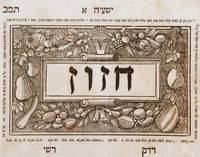
161952679Basel: Ludwig König 1619. First edition in part. Hardcover. Good. Eight parts in three volumes folio biblical texts and commentary in four parts continuously foliated; three supplemental sections each with separate foliation; Tiberias 1655 with separate pagination here bound after the Haftarot - Vol. 1: 6 title and prelims 1-228 1 sect. title 234-441 1 blank ff. Vol. 2: 1 sect. title 442-705 3 blank 707 sect. title-837 1 blank ff. Vol. 3: 839 half-title-881 1 blank 883-946; 8 Targum Yerushalmi; last leaf unfoliated; 67 Masorah 1 blank; 1 title 2-36 Haftarot ff.; 8 title and prelims 108pp. Despite the gap in foliation between the first and second parts and numerous errors in foliation throughout the Rabbinic Bible collates complete with all blanks noted in Prijs Die Basler hebräischen Drucke and the Haftarot bound at the end. Largely arranged in two columns of biblical texts in square font surrounded by commentaries in rabbinic Rashi font; biblical texts read from right to left. This copy with collective Hebrew title surrounded by biblical quotations in Hebrew set within elaborate woodcut architectural borders; brief preface in Hebrew by Abraham Braunschweig at the verso. Hebrew sectional titles set within the same woodcut borders for the three other biblical sections and the Haftarot with a plain letterpress half-title for the Five Megillot. Opening word of each biblical book set in large one-third to one-half page cartouche vignettes with elaborate woodcut borders and surrounding letterpress Hebrew text. Main title Jewish date chronogram = 5378 1618-1619. Near-contemporary half calf over speckled boards worn and rubbed; spines with raised bands gilt morocco lettering pieces and old paper labels heavily faded. About two-thirds of the text embrowned ranging from minimal to moderately heavy; worm tracing in a 1- by 2-inch section at leaves 541-553 affecting text. A good complete set notably containing the Ashkenazi Haftarot readings not found in all copies.<br /> <br /> Sixth Rabbinic Bible in Hebrew: Mikra'ot Gedolot edited by Johann Buxtorf I 1565-1629 professor of Hebrew at the University of Basel and the foremost Christian Hebraist of his era with the assistance of the Jewish scholars Abraham Braunschweig who served as the principal corrector and Mordechai Gumplin of Posen. This was "a truly audacious undertaking for his time" Burnett as no Christian scholar had yet attempted to edit the entire biblical corpus including the Aramaic versions Targumim and masoretic notes. Based mainly on the third Rabbinic Bible published by Daniel Bomberg at Venice in 1546-1548 the editor has carefully incorporated elements from two other Venetian editions. At the verso of the Latin title Buxtorf provides a detailed bibliographical excursus on the earlier Venetian editions and offers a tribute to Bomberg's industry by reprinting the colophon of the second Venetian Rabbinic Bible 1524-1525 at the conclusion of the masoretic appendix with text by the Hebrew grammarian and lexicographer Elijah Levita 1468 or 1469-1549 and a new introduction by Abraham Braunschweig. The design of the sectional titles and separate book title vignettes closely model those of the Venetian editions. "Buxtorf did not plan simply to reprint one of the existing Venice editions but rather to assemble the best features of them all into one work" and "to provide theologians with what he considered the most important tools for interpreting the Old Testament" Burnett. Buxtorf served in an official capacity as Basel's Hebrew censor charged with the oversight of all Jewish printing in the city and insuring that "no 'blasphemies' or slurs against Christians or Christianity appear in any book printed in Basel" Burnett. He carefully edited the Jewish commentaries in the Rabbinic Bible in accordance with this mandate "and removed many words and phrases which had escaped the attention of earlier censors" Burnett. <br /> <br /> The Rabbinic Bible contains the vocalized Masoretic text of the Hebrew Scriptures with accents and a vocalized Targum an Aramaic paraphrase of the biblical text: Onkelos for the Pentateuch; Jonathan b. Uzziel for the Prophets; and Targum Hagiographa for the Writings. The Hebrew and Aramaic versions are printed in square characters and presented in facing columns at the center of each page. The Jerusalem Targum of the Pentateuch appears as an appendix. In addition to the Aramaic paraphrases the Rabbinic Bible includes a massive scholarly apparatus of biblical commentaries by Rashi Ibn Ezra Baal ha-Turim Jacob b. Asher R. David Kimchi Radak R. Levi b. Gershon Ralbag Saadia Gaon and R. Isaiah along with the Masora a corpus of critical notes on the external form of the Biblical text compiled by Jewish scholars from late antiquity through the medieval era. As frequently occurs a copy of Buxtorf's work on the textual history of the Hebrew Bible Tiberias the 1655 revised edition is bound-in. This work was made possible by the publication in 1538 of Elijah Levita's Masoret ha-Masoret a commentary on the Masora which Buxtorf translated into Latin for his own private use in 1593. While "Buxtorf was concerned with the integrity of the consonantal text and the origin and integrity of the vowel points and accents of the Hebrew Bible from the very beginning of his scholarly career." While he had earlier published a long excursus on the age of the vowel points and accents in his 1609 Thesaurus Grammaticus "Tiberias is Buxtorf's fullest and most impressive work on the history of the biblical text" Burnett. Intended as a reference work for Christian students and scholars interested in studying the Masora Buxtorf was also keen to refute the view advanced by Levita that the Hebrew vowel points were early medieval innovations. Our folio version of Tiberias was intended to accompany the Rabbinic Bible and has the same architectural borders at the title. König also published a quarto edition in the same year but only the folio version includes a critical commentary on the Masora in which Buxtorf proposes various corrections to the Masoretic notes. <br /> <br /> As noted at the title Buxtorf's faithful study and tireless labor studio fido et labore indefesso yielded notably long-lasting results: "The Basel rabbinical Bible became a standard tool for research among Christian scholars and would remain so. until the end of the nineteenth century" Burnett. A vast array of early modern scholars including Protestants like Johannes Drusius and John Selden as well as Roman Catholics like Robert Bellarmine and Andreas Masius owned a copy or two of the Rabbinic Bible. "Johannes Buxtorf's thoroughly censored "Christian" version of the Rabbinic Bible Basel 1618-19 only made it easier for Hebraists to own copies of their own" Burnett Christian Hebraism in the Reformation Era p.163.<br /> <br /> A note on the date of publication: "The actual printing began between the mid-August and mid-September of 1618. According to the colophon production ended on the 24 of Ab 379 = August 4 1619 but since this date also appeared on the colophon of the Bomberg Biblia rabbinica edition of 1524-25 reprinted unchanged in the 1546-48 and 1568 editions it is suspect. Prijs suggested that the probable completion date was sometime during Ab of 379 between July 12 and August 10 of 1619" Burnett. References: Biblia Sacra: Burnett 7. Cowley 87. Darlow & Moule 5120 like our copy bound with the 1665 second edition of Tiberias cf. 5093. Davidson Otsar ha-shirah vol.1 p.406 no.8954. Prijs 219. Steinschneider 423 423b. VD17 23:675325G. S. Burnett Christian Hebraism in the Reformation Era Leiden: Brill 2012 p.163. Tiberias: Burnett 114. Prijs 272a. For detailed analyses of both works see: S. Burnett From Christian Hebraism to Jewish Studies Leiden: Brill 1996 pp.169-239 chaps. 6 & 7. Ludwig König hardcover
(FT) 12mo. 310 pages. In Hebrew. SUBJECT(S) : Fiction. OCLC lists 18 copies worldwide. Ex library. Pages tanned, Water stains in corners, good condition. (HebLit-4-1)
8vo. 172, 32, 16 pages. In Hebrew. Volume 2 only. SUBJECT (S) : Palestine. OCLC lists no copies worldwide. Ex library with usual markings, covers are very worn, pages darkened, some pages are chipped or loose, hinges are splitting, fair condition. (MX-7-9)
IN HEBREW. RARE comprehensive index of Biblical and early 20th century Palestine regions and settlements. Each location is given by its contemporary Arab name, its ancient Hebrew (Biblical or Talmudic) name when one is available, and in its modern Hebrew name, providing it was colonized at the time. For each location, short geographical and historical information is also provided, along with references to the appropriate ancient sources. Appended to this book are a list of Biblical sites whose location in modern Palestine was not yet determined, and a list of Roman and Greek names (in Latin letters) for sites, which differ considerably from the Hebrew and Arabic names. The wealth of information contained within this book was gathered and compiled by Eliahu Sappir (1869-1911), one of the prominent figures of the first Aliyah, an educator and a geographer. 235x180mm. XXIV+163 pages. Quarter-cloth black rebound Hardcover. Cover and spine worn and stained. Cover corners and edges bumped and peeling. Spine edges and hinges bumped, tattered and glued. Sticker residue on spine front hinge. Front whitepage torn-out/missing. Rear whitepage and last page upper corner wrinkled. Rear whitepage slightly age-stained. Title page slightly age-stained and partly missing - left bottom corner torn-out. Previous owner's name written in ink on title page upper edge/corner. Pages III-VI left bottom corner missing - NO damage to text. Pages VII-VIII left bottom corner missing with slight damage to text. Page XVII/XVIII coming loose from binding. Binding slightly visible between some pages. Page 1/2 fore edge torn. Several pages have tattered edge - NO damage to text. Pages browning. [SUMMARY]: This extremely rare book, an invaluable research aid for anyone interested in the ancient and modern history of the Holy Land, has sustained some damage, but is overall in good reading condition.
IN HEBREW. RARE comprehensive index of Biblical and early 20th century Palestine regions and settlements. Each location is given by its contemporary Arab name, its ancient Hebrew (Biblical or Talmudic) name when one is available, and in its modern Hebrew name, providing it was colonized at the time. For each location, short geographical and historical information is also provided, along with references to the appropriate ancient sources. Appended to this book are a list of Biblical sites whose location in modern Palestine was not yet determined, and a list of Roman and Greek names (in Latin letters) for sites, which differ considerably from the Hebrew and Arabic names. The wealth of information contained within this book was gathered and compiled by Eliahu Sappir (1869-1911), one of the prominent figures of the first Aliyah, an educator and a geographer. 250x180mm. XXIV+163 pages. Hardcover with gilt lettering. Cover and spine worn and stained. Cover corners and spine edges bumped and peeling. Cover edges peeling. Spine hinges partly cracked. Inner cover, text block edges and some pages age-stained. Pages browning. [SUMMARY]: Save for the aforementioned wear, this invaluable research aid for anyone interested in the ancient and modern history of the Holy Land, is in good condition.
(FT) 8vo. 191 pages. Illustrated. In Hebrew. SUBJECT(S) : Education - Palestine; Schools - Palestine. OCLC lists 25 copies worldwide. Scharfstein (1884-1972) was a Hebrew educator both in Galicia and the United States, where he moved in 1914. In 1916, he began teaching at the Teachers Institute of the Jewish Theological Seminary, eventually becoming professor of Jewish education, and serving there until 1960. "A prodigious contributor to the Hebrew press, his column in the American Hebrew weekly Hadoar dealt with political and, especially with literary events. From 1907 Scharfstein also published educational texts embracing Hebrew literature, Jewish education, Bible, and Hebrew language. " (Silberschlag, EJ) Ex library. Boards chipped and stained, back hinge starting, good condition. (HebLit-4-13)
New York: Ogen Publishing House of Histadruth Ivrith of America, 1957. Cloth; 4to. X, 562 pages. In Hebrew, with title page and table of contents in English on verso (Title in English "Hebrew Education and culture in Europe Between the Two World Wars. ") Text on verso of title page; "This book is the second in the series of 'Morasha' aiming to perpetuate the heritage of Jewish culture in the shattered communities of Europe. " Illustrated with photographs and tables. SUBJECT(S) : Jews -- Education -- Europe. Jews -- Intellectual life. Jewish religious education -- Europe. OCLC lists 25 copies worldwide. Backstrip has jagged tear extending more than halfway down; edges worn and cover generally scuffed. There is a stain on the lower edge of the book which extends 1/2" up most pages, not affecting text. Interior of book is very clean. Fair condition. (LB-1)
1939N4645Jerusalem: Government Printer 1939. First Edition . Half Cloth. Very Good. 8vo. Some 12000pp for the 14 volumes. HEBREW LANGUAGE. Each colume with owner's stamp on the firtst page MODAI ADVOCATES -TEL AVIV Some spotting on edges and front end papers. A few pages loose. General minimal wear. UNIFORM HALF CLOTH BINDING. A VERY GOOD COPY OF THIS RARE OFFFICIAL PUBLICATION FO THE PALESTINE MANDATE. <br/> <br/> Government Printer hardcover
1st edition. Original paper wrappers. 8vo. 21 cm. In Hebrew. Title translates to The Awakener. Includes April (33 pages) , May (33 pages) , June (33 pages) July-August (73 pages) , September (36 pages) , October (37 pages) , November (36 pages) , Issue from 1907 (39 pages) . Not to be confused with the Tel Aviv reprint of the first year. Early Hebrew periodical which features many of the periods most well-known Hebrew writers. This periodical featured commentary on current affairs and literature, and greatly influenced the young Jews of the highly-influential Second Aliyah. (EJ, 2008) . The editor, Y. H. Brenner is considered a pioneer in modern Hebrew literature. Brenner (1881-1921) was initially from Russia, but escaped to London after deserting the Russian army during the Russo-Japanese war. It was in London that Brenner became instrumental in the Hebrew literature movement and Zionism. This culminated in his emigration to Palestine where he rose to prominence before his murder in the 1921 Jaffa riots. (Wikipedia, 2018) . SUBJECTS: Hebrew literature, Modern -- Periodicals. OCLC lists 15 copies worldwide (OCLC: 45947005) . Ex-library with no markings. Most issues are unbound with significant edge wear. Some loss of text in November issue, but others are Good. Overall Good- Condition. (YID-30-27)
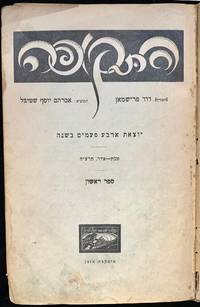
191843090Moskvah Moscow : A.Y. Shtibel 1918. First edition. Original boards 8vo 678 pages. 26 cm. In Hebrew. Title translates as “The Season.â€<br> Rare volume 1 published in the USSR of the quarterly literary magazine Ha-Tekufah. Includes essays by Simon Dubnow poetry short stories translations and articles.<br> Ha-Tekufah was a “Hebrew periodical devoted to literary scientific and social subjects which appeared first as a quarterly then as an annual intermittently between 1918 and 1950. Ha-Tekufah received the financial backing of Abraham Joseph Stybel a philanthropist who had placed David Frischmann in charge of launching Hebrew literary projects on an unprecedented large scale. Accordingly Frischmann established both the Stybel publishing house and launched Ha-Tekufah serving as the editor of both projects. The first volume of Ha-Tekufah appeared in Moscow early in 1918 before the Bolshevik regime had decided to suppress Hebrew literature. Frischmann published the works of the world's best authors and scholars. The literary standards of the periodical were high. Frischmann encouraged young authors for example Eliezer Steinman. In all respects and not least for its beautiful graphic work Ha-Tekufah was a rare phenomenon in Hebrew literature.†Jewish Virtual Library.<br> SUBJECTS: Hebrew literature Modern -- Periodicals. Hebrew literature Modern. OCLC: 25586768<br> Boards separated and pages edgeworn. Lacks backtrip spine covering. Good Condition internally. YID-46-7-’. Moskvah [Moscow] : A.Y. Shtibel unknown
(FT) Hardcover, 38 pages, 12mo. In Hebrew. SUBJECT(S) : Psychology. Translation of Habit, its importance in education; an essay in pedagogical psychology. OCLC lists 2 copies online (Harvard, Penn) . Library stamp on front and back page cover. Yellowing to pages. Slight bumping to cover corner. Good condition. (Rab-48-2)
(FT) Hardcover, 8vo, xv, 145 pages, portrait. In Hebrew. SUBJECT(S) : Satire, Hebrew. Sacrifice -- Judaism. Purity, Ritual -- Judaism. Erter, Isaac. Other Titles: Dr. Isaak Erter's gesammelte Schriften. Erter (1791-1851) was a Hebrew satirist of the Haskalah. Born in Koniuszek near Przemysl, Erter, during the earlier part of his life, lived in various places including Lvov, where he, together with a group of young maskilim, was excommunicated in 1816 by Rabbi Jacob Ornstein; Budapest, where he studied medicine; and Brody, then an important commercial and cultural center for Galician Jewry, where he settled in 1831 and remained for the rest of his life. In addition to his literary work, Erter was also active communally among Haskalah circles, showing special interest in the plans for a reform of contemporary Jewish society. Toward the end of his life, he collaborated with his friend Y. H. Schorr in the early stages of the founding of He-Halutz, a Hebrew periodical dedicated to the study of Judaica in the spirit of religious reform, and distinguished by a boldly critical treatment of problems relating to Jewish tradition. Erter's only book, Ha-Zofeh le-Veit Yisrael, consists of five satires, all of which had been published separately with the addition of some personal correspondence relevant to his literary career. Noteworthy among the satires are the following: Hasidut ve-Hokhmah, Tashlikh, and Gilgul Nefesh. Written in the form of epistles, several of the satires seem to have been modeled on the work of Lucian, the second-century Greek satirist, whose writings were very popular in European Rationalist literature and which Erter came to know in Wieland's German translation. Lucian's satiric and ironic treatment of Greek mythology and of ignorant and boorish antiquity during its decline was adapted by Erter in his fight against the traditionalist Jewish society of his day. The recurring character a type of "persona satirae" "the watchman of the House of Israel, " has its source in the prophet-castigator of Ezekiel 3: 17; by virtue of the authority of the biblical figure, Erter's watchman reviews the reality of Jewish society in Galicia and Poland in the first half of the 19th century. In this narrative, written in an autobiographical manner, the "observer" gathers evidence and confronts the reader with confessions of figures belonging to an imaginary, fanciful world, confessions made in a dream state or after death. Having endowed them with a keen rhetoric ability, Erter enables these figures to explain their character and experience by ironic exaggeration, coupled with the idealistic pathos characteristic of the Haskalah movement (Werses in EJ, 2007) . OCLC lists 17 copies worldwide. Ex-library with bookplate. Hinge repair. Stained pages. Notes on some pages. Chipping to edges of first few pages. Bumped corners and chipped edges of cover and spine. Otherwise, good condition. (Rab-40-28)
IN HEBREW AND ENGLISH. 17X23.5 cm. 428+xix. Softcover. Cover edge's are slightly folded. Spine slightly faded and chafed, the bottom slightly wrinkled. Pen writing on first white page. Else in good condition.
12mo. 342 pages. In Hebrew. OCLC lists 1 copy worldwide (Univ of Manitoba) . SERIES: Sifriyat "Dvir La`am. " Hazaz (1898-1973) was a Russian Hebrew writer. As a young man, he worked for the newspaper Ha-Am during the Russian Revolution, and escapes pogroms of 1920 by fleeing to the Crimean Mountains before moving to the recently-dismembered Ottoman lands and then to Western Europe. In 1931, he moved to Jerusalem. Hazaz had first been published in 1918, while still in Russia; his early stories were well received. In both his early writing and that done later in Germany and Israel, he conveys the anxiety felt by Jews during the early 20th century, between the Diaspora and the establishment of the state of Israel. For his contributions to Hebrew literature, Hazaz was awarded the Israel Prize twice, first in 1953 and again in 1971. After his death, the Hebrew Literary Center's building in Jerusalem was named after him. (EJ, 2007) Shalom Spiegel's copy with his bookplate. Has dust jacket. Very good condition. (HebLit-4-25)
150X220mm. Collection of short poetry and prose books. Hardcover. Library copy with usual markings. Cover and spine are very worn. Pages yellowing and stained. Few pages detached from inner binding. Inner binding exposed on several places. Disinfected because of worm signs. In fair condition. Rare!
1971R320127514Rand Mc Nally & Company. 1971. In-8. Relié. Etat d'usage, Tâchée, Dos satisfaisant, Intérieur acceptable. 132 pages - ouvrage en anglais et en hébreu - sens de lecture inversé - nombreuses illustrations en noir et blanc dans le texte - nombreuses annotations au stylo bleu à l'intérieur de l'ouvrage sans réelle conséquence sur la lecture.. . . . Classification Dewey : 492.4-Hébreu
R320130472non précisé. non daté. In-12. Broché. Bon état, Tâchée, Dos satisfaisant, Intérieur frais. 40 pages agrafées - ouvrage en hébreu - sens de lecture inversé - une lettre dactyolographiée du Président du fonds de restauration du livre et de l'enseignement Keren Hasefer Ve Ha-Limoud.. . . . Classification Dewey : 492.4-Hébreu
67122Berlin, Ferdinand Osertag Verlag,, 1923 Original hardcover binding,(1) 50 pages (1), 27x20cm. illustrated with 20 b/w illustrations (woodcuts) *fine condition.
RO30085532***. non daté. In-16. Relié demi-cuir. Etat d'usage, Plats abîmés, Dos abîmé, Intérieur frais. Paginé de 706 à 1036. Ouvrage en hébreu. Petites épidermures.. . . . Classification Dewey : 492.4-Hébreu