Olofsson, StaffanMareMagnum
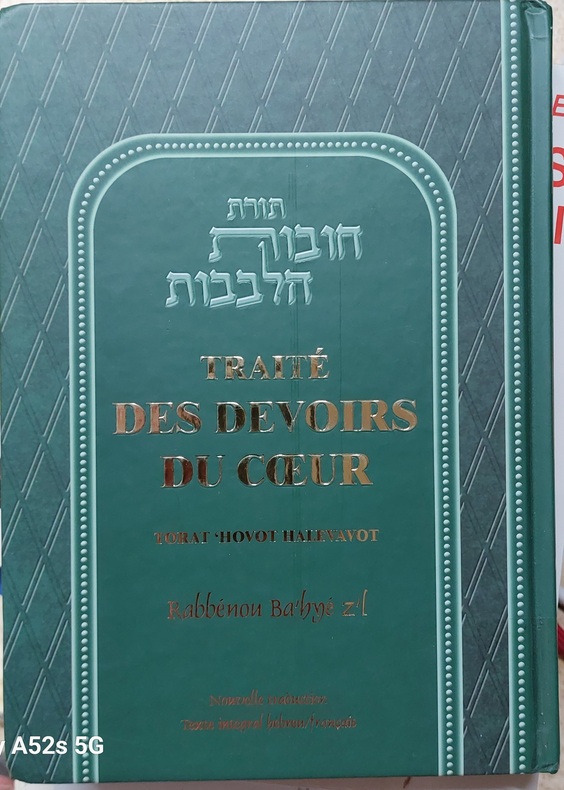
traité des devoirs du coeur
LRB73Nouvelle traduction - texte intégral hébreu/français - Volume 1 - éditions Salomon - Jerusalem 5766 - 398 pages - comme neuf
La Bonne Pioche · Cuisery, France50,00 €
2 965 résultats
23x15.5 cm. VI+296 pages. Softcover. As new.
LRB73Nouvelle traduction - texte intégral hébreu/français - Volume 1 - éditions Salomon - Jerusalem 5766 - 398 pages - comme neuf
RARE critical edition of Arabic and Ethiopic versions of a hagiographic work called "Martyrdom of Areta", with Italian translation, introduction and notes. 238x170mm. XXVIII+306 pages. Softcover. Cover slightly dirty and wavy. Bump-mark on front cover edge. Spine edges slightly bumped. Text block upper edge slightly stained. Some pages upper corner slightly bumped/wrinkled. [SUMMARY]: This extremely rare critical edition of an important source of the history of pre-Islamic South-Arabia and the Ethiopian Aksumite kingdom, with Italian translation, is in good condition.
240x160 mm. XV+298 pages. Hardcover with dust jacket. Gilt spine. Spine edges bumped. Else in good condition.
IN HEBREW. 23.5x16 cm. 76 pages. Hardcover. Yellowing cover slightly stained. Cover worn at corners and edges. Spine slightly rubbed, and slightly bumped at edges. Yellowing pages, Else in good condition.
First edition. Original boards. 8vo. 224 pages. 21 cm. In Hebrew, English, and Yiddish. Goldman 319. Title translates as A Hebrew Grammar: An Instructive Guide to the Holy Language for Jewish Schools and Homes. Hertz was born in Rebrin, Czechoslovakia, (or Lastomir, Hungary) in 5617 [1847] and he studied for three years under Rabbi Azriel Hildesheimer in Eisenstadt (or Berlin ) . He immigrated to America in 1884 and devoted the rest of his life to Jewish education. Hertz published poetry and linguistics and Biblical studies. He died in the Bronx in 1913. His son was Joseph H. Hertz, the chief rabbi of the British Empire and the editor of the "Hertz Chumash. " "An instructive guide to the Holy Language for Jewish Schools and Homes. Written in a most interesting and attractive style, with ample rules and explanations concerning Rashi script and the reading of unpunctuated Hebrew in English and Jewish-German. The English and Yiddish texts appear on facing pages (Goldman) . Grammatical rules are formulated in verse. SUBJECTS: Hebrew language -- Grammar. OCLC lists 7 copies worldwide. Minor shelf wear to boards. Internally Very Good. Overall Good+ Condition. (AMR-47-39)
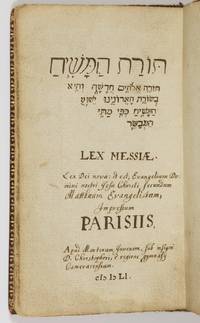
1700557661700. Very good-. Small octavo 14.1 by 8.5 cm. Manuscript in black and brown ink; 18-20 lines per page; text in vocalized Hebrew. 6 title and editor's preface 146 12 blank 10 notes. Lacks the first leaf which has been supplied in manuscript by a later owner. 19th-century limp morocco rubbed at extremities gilt dentelles marbled endleaves. Faint dampstain along bottom margin occasional smudges and mild stains else very good with crisp text.<br /> <br /> Early modern transcription of the Hebrew version of the Gospel of Matthew published in 1551 at Paris by Martin le Jeune with notes at the rear likely the work of a student. This edition was prepared by Jean Cinqarbres Quinquarboreus; 1514-1587 who jointly held the chair of King's Professor of Hebrew Literature at the University of Paris with Jean Mercier d. 1570. Lapide describes this as a "literal" edition and notes that the learned French bibliographer and father of the Oratory Jacques Le Long regarded it as the "true and authentic Gospel of Matthew." Like many of the surviving copies it lacks the Appendix which comprised the Seven Penetential Psalms Psalm CXIX Daniel's Prayer and the Ten Commandments. Apart from minor formatting changes e.g. breaks between chapters the text appears to be a faithful copy including vowel points and some of the additional cantillation marks the printed marginalia new Hebrew page numbers and Cinqarbres's dated preface. As the original version contains only 17 lines of text per page the transcription is not a page-for-page copy. Here the copiest appears quite fastidious in providing appropritate new catchwords! The Latin portion of the title however differs notably from the original which reads: Sanctum Domini nostri Iesu Christi Hebraicum Evangelium secundum Matthaeum.<br /> <br /> "In 1537 Sebastian Münster published his Hebrew version of the Gospel of Matthew at Basel the first printed edition of the New Testament in the so-called 'mother tongue of the evangelist' as he states in his preface" Lapide. Like the Paris edition of Hebrew Matthew upon which the present copy is based Münster entitled his version Torat ha-Mashiah The Teaching of the Messiah. While Münster's version of Matthew was long believed to be based on the 14th-century Hebrew translation by the Jewish polemicist Shem Tov ben Isaac ibn Shaprut more recent scholarship has called this attribution into question. "There are medieval Hebrew forms of Matthew that most scholars think of as retroversions from the Greek of canonical Matthew often made to serve in arguments between Christians and Jews. However some claim that these texts are a guide to the original Hebrew of Matthew French scholars like J. Carmignac and M. Dubarle have contributed to this thesis. Still other scholars think they can reconstruct the original Hebrew or Aramaic underlying the whole or parts of the Greek text of canonical Matthew on the assumption that the original was in Semitic. The vast majority of scholars however contend that the Gospel we know as Matthew was composed originally in Greek and is not a translation of a Semitic original" Brown.<br /> <br /> Provenance and annotations: The copiest has added notes following the main text comprising a Seder shel Miqra / Ordo Bibliorum in which the tripartite division of the Scriptures according to Jewish tradition is described. Then follows several pages of Hebrew terminology with biblical references and definitions in Latin. Along with one or two references to rabbinic literature an erudite reference to the Passover Haggadah notes Rabbi Judah's grouping of the ten plagues into three acronyms.<br /> <br /> At the head of the leaf inserted after Cinqarbres' preface is the note "When I bought this Mss. the first chapter from verse one unto verse 14 and part of verse 15. I filled in the missing verses. May. 18th. 1901. Llewellyn Saunderson 10 De Vesse Terrace Kingstown Co. Dublin" References: R. Brown Introduction to the New Testament 1997 p. 210; P. Lapide Hebrew in the Church Grand Rapids 1984 see Chap. IV "Modern Christian Hebraica" esp. pp. 53-58. Cf. Adams B1890 wanting the appendix; Darlow & Moule 5095: An independent edition of Shem Tob's version see no. 5088 which notes: The editor S. Münster obtained an imperfect MS. copy of St. Matthew's Gospel in Hebrew which had been made as early as 1385 for polemical purposes by Shem Tob b. Shaprut a Jew of Tudela in Castile. He revised and completed this for the press Basel: H. Petri 1537 adding a Latin translation of the Hebrew.; Delaveaux & Hillard 4644 noting Ibn Shaprut as the ulitmate source; Le Long/Masch 2 1781 p. 10. Schwarzfuchs Paris 212. Steinschneider 6591.26 under Münsterus.<br /> <br /> Full title noting original imprint: תורת המשיח תורת ××œ×”×™× ×—×“×©×” ×•×”×™× ×‘×©×™×¨×ª ×”××“×•× ×™× ×• ישוע המשיח כפי מתי המבשר <br /> Lex Messiae. Lex Dei nova: id est Evangelium Domini nostri Iesu Christi secundum Matthaeum Evangelistam Impressum Parisiis: apud Martinum Iuvenem sub insigni D. Christophori è regione gymnasii Cameracensium M.D.LI. 1551. unknown
39481Philadelphia: Printed by C. Sherman 5605. 8vo 5 volumes. 8 7/8 x 5 1/2 inches. Hebrew and English text on facing pages. Each volume inscribed at the head of the English-language title "To my beloved wife from her affectionate husband" the first volume with a later family annotation. Contemporary purple morocco spine in six compartments with raised bands lettered in gilt in the second and fourth repeating gilt decoration in others marbled edges marbled endpapers.<br/> <br/>Provenance: Solomon Nunes Carvalho each cover stamped in gilt<br/> <br/>Rare large-paper association copy of the first Jewish translation of the Pentateuch into English.<br/> <br/>More than any other person of his time Isaac Leeser 1806-1868 envisioned the development of a major center of Jewish culture and religious activity in the United States. He single-handedly provided American Jews with many of the basic religious texts institutions and conceptual tools they needed to construct the cultural foundation of what would later emerge as the largest Jewish community in the history of the Jewish people. Printed in 1845 this edition of the Pentateuch in five volumes included a vocalized Hebrew text of each of the Five Books of Moses together with an English translation and notes as well as the haftarot prophetic readings. Leeser actually began working on The Law of God in 1838. Among the factors involved in his decision to begin systematically working on a translation was the recent opening of Rebecca Gratz's Sunday School which met for the first time in March 1838 in Philadelphia and was desperately in need of appropriate study material. Students were compelled to use the King James Bible for want of a Jewish alternative. Religiously objectionable passages in other texts provided by Protestant organizations were either pasted over or torn out by Gratz's staff. Leeser who supported the Sunday School and was its chief academic resource person felt compelled to find more suitable texts for the students. The impetus for Leeser throughout was always his desire to provide the Jews of America with an English text of the Bible that was produced by one of their own and was not tainted by conversionist motivations. This copy with provenance to Solomon Nunes Carvalho who was a noted American painter photographer writer and inventor best known for traveling with John C. Fremont on his fifth expedition through Kansas Colorado and Utah. He published an account of that journey titled "Incidents of Travel and Adventure in the Far West; with Colonel Fremont's Last Expedition" 1860 and was considered a pioneer in travel photography. Isaac Leeser the hazzan of Congregation K.K. Mikveh Israel married Carvalho and his wife Sarah Miriam Solis on October 15 1845 in Philadelphia where Carvalho's father had a workshop.<br/> <br/>Rosenbach 569; Singerman 884; Goldman 7; Lance J. Sussman "Another Look at Isaac Leeser and the First Jewish Translation of the Bible in the United States" Modern Judaism Vol. 5 No. 2 Gershom Scholem Memorial Issue. May 1985 pp. 159-190. Printed by C. Sherman unknown books
38544Philadelphia: Printed by C. Sherman for the Editor 5605. Five volumes 8vo. 7 1/2 x 4 3/4 inches. Hebrew and English text on facing pages. Contemporary black morocco covers elaborately tooled in gilt spine gilt with raised bands in six compartments yellow endpapers gilt edges expert repairs to joints and tops of spines.<br/> <br/>Provenance: M. Nathans name in gilt on the upper covers<br/> <br/>The first Jewish translation of the Pentateuch into English: in an elaborate contemporary binding.<br/> <br/>More than any other person of his time Isaac Leeser 1806-1868 envisioned the development of a major center of Jewish culture and religious activity in the United States. He single-handedly provided American Jews with many of the basic religious texts institutions and conceptual tools they needed to construct the cultural foundation of what would later emerge as the largest Jewish community in the history of the Jewish people. Printed in 1845 this edition of the Pentateuch in five volumes included a vocalized Hebrew text of each of the Five Books of Moses together with an English translation and notes as well as the haftarot prophetic readings. Leeser actually began working on The Law of God in 1838. Among the factors involved in his decision to begin systematically working on a translation was the recent opening of Rebecca Gratz's Sunday School which met for the first time in March 1838 in Philadelphia and was desperately in need of appropriate study material. Students were compelled to use the King James Bible for want of a Jewish alternative. Religiously objectionable passages in other texts provided by Protestant organizations were either pasted over or torn out by Gratz's staff. Leeser who supported the Sunday School and was its chief academic resource person felt compelled to find more suitable texts for the students. The impetus for Leeser throughout was always his desire to provide the Jews of America with an English text of the Bible that was produced by one of their own and was not tainted by conversionist motivations. This binding is consistent with similar bindings on gift books of the era published and bound by Lippincott. This example with provenance to M. Nathans likely Moses Nathans 1811-1873 a prominent congregant of Philadelphia's Congregation Mikveh Israel.<br/> <br/>Rosenbach 569; Singerman 884; Goldman 7; Lance J. Sussman "Another Look at Isaac Leeser and the First Jewish Translation of the Bible in the United States" Modern Judaism Vol. 5 No. 2 Gershom Scholem Memorial Issue. May 1985 pp. 159-190. Printed by C. Sherman for the Editor unknown books
39481Philadelphia: Printed by C. Sherman 5605. 8vo 5 volumes. 8 7/8 x 5 1/2 inches. Hebrew and English text on facing pages. Each volume inscribed at the head of the English-language title "To my beloved wife from her affectionate husband" the first volume with a later family annotation. Contemporary purple morocco spine in six compartments with raised bands lettered in gilt in the second and fourth repeating gilt decoration in others marbled edges marbled endpapers.<br/> <br/> Provenance: Solomon Nunes Carvalho each cover stamped in gilt<br/> <br/> Rare large-paper association copy of the first Jewish translation of the Pentateuch into English.<br/> <br/> More than any other person of his time Isaac Leeser 1806-1868 envisioned the development of a major center of Jewish culture and religious activity in the United States. He single-handedly provided American Jews with many of the basic religious texts institutions and conceptual tools they needed to construct the cultural foundation of what would later emerge as the largest Jewish community in the history of the Jewish people. Printed in 1845 this edition of the Pentateuch in five volumes included a vocalized Hebrew text of each of the Five Books of Moses together with an English translation and notes as well as the haftarot prophetic readings. Leeser actually began working on The Law of God in 1838. Among the factors involved in his decision to begin systematically working on a translation was the recent opening of Rebecca Gratz's Sunday School which met for the first time in March 1838 in Philadelphia and was desperately in need of appropriate study material. Students were compelled to use the King James Bible for want of a Jewish alternative. Religiously objectionable passages in other texts provided by Protestant organizations were either pasted over or torn out by Gratz's staff. Leeser who supported the Sunday School and was its chief academic resource person felt compelled to find more suitable texts for the students. The impetus for Leeser throughout was always his desire to provide the Jews of America with an English text of the Bible that was produced by one of their own and was not tainted by conversionist motivations. This copy with provenance to Solomon Nunes Carvalho who was a noted American painter photographer writer and inventor best known for traveling with John C. Fremont on his fifth expedition through Kansas Colorado and Utah. He published an account of that journey titled "Incidents of Travel and Adventure in the Far West; with Colonel Fremont's Last Expedition" 1860 and was considered a pioneer in travel photography. Isaac Leeser the hazzan of Congregation K.K. Mikveh Israel married Carvalho and his wife Sarah Miriam Solis on October 15 1845 in Philadelphia where Carvalho's father had a workshop.<br/> <br/> Rosenbach 569; Singerman 884; Goldman 7; Lance J. Sussman "Another Look at Isaac Leeser and the First Jewish Translation of the Bible in the United States" Modern Judaism Vol. 5 No. 2 Gershom Scholem Memorial Issue. May 1985 pp. 159-190. Printed by C. Sherman unknown
dola3200Berlin: 1906-04. Thirteenth Edition of the Delitzsch translation of the New Testament. 16mo. Hebrew text. contemporary calf spine ends rubbed foxing to outer leaves. dola3200 Berlin: 1906-04 unknown
201011393PAROLE SILENCE 2010 165 pages 13 9x20 9x1 5cm. 2010. Broché. 165 pages.
371476Amsterdam: Joseph Jacob and Abraham the sons of Solomon Proops 5522. Titled printed in red and black. 2 178 2 179-332 10 Introduction etc. 2 160 2 161-350pp. Publisher's introduction and other preliminaries misbound preceding the later Prophets. Folio 15-7/8x10 inches. Nineteenth or early 20th century half morocco and marbled paper boards rear joint splitting worn at joints and head and tail of spine. Foxing principally to the title tear to the final text leaf. Provenance: General Theological Seminary bookplate. Titled printed in red and black. 2 178 2 179-332 10 Introduction etc. 2 160 2 161-350pp. Publisher's introduction and other preliminaries misbound preceding the later Prophets. Folio 15-7/8x10 inches. Besides being the first bi-lingual edition in Hebrew and Spanish this edition is the first Hebrew book whose publication was financed by an American - Abraham Mendes de Castro 1689-1762 of Curaçao - intended for use in the West Indies with the sale proceeds to benefit the Jewish communities of Jerusalem and Hebron. Cowley 102; Darlow & Moule 5156; Zedner 102; not in Steinschneider or Roest Joseph, Jacob and Abraham, the sons of Solomon Proops unknown
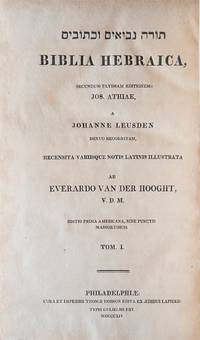
1814372931Philadelphia: Cura et Impensis Thomae Dobson edita ex aedibus Lapideis. Typis Gulielmi Fry 1814. First American edition. Text in Hebrew with notes in Latin. 6 296; 2 312 leaves. Half titles present in each volume. Uncut. 2 vols. 8vo. Original blue paper boards rebacked with plain paper. Provenance: Hugh Blair Grigsby booklabels. In a blue cloth folding box. First American edition. Text in Hebrew with notes in Latin. 6 296; 2 312 leaves. Half titles present in each volume. Uncut. 2 vols. 8vo. The first complete Hebrew Bible printed in America. Hebrew type was first used in the North American colonies in the Bay Psalm Book printed in 1640 in Cambridge. Over the next ninety-five years Hebrew type appeared in a handful of American imprints usually in brief examples of single words or short sentences. Paucity of appropriate type would continue to be a problem over the years that followed. The first Jewish Psalter was finally published in 1809 followed by this complete Bible five years later. "In 1812 Mr. Horwitz had proposed the publication of this edition of the Hebrew Bible the first proposal of the kind in the United States; early in 1813 be transferred his right and list of subscribers to Mr. Thos. Dobson who published soon afterwards the 1st volume" O'Callaghan. The title page indicates that this work is a reprinting of the second edition of the Joseph Athias Bible edited by Leusden with Latin notes by Everardo Van der Hought and that the Hebrew is printed without vowels. An important piece of American printing and of Jewish Americana. Darlow and Moule 5168a; Goldman 4; Rosenbach 171; Shaw and Shoemaker 30857; Singerman 236; M. Vaxer "The First Hebrew Bible Printed in America" Journal of Jewish Bib. 1940 vol. 2 pp. 20-26 Cura et Impensis Thomae Dobson edita ex aedibus Lapideis. Typis Gulielmi Fry unknown
170536556Amsterdam & Utrecht: H. Boom Joh. II van Waesberge Goethals Ger. Borstius Joh. Wolters Fr. Halma W. van de Water & W. Broedelet 1705. Third Edition . Hardcover - as published. Engraved title page in red & black plus four additional engraved title pages for each of the four parts into which the text is divided: 1 Genesis - Deuter.; 2 the Prophetae antiores; 3 the Prophetae posteriores; and 4 Hagiographa. Text is in Hebrew with the preliminaries and preface by van der Hooght & others as well as the printed marginalia in Latin. This is actually the third editon edited & revised by van der Hooght of the famous Hebrew Bible originally published by Joseph Athias in 1661. Thick octavo; a.e.g. Some light worming to end leaves pastedown & rear board; lacking rear front fly leaf & front rear fly leaf. Also first engraving detached. Spine is dry and rubbed along raised bands 5 panels with some light wear to edges & joints; head of spine is torn but without loss; rubbed label in 2nd panel present & readable; some worming at head of spine; small gouge on back board. A very nice internally clean tight copy of a scarce title. H. Boom, Joh. II van Waesberge, Goethals, Ger. Borstius, Joh. Wolters, Fr. Halma, W. van de Water, & W. Broedelet hardcover
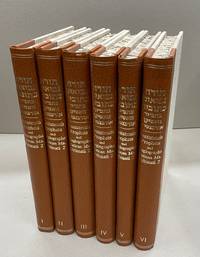
1979N4282aJerusalem: Makor 1979. Limited Edition . Original Half Leather. Fine. 4to. A LIMITED FACSIMILE EDITION OF 390 NUMBERED COPIES THIS COPY 112 A FINE COPY.- additional shipping fees for the 6 vols set will apply please enquire. <br/> <br/> Makor hardcover
1995088202Eliner Library. Near fine hardcover in very good dust jacket. . Near Fine. Soft cover. 1995. Eliner Library paperback
245x180mm. 372 pages. Hardcover. Cover slightly yellowing and stained. Cover corners and edges bumped. Spine edges bumped. Else in good condition.
245x175mm. 372 pages. Hardcover. Cover corners and spine edges bumped. Sticker on rear cover. Else in good condition.
21x13.5cm. 377 pages. Softcover. In good condition.
2013100114892Contemporary French Fiction 2013 216 pages 10 8x1x17 4cm. 2013. pocket_book. 216 pages.
(FT) 8vo. 236 pages. In Hebrew. Volume nine (of fourteen) only. SUBJECT(S) : Jews - history; Israel - history. OCLC lists 15 copies worldwide. Bookplate, occasional spots on pages, otherwise good condition. (HebLit-5-17)
(FT) 8vo. 346 pages. In Hebrew. SUBJECT(S) : Hebrew literature, Modern -- History and criticism. In good condition. (heblit1-12)
(FT) 4to. Xii, 149 pages. In Hebrew. Volume one (of three) only. SUBJECT(S) : Hebrew literature, modern - history and criticism. Lachower (1883-1947) was a Hebrew literature critic and historian. "[His] approach to literature is both critical and scholarly. He studies the literary method and conceptual framework of the author, quoting copiously from the work under discussion. But he also probes the author's motives, stressing the different and often contradictory trends in his work and personality. Lachower's own writing, at times, alternates between an objective, matter-of-fact, somewhat dry style and impressionistic musings couched in metaphorical, often ornate, language. During the early period he discusses contemporary authors of the modern national renaissance, e. G. , S. Tchernichowsky, H. N. Bialik, Z. Shneur, U. N. Gnessin, and others. His detailed discussion of D. Frischmann and M. J. Berdyczewski shows a certain affinity in outlook between him and these two authors. He shunned the social-national approach to literature then current among his contemporaries. Instead of interpreting a work in the light of social conditions, he attempted to expound its intrinsic meaning. Besides the aesthetic aspects of literature, he was deeply interested in its philosophical and conceptual presuppositions. " (EJ, 2007) Covers edgeworn, pages a little tanned, good condition. (HebLit-4-20)
(FT) 8vo. Xvii, 430 pages. In Hebrew. SUBJECT(S) : Materialism. OCLC lists 7 copies worldwide. Ex library. Good condition. (HebLit-4-8)