8 080 résultats
249263N.p. n.d. 3 stanzas with a 5 line refrain to each quatrain of verse. 1 page. 1 vols. 8vo. Some soiling. 3 stanzas with a 5 line refrain to each quatrain of verse. 1 page. 1 vols. 8vo. Thomas Dunn English 1819-1902 was a proilific author of poems ballads and novels; he also server two terms in the U.S. Congrress as a Representative from New Jersey; but his fame as a writer rests on the ballad in wrote in 1843 "Ben Bolt." <br /> <br /> English is also remembered as the bitter foe of his former friend Edgar Allan Poe. The two had a falling out which resulted in a fist fight as well as a long running literary feud. unknown
12521On Burnand's letterhead 27 The Boltons SW London 8 December 1891. 2pp. landscape 12mo. Addressed to 'Dear Furniss'. He is glad to hear of Furniss's success: 'Your tour ends after the last dinner but one of the year. No dinner Xmas week! awful that isn't it When all are feasting no dinner for the Punch boys!!' He hopes Furniss will be 'here with us'. Had Furniss been 'on the spot' Burnand would have got him 'to substitute something for your John Bull picture in almanack which no one I do not speak of "The Table" but of our best friends outside comprehends. However thats done & can't be undone; but its as well to bear it in mind so as to know the style of thing to avoid when Xmas comes again'. He reminds Furniss that Christmas is 'a time of "peace & goodwill"' and urges him to 'let byegones be byegones whether spelt thus or "bygones" - which I don't know bury the hatchet as the Tomahawk was long ago buried'. The 'Tomahawk' was a a satirical London magazine of the 1870s and the reference may be to a feud between Furniss and its editor Arthur William a'Beckett 1844-1909 who was to fall on hard times towards the end of his life. On Burnand's letterhead, 27 The Boltons, SW [London], 8 December 1891. unknown
11180Undated. 13 Cambridge Street Hyde Park. 4 pp 12mo. Good on lightly-aged paper. The unnamed recipient appears to have been named as executor in a prvevious will of Sir Henry Bishop. Opens in dramatic style: 'I was very greatly surprised to receive a letter from you this morning dated from Brighton as my poor Brother Sir Henry Bishop had not the slightest idea that you were still an inhabitant of this world having heard of your death some time since in consequence of which he made another will similar to the one in your possession but changing the executors'. The 'Policy of Assurance' which her correspondent mentions 'has not been kept up indeed I understand the office has failed'. Her 'poor Brother was long an Invalid & latterly a great sufferer' but she hopes the recipient will not 'believe for a moment that his relatives ever allowed him to want either the comforts or the necessaries of life no one could be more cared for or attended to by those belonging to him'. While she admits that her brother's 'pecuniary difficulties . might have been relieved in a more feeling & kind manner than they have been' her correspondent will see from the newspapers that 'his troubles in this world are at an end & I trust that our loss will be his gain'. Undated. 13 Cambridge Street, Hyde Park. unknown
11872On his letterhead 15 Merton Hall Gardens SW20. 14 August 1934. 1p. 4to. On aged paper. Printed in block capitals at head of letter: 'Experienced actor-dramatist and film adapter. Author of plays and films produced in England and America. Expert in "Dramatic Construction" gained in years of practical experience on the stage and in films. Adapts stories to the talking films the bigger the story with opportunities of being developed on a large scale the better.' Addressed to 'Commander L. A. da Costa Ricci Naval & Military Club 94 Piccadilly W'. Dawson puts himself forward if Bartimeus considers 'Awfully Big Adventure' or any other of his stories 'adaptable to the talking films - . something that can be developed by dramatic & perhaps sensational situations - there is a market for such a thing I adapted "A Gentleman of France". Stanley Weyman - & "Down under Donovan". Edgar Wallace - both produced here - wrote "Ambition" - produced in America - I am in touch with Hollywood - & glad to arrange to adapt something to put forward'. On his letterhead, 15 Merton Hall Gardens, SW20. 14 August 1934. unknown
761623 April 1908. On letterhead of The Westminster Gazette. 12mo: 2 pp. On the rectos of the two leaves of a bifolium. Good on lightly aged and spotted paper. Her letter has been handed to him by 'Mr Spender'. He would be 'very pleased to have the temperance cartoons circulated as post cards' and has asked 'the manager here' for a costing. 'Some of the cartoons I believe are being produced as posters by the Liberal Publication Department and by Temperance organisations.' 23 April 1908. On letterhead of The Westminster Gazette. unknown
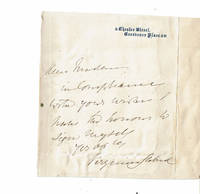
96507Grosvenor Place 19th Century. . Good. - Over 15 words penned on 5-1/8 inch high by 4-3/8 inch wide "5. Chester Street. Grosvenor Place S.W." embossed stationery. Replying to a request for an autograph the singer writes that "In compliance with your wishes I have the honour to sign myself yrs truly Virginia Gabriel". Once folded the note is mounted with glue from the verso onto slightly larger heavier stock clipped from an album. An unidentified autograph note is mounted on the verso of the mount. Good. <p>The English singer and composer Virginia Gabriel 1825-1877 studied piano with Johann Peter Pixis Theodor Dohler Sigismond Thalberg and Bernhard Molique. She also studied composition with the opera composer Saverio Mercadante. Gabriel composed popular ballads which were highly regarded but given the times she struggled to gain recognition for her more serious compositions and she had to personally publish her cantata "Dreamland". Gabriel died from injuries sustained from a fall from a carriage just a few short years after marrying the librettist George March. In addition to "Dreamland" Gabriel wrote several cantatas including "Evangeline" and "Graziella". She also wrote several operas including "Widows Bewitched" "A Quiet Chateau" "Lost and Found" "Grass Widows" "The Shepherd of Cournouailles" among others. Grosvenor Place, 19th Century. unknown
11661Cuba Villa Bickerton Road Highgate N. 6 March 1882. 2pp. 12mo. Bifolium.Good on lightly-aged paper. In stamped envelope with London and Blackburn postmarks addressed by Smith to 'J. T. Baron Esq. / 18 Griffin Street / Witton / Blackburn.' He is only able to reply to Baron's not now having been 'ill & confined to bed'. He thanks him 'for the kind expressions you use respecting my Life of Gladstone which I am glad you like so much. I suppose you are aware that I have recently published through Messrs. Hodder & Stoughton a companion work the Life of Mr. Bright' His 'Poets & Novelists' is obtainable from the publishers Smith Elder & Co. His 'Shelley' is out of print but if Baron sends six shillings in stamps Smith will obtain a copy for him. He concludes with a couple of suggestions on how to reach the journalist William Cox Bennett 1820-1895. Cuba Villa, Bickerton Road, Highgate, N. 6 March 1882. unknown
9978Downing Street 4 May 1855. Four pages 12mo bifolium small closed tear on fold mainly good condition. "It has been represented to me that the Bill of which you have given notice for Tuesday the 8th is of a nature to affect the rights of the Crown in connexion with the Duchy of Lancaster. I have consulted the speaker on the subject & he thinks that from the title it appears to be a private bill which must by introduced and not upon motion - Will you have the kindness to give me some information on the object of it." Note: although Ricardo took an active interest in the railways and telegraph this probably refers to his initiatives for Free Trade judging by other letters which came up in the same auctiion lot. Downing Street, 4 May 1855. unknown
1316927 April 1831. 1p. 4to. Bifolium addressed on reverse of second leaf by Stafford to 'Mr. Nichols 25. Parliament St. Westminster'. Very good on lightly-aged paper with seal cut away from second leaf and thin strip of stub along one edge. The letter reads: 'Lord Stafford received from the late Duke of Norfolk a Copy of Mr. Dallaway's work & has since subscribed to one by Mr. Dallaway & Mr. Cartwright - if the volume referred to by Mr. Nichols is an additional work Lord Stafford will be happy to have it. Ap. 27. 1831.' The note possibly refers to the new edition of 'The Parochial Topography of the Rape of Arundel in the Western Division of the County of Sussex' published by Nichols in 1832 part of Cartwright's revision of Dallaway's work which Nichols had begun reprinting in 1830. 27 April 1831. unknown
937817 January 1803; Stanhope Street London. 8vo 1 p. Text clear and complete. On aged and creased paper with chipping to extremities. Thin strip of stub adhering to reverse which carries the address in Sanderson's hand: 'Mr: Lowry No: 57 Tichfield St:'. He asks him to 'send the Books by the Bearer. I find my self better & am in hopes of goeing out in a Day or two if weather permits'. He concludes by sending his compliments to Lowry's wife and daughters. Docketed in a contemporary hand at foot of page: 'One of the greatest Mathematicians of this country Originally and occasionally till his Death a Taylor'. Sanderson's trade is not mentioned in his obituary in the New Monthly Magazine February 1814 pp.91-2 where he is said to have been indebted in his last years to 'the liberality and care of his friends Sir John and Lady Walsh and Mr. Burgoyne whose proficiency in mathematics had enabled them justly to appreciate his extraordinary talent and acquirements'. The obituary notes his acquaintance with 'Lauden Todd Maskelyne Wales Hutton Dalby and Bonnycastle'. 17 January 1803; Stanhope Street, London. unknown
13004Letter on letterhead of 5 Redcliffe Square South Kensington SW10. 28 January 1946. Item One: Autograph Letter Signed from Richter to Swan. 1p. 12mo. In good condition on lightly spotted paper. From the letter it would appear that in 1946 Richter was acting as one of the selectors for the 59th Exhibition of the Royal Institute of Oil Painters at the Royal Academy of Arts Piccadilly London. He writes that he is enclosing 'the mighty deed a book as the letter explains also the invitation for the exhibition at the Royal Academy valid from Feb. 13 to March 17. I hope we shall have a good show we commence selecting the work tomorrow.' Item Two: The printed invitation mentioned by Richter in the letter. On card headed 'The Royal Institute of Oil Painters. Signed by 'H. Davis Richter' and filled in by him for 'Mrs. Dorothy Swan' and friend. Items Three Four and Five: Black and white postcard photographs of three of Richter's paintings: 'A day of festival' Paris Salon 1930 with 'silver medal' added by Richter 'Maud Allan's Music Room' Paris Salon 1933 'Changing London' Paris Salon 1939. The last card blind stamped with Richter's Redcliffe Square address. All three items with manuscript messages on reverse. Letter on letterhead of 5 Redcliffe Square, South Kensington, SW10. 28 January 1946. unknown
192434767New York: 16th December 1924. 1924. Good. - Letter penned in black ink & filling most of the first side of a sheet of his light gray letterhead with his address printed in raised lettering at the top. The letterhead is folded once to form 4 sides each approximately 8 inches high by 6 inches wide. Signed "Cosmo Hamilton". The letter is very lightly creased with a small stain at bottom left & a light glue mark along the top edge. There is a stain & a collector's pencil notation on the 4th side. Folded once for mailing.Good. <p>Hamilton thanks Mr. Remington for his very kind letter. "It is indeed good to know that you liked 'Unwritten History' so much. I am grateful for your help & refreshed by your enthusiasm. It gives me great pleasure to send you a photograph & to think that it will earn the honour of a place on the walls of your office." "Unwritten History" was Hamilton's autobiography and was published by Little Brown & Co. in 1924 the year of this letter.<p>Cosmo Hamilton 1870-1942 was an English playwright and novelist the author of several London musicals as well as Broadway shows and many screenplays. Several of his novels were adapted for film. New York: 16th December, 1924. unknown
13005'Dublin Saturday 18 April 1829'. Postmarked 20 April 1829. 2pp. 4to. Bifolium. Very good on lightly-aged paper. Addressed by Waylett on reverse of second leaf 'To/ J. M. Donnell Esq Theatre Royal Cork' with oval postmark in red in two parts: 'MIDDAY MAIL 20 AP 1829'. According to Waylett's entry in the Oxford DNB 'On 12 May 1825 she made as Zephyrina in The Lady and the Devil her first appearance at the Haymarket under D. E. Morris. It was a successful début but she was not encouraged by the managers and after playing many different parts some original she went to Dublin. Here she took at the Hawkins Street Theatre the part of Phoebe written especially for her by John Poole in his Paul Pry. She also stood in high favour in Dublin and Cork as a singer. After her return from Dublin Waylett went again to King's Lynn where local families bestowed gifts upon her.' The letter begins: 'My Dear Sir I beg to express my sincere thanks for your very kind Letter. I regret that circumstances will not admit of my visiting Cork at present. I leave Dublin to morrow or Monday for England.' She sends her regards 'to Mrs M.D. and all friends' and in a postscript tells him that he will 'write the verse for my next visit'. 'Dublin Saturday [18 April 1829]'. Postmarked 20 April 1829. unknown
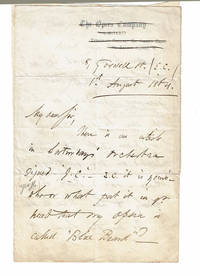
186496471August 1st 1864. 1864. Good. - A two-and-a-half page letter consisting of over 80 words penned on three sides of 8 inch high by 5-1/8 inch wide "The Opera Company" stationery. Hatton has crossed out the letterhead and penned his home address below. In his letter addressed to James Couper sp Hatton seeks to correct the assumption made in an article about the title of his forthcoming opera: "My dear Sir" he writes "There is an article in Saturday's Orchestra signed 'J.C." -- J.C. it is yours -- what put it in yr head that my opera is called 'Blue Beard' The story of my work is as unlike the career of that courageous individual as it well can be." He goes on to write that he's not yet decided on a name for his work "but I think it is likely to be 'Rose de mai-" and requests that J.C. correct the mistake. Signed "J.L. Hatton". The recipient has penciled "yes JC" in the left margin of the first page affirming that he was indeed the author of the article. Folded several times for mailing with a couple of short tears along the edges of the folds. The bottom third of the integral second leaf has been clipped without loss to the text. Apparently once mounted into an album with paper remnants along the top and inner edges of the verso of the second leaf. Good. <p>The English composer conductor pianist and singer John Liptrot Hatton 1809-1886 was a pupil of Michael Maybrick and also studied in the academy of Mr. Molyneux. An organist by the age of 16 he acted on the Liverpool stage and later performed in London in Macready's Drury Lane production of "Othello". A man of many talents he was making a name for himself as a musician and composer at the same time directing the choruses in the English Opera series at the Theatre Royal Drury Lane and composing his own works. His fist operetta "Queen of the Thames or The Anglers" was followed by a more ambitious work "Pascal Bruno". He composed numerous songs in the style of the German classics and performed as a pianist. Hatton toured in the U.S. from 1848 to 1850 performing several public and private concerts in New York City which included some of his own works. As a composer Hatton set to music various songs to poems by Robert Herrick perhaps the most famous of which was "To Anthea". Engaged as Director of Music at the Princess's Theatre in London he composed music for "Macbeth" "Sardanapalus King of Assyria" "Henry VIII" "Faust and Marguerite" and several of Shakespeare's plays. In 1864 his third opera "Rose or Love's Ransom" likely the work to which he refers in his letter was performed at the Royal English Opera Covent Garden. August 1st, 1864. unknown
99364 July 1944; St John's Cottage Cambridge. Landscape 12mo. 12 lines. Text clear and complete. Good on aged paper in envelope addressed by Lamb to Inglis. On 'seeing the picture after that long interval' he was 'not ashamed of it' but 'when it was new my friends used to rag me about my "Morgue" pictures' there being 'a few others of similar gruesome import'. Now that he is 'far past youth' he is 'painting mostly scenes of sweetness & serenity'. He is sorry that she is 'denied the priviledge sic I have enjoyed all these sinister times' that of being able to paint. 4 July 1944; St John's Cottage, Cambridge. unknown
1291936 Queens Crescent Haverstock Hill NW London. 25 March 1867. 2pp. 12mo. Bifolium. Good on lightly-aged paper with small hole through both leaves. He will be too busy over the following days to visit Clark in person 'and so I send you the first act of the MSS I talked to you about - I may say I read the 1st. act one afternoon to Miss Terry who wanted to take it to Webster - but I was disinclined'. If Clark 'had anything to do with it - the Blacksmith would be the last word underlined part'. He asks Clark to return it as soon as he can: 'as this is the American copy - and they expect it but of course won't get it by next mail'. 36 Queens Crescent, Haverstock Hill, NW [London]. 25 March 1867. unknown
11548Without place or date. Published in 'Youth's Companion' vol.73 London 1899. 1p. 4to. The beginning of the article only: 21 lines of text ending abruptly. Torn from notebook. Very good on aged paper. A corrected draft with the deleted original title reading 'Work & Wage in Downing St'. An interesting item casting light on the working practices of a pioneer of parliamentary journalism. Begins: 'The keeness of competition for ministl office in Great Britain is certainly not inspired by sordid motive.' Without place or date. [Published in 'Youth's Companion', vol.73, London, 1899.] unknown
9747Postmarked 16 and 17 August 1953; London Paddington. Eleven closely-written lines on one side of a self-printed postcard addressed with postmarks on the other side. Fair on aged paper with minor damage to corners not affecting text from previous mounting. He has had 'four years experience of Prep. School teaching' and believes that 'the one essential is that the master himself should love English literature and be prepared to re-tell its masterpieces to the boys at their own age-level'. Explains how this applies in the cases of Shakespeare Scott and Dickens. Postmarked 16 and 17 August 1953; London, Paddington. unknown
903424 November 1899; on letterhead of 25 Finchley Road London N.W. 4to 2 pp. Text clear and complete. On aged and lightly-creased paper. 'The nature of my business is a desire to become a tenant of the Prince of Wales Theatre for a long or short time and entirely subject to existing arrangements in order to produce a play which good judges as well as myself regard as one if not the play of the present generation'. The name of the play is not given. Barnes states that 'if Mr Harvey is your permanent tenant it would quite suit me to do the play at any time <> another provincial Town'. He offers 'a short or long lease . with unimpeachable security'. Barnes's offer does not appear to have been taken up. Barnes is the author of 'Forty Years on the Stage. Others - Principally - And Myself' London 1914. 24 November 1899; on letterhead of 25 Finchley Road, London, N.W. unknown
12440On Y.M.C.A. letterhead 'On Active Service With the British Expeditionary Force' 15 September 1917. 2pp. 4to. 53 lines. Fair on lightly-aged paper with minor traces of previous mounting at head and a light and unobtrusive water stain. The letter is headed by Rose 'Y.M.C.A. B.A.P.O.2 B.E.F. France'. Regarding Sheppard's recently-published 'Quest of Ledgar Dunstan' Rose writes: 'You have a wonderfully keen mental eye which sees everything with extraordinary sharpness & you have a literary hand which etches with just & delicate touch. The book is also one of singular intensity of feeling which carries the reader along fascinated & thrilled. The mad-house scenes are like Dostoievsky for pathetic vividness & power.' Rose continues with a detailed analysis of Sheppard's 'rvery remarkable book' and literary talents before reporting that he is 'out here for six months giving talks on the war & its issues to the troops every night'. He returns to Cambridge on 8 October 'for a very dull Term'. He regrets that he is 'out of touch with the literary papers' but will be pleased to be of service. The letter ends: 'Remember me to your brother whom I have not seen for long.' A postscript reads: 'By the way suitable Y.M.C.A. workers are badly needed out in France.' On Y.M.C.A. letterhead, 'On Active Service | With the British Expeditionary Force', 15 September 1917. unknown
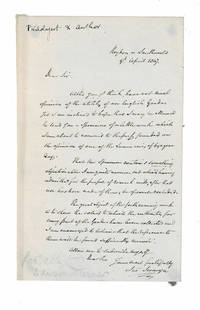
1847100140<p>Southwold April 9th 1847. 1847. Very good. - Over 125 words penned on 7 inch high by 4-3/8 inch wide creamy white paper. The philologist and author James Jermyn regarding a pamphlet he is about to publish: "Altho you I think have not much opinion of the utility of an English Gradus yet I am inclined to hope that I may be allowed to send you a specimen of the little work." Signed "Jas. Jermyn". Folded for mailing the letter was once likely mounted in an autograph book with remnants of gray paper adhering to the corners of the verso and a strip of paper along one edge of the verso. The words "Philologist & author" are penned in an unknown hand at the top of the letter and "Probably to Dawson Turner" is lightly written in pencil at the bottom. Very good.</p><p>The philologist and author James Jermyn 1773-1852 settled at Southwold where he was appointed collector of the pier dues. He was the author of numerous works and pamphlets including a 12-page pamphlet "Prospectus and Specimen of an English gradus and dictionary of ideas: containing the synonyms epithets and phrases of out language faithfully collected from the great body of English poetry and other authorities" published in 1848.</p> Southwold, April 9th, 1847.
9339Undated. 4to 1 p. Text clear and complete. On aged and creased paper. He is returning the score and asks Hedgely to 'copy the three voice parts of the two canons Criste Eleison & Crucifixus & the Voice part of the Soprano Song Gratias Agimus' and to send the whole back 'as soon as you can finish them'. Undated. unknown
13229On letterhead of Grove Lodge The Grove Hampstead London NW3. 20 April 1929. In good condition on lightly aged and creased paper. Galsworthy writes: 'Dear Evans Here is the MS. Price £300 amended from 315 less half your Commission £30. = £285. nett. Sincerely yours John Galsworthy'. For such a short message the manuscript shows signs of indecision: the latter part from the word 'less' has clearly an addition and the word 'half' has been inserted with a caret. While the manuscript referred to may well be the second collection of Forsyte Novels 'A Modern Romance' published by Heinemann's in 1929 Galsworthy's price does seem rather cheap. On letterhead of Grove Lodge, The Grove, Hampstead, London, NW3. 20 April 1929. unknown
878710 November 1906; on letterhead of 88 Kensington Park Road W. London. 8vo 1 p. Nine lines. Text clear and complete. Fair on aged and lightly-spotted paper lightly-creased and with small closed tears at edges of central crease. From the context of other items in the same collection this letter relates to an 'Artists general Benevolent Banquet' for which Dollman was acting as steward. Hassall writes that the previous year he 'got into trouble through giving subscriptions to stewards of other society's than the Royal. Institution.' so that 'if there's to be an R. I. table this year I must support it for all I'm worth'. If there is no Royal Institution dinner he will be 'pleased to swell your ranks'. He will keep Dollman's letter 'handy' until he is sure 'in which direction my allegiance lies'. 10 November 1906; on letterhead of 88 Kensington Park Road, W. [London] unknown
973019 March 1904; on his letterhead of 5 Orme Square Bayswater London. 12mo 2 pp. Thirty lines. Text clear and complete. Good on lightly-aged paper with small trace of mount adhering to one corner. Takes her to task for the vagueness of her plans. Even if a well-managed library existed at Cottesmore 'it is not likely I should render any assistance as I only help those who help themselves and give proof of continued cooperation'. He is surprised that Carnegie has made a donation and discusses the stipulation made by him on giving £30000 towards Marylebone Library. 19 March 1904; on his letterhead of 5 Orme Square, Bayswater, London. unknown