8 080 résultats
9582Signature dated by Rickman to 3 July 1809. 12mo 2 pp the autograph being on one side and Rickman's on the other. Fair on aged paper with traces of previous mounting on one side. Large bold signature 'J: Wolcot' with biographical note on one side and the note signed 'Clio Rickman' on the other: Written by the celebrated Peter Pindar when entirely blind on my calling on him the 3d of July 1809 my boy <Robert> with me'. Signature dated by Rickman to 3 July 1809. unknown
920818 July 1872; 3 Plowden Buildings Temple. 16mo 1 p. Bifolium. Eight lines. Text clear and complete. On stained aged paper. An uncommon autograph written in a distinctive stylised hand in purple ink. Reluctantly announcing his inability to go on 'the Barge trip' which he had looked upon 'as the pleasantest excursion of the year & alas & alas not that a lass has any thing to do with my engagement I shall be unable to be with you'. According to his obituary in The Times Ashby-Sterry 'knew the Thames as intimately as he knew London and his favourite recreations were rowing and sailing and detailed explorations of old and new London'. 18 July 1872; 3 Plowden Buildings, Temple. unknown
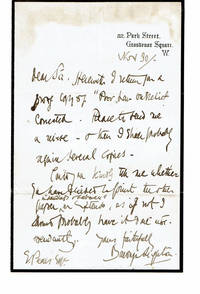
96528Grosvenor Square November 30 19th Century. . Good. - Over 50 words penned on 7 inch high by 4-1/2 inch wide "52 Park Street Grosvenor Square" stationery framed by black mourning borders. Sir Balwyn Leighton writes to the historian Edward Pears that he is sending him a corrected "proof copy" of his pamphlet "Poor Law out-relief" requesting several copies when printed. He also inquires as to whether his other paper will also be printed. Signed "Baldwyn Leighton". Folded for mailing the top edge is darkened with a small hole to the top right corner. The letter was likely once mounted into an album as evidenced by glue stains and paper remnants along the top edge of the verso. Good. <p>The English Conservative Party politician Sir Baldwyn Leighton 8th Baronet 1836-1897 was educated at Eton College and Christ Church Oxford. He served in the South Salopian Yeomanry Cavalry. He was J.P. and Deputy Lieutenant for Shropshire. Leighton was later elected as a Member of Parliament for South Shropshire. Classifying himself as a liberal Conservative party member he published several pamphlets on "poor law" and "Labour" as well as the "Letters of the Late Edward Denison MP".<p>The British barrister Sir Edwin Pears 1835-1919 was a historian and author who for a period of 40 years lived in Constantinople. He settled there in 1873 practicing in the consular courts and served as president of the European bar in what is now Istanbul. Pears traveled throughout Turkey and its dominions and studied its history and culture. As a correspondent for The Daily News in 1876 he described Ottoman atrocities and Bulgaria's April Uprising. His book "Turkey and its People" was published in 1911. Grosvenor Square, November 30 [19th Century]. unknown
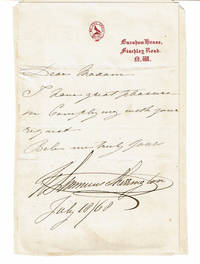
186896515July 1868. 1868. Very good. - Over 15 words penned on her 6-1/8 inch high by 3-7/8 inch wide "Burnham House Finchley Road" stationery with the address and the motto "Ex Una Omnia" surrounding the image of a bird embossed in red at the top. The soprano expresses her "pleasure in complying" with the recipient's request for an autograph. Signed "H. Lemmens-Sherrington". Once folded the note has been mounted with glue from the verso onto heavier stock which has been clipped from an album. Very good. <p>The English concert and operatic soprano Helen Lemmens-Sherrington 1834-1906 was born in Northern England though she spent much of her early life in Belgium studying at the Brussels Conservatory. Her London debut came in 1856 after having performed throughout Europe. Though she mostly sang roles in concert performances through the earlier part of her career she started appearing in operatic soprano roles in the first half of the 1860's performing at Covent Garden among other leading theaters. She later taught at the Brussels Conservatory as well as London's Royal Academy of Music and the Royal Manchester College of Music. July, 1868. unknown
1317420 North Side Clapham Common SW London. 19 December 1898. 2pp. 16mo. Bifolium. Very good on lightly-aged paper with small hole through both leaves at top inner corner. Beneath the signature the faint stamp of the St. James's Budget 15 Dorset Street EC. Raven-Hill points out that the Pall Mall Budget had only the right to use his drawings 'in that paper' and that he holds 'the entire copyright of all my drawings that appeared' in that magazine. 'If you want any of mine you could of course get the blocks from them & we could come to some arrangement about using them'. 20 North Side, Clapham Common, SW [London]. 19 December 1898. unknown
13411On letterhead of 11 Buckingham Gate S.W. London. 23 May 1911. 2pp. 12mo. In good condition on aged and worn paper. The letter reads: 'Dear Prof. Candy I think you would wish to see enclosed which please return after perusal. If you hear of anything kindly let me know. It is the most pressing difficulty we have and we see no present way of surmounting it. With renewed thanks always sincerely yours Mackenzie Bell'. On letterhead of 11 Buckingham Gate, S.W. [London]. 23 May 1911. unknown
18412221746<p>"C. J. Mathews" 1 page T.R.L.G. January 25 1841 to "Sir". 7 1/4" x 4 1/4" inlaid to size. Very good.</p><p>In part: "Before I send you the answer you demand and which you tell me is to be made the subject of a public discussion allow me to inquire whether I am at liberty to publish your letters."</p><p>Mathews born Dec. 26 1803 Liverpool England — died June 24 1878 Manchester England English actor dramatist theatre manager writer of comic sketches and one of the best high comedians ever to appear on the English stage.</p> unknown
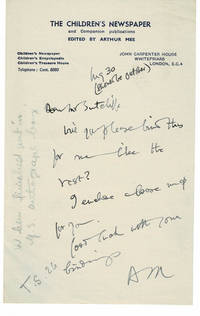
193898924London circa 1938. 1938. Fine. - Approximately 27 words penned on his 8 inch high by 5 inch wide "The Children's Newspaper" stationery. A brief letter in which Arthur Mee asks the book binder George Sutcliffe Sangorski & Sutcliffe "Will you please bind this for me like the rest." Signed "A.M". with a brief annotation in pencil in the margin most probably initialed by Sutcliffe: "When finished put in - Autograph box." Near fine. <p>The English writer journalist and educator Arthur Mee 1875-1943 is best known for "The Harmsworth Self-Educator" "The Children's Encyclopaedia" and "The Children's Newspaper". He left school at 14 to work at a local newspaper and became an editor by the age of 20. Contributing many articles he went to work for The Daily Mail in 1898 and subsequently became literary editor. Though they bore an anti-Catholic and anti-intellectual slant his books continued to be published after his death at 67 years old especially his guide to the counties of England "The King's England". "The Children's Encyclopaedia" was translated into Chinese and was published in the United States as "The Book of Knowledge". London, circa [1938]. unknown
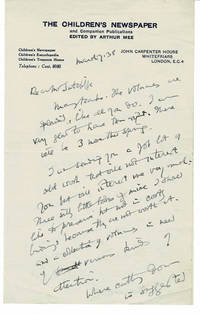
193898923London March 7. 1938. 1938. Very good. - Two pages consisting of over 140 words penned on 2 faces of his 8 inch high by 5 inch wide "The Children's Newspaper" stationery with an integral attached leaf. Arthur Mee thanks the book binder George Sutcliffe Sangorski & Sutcliffe for his work "Many thanks. The volumes are splendid like all you do." He informs him that he is "sending you a job lot of odd work that will not interest you but will interest me very much. Where cutting down is suggested I leave it to your discretion." Signed in full "Arthur Mee". Folded for mailing with a few light creased else near fine. <p>The English writer journalist and educator Arthur Mee 1875-1943 is best known for "The Harmsworth Self-Educator" "The Children's Encyclopaedia" and "The Children's Newspaper". He left school at 14 to work at a local newspaper and became an editor by the age of 20. Contributing many articles he went to work for The Daily Mail in 1898 and subsequently became literary editor. Though they bore an anti-Catholic and anti-intellectual slant his books continued to be published after his death at 67 years old especially his guide to the counties of England "The King's England". "The Children's Encyclopaedia" was translated into Chinese and was published in the United States as "The Book of Knowledge". London, March 7. 1938. unknown
1323233 St. Julian's Road Kilburn London N.W. 30 November 1881. 1p. 12mo. Good on lightly-aged paper. The letter reads: 'My Dear Sir I ought to have thanked you sooner for your kind note of the 21st. but I have been much occupied. It would be pleasant for me to try my hand on Byron or Browining but I could not dare do so without more chance of continuous work than I can hope for at present.' 33 St. Julian's Road, Kilburn, London N.W. 30 November 1881. unknown
1068320 July 1973; on letterhead of the Times Literary Supplement. 12mo 1 p. Twelve lines. Text clear and complete. Good on lightly-aged paper. Addressed to 'Mr. Stanford'. He is returning the poems Stanford has sent him possibly Stanford's edition of 'Pre-Raphaelite Writing' 1973 as he is 'not quite convinced' by them. Asks Stanford - if he still has 'some credit' with him - to review for the TLS the 'newly issued Complete Poems of Ivor Gurney'. Gives details of how Stanford should proceed if he is interested. 20 July 1973; on letterhead of the Times Literary Supplement. unknown
932815 June 1898; on letterhead of Weston Lodge 16 Grove End Road London NW. 12mo 1 p. Ten lines. Clear and complete. On bifolium with mourning border. Fair on aged and discoloured paper. Endorsing the application of Walter F. Stocks for 'the vacant professorship of landscape painting in Queen's College'. Stocks 'has been an exhibitor at the Royal Academy for many years' and Calderon 'has admired his paintings on our walls'. 15 June 1898; on letterhead of Weston Lodge, 16 Grove End Road, London NW. unknown
11665On letterhead of 9 Marlborough Place St John's Wood NW. 'Sunday Evening' no date. 3pp. 12mo. Bifolium with mourning border. Good on lightly-aged paper with thin neat strip of paper mount at head of third page. The sense of humour for which the St John's Wood Clique was known is reflected in the letter which begins: 'Marks Storey and I have just returned from Paris to which dissolute city we went to see the "Salon" and after a hard course of study of pictures frescoes elaborate "menus" at Champeaux and female costume reduced to its simplest form at Offenbach's Theatre - where it chiefly consists of a belt with a few small coins hanging about here we are home again - to Virtue Simplicity and Work!' He is sorry to be late replying: Horsley's friend's drawing is a good one and he has 'many friends better able than myself to advise him'. 'The sending in is to-morrow and so good luck to him - I am sure he thoroughly deserves it.' Calderon writes that he and his colleagues were all very sorry to learn the cause of Horsley's absence from the last meeting: 'it was badly attended - besides yourself - Ward and Leighton were absent - but very interesting as Cope brought forward his motion'. Calderon has 'seriously studied the "lighting" at the Salon' and wants to 'try it in one room here'. He ends by asking: 'Will you back me up' On letterhead of 9 Marlborough Place, St John's Wood, NW. 'Sunday Evening' [no date]. unknown
11844On letterhead of the Junior Athenaeum Club Piccadilly. 30 January 1874. 4pp. 12mo. Good on lightly-aged paper. He gives his 'best thanks' for his correspondent's 'watchful kindness'. As his 'acquaintance with Academicians is very limited' he has 'not yet solicited any one to propose me at the R.A.' and he 'would gladly accept Mr. E. M. Ward's obliging offer - and think Mr. G. D. Leslie or Mr Dobson would second me'. He made 'such a mistake' the previous evening by going to the Vestry Hall Chelsea. He found 'on reading the circular again how I had erred'. He regrets 'to have lost the pleasure of hearing you read Sir Jasper - Another regret not unmixed with shame is that the design for Mrs S. C. Hall's tales is not yet complete but in a few days I will send it.' Hall's 'Trial of Sir Jasper: A Temperance Tale in Verse' was published in 1873. On letterhead of the Junior Athenaeum Club, Piccadilly. 30 January 1874. unknown
198129029N. P. Andover Hampshire 1981. 1 page. 1 vols. 4to. To Wesley Hartley an educator and teacher. Note written in the upper margin of a letter folded else fine. 1 page. 1 vols. 4to. Responding to Hartley's query about some biographical details and his education he recommends that "you will find a more revealing answer to your questions in my autobiography " and that "It's above all important for writers to read widely continuously and above all for pleasure" <br/><br/> unknown
187835058London: January 14th 1878. 1878. Very good. - 17 words penned in black ink on a cream-colored 7 inch high by 4-3/8 inch wide sheet of his letterhead with his address printed at the top. The letter has been tipped onto a sheet of pink paper approximately 8-3/4 inches high by 7 inches wide. Signed "W. Morley Punshon". `The left edge of the mount is faded and both the letter & the pink paper are lightly rippled from the mounting. Very good. <p>Punshon writes to a Mr. Frendship: "I am quite unable to take any additional engagements. I am embarrased by the number I have".<p>William Morley Punshon 1824-1881 was an English nonconformist minister. Ordained in Manchester in 1849 he went to Chicago as the representative of the Wesleyan Methodist conference. He subsequently settled in Canada and did much to advance the cause of his denomination. His preaching and lectures drew great crowds both in Canada and the United States and he was five times president of the Canadian conference. He also restored the fortunes of the flagging Victoria college in Cobourg Ontario now Victoria University and created the great Metropolitan Methodist Church in downtown Toronto now Metropolitan United Church. London: January 14th, 1878. unknown
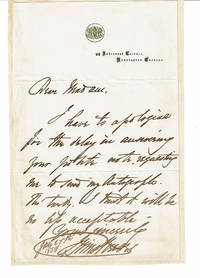
186896509Kensington Gardens January 27th 1868. 1868. Very good. - Approximately 32 words penned on his 7 inch high by 4-1/2 inch wide stationery embossed with his monogram and Kensington Gardens address. Replying to a request for his autograph Reeves writes "I have to apologize for the delay in answering your polite note requesting me to send my autograph." Signed "Sims Reeves" with the date penned within his signature's flourish. Once folded the letter is mounted with glue from the verso onto heavier stock clipped from an album. Very good. <p>Considered the foremost English operatic oratorio and ballad tenor vocalist of the mid Victorian era John Sims Reeves 1821-1900 received his early music education from his father who was a bass soloist in the Royal Artillery Band. He was appointed organist and choirmaster of North Gray church at the age of 14. He trained under Thomas Simpson Cooke first as a baritone and then a tenor while also learning to play several instruments. Kensington Gardens, January 27th, 1868. unknown
12127On letterhead of the Royal Masonic Institution for Boys Wood Green London. 10 June 1882. 2pp. 12mo. Bifolium. Very good on lightly-aged paper. In original envelope with stamp and postmarks addressed by Morris to Baron at 18 Griffin Street Witton Blackburn. Morris begins by giving details of the availability of his 'Etymology of Local Names' and 'Historical Outlines' before informing Baron a brazen autograph hunter that he does not know 'Wm. Morris' Address but a letter addressed to him & sent to his publisher would be forwarded'. On letterhead of the Royal Masonic Institution for Boys, Wood Green, London. 10 June 1882. unknown
11536St John's College Cambridge. 19 November 1721. 1p. 8vo. Bifolium. Twenty-seven lines of text. Good on aged paper with minor traces of previous mounting. Addressed with black ink circular postmark '20 NO' on reverse of second leaf ''To Mr Ellis att Mr Taverners in Thread-needle Street'. The letter begins: 'Nothing can yield Persons in our Stations greater Satisfaction than to be entertain'd in our silent Retirement with some harmless amusements from a facetious & learned Correspondent. for without these while we were endeavouring with ye uttmost Diligence to know ye World as some People please to call it we shouldn't att last know whether wee were in it or not; But like ye People that never go beyond ye Smoak of ye Town Chimneys stare att every thing wee see & imagine ye Rest of Mankinde to be a new Creation.' He explains that he has resolved to 'preserve a Correspondence with those I knew before' and to 'form a new one with those whose extensive Character only made 'em known to me'. He hopes to pay Ellis 'in Current Coin; which I hope you will comply with & speedily lay your demands on' Murdin. Between 1740 and 1759 Murdin published his valuable 'Collection of State Papers relating to affairs in the reign of Elizabeth from 1571 to 1596: transcribed from original papers and other authentic memorials left by W. Cecill Lord Burghley and reposited in the library at Hatfield House.' Johnson stated in Boswell's Life that the 'most literary conversation' he ever enjoyed was at the table of 'Jack Ellis a money scrivener behind the Royal Exchange' at whose house he at one point dined twice a week. St John's College, Cambridge. 19 November 1721. unknown
13400Note: 21 Beauvoir Street Portland Place London on his crested letterhead; 10 November 1869. Portrait: 'Photographed by Elliott and Fry London'. Note: 1p. 12mo. In fair condition lightly-aged laid down on paper with traces of glue to one margin. In response to a request for an autograph it reads: 'Novr 10/69 21 Beauvoir St Portland Place London. W. Dear Sir I send this in accordance with your request to Mr Lacy.' I am Dear Sir Yours R. H. Holden Esqre'. Engraving: On 14 x 10.5 cm paper laid down within border on 21 x 14 cm paper. Good: Photogravure 11 x 8 cm image cut from a magazine. Showing a bearded Horne in old age with velvet writing cap. Note: 21 Beauvoir Street, Portland Place, London, on his crested letterhead; 10 November 1869. Portrait: 'Photographed by Elliot unknown
980919 October 1867; Abinger Dorking Surrey. 12mo 2 pp. Bifolium. Twenty-two lines. Text clear and complete. Good on aged paper with closed tear at top part of gutter. His wife 'who always manages my St Anns Votes' says that his are engaged 'for two or 3 elections' but should circumstances change she will think of his request. The 'cards & cake' were safely received along with the news of Walton's 'change of estate'. He hopes to 'find him again a neighbour' the following season. Discusses the effects of the weather and asks whether Walton has 'sent to the Dudley an oil picture'. 19 October 1867; Abinger, Dorking, Surrey. unknown
909519 August 1844; Court of Bankruptcy. 12mo 3 pp. Thirty-three lines. Text clear and complete. Fair on lightly-aged paper with traces of mount on reverse of second leaf which is docketed 'C. Fane to G. Joy 19 Augt. 1844'. A significant and interesting letter on a topic later tackled by Dickens in 'Bleak House' by a judge who was an active member of the Law Amendment Society and whose decisions according to his entry in the Oxford DNB 'were frequently the subject of comment' although 'very few of his judgments were reversed on appeal'. Fane sympathises with Joy's 'misfortunes' as he does 'with the case of every man who has the misfortune to be involved in a Chancery suit'. There is however nothing that he could proposer 'relating to Insolvency or Bankruptcy' that could 'redress the wrongs to wh. the delays of Chancery have subjected you'. The main cause of these delays is the 'tossing of the suitor from the Judge to the Master & from the Master to the Judge till the subjt. in dispute is wasted in expense'. The only remedy is for the judge to be compelled 'to carry out his own desires without references to Masters' or to 'so raise the station power & responsibilities of Masters as that they shall become independent judges'. Small contemporary cutting laid down at head of first page reading 'SUBDIVISION COURT WEST SIDE. Commissioners. Sir Charles Frederick Williams kt. Josh. Evans esq. hon. Robert G. Cecil Fane.' 19 August 1844; Court of Bankruptcy. unknown
198129031Cornwall: St. Austell 1981. 1 page. 1 vols. 4to. To Wesley Hartley an educator and teacher.An aerograpm folded else excellent. 1 page. 1 vols. 4to. Responding to Hartley's query about his education he writes "I feel I owed everything to my high school education that was the foundation of every thing that was achieved subsequently.college experience is not necessary for creative writing. Examples-Shakespeare Dickens Hardy Kipling Jane Austen George Eliot the Brontes or Whitman Melville & others" <br/><br/> St. Austell unknown
7605'Au Mai Jouy Près Versailles 23 Juin 1834'. 12mo 4 pp. Bifolium. Good on lightly aged paper. Addressed to 'Monsieur et Confrère'. He replied to de Monglave's last letters a couple of days previously and he has addded 'deux ou trois propositions que je vous <fais> de traduire en bon François et de lire à notre comité au Conseil'. He wants to get to know 'quelques uns de mes voisins dans ce village où j'ai l'intention de passer six mois' and asks for letters of introduction. Lists four families he wishes to get to know and names some individuals with whom he is a little acquainted. In 1833 Bannister published in Paris an anonymous pamphlet entitled 'Appel en faveur d’Alger et de l’Afrique du Nord par un Anglais'. 'Au Mai, Jouy, Près Versailles, 23 Juin 1834'. unknown
186036704May 21st circa 1860s. 1860s. Good. - A few words penned in black ink on part of a sheet of letterhead 5-1/4 inches high by 4-1/4 inches wide with the embossed Privy Council seal printed in blind at the top. The paper is mounted on a piece of card of the same size. Signed "John Simon". The letterhead is slightly discolored from the mounting with 2 tiny brown marks near the top edge. The note was folded twice for mailing. There are glue marks remnants of paper & 2 ink notations on the verso of the mount. Good. <p>Simon writes that the change proposed by his correspondent is quite acceptable to him.<p>Sir John Simon 1816-1904 was an English pathologist surgeon and public health reformer. He held surgical posts at King's College Hospital and St. Thomas's Hospital in London from 1840 until 1876. Public health was not considered a responsibility of the government in the early 19th century. Parliament passed the Public Health Act of 1848 partly in response to Simon's influence and to deal with the threat of cholera and other public health problems. Simon was appointed the first Medical Officer of Health for the City of London. He was later made the head of the Medical Department of the Government and remained in that post until his retirement in 1876. Though he had no previous public health experience Simon's ongoing interest in pathology gave him a distinct advantage as a medical officer. He called for municipal action to provide adequate sanitary disposal and drainage improved standards of housing and upgrading of the water supply. His advocacy resulted in the Sanitary Act of 1875 which for the first time made a public health law universal and compulsory. Simon was also a member of Privy Council 1858-1876 and President of the Royal Society 1879-1880. May 21st, circa [1860s]. unknown