8 080 résultats
118467 Fitzroy Square London. 28 October 1850. 1p. 12mo. In good condition with slight discolouration from glue. Reads: 'Mr Eastlake presents his compliments to Mr. Mauld & begs to enclose a half sovereign for the young lady on whose behalf Mr. Mauld has applied to him. 7. Fitzroy Square Octr. 28. 1850.' 7 Fitzroy Square, London. 28 October 1850. unknown
118477 Fitzroy Square London. 5 February 1863. 1p. 12mo. Good with the blank second leaf of the bifolium having slight staining from mount and having laid down on it a newspaper cutting headed 'DEATH OF SIR C. EASTLAKE' docketd 'E & T Dec 26/65'. The note reads: 'Sir Chas Eastlake presents his compts. to Mr Whitaker & begs to inform him that Mr Millais' address is No. 7. Cromwell Place Kensington. S.W. 7. Fitzroy Sqr. London Feby 5 1863.' 7 Fitzroy Square, London. 5 February 1863. unknown
11704'Clifton Bristol. August 16th.' 1821. 2pp. 4to. Bifolium. Good on lightly-aged paper. Addressed by Elton on reverse of second leaf to 'John Taylor Esq.' Taylor had assumed the editorship of the London Magazine on the death by duel of John Scott in February 1821. Elton begins by informing Taylor that he has 'not been able yet to manage the Batrachomyomachia to my mind'. Elton's translation of 'The Battle of the Frogs and Mice' would appear anonymously in the issue of October 1821 as the second of a series named 'Leisure Hours'. He has instead 'sent some chit-chat to serve as an introduction'. 'On Homer's Battle of the Frogs and Mice' appeared in September 1821 as the first of the series. He intends this as 'the first of occasional desultory papers of criticism poetry or the like: a specimen or two of the Battle of Frogs may form the second of the series'. Changing the subject he now declines two books Taylor has sent him to review: he feels that too much has already been said about Madame de Stael and he has 'already administered the ferula to her somewhat roughly'. He is 'equally diffident about Bonaparte's literary character' and asks whether 'Mr Hazlitt or Leigh Hunt' are not 'the fittest men to undertake it'. He feels that to 'enter fully' into Taylor's 'plan relative to the Monthly Literature seems to require the interchange of sentiments in conversation' and that this is 'one of the disadvantages of a periodical contributor residing in the country'. He suspects that 'a London domicile' is 'necessary for the convenient and ready arrangement and execution of this sort of monthly summary'. He has been 'thinking of some regular supply of poetry translated or original independent of the incidental passages in the Leisure Hours' but has not yet 'ascertained either my plan or my powers'. In the first part of a postscript he asks 'What is Knickerbocker Washington Irving & is he worth reviewing' This appears to be a reference to a footnote to the 'Epistle to Elia' by 'OLEN' published in the August 1821 issue of the London Magazine; the footnote also discusses two readings of that poem thanks Taylor 'for the Magazine' and ends 'It is a pity the writer who so ably reviewed Crabbe does not continue his "Series of Living Poets." 'Clifton [Bristol]. [August?] 16th.' [1821]. unknown
9108'3 Queen Sq 1st. June <year>. 12mo 2 pp. In bifolium. Good on lightly-aged paper. Difficult hand. He has not considered the question carefully but his impression is that 'the Monopoly of the printing of the Holy Scriptures in Scotland and Ireland might cease by the Kings Printers not only without injuring but with benefit to the public'. '3 Queen Sq | 1st. June <year?>. unknown
1096319 October 1858; 32 Dover Street London. Draft of Wilberforce note dated 21 October 1858. 12mo 3 pp. Regarding the 'assigning of an income to the Regius Professor of Medicine out of the Ewelme Charity': 'I trouble you with a line to say that I have recommended the allowance of £250 a year and that when the revenues of the Charity shall reach £1000 a year it shall be submitted to the Court to increase the amount to £300 or £350'. Asks if there is 'any other matter connected with my office upon which you would wish for information before I seek a week or two's repose of which I have had none not even for an hour since I came into office.'. The note to Acland on the reverse of the second leaf of the bifolium is addressed to him at Lavington Petworth and signed 'Samuel Oxon': 'My dear Acland will you send me this back with a line saying if there is anything touching Ewelme you would have me express'. Written up one side of the letter Wilberforce has written 'When do you come' 19 October 1858; 32 Dover Street, London. Draft of Wilberforce note dated 21 October 1858. unknown
12359New Street. 9 August 1845. 3pp. 12mo. Bifolium. Fair on lightly-aged paper. It is not 'from inattention or indifference' that Kelly has left Barry's letter unanswered. 'I think it would be inconsistent with my duty in the office which I now hold to become a member of your very excellent association'. Possibly a reference to the Association for Promoting the Relief of Destitution in the Metropolis to which Barry was a subscriber in 1845. Kelly would however like Barry to convey 'to the gentlemen composing it . the deep interest I shall ever feel in the important question to which their deliberations & exertions are directed.' New Street. 9 August 1845. unknown
12628'Rolls Rolls House Chancery Lane - 15 June no year'. 4pp. 12mo. Bifolium. Good on lightly-aged paper. Palgrave begins: 'My dear Inglis/ I have had such avalanches last word underlined of business - and most of a confidential nature - that I have really been unable to write to you. By confidential business I mean business of a class which I cannot open to mhy clerks - and what must be either copied by my own hands or at home - If it had not been for Fanny Brown in addition to her sister I do not know what I should have done'. He has a 'distant notion' of his 'future plans': going to Albano in August and staying there until 'Rome becomes tolerably healthy'. He is in 'much perplexity about future residence' findigin it 'so difficult to suit me and your brothers'. He hopes to 'get rather more out of London' and thinks 'Mr Freshfield's house just behind Mr F<alke>'s may suit'. In the last paragraph Palgrave refers to 'K<> Hall' and the 'hope that Frank Palgrave's eldest son Francis Turner Palgrave 1824-1897 editor of the celebrated 'Golden Treasury' will fall upon his legs . But I can give no help in this matter however much I could wish.' 'Rolls [Rolls House, Chancery Lane] - | 15 June [no year]'. unknown
851627 September 1856; on letterhead of the Crystal Palace Sydenham. 12mo 2 pp. On grey paper. Twenty lines. Text clear and complete. Aged and with chipping to extremities and traces of mount on reverse. He is 'so cruelly busy just now with the investigations into the frauds lately perpetrated on the compy and with the anxieties & worries consequent thereon' that he can only forward 'the testimonial rewritten to the present date'. All the gentlemen he names - 'Paxton Laing &c are out of town just now'. Concludes: 'My support is a very poor one but I can really do no more just now.' On 1 November 1856 William Robson was found guity of frauds on the Crystal Palace Company amounting to around £28000 and transported for twenty years. 27 September 1856; on letterhead of the Crystal Palace, Sydenham. unknown
12886Address in bottom left-hand corner of 'W. Roberts 47 Lansdowne Gardens Clapham S.W.' Circa 1898. 1p. folio. Good on a lightly-aged piece of ruled paper. In two columns with the left-hand column written out by Roberts with his address at the foot headed 'Name of Exhibition' and listing twelve international exhibitions between 1862 Amsterdam and 1898 Brussels. The right-hand column headed 'Picture Exhibition' carries Alma-Tadema's responses some of which are written in darker ink than others indicating that they were added at more than one point. Alongside 'Paris EU 1867' he writes '13 pictures amongst them. the Education of the Children of Clovis the two above An entrance to a Roman theatre armuror's sic shop. Agrippina visiting the ashes of Germanius Egyptian game'. For 'Vienna 1893' and 'Melbourne 1880' he writes 'don't remember'. The last entry for 'Royal Scottish Academy: date' reads: 'A medal of Honorary Membership given on the occasion of my election to that honour. 1877.' While Roberts does not appear to have written on Alma-Tadema directly he was a voluminous author who at the time of writing had just completed a two-volume work on the London auctioneers Christie's 1897. See image. Address in bottom left-hand corner of 'W. Roberts 47, Lansdowne Gardens, Clapham, S.W.' [Circa 1898.] unknown
9663Without date or place. On piece of laid paper 5.5 x 8 cm. Clear signature on lightly-aged and spotted paper. From the collection of James C. Webster Secretary Athenaeum Club London who has written above the signature 'Royal Society of L<.>' and beneath it 'Sir Philip Francis author of "Junius"'. Without date or place. unknown
124758 Harley Street London. 15 June 1866. 1p. 12mo. Good on a piece of lightly-aged paper with fold lines. Possibly written in response to a request for an autograph. Reads: 'With Dr. Jenners Compts. & thanks - 8 Harley St June 15th 1866.' 8 Harley Street, London. 15 June 1866. unknown
12292Woodthorpe Road Ashford Middlesex. Undated. 2pp. 12mo. Fair on aged grey paper with slight chipping at one corner. The letter accompanies a copy of an unnamed play which Phillips hopes will interest Greenwood. 'I will stand or fall by it. I have learnt so much from your criticism more indeed than from any one that I should hope that you might continue possibly that line of such sane and helpful criticism which I have learned to look for from "the onlooker".' He concludes by declaring that there is no one to whom he is sending the book 'with greater pleasure'. In a footnote he states that he would consider it 'a very real privilege' if they might meet: 'I leave it to you.' There is no record of any work named 'The Onlooker' by an author named Greenwood but James Greenwood did use such pseudonyms as 'One of the Crowd' and 'The Amateur Casual'. Woodthorpe Road, Ashford, Middlesex. Undated. unknown
11988Grosenor St London. 5 March 1859. 2pp. 12mo. Fair on lightly-aged paper with minor water staining and a couple of spike holes. An intriguing communication beginning: 'I would not if I were you allow myself to be so worried.' Smirke feels that as 'Mess: Saunders & Co have not been backward in representing themselves as Principals in the matter' and as they 'are as largely as - or more largely interested' than Lloyd himself 'in obtaining a payment they had better themselves address Sir Robert'. Lloyd's 'character is safe as the naturalist and as the member of the firm who contributed science; Let them exhibit themselves as men of business'. He ends by urging Lloyd not to allow himself 'to be made instrumental in dunning'. Grosenor St [London]. 5 March [1859]. unknown
1113618 September 1904; Charterhouse Godalming. 4to 1 p. Fourteen lines. Text clear and complete. Fair on aged paper with negligible hole caused by wear not affecting text. He is enclosing a 'notice of the Joint Resolution' which 'recites facts gives reasons & is outspoken'. He has 'not had time to dwell much on its literary shape wh. is however not of great moment'. He has 'partly read Armstrong's book' Edward Armstrong fellow of Queen's College and is 'in sympathy' with 'a considerable part of the early addresses'. He could let Humberstone have a notice of it soon 'but I do not think I am prepared to "demolish" it though there is much perhaps to criticize'. He found the 'Article on Registration' 'excellent' and did not know it was Humberstone's. 18 September 1904; Charterhouse, Godalming. unknown
182533934London: 18th April 1825. 1825. Good. - Octavo. 25 words penned in black ink on a sheet of ctream paper approximately 6-3/4 inches high by 4-5/8 inches wide. The letter is mounted on a slightly larger piece of tan paper. Signed "Yours very truly / Daniel Terry" with his Alfred Place address and the date below the signature. There is some light staining to the letter's left bottom corner with some tiny marks to its left margin. Folded twice for mailing. Good. <p>Terry's note addressed to "My dear Kelly" is accepting an invitation to dine with Kelly and a mutual friend.<p>Daniel Terry c. 1780-1829 was an English actor and playwright who made his career in London Edinburgh and the northern English provinces. He was a close associate of Walter Scott and adapted several of Scott's works for the stage. The first of these was a musical adaptation of "Guy Mannering" in which Terry appeared in March 1816. [London]: 18th April, 1825. unknown
13811Place not stated. T. J. Cobden-Sanderson's signature dated 27 November 1907 and another dated March 1908. The rest undated. 1p. 12mo. Good on aged paper. At the head of the page is the elegant signature of 'T. J. Cobden-Sanderson 27 November 1907' followed by 'Anne Cobden-Sanderson' and 'Stella Cobden-Sanderson'. The fourth signature dated March 1908 is illegible. It is followed by 'J Paul Clairmont Clarence A. Mc.Williams Ralph Waldo Lobenstine'. Lobenstine 1874-1931 was a Yale-educated physician. Place not stated. T. J. Cobden-Sanderson's signature dated 27 November 1907, and another dated March 1908. The rest undated. unknown
12476Ramsdon sic. 24 January 1822. 2pp. 12mo. In a windowpane mount on a leaf removed from an album. The letter itself very good on aged paper; the mount worn at extremities. He begins by informing the recipient that his 'last Letter has made ample atonement for the provocation of the preceding' and he has 'ever been the foremost both in word & deed to keep my wings in motion. I speak this seriously: my former note was only a temporary petulance'. The second paragraph begins: 'I must positively have another Paper for my Orators'. He has 'run to a fearful length & yet have cramped myself all the way. Besides what I enclose I shall have ready as much to forward in the shape of reflexion inferences &c before I enclose with my legal oratory. And then I have the Political Oratory on my hands'. He continues: 'I engage to bring Demosthenes upon the stage in a new manner & when I have him there I should like to shew him to as much advantage as I can'. The letter continues in the same vein with a postscript beginning: 'Let me hear as soon as you can that my time of gestation is extended.' Ramsdon [sic]. 24 January 1822. unknown
114352 Leicester Place Leicester Square; 17 November 1819. 4pp. 4to. Bifolium. Good on lightly-aged paper. Addressed on the reverse of the second leaf to 'T: P: Cooke Esqre Royal Coburg Theatre' with two postmarks. The two men do not appear to have been related. TSC requests TPC's 'friendly interference to endeavour at getting from Mr. Chilvers music copyist to the Coburg Theatre a Symphony which he got from me two months since under a promise to let me have it copied in six days.' TSC states 'I have been seriously injured and am unlikely to be more so in my profession for want of it as it is a work of much labour and I have been compelled to repeatedly disappoint those to whom its perusal was to be submitted for their approval of my qualifications for a situation of considerable import to me-'. He has 'time after time allowed sufficient scope to avoid interference' with Chilvers' 'duty to the Theatre But in fact he trifles with me beyond all endurance and what is worse has made me appear to do so with others who have it in their power much to serve me.' He continues to complain of Chilvers' 'shameful neglect' and requests from TPC 'all the convenient dispatch in this affair in your power'. Accompanying the letter is an original engraved portrait by Thomson from Burgess of 'MR. T. COOKE AS CARLOS.' published in 1818 by Simpkin & Marshall. It is lightly spotted but otherwise in good condition on a 12mo leaf. 2 Leicester Place, Leicester Square; 17 November 1819. unknown
1330335 Little London Chichester. 23 December 1895. 2pp. 12mo. In very good condition on lightly-aged paper with pin holes to one corner. Addressed to 'The Edr. St. James's Budget'. 'To the best of my recollection the drawings I made for the P. M. Budget were sold to include copyright. If not stated - this was the understanding - and therefore my interest in them so far as Black and White is concerned has ceased. But should you think of adapting any of them to the purposes of coloured pictures - I think you would require my consent which I should be at liberty to give or not as I thought proper.' 35 Little London, Chichester. 23 December 1895. unknown
12294Undated 1943. The three items are stapled to one another in good condition on lightly-aged paper. The first item is the typescript which is 1p. 4to. It is addressed to 'Dear Brother Artist' and begins: 'You will possibly be rather surprised to receive a letter from me but after having spent most of my life in the Provinces I now find myself landed in London. I am surprised at the amount of discussion and activity that takes place here regarding the "politics" of the theatre - and realise how you in the Provinces are apt to get left out. With regard to Sunday Opening I think that this is a matter which primarily affects you personally. I am rather surprised to find that a few West End actors who know nothing of those train journeys from Scunthorpe to Lincoln via Plymouth because the Railway Company is repairing a tunnel - on Sunday! were opposed to bettering the travelling and working conditions of 75% of our Profession - and that means you again.' A reference to 'the Progressive bunch the anti-D.O.R.A.'S' follows with an injunction for 'those of you who are Equity members - to vote in the Ballot. Whether you are for or against - vote and vote now - post that card now.' The draft ends: 'Yours sincerely Signature block'. In a postscript Trinder apologises 'for poking my nose into something that appears not to concern me by sending you this book. But I feel it concerns everyone in the show business be it circus music-hall or the "legit." to give the Forces and the Public what they obviously want and need.' The facsimile of Trinder's signature the 'Signature block' referred to in the typewritten draft is 8.5 cm long on a 5 x 20cm strip of paper. The manuscript draft with several emendations is 4pp. 12mo and is written out in pencil on four leaves. A copy of Trinder's printed circular is among the Robert Donat papers at the John Rylands Library in Manchester. Undated [1943]. unknown
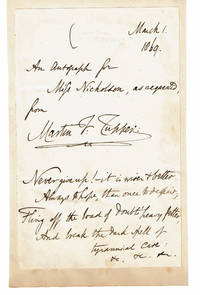
186996305Guildford Surrey U.K.: March 1 1869. 1869. Good. - A note on a 7 inch high by 4-1/2 inch wide sheet of his letterhead sending his autograph to a Miss Nicholson as requested and quoting 4 lines from one of his most famous poems. The letterhead has been mounted on a slightly larger sheet of card by the recipient. There are a few small stains to the edge of the note with light glue staining to the bottom edge of the mount. The note has been folded twice for mailing. Good. <p>Tupper quotes the first four lines of his famous poem "Never Give Up!": "Never give up!--it is wiser and better / Always to hope than once to despair; / Fling off the load of doubt's heavy fetter / And break the dark spell of tyrannical care / &c. &c. &c.". Tupper makes a change to the third line which reads "Doubt's cankering fetter" in the published version.<p>Martin Farquhar Tupper 1810-1889 was an English writer and poet. He was the author of "Proverbial Philosophy". Guildford, Surrey, U.K.: March 1, 1869. unknown
12882Kensal Manor Hourse Harrow Road; 11 March 1846. 3pp. 12mo. Bifolium. Good on lightly-aged paper. Ainsworth begins: 'My dear Mr. Fullom I am happy to tell you that you are under a great mistake. Your manner on the occasion you refer to produced the most favourable impression upon me.' Fullom 'exhibited great delicacy and modesty' and Ainsworth 'stated as much to Mr. Hurst'. The omission was in fact on Ainsworth's own part in neglecting to thank Fullom for his 'flattering proposal to dedicate your romance to me'. Ainsworth accepts 'this testimony of Fullom's regard with much pleasure' and assures him that he will watch his 'future career' with 'much interest'. He concludes by assuring Fullom that he will be happy to be of any assistance to him. Fullom's earliest book appears to be the novel 'The King and the Countess' published by Henry Colburn in 1849 dedicatee unknown. COPAC only carries one work of his published by Hurst & Blackett: the fourth edition of his 'The marvels of science and their testimony to Holy Writ' 1853. Kensal Manor Hourse, Harrow Road; 11 March 1846. unknown
929623 January 1919; on letterhead of the Savile Club Piccadilly. 12mo 1 p. Twelve lines of text. Clear and complete. Good on lightly-aged and creased paper. 'No cheque from the Bystander . my new novel will be out in two months or so. I intend to shock you with that.' Perhaps referring to George's 'Blind Alley' or 'Eddies of the Day' both published in 1919. 23 January 1919; on letterhead of the Savile Club, Piccadilly. unknown
2222172<p>"Evelyn Waugh" in black fountain pen ink Islington n.d. on his personal 17A Canonbury Square Islington N.1 North 5788 letterhead paper watermarked "Warriston Vellum" November 4 n.y. but ca. 1928 4 1/2" x 7" 1 page with integral leaf. Very good minor signs of handling.</p><p>To Henry Williamson</p><p>Letter thanking Williamson for his compliments on his recent novel.</p><p>In part: ".how surprising to get back the book.I enjoyed writing it which I gather is an unusual experience.we leave at the end of this week for a month or two in Constantinople."</p><p>See "diaries" page 301. Sunday November 11 1928 where Waugh discusses a visit with Henry Williamson and loan of a copy of "Decline and Fall."</p><p>In part: ".He is quite elderly - though I find him coupled with me in reviews as promising young writers - and wholly without culture."</p>
1116619 August 1844; 29 Devonshire Street Queen Square London. 12mo 2 pp. 21 lines. Text clear and complete. Good on lightly-aged paper. He thanks him for his 'letter Copy of Flora Macdonald' and asks which letters he gave him 'of travellers'. 'Richard Lander I cannot give you. Of John I can & of poor Stothard - who was murdered at Bokarra Bokhara & of Alexander Burnes - but my impression is that I gave you those'. He has 'not heard again from <Manahgie>' and thinks that 'Miss Cole had better have the ring in her own possession - tis better than nothing'. 19 August 1844; 29 Devonshire Street, Queen Square [London]. unknown