Aristotle; ID [John Dickenson] I DBiblio.com
6 484 résultats
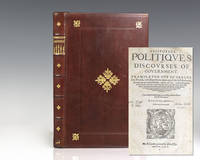
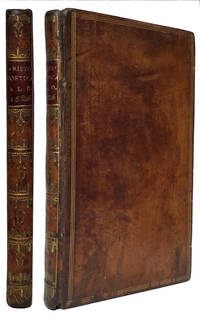
159854462London: Adam Islip 1598. Very good plus. First edition in English of one of the most influential political treatises in history. The works of Aristotle especially his ETHICS and companion POLITICS were considered foundational reading for any educated person from the Renaissance forward: all modern philosophers working in the Western tradition build upon or react against his work from Thomas Hobbes and John Locke to Karl Marx. According to Randolph Greenfield Adams "There are indeed few fields of thought in which it is so true that the would-be contributor finds that his 'contribution' has already been made by someone else and almost certainly by Aristotle as it is in the field of politics" 132. His POLITICS has had a direct impact on major historical turning points such as the American Revolution which was characterized by putting Aristotle's "theories and doctrines into practice" 134. <br /> <br /> Central to Aristotle's approach in this book is the idea that "man is by nature a political animal" Rackham translation. His conclusions rarely match today's views yet POLITICS "offers every reader entry into reflection on political life by raising fundamental questions: What is the aim of political community Why should some people govern others Who should count as a citizen" Deslauriers & Destrée 3. As the editors of PRINTING AND THE MIND OF MAN put it "his method still underlies all modern thinking." Folio 10.75'' x 7.25''. Modern period-style full brown goatskin gilt rules central gilt ornaments and cornerpieces elaborately gilt-stamped spine. Red speckled edges. Illustrated with woodcut initials and head- and tailpieces. Text collated complete lacking first and final blanks A1 NN6 as common. Table of chapters and errata at rear. 30 393 4 1 pages. A few early ink annotations in Latin. Two leaves T5 CC5 with corner folds before trimming. Some gatherings toned light spot of soil to title page a few leaves at beginning and end with archival paper repairs at margins. Adam Islip unknown
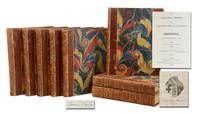
1812140947913London: Printed for the Translator by Robert Wilks 1812. First Edition in English. Very Good. First edition in English of the works of Aristotle one of 50 sets printed and boldly signed by the translator Thomas Taylor in ink at the end of the first volume. All volumes bear the armorial bookplates of noted bibliophile and Bronte family benefactor Frances Mary Richardson Currer 1785-1861. <p>Incomplete set with eight of ten volumes present of the complete translation. Uniformly bound by "J. Mackenzie Binder to the King" in contemporary half morocco over French Curl marbled boards with spines lettered and tooled in gilt; all edges gilt 4to. Very Good with wear extremities rubbed sporadic foxing hinges slightly tender. <p>Volumes include: 1. The Organon 1807. 2. The Treatises on the Soul 1808. 3.The History of Animals 1809. 4.The Treatises on the Parts and Progressive Motion on Animals etc. 1810. 5. The Rhetoric 1811. 6. The Great Edemian Ethics 1811. 7. A Dissertation on the Philosophy of Aristotle 1812.8. The Metaphysics first edition of 1801. <p>The first collected English translations of Aristotle's works from Orphic fragments by Neoplatonist scholar Thomas Tyler 1758-1835. Provenance of famed bibliophile and collector Frances Mary Richardson Currer whose well-curated and respected library expanded to nearly 20000 volumes. Bibliographer Thomas Frognall Dibdin remarked that she was "the head of all female book collectors in Europe." Known for her philanthropic endeavors she donated a sum of 50 pounds to Patrick Bronte father of Charlotte Bronte when he was widowed in 1821. Currer also contributed an unknown amount to the Clergy Daughter's School that the Bronte sisters attended. Scholars postulate that Charlotte chose the non de plume of "Currer Bell" for her first published 1847 novel Jane Eyre in honor of Currer's philanthropy. A desirable set even without Currer's bookplate that seldom comes up for sale. Printed for the Translator by Robert Wilks unknown
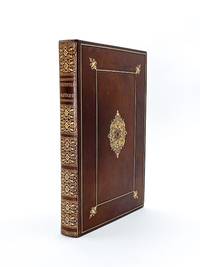
1598138658London: Adam Islip 1598. Rare first edition in English of one of the world’s most important and influential political texts “the most valuable work on that branch of philosophy that has descended to us from antiquity.†Small folio bound in full leather gilt titles and tooling to the spine front and rear panels. In near fine condition bookplate small name to the title page small paper repair to the first few pages. First editions are exceptionally rare. Aristotle’s Politics written circa 350 B.C. “is the most valuable work on that branch of philosophy that has descended to us from antiquity†McCulloch 356. It marks “a genuine attempt at political science. Aristotle shows the ways in which oligarchies fall and the variety of situations that may follow. He goes through the likely causes of revolution. He is conscious of classes and their interests†Levi 403. The work embodies “theories of perennial value and refutations of fallacies which are always re-emerging†Hazlitt 36. Aristotle’s history of mature Athenian democracy and the development of that city-state’s constitution greatly influenced modern political philosophy. Politics had a particularly profound effect on the formation of the United States government: Jefferson had a copy of LeRoy’s French translation in his library Sowerby 2347 and many of the basic tenets of the U.S. Constitution derive directly from Aristotle making him in some sense “the father of modern democracy†PMM 94. Title page with woodcut-engraved device woodcut-engraved initials head- and tailpieces. STC 760. Pforzheimer 10. Brueggemann 184-85. CBEL I:800. Cox I:59. Harris 14 Lowndes 68. Palmer 12. Smith 31. See PMM 38 94. Adam Islip hardcover
1472112<p>Very rare first edition mentioned by Goff of the<i> Introduction à la Philosophie de Platon</i> by Alcinous his disciple.</p><p>A superb and precious copy with huge margins ink rubricated initials and the first two letters illuminated the first one being enhanced in gilt.</p><p><b>Very rare first incunabula edition of the Introduction à la philosophie de Platon by Alcinous.</b></p><p>Given by Antoine Koburger.</p><p>It is the only one mentioned by Goff.</p><p>Goff A-365 ; Hain 620; Pellechet 419; Stillwell A-332 ; Proctor 1965 ; BMC II 412 ; Panzer p.9 ; Santander II n°58 ; A. A. Renouard <i>Catalogue de la bibliothèque d'un amateur</i> I p.174.</p><p>A superb and precious copy with rubricated initials in red ink and the first two letters illuminated the first one being enhanced in gilt. </p><p><i>"A rare piece."</i> Renouard</p><p>"<i>First very rare edition printed on long lines with no distinction of chapter or sections and without numbers signatures or catchwords. The totality of this volume is of 22 printed leaves: at the beginning there is a dedication epistle by the bishop of Tropea Petrus Balbus Pisanus author of this Latin version of Alcinous to the cardinal Nic. De Cusa ; then comes the text at the end of which we can read this subscription: Epitoma Alcinoi in disciplinaru Platonis definit. Anno salutis. M. CCCC. LXXII. Die vero XXIIII. Mensis Novebris."</i>Santander who lists this edition as being the first</p><p>Antoine Koburger 1443-1515 a German editor bookseller and one of the most distinguished and active printers of the 15th century was renowned for the "<i>Chroniques de Nuremberg</i>" he published in 1493.</p><p>Alcinous was popular in the 1st century CE.</p><p>A student of the school of Alexandria and faithful to its spirit he was one of the first to start blending into Plato's doctrine Aristotle's opinions and some oriental ideas. </p><p>There is sufficient proof of that in his <i>Introduction à la philosophie de Platon</i> a digest where he largely exposes this vast system while adding some foreign elements to it. For example when he speaks of spirits and demons he seems to know a lot more than Plato: to him some are visible and some invisible; he distributes them among all of the elements and tells us about their relationships their influence — before our eyes a complete demonology is born from which the only next step possible is towards magic." <i>Dictionnaire des Sciences philosophiques</i> pp.48-49 </p><p>We know of Plato and some of his texts; but there are only a few who have an accurate and precise idea of the whole philosophical system of the prince of philosophers. </p><p>Presenting to amateurs of philosophy a summarized tableau of what Platonism is was doing them a great favor. </p><p>This is what the Platonist philosopher Alcinous undertook and executed in this book that we can consider like a lost pearl in the dust of the centuries.</p><p><u>How intriguing it is to find gathered in a miniature frame a philosophical system that for so long sat at the highest level of the opinion especially nowadays when this kind of curiosity is hard to satisfy: for it is difficult to have in one's possession the complete works of Plato. </u></p><p><u>Plato's texts are numerous and quite diverse but there is no order that links the different treaties between them. This reduced map of Platonism must be considered very precious as it gives the mind the ability to grasp this vast ensemble at first glance. </u>J. J. Combes-Dounous</p><p>This translation of Alcinous' text is due to the talent of Pietro Balbus.</p><p><b>A superb and precious copy of this very rare incunabula edition with very wide margins height: 315 mm </b><b>rubricated initials in red ink with the first two letters illuminated the first one being enhanced in gilt.</b></p><p>The copy mentioned by BMC was only 303 mm high.</p><p>Provenance : Library of <i>Moreau</i> 10 December 1934 n° 18.</p> Antoine Koburger hardcover
LCS-1864053
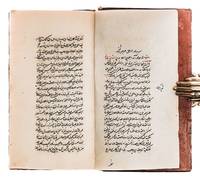
64949Timurid Persia circa 1500 AD. Arabic manuscript on paper 143 leaves plus 1 flyleaf 19 lines to the page written in black slanted naskh headings and important words in red occasional marginal commentary in a black gilt Safavid stamped binding with polychrome filigree doublures. An ownership note on folio 1A reads: The book Analut qiy which is the Book of the Syllogism authored by Aristotle and translated by Ibn al-Muqaffa' passed into the possession of the humblest servant Ibn Muhammad B qir Jaafar in the year nine hundred and eighty-one. The author: Ab al-Wal d Muhammad ibn Ahmad ibn Rushd 1126–1198 known in the Latin West as Averroes was one of the most influential thinkers of the medieval world. Born in Córdoba the great intellectual centre of al-Andalus he trained in law medicine theology and philosophy. His early career combined service as a jurist and physician with a deep engagement in the study of Aristotle whose works were being rediscovered and systematically commented upon across the Islamic world. Averroes' fame rests above all on his philosophical writings especially his vast series of commentaries on Aristotle for which he was hailed in Europe as The Commentator. These ranged from short epitomes to expansive line-by-line exegeses and together they provided the most comprehensive account of Aristotelian logic natural philosophy and metaphysics available in the Middle Ages. Translated into Hebrew and Latin from the thirteenth century onward his works shaped the course of scholastic philosophy influencing figures such as Thomas Aquinas Siger of Brabant and later Renaissance humanists. In the Islamic world Averroes stood at the intersection of philosophy law and theology. He defended the compatibility of reason and revelation in works such as Tah fut al-Tah fut The Incoherence of the Incoherence written in response to al-Ghaz l . He also contributed to medicine with his encyclopedic Kulliyy t the Colliget in Latin. His intellectual project reflected the dynamism of twelfth-century al-Andalus where Muslim Jewish and Christian scholars shared a common commitment to rational inquiry. Averroes' legacy embodies the transmission of Greek philosophy through the Islamic tradition into Europe making him a pivotal figure in the history of philosophy. The text: Talkh s Kit b al-Qiy s is Averroes' Middle Commentary on Aristotle's Prior Analytics the foundational treatise in which Aristotle first articulates the theory of the syllogism the core of ancient and medieval logical science and the starting point of the Organon. In the Middle Commentaries Averroes recasts Aristotle's arguments into a clear pedagogical style designed for teaching striking a balance between concise epitomes and exhaustive line-by-line exegesis. This tiered approach—short j mi' middle talkh s and long tafs r—is one of Averroes' major contributions allowing readers of different levels to engage systematically with Aristotelian logic and helping to establish his reputation as "The Commentator" in the Latin West. Aristotle's Prior Analytics holds a privileged position within the Organon laying out the rules by which valid conclusions necessarily follow from premises—the figures and moods of the syllogism. Because logic was regarded not as a science but as the instrument of all the sciences mastery of the Prior Analytics was essential for philosophical medical theological and legal reasoning throughout late antiquity and the medieval period. By reorganising and clarifying Aristotle's material Averroes ensured the continued vitality of the Organon-centred curriculum across Arabic Hebrew and Latin traditions keeping the art of demonstration central to intellectual life. The manuscript is especially valuable for its textual history. The opening folio attributes the work to the translation of Ibn al-Muqaffa d. c. 757 the celebrated Abbasid-era translator whose renderings of Greek philosophical texts—including the Organon—formed the earliest Arabic corpus of Aristotelian logic. This direct reference links the manuscript to a chain of transmission that stretches from early Abbasid translation efforts through Averroes' systematic commentaries to Timurid scribes who preserved the text for subsequent scholars. The influence of Averroes' logical writings was profound. From the thirteenth century his commentaries were translated into Hebrew and Latin and became core texts in universities such as Paris and Padua shaping scholastic debate and giving rise to the current of "Latin Averroism." Many scholastic philosophers including Thomas Aquinas encountered Aristotle primarily through Averroes' interpretative lens. Timurid Persia, circa 1500 AD. unknown
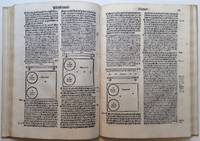
1517260577Venice: Luce Antony de Giunta 1517. hardcover. very good. Illustrated with a fine woodcut headpiece showing St. Thomas teaching; many decorative initials and in-text diagrams throughout and printer's device at end. 6 147 leaves with black letter Latin text printed in double columns. Folio later vellum-backed boards. Venitijs Impensis domini Luce Antonij de Giunta Florentini 1517. A tear in the title page has been carefully mended still a very good tight copy with some contemporary ink marginalia.<br/><br/> Scarce. OCLC lists only 5 copies including those at Cambridge NYU and University of Pennsylvania. An early edition of Saint Thomas Aquinas' 1225-1274 "great commentary on Aristotle's physics - the most important scholastic commentary on this seminal text of ancient science. Aquinas the philosopher is forever entwined with Aristotle as the former came onto the scene just as the Aristotelian corpus arrived in Latin translation and questions of the relation between faith and reason challenged the modus vivendi that had been in effect for centuries." USTC 859417<br/><br/> Luce Antony de Giunta unknown books
1517260577Venice: Luce Antony de Giunta 1517. hardcover. very good. Illustrated with a fine woodcut headpiece showing St. Thomas teaching; many decorative initials and in-text diagrams throughout and printer's device at end. 6 147 leaves with black letter Latin text printed in double columns. Folio later vellum-backed boards. Venitijs Impensis domini Luce Antonij de Giunta Florentini 1517. A tear in the title page has been carefully mended still a very good tight copy with some contemporary ink marginalia.<br/> <br/> Scarce. OCLC lists only 5 copies including those at Cambridge NYU and University of Pennsylvania. An early edition of Saint Thomas Aquinas' 1225-1274 "great commentary on Aristotle's physics - the most important scholastic commentary on this seminal text of ancient science. Aquinas the philosopher is forever entwined with Aristotle as the former came onto the scene just as the Aristotelian corpus arrived in Latin translation and questions of the relation between faith and reason challenged the modus vivendi that had been in effect for centuries." USTC 859417<br/> <br/> Luce Antony de Giunta unknown
153632482Venetiis Venice: Aldus In aedibus haeredum Aldi et Andreae Asulani soceri 1536. First Edition. Hardcover. iiii i 6-28 numbered leaves 26 numbered leaves 1 2 unnumbered leaves including index errata colophon and printer's device. Aldus engraved printer's device to title page and and verso of last leaf. Later full calf tooled in gold on the sides spine with gilt decorations and red morocco label lettered in gold all edges gilt marbled endpapers gilt inner dentelles. This exceedingly scarce title is extremely important in the history of humanist literature and marks Aristotle's influence on literature from the time of the Renaissance through the period of Romanticism. The rediscovery of the Greek philosopher's Poetics in the early 1500s had a profound impact on literary theory especially in poetry. The volume includes the Greek text plus Alessandro Pazzi's influential Latin translation and two fascinating prefatory letters. With the neat bookplate of noted translator and folklore aficionado Charles James Billson on the front pastedown endpaper. Internally extremely clean except for a small stain on the front free endpaper and to the top edge of the first few leaves. There are some old very faint annotations to the margins on some of the leaves. An extremely charming copy. Graesse I.213. "Ce petite volume est fort rare." Renouard Annales de l'imprimerie des Alde p. 275. ; Small octavo. Aldus (In aedibus haeredum Aldi, et Andreae Asulani soceri) hardcover
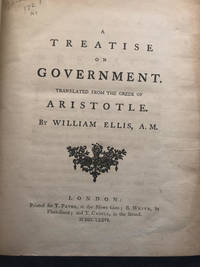
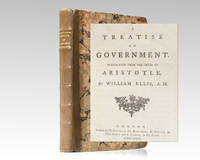
1776140942627London: T. Payne B. White and T. Cadell 1776. First English Edition. Near Fine. First English edition and the first edition in the English language; translated by William Ellis directly from the Greek. Fireside poet James Russell Lowell's copy inscribed to him by his friend American transcendentalist writer and artist C.P. Cranch. <p>Quarto. 8.75 x 11 in. 428 12 index pp. Bound in somewhat recent full calf with four raised bands and red leather spine labels titled in gilt. Browning to title page first blank is reinforced at edges and title page is re-margined. A touch of soiling and staining to preliminary pages and page edges sporadic foxing and light toning throughout with several light pencil ticks in the margins. <p>This was the only English edition of Aristotle's Treatise on Government from the 18th-century. A copy of this very text was owned by Thomas Jefferson and was influential among the founding fathers of the United States of America. A lovely copy of a scarce and important book. T. Payne, B. White, and T. Cadell unknown
177681182London: T. Payne 1776. First edition in English of this important work on government by Aristotle. Quarto bound in three quarters leather over marbled boards gilt titles to the spine raised bands. In very good condition with light toning to the text and wear. Bookseller plate of George Gregory Bath Sept. 22 1936 on the front pastedown. Translated by William Ellis. An important text in both the history of philosophy and in sparking the development of western political democracy. Ellis' translation was the first direct into English from the original Greek of Aristotle's "Politics." Loys Le Roy translated this work into French which was subsequently translated into English in 1597. Ellis' translation is considered more accurate and for many the most important translation in bringing Aristotle's treatise to enlightenment statesmen and philosophers. The bibliographer Lowdnes notes that Ellis' work appeared in this quarto edition 1776 priced at 15 shillings and was reprinted with little change in 1778. Lowndes praises Ellis' edition as "A faithful and perspicuous version." Aristotle's On Government via this English translation became a landmark text in the history of Western political thought a text which influenced late 18th and 19th century political thought in the English speaking world. Dr. B. E. Bryant notes that Thomas Jefferson owned a copy of the Ellis translation which influenced his drafting of the American Declaration of Independence: "Like most other well-educated individuals of his day Jefferson was thoroughly exposed to classical philosophy. We know for certain he owned a copy of the William Ellis 1776 translation of Aristotle's Politics and even cited Aristotle as one of the sources he used for the Declaration of Independence." Aristotle's "On Government" constitutes the first treatise of the conditions under which philosophy is possible within politics and thus the work that as much as any other founded political philosophy. The influence that this work has had on later political thinking is difficult to exaggerate and the fact that the work became available in a translation into English directly from the original Greek has been of the utmost importance to the development of political thought in England and America. Ellis' Aristotle is the only 18th century translation a an accurate and smoothly readable version that is still in print after more than 200 years. T. Payne hardcover
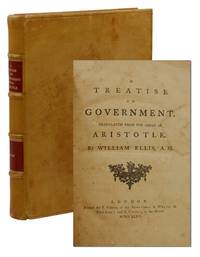
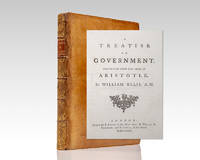
1776149288London: Printed for T. Payne at the Mew Gate; B. White in Fleet-street; and T. Cadell in the Strand 1776. First edition in English of Aristotle's' enormously influential work on government the only edition in the English language published during the 18th century. Quarto bound in full contemporary calf with elaborate gilt tooling to the spine in six compartments within raised gilt bands morocco spine label lettered in gilt gilt turn-ins. In good condition. A scarce and important work a copy of which was owned by Thomas Jefferson and influenced the drafting of the American Declaration of Independence. An important text in both the history of philosophy and in sparking the development of western political democracy. Ellis' translation was the first direct into English from the original Greek of Aristotle's "Politics." Loys Le Roy translated this work into French which was subsequently translated into English in 1597. Ellis' translation is considered more accurate and for many the most important translation in bringing Aristotle's treatise to enlightenment statesmen and philosophers. The bibliographer Lowdnes notes that Ellis' work appeared in this quarto edition 1776 priced at 15 shillings and was reprinted with little change in 1778. Lowndes praises Ellis' edition as "A faithful and perspicuous version." Aristotle's On Government via this English translation became a landmark text in the history of Western political thought a text which influenced late 18th and 19th century political thought in the English speaking world. Dr. B. E. Bryant notes that Thomas Jefferson owned a copy of the Ellis translation which influenced his drafting of the American Declaration of Independence: "Like most other well-educated individuals of his day Jefferson was thoroughly exposed to classical philosophy. We know for certain he owned a copy of the William Ellis 1776 translation of Aristotle's Politics and even cited Aristotle as one of the sources he used for the Declaration of Independence." Aristotle's "On Government" constitutes the first treatise of the conditions under which philosophy is possible within politics and thus the work that as much as any other founded political philosophy. The influence that this work has had on later political thinking is difficult to exaggerate and the fact that the work became available in a translation into English directly from the original Greek has been of the utmost importance to the development of political thought in England and America. Ellis' Aristotle is the only 18th century translation a an accurate and smoothly readable version that is still in print after more than 200 years. Printed for T. Payne, at the Mew Gate; B. White, in Fleet-street; and T. Cadell, in the Strand unknown
Bv2430<p>Aristotle. A Treatise on Government. Translated from the Greek by William Ellis. London: Printed for T. Payne and T. Cadell 1776. Quarto period style full calf gilt. First edition of the first English translation directly from the Greek of Aristotle's important work on politics and government. "The father of modern democracy" PMM 38. An exemplary copy. This influential work elucidates the political principles of Aristotle the father of political science and lays out his recommendations for the structure of government. Aristotle's timeless insights on governance law and the role of citizens in society are brought to life in this English translation by Ellis which lay on the shelves of Jefferson's own library. Jefferson later counseled that the Declaration of Independence's authority rested on the "harmonising sentiments" of the day including the works of Aristotle Cicero Locke and Sidney. As Ayn Rand noted in various writings on Aristotle Aristotle s philosophy was the intellect s Declaration of Independence FNI 22. In Rand s review of JH Randall s Aristotle she wrote Throughout history the influence of Aristotle s philosophy particularly of his epistemology has led in the direction of individual freedom of man s liberation from the power of the state…Aristotle via John Locke was the philosophical father of the Constitution of the United States and thus of capitalism The Objectivist Newsletter May 1963. Like America's Declaration this English translation of Aristotle's Treatise on Government loomed in 1776. The meticulous translation by William Ellis captures the essence of Aristotle's teachings offering a comprehensive and accessible exploration of the Master s thoughts on the workings of government and civic life. Scholars agree that the Ellis translation was one of the sources Jefferson consulted as he drafted of the Declaration of Independence. Two small ex libris stamps appear in the text one on the verso of the Title and another on P. 99. Pages are toned in the margins where occasional penciled notations appear not interfering with text. A beautiful copy handsomely bound. Book #Bv2430. $15000. We specialize in Rare Ayn Rand and other legends and landmarks.</p> William Ellis hardcover
1776151205London: T. Payne 1776. First edition in English of this important work on government by Aristotle. Quarto bound in contemporary half calf over marbled boards full morocco spine label raised bands. In very good condition. Translated by William Ellis. An exceptional example of this cornerstone work. An important text in both the history of philosophy and in sparking the development of western political democracy. Ellis' translation was the first direct into English from the original Greek of Aristotle's "Politics." Loys Le Roy translated this work into French which was subsequently translated into English in 1597. Ellis' translation is considered more accurate and for many the most important translation in bringing Aristotle's treatise to enlightenment statesmen and philosophers. The bibliographer Lowdnes notes that Ellis' work appeared in this quarto edition 1776 priced at 15 shillings and was reprinted with little change in 1778. Lowndes praises Ellis' edition as "A faithful and perspicuous version." Aristotle's On Government via this English translation became a landmark text in the history of Western political thought a text which influenced late 18th and 19th century political thought in the English speaking world. Dr. B. E. Bryant notes that Thomas Jefferson owned a copy of the Ellis translation which influenced his drafting of the American Declaration of Independence: "Like most other well-educated individuals of his day Jefferson was thoroughly exposed to classical philosophy. We know for certain he owned a copy of the William Ellis 1776 translation of Aristotle's Politics and even cited Aristotle as one of the sources he used for the Declaration of Independence." Aristotle's "On Government" constitutes the first treatise of the conditions under which philosophy is possible within politics and thus the work that as much as any other founded political philosophy. The influence that this work has had on later political thinking is difficult to exaggerate and the fact that the work became available in a translation into English directly from the original Greek has been of the utmost importance to the development of political thought in England and America. Ellis' Aristotle is the only 18th century translation a an accurate and smoothly readable version that is still in print after more than 200 years. T. Payne hardcover
149329071<p>Printed in Venice in 1493 by Simon Bevilaqua for Alexander Calcedonius this folio edition of Saint Thomas Aquinas's commentary on Aristotle's Metaphysics remains complete including the final leaf with the printer's mark. The volume represents a critical text in early philosophical scholarship combining scholastic interpretation with Aristotelian inquiry. The commentary captures core metaphysical themes including form substance and being. With 308 unnumbered leaves this folio presents the content in a clear typographic layout typical of Venetian incunabula. Entries appear in ISTC Goff GW HC and Proctor reinforcing its documentation among major catalogues. Edition: First Bevilaqua edition. Format: Folio 31cm x 23cm single volume. Condition: Very good. Collation: 308 leaves. Illustrations: One woodcut printer's device. References: ISTC it00246000; GW M46202; Goff T246; HC 1509; Proctor 5383. #00000 PHOTOS AVAILABLE UPON REQUEST.</p> for Alexander Calcedonius, Simon Bevilaqua hardcover
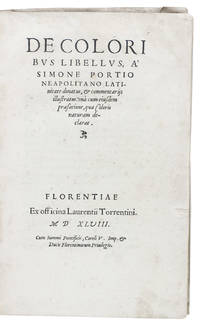
1548642CKI1RIA1QFlorence 1548. 4to. Lorenzo Torrentino Contemporary limp sheepskin parchment straight sewn on 3 wittawed thongs laced through the joints manuscript title down the spine with 4 fragments of a Latin manuscript in an upright humanistic hand on vellum used as spine lining. With 2 large woodcut historiated initials and a vine leaf ornament by Granjon Vervliet 178: 1st recorded in this year. Set in roman types with whole paragraphs in Greek 2 sizes and the dedication and some end matter in italic. 197 3 pp. First edition of one of the earliest printed books about colour translated from the Greek into Latin and with commentary by the Neapolitan physician and philosopher Simone Porzio 1497-1554. Usually attributed to Aristotle it is now thought to be the work of the peripatetic scholar and pupil of Aristotle Theophrastus.''As the author states at the end of the treatise it is intended rather to supply data for a detailed examination into the scientific theory of colour than to expound a complete thesis. He has realized that the development of colour in animals and plants depends to some extent on heat and he seems to suggest that heat and moisture are the controlling factors. It is of more value as a collection of observed facts than for any theory of the origin and development of colour in physical life'' Aristotle Minor Works Cambridge and London Loeb Classical Library 1936 p. 3.With some spotting on the title-page and some marginal tears not approaching the text but otherwise in very good condition and with large margins. Binding with the sewing supports broken a tear in the backstrip and some small stains. An important treatise on colour and one of the earliest.l Adams P1958; Caillet 8881; EDIT16 CNCE 16133; Hoffman I 289 "rare and very important"; Kemp The science of art p. 264; Schwab Bibliographie d'Aristotle 3503; USTC 803281. hardcover
18128308London: Printed for the Translator by Robert Wilks 1812. Mixed. 1/2 morocco. Very good. Lg. 4to. 8 vols. Uniformly bound by "J. MacKenzie Binder to the King" in contemporary half maroon morocco ornately gilt over marbled boards. A.e.g. Extremities a bit rubbed but all are in very good condition. Boldly signed by Taylor in ink at the end of the first volume. All of the volumes with the bookplate of Frances Mary Richardson Currer 1785-1861 called the "head of all female book collectors in Europe" by T. F. Dibdin. Eight of the ten volumes of the complete translation of Aristotle's works from the original Greek into English. Only 50 sets were printed and today they seldom appear for sale. There are some sets which have 11 volumes. These contain both the first edition of THE METAPHYSICS which Taylor translated in 1801 and printed in the same large quarto format and the second edition of the METAPHYSICS with significant added material revised for "The Works" in 1812. Our set offered contains the 1801 first edition as listed below. Lacking from our set are the volumes titled "The Physics" and "The Treatises on the Heavens etc." The eight volumes present in this set are the following: 1. The Organon. 1807 2. The Treatises on the Soul. 1808 3. The History of Animals. 1809 4. The Treatises on the Parts and Progressive Motion of Animals etc. 1810 5. The Rhetoric. 1811 6. The Great and Eudemian Ethics. 1811 7. A Dissertation on the Philosophy of Aristotle. 1812 8. The Metaphysics first edition of 1801. Printed for the Translator by Robert Wilks unknown books
1500284J<p>Venice: Simon de Luere for Andreas Torresanus 4 September 1500 1500.</p><p>Second edition after that of 1481. This copy is bound in contemporary 1/4 blind-tooled goatskin over wooden boards with 3 of 4 metal catches on front cover rebacked retaining most of original backstrip conspicuous termite damage on front cover rear cover replaced with modern board endpapers renewed; contents washed with residual soiling on opening leaves worming through much of volume generally not impairing legibility crude restoration in blank margins at beginning and end .G</p><p>Ethica Nicomachea Books 1-10 in the Latin translation of Robertus Grosseteste 1175-1253 incipit "OMnis ars et omnis doctrina similiter autem et actus et electio bonum quoddam ap=petere videtur. Jdeo bene enunciauerunt bonum quod omnia appetunt" b1r-y9v; colophon Venetijs impresse arte Simonis de Leure: impensis viro domini Andree Torresani de Asula. Anno M.D. die vero IIIJ. Septebris. y10r; printer's register y10r. Wood cut diagrams. The first Latin translations of Aristotle's Nicomachean Ethics the Ethica vetus and the Ethica nova are the object of six commentaries from the first half of the thirteenth century presumably written by Parisian arts masters. Typical for these early commentaries is the interpretation of Aristotle's doctrine in the light of Christian religion. In 1246/1248 Robert Grosseteste achieved a complete translation of the Nicomachean Ethics. The first to write commentaries on it were Albert the Great twice and Thomas Aquinas. Both attempted to interpret Aristotle philosophically avoiding the theological implications. Burley turned to moral philosophy and varia rather late in his life completing his exposition of Aristotle's Ethics in 1333-1334 and of the Politics in 1340-1343.</p><p>¶There are two printed editions of this work the one offered here is the second the first is quite rare-Goff B 1300 3 copies Harvardand St Bonaventure Univ. and University of Penn</p><p>¶The copy offered today is also rare- Goff B1301 3 copies</p><p>Free Library of Philadelphia Newberry Library U. of Illinois.</p><p>Goff; B-1301 ; BM 15th cent.; V 576 IB. 24667; GW; 5779; ; Hain-Copinger; 4144; Harman; 191; ISTC online; ib01301000; Proctor; 5269; Pellechet; 3080</p><p>.</p> Venice: Simon de Luere for Andreas Torresanus, 4 September 1500 hardcover
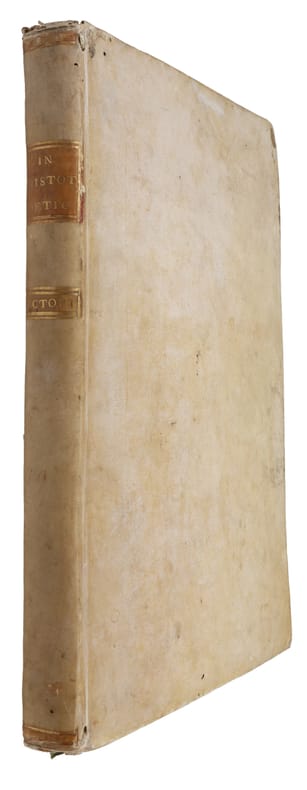
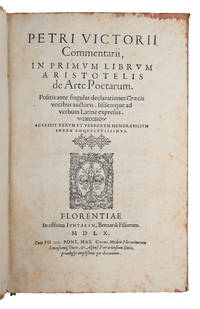
161062508Florence, In officina Iuntaru, Barnardi Filiorum, 1560. Small folio. 18th century full vellum with gilt labels to spine. Wear to capitals and small worm tracts towrad opper hinges. Corners a bit bumped. A very nice and sturdy binding. Marbled edges. Some browspotting throughout. Small wormholes to blank margin of final leaf, far from affecting imprint. Woodcut vignette to title-page and to verso of colophon-leaf. (10), 308, (12) ff.
161062508Florence In officina Iuntaru Barnardi Filiorum 1560. Small folio. 18th century full vellum with gilt labels to spine. Wear to capitals and small worm tracts towrad opper hinges. Corners a bit bumped. A very nice and sturdy binding. Marbled edges. Some browspotting throughout. Small wormholes to blank margin of final leaf far from affecting imprint. Woodcut vignette to title-page and to verso of colophon-leaf. 10 308 12 ff. <br/><br/><em>The rare first edition of Vittore's main work his great edition translation and commentary on Aristotle's Poetics which is arguably the most important and influential commentary on the work ever published profoundly shaping our understanding and interpretation of Aristotelian literary theory. Petrus Victorius or Piero/ Pietro Vittore/Vettore 1499-1584 is not only the “first great editor of the Poetics†McMahon he is also considered "the greatest Greek scholar of Italy" Whibley “the leading Italian scholar of his time†Encycl. Britt. “the last great figure from that period in the domain of Greek studies†Willamowitz and “the foremost representative of classical scholarship in Italy during the sixteenth century which for Italy at least may well be called the “saeculum Victorianumâ€.†Sandys. His magnum opus and without doubt most influential work is his edition with commentary of Aristotle’s Poetics which is of seminal importance in several respects. It is crucial to our understanding of Aristotle’s great work shaping the way that all later scholars have read it. The understanding of Aristotle’s work on poetry came to define the way that we have understood literature and fiction ever since the Renaissance and Victorius is the leading interpreter. ““From the sixteenth century to Romanticism European literary theory used the term marvel or wonder It. meraviglia ammirabile Fr. merveille Sp. maravilla to designate everything that was on the conceptual margins of the poetics of probability and imitation. The discovery and complete reception of Aristotle’s Poetics between the fifteenth and sixteenth centuries resulted in the dissemination of an idea of poetry as the imitation of the actions of men whose main part was the plot or the structuring of actions ordered according to the laws of necessity credibility and probability. This formed the basis of Neo-Aristotelian poetics which determined the ways of thinking about literature and fiction for more than four centuries.†Vega p. 280. Especially the idea of “wonder†in Aristotle’s Poetics came to be one of the founding ideas of modern literary theory. And especially here Victurius’ reading is groundbreaking playing a central part in the reception and understanding of the work over the centuries to come. “A single editorial decision in just one passage and what is more in a complex fragmentary unfinished text like the Poetics affects the entire work…†Vega p. 284. “The text of the Poetics that can be read in the editions and translations of the sixteenth century and a large part of the seventeenth with one exception as we shall see NB. This exception is Victorius does not include the term alogon in the passage that deals with wonder. It does not appear in the first Greek edition the famous Aldine princeps of 1508 or in the Latin translations of the end of the fifteenth century; it is not in the edition and translation by Alexander Paccius or Pazzi the one most widely read in the sixteenth century neither does it appear in the edition with commentary by Francesco Robortello nor in Vincenzo Maggi’s Enarrationes nor in the vernacular commentaries of Ludovico Castelvetro and Alessandro Piccolomini. What is more a detailed revision of the history of the text reveals that no manuscript of the Poetics and no direct or indirect testimonies not even in the Arabic branch of its transmission have ever included the term alogon.†Vega p. 282. It is Victorius who is solely responsible for the reading that is generally accepted today as well. “The moment when the idea of irrationality alogon appears for the first time in Aristotle’s text can be identified without hesitation as 1560 which is the date when the edition translation and commentary on the Poetics by the philologist and Hellenist Pier Vettori or Victorius was printed on the presses of Giunti in Florence. Vettori is the one who first edits alogon even though no testimony provides him with this reading and he does so fully aware of his choice and its implications†Vega pp. 287-89. “The success of Victorius’ reading while not immediate was extraordinary.†Vega p. 287 Antonio Viperano accepts the reading “alogon†with all it involves De poetica libri tres Ricciboni adapts it in his edition of Aristotle’s Poetics Tasso embraces it Discorsi dell’arte poetica Discorsi del poema eroico and it is implicit in Alonso López Pinciano’s Philosophia Antigua Poetica. Vossius in 17th century Germany makes abundant glosses on alogon in his books on poetics and the commentators and translators of the “Poetics†in France preferred Victorius’ reading in every case. “Victorius’ conjecture seems to have convinced all editors and commentators who reproduce it without question in every case.†Vega p. 289. The influence of Victorius’ interpretation of Aristotelian literary theory that he presented in his magnum opus i.e. the present work was not limited to the use of specific words that changed the reception history of Aristotle’s Poetics. His entire view of poetry through an interpretation of Aristotle was highly original and came to define the way we understand literature in general. Victorius was one of the first to put forth the belief that heroic poetry should present a Platonic idea of perfect virtue contributing to the centuries long doctrine of the perfect hero as perfect exemplar and he was one of the first to revive Aristotle’s idea of purgation from tragedy still widespread today and to also understand the existence of a purgation from poetry. “He viewed poetry as a moderator of minds “By reading poetry men “become moderate in temper and their turbid motions are extinguished.†Poems “purge our minds of blemish and spotâ€. Vettori realized that Aristotle’s reference to catharsis should be applied to tragedy alone but he added that similar purgations could be achieved by other kinds of poetry effective however on other passions than pity and fear and with the aid of other instruments.†Hathaway pp. 292-93. Apart from his overall interpretation of Aristotle’s literary theory and his groundbreaking reading of the most central passages of the Poetics Victorius was also the first to determine that the Aristotelian text that has come down to us is not complete. “Victorius was the first to see that the treatise now known as the Poetics is only the surviving portion of a larger work.†Bywater p. XX. “during his lifetime five medals were struck in his i.e. Victorius’ honour and his portrait was painted by Titian… His fame was not limited to his own land or his own time. His scrupulous care and unwearied industry are lauded by Turnebus who declines to be compared with him even for a moment; the epiteths doctissiums optimus and fidelissimus are applied to him by the younger and the greater of the two Scaligers while Muretus calls him eruditorum coryphaeus; and similar eulogies might be quoted from Justus Lipsius. Dacius … and Graevius. He is described as having climbed the “hill of virtue†and taken his place on its summit between Cicero and Aristotle. In his funeral oration Salviati says of him in the personification of Italia: “Now no more shall distant peoples cross the snows of the Alps to see Victorius or men of mark arrive from every land to hear him; or princes hold converse with him. Now no more shall the works of scholars in all parts of the world be sent here for his approval; or youth learn wisdom from his lips.†Sandys pp. 139-40. “No one said a contemporary of his in a funerary laudatio ‘left Aristotle in a cleaner state purgatior’.†Baldi. _____________________________________________ Adams: 1905; Brunet V: 1179; Graesse I: 213 â€Ã©dition excellente quant à la critique†and noting that some copies bear the dates 1563 and 1564. Sandys: A History of Classical Scholarship Vol. II 2003 pp. 135-140. Hathaway Baxter: The Age of Criticism: The Late Renaissance in Italy. Cornell University Press 1962. A.Philip McMahon: On the Second Book of Aristotle's Poetics and the Source of Theophrastus' Definition of Tragedy Authors. In: Harvard Studies in Classical Philology 1917 Vol. 28 1917 pp. 1-46. Christopher Rowe: Petrus Victorius and Aristotle’s Eudemian Ethics Cambridge University Press online 2025. Vega Maria José: Wonder and the Irrational. The Invention of Aristotle’s Poetics in the Sixteenth Century. In: Nous Polis Nomos. Berlin Academia Verlag 2016. Baldi: Il greco a Firenze e Pier Vettori 1499–1585 Alessandria 2014 117. </em> hardcover
149864765Venedig, Bartholomaeus de Zanis für Octavianus Scotus, 9. August 1498. 4°. Mit zahlr. tlw. figürl. Holzschn.-Initialen u. Holzschn.-Druckermarke von Scotus am Ende. 6 nn., 89 num. Bll. (ohne das letzte weiße), Späterer blindgepr. Ldr.-Bd. a. 3 Bünden im Stil d. Zt.
152014721Augsburg: Grimm & Wirsung 1520. Printed throughout in Roman letter of various sizes and mostly in double columns. First title page in red and black; heraldic woodcuts on second and third titles devices initials and text diagrams throughout. Final leaf with large woodcut of Saint Catherine on colophon is in facsimile on contemporary paper. Old vellum new endpapers; occasional stains and a few wormholes. This edition of Aristotle’s scientific works on the motion of heavenly bodies his physics meteorology on the process of birth and generation and on the soul of man was brought together by Johann Eck 1486-1543 and here first printed in Augsburg by Grimm and Wirsung. This is also the first time the beautiful heraldic woodcuts were used. Research suggests that the artist could be Hans Burgkmair who worked in Augsburg at the time the book was printed. Another source indicates the woodcuts could be by the “Petrarca-Master†or that Books 2 and 3 were done by Hans Weiditz.<br /> <br /> See F. Edward Cranz A Bibliography of Aristotle Editions 1501-1600: 107.846 p. 17; 107. 853 p. 18; 107.864 p. 19; Proctor 10873 10900 10914; VD16 A 3563 33793334; Metzler Eck 16 22 34. Grimm & Wirsung unknown
1550P8126The Works of Aristotle "per Des. Eras Roterordamvm" 1550. 2 volumes in one folio 323 x 192mm. Third Edition of The Works of Aristotle of the original text in 1831 prepared by Simon Grynaeus. This edition retains the original letter from Erasmus to Thomas More's son John. Woodcut initials a few woodcut illustrations old calf a few early annotations numerous notes in Latin Greek and English on front and rear flyleaves probably nineteenth-century and in text in ink pencil and red crayon neat annotations in Greek in second volume Greek quotation from Aristotle written on first title-page occasional light staining T5 torn in margin binding rubbed rebacked. Two of history's greatest minds converge. Book #P8126. $6500. We specialize in Rare Ayn rand erotica history and science. Johann Bebel and Michael Isengrin, 1550 hardcover
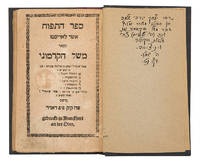
122188Frankfurt an der Oder Elsner 1800. . 8vo 18 x 11 cm; modern black cloth with Hebrew hand-written title to spine; 80 woodcut illustrations some browning to pages some staining to title; bookplate to front inner cover; 72 81-84 65-68 91-100 ll. misfoliated.<br /> Although the fable of Sefer HaTapuach is attributed to Aristotle there are claims that it is in fact a medieval Neo-platonic Arabic work of unknown authorship.<br /><br />Sefer Meshal HaKadmoni is considered to be the first fully illustrated printed book in Hebrew the first edition of which was printed circa 1491 in Brescia by the Soncino family printers with different illustrations.<br /><br />It is a collection of moral fables and animal stories by Isaac ben Solomon ibn Abi Sahula in rhyming prose interspersed with verse. Ibn Sahula who was both a scholar and a physician was born in 1244 in Guadalajara Castile and was a wanderer for much of his life. He was a student under the Kabbalist R. Moses of Bugros and wrote secular poetry until around 1281 when his outlook changed. It was then that he began to write Meshal Ha-Kadmoni.<br /><br />Ibn Sahula writes that his material is original but based on the Talmud and Midrashim and that in style he has followed the example of the prophets who presented moral lessons in allegorical form. He also sets out to demonstrate that Hebrew is as suitable a vehicle for conveying moral lessons as Arabic. The stories show both Kabbalistic and Indian influences.<br /><br />The use of animal characters is not typical in Jewish writing but Ibn Sahula employs this device in order to deliver the tale's moral in the clearest way possible. While animals in Christian fables were usually characterised by a single dominant characteristic the cowardly rabbit the cunning fox Ibn Sahula gave the animals in his fables complex characters and highly specific religious tendencies: the birds pray in a 'minyan' in a synagogue; the deer prays three times a day; and the lion dreams of making a pilgrimage to the Holy Land.<br /><br />Some eighty woodcut illustrations grace the 64 leaves of this book with one or two captioned woodcuts to a page. Though the illustrations resemble those of incunabula editions Meir Parenzo the printer of this edition commissioned an entire new series of woodcuts providing more detail and artistic sophistication. The illustrations were prepared by three different hands. <br /><br />The first edition of this work was printed circa 1491 in Brescia by the Soncino family printers with different illustrations.<br /> Vinograd Frankfurt 479. Frankfurt an der Oder, Elsner, 1800. hardcover
1514104082Venice: Gregorium de Gregorijs 1514. Rare 16th century printing of Aristotle's Posterior Analytics; bound together with Spanish Franciscan theologian Antonius Andreas's best known work Quaestiones super XII libros Metaphysicae Aristotelis. Quarto bound in contemporary parchment over handmade paper-covered boards woodcut initials text in two columns. In very good condition. A rare and desirable collection. The Posterior Analytics is a text from Aristotle's Organon that examines demonstration definition and scientific knowledge. In the work Aristotle distinguishes 'demonstration' as a syllogism productive of scientific knowledge and 'definition' as the statement of a thing's nature: the meaning of its name or of an equivalent nominal formula. In the Prior Analytics syllogistic logic is considered in its formal aspect; in the Posterior it is considered in respect of its matter. The "form" of a syllogism lies in the necessary connection between the premises and the conclusion. Aristotle concludes the book with the way the human mind comes to know the basic truths or first principles which are not innate because people may be ignorant of them for much of their lives. Of all types of thinking scientific knowing and intuition are considered as only universally true where the latter is the originative source of scientific knowledge. Gregorium de Gregorijs hardcover