6 501 résultats
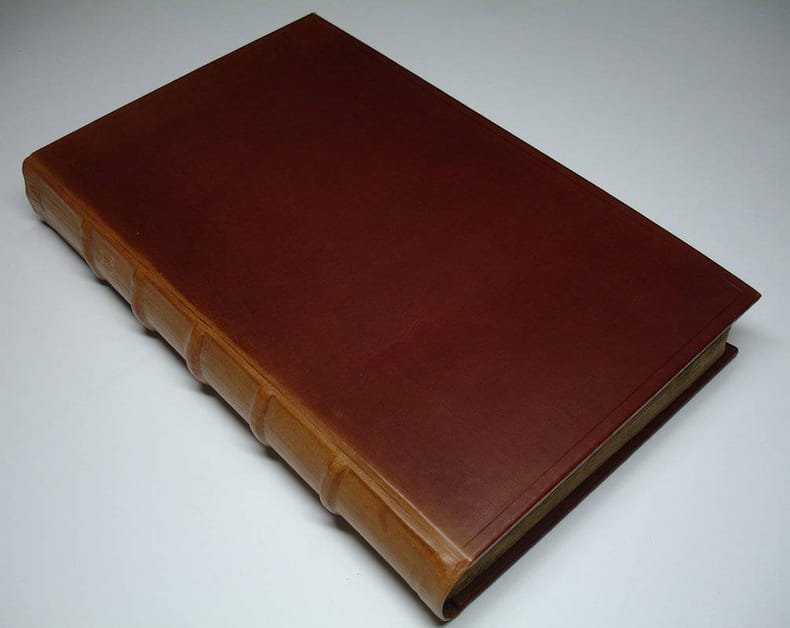
1807019227London: Printed for the Translator.by Robert Wilks 1807. Book. Very good condition. Hardcover. First Edition. Quarto 4to. iv 844 pages of text. Newly rebound in quarter leather with raised bands on spine and marbled paper-covered boards. The title page and several pages have minor creasing/wrinkling. The final page of text is signed by the translator Thomas Taylor. According to Lowndes this is the 2nd work in a 10 volume publication from 1806-1812 of Aristotle's Works. Only 50 copies of each was printed at the expense of William Meredith Esq. There is foxing scattered lightly throughout the text. Previous owner's engraved armorial bookplate was lifted and affixed to the inside front cover: William Page Thomas Phillips. Logic. Ammonius Saccas of Alexandria; Porphyry ca.234 - ca.305; Simplicius of Cilicia. First edition. Printed for the Translator...by Robert Wilks Hardcover books
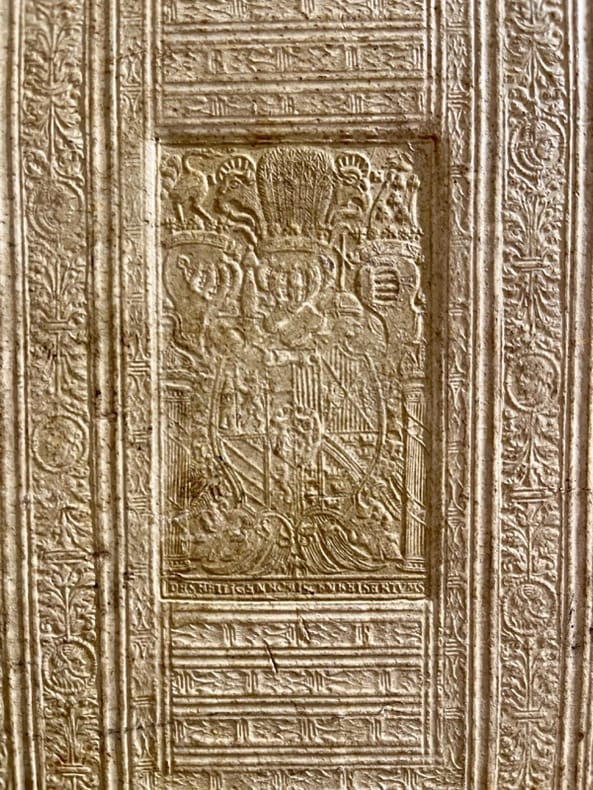
159020050Lugduni (pour Genève), Apud Iacobum Bubonium [et] Apud Guillelmun Leamarium, 1590. Deux tomes en un volume in-folio de [20]-751 (chiffrées 1-430; 435-755) -[1] et [4]-595-[65] pages, plein vélin sur ai de bois, dos muet à 5 nerfs, plats bordés de plusieurs roulettes dont une large aux entrelacs végétaux, et deux autres aux portraits de figures historiques, motif central du plat supérieur aux armes du Saint Empire romain germanique et au plat inférieur celles du grand électeur de Saxe, fermoirs en laiton.
198527324Penguin Books. As New. 1985. Paperback. FREE UPGRADE to Courier/Priority Shipping Upon Request - IN STOCK AND IMMEDIATELY AVAILABLE FOR SHIPMENT - -- with a bonus offer-- . Penguin Books paperback
15421412010050Venetiis: Brandinus & Octavianus Scotus 1542-01-01. Hardcover. Good. 0x0x0. Folio. 2 85p 48p 1. Bound in modern leather. 4 raised bands. Gilt title to second compartment. Printers imprint to final leaf. Fine binding and cover. New FFEP. Marginal dampstain throughout. Otherwise clean unmarked pages. <br><br>John Philoponus also known as John the Grammarian or John of Alexandria was a Christian and Aristotelian commentator and the author of a considerable number of philosophical treatises and theological works. A rigorous sometimes polemical writer and an original thinker who was controversial in his own time John Philoponus broke from the Aristotelian-Neoplatonic tradition questioning methodology and eventually leading to empiricism in the natural sciences. He established his own independent thinking in his commentaries and critiques of Aristotle's On the Soul and Physics. In the latter work Philoponus became one of the earliest thinkers to reject Aristotle's dynamics and propose the 'theory of impetus': i.e. an object moves and continues to move because of an energy imparted in it by the mover and ceases movement when that energy is exhausted an early that was the first step towards the concept of inertia in modern physics. <br>His works were widely printed in Latin translations in Europe from the 15th century onwards. His critique of Aristotle in the Physics commentary was a major influence on Giovanni Pico della Mirandola and Galileo Galilei who cited Philoponus substantially in his works often citing him more than Plato. Philoponus' main significance in the history of science lies in his being at the close of antiquity the first thinker to undertake a comprehensive and massive attack on the principal tenets of Aristotle's physics and cosmology an attack unequaled in thoroughness until Galileo. <br><br> LC: Adams P1058 Venetiis: Brandinus & Octavianus Scotus hardcover
15541506230049Venice: Apud Hieronymum Scotum 1554-01-01. Hardcover. Good. Folio. Original vellum. Minor soiling to cover. Good binding and cover. Later leather binding straps. Later end pages. Printer's device on title page. Text generally clean a few lines of early marginal notation and underlining. Collated: A-L8 M-M6 N-N4 in 8's with the title as leaf A1. Faint stain on first few leaves. Edito princeps 1535. Refs: British Museum p. 44. STC Italy Vol I. p. 99; Not in Brunet. <br><br> Johannes Philoponus John the Grammarian or John of Alexandria was an important Aristotelian commentator and Christian theologian. John's commentaries on Aristotle were influential on medieval and early modern thinkers in Europe such as Gianfrancesco Pico della Mirandola and Galileo. Philoponus has been seen as an important precursor to the establishment of empirical philosophy. <BR> In this book Philoponus comments on Aristotle's De Anima On the Soul and substantially modifies Aristotle's ideas. His commentary deals specifically with Aristotle's theory of light "Philoponus contends that Aristotle' view fails to account both for the laws of optics. Philoponus modifies the theory so as to save the phenomena he proceeds to re-interpret the term Energeia not as a state of actuality but rather as an 'incorporeal activity' which besides constituting the transparency of the medium is also capable of warming bodies.Due to this novel interpretation of Aristotle's terminology light is now understood not statically but as something dynamical." - Stanford Philosophical Encyclopedia. <BR>It should also be noted that since Michael Hayduck's edition Berlin 1897 it is generally assumed by scholars that the third book of the commentary that had been ascribed to John Philoponus wasoriginally written by Stephanus of Alexandria as is attested in the manuscript Parisinus gr. 1914 11th/12th cent. An important early work in physics and natural philosophy. Venice: Apud Hieronymum Scotum hardcover
79269Basle Basileae Eusebii Episcopii opera ac impensa 1582. Folio. XX62312 index1 printer's mark p. Modern calf 35.5 cm Details: Nice copy bound in modern full redbrown calf with 5 raised bands on the back. Spine short title in gilt: 'ARISTOTELIS / DE REPVBLICA'. Text in three columns with the Greek in the centre flanked by the Latin translations of Piero Vettori and Denys Lambin respectively on each side. Large printer's woodcut device to the title and last page depicting a bust of 'Hermes triceps' three-headed Hermes on a pillar; each of the heads wears a winged helmet; the middle Hermes holds in his right hand a caduceus and in his left a bishop's staff Episcopius!; from the pillar seems to hang a chopped off head. Large historiated woodcut letter on leaf a2 woodcut letters of various sizes throughout the text. Wide margins Condition: First and last leaf dust-soiled. Small and faint name on the title. Paper yellowing. Small bookplate on the front pastedown. 2 bookplates on the lower pastedown Note: The Greek scholar/philosopher Aristotle 384-322 B.C. is one of the foremost names in the history of thought and perhaps the most influential of all who have ever written. His influence on Werstern science and culture is immense. His boundless industry extended to most branches of higher learning. 74 treatises genuine and spurious have come down to us under his name. His 'Politics' literally 'the things concerning the polis' is among his best known and most widely read works. It embraces in 8 books the historical theoretical and practical aspect of politics. To Aristotle 'politics were the very crown of philosophical study . and the ultimate end of the State to provide an environment in which those capable of the highest mental and moral development might attain thereto. . The important sections of this great work are the sketch of the ideal state . the account of the various forms of government . the discussions of sovranty and responsibility and of kingship'. H.J. Rose 'A handbook of Greek literature' Oxford 1965 p. 276 § This Basle edition of 1582 of the Politics adopts the Greek text Latin translation and the famous commentary earlier published by the Italian scholar Piero Vettori Petrus Victorius 1499-1585 at Florence in 1576. Vettori professor of Greek and Latin in the 'Studio Fiorentino' at Florence was the greatest Italian Greek scholar of his time. His best known works in the field of Greek philology are his commentaries on Aristotle's Rhetoric 1548 Poetics 1560 Politics 1576 and Nicomachean Ethics 1584. Every chapter caput in this Politics edition of 1582 is printed separately followed by Vettori's very extensive and rich commentary. The Greek text is flanked by 2 Latin translations one of Vettori and one which the French scholar and Royal Reader in Greek Denys Lambin Dionysius Lambinus 1520-1572 had published in Paris in 1567. Added to the chapters are hot from the press the notes and diagrams of the Basle professor of Greek and Moral philosophy Theodor Zwinger Theodorus Zuingerus 1533-1588. He is best known for his editions of the Nicomachean Ethics Basle 1566 and the Politica of Aristotle Basle 1582 in which he transformed these works in a series of diagrams analysing and showing their structures in systematic tables. Appended are the 'Pythagoreorum fragmenta politica' in the edition of the French scholar Jean de Sponde or Johannes Spondanus 1557-1595 Provenance: Bookplates of: 'United Presbyterian Church. 'Brown library'. Glasgow 66 Virginia St.' and of 'United Presbyterian College. Brown-Lindsay Library. Shelfmark 3C1.1 No. 5154'. § Small bookplate 'Bibliotheca Classica Stephaniana' of the Swedish classical scholar Staffan Fogelmark on the front pastedown. Fogelmark was Reader in Greek 1972-85 at Lund University; Lecturer in Greek 1985-96. University of Gothenburg: Professor of Greek 1997-2004 Ref: VD16 A 3582 & VD16 P 5468. Bibliotheca Bibliographica Aureliana 38 no. 108.655; Hoffmann 1294. Griechischer Geist aus Basler Pressen no 129. Ebert 1166; Graesse 1214. Adams A 1914. Moss 1129; Not in Brunet Collation: alpha6 beta4 a-z6 A-2G6 Photographs on request Heavy book may require extra shipping costs hardcover
79269Basle (Basileae), Eusebii Episcopii opera ac impensa, 1582.
1542133014Parisiis: Ex officina Prigentii Caluarini ad Geminas Cyppas in Clauso Brunello 1542. Rare 16th century French printing of Aristotle's pioneering work on zoology which had a powerful influence on zoology for over two thousand years. Octavo bound in full polished calf engraved title pages. Rebacked. In very good condition. Written in the fourth century B.C.E. Aristotle's History of Animals had a powerful influence on zoology for some two thousand years. Generally seen as a pioneering work of zoology Aristotle frames his text by explaining that he is investigating the what the existing facts about animals prior to establishing the why the causes of these characteristics. The book is thus an attempt to apply philosophy to part of the natural world. Throughout the work Aristotle seeks to identify differences both between individuals and between groups. The work contains many accurate eye-witness observations in particular of the marine biology around the island of Lesbos such as that the octopus had color-changing abilities and a sperm-transferring tentacle that the young of a dogfish grow inside their mother's body and that the male river catfish guards the eggs after the female has left. Some of these were long considered fanciful before being rediscovered in the nineteenth century. It continued to be a primary source of knowledge until in the sixteenth century zoologists including Conrad Gessner all influenced by Aristotle wrote their own studies of the subject. Ex officina Prigentii Caluarini ad Geminas Cyppas in Clauso Brunello unknown
1545D11150Venice: Hieronymus Scotus 1545. Hardcover. Very Good. 8vo 157 x 106mm. 8 307pp. 13 leaves including final blank. Woodcut printers device of Scotus with personification of globe and motto FIAT PAX IN VIRTUTE Peace be with thee. Latin translation by Theodore Gaza. 12-line woodcut historiated initials at beginning of first chapter and at beginning of the Universalis generationis partitio. p. 224 of heraldry. Few woodcut initials throughout. Contemporary vellum; worn; spine and covers darkened; scattered stains worming affecting title next leaf and last 3 leaves; edges stained brown and gauffered to floral pattern. Sound copy enhanced by Latin marginalia in an contemporary hand. The Renaissance public as a part of their reading system frequently engaged Aristotles natural writings. Even at the height of this period at a time when Theodore Gaza had already produced his celebrated versions of Aristotles zoological corpus these works obtained wide recognition. <br/><br/>Aristotles zoological works edited by Theodore Gaza with Italian Renaissance commentary sparked on by the availability of Gazas text. Gazas version of the treatises were paraphrases of Aristotles zoological works but also included personal observations and information drawn from the other authors. Gaza in fact held a virtual monopoly on the biological works of Aristotle his translation completely overshadowing those before him and especially of his rival George of Trebizond. Gazas text had been used mainly as a source of quotations and only in philological and medical works such as Castigationes plinianae by Ermolao Barbaro or Benedettis Historia corporis humani. By 1521 starting with a course on the De Partibus animalium held in Bologna did the official Renaissance tradition of interpretation on Aristotles zoology take form. The Latin text which contributed to this renewed interest was none other than the elegant translation by Gaza. University Aristotelianism specifically that concerning the zoology was approached by the various interpreters in the context of systematic exploration of the encyclopedic work as a whole. The ample annotations of this volume showcase precisely this type of interaction with the evolving conversation. Gazas work throws light on Renaissance Aristotelianism carried out through the grid of scholastic commentary. Hieronymus Scotus hardcover
1545D11150Venice: Hieronymus Scotus 1545. Hardcover. Very Good. 8vo 157 x 106mm. 8 307pp. 13 leaves including final blank. Woodcut printers device of Scotus with personification of globe and motto FIAT PAX IN VIRTUTE Peace be with thee. Latin translation by Theodore Gaza. 12-line woodcut historiated initials at beginning of first chapter and at beginning of the Universalis generationis partitio. p. 224 of heraldry. Few woodcut initials throughout. Contemporary vellum; worn; spine and covers darkened; scattered stains worming affecting title next leaf and last 3 leaves; edges stained brown and gauffered to floral pattern. Sound copy enhanced by Latin marginalia in an contemporary hand. The Renaissance public as a part of their reading system frequently engaged Aristotles natural writings. Even at the height of this period at a time when Theodore Gaza had already produced his celebrated versions of Aristotles zoological corpus these works obtained wide recognition. <br/><br/>Aristotles zoological works edited by Theodore Gaza with Italian Renaissance commentary sparked on by the availability of Gazas text. Gazas version of the treatises were paraphrases of Aristotles zoological works but also included personal observations and information drawn from the other authors. Gaza in fact held a virtual monopoly on the biological works of Aristotle his translation completely overshadowing those before him and especially of his rival George of Trebizond. Gazas text had been used mainly as a source of quotations and only in philological and medical works such as Castigationes plinianae by Ermolao Barbaro or Benedettis Historia corporis humani. By 1521 starting with a course on the De Partibus animalium held in Bologna did the official Renaissance tradition of interpretation on Aristotles zoology take form. The Latin text which contributed to this renewed interest was none other than the elegant translation by Gaza. University Aristotelianism specifically that concerning the zoology was approached by the various interpreters in the context of systematic exploration of the encyclopedic work as a whole. The ample annotations of this volume showcase precisely this type of interaction with the evolving conversation. Gazas work throws light on Renaissance Aristotelianism carried out through the grid of scholastic commentary. Hieronymus Scotus hardcover books
201191612Continuum. New. 2011. Hardcover. 0826462715 . FREE UPGRADE to Courier/Priority Shipping Upon Request - IN STOCK AND IMMEDIATELY AVAILABLE FOR SHIPMENT - Flawless copy brand new pristine never opened -- 192 pages. Description: "A new account of Aristotles 'Ethics' this book argues for the central importance of the concept of techne or craft in Aristotles moral theory. Exploring the importance of techne in the Platonic and pre-Platonic intellectual context in which Aristotle was writing Tom Angier here shows that this concept has an important role in Aristotle's 'Ethics' that has rarely been studied in Anglo-American scholarship. Through close-analysis of the primary texts this book uses the focus on techne to systematically critique and renew Aristotelian moral philosophy. 'Techne in Aristotles Ethics provides a novel and challenging approach to one of the Ancient Worlds most enduring intellectual legacies. " -- with a bonus offer-- . Continuum hardcover
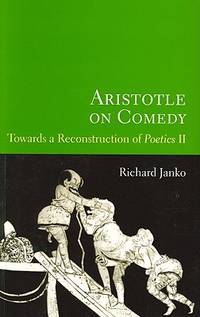
200334966United Kingdom: Duckworth Pub. New. 2003. Paperback. 0715631691 . FREE UPGRADE to Courier/Priority Shipping Upon Request IN STOCK AND IMMEDIATELY AVAILABLE FOR SHIPMENT - FLAWLESS COPY BRAND NEW PRISTINE NEVER OPENED - 320 pages; 5 3/8 x 8 1/2 inches -- In 1839 the Tractatus Coislinianus a summarised treatise on comedy was published from a tenth-century manuscript. Its discoverer suggested that it derived from the lost second book of Aristotles "Poetics" which inaugurated the systematic study of comedy but it was soon condemned as an ignorant compilation verging on forgery and thus matters stood until the first publication of "Aristotle on Comedy" in 1984. Richard Jankos edition of the text is accompanied by a facing translation interpretive essays reconstruction and commentary. The book is now made available in paperback for the first time with a new Preface and additional bibliography. -- REVIEW: "This is a splendidly vigorous book. Janko presents his case with enthusiasm and panache. He is forthright in expressing his own views and in denouncing the errors of other scholars. His arguments some of them complex are invariably clear - and often deliciously clever. Whatever the truth about TC Tractatus Coislinianus Jankos conclusions must be taken seriously. . No reader will be able to stay silent about this fascinating book." ----Jonathan Barnes "Phronesis" -- with a bonus offer-- . Duckworth Pub paperback
196952182La Salle IL: Open Court Pub Co. As New. 1969. Hardcover. FREE UPGRADE to Courier/Priority Shipping Upon Request IN STOCK AND IMMEDIATELY AVAILABLE FOR SHIPMENT - Text pristine clean & unmarked - 160 pages. -- with a bonus offer-- . Open Court Pub Co hardcover
52382New York: Carlton House. As New. N.D. Hardcover. FREE UPGRADE to Courier/Priority Shipping Upon Request IN STOCK AND IMMEDIATELY AVAILABLE FOR SHIPMENT - Text pristine clean & unmarked tight to the spine - ND Circa1950 337 pages -- with a bonus offer-- . Carlton House hardcover
196153801New York: Hafner Publishing Company. As New. 1961. Paperback. FREE UPGRADE to Courier/Priority Shipping Upon Request IN STOCK AND IMMEDIATELY AVAILABLE FOR SHIPMENT - Tight to spine - 233 pages -- with a bonus offer-- . Hafner Publishing Company paperback
194313498Walter J. Black. As New. 1943. Hardcover. FREE UPGRADE to Courier/Priority Shipping Upon Request - IN STOCK AND IMMEDIATELY AVAILABLE FOR SHIPMENT - Book In fine Condition -- with a bonus offer-- . Walter J. Black hardcover
27542Modern Library. As New. 1947. Paperback. 0394309731 . FREE UPGRADE to Courier/Priority Shipping Upon Request - IN STOCK AND IMMEDIATELY AVAILABLE FOR SHIPMENT - -- with a bonus offer-- . Modern Library paperback
14945The Library of the Liberal Arts / Bobbs-Merrill. As New. N.D. Paperback. FREE UPGRADE to Courier/Priority Shipping Upon Request - IN STOCK AND IMMEDIATELY AVAILABLE FOR SHIPMENT - AS NEW THE TEXT BLOCK IS PRISTINE CLEAN UNMARKED AND IN EXCELLENT CONDITION - - ND; c 1962 -- with a bonus offer-- . The Library of the Liberal Arts / Bobbs-Merrill paperback
196714633Regnery Gateway. As New. 1967. Paperback. FREE UPGRADE to Courier/Priority Shipping Upon Request - IN STOCK AND IMMEDIATELY AVAILABLE FOR SHIPMENT - AS NEW THE TEXT BLOCK IS PRISTINE CLEAN UNMARKED AND IN EXCELLENT CONDITION - - -- with a bonus offer-- . Regnery Gateway paperback
14041New York: Heritage Press. As New. 1964. Hardcover. 1199994448 . FREE UPGRADE to Courier/Priority Shipping Upon Request - AS NEW THE TEXT BLOCK IS PRISTINE CLEAN UNMARKED AND IN EXCELLENT CONDITION - .Decorated cover boards. -- with a bonus offer-- . Heritage Press hardcover
14776Everyman's Library. New. Hardcover. FREE UPGRADE to Courier/Priority Shipping Upon Request - IN STOCK AND IMMEDIATELY AVAILABLE FOR SHIPMENT - Book In fine Condition. Copyright 1964. -- with a bonus offer-- . Everyman's Library hardcover
85189Mentor / New American Library. As New. 1963. Paperback. 0451612175 . FREE UPGRADE to Courier/Priority Shipping Upon Request - IN STOCK AND IMMEDIATELY AVAILABLE FOR SHIPMENT - AS NEW THE TEXT BLOCK IS PRISTINE CLEAN UNMARKED AND IN EXCELLENT CONDITION - - Corresponds to: ISBN: 0451612175. 432 pages. -- with a bonus offer-- . Mentor / New American Library paperback
52571Oxford At the Clarendon Press. As New. Hardcover. FREE UPGRADE to Courier/Priority Shipping Upon Request IN STOCK AND IMMEDIATELY AVAILABLE FOR SHIPMENT - TEXT PRISTINE TIGHT TO THE SPINE - Corresponds to ASIN: B000VMA58E -- with a bonus offer-- . Oxford At the Clarendon Press hardcover
200791625Continuum. New. 2007. Hardcover. 0826494854 . FREE UPGRADE to Courier/Priority Shipping Upon Request - IN STOCK AND IMMEDIATELY AVAILABLE FOR SHIPMENT - Flawless copy brand new pristine never opened -- 256 pages. Description: "The work of Aristotle 384-322 bc is considered to be one of the great achievements of the ancient world and is a foundation of both Western and Middle Eastern philosophy and science. Although Aristotle left significant material on almost all branches of learning what has survived is a somewhat disorganized collection of notes and lectures. Moreover the centuries of interpretation across various epochs and cultures tend to cloud our understanding of him. Thomas Kiefer breaks through this cloud of interpretation and provides an organized account of one key part of Aristotle's philosophy namely his theory of knowledge. This theory concerns what is knowledge what we can know and how we can do so. Kiefer's book is the first work that takes this theory as its sole focus and reconstructs it systematically. Kiefer's work throughout provides many new interpretations of key parts of Aristotle's philosophy including an unnoticed -but crucial- distinction between knowledge in general and knowledge for us the differences between his semantic and psychological requirements for knowledge and 'nous' which is perhaps the most obscure notion in Aristotle's work. He also concludes with a summary of Aristotle's theory in the terms and style of contemporary epistemology. Kiefer's work should be of interest to anyone involved in the history of philosophy or contemporary epistemology." -- with a bonus offer-- . Continuum hardcover
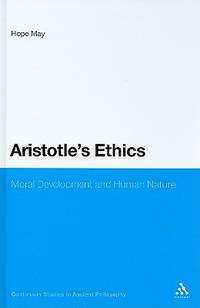
201091615Continuum. New. 2010. Hardcover. 0826491103 . FREE UPGRADE to Courier/Priority Shipping Upon Request - IN STOCK AND IMMEDIATELY AVAILABLE FOR SHIPMENT - Flawless copy brand new pristine never opened -- 204 pages. Description: "Aristotle's 'Nicomachean Ethics' is devoted to the topic of human happiness. Yet although Aristotle's conception of happiness is central to his whole philosophical project there is much controversy surrounding it. Hope May offers a new interpretation of Aristotle's account of happiness - one which incorporates Aristotle's views about the biological development of human beings. May argues that the relationship amongst the moral virtues the intellectual virtues and happiness is best understood through the lens of developmentalism. On this view happiness emerges from the cultivation of a number of virtues that are developmentally related. May goes on to show how contemporary scholarship in psychology ethical theory and legal philosophy signals a return to Aristotelian ethics. Specifically May shows how a theory of motivation known as Self-Determination Theory and recent research on goal attainment have deep affinities to Aristotles ethical theory. May argues that this recent work can ground a contemporary virtue theory that acknowledges the centrality of autonomy in a way that captures the fundamental tenets of Aristotles ethics." -- with a bonus offer-- . Continuum hardcover