1 706 résultats
174046487Amsterdam, Francois Changuion, 1740. Small 8vo. Bound in 2 fine contemp. full calf. Profusely gilt spines, title-and tomelabels in leather with gilt lettering. Gilt border on covers. Titlepages in red/black with engraved vignettes. CII,(2),429(6),550 pp. and 2 engraved plates, each with 3 portraits (Leibniz, Newton, Clarke). Printed on good paper. Internally fine and clean.
182044416Mainz Simon Müller'schen Buchh. 1820. Contemp. full mottled calf. Titlelabel with gilt lettering. VICXXVI3462 pp. A faint dampstain to lower right corners of thelast ca. 40 lvs. Clean and printed on good paper. German-Latin paralelltext. unknown
182044416Mainz, Simon Müller'schen Buchh., 1820. Contemp. full mottled calf. Titlelabel with gilt lettering. VI,CXXVI,346,(2) pp. A faint dampstain to lower right corners of thelast ca. 40 lvs. Clean and printed on good paper. German-Latin paralelltext.
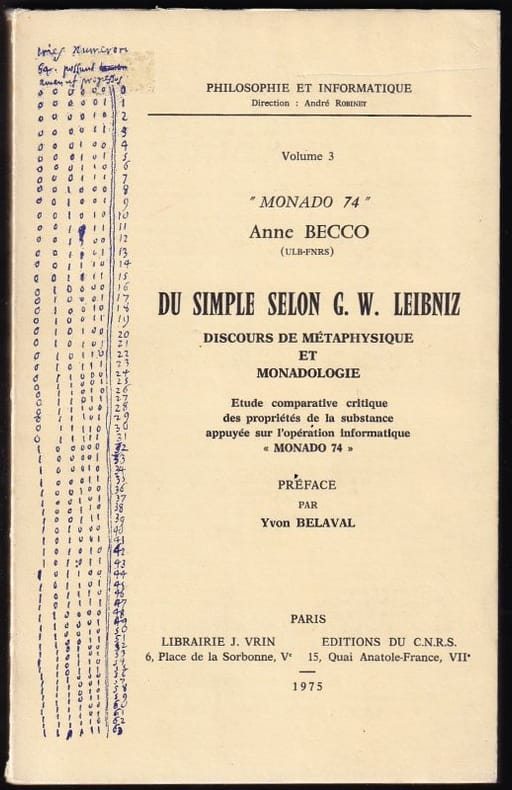
197518239Vrin 1975 Paris, librairie J. Vrin / éditions du CNRS, collection Philosophie et Informatique, 1975. Préface par Yvon Belaval. In-8 broché de IX - 198 pp. Très bon état, proche du neuf.
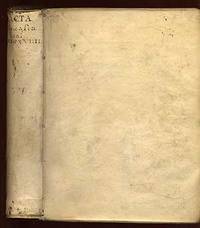
171958539Leipzig: Johan. Grossii Haeredes Joh.Frid. Gleditsch & Fil. Thomam Fritschium / Typis Bernardi Christop. Breitkopfii 1719. Hardcover. Near Fine. Quarto. Contemporary vellum. 540 pp. Indices errata. Four engraved plates one folding. Old institutional bookplate a nice near fine copy. Text in Latin. A volume in an annual series of books published from 1682 to 1734 containing surveys of recent advances in science and literature. Contains contributions by Leibniz and others. An attractive copy. Johan. Grossii Haeredes, Joh.Frid. Gleditsch & Fil., Thomam Fritschium / Typis Bernardi Christop. Breitkopfii hardcover
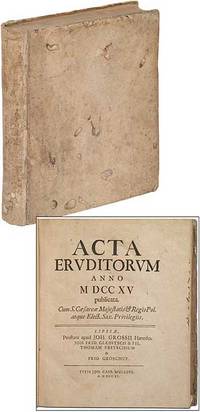
171556335Leipzig: J.OH. Grossii Haeredes Joh.Frid. Gleditsch & Fil. Thomam Fritschium & Frid. Groschuf 1715. Hardcover. Very Good. Quarto. 549 pp. Indices. Seven engraved plates three are folding. Contemporary stiff pastepaper boards. Some spotting to the boards still a sound very good copy. Text in Latin. A volume in an annual series of books published from 1682 to 1734 containing surveys of recent advances in science and literature. Includes Leibniz de Origine Francorum disquisitio. An attractive copy. J.OH. Grossii Haeredes, Joh.Frid. Gleditsch & Fil., Thomam Fritschium & Frid. Groschuf hardcover
168345599Leipzig Grosse & Gleditsch 1683. 4to. Without wrappers. In: "Acta Eruditorum Anno MDCLXXXIII" No.III X March and October issues. Pp. 81-128 pp. 417-464 a. 2 engraved plates. Entire issues offered. Tschirnhaus's papers: pp. 122-124 pp. 433-437. Some browning as usual. <br/><br/><em>First appearance of Tschirnhaus's two papers in which he used infinitisimal methods which were very close to Leibniz's method and where he tried to lay down criteria for rational quadratures in the case of conic cubic and quadratic curves papers that led Leibniz to publish his first paper on the differential calculus the "Nova Methoda" in the Acta for 1684 in order to secure his priority over Tschirnhaus concerning the calculus. Leibniz discovered when he read Tschirnhaus' papers that Tschirnhaus had here published results showing similarity with Leibniz's invention of the calculus as he had confided to Tschirnhaus earlier during their Parisian stay and this without references to Leibniz.The second issue contains an original paper by LEIBNIZ: "Meditatio Juridico-Mathematica de Interusurio simplice". Pp. 425-32. </em> unknown
1313823120.Gpaperback. Good. Access codes and supplements are not guaranteed with used items. May be an ex-library book. paperback
1313397644.Gpaperback. Good. Access codes and supplements are not guaranteed with used items. May be an ex-library book. paperback
2006LFA-126719576Revue trimestrielle fondée par Raymond Aron : 288 pages, format 185 x 255 mm, brochée, bon état
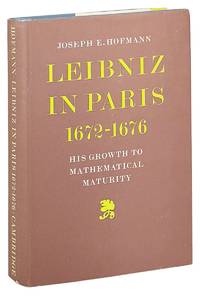
197446578Cambridge: Cambridge University Press 1974. Very Good/Very Good. Cambridge: Cambridge University Press 1974. First U.K. Edition. Octavo; publisher's boards in brown price-clipped dust jacket designed by Michael and Shirley Tucker; xi1372pp.; portrait frontispiece mathematical equations throughout. Light shelf wear to jacket margins very slight spine lean corners bumped else Very Good and sound. Ownership ex libris of the late chemist and bibliophile Sydney Ross to front pastedown. Cambridge University Press unknown
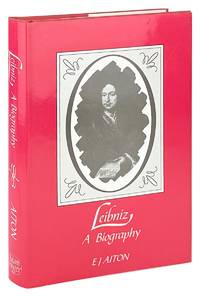
198546582Bristol: Adam Hilger Ltd 1985. Fine/Near Fine. Bristol: Adam Hilger Ltd 1985. First Edition. Octavo; publisher's boards in pictorial dust jacket; xiv370pp.; halftone illus. throughout. A Fine copy. Adam Hilger Ltd unknown
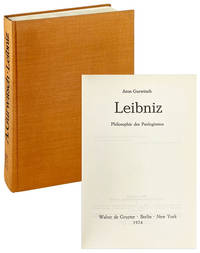
197426719Berlin: Walter de Gruyter 1974. Very Good. Berlin: Walter de Gruyter 1974. Octavo. 495 pp. Brown boards stamped in black. No dust jacket. Text in German. Light shelfwear and dust soiling to edges of boards and corners bumped. Binding is sound. Previous owner's inscription to front free endpaper but pages otherwise unmarked. Walter de Gruyter unknown
171744194Leipzig Grosse & Gleditsch 1717. 4to. In: "Acta Eruditorum Anno MDCCXVII". The entire volume offered in contemporary full vellum. Hand written title on spine. A yellow label pasted on to top of spine. A small stamp to title-page and free front end-paper. Library label to pasted down front free end-paper. As usual with various browning to leaves and plates. Pp. 317-322; Pp. 322-336; Pp. 353-360; Pp. 360-362. Entire volume: 4 553 39 pp. seven engraved plates. <br/><br/><em>First printing of the famous Libnitz-issue of Acta Eruditorum published a year after the death of Leibnitz including the renowned obituary by the German philosopher Christian Wolff. In 1706 Leibniz recommended Wolff for the Professorship at Halle the post Wolff held for seventeen years until his dismissal and in 1711 Leibniz sponsored Wolff's membership to the Berlin Academy. It is also mentioned that during the year of Leibniz's death in 1716 Leibniz visited Wolff in Halle when returning to Hanover from Vienna. To honor Leibnitz memory Wolff undertook the project of writing ELOGIUM GODOFREDI GUILIEMI LEIBNITII a treatise of the life of Leibnitz. As early as 1679 George I acting as Leibnitz patron directed him to write the history of the house of Brunswick. Immediately after he began arranging material he had collected. The work was however only the preparatory steps when Leibnitz died in 1716 and the work was never published. The present paper NOTITIA DE HISTORIA BRUNSUICENSI is the only part of the work which could have become a opus magnum with historiography that has ever been published. The volume also contains:Goldbach Christian. Temperamentum Musicum Universale. Pp. 114-15.And many other papers by influential contemporary mathematicians philosophers and historians. </em> hardcover
169632Hannov. et Gurlpherpit Hannover Wolfenbütte: Gothofredi Freytagii Gottfried Freytag 1696. First edition. Papered spine. Printer’s device on last page. In fine condition. First edition. Papered spine. Printer’s device on last page. 8º; a1–b8 c1–3 .; 37 1 p. <p><br /> Scarce pharmacological work on the ipecacuanha root that can be used as an emetic nauseant expectorant and diaphoretic. <br /> <p><p><br /> “Relatio ad inclytam Societatem Leopoldinam Naturae Curiosorum de novo antidysenterico Americano magnis successibus comprobato†Relation to the Illustrious Leopoldine Society of Naturalists Concerning the New American Anti-Dysentery Drug Attested with Great Success is Leibniz’s most comprehensive and influential contribution to the history of medicine and pharmacy. <br /> <p><p><br /> Leibniz wrote the treatise after he read the study on ipecacuanha root written by Willem Piso and Georg Marggraf published in Historia naturalis Brasilia 1648 and evidently after conducted experiences with the root himself. The root was made famous after it was used successfully to treat the King of France Louis XIV’s dysentery in 1672 by the Dutch physician John Frederick Helvetius 1625–1719. <br /> <p><p><br /> The work has been published in the same year as an appendix to Martin Lister’s “Sex exercitationes medicales de quibusdam morbis chronicis†Frankfurt and Leipzig 1696 and also to “Miscellanea curiosa sive Ephemeridum medico-physicarum Germanicarum†Nuremberg 1696. Lister’s work was printed by Freytag too the difference is merely the lack of the colophon on the “Lister-editionâ€.<br /> <p><p><br /> Ref.: Smith J. E. H.: Divine Machines. Leibniz and the Sciences of Life. Princeton University Press 2011.; Dutens II. 2. pp. 110–119.; Ravier 36.<br /> <p>. Gothofredi Freytagii (Gottfried Freytag) unknown
171244073Leipzig Grosse & Gleditsch 1712. 4to. In: "Acta Eruditorum Anno MDCCXII". The entire volume offered in contemporary full vellum. Hand written title on spine. A yellow label pasted on to top of spine. A small stamp to title-page and free front end-paper. Library label to pasted down front free end-paper. As usual with various browning to leaves and plates. Pp. 167-69. Entire volume: 2 555 35 pp. five engraved plates. <br/><br/><em>First printing of one of Leibniz's latest publications in which he proposed an interpretation of infinitesimals by a comparison of bodies of different extensions. The paper is a response to to a problem raised by French philosopher and mathematician Antoine Arnauld who wrote an important philosophical work known as "The Logic of Port-Royal" from 1662 and "Geometry" 1667. In the book he includes an example of symbolic rules that he considers to be against our basic intuitions on magnitudes and proportions. His reasoning goes as follows "Suppose we have two numbers a larger and a smaller one. The proportion of the larger to the smaller one should evidently be larger than the proportion of the smaller to the larger one. But if we use 1 as the larger number and - 1 as the smaller one this would lead to 1/-1 > -1/1 which is against the rules of algebra". Heeffer The Methodological Relevance of the History of Mathematics for Mathematics Education 1992.Leibniz saw this as a genuine mathematical problem but argued that the division should be performed as a symbolic calculation. "Following Leibniz the infinite appeared in two forms as the i Contiuous infinite and ii the discrete infinite. The status of the differentials is closely related to the status of the infinite. . As a consequence there is no clear and consistence distinction between continua of different kind related to i geometry and to ii mechanics. . Leinbiz did neither consequently argue mathematically or arithmetically nor consequently geometrically phenomenologically and mechanically. But The correlation between mathematics and physics is as impressive as possible. Suisky Euler as physicist 2009 p. 89-90.The volume also contains:Bernoulli Johann. Angulorum arcuumque sectio indefinita per formulam universalem expressa. Pp. 274-277; 329-30.And many other papers by influential contemporary mathematicians philosophers and historians. </em> hardcover
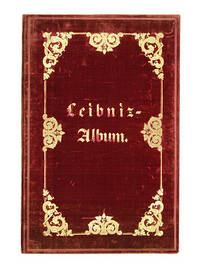
37941Hannover Hahn 1846. Folio 45.3 x 29.5 cm. vi 28 pp. With a nice engraved portrait of Leibniz and one wood-engraving of his house in Hannover. Very nice and highly unusual red velvet binding with elaborate gilt decorated embossed decorations and letterings. = Rare memorial contribution to the famous German polymath principally mathematician and philosopher Gottfried Wilhelm von Leibniz 1646-1716 in a fantastic binding. 'Leibniz sometimes spelled Leibnitz was a prominent German polymath and one of the most important logicians mathematicians and natural philosophers of the Enlightenment. As a representative of the seventeenth-century tradition of rationalism Leibniz's most prominent accomplishment was conceiving the ideas of differential and integral calculus independently of Isaac Newton's contemporaneous developments. Mathematical works have consistently favored Leibniz's notation as the conventional expression of calculus. It was only in the 20th century that Leibniz's law of continuity and transcendental law of homogeneity found mathematical implementation by means of non-standard analysis. He became one of the most prolific inventors in the field of mechanical calculators. While working on adding automatic multiplication and division to Pascal's calculator he was the first to describe a pinwheel calculator in 1685 and invented the Leibniz wheel used in the arithmometer the first mass-produced mechanical calculator. He also refined the binary number system which is the foundation of all digital computers. In philosophy Leibniz is most noted for his optimism i.e. his conclusion that our universe is in a restricted sense the best possible one that God could have created an idea that was often lampooned by others such as Voltaire. Leibniz along with René Descartes and Baruch Spinoza was one of the three great 17th-century advocates of rationalism. The work of Leibniz anticipated modern logic and analytic philosophy but his philosophy also assimilates elements of the scholastic tradition notably that conclusions are produced by applying reason to first principles or prior definitions rather than to empirical evidence. Leibniz made major contributions to physics and technology and anticipated notions that surfaced much later in philosophy probability theory biology medicine geology psychology linguistics and computer science. He wrote works on philosophy politics law ethics theology history and philology. Leibniz also contributed to the field of library science. While serving as overseer of the Wolfenbüttel library in Germany he devised a cataloging system that would serve as a guide for many of Europe's largest libraries. Leibniz's contributions to this vast array of subjects were scattered in various learned journals in tens of thousands of letters and in unpublished manuscripts. He wrote in several languages but primarily in Latin French and German.' Wikipedia. Editor of this memorial album was the German historian Carl or Karl Ludwig Grotefend 1807-1874 who also participated in the publication of Leibnizens Gesammelte Werke Leibniz's collected works. Inner hinge a bit tender; some light shelf-wear to one corner and some of the velvet but overall in great condition. unknown
73016Paris, Hachette, 1860, in 8° relié demi-basane, dos orné de filets dorés, VIII-502 pages.
44785P., Alcan, 1915, in 8° broché, VII-375 pages.
178260306Toulouse, 1782 et 1788, , 2 ouvrages en 1 volume in-4 de 22 pages et 1 planche, puis de 40 pages, demi-veau moderne, dos lisse portant une pièce de titre, Deux mémoires en édition originale tirés des "Histoire et mémoires de l'Académie royale des sciences, inscriptions et belles lettres de Toulouse" (pages 43-64 du premier volume paru en 1782, et pages 29-72 du troisième volume publié en 1788). Roger Martin, appelé aussi Abbé Martin jusqu'à la Révolution, naquit en 1742 à Estadens dans la Haute-Garonne ; brillant élève de sciences, il fut nommé professeur de philosophie à 20 ans au Collège Royal de Toulouse. Passionné de physique et de mathématique, il parvint à faire instaurer dans ce même Collège un cabinet de physique expérimentale ; les leçons qu'il y professait eurent un grand succès. Dans les deux présents mémoires, lus à sept ans d'intervalle devant l'Académie de Toulouse, l'auteur pose le problèmes de l'infini mathématique à l'aune de la méthode du calcul différentiel initié par Newton et développé par Leibniz, tout en appréhendant ses méthodes nouvelles et modernes par le biais de "la méthode des Anciens, connue sous le nom de méthode d'exhaustion ou des limites". Traces de mouillures anciennes sur le premier mémoire. Couverture rigide
174731752AB1747. First English Edition. London Printed for R.Dodsley 1747. Octavo. 72 pages. Modern cloth. The bookblock with signs of stitching to the inner margin possibly used to be part of a Sammelband. Last three leaves with paper-restoration and manuscript inscription to last page looks like a 18th century gift-inscription. With numerous manuscript - annotations in the tracts of George Berkeley namely in "A Word to the Wise" "Farther Thoughts on Tar-Water" "The Querist". From the library of Daniel Conner Manch House County Cork. Bound with: "Berkeley George Bishop of Coyne - "A Miscellany Containing Several Tracts on Various Subjects. By the Bishop of Cloyne. London Printed for J. and R. Tonson and S.Draper 1752. VI 267 1 pages. Title-page witme minor paper-restoration. This wonderful collection by the eminent ANglo-Irish Philosopher includes the following Pamphlets / Tracts as called for: 1. Farther Thoughts on Tar-Water 2. An Essay towards preventing the Ruin of Great-Britain 3. A Discourse addressed to Magistrates and Men in Authority. Occasioned by the enormous Licence and Irreligion of the Times. 4. A Word to the Wise - Or an Exhortation to the Roman Catholic Clergy of Ireland This section "A Word to the Wise" includes several interesting annotations: a. an underlining of the sentence: "Seeing you are obnoxious of the Law" with a comment "Oh! infamous" b. annotation: "the catholic clergy cannot be accused even by there greatest enemies of having been influenced by interested motives therefore this hint of his lordship was not of much avail" 5. A Letter to the Roman Catholics of the Diocese of Cloyne 6. Maxims concerning Patriotism 7. The Querist - Containing several Queries proposed to the Consideration of the Public 8. Verses on the Prospect of Planting Arts and Learning in America 9. A Proposal for the better supplying of Churches in our Foreign Plantations and for converting the Savage Americans to Christianity by a College to be erected in the Summer Islands otherwise called The Isles of Bermuda 10. A Sermon preached before the Incorporated Society for the Propagation of the Gospel in Foreign Parts; at their Anniversary Meeting in the Parish-Church of St.Mary-le-Bow in 1731 11. De Motu ; sive de motus principio & natura & de causa communicationis motuum ______________________________________________________________________________ hardcover
201607780Paris, Librairie Philosophique de Lagrange, 1866 ; in-8, 695-706 pp., cartonnage de l'éditeur. Les 2 volumes. Avec une introduction et des notes par M. Paul Janet en 2 volumes - Gravure en noir et blanc en frontispice du tome I (portrait). As dos.coins un peu usagés Tampons de bibliothèque en pages de titre. Bords des plats légèrement frottés. Avec une Intro. et des Notes par Paul Janet. In-8 Relié demi-cuir noir Bon état. Couv. convenable. Dos à nerfs. rousseurs.
Hardcover in-8°, 496 pages, reliure plein simili, titre dore. (voir aussi "Revue Philosophique") N° 71-72 : Husserl - N° 73-74 : La Notion de structure Tres bel exemplaire. [NV-41] Tres bel exemplaire.
Hardcover in-8°, 511 pages, reliure plein simili, titre dore. (voir aussi "Revue Philosophique") N° 75 : Maine de Biran - N° 76-77 : Leibniz - N° 78 : Franz Brentano. Tres bel exemplaire. [109B-6] Tres bel exemplaire.
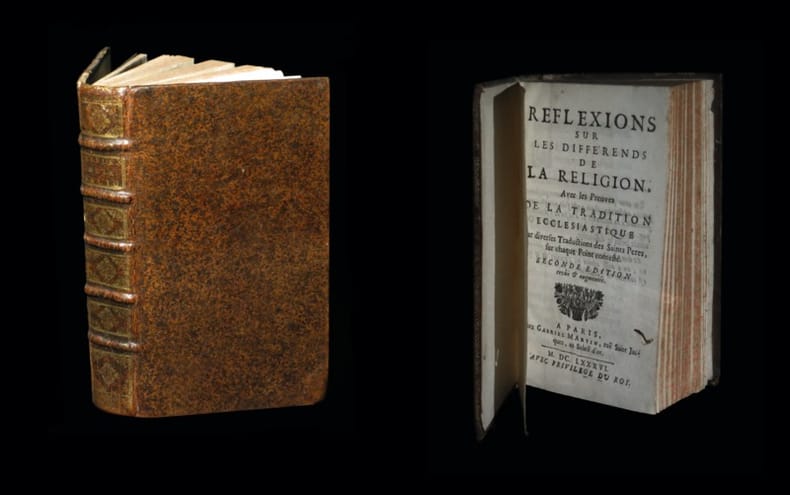
168625828A Paris, chez Gabriel Martin, 1686. 3 parties reliées en un vol. au format in-12 (164 x 98 mm) de 10 ff. n.fol., 154 pp. et 1 f. bl. ; 164 pp. et 111 pp. Reliure de l'époque de plein veau glacé et moucheté havane, plats jansénistes, dos à nerfs orné de filets gras à froid, roulette dorée sur les nerfs, caissons d'encadrement dorés, larges fleurons dorés, titre doré, palette dorée en tête et queue, roulette dorée sur les coupes, tranches jaunes et mouchetées.