AUTORI VARI AA. VV.MareMagnum

1 706 résultats
UNIVERSITà DEGLI STUDI DI MILANO FACOLTà DI LETTERE E FILOSOFIA QUADERNI DI ACME 8 MISCELLANEA SECENTESCA SAGGI SU DESCARTES FABRI WHITE CISALPINO LA GOLIARDICA 1987 181 PP. LIEVI SEGNI DEL TEMPO, VOLUME PERFETTO E INTONSO, MAI SFOGLIATO.
19466925BWeimar, Hermann Böhlaus Nachf., 1946. 8° (20 x 13,8 cm), 15 Seiten Hellgrauer OKt. (lichtrandig) mit Blaudruck Titel gestempelt
ria9780198876588_inpPaperback / softback. New. New Book; Fast Shipping from UK; Not signed; Not First Edition; This new edition of Modern Fortran Explained provides a clear and thorough description of the latest version of Fortran written by experts in the field with the intention that it remain the main reference work in the field. paperback
ria9780198876571_inpHardback. New. New Book; Fast Shipping from UK; Not signed; Not First Edition; This new edition of Modern Fortran Explained provides a clear and thorough description of the latest version of Fortran written by experts in the field with the intention that it remain the main reference work in the field. hardcover
199289900Klincksieck 1992 In-8 broché 24 cm sur 16. 158 pages. Bon état d’occasion.
1995100133865Cornell University Press 1995 304 pages 15 2x22 8x1 8cm. 1995. Broché. 304 pages.
Mm 145x220 Brossura editoriale con bandelle di pp. 115, in stato di nuovo. SPEDIZIONE IN 24 ORE DALLA CONFERMA DELL'ORDINE.
In-8° (cm. 24,3xx17), cartoncino leggero editoriale. Cifre a penna in cop. e in capo alla prima facciata. Esercizio di logica a penna al verso del piatto anteriore. Annotazioni a penna al margine di p. 12, di p 16, tre segni a penna a 3 margini. BARONE, filosofo, docente di Filosofia teoretica e Preside della Facoltà di Lettere e Filosofia all'Università di Pisa, collaboratore del quotidiano "La Stampa". Censito in 2 bibl.
1966017529Martin Sändig, Wiesbaden 1966. Leinen Tadellos
br. Questo lavoro, che si colloca al confine tra la storia della filosofia e la storia della scienza, analizza il costante interesse dimostrato da Gottfried W. Leibniz (1646-1716) per la nascente microscopia, che spalancò alla scienza moderna campi di indagine interamente nuovi. La più piccola goccia d'acqua rivela un pullulare di creature invisibili a occhio nudo, che estendevano la scala naturale ben oltre i limiti allora conosciuti. Leibniz, che fu sempre particolarmente sensibile, in ogni campo della sua attività, teorica e pratica, a ciò che è infinitamente piccolo, non esitò a utilizzare prontamente l'osservazione del microcosmo come supporto empirico del "nuovo sistema della natura" che andava elaborando: una sorta di atomismo vitalistico, noto anche come "monadologia". In esso trovava una formulazione rigorosa la tesi che il mondo attuale realizza la massima varietà ordinata possibile, idea che Leibniz cercò di corroborare attraverso le nuove scoperte osservative, in un dialogo costante tra "scienza colta" e "saperi tecnici", speculazione metafisica e risultati sperimentali. Prefazione di Massimo Mugnai.
201112978(Berlin), Akademie, (2011). Gr.-8vo. XVIII, 288 S. Illustr. OPp.
18749Paris, NRF, Gallimard, bibliothèque des idées, 1976. In-8 (225x140mm) broché de 398 p. Quelques petites marques au crayon de papier (très facilement effaçables). Rousseurs discrètes, très bon état général.
196268184J. Vrin, coll. "Bibliothèque d'histoire de la philosophie" 1962 1 vol. broché in-8, broché, 284 pp. Edition originale. Dos un peu ridé, deux petites brunissures à la 1ère de couverture. Sinon bon état général.
196268184J. Vrin, coll. "Bibliothèque d'histoire de la philosophie" 1962 1 vol. broché in-8, broché, 284 pp. Edition originale. Dos un peu ridé, deux petites brunissures à la 1ère de couverture. Sinon bon état général.
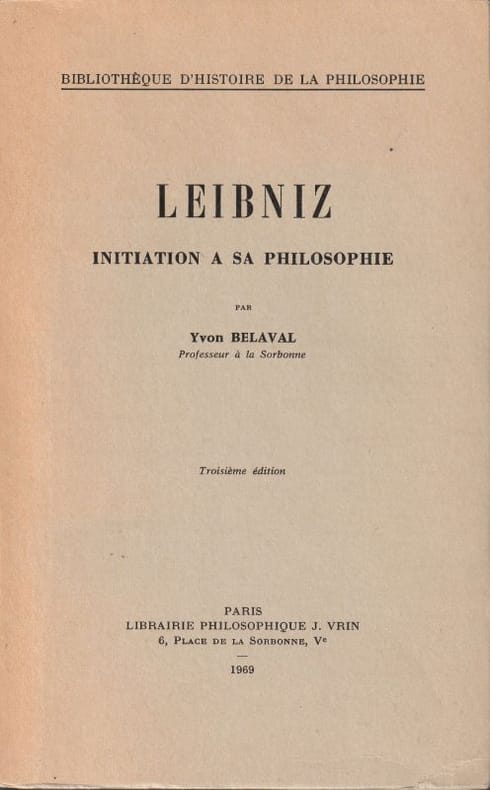
Vrin, 1969, 3e édition, 284 pp., passages signalés au stylo, couverture un peu défraîchie, état correct.
19697489Vrin In-8, broché,couverture stricte , 285 pages, très agréable exemplaire.
196231448Paris Librairie Philosophique J. Vrin 1962 In-8 La première édition de cet ouvrage a été effectuée en 1952 sous le titre : Pour connaître la pensée de Leibniz aux éditions Bordas - 285 pp
in-8, 559 p., notes de bas de p., broché, couv. Très bel ex. [CA30-1]
in-12, 559 pages, -, broche, couverture illustree plast. Tres bel exemplaire. [MI-21]
Mm 125x200 Collana "Biblioteca Sansoni" - Brossura editoriale di xii-600 pagine. Copia in stato di eccellenza. SPEDIZIONE IN 24 ORE DALLA CONFERMA DELL'ORDINE.
194614329ABJena, Rauch, 1946. 47 S. OKart. (Zeugnisse europäischen Geistes, Heft 1).
194614581ABJena, Rauch, 1946. 47 S. OKart. (Zeugnisse europäischen Geistes, Heft 1).
16962447Leipzig: Gross & Fritsch 1696. First edition. vellum marbled boards. Very Good. FIRST PRINTINGS OF THE PAPERS DOCUMENTING THE PROPOSAL AND SOLUTION OF THE "BRACHISTOCHRONE PROBLEM" ONE OF THE MOST FAMOUS MATHEMATICAL CHALLENGES AND ONE OF THE EARLIEST PROBLEMS POSED IN THE CALCULATION OF VARIATIONS. The challenge of the brachistochrone "began in June of 1696 when Johann Bernoulli published a challenge problem in Leibniz's journal Acta Eruditorum. Obviously a legacy of public challenge remained from the days of Fior and Tartaglia. Although contests were now conducted in the sedate pages of scholarly journals they retained their power to make or break reputations as Johann himself observed:<br /> <br /> '. it is known with certainty that there is scarcely anything which more greatly excites noble and ingenious spirits to labors which lead to the increase of knowledge than to propose difficult and at the same time useful problems through the solution of which as by no other means they may attain to fame and build for themselves eternal monuments among posterity.'<br /> <br /> "Johann's particular challenge was a good one. He imagined points A and B at different heights above the ground and not lying one directly above the other. There is certainly an infinitude of different curves connecting these two points from a straight line to an arc of a circle to any number of other wavy undulating paths. Now imagine a ball rolling from A down to B along such a curve. The time it take to complete the trip depends of course on the curve's shape. Bernoulli challenged the mathematical world to find that one particular curve AMB along which the ball will roll the shortest time. He called this curve the 'brachistochrone' from the Greek words for 'shortest' and 'time'.<br /> <br /> "An obvious first guess is to take AMB as the straight line joining A and B. But Johann cautioned against this simplistic approach:<br /> <br /> '. to forestall hasty judgment although the straight line AB is indeed the shortest between the points A and B it nevertheless is not the path traversed in the shortest time. However the curve AMB whose name I shall give if no one else discovered it before the end of this year is one well-known to geometers.'<br /> <br /> "Johann gave the mathematical world until January 1 1697 to come up with a solution. However when his deadline arrived he had received but one solution from the 'celebrated Leibniz' who:<br /> <br /> 'has courteously asked me to extend the time limit to next Easter in order than in the interim the problem might be made public . that no one might have cause to complain of the shortness of the time allotted. I have not only agreed to this commendable request but I have decided to announce myself the prolongation and shall now see who attacks this excellent and difficult question and after so long a time finally masters it.'"<br /> <br /> At this point Johann and others were surprised and perhaps a little delighted that they had not received a solution from their English rival Sir Isaac Newton. Wondering if Newton has not noticed the challenge Johann sent Newton directly a personal letter outlining the problem. When Newton received the letter he did not disappoint. As Newton's niece Catherine Conduitt explained:<br /> <br /> "When the problem in 1697 was sent by Bernoulli - Sir I.N. was in the midst of the hurry of the great recoinage and did not come home till four from the Tower very much tired but did not sleep till he had solved it which was by four in the morning."<br /> <br /> "Even late in life and tired from a hectic day's work Isaac Newton triumphed where most of Europe had failed! It was a remarkable display of the powers of the great British genius. He had clearly felt his reputation and honor were on the line; after all both Bernoulli and Leibniz were waiting in the wings to publish their own solutions. So Newton rose to the occasion and solved the problem in a matter of hours. Somewhat exasperated he is reported at one point to have said 'I do not love . to be . teezed by foreigners about Mathematical things.'<br /> <br /> "Back in Europe as Easter neared a few solutions came into the hands of Johann Bernoulli. The curve that everyone was seeking - one that 'is well-known to geometers' - was none other than an upside-down cycloid. This important curve was studied by Pascal and Huygens but neither of these mathematicians had realized that it would also serve as the curve of quickest descent. Johann wrote with characteristic hyperbole '. you will be petrified with astonishment when I say that precisely this cycloid . of Huygens is our required brachistochrone.'<br /> <br /> "On Easter the challenge period had expired. All together Johann had received five solutions. There was his own and the one from Leibniz. His brother Jakob came through perhaps to Johann's dismay with a third and the Marquis de l'Hospital added a fourth. Finally there was a submission bearing an English postmark. Opening it Johann found the solution correct although anonymous. He clearly had met his match in the person of Isaac Newton. Although unsigned the solution bore the unmistakable signs of supreme genius.<br /> <br /> "There is a legend - probably of dubious authenticity but nonetheless of great charm - that Johann partially chastened partially in awe put down the unsigned document and knowingly remarked 'I recognize the lion by his claw.'" Quoted from William Dunham Journey Through Genius: The Great Theorems of Mathematics Wiley 1990 page 199-202.<br /> <br /> The Brachistochrone Papers - the proposal and the solutions included:<br /> <br /> Johann: Supplementum defectus geometria cartesianae circa inventionem locorum; 2. Leibniz: Communicatio suae pariter duarumque alienarum ad edendum sibi primum a Dn. Joh. Bernoullio; 3. Johann: Curvatura radii in diaphanis non uniformibus . ; 4. Jakob: Solutio problematum fraternorum . ; 5. L'Hospital: Solutio problematis de linea celerrimi descensus; 6. Tschirnhaus: De methodo universalia theoremata eruendi . ; 7. Newton: Epistola missa ad praenobilem virum D. Carolum Mountague .<br /> <br /> Note: Newton's solution original appeared in the Philosophical Transactions.

<br /> <br /> Provenance With stamps and withdrawal markings 7-3-1984 from the famous John Crerar Library Chicago. <br /> <br /> In: Acta Eruditorum vol. 15 and 16: no.1 in 15:264-69 1 plate; no. 2 in 16:201-5 1 plate; no. 3 in 16: 206-11; no. 4 in 16:211-17; no. 5 in 16: 217-20; no. 6 in 16: 220-23; no. 7 in 16: 223-24. Leipzig: Gross & Fritsch 1696-1697. The two entire volumes offered. Quarto 208x170 mm. Two volumes in uniform contemporary three-quarter vellum over marbled boards. pp 2 604 and 9 plates; 8 594 and 8 plates. Some heavy worming to pp 324-42 and plate vi of volume 15 which is not part of any of the above mentioned articles. 1697 volume with repaired gutter tear to plate 8; reinforcement to p.449/50 and minor restoration to binding. Some toning throughout as usual with the Acta. In all a very good set. Gross & Fritsch unknown books
114718ABNachdr. d. Ausg. Paris 1937. Hildesheim: Olms; 1966. V 703 S. Oln. Leichte Spuren von entferntem Namensschildchen und Tesafilm im Einband bzw. auf Vorsatz. Sonst keine Mängel und sehr gut. 1966 unknown
1982100573Editions CEDIC , Histoire des Mathématiques Malicorne sur Sarthe, 72, Pays de la Loire, France 1982 Book condition, Etat : Bon broché, sous couverture imprimée éditeur jaune petit In-4 oblong 1 vol. - 279 pages