130 résultats
15421298970Basileæ: In officina Frobeniana 1542. Hardcover. Folio 8 816 pages 28 pages index; VG; bound in contemporary full vellum paneled spine with faded ink lettering to head of spine full tooling to boards partial beveling to edges; bound with two clasps majority of lower clasp missing upper clasp present; slight scraping to text block from clasp; woodcut printer's device on title page and verso of final leaf; woodcut initials; colophon on verso of final leaf; text in Latin with sections in Greek; wide margins; no bookplates or previous owners markings; index in rear; This edition is part 2 of "Nouum Testamentum iam quintum ac postremum accuratissima cura recognitum à Des. Erasmo Roterodamo cum annotationibus . Basileae 1541 1542 - cf. colophon.; consignment; shelved case 4. 1298970. Shelved Dupont Bookstore. In officina Frobeniana hardcover books
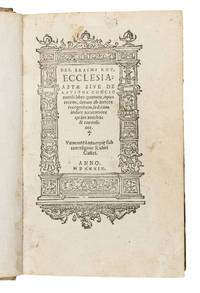
1539ABC_49727Antwerp: sub intersignio Rubri Castri = Guilielmus Montanus 1539. 18th-century half vellum with a brown paper title label on the spine lettered in black the manuscript year of publication at the foot of the spine decorated paper sides with a hand drawn floral design in red and blue ink red edges. Small 8vo. With an architectural woodcut border on the title page 7 decorated metalcut initials 5 woodcut headpieces 7 woodcut tailpieces and a woodcut printer's device at the end of the work. Scarce early edition of an influential manual on preaching. It was one of the last major works which Erasmus produced and is considered one of his most significant treatises on theology. The work was incredibly popular in his own time as Erasmus had been pressured for many years to write it. The present edition which is the first by Montanus and the third authorised edition is relatively scarce however with only two other copies recorded in sales records of the 21st century."The Ecclesiastes is really a collection of three works: a theological treatise on the importance of preaching and the role of the preacher in the church Book I a textbook on homiletics and hermeneutics which provides the preacher with the basic tools necessary for both the interpretation of scripture and the construction and delivery of sermons based on biblical terms Books II and III and a list of sermon topics with an explanation of how some of them should be developed. From this organization it is clear that Erasmus attempted to provide his contemporaries with both a theology of preaching and clear and precise advice on the art of preaching" Kleinhans.With 18th-century annotations on the front pastedown and in the margins of some of the leaves several portions of text are underlined. The edges and corners of the boards are somewhat scuffed the vellum is somewhat soiled and stained. The work is somewhat browned throughout with brown ink stains on a few leaves affecting a few words minor loss of material in the lower margin of a7 and a8 without affecting the text. Otherwise in good condition.l Adams E-631; De Reuck 179; Erasmus Online 1682; Nijhoff & Kronenberg 2923; STCV 12926615; USTC 440876; Vander Haeghen I 78; not in Bezzel; cf. Kleinhans R.G. "Erasmus Ecclesiastes and the Church of England" in Historical Magazine of the Protestant Episcopal Church 39 3 1970 pp. 307-14; Rouzet Dictionnaire des imprimeurs belges p. 153. sub intersignio Rubri Castri (= Guilielmus Montanus), hardcover
1519PHO-1100Haguenau, apud Thomas Anshelm, 1519 (M.D.XIX Mense Maio). Pet. in-4, cartonnage postérieur ,titre encadré , LXXIX f.,3ff.n.ch. (R 6),( table et marque d’imprimeur) .Exemplaire très frais, écriture sur le titre .
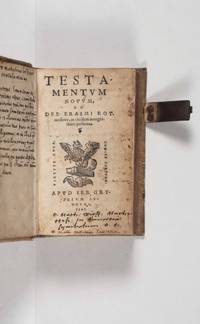
154749141Lyon: Sebastian Gryphius 1547. Hardcover. Very Good-. 16mo in 8s: a-z8 A-Z8 aa8 bb8 =384 leaves; blank bb7-8. 763 5 blankpp. Printer’s device at title woodcut lettrines. Text in italic headlines and chapter headings in roman; printed marginalia. Later pigskin over bevelled boards tooled in blind brass clasps one of two and catches manuscript title at spine. Extensive old manuscript notes at front endleaf and four blank leaves at the end including the two integral blanks; occasional marginalia and underlining. Title soiled with some slight erosion at margin from oxidation of the clasps else a very good copy with clean fresh text throughout. Complete with the two final blank leaves.<br /> <br /> Second Gryphius edition and a rather uncommon early sixteenth-century printing of Erasmus’ Latin translation of the New Testament first published at Basel in 1516. According to Baudrier Ly. V. 804101/Cat. de Lignerolles Paris Porquet 1894 no. 48 Gryphius first published this translation in 1542 and 1543 as a 16mo of 847 pages; neither of these issues appear in Deleveau & Hillard. Like the present edition these early Gryphius printings of the Erasmus New Testament survive in only a handful of copies. The text opens with Erasmus' dedication to pope Leo X followed by his preface to the reader a general index of the New Testament corpus a listing of the chapters of the four Gospels and a brief passage from Jerome's catalogue of ecclesiastical writings. The editor's introductions precede each book. The text concludes with Erasmus' translation of a brief discussion of apocryphal literature partly from Athanasius though Erasmus questions the attribution: "De libris utriusque testamenti partim reiectus aut non sine contradictione admissis partim apocryphis ex Athanasio tametsi mihi suspectus est titulus." <br /> <br /> Provenance and annotations: Extensive early annotations in more than one hand appear throughout the book; many marginal notes have been added throughout the Gospel of Matthew. At the front of the book beginning with the free endleaf: "Poeta de Pythogora" several stanzas in Latin and Greek; facing the title: A morning prayer "Oro matutina lecturis oracula divina" 11 lines; an accounting of biblical eras 10 lines since Abraham David and the Babylonian Exile appears at the verso of the title leaf. The final blank page the two intergral blank leaves and two additional blanks added by the binder are filled with notes in several different hands including: a passage from Augustine's De doctrina christianae 14 lines; noted as book 2 chapters 11 and 12 along with four lines about Tertullian; four pages of notes on the twelve disciples numbered; a Greek text discussing the divine names in which the tetragrammaton is written in Hebrew letters; a passage from a letter of Basilius Magnus in Greek with Latin translation.<br /> <br /> Printed label of Edward Davis Hoblyn 1809-1881 and his manuscript entry dated 1831 at the free endleaf. Edward was likely related to the renowned book collector Robert Hoblyn 1710-1756 of Cornwall. A catalogue of Robert’s collection was printed in 1768 as Bibliotheca Hobliniana and reissued by Murray in 1769 with a new titlepage. The library remained with Robert’s widow and was sold in 1778. The present work is not listed in the Bibliotheca though no fewer than nineteen 16th-century Latin Bibles and Testaments appear in the catalogue. Gift inscription of D. N. Goodman of San Francisco California to Father J. L. Damas at front pastedown dated 1935. References: Baudrier 8 217. Baumgarten Nach. v. merkw. Büchern 8 1755 206 noting that this and the later Gryphius edition which Le Long assigns to the master printer’s workshop are in fact identical and notable examples of elegant typography. Deleveau & Hillard 4407 BNF. Le Long Leipzig 1709 1:751 & 2:478 Bibl. Colbertina - the earlier Gryphius edition of 1542/43 is not cited in either part. Le Long-Masch 2.3 p. 599 noted as the first New Testament ex. Erasmi to appear at Lyon. Sebastian Gryphius hardcover
1532748951Basileae per Iohannem Hervagium Johannes Herwagen 1532. Full leather. Sexto 22 532 207 5 Variae Lectiones 47 Annotationes 1 pagesBinding repair by J. Taylor Seton “successor to the late James Taylor 3 Mound Place Edinburgh†Recently rebacked. Margin notes and underlining throughout. Photos upon request. Basileae per Iohannem Hervagium [Johannes Herwagen] hardcover
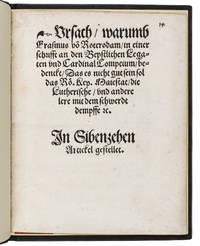
1531ABC_49886Strasbourg or Nuremberg 1531. 4to. Georg Ulricher or Wolfgang Heußler Modern blind-tooled mottled calf with a double fillet border on both boards. 3 1 blank ll. Rare German edition of a letter Erasmus sent to the papal legate Lorenzo Campeggi 1474-1539 on August 18 1530. In this letter Erasmus expresses his fear that the Holy Roman Emperor would declare war to the Protestant German princes and explains in 17 articles why violence is not the answer. He never printed the letter himself and it probably never reached Campeggi. According to Allen Erasmus wrote that "it was intercepted by the treachery of some unnamed 'evangelical' and printed without authority in Strasburg". The letter was translated into German and indeed published several times in Strasbourg Wittenberg Magdenburg and Nuremberg in 1531. The present edition does not have an imprint but was either printed in 1531 in Strasbourg by Georg Ulricher or in 1546 in Nuremberg by Wolfgang Heußler. It is quite rare as we not been able to find any other copies of the present edition in sales records of the past hundred years.With a red bookbinder's label "Period Bookbinders Bath England" mounted on the recto of the last free flyleaf. The work is lightly browned and foxed the inner margins have been reinforced. Otherwise in good condition.l Bezzel 26; Erasmus Online 1874; USTC 704493 and 704494; VD16 E 1881 and VD16 E 1882; Vander Haeghen I 88; not in Adams; BM STC German; De Reuck; cf. Allen Opus Epistolarum Erasmi vol. IX intro. to Ep. 2366. hardcover
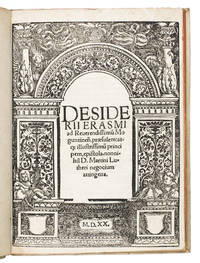
1520ABC_49889Augsburg 1520. 4to. Sigmund Grimm and Marcus Wirsung 19th-century gold-tooled vellum with a black morocco title label and a black morocco label with the year of publication on the spine lettered in gold a double fillet border on both boards red edges marbled endpapers. With an elaborate woodcut title border by Hans Weiditz. 4 ll. Early print of the letter Erasmus wrote to Cardinal Albrecht of Brandenburg Archbishop of Mainz in October 1519 with statements about Luther. In it Erasmus recommends to hear Luther whom he defends in several instances and suggests to help him where he errs. The letter was delivered by Ulrich von Hutten 1488-1523 and likely published without Erasmus's consent. The present edition is one of seven unauthorised editions published in the same year. It was printed by Marcus Wirsung ca. 1460-ca.1520 and Sigmund Grimm ca. 1480-1530 whose printing office was the most important publication centre for humanist literature in pre-Reformation Augsburg. Their edition includes a beautiful title border by Hans Weiditz 1495-ca.1537 and is among the rarest of the seven with only five copies recorded by the Universal Short Title Catalogue USTC. The present copy was auctioned at Sotheby's in 1955 and 1980 and is one of only two copies that we have been able to trace in sales records.The boards are somewhat warped. The work has been bound with 25 blank leaves. Otherwise in good condition.l Adams E 871; Allen Opus epistolarum Erasmi IV 1033; Bezzel 28; BM STC German p. 276; Erasmus Online 1957; Proctor 10920; USTC 635546 5 copies; Vander Haeghen I 93; VD16 E 1887; not in De Reuck. hardcover
1523ABC_50186Antwerp: Michiel Hillen van Hoochstraten 1523. Modern boards covered with a leaf from a Latin incunable probably part of a commentary on the Song of Solomon red sprinkled edges. 8vo. With a full-page woodcut illustration incorporating Hillen van Hoochstratens device on the last page and 3 woodcut decorated initials. First Antwerp edition published in the same year as the first Froben edition in Basel of Erasmus De sarcienda ecclesiae concordia. Dedicated to Julius Pflug of Eytra 1499-1564 later the last Catholic Bishop of Naumburg the work sets out Erasmus most urgent appeal for unity at a moment when the fractures of the Reformation were widening by the month. Pflug who valued peace and moderation shared Erasmus unease about the increasingly bitter debates dividing Western Christendom.De sarcienda ecclesiae concordia opens as a commentary on psalm 83 in which Erasmus underscores the spiritual necessity of harmony within the Church. From this biblical foundation he advances his lifelong conviction: that a polarised Christendom is fundamentally at odds with the teaching and example of Christ. In passages marked by clarity moral urgency and classical poise Erasmus argues that contentious theology has little to do with genuine faith and everything to do with human pride.Appended to the treatise is the brief Precatio pro pace ecclesiae addressed to the Cologne jurist Johann Rinck further underlining Erasmus conviction that peace moderation and the diligent search for concord must prevail over doctrinal intransigence.With very minor underlining on three pages and one tiny marginal annotation a small ink stain in the upper margin of the title page a small wormhole running from leaves A6 to B6 and some occasional water staining confined to the margins. Otherwise in good condition.l Adams E 387; De Reuck 248; Erasmus online 2340; Nijhoff & Kronenberg 798; STCV 12920380; USTC 403885; Vanderhaeghen I 117. Michiel Hillen van Hoochstraten, hardcover
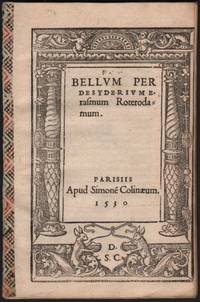
1530329Parisiis Paris: Apud Simonem Colinaeum Simon de Colines 1530. Reprint of the printer's edition of 1525. First printed by Johann Froben in 1517. Papered spine. In fine condition. Title within elaborate woodcut border with initials S.D.C. and Geoffroy Tory’s Lorraine cross. Title within elaborate woodcut border with initials S.D.C. and Geoffroy Tory’s Lorraine cross. Reprint of the printer's edition of 1525. First printed by Johann Froben in 1517. Papered spine. 8º a–c8 c8 blank; 23 1 blank leaves. <p><br /> Erasmus’ famous pacifist text on the adage “dulce bellum inexpertis" war is sweet to those who have not tried it. It was first published in the revised and enlarged edition of “Adages†called “Proverbiorum chiliades" 1515 Basel; Froben and published separately in 1517 also by Froben. <br /> <p><p><br /> “Bellum" is the first essay where Erasmus speaks of Jews contemporary to him praises them along with the Turks and the pagans as well as various peoples of Europe Asia and Africa for their virtuous living. He writes: “When has the sword murder arson plundering turned conquered people into good Christians! Openly to be a Turk or a Jew is lesser evil than to pretend to be a Christian. I prefer a real Turk to a false Christian.†<br /> <p><p><br /> The printer Simon de Colines 1480–1546 is most notable for his 1525 “Grandes Heures de Simon de Colines†the illustrator was the same Geoffroy Tory 1480–1533 who made the design of the woodcut border of this book.<br /> <p><p><br /> Bibl.: Markish Shimon: Erasmus and the Jews. Chicago. University of Chicago Press 1986.; Johnson Carina L.: Cultural hierarchy in sixteenth-century Europe. The Ottomans and Mexicans. Cambridge; New York. Cambridge University Press 2011.; Olin John C.: Six essays on Erasmus and a Translation of Erasmus' Letter to Carondelet 1523. New York. Fordham University Press 1979.<br /> <p><p><br /> Moreau III 2074. <br /> <p>. Apud Simonem Colinaeum (Simon de Colines) unknown
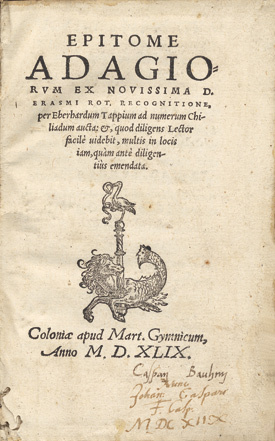
15499472Cologne, Mart. Gymnicus, 1549 ; in-8 ; plein vélin estampé sur ais de bois, dos à trois gros nerfs, fermoirs de cuivre (reliure de l'époque) ; (16) y compris le titre, 632, [634], (76) pp. index, (1) f. blanc (*, AZ, Aa-Xx - 8, Yy - 4).
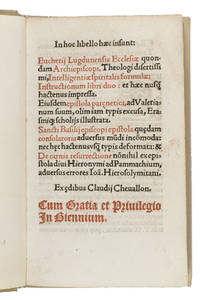
1523ABC_49898Colophon: Paris 1523. 8vo. Claude Chevallon Modern half vellum and beige paper sides blue sprinkled head- and fore-edge manuscript author and title on the spine in brown ink. With Cevallons woodcut device on the verso of the final leaf the title is printed in red and black and 10 woodcut decorated initials. 6 CVII 1 ll. Collection of patristic writings many of which appear here in print for the first time. The book opens with the spiritual writings of Eucherius ca. 380-ca. 449 CE Archbishop of Lyon including his Intelligentiae spiritalis formulae and two instructional treatises both of which are printed here for the first time.At the heart of the volume is Eucherius paraenetic letter to Valerianus a moral exhortation encouraging the rejection of worldly distractions and the pursuit of true Christian wisdom. Although this letter had been printed previously it is presented here together with annotations by Erasmus.Also included is a consolatory letter by Basil the Great Bishop of Caesarea 330-379 CE intended to support believers facing the hardships of earthly life. Like the instructional works of Eucherius this letter also appears here in print for the first time. The final text is a fragment from a letter by Saint Jerome ca. 342/7-420 CE to Pammachius d. 410 CE defending the doctrine of the resurrection of the flesh and refuting the teachings of John of Jerusalem.The exact date of publication remains uncertain but it is unlikely that the book appeared before 1520 the year when Chevallon first began using his soleil dor printers device.The pages show some browning and water staining throughout. Overall in good condition.l BM STC French p. 157; Erasmus Online 4203; Vander Haeghen II 25; Moreau & Renouard III 498; Renouard P. Marques 176; USTC 184320; not in Adams; De Reuck; Kossmann; Meyers. hardcover
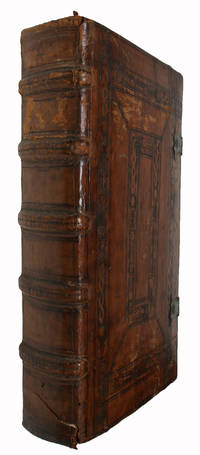
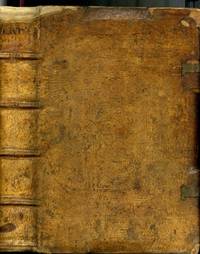
153147178Basel Froben 1531 Coloniae Petrus Quentell 1536. Folio. Bound together in a beautiful contemporary full calf binding over wooden boards. Blindstamped ornamental frames to boards. Five raised bands to spine. Remains of brass clasps to boards. Brass at corners of boards and brass strips to bottom edges of boards. A tear through the letter at the lower capital no loss. Some scrathing of leather mostly to back board and upper part of spine. The titles of the two works written in contemporary hand to the outer edge. The strong vellum cords which go through the the wooden boards can be seen on the inside of the wooden boards which also have some initials in red and blue paint possibly from a painted leaf that has rubbed off First title-page a bit dusty otherwise very nice clean and crisp throughout. Eucherius: Froben printer's device to title-page to final leaf of the first part to the half-title of the second part Episcopi Commentariorum in libros Regum ad Veranium & Salonium and to the last leaf of that part. Beautiful large woodcut initial at beginning of each new work. 8 194 2; 310 2 pp.Radulphus: Woodcut device to title-page. Numerous beautiful woodcut allegorical initials both large and smaller throughout. 4 - title dedications 14 - index 6 314 pp. <br/><br/><em>First editions of both works being the first edition of the works "Several Studies" of St. Eucharius most of them printed for the first time here as well as the first edition of Rodulfus Tortarius' or Radulphus Flaviacensis commentaries of Leviticus the third of the Books of Moses written in Latin in 20 books. Saint Eucherius bishop of Lyon ca. 380 - ca. 449 was a high-born and high-ranking ecclesiastic in the Christian Church of Gaul. He is remembered for his letters advocating extreme self-abnegation. Henry Wace ranked him "except perhaps St. Irenaeus the most distinguished occupant of that see"."St. Eucherius Bishop of Lyons theologian born in the latter half of the fourth century; died about 449. On the death of his wife he withdrew to the monastery of Lérins where his sons Veranius and Salonius lived and soon afterward to the neighbouring island of Lerona now Sainte-Marguerite where he devoted his time to study and mortification. Desirous of joining the anchorites in the deserts of the East he consulted John Cassian who in reply sent him some of his "Collationes" describing the daily lives of the hermits of the Thebaid. It was at this time that Eucherius wrote his beautiful letter "De laude Eremi" to St. Hilary of Arles c. 428. Though imitating the virtues of the Egyptian solitaries he kept in touch with men renowned for learning and piety e.g. Cassian St. Hilary of Arles St. Honoratus later Bishop of Marseilles and Valerian to whom he wrote his "Epistola parænetica de contemptu mundi". The fame of Eucherius was soon so widespread in southeastern Gaul that he was chosen Bishop of Lyons. This was probably in 434; it is certain at least that he attended the First Council of Orange 441 as Metropolitan of Lyons and that he retained this dignity until his death. In addition to the above-mentioned letters Eucherius wrote "Formularium spiritualis intelligentiæ ad Veranium" and "Institutiones ad Salonium" besides many homilies. His works have been published both separately and among the writings of the Fathers." Catholic Encyclopedia. His "Epistola paraenetica ad Valerianum cognatum de contemptu mundi "Epistle of exhortation to his kinsman Valerian On the contempt of the world" is an expression of the despair for the present and future of the world in its last throes shared by many educated men of Late Antiquity with hope for a world to come. Erasmus thought so highly of its Latin style that he edited and published it at Basel in 1520. His commentaries on the work are also included here. His "Liber formularum spiritalis intelligentiae" which is addressed to his son Veranius is a defence of the lawfulness of reading an allegorical sense in Scripture bringing to bear the metaphors in Psalms and such phrases as "the hand of God" The term anagoge in Greek is employed for the application of Scripture to the heavenly Jerusalem to come and there are other examples of what would become classic Medieval hermeneutics.Rodulfus Tortarius also known as Raoul of Tourtier Raoul de La Tourte Radulphus Flaviacensis c.1063 - c.1122 was a French Benedictine monk of the Abbey of Fleury-sur-Loire and a poet writing in Latin. He is known both for his style of writing his biblical commentaries and religious works and his literary and comic tales. His commentary on "Leviticus" is considered important and influential. The first edition of the work is rare. </em> hardcover
153147178Basel, Froben, 1531 + Coloniae, Petrus Quentell, 1536. Folio. Bound together in a beautiful contemporary full calf binding over wooden boards. Blindstamped ornamental frames to boards. Five raised bands to spine. Remains of brass clasps to boards. Brass at corners of boards and brass strips to bottom edges of boards. A tear through the letter at the lower capital, no loss. Some scrathing of leather, mostly to back board and upper part of spine. The titles of the two works written in contemporary hand to the outer edge. The strong vellum cords, which go through the the wooden boards can be seen on the inside of the wooden boards, which also have some initials in red and blue paint, possibly from a painted leaf that has rubbed off? First title-page a bit dusty, otherwise very nice, clean, and crisp throughout. [Eucherius:] Froben printer's device to title-page, to final leaf of the first part, to the half-title of the second part (Episcopi Commentariorum in libros Regum ad Veranium & Salonium) and to the last leaf of that part. Beautiful large woodcut initial at beginning of each new work. (8), 194, (2)" 310, (2) pp.[Radulphus:] Woodcut device to title-page. Numerous beautiful woodcut, allegorical initials, both large and smaller, throughout. (4 - title, dedications), (14 - index), (6), 314 pp.
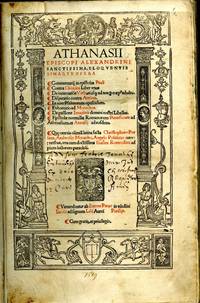
1519048644Paris: Ioanne Paruo Jean Petit 1519. First Edition. Hardcover Vellum. Very Good Condition. First part dated 1518 second 1519. Later overlapping parchment. browned new endpapers. Some soiling to title page top edge excised likely for a signature page numbers added to upper right in pencil slight scattered browning light dampstain to upper edge of final leaves. A nice wide margined copy two parts in one with the integral blank between them. Rubricated throughout. 6 255 1 bl. 64 ff.<br /> <br /> Scarce edition with the important commentary on Paul's Epistles here attributed to Athanasius but actually by Theophylact of Ohrid. They were a "profound influence" on Erasmus' new testament and his In Praise of Folly Obolensky Six Byzantine Portraits 1988. 22 copies in OCLC but only 3 in the US. Rare in commerce.<br /> <br /> <br /> contains: Commentari in Epistolas Pauli Contra gentiles liber unus : De incarnatione Verbi eiusque ad nos per corpus aduentum : Disputatio contra Arrium : In uim Psalmorum opusculum : Exhortatio ad Monachos : De passione imaginis domini nostri libellus : Epistolæ nonnullæ Romanorum pontificum ad Athanasium et Athanasii ad eosdem Size: Folio. Quantity Available: 1. Shipped Weight: Under 1 kilo. Category: Religion & Theology; Antiquarian & Rare. Inventory No: 048644. Ioanne Paruo (Jean Petit) hardcover
1531049721Basel: Officina Frobeniana Froben 1531. First Edition. Hardcover Vellum. Very Good Condition. Contemporary rolled pigskin worn and discolored with old repairs to spine ends and edges but quite sound. Clasps intact. Early notes and an old bookseller catalog entry to front pastedown. The notes appear to be in two hands one contemporary in the same or similar ink to Chripstoph Binder's signature to the title and the other a little later. Title page printer's device with early coloring. Neat marginal notes and underlining throughout heavier early on and at the end neat interlinear notes and notes to the Erasmus letter. Many of the later notes written in triangular format. Scattered stains tiny wormtrails heavier early on some marginal dampstaining at beginning and end. A nice copy. Separate title page for the Chronologia.<br /> <br /> 8 244 243 210 91 74 45 1 p.<br /> <br /> Provenance: With the signature on the ttitle page of Württemberg theologian Christoph Binder 1519-1596 the first Protestant abbot of Adelberg Abbey. Size: Folio. Quantity Available: 1. Shipped Weight: Under 1 kilo. Category: History; Antiquarian & Rare. Inventory No: 049721. Officina Frobeniana (Froben) hardcover
15424110DB1542. Getruckt zuo Zürych bey Christoffel Froschouer im Jar 1542. 2°. 33 Bl. DLXVIII 1 Bl. unbedruckt. Geprägter Lederband über Holzdeckeln mit 5 Bünden. Handschriftlicher Eintrag von alter Hand auf dem vorderen Innendeckel. Seite DLXV falsch paginiert DLXX. - Einband berieben und bestossen mit Schadstelle am oberen Kapital. Titelblatt lose mit Schadestellen. Durchgehend leicht gebräunt. im hinteren Teil mit Wurmfrass im oberen Teil der Seiten. unknown
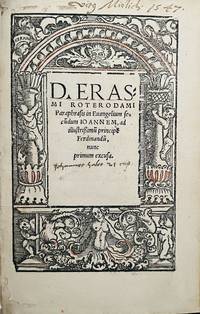
1521371922Basel: Froben 1521. Titles within ornamental woodcut borders; initials and headpieces throughout. Froben's Printer's device on PP10v. Collation: O-V8; Cc-Hh8 Ii4 Kk-Oo8 Pp10; X8-Bb10. Bound out of order lacking Kk8 blank; X2 is signed "X3". 1 vols. 8vo. Nineteenth century drab paper spine and marbled boards. Armorial bookplate: Ex libris Liechtensteinianis and bookplates of General Theological Seminary. Titles within ornamental woodcut borders; initials and headpieces throughout. Froben's Printer's device on PP10v. Collation: O-V8; Cc-Hh8 Ii4 Kk-Oo8 Pp10; X8-Bb10. Bound out of order lacking Kk8 blank; X2 is signed "X3". 1 vols. 8vo. Shortly after Erasmus' revolutionary edition of the Greek New Testament of 1516 he undertook the Paraphrases intending to "retell" the books of the New Testament in one uninterrupted voice without the clutter of textual commentary or critical interruption. It was a bold undertaking and in 1517 Erasmus began with the letters of Paul. They were first issued separately starting with Romans in 1517; and editions appeared in Louvain Thierry Martens Leipzig Valentin Schumann and Basel Johann Froben. Beginning in 1519 Froben began to publish groups of the Paraphrases and in 1521 a collected edition of all of the Pauline letters. <br /> This is a nonce volume containing the latter part of the 1521 Froben edition of the Paraphrases of Erasmus. The first half of the book is not present gatherings a-N comprising the Epistles to the Romans Corinthians Galatians Ephesians Philippians Colossians and Thessalonians. The colophon states the edition was completed in July 1521.<br /> Four complete sections with their individual title pages:<br /> A Paraphrases in Epistolas Pavli ad Timotheum duas ad Titum unam et ad Philemonem unam. Item In catholicas epistolas Apostolorum Petri duas Unam Iudae Unam Iacobi et Treis Ioannis et ad Hebraeos unam. Per Erasmum Roterodamum. Anno M.D.XXI.<br /> B Paraphrases Erasmi Roterodami in epistolas canonicas Unam Iacobi et Treis Ioannis. R. D. D. Matthaeo Cardinali Sedunensi Com. Valesij dedicatae. Woodcut border with date 1520<br /> C In Epistolam ad Hebraeos paraphrasis per Erasmum Roterodamum exterma. R. P. ac D. D. Syluestro episcopo Vuigorniensi dedicatae.<br /> D Paraphrases Erasmi Roterodami in epistolas canonicas Duas Petri Unam Iudae Unam Iacobi et Treis Ioannis. Woodcut border with date 1520. Bound out of sequence: this section begins with leaf X1 and has a separate title page although it is a subsection of part B.<br /> <br /> Any of the lifetime editions of the Paraphrases whether from the spearate printings or the collected edition are rare in the market. VD16 E 3376 Froben unknown
15253089Argentorati Strasbourg: Excudebat Joannes Knoblochus Johann Knobloch 1525. First Strasbourg edition of Erasmus’ commentary on the Gospel of John. n contemporary richly tooled pigskin on wooden boards with three raised bands two clasps upper one partly missing. Provenance: F MINOR CON RATIS lettered on the front panel in black; from the Franciscan Convent of Regensburg. Title page with architectural woodcut border. Two 16th-century possessor’s inscriptions on the title page. The border of the title page the first initial and a few words of the dedication colored in red by a contemporary hand. Occasional notes and chapter numbers at the upper corner in somewhat later gray ink. o1 and t3 torn at the margin. Binding somewhat rubbed at the extremities the upper other corner of the front panel bumped. Overall in very good condition. First Strasbourg edition of Erasmus’ commentary on the Gospel of John. n contemporary richly tooled pigskin on wooden boards with three raised bands two clasps upper one partly missing. Provenance: F MINOR CON RATIS lettered on the front panel in black; from the Franciscan Convent of Regensburg. 8º; Sign.: a–y8 z4 A8 last blank; ff. 185 3 last blank. First Strasbourg edition of Erasmus’ commentary on the Gospel of John.<p><br /> <br /> Between 1517 and 1523 Erasmus composed and published his monument project a commentary on all New Testament books except Revelation in the form of a paraphrase. In the present volume Paraphrase on John first published in 1523 Erasmus advocates a new Christianity “the philosophy of Christ†and implicitly criticizes the clergy of his own age. <p><br /> <br /> A scarce edition USTC locates only six copies in Germany 5 and Belgium 1 and RBH recorded 3 copies within the last 100 years. <p><br /> <br /> USTC 625980. [Excudebat Joannes Knoblochus (Johann Knobloch)] unknown
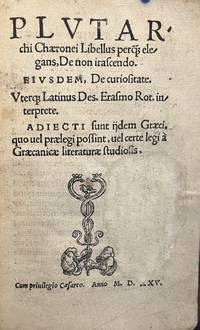
15253072Basileae Basel: apud Ioannem Frobenium 1525. First edition. In later tooled leather. Woodcut device on title page woodcut initials. Pages tanned. The title page and a few tears and wormholes inside are restored loss of letters on e8–f3 no effect on legibility. A blue inkblot at the upper edge of the first 7 leaves. Occasional stains. Near contemporary faint underlines and notes in ink throughout. Printed marginal notes shaved. Overall in good conditio. First edition. In later tooled leather. Woodcut device on title page woodcut initials. Coll.: a4 b–k7 k8 with woodcut device otherwise blank missing; ff. 75. The first edition of Erasmus’ Latin translation of Plutarch’s De curiositate printed together with the original Greek text. Dedicated to the Hungarian nobleman Alexius Thurzo.<br> <br /> <br /> De curiositate is a chapter of Plutarch’s Moralia which Erasmus after getting familiar with the original Greek text as a proofreader of the 1509 Aldina edition started to translate into Latin while in Cambridge in 1511. The first compilation of eight chapters in his translation was published in 1514 in Basel by Froben. The present book besides Erasmus’ Latin translation contains the original Greek text of De curiositate too.<br /> The book is dedicated to Alexius Thurzo Elek Thurzó Bethlenfalvi; 1490–1543 a Hungarian nobleman the Treasurer of the Kingdom of Hungary at the time of the publication between 1523 and 1527 and later the Judge Royal 1527–1543. Alexius Thurzo “and two of his brothers Johannes I bishop of Wroclaw and Stanislaus bishop of Olomouc all became correspondents and patrons of Erasmus and of many humanists in eastern Europe. Unlike his brothers Alexis followed a secular career in the mining business and in public office. After the death of King Louis Il of Hungary in the battle of Mohács 1526 he became an important supporter of the Hapsburg dynasty’s claims in the parts of Hungary not conquered by the Turks. Like his brothers the bishops however he was an active patron of humanistic learning. This dedication was offered at the urging of Jan Antonin of Košice Joannes Antoninus Cassoviensis or János Antal Kassai; 1499–1548/1563 a young physician educated at Padua who had treated Erasmus for kidney stones while visiting Basel in 1524 and who after returning to Hungary and Poland promoted contact between his wealthy patrons and Erasmus.†1572 - The Correspondence of Erasmus<br> <br /> <br /> Extremely scarce Erasmus first edition. RBH records only one copy sold at auction by the Sotheby’s in 1974.<br /> USTC 684281<br> <br /> <br /> Literature: Erasmus D Dalzell A Nauert CG. The Correspondence of Erasmus: Letters 1535-1657 January-December 1525. Toronto Ont: University of Toronto Press; 1994. [apud Ioannem Frobenium] unknown
15256388Basel: Johannes Froben 1525. Very Good/Erasmus's edition of Pliny's Natural History conserving the notes from Ermolao Barbaro's edition of 1492 printed by Johannes Froben at the height of his powers. Froben's title page is effectively a billboard: "We give you the work of the Divine Pliny called History of the World more emaculate than any edition ever produced before starting with the annotations of erudite men first among them Ermolao Barbaro and then exemplary contributions by learned people which are still worth correcting with faith in the oldest codices from which we have restored many faults do difficult to find that no one no matter how learned could find them or had found them. We have nothing to envy. We have defeated all of our elders. And if someone now takes this prize from us we will not envy them but we will be grateful for the improvement of public education. Go reader and be fruitful. And by the way we added an index that lacks for nothing. Folio 37 cm; 18 leaves 671 143 pages. Woodcut printer's device the double-headed caduceus designed by Holbein on title page on verso of p. 671 on the title page of the index and on the final page. Holbein's detailed chiaroscuro woodcut initials throughout. Bound in vellum over boards titled in manuscript on spine. Old jottings in manuscript on upper board apparently an Italian and Latin vocabulary list including the names of foodstuffs. Portion of vellum near head of spine replaced. Erasmus's name on running head of dedicatory letter aggressively inked over! Occasional scattered very light foxing in a generally bright and unblemished text. References; Adams P-1560; van der Haeghen Biblioteca Erasmiana p. 45. For the initials among Holbein's largest see Schneeli and Heitz table V #II and table LXXXIII #XL. Johannes Froben hardcover books
155649550Basle: Froben 1556. Vellum. Very Good. Folio. Two volumes in one. Pp. 8 p.l. 787 1 blank; 10 391 1 device. Separate title pages for each volume with large woodcuts of Froben's device on each plus one on final page. Numerous large and small historiated woodcut initials. Contemporary vellum binding with large blind-stamped arabesque on both sides gilt lettering piece later added. Binding a little soiled minor wear to extremities corners exposed small burn mark on lower edge of front cover lacking ties. Extensive notes in an old hand on front free endpaper but otherwise an exceptionally fine copy internally in a still attractive binding. In addition to his famous edition of the Greek New Testament published with a Latin translation in 1516 Erasmus also produced a paraphrase of the whole New Testament with the exception of the Apocalypse between 1517 and 1524. Written in his spontaneous and natural Latin style the work was received with great acclaim and an English translation made in 1548 was ordered to be placed in all parish churches next to the Bible. The present edition is an early reprint of the first complete edition issued by Johann Froben in 1524. Adams E737. Froben unknown
1522ABC_49903Cologne: Eucharius Cervicornus 1522. Contemporary blind-tooled calf with armorial panel-stamps. Sewn on 4 supports with corresponding raised bands on the spine with remnants of 4 pairs of green closing ties re-backed. 4to. With an elaborate woodcut frame on the title page and 2 smaller woodcut frames on the first pages of the texts and 5 woodcut decorated initials. 2 parts in 1 volume. Including: ERASMUS Desiderius. Commentarius in psalmum quare fremuerunt gentes. Second edition printed in the same year as the first of Erasmus version of the Commentaries on the psalms attributed to Arnobius the Younger a Christian priest active in 5th-century Gaul. Arnobius interprets the psalms allegorically relating their content to Christ and the Church. First printed in folio by Froben in Basel in September 1522 the present 4to edition was published shortly after that same year in Cologne by Eucharius Cervicornus. It contains Erasmus preface addressed to Pope Adrian VI the commentary of Arnobius on the psalms and Erasmus own extensive commentary on psalm 2 Quare fremuerunt gentes. The present copy is bound in a contemporary Cologne binding attributed to an anonymous binder active circa 1510. Both boards feature a panel-stamped frame including three armorial shields of the city arms of Cologne ermine field with three open crowns the arms of the Archbishopric of Cologne a black cross on a silver field and a diagonally banded shield likely the binders own mark. Inside there are two identical rectangular panels made up of a stamp with bird motifs and the motto Clamo ad te Domine "I call to you Lord".With two book plates mounted on the front pastedown Thomas Brooke F.S.A. Armitage Bridge and one with the motto Pro viribus summis contendo a small manuscript cypher CP on the title page and Erasmus commentary contains manuscript annotations in the margins and on the final blank page by a near-contemporary hand. The binding has been re-backed the head of the spine is slightly damaged the corners of the boards are slightly damaged the original blind-tooled leather on the boards is somewhat dry and cracked affecting the clarity of the stamps and with some small scratched in the leather on the front board. Some occasional browning and water- staining in the margins. Otherwise in good condition.l Bezzel 554; Goldschmidt 57; Jenkins 2.1; USTC 613135; Vander Haeghen II 10; VD 16 B 3132 and VD 16 E 2460; not in: BM STC German De Reuck. Eucharius Cervicornus, hardcover
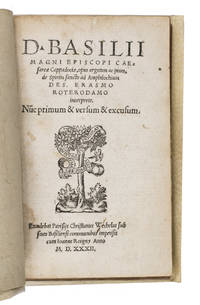
1532ABC_49897Paris 1532. Small 8vo 9.5 x 14.9 cm. Chréstien Wechel and Jean Roigny Modern limp overlapping vellum sewn on 3 supports laced through the joints red edges and with 2 sets of green cloth ties. With Wechels woodcut printers device on the title page and the verso of the otherwise blank last leaf and 2 woodcut decorated initials. 124 3 blank1 pp. Very rare second edition of Erasmus translation of a theological treatise attributed to Basil of Caesarea 330-379 CE.It was published shortly after the first edition published in May of the same year by Froben and Episcopius in Basel May 1532. The work is very rare we have traced only one other copy in sales records of the past 100 years. Erasmus' translation is accompanied by a dedicatory epistle to Joannes Dantiscus 1485-1548 Bishop of Culm and a prominent diplomat of the Polish court. The letter dated April 30 1532 reflects Erasmus conviction that direct engagement with the texts of the Church Fathers rather than with flawed Latin intermediaries was vital for the renewal of Christian piety. As Erasmus himself declared: "It would be of great benefit to sacred letters and Christian devotion if Basil himself in Greek and not the shadow of Basil a Latin translation were made available to all."His source text was a Greek edition he had published just two months prior. According to Julián 2022 Erasmus wanted to publish everything they could find from Basil lamenting that in the existing Latin versions "the greater part of him is missing." Interestingly the legacy of this work can be traced further back to the 15th century when George of Trebizond 1395-1486 a Greek scholar from Crete was commissioned by Cardinal Bessarion 1403-1472 in 1440 to translate both De spiritu sancto and Contra eunomium into Latin. George struggled with the theological complexity of the material confessing in his preface 1442 that he lacked the necessary theological training and fluency in Latin. Erasmus' later effort can be seen as a corrective and a fulfilment of that earlier humanist ambition to make the Greek Church Fathers accessible to a Western audience in an accurate and readable form.Small tear in title page not affecting the text lightly water-stained margin and slightly browned throughout. Overall in very good.l Colón 11; no. 158; Vander Haeghen II 13; Moreau IV 338; V.P. Julián Erasmo traductor y editor de los Padres de la Iglesia: Crisóstomo Basilio y Orígenes. Salmanticensis 691-22022 039-075; USTC 185205 lost book; WorldCat 150413518 913004144 3 copies; not in Adams BM STC German De Reuck; Index Aureliensis; cf. for the Basel 1532 edition: USTC 640558 1 copy; WorldCat 257292311 1374477181 150413518 3 copies. hardcover
1521ABC_49920Basel 1521. Folio. Johann Froben Contemporary blind-tooled pigskin over wooden boards with brass catch- and anchor plates along the fore-edge of the boards lacking the clasps. With a detailed woodcut border on the title page and the first page of the dedication. Further with a small woodcut illustration incorporating Frobens device on the verso of the last leaf and with woodcut decorated initials throughout. 24 515 1 blank 32 pp. Second edition of Saint Cyprians works as edited by Erasmus published by Froben one year after their first edition. Between 1516 and 1521 Erasmus worked closely with Johann Froben the humanist printer in Basel on a series of editions of the Latin Church Fathers: Jerome Augustine Ambrose Hilary and Cyprian. Erasmus aim was to purify the texts of the Fathers from medieval corruptions to restore their authentic doctrine by returning to the original sources and to present the Early Church as a model for a purer form of Christianity a theme that directly reflected his theological-humanist ideal.Erasmus states that he has cleansed the text of errors added a few minor treatises from ancient manuscripts and removed the works that seemed to have been falsely attributed to Cyprian. Thascius Caecilius Cyprianus ca. 210-258 CE later known as Saint Cyprian was an influential Church Father of the early Latin Christian tradition. Shortly after his baptism he became bishop of Carthage one of the most important Christian centres in the Roman Empire. Most of his works are pastoral letters and treatises here arranged in the index by type. The manuscript appears to have been used for study as the annotations highlight portions of the text and draw comparisons between Augustine and Cyprian.With small strips of manuscript waste visible in the gutters of the pastedowns a small owners inscription H. Reimers Erlang. 1899 in the upper outer corner of the first blank flyleaf along with elaborate manuscript annotations on the recto of that same leaf numerous contemporary and later annotations in three different hands throughout and some of the text underlined. The leather around the top and fore-edge of the front board has been restored the leather on the back board is somewhat damaged some small worm holes in the leather reveal the wooden boards below. The binding is rubbed the clasps are lacking and the head and foot of the spine are somewhat damaged the structural integrity of the binding nevertheless remains intact. The first blank flyleaf has been restored in the gutter margin the last leaf has been restored in the fore-edge margin the edges of the leaves are somewhat browned. Otherwise in good condition.l Adams C3150; BM STC German p. 234; De Reuck 417; USTC 679668; Vander Haeghen II 23; Huizinga VI p. 148; VD 16 C 6509; not in Bezzel. hardcover
153672393Parissiis: Simonem Colinaeum 1536. Simonem Colinaeum unknown