134 résultats
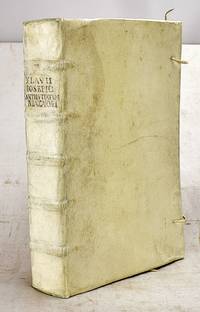
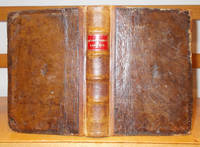
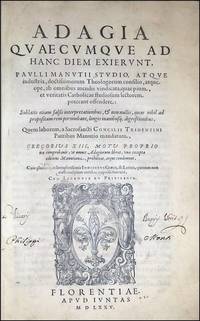
157572<p><b>FINE AND IMPORTANT ALDINE EDITION OF ERASMUS ADAGES</b>Erasmus Roterodamus. <b><i>Adagia</i></b><i> quaecumque ad hanc diem exierunt Paulli Manutii studio atque industria . ab omnibus mendis vindicata quae pium et veritatis Catholicae studiosum lectorem poterant offendere: sublatis etiam falsis interpretationibus & nonnullis . digressionibus. Quem laborem a sacrosanti Concilii Tridentini patribus Manutio mandatum Gregorius 13. motu proprio ita comprobauit vt omnes Adagiorum libros vna excepta editione Manutiana prohibeat atque condemnet. </i><i>Cum plurimis ac locupletissimis indicibus Graecis & Latinis quorum nonnulli nusquam antheac impressi fuerunt</i>. Florentiae apud Iuntas MDLXXV Florence Giunti for the Aldine Press <b>1575</b>.2° later limp <i>cartonnage</i> handwritten title and library label at spine ff. 4 columns 1454 i.e.1440 ff. 36.Giunti device at title and final leaves. Woodcut headletters. Text in Latin on two columns with some passages in Greek.Aldus Manutius' dedicatory to pope Gregory XIII.<b>Fine and important edition revised by Aldus Manutius the Younger of the renowned collection of Latin and Greek adages sayings proverbs mottos epygrams compiled by Erasmus</b>.Paul Manutius was commissioned by the Fathers of the Council of Trent to correct the work reorder purge by false interpretations and doctrinal errors in order to make this edition the only one approved by the Church the bull of Gregory XIII as stated in the title prohibits and condemns the other editions.<b>Desiderius Erasmus Roterodamus</b> 1466 – 1536 known as Erasmus of Rotterdam or simply Erasmus was a Dutch Renaissance humanist Catholic priest social critic teacher and theologian.Amongst humanists he enjoyed the sobriquet "Prince of the Humanists"; he has been called "the crowning glory of the Christian humanists". Using humanist techniques for working on texts he prepared important new Latin and Greek editions of the New Testament. These raised questions that would be influential in the Protestant Reformation and Catholic Counter-Reformation.<b>Provenance</b>: Ownership signature <i>Philippi Monti</i> at title-page beside the printer device.<b>References</b>: Renouard 220. 14. STC <i>Italian</i> 236; Adams E-443. BMC 236. CNCE 18245 & 18247.</p> Giunti for the Aldine Press paperback
1557097858Paris: Robert Estienne 1557. Vellum. pp. 112 8; 128 16; 192 36 of 40: 2 leaves missing. 12mo. Vellum with hand-lettered spine and yapped edges with the ties missing. Each title shows the famous Estienne olive tree vignette on the title page first and last titles include a colophon. Very good. In "de Magistratibus" Fiocci lists and explains the offices of Roman priests and magistrates. This work was reprinted many times in the 15th-17th centuries. The second title which translates to "The Beauties of the Latin Language" was written in 1431 to praise the Latin language and advocate for its proper usage. The third is a reprint of Erasmus' Biblical paraphrases. All three titles were popular in the 16th century and these reprints are published by famous Parisien printer Robert Estienne who inherited the press from his father Henri in 1526: Francis I later made him the King's Printer. Robert Estienne unknown
15708875Cologne: Apud Gualtherum Fabricum & JoannemGymnicum sub Monoccrote 1570. Pigskin. Very good . Sm. 8vo. 1675345pp. Woodcut device on title page. 2 woodcut historiated initials. Original roll tooled pigskin binding spine soiled. Covers with a large central stamp depicting a royal personage holding a sword and the scales of justice back cover image rather worn. Ownership signature of Andreas Drischel on verso of front free endpaper dated 1578. VD 16 E 2050. Apud Gualtherum Fabricum, & JoannemGymnicum sub Monoccrote unknown books
152245648Straßburg, Johann Knobloch d. Ä., 1522. 8°. Mit Holzschn.-Titelbordüre, einer Holzschn.-Anfangsinitiale u. einer großen Holzschn.-Druckermarke am Ende. 95 num., 1 nn. Bll., Mod. Ppbd.
15411903140038Basel: Westhemerus 1541. Hardcover. Good. 2nd ed. First published in 1538. Contemporary vellum-backed pasteboard binding. Solid binding some wear to cover extremities. All edges red. Printer's snake device verso colophon. Internally clean and unmarked. Early signature of Robert Guyard Roberti Guyardi and "Carmelus Cadomensis". A collection of Erasmus letters for the use in Latin schools. Refs: Index Aurel. 163.109 9. VD-16 E-2958. Vanderhaeghen I 101. Bezzel 1043. Cat. Rotterdam 121. De Reuck 220. Not in Adams. "Adiecimus in Calcem proverbiorum & graecarum vocum interpretationem floresq ; in elocutione latina selectissimos que omnia commentarii vice esse possunt ; opus novum et recens natum. Basel: Westhemerus hardcover
15591807040010Basel: Frobenium et Nicol. Episcopium Froben 1559. Hardcover. Good. Bound in contemporary 1/2 vellum. Worn cover edges. Collated: 10 of 12 preliminary pages 886 pages blank 16 leaves. Lacking 2nd preliminary leaf and top half of 3rd. Handsome Froben printer's device on title and final leaf. Internally clean. Larger figurative initials at the start of each section and smaller historiated initials throughout. All edges red. Not in Adams See Adams J 360 for first edition of 1534 De bello Judaico; Contra Apionem; De imperio rationis Later Latin edition of one of the main works of the ancient historian Flavius Josephus 38-100 on Roman-Jewish history. Basel: Frobenium et Nicol. Episcopium (Froben) hardcover
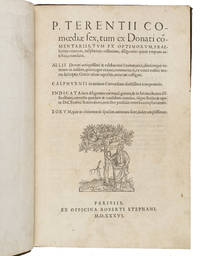
1536ABC_49923Paris: Robert Estienne 1536. Late 17th-century calf sewn on five supports with corresponding raised bands richly gold-tooled spine with the author title and year lettered in gold and red and-brown sprinkled edges. Small folio 20.2 x 30.3 cm. With Estiennes small woodcut device ona small woodcut the title page. Second edition of Terences Comoediae published by the French humanist and printer Robert Estienne 1503-1599. Publius Terentius Afer also known as Terence ca. 195-ca. 159 BCE was a Roman playwright of North African origin and one of the foremost authors of Latin comedy. The present work includes the commentary of Aelius Donatus 4th century CE based on a manuscript provided by Estiennes father-in-law Josse Bade 1462-1535. Donatus was a Roman grammarian and teacher of rhetoric best known for his grammatical works Ars Minor and Ars Maior. Building on Estiennes earlier 1529 folio edition this one was printed in the new Roman types and divided into acts and scenes a notable innovation. In addition Estienne incorporated Erasmus treatise on comedic metres which provided a scholarly analysis of the rhythmic and metric structures of classical comedies enhancing readers understanding of Terences original cadence and comedic effect.The boards are severely rubbed light foxing and staining throughout the title page is very slightly browned the head margin is cut slightly short. Otherwise in good condition.l Adams T 326; BM STC French p. 416; De Reuck 512; Inventaire chronologique des editions Parisiennes du XVIe siecle V 314; Renouard Estienne I 43 no. 15; Schreiber 52; USTC 147028 9 copies; Vander Haeghen II 55. Robert Estienne, hardcover
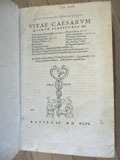
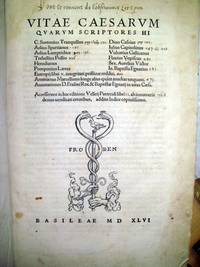
154613096Basilae Basel Bâle Basel: Froben 1546. Fine. Froben Basilae Basel Bâle Basel 1546 33 x 22.50 cm relié Colophon: Basileae per Hieronymvm Frobenivm et Nic. Episcopvm mense Septembri M.D.XLVI. First edition. Decorated with numerous historiated initials. Printer's device on the title page and verso of the final leaf. Absent from French catalogues but present in English catalogues 2 copies in Germany at the GBV union catalogue of northern Germany and one at the University of Munich. The 1544 edition published in Paris does not include Erasmus's notes and the complete assembly of authors gathered in this edition; the Parisian edition was reissued in 1551 in Lyon by Gryphium but not this Froben edition which reproduces only Egnazio's edition. The first edition of Suetonius dates from 1479. Full sheep binding 17th century decorated raised spine red morocco title label. Overall rubbed and worn on boards numerous scratches upper headcap missing 2 upper corners broken and missing. Fine interior condition with pale dampstaining running through about twenty pages at top center pp. 29 to 45. Several pagination errors same number repeated leaf skipped without lack. The evident interest of this edition was to gather together all the writers of antiquity who wrote about the Roman empire not only Suetonius but also rarer writers such as Dio Cassius translated by Merula Herodian translated by Angelo Ambrogini Poliziano Spartianus or Lampidius Velleius Paterculus Vulcatius Gallicanus Ammianus Marcellinus. Two commentators: Erasmus died in 1536 and Giovanni Battista Egnazio 1478-1553. Froben 1501-1563 is one of the great publishers of the Renaissance and the worthy successor of Johann Froben the first of the dynasty who established his printing house in Basel in 1491; it was with him that Erasmus was linked and worked and Jerome Froben merely reaped the fruits. This edition is the alliance of Froben and Nikolaus Episcopius his brother-in-law. Gothic manuscript note: ""pour le couvent de l'observance des Lyon"" and manuscript pagination of the authors. Froben hardcover
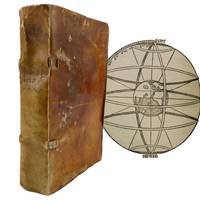
1558800Wittenberg: Krafft 1558. Softcover. Fair. Misc. A remarkable survivor clearly a student's copy of Sacrobosco's Libellus de Sphaera printed in 1558 with the student's inscription at the bottom of the title page and a question and answer styled study guide bound at the rear 1560 by Hartmann Beyer. The shared shelfmark from the title page to the binding indicates the wallet-style binding may be contemporary to the book. Also this copy still retaining its broadside with the locations of the sun updated since the 365.25 days per calendar year causes yearly drift in the location of the sun by day since the true day is slightly shorter. Sacrobosco's work was first produced around 1230 a text book dedicated to spherical astronomy. Although Sacrobosco did use the Earth as central to all rotation his methods of finding the locations of stars the sun and moon based on elliptical patterns was fairly reliable and became the standard of students for centuries to come. He also correctly identified the world as a sphere. By 1558 the idea of the Earth as the center of the universe was largely dispelled but Sacrobosco's calculations and tables were so good that they were yet to be replaced so academies were updating to accommodate the new science. This copy has the commentary and editing of several 16th century scholars Philip Melanchthon and Erasmus Reinhold as well as a second book with commentary of Hartmann Beyer. The university usage of this copy is clear and to be noted. The scholar one Wolfgang notes at the bottom of the title page that he is studying physics. The 17th century date of study denotes that an older book was still acceptable in studies. Yet despite the later date the binding contains both the 1558 Sacrobosco and essentially a 1560 study guide posing the question ""Has this book been used for study before Wolfgang wrote in it"" A mystery is the Cistercian monastery also holding the work. Did they possess the book before or after Wolfgang Or was it from a different Cistercian monastery that was dissolved during the protestant reformation years leading up to Wolfgang's study Bibliographic Details - 1558 Sacrobosco - Universal Short Title Catalogue USTC number 668014 6 copies recorded in the world's libraries. 1560 Quaestiones. - Universal Short Title Catalogue USTC number 689026 5 copies recorded in the world's libraries and USTC 689025 recording four more copies. Physical Attributes - Measures approx. 15 x 9 x 3 cm. Vellum wallet-style wrapper. Spine with two bands. Spine with author/title in old hand. Sacrobosco's work is illustrated throughout some with diagrams that could be used as the base for moving parts. Sacrobosco - Pages - Not paginated Collation - A-R8 with last two blank leaves present. Collates complete. Beyer - Pages - xxxii 302 2 blank pages last leaf blank Collation - aa8 a8 b-u8 collates complete. Condition - See pictures. Wallet-style vellum binding with wear and cockling waviness. Bottom of flap corner chipped away. Top front strap missing from binding to text block causing looseness still connected in back. No pastedowns used. Matching library number to title page written on front board inner as well as bookseller notes of date/publication and ex libris of Gingerich. 1st gathering almost loose chipping to top edge. Title page heavily annotated with two ex libris. One is the library of a Cistercian monastery and the other is of an early 16th century student. The title page has heavy toning and some chipping along edges. Bottom corner of front of text block dog eared. Throughout text block there is use consistent with student usage. Occasional thumbing dog-eared corners annotations page-edge chips/tears fox spots candle ember marks etc. Occasional moisture mark from edge second half from upper corner worst at last page. Occasional faded page E gathering ink light. Krafft
15542212260023Basel: Froben 1554. First Edition. Hardcover. Acceptable. Opera of Josephus: Containing Sigmund Gelen and Erasmus's translations Folio. Bound in modern vellum with leather ties. Woodcut printer's device on title. 8 886 blank 24 of 32 pages. Lacking last 8 pages of the appendix. Some contemporary marginalia but generally sound. "De imperio rationis" is from Erasmus's 1517 translation. Hoffmann II:593. Not in Adams. Contents: 1. Antiquities of the Jews with Flavius's autobiography translated by the Czech philologist Sigmund Gelen 1497-1554; 2. the Jewish war; 3. Against Apion both in the late antique translation by Ruffinus of Aquilea 340-410 revised by Gelen; 4. a treatise on the martyrdom of the Maccabees edited by Erasmus. Froben hardcover
153194471531 Parisiis in via Iacobaea, apud Ludouicum Cyaneu sub duobus Gallis & Ionnem Roigninum sub Basilisco, 1531. Un volume in-12 (12 x 16,5 cm), [16]-746-[36] pp. (epistola nuncupatoria + lib. I-VI + index). Signatures: aii-cciiiib. Colophon: « Parisiis ex officina ludovici Cyanei sub duobus gallis in via Iacobea, Anno M.D.XXXI, mense Augusto». Livre bien complet de tous ses feuillets. Dans une reliure dépoque en cuir marron foncé, les plats estampés à froid, dos à cinq nerfs, tranches rouges. La couverture, notamment le dos, ont été habilement restaurés au XXe siècle, tout comme la page de titre et la dernière garde. Pages salies en début et fin d'ouvrage, écritures anciennes à la plume au verso de la page de titre, quelques soulignages dans le corps du texte, sinon ouvrage en bon état et parfaitement lisible.
153592971535 Basileae, in officina Frobeniana [per Hieronymum Frobenium et Nicolaum Episcopium], 1535. Un volume in-8° (122 x 181 mm) de [16]+864+[56] pages, marques dimprimeur au titre et en dernière page. Reliure de lépoque en plein en plein veau glacé marron estampé à froid et portant sur le plat supérieur le nom de son propriétaire, Hupert Heymer, fermoirs de laiton, dos à nerfs orné à froid. Charnières fendues, mais les doubles ficelles des nerfs sont intactes! Ex-libris manuscrit au haut de la page de titre: «Colleg[ii] Soc[i eta]tis Jesu, Silvae Duc[is] (biffé et remplacé par ) Alosti, 1621» (Hertogenbosch, Pays-Bas, et Alost, Belgique).
1534372192Basel: Froben 1534. Froben's printer's device on first and last leaf of each work. 415 1; 191 1pp. 8vo. Early half calf and pastepaper boards. Spine ends rubbed front joint cracked but cords holding. Very good. Froben's printer's device on first and last leaf of each work. 415 1; 191 1pp. 8vo. Early Froben edition of a pedagogical work by Erasmus "On the Writing of letters" first published in 1522 with a collection of aphorisms or "Parallels" gathered out of Plutarch's Moralia Seneca Lucian Xenophon Demosthenes Aristotle Pliny and Theophrastus. An edition was published in Cologne in the same year and the work was a standard throughout the sixteenth century. VD16 E2515 E3257. Provenance: Princes of Liechtenstein armorial bookplate; General Theological Seminary bookplate Froben unknown
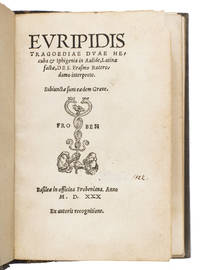
1530ABC_49914Basel 1530. 8vo 10.4 x 15.4 cm. Froben Office heirs of Johann Froben 19th-century half brown calf and grey paper sides. With a woodcut printer's device on the title page and final page and 7 decorated woodcut initials. 293 1 1 blank 1 pp. This volume brings together Erasmus renditions in Latin of two of Euripides most enduring tragedies titled Hecuba and Iphigenia in Aulis presented alongside the original Greek texts beginning on page 169. Euripides ca. 480-ca. 406 BCE was a Greek tragedian of classical Athens. He is one of only three Greek tragedians whose plays have survived in full the others being Aeschylus and Sophocles.Both plays in the present work explore the devastating costs of war through the eyes of women caught in its aftermath. In Hecuba the former queen of Troy endures unspeakable losses the sacrifice of her daughter Polyxena the murder of her son Polydorus and ultimately a brutal act of revenge that leads to her mythical transformation into a howling dog symbolising her complete descent into grief and rage.Iphigenia in Aulis is set on the eve of the Trojan War focusing on Agamemnons impossible decision to sacrifice his daughter Iphigenia to appease the goddess Artemis and allow the Greek fleet to sail. The play confronts themes of duty honour and the personal costs of collective ambition. These themes echo tragically in Hecuba which portrays the wars bitter consequences. Together these tragedies form a poignant narrative arc from the sacrifices made to start a war to the wreckage and human suffering left in its wake.With a partially erased manuscript note on the title page 1822. Some water staining in the margins and a few small holes in the inner margin not affecting the text. Otherwise in good condition.l Adams E 1042; BM STC German p. 289; De Reuck 425; Erasmus Online 4215; Vander Haeghen II 25; VD 16 E 4231; USTC 654881; not in Kossmann. unknown
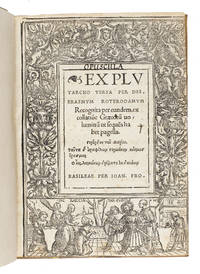
1520ABC_49876Basel: Johann Froben 1520. Modern gold-tooled half calf and marbled paper sides with the author title and year of publication lettered in gold on the spine red sprinkled edges. 4to. With the title set within an elaborate woodcut frame a smaller woodcut frame on the verso of the title page and the first page of the first text. Further with 9 woodcut decorated initials woodcut headpieces and a small woodcut illustration incorporating Frobens device on the last page. This finely printed 1520 Basel edition presents a collection of Erasmus earliest translations from the works of the Greek moral philosopher Plutarch. The volume presents eight of Plutarch's shorter treatises addressing themes such as friendship health and the nature of the human soul.One of the most notable inclusions is De discrimine adulatoris et amici How to tell a flatterer from a friend a treatise Erasmus translated during his time in Cambridge and dedicated to King Henry VIII. The text which explores the subtle art of distinguishing true friendship from sycophancy resonated in an era when rulers were often surrounded by flattering courtiers. With characteristic tact Erasmus hoped the work might serve both as philosophical instruction and as a gentle warning to the young English king particularly in light of those who had encouraged Henrys war with France.Furthermore the present work includes two of Plutarchs important medical treatises in Erasmus translation: De tuenda bona valetudine Advice on keeping well and Utrum graviores sint animi morbi quam corporis Are diseases of the soul more serious than those of the body. The latter contains strikingly early and thoughtful reflections on what we now recognise as mental illness. Other works included in this volume are: Quo pacto quis efficere possit ut capiat utilitatem ab inimico reflections on transforming enmity into wisdom and personal growth. In principe requiri doctrinam on the necessity of wisdom and education in a prince. Cum principibus maxime philosophum debere disputare a meditation on the philosophers role in advising those in power. Num recte dictum sit e ßsa on the meaning of the maxim lathe biosas: to live quietly and modestly. De cupiditate divitiarum a discourse on avarice and the moral corruption born of greed.With a small manuscript note added above the title opuscula and a 17th- or 18th-century owners inscription by an otherwise unidentified Johannes below the colophon on the final page. Slightly foxed and browned throughout the fore-edge and lower margins are cut slightly short barely affecting the printed marginalia. Otherwise in good condition.l Adams p. 654; Ledo pp. 260-66; USTC 655014 6 copies; Vander Haeghen II 46; VD 16 P 3718; not in BM STC German; De Reuck. Johann Froben, unknown
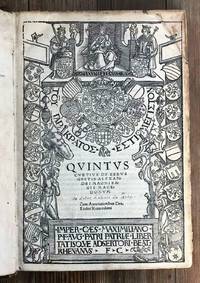
1518curtius<b>Erasmus Finds His Vacation Reading Deficient So He Prepares a New Critical Edition</b><b> <br /></b><br />Folio. 4 LXXXIX leaves; 10 124 pages. Late sixteenth century leather; light scuffing hinges cracked but cords holding tightly; insect damage to text block with loss of text throughout; margins in Orosius trimmed close affecting title image. First printing of Erasmus' critical edition of Quintus Curtius. This first century Roman biography of Alexander the Great was an early Renaissance bestseller with editions from at least a dozen printers throughout Europe by 1517. Erasmus brought it as reading material on a voyage to England in 1517 and finding the text incomplete and corrupt he prepared his own critical edition. This was first published by his friend Strasbourg printer Matthias Schürer in 1518. Erasmus' version proved so popular that five more printers had issued their own editions of his text by 1541; these in turn were reprinted a total of five more times by 1575. This first edition is scarce on the market with Rare Book Hub locating only one sale at auction since 1971 at PBA in 2008 for $2400. <br /><br /><b>Bound with</b>: Paulus Orosius <i>Adversvs paganos historiarvm libri septem</i>. Cologne: Eucharius Cervicornus 1526. An attractive copy of this first universal history by a Christian writer Paulus Orosius c 375-c 418 a Hispanic student of St Augustine who traveled widely throughout the Mediterranean. Elaborate title page border depicting the labors of Hercules signed "AW" Anton Woensam 1493-1541 a prolific painter and woodcut artist whose work was favored by the booming publishing industry in Cologne. Other page borders and initials are also by Woensam as described by Merlo 1864.<br /><br /><br /><br /> Schürer hardcover books
1535009530Basileae : In officina Frob. 1535: Basileae : In officina Frob. 1535 1535. Collation 194pp2 blank 126pp 2 422pp. This being volume 2 parts 456. First 2 parts dated 1535 final part 1532. Volume 2. pt. 4: D. Erasmi Roterodami paraphrasis in Euangelium secundum Ioannem ad illustrissimum principem Ferdinandum per autorem recognita. 194pp.1535. pt. 5:1. In Acta Apostolorum paraphrasis Erasmi Roterodami ab autore recognita. 126 2pp. 1535. pt5:2. Secundus continens paraphrasim D. Erasmi Roterodami in omneis epistolas apostolicas summa cura denuo ab ipso autore recognitam emendatamque tum ex archetypis tum eruditorum animaduersione ita ut accuratius fieri uix potuerit. Caetera cognosces lector inuersa pagin. 442pp.1532. Bound in full early calf. Rebacked at some time not recently retaining original boards raised bands elaborate gilt tooling within compartments leather title labels. Calf lightly rubbed and scuffed. Binding in very good clean firm condition. Internally first title dust or dirt marked some light staining to first 25 pages early neat previous owners name inscription on bottom section of title. Pages in very good clean condition throughout. A very nice clean copy in a very attractive early binding. A6. Full-Leather. Very Good Plus. Folio - over 12" - 15" tall. Basileae : In officina Frob., 1535 Hardcover
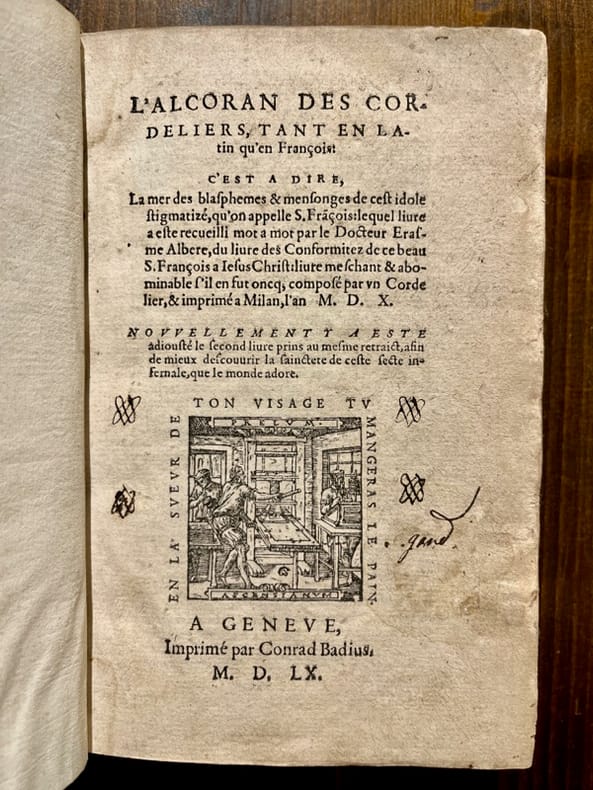
156019664A Genève, imprimé par Conrad Badius, 1560. 2 parties en un volume in-8 de 8-278-[2] et [16]-303-[1] pages [A4; a-r8; s4; *8; A-T8]. Reliure 19ème en plein veau brun, dos à nerfs orné de petits fleurons dorés. Les plats sont constitués du cuir de la reliure originale, ornés au centre d'une large pastille dorée, décorée d'arabesque; encadrés de double filets dorés et à froid, Tranches dorées.
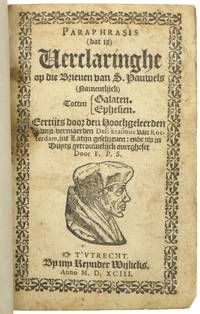
159312512Amsterdam Pieter la Burgh / T'Utrecht Reynder Wijlicks 1658/1593. 2 werken in 1 band 124 142 p. Origineel Perkament 8°. Twee werken van Erasmus in het Nederlands vertaald waarvan het tweede in deze uitgave uiterst zeldzaam is. Amsterdam, Pieter la Burgh / T'Utrecht Reynder Wijlicks unknown
152920903bâle Johann Froben 1529 -in-folio plein-veau 2 Parties en 1 Volume, reliure plein veau brun raciné in-folio (binding full calfskin in-folio) (37,6 x 26 cm), RELIURE D'EPOQUE avec le dos entièrement restauré au 19ème, dos à nerfs (spine with raised band) décoré "or" et à froid (gilt and blind stamping decoration), auteur et titre frappés "or" avec filet "or" de part et d'autre, filet "or" en place des nerfs avec un filet or et un filet à froid de part et d'autre des nerfs, filet or en tête et en pied, plats avec les armoiries "or" (au centre) de Claude PELLOT, 1er Président au Parlement de Normandie (Ex-Libris aux mêmes Armes gravées sur cuivre en noir à l'envers du titre), roulette "or" sur les coupes avec manque de dorure (blurred gilding) et manque de cuir, toutes tranches lisses jaspées rouges, Ex-Libris gravé en noir sur sur papier velin crème au dos de la couverture : aux armes de LE FILLEUL des GUERROTS, Chateau des Guerrots [ Heugleville sur Scie (Seine-Maritime, Normandie, France)] + Ex-Libris : "Ex libris Monasterii Sanctae Mariae de Petra Gyrante"Abbaye Sainte-Marie de la Pierre-qui-Vire (Congrégation des Bénédictins de Subiaco) illustré en rouge sur etiquette crème , Texte en Latin, sans illustrations (no illustration) excepté une marque de l'Editeur FROBEN en bas du titre gravée sur bois en noir et la même en fin de volume (même chose pour la 2ème partie) + orné de Lettrines historiées (and illuminated of dropped initials) gravées sur bois en noir, (24 + 596 [i.e. 610] + [2]) + (190 p. d' INDEX) pages, 1529 Basileae : [Johann Froben], (Basileae : in officina Io. Frobenij, 1528) Editeur,
15597737Bâle 1559 1 Basilea: Per Hier. Frobenium et Nicol. Episcopium, 1559. In-4: 23 x 33,5 cm, 6 ff. n. chiff. [titre, tables], 886 pp. [Antiquitatum Judaicarum Liber I-XX; Flavii Josephi vita; De bello Judaico Liber I-VII; Contra Apionem Liber I-II; De Machabaeis]+ 17 ff. n. chiff. [index, colophon]. Nouvelle édition, augmentée et révisée, de ce Flavius Joseph des Froben de Bâle paru pour la première fois en 1534. Traduction latine par lhumaniste tchèque par Sigmund Gelen (1497-1554) du corpus josephien comprenant Les antiquités judaïques, La guerre des Juifs, lAutobiographie de Flavius Josèphe, Contre Apion. À cela sajoute le De Imperio rations, ou De Machabaeis, édité quand à lui par Erasme (1467-1536). Marque des Froben à la page de titre et au colophon. (Heinz Schreckenberg, Bibliographie zu Flavius Josephus, I, Leiden, 1968, p. 14)Reliure de la première moitié du XVIIIe en veau blond. Dos à cinq nerfs avec pièce de titre en maroquin rouge et caissons ornés aux petits fers. Toutes tranches rouges. Ex-libris manuscrit à la page de titre: «Renatus Guillaume Presbiter 1729». Ex-libris: «André Gutzwiller». Coupe du plat supérieure abîmée. Larges mouillures aux premiers et derniers ff., sans altération du contenu. Quelques marginalia. Désirable pour la somptueuse typographie des Froben!
15672733Basileae : Apud haeredes Nicolai Brylingeri M. D. LXVII. 1567 1567. Hardcover. Good. 26 643 1 p. the last page blank ; 17 cm. 8vo ; References: Adams; T-361; VD16; T-466 ; OCLC: 35196231 ; preface by Desiderius Erasmus dated 1532 ; includes commentary on each play by Giovanni Calfurnio ; Title vignette; initials ; Signa tures: a-z8 A-T8 Nota Bene: incomplete volume : A-B are missing pages 339-375 comprising Actus II Scena I - Actus III Scena II of Adelphi ; Contemporary panel-stamped cream/butter-colored pig-skin binding ; raised bands ; green speckled fore-edg e ; two-tone silk headband ; bookplate "E Bibliotheca Collegii Cremsensis" dated 1818 with ownership written in ink across title page ; large crayon pencil mark in red "LVIII29" on lower portion of title page ; text in Latin italic type font f or the text of the plays ; only one other known institution copy held by the Newberry Library ; slight worm damage to top of spine ; soiling ; marginalia on some pages in a contemporary humanist hand on pages 2-5 17-19 439-40 445 478-79 491-92 529-30 615 640-42; name and text on back ep in a German hand writing Frakturschrift consisting of a paraphrased quote from the Psalms ; Contents : Terentii Vita -- Andria -- Evnvchvs. Eunuchus -- Heavtontim. Heautontimorumenos -- Adelph. A delphi -- Hecyra. -- Phormio. ; also contains a poem in Latin iambs by Erasmus printed on the reverse of title page ; G <br/> <br/> Basileae : Apud haeredes Nicolai Brylingeri, M. D. LXVII. (1567) hardcover
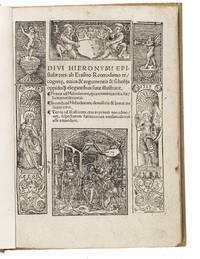
1518ABC_49875Cologne: Johann Gymnic 1518. Modern faux-leather-patterned paper with a grey paper label on the spine with the authors name lettered in silver Erasmus v. Rotterdam. 4to. With the title set with in a frame built up from 4 or possibly 6 woodcut illustrations including printer's initials and the date 1518 and 10 woodcut decorated initials. Selection of three letters by the Church Father Jerome of Stridon Saint Jerome ca. 342/47-420 CE edited and annotated by Erasmus. Erasmus felt a profound connection to Jerome. He saw in the ancient Church Father not only a kindred spirit but also a mirror for his own intellectual and spiritual journey. Included in this volume are three letters: first the epistle to Heliodorus on the praise of the solitary life de vita solitaria a stirring defence of ascetic withdrawal from the world; second the epistle to Heliodorus on the misery of human life de miseria vitae humanae a sombre reflection on the fleeting nature of earthly existence; and third the epistle to the monk Rusticus on avoiding familiarity with women de mulieribus evitandis a warning shaped by both monastic ideals and Jeromes personal convictions. Additionally a short fourth letter addressed to Onasus is included at the end of the volume though it does not appear on the title page. In this letter he satirically addresses the priest Onasus who had a deformed nose and his feeling of being unjustly attacked and being made a fool of in other letters and writings by Jerome.With early manuscript annotations corrections etc. of the printed text in the margins and occasional underlining of the text mainly concerning the third letter written in three different hands in both brown and black ink. With a 0.5 cm worm hole in the gutter margin not affecting the text. Occasional foxing and browning and some water staining in the fore-edge margin of several leaves. Overall a good copy.l BM STC German p. 440; USTC 640603 3 copies; Vander Haeghen II 29; VD 16 ZV 7938; not in Adams; De Reuck. Johann Gymnic, hardcover
1547014688Basileae: Hieronymus Froben & Nikolaus Episcopius 1547. Book measures 16.5x11.5.cm. 415pp.1pp printer's device. Rebacked retaining period or early boards raised bands leather lebel. Some wear to edges of boards. Binding in very good clean firm condition. Internally previous owners bookplate very light staining of browning to margins. Pages in very good clean condition. A very nice copy. F. Leather. Very Good. 8vo. [Hieronymus Froben & Nikolaus Episcopius]