4 530 résultats
cm. 17 x 24, 226 pp. Biblioteca della ?Rivista di storia e letteratura religiosa? - Studi La polemica fra Erasmo e gli umanisti vicini alla Curia romana, il nesso fra preferenze di stile e scelte politico-religiose. 436 gr. 226 p.
8859616875.Gpaperback. Good. Access codes and supplements are not guaranteed with used items. May be an ex-library book. paperback
ria9781119542384_inpPaperback / softback. New. New Book; Fast Shipping from UK; Not signed; Not First Edition; N/A paperback
in-16°, pp. 64 con 16 ill. f.t. e alcuni disegni n.t. Leg. in cartonato edit. con velina titolata in sovrac. Lievi bruniture del tempo e piccola mancanza alla velina di sovrac. in alto. Buono l'interno, salvo leggera brunitura del tempo.
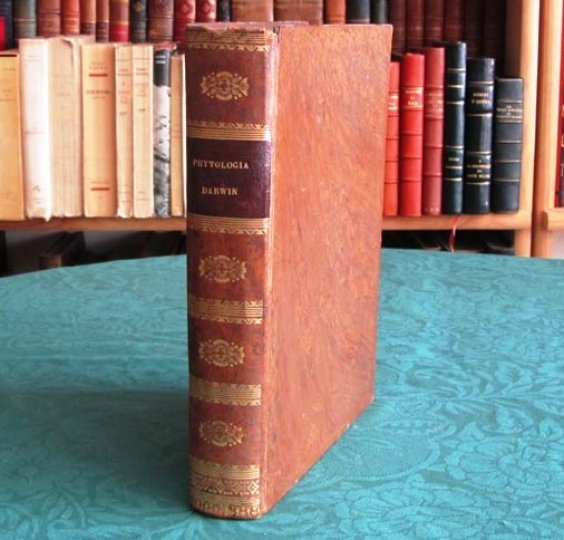
19411Paris De l'imprimerie de Digeon, An VIII 1800 in 12 1 volume reliure demi basane rouge ancienne, dos lisse orné de filets et fleurons dorés, pièce de titre de cuir noir, faux-titre, titre, 412 pages, petite trace de mouillure dans la marge supérieure de quelques feuillets. Edition originale de la traduction française. Erasmus Darwin, Elston 1731-Nottingham 1802, Poète et naturaliste britannique. Bon exemplaire ( Photographies sur demande / We can send pictures of this book on simple request )
1539Dublin, Byne, 1800, un volume in 8 relié en pleine basane marbrée, dos orné de filets dorées (reliure de l'époque), (petit accroc à la coiffe, quelques rousseurs), 8pp., 556pp., (6), 12 PLANCHES dépliantes
180014595With the theory of draining morasses and with an improved construction of the drill plough. By Erasmus Darwin, M.D.F.R.S. author of Zoonomia, and of the Botanic Garden.Contents.Introduction.Part the firt. Physiology of vegetation.sect.I. Individuality of the Buds of Vegetables. II. Their Absorbent Vessels. III. Their Umbilical Vessel. IV. Their Pulmonary Arteries and Veins. V. Their Aortal Arteries and Veins. VI. Their Glands and Secretion. VII. Their Organs of Reproductions. VIII. Their Muscles, Nerves, and Brain.Part the second. Economy of Vegetation.IX. The Growth of Seeds, Buds, and Bulbs. X. Manures, or the Food of Plants. XI. Of draining and Watering Lands. XII. Aeration and Pulverisation of the Soil. XIII. Of Light, Heat, Electricity. XIV. Diseases of Plants.Part the third. Agriculture and Horticulture.XV. Production of Fruits. XVI. Production of Seeds. XVII. Production of Roots and Barks. XVIII. Production of Leaves and Wood. XIX. Production of Flowers. XX. Plan for disposing a Part of the System of Linneus into more Natural Classes and Orders.Appendix. Improved Construction of the Drill Plough.Édition originale rare. London, Johnson 1800. 612 pp + index + 12 planches (dont 2 repliées). Ex-libris aux Armes de la bibliothèque de Bellotti S.Reliure pleine basane marbrée de l'époque. Dos lisse orné et doré avec pièce de titre. Roulette dorée sur les coupes. Quelques pâles rousseurs sans gravité. Petit accident à la coiffe supérieure. Exemplaire exceptionnel pour ces planches. Bon état. Format in-4° (27x22).
197362885London, The Scholar Press Limited, 1973. 4to. In the original yellow cloth with gilt lettering in the original dust-jacket. Dust-jacket with light wear and ex-libris pasted on to verso of front board, otherwise a nice and clean copy. (14), 174, (2), 124 pp.
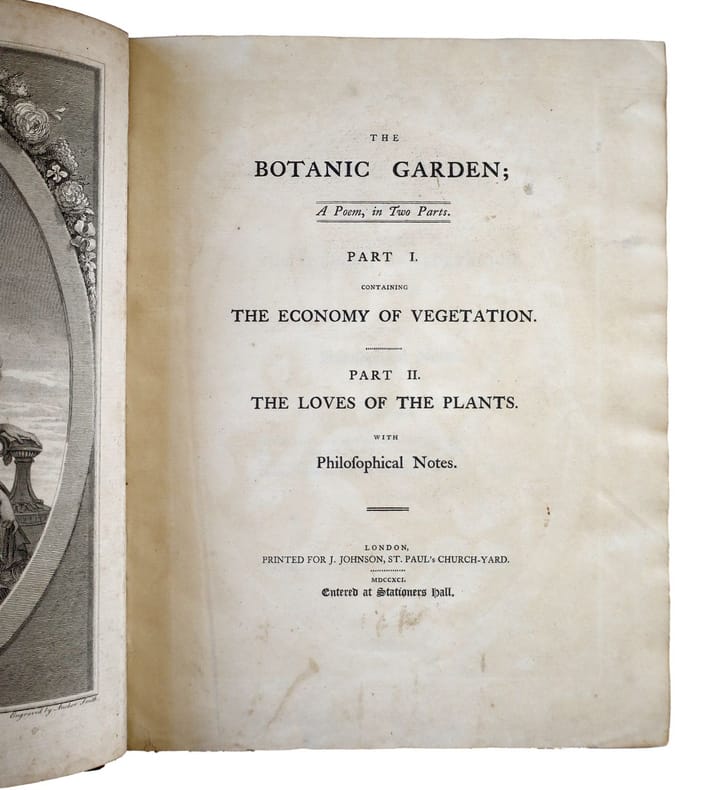
179193718London, printed for J. Johnson, 1791, in-4, Front, XII-214-126-[2] pp, 9 pl. dont 1 depl.; front, [2]-IX-197 pp, 9 pl, Reliure ancienne, dos lisse, plats de veau brun rapportés, Célèbre poème scientifique du grand père de Charles Darwin, Erasmus Darwin (1731-1802). Cet exemplaire comprend la première édition de la première partie (The Economy of Vegetation) et la troisième édition de la deuxième partie (The Loves of the Plants), enrichie de deux planches supplémentaires par rapport à la première édition de 1789. Le Jardin botanique fut publié de manière inversée, selon le souhait de l'auteur, qui fit d'abord paraître la seconde partie de l'ouvrage (1789 et 1790), la jugeant plus apte à divertir et charmer. Comme dans les autres oeuvres d'Erasmus Darwin, ce poème contient un grand nombre d'informations scientifiques souvent avancées. La première partie, plus scientifique, couvre la philosophie naturelle et fait état de nombreuses recherches et inventions contemporaines, telle que l'histoire du cosmos. En seconde partie, l'auteur explique le système de la reproduction sexuée de Linné avec les propriétés remarquables de certaines plantes en particulier. L'aïeul de Charles postule que la reproduction sexuelle est au coeur des changements et des progrès de l'évolution, tant chez les humains que chez les plantes. Cette conception d'une transformation progressive des espèces appartient aux sciences de la reproduction et rejoint les théories pré-évolutionnistes qui sont apparues à l'aube du XIXe siècle (Laniel-Musitelli). Néanmoins, son petit-fils, Charles, déclara que la théorie d'Erasmus n'avait pas eu d'effet sur L'origine des espèces. Le Jardin botanique est également précieux pour son illustration, qui comporte deux frontispices, 18 planches et une vignette dans le texte : 5 des planches du volume I ont été gravées par William Blake, soit 4 gravures du vase de Portland et la planche de la Fertilisation de l'Égypte, d'après un dessin de Johann Heinrich Füssli (Henry Fuseli), célèbre peintre du Cauchemar. Ex-libris gravé de Marcus Jacobson. Coins et dos anciennement refaits. Épidemures sur les plats. Légères rousseurs et salissures sur les premiers feuillets. Garrison & Morton n° 8921. Sophie Laniel-Musitelli, "Erasmus Darwin : naissance du transformisme dans le texte poétique". In Bulletin d'histoire et d'épistémologie des sciences de la vie, 2011/1 (Volume 18), p. 25-40. Couverture rigide
18104956A Gand, chez P. F. de Goesin-Verhaeghe; rue Haute-porte, n°229, 1810-1811. 1810 4 vol. in-8° (212 x 138 mm.) de: I. [3] ff. (faux-titre, titre, épigraphe); 20 pp. (préface du traducteur); [1] f. (titre de la première partie); 23 pp. (reprise de la pagination à 19, préface de l'auteur); [1] p. (table); 614 pp.; [1] p. (errata); 3 planches aquarellées ; II. [2] ff. (titre, table); 659 pp.; [2] pp. (errata, avis au relieur); 4 planches (3 aquarellées, 1 gravée); III. XIV pp. (titre, titre de la deuxième partie, préface de l'auteur); 586 pp.; 3 planches gravées; IV. [1] f. (titre); 570 pp. (dont table); 1 planche dépliante gravée. Un total de 11 planches (dont 1 dépliante et 6 à l'aquarelle). (Corps douvrage très frais). Demi-basane d'époque, plats recouverts de papier marbré, dos lisses ornés, titre et tomaison de maroquin noir, tranches jaspées. (Quelques petites rousseurs).
SLIVCN-9781536148749NOVA SCIENCE PUBLISHERS INC (2/2019)
SLIVCN-9781536148725NOVA SCIENCE PUBLISHERS INC (2/2019)
180731376Gand, Goesin-Verhaeghe, 1807, in-8, 84pp, Document dé-relié et sans couvertures, Document dé-relié et sans couvertures sinon bel exemplaire complet! 84pp
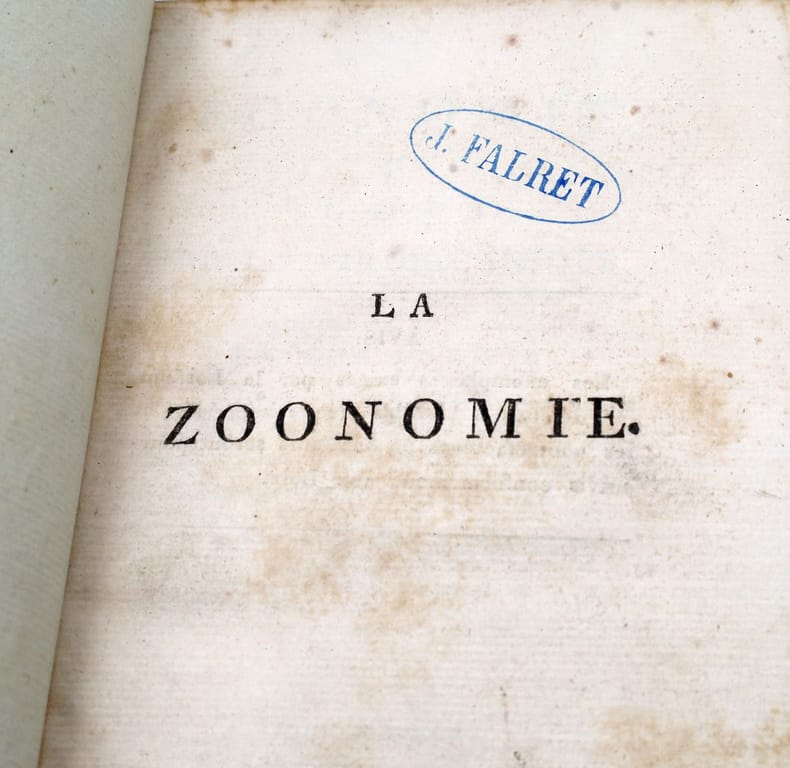
1810101765Gand, P. F. de Goesin-Verhaeghe, 1810-1811, in-8, 4 vol. : [6]-20 pp, [1] ff, pp. 19 à 23-[1], 614 pp, 3 pl. ? [4]-659-[1] pp, 4 pl. ? XIV-586 pp, 3 pl. ? [2]-570 pp, 1 pl. dépl, Demi-veau glacé postérieur, dos lisses et fleuronnés, pièces de titre et de tomaison havane, tranches marbrées, Première édition française de cet ouvrage majeur par le grand père de Charles Darwin, Erasmus Darwin (1731-1802). Cette somme, où se mêlent médecine, biologie et philosophie naturelle, avec certaines intuitions évolutionnistes, a été publiée à l'origine en 1794-1796 (Zoonomia; or the laws of organic life. 2 vols. London, J. Johnson). Le texte est illustré de onze planches, dont cinq en couleurs, qui représentent des expériences de persistence rétinienne et des inventions - ou appareil améliorés - de l'auteur : une machine thérapeutique à décharge électrostatique, consistant en une planchette et deux tubes de verre; un fauteuil orthopédique; une boîte à brosse circulaire pour pulvérisation de quinquina et de céruse dans le traitement de la phtisie; et un "lit de repos mobile à roues", envisagé pour faire tourner les malades afin de les endormir. Erasmus Darwin, inventeur, poète et pionnier en médecine, s'est préoccupé de philosophie naturelle et s'est intéressé aux recherches et inventions contemporaines. Il conçut un moulin à vent horizontal, une charrue améliorée, une pompe rotative ou encore une machine parlante. Il travailla aussi sur la turbine à vapeur, les toilettes, les élévateurs de canal et les télescopes. Il explora encore la formation des nuages, décrivit la photosynthèse et défendit un traitement humain des maladies mentales (Heirs of Hippocrates n° 998). On le considère comme un théoricien précoce de l'évolution : il postulait que la reproduction sexuelle est au coeur des changements et des progrès de l'évolution, tant chez les humains que chez les plantes. Son célèbre descendant déclara toutefois que la théorie d'Erasmus n'avait pas eu d'effet sur L'Origine des espèces (Laniel-Musitelli) : toutefois, Charles Darwin reconnaissait l'intérêt des travaux de son aïeul, en admettant notamment qu'il était "curieux de voir combien le docteur Erasme Darwin, [son] grand-père, dans sa Zoonomia (...), a devancé Lamarck dans ses idées et ses erreurs"*. Garrison & Morton n° 105 pour l'édition originale; Heirs of Hippocrates n° 999 pour la 2e édition anglaise. Sophie Laniel-Musitelli, "Erasmus Darwin : naissance du transformisme dans le texte poétique". In Bulletin d'histoire et d'épistémologie des sciences de la vie, 2011/1 (Volume 18), p. 25-40. Cachet ex-libris du psychiatre J[ules] Falret. Charnières fendillées et fragiles, manque en tête d'un dos. Bon état intérieur. * Charles Darwin, L'origine des espèces au moyen de la sélection naturelle (...) traduit sur la 6e édition anglaise, par Ed. Barbier. Paris, Reinwald, 1876, p. X. Couverture rigide

195515620Circleville Oh.: Ross County Historical. Very Good. 1955. Hardcover. Originally published in The Columbus Dispatch 1955; Reprinted by Ross County Historical as part of the Ohio Valley Folk Tale Research Project; light soil to wraps; otherwise VG . Ross County Historical hardcover books
17971978Derby: J. Drewry 1797. First edition. Contemporary quarter calf over marbled boards; spine ruled in gilt with red morocco label; all edges dyed yellow. Boards and spine rubbed; some chipping along edges. Original stab holes visible in gutter margins. Previous owner's bookplate on front pastedown; ink signature of Mary Wolley to front free endpaper; light foxing. Quarto collates complete with half title and engraved frontispiece: viii 9-128. Bound after Fosbrooke T.D. The Economy of Monastic Life. Glocester: Printed by R. Raikes 1792. First edition dedicated to Edward Jenner who is also listed as a subscriber. Internally a copy in excellent condition.<br/><br/>The grandfather of the illustrious Charles Darwin Erasmus Darwin wrote this treatise on the education of young women to support his own daughters' school at Ashbourne. Darwin's treatise takes a comprehensive view of women's education suggesting that it should reach beyond social skills such as the "perpetual appearance of attention" polite dancing and flattering dress and into formal intellectual pursuits including literature history mathematics and the natural sciences. While he promoted women's education in part to improve the likelihood of companionate marriages Darwin's text tentatively acknowledges that a marital partnership can only function happily when both parties have an intelligent understanding of the world and the ability to participate in it. "A radical campaigner for equality he condemned slavery supported female education and opposed conventional Christian ideas on creation" Farra. With a bookplate from the library of the Wolley family this particular copy has the ownership signature of female reader Mary Wolley. J. Drewry unknown books
41602Margin: 220x142 mm. Very minor tearing in bottom margin faint foxing. unknown books
179541603London: J. Sewell 1795. Plate: 186x110 mm. Margin: 223x131 mm. Light soiling faint foxing edges trimmed. J. Sewell unknown books
15602A Plan for the Conduct of Female Education in Boarding Schools" by Erasmus Darwin. First edition. 1797. Derby: Printed by J. Drewry; for J. Johnson St. Paul's church-Yard London. Rebacked in half calf over boards; spine ruled in gilt with gilt title; Erasmus Darwin was the illustrious grandfather of Charles Darwin and wrote this treatise on the education of young women to help his daughters Susan and Mary when setting them up as proprietors of a boarding school. Darwin's is a voice of practical moderation in women education as much concerned with health and the physical environment as with the nurturing of mental and social faculties for women and girls. Darwin's treatise takes a comprehensive view of women's education suggesting that it should reach beyond social skills and a women should educate herself in literature history natural sciences and even mathematics. unknown books
180036911London 1800. First Edition. 4to pp. Illustrated with 12 engraved plates including one folding and one double page. Bound in contemporary 3/4 calf piece nicked from the bottom of the spine some foxing couple of plates with water stain plates foxed. Generally a very clean copy. Author Kenneth Robert's copy with his bookplate. Henrey 615; Nissen 452; King-Hele Erasmus Darwin 58-62; Wheeler Gift 621; McDonald page 224. Erasmus Darwin 1731-1802 was an English physiologist and poet the grandfather of Charles Darwin. A physician in Litchfield UK Darwin kept an 8 acre botanical garden. Darwin's reputation rests on his long poem The Botanic Garden 1789 which anticipates the Linnaean system. It was crude poetry seemingly written in a carriage while Darwin was traveling between patients. He decribed the plants through a misplaced amusing personification . In the present work he described the plants as having sensation and volition. Roberts is best rememebred for his American historical romances ie Trending into Maine Northwest Passage Arundel etc. unknown books
180441039London 1804. 468 x 376 mm. image size 282 x 241 mm. excluding caption. A few small marginal tears faint crease in lower margin but very good. Fine portrait of physician / naturalist Erasmus Darwin grandfather of Charles who himself included a statement of evolution in his poem "The Botanic Garden." The portrait was engraved by J. Heath after the portrait by James Rawlinson 1769-1848. unknown books
179143999London: J. Johnson 1791. <p>Darwin Erasmus 1731-1802. The botanic garden: A poem in two parts . . . 4to. xii 214 126 2; 2 ix 197 1pp. General title-leaf misbound before title-leaf to Part II. 20 engraved plates including 5 by William Blake 1757-1827; 2 of the plates are after drawings by John Henry Fuseli 1741-1825. London: J. Johnson 1791. 275 x 207 mm. Half calf gilt marbled boards in period style. Minor foxing and offsetting small marginal stains on two or three plates not affecting the images marginal tears in signature S and one plate repaired but very good. </p> <p> First Edition of Part I; third edition of Part II containing two more plates than the first edition of 1789. Darwin's first major literary work and the chief source of his fame during his lifetime. "The Botanic Garden an annotated scientific poem in Augustan couplets appeared in two parts of which the second The Loves of the Plants 1789 was published before the first The Economy of Vegetation 1791. Darwin decided to publish the second part of the work first because it was better suited ‘to entertain and charm.' The first part of the work is more ambitious than the second covering all natural philosophy and embodying many of the researches and inventions of Wedgwood Watt Boulton and others. The design of the totality was Darwin wrote ‘To enlist Imagination under the banner of Science . . . to induce the ingenious to cultivate the knowledge of botany . . . and recommending to their attention the immortal works of the celebrated Swedish naturalist—Linnaeus'" Dictionary of Scientific Biography. The Botanic Garden is also important for the five plates in Vol. I engraved by William Blake: four engravings of the Portland vase and the "Fertilization of Egypt" after a design by Fuseli. Keynes Blake 103. King-Hele Erasmus Darwin pp. 97-119. </p> . J. Johnson unknown books
1795019670London: Printed for J. Johnson St. Paul's Church-Yard 1795. Book. Very good condition. Hardcover. 3rd Edition. Quarto 4to. Part I: 3rd edition printed 1795; xx 200 pages of text. Part II: 4th edition printed 1794; viii 218 pages followed by Additional Notes with 124 pages. Leather spine and corners with marbled paper-covered boards; hinges professionally mended. The spine has two large raised sections and is gilt lettered and decorated. Part I and Part II each contains a frontispiece. The text contains 19 plates including one fold-out and an additional in-text engraving. Previous owner's bookplate and notation on the inside front cover. Two plates are by William Blake Fertilization of Egypt and Tornado with 4 plates of the Portland Vase attributed to Blake but are unsigned. Two plates by Fuseli. Except for a few spots of soiling in the margins the text is clean and unmarked. Height = 285mm 11 1/4. . Printed for J. Johnson, St. Paul's Church-Yard Hardcover books
17981321472New York: Printed by T. & . J. Swords 1798. First American Edition. Hardcover. Octavo 8 xi 5 256 x 11-146 2; VG: bound in period tree calf with gilt border marbled endpapers; newly rebacked with brown leather previous black leather label preserved; the first title page has the ownership name of Mary Livingston dated 1820; Each part has separate t.p.; Part 1 is from the 3rd London ed. part 2 from the 4th; OF consignment; shelved case 0. 1321472. Shelved Dupont Bookstore. Printed by T. & . J. Swords hardcover books
1804227777New York: Printed and sold by T. and J. Swords 1804. First American. 256pp. 1 vols. 8vo. Later library cloth. Library stamps. First American. 256pp. 1 vols. 8vo. Shaw & Shoemaker 6123 Printed and sold by T. and J. Swords unknown books