Erasmus, DesideriusBiblio.com
115 résultats
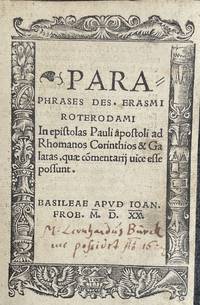
15202283Basileae Basel: Apud Ioan. Frob. Colophon: Per Hieronymvm Frob. Ioan Filium Johann and Hieronymus Froben 1520. First collected edition. . In 17th century vellum the author’s name lettered in ink to spine tinted edges. Leonhard Bürck’s possessor’s inscription in ink on the title page and p. 431. Woodcut borders to the four title pages. Woodcut initials and headpieces. Woodcut printer’s device at the end. Old underlines and marginal notes in ink to a few pages. Stains occasionally. Old restoration to O1–2 with no effect on the text. Overall in very good condition. First collected edition. . In 17th century vellum the author’s name lettered in ink to spine tinted edges. Leonhard Bürck’s possessor’s inscription in ink on the title page and p. 431. Woodcut borders to the four title pages. Woodcut initials and headpieces. Woodcut printer’s device at the end. 465=495 1 p. Some misnumberred omitted. Coll.: A–K8 L4 M–Z8 2A–2e8 2F4 2G–2I8. <p><br /> Scarce first edition of Erasmus’ paraphrases on the first four Pauline epistles with possessor’s inscription of the important 17th-century publisher in Frankfurt Leonhard Brück.<br /> <p><p><br /> <br /> The present volume of Paraphrases is the first collected edition of Erasmus’ monumental commentary on the Gospels which was composed and published between 1517 and 1523. <br /> Erasmus began the work on the commentary of the Gospels with the Pauline epistles. They were first issued separately starting with the paraphrase of Romans in 1517 Thierry Martens continued with both epistles of Corinthians 1519 Thierry Martens and the Galatians which was published in 1520 by Martens in Louvain and Froben in Basel. The remaining epistles appeared by 1521 when they were also published in a collected edition by Froben. Any of the lifetime editions of the Paraphrases both separate and collected are rare on the market.<br /> <p><p><br /> <br /> Provenance: inscription on title page and on p. 431 “M. Leonhardus Bürck me possidit Anno 162â€; Leonhard Bürck Burck Burkius Burcken was a printer and publisher in Frankfurt active between 1611 and 1628. Bürck is identified as the step-grandfather of Hans Jakob Christoffel von Grimmelshausen.<br /> <p><br /> USTC 682544 5 copies only in Germany; Bezzel 1163; VD 16 E 3060. Apud Ioan. Frob. [Colophon: Per Hieronymvm Frob. Ioan Filium] [Johann and Hieronymus Froben] unknown
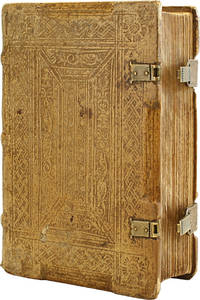
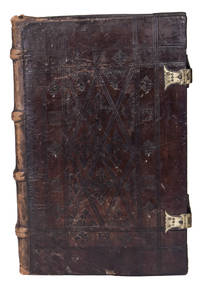
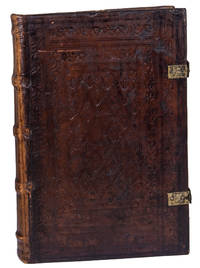
1520253908Basel: Johann Froben 1520. First collected editions. Titles within ornamental woodcut border initials printer's device in colophon. 465 i.e. 495 1; 167 1; and 141 3 pp. 1 vols. 8vo. Contemporary blindstamped pigskin over wooden boards spine in four compartments with raised bands over doubled cords ruled in blind and crossed floral ornaments boards tooled with floral borders about a central field edges ochre. Covers somewhat soiled one brass clasp missing upper joint just starting but quite firm; internally a SUPERB near flawless copy. Bookplate and ownership signature of scholar and author Nathan Comfort Starr. First collected editions. Titles within ornamental woodcut border initials printer's device in colophon. 465 i.e. 495 1; 167 1; and 141 3 pp. 1 vols. 8vo. First collected editions of these "Paraphrases" of the letters of Paul which were undertaken shortly after Erasmus's revolutionary edition of the Greek New Testament of 1516. As part of that monumental reconstruction of the New Testament Erasmus' intention was to "retell" the books of the New Testament in one uninterrupted voice without the clutter of textual commentary or critical interruption. It was a bold undertaking and in 1517 Erasmus began with the letters of Paul. They were first issued separately starting with Romans in 1517; and editions appeared in Louvain Thierry Martens Leipzig Valentin Schumann and Basel Johann Froben. The collected issues - such as the three which are bound together in this exquisite volume - began to be issued in Basel by Froben in 1519; and finally in 1521 Froben issued a collected edition of all of the Pauline letters. All of the lifetime editions both separate and collected are rare on the market; this copy is in a well preserved contemporary pigskin binding first binding. Adams E790; E792; E791; VD16 E 3060; E 3324; E 3328 Johann Froben unknown
152245648Straßburg, Johann Knobloch d. Ä., 1522. 8°. Mit Holzschn.-Titelbordüre, einer Holzschn.-Anfangsinitiale u. einer großen Holzschn.-Druckermarke am Ende. 95 num., 1 nn. Bll., Mod. Ppbd.
15672733Basileae : Apud haeredes Nicolai Brylingeri M. D. LXVII. 1567 1567. Hardcover. Good. 26 643 1 p. the last page blank ; 17 cm. 8vo ; References: Adams; T-361; VD16; T-466 ; OCLC: 35196231 ; preface by Desiderius Erasmus dated 1532 ; includes commentary on each play by Giovanni Calfurnio ; Title vignette; initials ; Signa tures: a-z8 A-T8 Nota Bene: incomplete volume : A-B are missing pages 339-375 comprising Actus II Scena I - Actus III Scena II of Adelphi ; Contemporary panel-stamped cream/butter-colored pig-skin binding ; raised bands ; green speckled fore-edg e ; two-tone silk headband ; bookplate "E Bibliotheca Collegii Cremsensis" dated 1818 with ownership written in ink across title page ; large crayon pencil mark in red "LVIII29" on lower portion of title page ; text in Latin italic type font f or the text of the plays ; only one other known institution copy held by the Newberry Library ; slight worm damage to top of spine ; soiling ; marginalia on some pages in a contemporary humanist hand on pages 2-5 17-19 439-40 445 478-79 491-92 529-30 615 640-42; name and text on back ep in a German hand writing Frakturschrift consisting of a paraphrased quote from the Psalms ; Contents : Terentii Vita -- Andria -- Evnvchvs. Eunuchus -- Heavtontim. Heautontimorumenos -- Adelph. A delphi -- Hecyra. -- Phormio. ; also contains a poem in Latin iambs by Erasmus printed on the reverse of title page ; G <br/> <br/> Basileae : Apud haeredes Nicolai Brylingeri, M. D. LXVII. (1567) hardcover
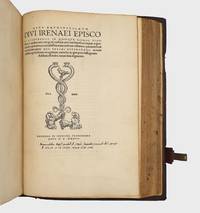
1571D10980Basel: Eusebius Episcopius & heirs of his brother Nicolaus 1571. Hardcover. Very Good. 8vo 165 x 104mm. 36 621 63 pages including final leaf with printers device of the word EPISCOP. Episcopus separated by stork surmounting bishops crozier on verso. Edited by Desiderius Erasmus; revised by Johann Jacob Grynaeus. Contemporary calf over wooden boards with blind-stamped arabesque centerpiece on covers brass catches lacking clasps rebacked spine gilt labeled IRENAEI HAERESES 1571; front joint cracked but cords intact; dark stain on opening leaves paper cracks and small holes in title not affecting text some light dampstaining in hinge toward end. 17th-century signature of Robert Baillie to title the famous Covenanter according to pencil note on front endpaper. 19th-century Chiesa Libera stamp on title; and pictorial bookplate of Douglas and Mildred Horton dated 1962 to front pastedown. Reverend Dr. Douglas Horton married Mildred née McAfee in 1945 who was a prominent female captain in the United States Naval Reserve and later the president of Wellesley College. <br/><br/>Irenaeus theological treatise written c. 180 attacked contemporary Christian heresies particularly Gnosticism and the system devised by Valentinus c. 100-c. 160. Irenaeus treatise also supported the idea that bishops maintained apostolic ties to the era of Christ and that a bishop was the best guide to understanding scripture. Given the very bishop-centric message of this work perhaps it is not curious at all that the Episcopius press expressed interest in printing it In Latin Episcopus is bishop. It was not until the 16th century that Irenaeus Opus eruditissimum was widely disseminated first published in Latin by Froben of Basel in 1526 and in the original Greek in 1570. Erasmus famously edited this Latin edition which appeared a year after the first Greek. In it he removed two annotations which referred to baptism and purgatory and also corrected a passage concerning the fault of Adam. The text itself is a new translation of the first book with an extensive dedication to the Basel Mayor Bernhard Brand and the founder of the Basel Reformed Orthodoxy Church Johann Jacob Grynaeus. Irenaeus Opus appears in 10 editions before this one published in both Basel 1528 1534 1548 1554 1560 and Paris 1541 1545 1563 1567 1570. This volume once belonged to Robert Baillie 1602-1662 a Glaswegian and Presbyterian minister and writer known for his Letters which faithfully recorded public events and his participation via correspondence. Baillie was a leader in the 17th century movement that rejected the Church of Englands Book of Common Prayer. From a reformative point of view Baillie would have found interest in Irenaeus work which recognized the canonical character of the gospels. For a work against the Gnostics it is said to contain valuable historical information and a great many New Testament quotations which are a witness to the New Testament text long prior to any extant manuscript; it is the first systematic exposition of Christian theology--Sarton I 294. Hoffmann II 466. Eusebius Episcopius & heirs of his brother Nicolaus hardcover
1534372762Basel: Froben 1534. Third revised Erasmus edition first 1526; second 1528 of Irenaeus' treatise "Against Heresies. Printer's device on titlepage and last page; head-pieces; initials; printed marginalia. 1 vols. Folio. Near contemporary dark calf over wooden boards stamped in blind upper board dated 1545 brass clasps. Headcaps worn one clasp perished. Third revised Erasmus edition first 1526; second 1528 of Irenaeus' treatise "Against Heresies". Printer's device on titlepage and last page; head-pieces; initials; printed marginalia. 1 vols. Folio. Third Erasmus edition of Irenaeus' treatise Against Heresies consisting of five books which are preserved in their entirety only in their Latin version. It is Irenaeus' principal literary work which had a significant impact on the development of the church during the first three centuries.<br /> <br /> Colophon: Basileae in officina Frobeniana per Hieronymum Frobenium et Nicolaum Episcopium An. M D XXXIIII mense Martio.<br /> The work is bound with an extensive commentary on the Gospel of Matthew by Wolgang Musculus 1544. The nicely preserved binding is dated M.D.XLV. 1545 on upper board. VD16 I 318. Provenance: Provenance: title page of Musculus signed: Ludovicus Rabus . 1544 and Iohannes Longlinus . 1550; bookseller's label on front paste-down: G. & B. Westermann Bros. Deutsche Buchhandlung 290 Broadway New-York; Bookplate of Rev. Edwin A. Dalrymple; Maryland Diocesan Library; General Theologiccal Seminary bookplates and stamps Froben unknown
1522032982Coloniae: Heronem Alopeciu 1522 An extremely scarce early edition published in September 1522 - a month after the authorised Basel edition - by Hero Alopecius in Cologne. We have only been able to find one reference to it University of Toronto. Erasmus arranged publication of the Basel edition in August 1522 in response to the appearance of an unauthorised version in Cambridge in 1521. He had originally worked on the content in 1509-1511 and this work developed from his earlier writing and lectures became a popular and important text book on the writing of letters. It was much reprinted. This copy is newly rebound in full calf with panelled design to boards and gilt titles to spine. The page edges are red although this may not be contemporary. New endpapers. Contents with 2 initial blanks - the first with ink notation on the edition - this looks likely to be 1800's in date and the paper does not look contemporary. Title with elaborate design including 2 cherubs holding a shield with 3 crowns with contemporary latin note at the top; letter from Erasmus to Nicolao Beraldo pp 2-4; text with beautiful decorative initial capitals pp 5-414 Finis. No final blanks. There is some scholarly annotation in latin and gentle underlining - this could be contemporary. There are a number of mispaginations but the ties work in all cases: 47-74-75-50; 51-78-79-54; 55-82-83-58; 59-98-87-62-63-90-65; 170-117-172; 177-168-179; 192-191-192-193. There are a number of professional paper repairs: to the side of the title page and page 13/14; from p 357 onwards where the top corner tips had been burnt out - this begins with the just the tip but towards the end of the work includes some page numbers and just clips a couple of margin notes - the final 2 leaves have repair to sides. These corners do not have the red edges. Towards the end of the work there are a few pages with some grubbiness at the bottom corners. Otherwise the work is very clean with high quality paper. Please enquire if you would like to see additional images Heronem Alopeciu hardcover
1534372192Basel: Froben 1534. Froben's printer's device on first and last leaf of each work. 415 1; 191 1pp. 8vo. Early half calf and pastepaper boards. Spine ends rubbed front joint cracked but cords holding. Very good. Froben's printer's device on first and last leaf of each work. 415 1; 191 1pp. 8vo. Early Froben edition of a pedagogical work by Erasmus "On the Writing of letters" first published in 1522 with a collection of aphorisms or "Parallels" gathered out of Plutarch's Moralia Seneca Lucian Xenophon Demosthenes Aristotle Pliny and Theophrastus. An edition was published in Cologne in the same year and the work was a standard throughout the sixteenth century. VD16 E2515 E3257. Provenance: Princes of Liechtenstein armorial bookplate; General Theological Seminary bookplate Froben unknown
15291832Coloniae: Iohannem Gymnicum 1529. Rare edition a sound complete copy lacking only the final blank. Title within pictorial woodcut border. Octavo contemporary blind-tooled calf over wooden boards dated 1534 in blind brass clasps minor statins and soiling and some early penned marginalia. Also bound in are three additional works De Civilitate Morum Puerilium; Plutarch. De Liberis Educandis; and Horatius Flaccus. Iohannem Gymnicum hardcover
1525LCS-17326<p><strong>Erasmus and his master Laurent Valla: three founding works of the Renaissance </strong><strong>preserved in their contemporary blind-stamped binding.</strong></p><p><strong>Strasbourg 1523 1525. Cologne 1525.</strong></p><p><strong>From the <em>Campana</em> collection with this 16th century handwritten ex-libris </strong></p><p><strong><em>"Jacobi Campana et Amicorum 1530".</em></strong></p><p>In total three texts bound in one 8vo volume 148 x 100 mm of: I/ 184 ll. the last one blank; II/ 28 ll. ; III/ 1 title-page 148 pp. 10 pp. of index 1 bl.p. Numerous handwritten notes on the last 2 ll. of the 1st text. Bound in blind-stamped pigskin over wooden boards brass clasps. <em>Contemporary binding.</em></p><p>Collection in quite rare and very early editions of 3 important founding works of the Renaissance in philology and grammar by Erasmus and by his master Laurent Valla.</p><p><em>Laurent Valla "the greatest humanist of the first half of the 15th century" </em>was born in Rome around 1407. Guilio Vallese.</p><p><em>"Deeply convinced of the superiority of the antique culture renewed at the time in which he saw an incomparable ferment of regeneration Valla in order to defend it didn't hesitate to take the chance of being condemned in front of the Inquisition court. As other humanists of this time he claimed to be of the rationalist moral antique transmitted in the books of Wisdom when the Middle Ages had impoverished or lost the very meaning of it."</em></p><p>Valla's most famous treatise "<em>Des élégances de la langue latine</em>"that had most contributed to his reputation in six books was quickly given in every school and kept on being a teaching text for the greatest part of the 16th century.</p><p>Erasmus who professes many times in his letters a vivacious admiration for the author and for this particular work had made in his youth an extract for his personal use which was printed twice without his consent.</p><p><em>Valla's observations are about the value of certain forms of words about the value of several difficult terms and even more about the synonymy of the Latin language. This work proves a great sagacity of researches and a great judgment. "King Alphonse who really liked this kind of studies didn't get tired of hearing Valla and let him sometimes battling with Antoine de Parlerme "inde ivae". He gave him a diploma enriched with a golden speech bubble in which he declared him illustrious in almost every science as well as in poetics."</em></p><p>Are joined to this major work of Valla the two great founding texts it inspired to Erasmus:</p><p>-The first one <em>De Conscribendis epistolis</em> in the second edition from Strasbourg of 1525. It was such a success that it was after this one reprinted 77 times in the 16th century alone.</p><p>-The second one <em>De Constructione octo partium orationis libellus</em> printed for the first time in 1514 is here in the edition printed on August 11th 1523 at Sigismon Grim. It was followed by 61 editions in the 16th century alone.</p><p>A magnificent copy with wide margins preserved in its first blind-stamped binding; the clasps and ties are intact.</p><p>It comes from the collections <em>Jacob Campana</em> and <em>Gaspar Campana</em> and bears these two handwritten ex-libris "<em>Jacobi Campanae et Amicorum 1530</em>" and "<em>Gaspari Campanae et Amicorum</em>".</p><p>The<em> Campanas</em> illustrious Neapolitan family counted <em>César Campana</em> among their members a fine erudite from the 16th century.</p><p>FRANCAIS</p><p><strong>Erasme et son maître Laurent Valla : trois uvres fondatrices de la Renaissance</strong></p><p><strong>conservées dans leur première reliure estampée à froid.</strong></p><p><strong>Strasbourg 1523 1525. Cologne 1525.</strong></p><p><strong>De la bibliothèque <em>Campana</em> avec cet ex-libris manuscrit du XVIe siècle</strong></p><p><strong><em>" Jacobi Campana et Amicorum 1530 ".</em></strong></p><p>Soit trois textes reliés en un volume in-8 de I/ 184 ff. le dernier blanc ; II/ 28 ff. ; III/ 1 p. de titre 148 pp. 10 pp. d'index 1 p.bl. Nombreuses annotations manuscrites sur les 2 derniers ff. du 1er texte. Relié en peau de truie estampée à froid sur ais de bois dos à nerfs attaches et fermoirs de laiton. <em>Reliure de l'époque.</em></p><p>148 x 100 mm.</p><p>Réunion en éditions fort rares et très précoces de trois grands textes fondateurs de la Renaissance en philologie et grammaire d'Erasme et de son maître Laurent Valla.</p><p><em>Laurent Valla " le plus grand humaniste de la première moitié du XVe siècle "</em> naquit à Rome vers 1407. Guilio Vallese.</p><p><em>" Profondément convaincu de la supériorité de la culture antique alors renaissante dans laquelle il voyait un ferment incomparable de régénération Valla pour la défendre n'hésita pas à courir le risque d'une condamnation devant le tribunal de l'Inquisition. Comme d'autres humanistes de ce temps il se réclamait de l'antique morale rationaliste transmise dans les livres de la Sagesse dont le Moyen Age avait appauvri ou perdu la signification même. "</em></p><p>Le traité le plus célèbre de Valla qui avait le plus contribué à sa réputation<em>" Des élégances de la langue latine "</em> en six livres se répandit rapidement dans toutes les écoles et continua de faire texte d'enseignement pendant la plus grande partie du XVIe siècle.</p><p>Erasme qui professe en beaucoup d'endroits de ses lettres une vive admiration pour l'auteur et pour cet ouvrage en particulier en avait fait dans sa jeunesse un extrait pour son usage qui fut imprimé deux fois sans son consentement.</p><p><em>Les observations de Valla portent sur la valeur de certaines formes de mots sur celle de plusieurs termes difficiles et plus encore sur les synonymies de la langue latine. Ce travail atteste une grande sagacité de recherches et un rare discernement. " Le roi Alphonse auquel ce genre d'études plaisait singulièrement ne se lassait pas d'entendre Valla et le mettait quelquefois aux prises avec Antoine de Parlerme " inde ivae ". Il lui donna un diplôme enrichi d'une bulle d'or dans laquelle il le déclarait illustre en presque toutes les sciences ainsi qu'en la poétique. "</em></p><p>Sont joints à cette uvre phare de Valla les deux grands textes fondateurs qu'elle inspire à Erasme :</p><p>-Le premier <em>De Conscribendis epistolis</em> dans la seconde édition strasbourgeoise de 1525. Son succès fut tel qu'elle fut après celle-ci réimprimée 77 fois pour le seul XVIe siècle.</p><p>-Le second texte <em>De Constructione octo partium orationis libellus</em> imprimé pour la première fois en 1514 est ici dans l'édition achevée d'imprimer le 11 août 1523 chez Sigismon Grim. Elle fut suivie de 61 éditions pour le seul XVIe siècle.</p><p>Magnifique exemplaire à belles marges conservé dans sa première reliure estampée à froid dont les fermoirs et les attaches sont conservés intacts.</p><p>Il provient des bibliothèques <em>Jacob Campana</em> et <em>Gaspar Campana</em> et porte ces deux ex-libris manuscrits <em>" Jacobi Campanae et Amicorum 1530 "</em> et <em>" Gaspari Campanae et Amicorum "</em>.</p><p>Les<em> Campana</em> illustre famille napolitaine comptèrent parmi leurs membres <em>César</em> <em>Campana</em> fin lettré du XVIe siècle.</p> Iohannem Heruagium.
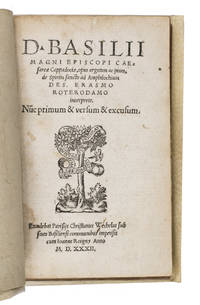
1532ABC_49897Paris 1532. Small 8vo 9.5 x 14.9 cm. Chréstien Wechel and Jean Roigny Modern limp overlapping vellum sewn on 3 supports laced through the joints red edges and with 2 sets of green cloth ties. With Wechels woodcut printers device on the title page and the verso of the otherwise blank last leaf and 2 woodcut decorated initials. 124 3 blank1 pp. Very rare second edition of Erasmus translation of a theological treatise attributed to Basil of Caesarea 330-379 CE.It was published shortly after the first edition published in May of the same year by Froben and Episcopius in Basel May 1532. The work is very rare we have traced only one other copy in sales records of the past 100 years. Erasmus' translation is accompanied by a dedicatory epistle to Joannes Dantiscus 1485-1548 Bishop of Culm and a prominent diplomat of the Polish court. The letter dated April 30 1532 reflects Erasmus conviction that direct engagement with the texts of the Church Fathers rather than with flawed Latin intermediaries was vital for the renewal of Christian piety. As Erasmus himself declared: "It would be of great benefit to sacred letters and Christian devotion if Basil himself in Greek and not the shadow of Basil a Latin translation were made available to all."His source text was a Greek edition he had published just two months prior. According to Julián 2022 Erasmus wanted to publish everything they could find from Basil lamenting that in the existing Latin versions "the greater part of him is missing." Interestingly the legacy of this work can be traced further back to the 15th century when George of Trebizond 1395-1486 a Greek scholar from Crete was commissioned by Cardinal Bessarion 1403-1472 in 1440 to translate both De spiritu sancto and Contra eunomium into Latin. George struggled with the theological complexity of the material confessing in his preface 1442 that he lacked the necessary theological training and fluency in Latin. Erasmus' later effort can be seen as a corrective and a fulfilment of that earlier humanist ambition to make the Greek Church Fathers accessible to a Western audience in an accurate and readable form.Small tear in title page not affecting the text lightly water-stained margin and slightly browned throughout. Overall in very good.l Colón 11; no. 158; Vander Haeghen II 13; Moreau IV 338; V.P. Julián Erasmo traductor y editor de los Padres de la Iglesia: Crisóstomo Basilio y Orígenes. Salmanticensis 691-22022 039-075; USTC 185205 lost book; WorldCat 150413518 913004144 3 copies; not in Adams BM STC German De Reuck; Index Aureliensis; cf. for the Basel 1532 edition: USTC 640558 1 copy; WorldCat 257292311 1374477181 150413518 3 copies. hardcover
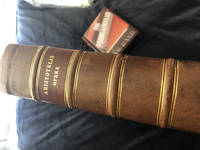
1550P8126The Works of Aristotle "per Des. Eras Roterordamvm" 1550. 2 volumes in one folio 323 x 192mm. Third Edition of The Works of Aristotle of the original text in 1831 prepared by Simon Grynaeus. This edition retains the original letter from Erasmus to Thomas More's son John. Woodcut initials a few woodcut illustrations old calf a few early annotations numerous notes in Latin Greek and English on front and rear flyleaves probably nineteenth-century and in text in ink pencil and red crayon neat annotations in Greek in second volume Greek quotation from Aristotle written on first title-page occasional light staining T5 torn in margin binding rubbed rebacked. Two of history's greatest minds converge. Book #P8126. $6500. We specialize in Rare Ayn rand erotica history and science. Johann Bebel and Michael Isengrin, 1550 hardcover
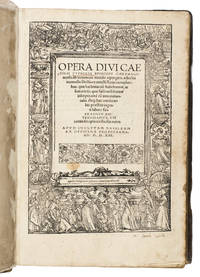
1520ABC_49926Basel 1520. Folio. Johann Froben Contemporary richly blind-tooled calf over wooden boards with brass clasps catch- and anchor plates along the fore-edge and brass edge guards around the corners and on the bottom board edge near the spine manuscript waste pastedowns re-backed. With an elaborate woodcut border on the title page and on the first page of the dedication. Further with a small woodcut illustration incorporating Frobens device on the verso of the last leaf numerous woodcut decorated initials by Ambrosius Holbein throughout and some ornamental woodcut headpieces. 24 515 1 blank 32 pp. First edition of the works of Thascius Caecilius Cyprianus Saint Cyprian ca. 210-258 CE edited by Erasmus. The present work is a landmark in the history of humanist scholarship and a cornerstone of Erasmuss lifelong effort to restore the authentic voice of the Early Church Fathers. Working in Basel Erasmus devoted himself to what he regarded as his highest calling: presenting these foundational Christian sources to a wider audience and revealing the truth of the Gospel in its original simplicity.In this edition Erasmus rescued Cyprians writings from centuries of textual corruption carefully correcting medieval errors and adding several minor treatises from ancient manuscripts that had never previously been printed. It includes Cyprians pastoral letters and doctrinal works arranged by theme and reflects the bishops deep concern with church unity moral discipline and the challenges of the early Christian community.This 1520 edition of Cyprians works marks the true beginning of Erasmus great Basel enterprise: a series of monumental editions that would soon include works by Arnobius 1522 Hilary 1523 Jerome 1524 Irenaeus 1526 Ambrose 1527 Augustine 1528-29 and Chrysostom 1530. This rapid succession of vast editorial projects reveals both Erasmuss astonishing intellectual energy and his conviction that the wisdom of these Church-Fathers could renew Christian life.More than a critical edition the present work embodies the spirit of Christian humanism itself: rigorous scholarship in the service of faith. It stands as one of Erasmus' most significant achievements and a defining moment in the recovery of patristic learning in the Renaissance.With manuscript waste pastedowns three stamps of the Roman Catholic Saint Maria-Magdalena church in Zaandam on the title page occasionally some near contemporary manuscript annotations in the margins and some of the text has been underlined. The work has been re-backed lacking the backstrip of the original binding the edges of the leather around both boards is slightly damaged revealing the wooden boards below the spine is somewhat rubbed. The edges of the first and last few leaves are slightly frayed some occasional water staining in the fore-edge margin not affecting the text some slight staining and dust soiling throughout. Otherwise in good condition.l Allen 1000; De Reuck 416; Huizinga VI p. 148; USTC 679667; Vander Haeghen II 23; VD 16 C 6508; not in Adams; Bezzel; BM STC German. hardcover
1521ABC_49920Basel 1521. Folio. Johann Froben Contemporary blind-tooled pigskin over wooden boards with brass catch- and anchor plates along the fore-edge of the boards lacking the clasps. With a detailed woodcut border on the title page and the first page of the dedication. Further with a small woodcut illustration incorporating Frobens device on the verso of the last leaf and with woodcut decorated initials throughout. 24 515 1 blank 32 pp. Second edition of Saint Cyprians works as edited by Erasmus published by Froben one year after their first edition. Between 1516 and 1521 Erasmus worked closely with Johann Froben the humanist printer in Basel on a series of editions of the Latin Church Fathers: Jerome Augustine Ambrose Hilary and Cyprian. Erasmus aim was to purify the texts of the Fathers from medieval corruptions to restore their authentic doctrine by returning to the original sources and to present the Early Church as a model for a purer form of Christianity a theme that directly reflected his theological-humanist ideal.Erasmus states that he has cleansed the text of errors added a few minor treatises from ancient manuscripts and removed the works that seemed to have been falsely attributed to Cyprian. Thascius Caecilius Cyprianus ca. 210-258 CE later known as Saint Cyprian was an influential Church Father of the early Latin Christian tradition. Shortly after his baptism he became bishop of Carthage one of the most important Christian centres in the Roman Empire. Most of his works are pastoral letters and treatises here arranged in the index by type. The manuscript appears to have been used for study as the annotations highlight portions of the text and draw comparisons between Augustine and Cyprian.With small strips of manuscript waste visible in the gutters of the pastedowns a small owners inscription H. Reimers Erlang. 1899 in the upper outer corner of the first blank flyleaf along with elaborate manuscript annotations on the recto of that same leaf numerous contemporary and later annotations in three different hands throughout and some of the text underlined. The leather around the top and fore-edge of the front board has been restored the leather on the back board is somewhat damaged some small worm holes in the leather reveal the wooden boards below. The binding is rubbed the clasps are lacking and the head and foot of the spine are somewhat damaged the structural integrity of the binding nevertheless remains intact. The first blank flyleaf has been restored in the gutter margin the last leaf has been restored in the fore-edge margin the edges of the leaves are somewhat browned. Otherwise in good condition.l Adams C3150; BM STC German p. 234; De Reuck 417; USTC 679668; Vander Haeghen II 23; Huizinga VI p. 148; VD 16 C 6509; not in Bezzel. hardcover
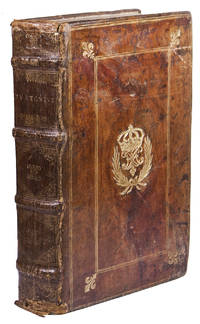
1533ABC_49917Basel 1533. Small folio 21.5 x 31.8cm. colophon Hieronymus Froben & Nicolaus Episcopius 17th-century gold-tooled mottled calf sewn on 4 supports with corresponding raised bands on the spine. Both boards show two triple fillet frames the smaller frame with four fleurs-de-lis cornerpieces on each outer corner and within the smaller frame a centrepiece containing the monogram of the Collège Royal de Navarre in Paris a crown a fleur-de-lis and a laurel wreath can be found. 4 of the 5 compartments on the spine show the same gold-tooled monogram of the College the second compartment from the top contains Svetoniuvs lettered in gold. Further with marbled endpapers gold-tooled board edges and gilt edges. With Frobens large woodcut device on the title page repeated on the final page and several large woodcut initials after Holbein. 2 parts in 1 volume 44 786 2 blank 84 pp. Beautifully bound copy of a collection of Roman imperial biographies known as the Historia Augusta which was supposedly written by 6 authors of the late Roman Empire: Aelius Spartianus Julius Capitolinus Vulcacius Gallicanus Aelius Lampridius Trebellius Pollio and Flavius Vopiscus collectively known as the Scriptores Historiae Augustae. Although modern scholarship questions the authenticity and authorship of these texts they remain a crucial source for understanding the history politics and personalities of the Roman emperors from Hadrian r. 117-138 CE to Numerian r. 283-284 CE.The present edition of the Historia Augusta was edited and annotated by Erasmus alongside several notable scholars including Giovanni Battista Egnazio or Egnatius 1478-1553. Additionally this volume contains a second part with a divisional title page on p. 545: Rerum gestarum libri XVII written by Ammianus Marcellinus ca. 330-ca. 400 CE the last major historian of the Roman Empire. As a former soldier and eyewitness to many events he describes Ammianus essentially wrote a continuation of the history of Tacitus offering vivid accounts of military campaigns court politics and the slow unravelling of Roman power in the West.This version of the Historia Augusta was already printed in 1518 by the Basel publisher Johann Froben. For that edition Erasmus contributed an edited version of Suetonius along with a preface although the title page misleadingly implied that he had also edited Ammianus work. The present edition followed in July 1533 issued by Hieronymus Froben in partnership with Nicolaus Episcopius which incorporated the recently discovered Books 27-30 of Ammianus. Contrary to some claims the editor of that 1533 edition was not Conradus Goclenius but Sigismundus Gelenius. It appears that Erasmus perhaps distracted or misremembering once confused the two names.On the title page surrounding the Froben device there is an ownership inscription reading: DVJON - JVNIVS. This could refer either to Franciscus Junius the Elder François du Jon 1 May 1545 - 23 October 1602 a prominent Huguenot theologian or more likely to his son Franciscus Junius the Younger François du Jon 29 January 1591-1677 the noted philologist and pioneering scholar of Germanic languages known for his extensive collection of ancient manuscripts. With underlinings and marginal annotations throughout including brief notes on the text as well as references to related materials. In a few places the outer margins have been slightly trimmed affecting only a small number of annotations. The spine shows light rubbing with some wear to the spine ends the text is lightly browned throughout. Overall a very good copy.l Adams S 2025; BM STC German p. 842; Clarence H. Miller The Correspondence of Erasmus: Letters 2635 to 2802 volume 19 2019; Erasmus Online 4325; USTC 679548; VD16 E 3647; not in De Reuck; cf. for the monogram of the College de Navarre see: Archives de la Société des collectionneurs dex-libris Paris: 1895 2d Année No. 1 Janvier pp. 66-69. hardcover
156374559latin version of Erasmus's new translation of the Bible 4 320 16 leaves woodcuts in text throughout "Argumenta Capitvm Capitum in Omnes Novi Testamenti libros" to rear in elegiac verse Published in Officina Froschouiana hardcover
15238509Argentorati Strasburg: Iohannes Cnobloch execudebat Quinto Idus Iunias Anno. M.D.XXIII. 1523. 1523 20 130 i.e. 120; 107 1 leaves ; 16 cm. Collates Aa8 Bb4CC8 a-p8 A-N8 O4. D&M 6103a. Recently bound in calf to style with blind decoration to the boards. The spine has raised bands and is titled in gilt. Marginal annotations thoughout. Part title to Epistolae Apostolicae and Cnobloch's device printed at the end of both parts. The imprint and date are supplied from the colophon. The text of each book begins with a 14 line rubricated initial including one decorated with three parrots at the start of Evangelium Secundum Ioannem. PROVENANCE: The title page verso has the bookplate of the Nuremburg bookseller collector and bibliographer of alchemical literature Friedrich Roth-Scholtz 1687-1736. The title page and part title have a neat 19th century stamp of the Univerity of Erlangen now Erlangen-Nuremberg. an excellent early printing of Erasmus' important NT. Argentorati (Strasburg): Iohannes Cnobloch execudebat Quinto Idus Iunias Anno. M.D.XXIII. hardcover
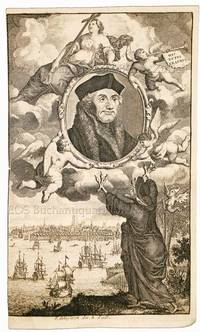
1600686CG1600. Um 1600. Kupferstich Brustbild mit der Ansicht der Stadt Rotterdam von Bleujwyk . Blattgrösse: 14 x 85 cm. Knapp beschnitten. unknown
1515ABC_49919Basel: Johann Froben 1515. Contemporary blind-tooled calf over wooden boards with brass and leather clasps along the fore edge professionally re-backed with later blank pastedowns. Folio. With the title set in a splendid woodcut frame by Urs Graf including Froben's small woodcut device woodcut decorations in the fore-edge and gutter margins of the table of contents verso of the title page and another elaborate woodcut frame on the first page of the dedication. Further with some woodcut initials and Froben's large woodcut device below the colophon on the last page. Senecas complete works here carefully prepared by Erasmus and printed by the renowned Basel publisher Johann Froben are remarkable both for its scholarly rigor and its historical significance. The present work represents one of the earliest Renaissance printings of Senecas writings presenting essays letters and philosophical dialogues that guide the reader toward virtue wisdom and a well-examined life. Erasmus thorough editorial care ensured that the texts were largely purged of errors making this edition an important reference for both humanist scholars and students of classical literature.In addition to the main works this volume includes a number of supplementary writings added by Erasmus reflecting his deep engagement with Senecas philosophy and his commitment to moral and linguistic improvement. The preface encourages attentive reading promising both the refinement of language and the betterment of ones life.The work entitled Ludus de morte Claudii Caesaris includes marginal commentary by Beatus Rhenanus a German humanist and reformer who was a friend of Erasmus and actively involved in the publishing activities of Johann Froben.With printed ex libris bookplate mounted on the front pastedown manuscript waste visible between the front and back endpapers a few manuscript annotations in the margins and some of the text underlined. The binding shows signs of wear the boards have been rubbed some loss of material a small worm hole in the back board the pages are cut slightly short at the head not affecting the text and some occasional slight staining and browning. Otherwise in good condition.l BM STC German p. 808; USTC 667432; Vander Haeghen II 49; VD 16 S5758; not in Bezzel; De Reuck. Johann Froben, hardcover
1547014688Basileae: Hieronymus Froben & Nikolaus Episcopius 1547. Book measures 16.5x11.5.cm. 415pp.1pp printer's device. Rebacked retaining period or early boards raised bands leather lebel. Some wear to edges of boards. Binding in very good clean firm condition. Internally previous owners bookplate very light staining of browning to margins. Pages in very good clean condition. A very nice copy. F. Leather. Very Good. 8vo. [Hieronymus Froben & Nikolaus Episcopius]
1523ABC_50186Antwerp: Michiel Hillen van Hoochstraten 1523. Modern boards covered with a leaf from a Latin incunable probably part of a commentary on the Song of Solomon red sprinkled edges. 8vo. With a full-page woodcut illustration incorporating Hillen van Hoochstratens device on the last page and 3 woodcut decorated initials. First Antwerp edition published in the same year as the first Froben edition in Basel of Erasmus De sarcienda ecclesiae concordia. Dedicated to Julius Pflug of Eytra 1499-1564 later the last Catholic Bishop of Naumburg the work sets out Erasmus most urgent appeal for unity at a moment when the fractures of the Reformation were widening by the month. Pflug who valued peace and moderation shared Erasmus unease about the increasingly bitter debates dividing Western Christendom.De sarcienda ecclesiae concordia opens as a commentary on psalm 83 in which Erasmus underscores the spiritual necessity of harmony within the Church. From this biblical foundation he advances his lifelong conviction: that a polarised Christendom is fundamentally at odds with the teaching and example of Christ. In passages marked by clarity moral urgency and classical poise Erasmus argues that contentious theology has little to do with genuine faith and everything to do with human pride.Appended to the treatise is the brief Precatio pro pace ecclesiae addressed to the Cologne jurist Johann Rinck further underlining Erasmus conviction that peace moderation and the diligent search for concord must prevail over doctrinal intransigence.With very minor underlining on three pages and one tiny marginal annotation a small ink stain in the upper margin of the title page a small wormhole running from leaves A6 to B6 and some occasional water staining confined to the margins. Otherwise in good condition.l Adams E 387; De Reuck 248; Erasmus online 2340; Nijhoff & Kronenberg 798; STCV 12920380; USTC 403885; Vanderhaeghen I 117. Michiel Hillen van Hoochstraten, hardcover