ERASMUS, DesideriusBiblio.com
115 résultats
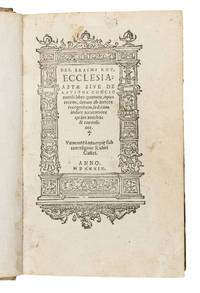
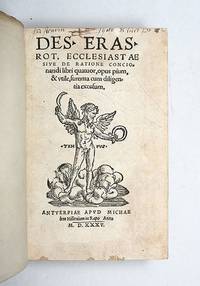
1535150907Antwerp: Michael Hillenius 1535. Rare 16th-century English blind stamped panels One of two pirated editions of Erasmus's Ecclesiastes published in Antwerp the same year as Froben's authorized original. The covers of this copy bear two handsome and rare blind stamped panels attributed to the Dutch binder Gerard or Garrett Pilgrim active in England at the beginning of the 16th century. Pilgrim was a native of Antwerp who worked as a bookseller and bookbinder in Oxford from at least 1524 until his death in 1536. The two panels of which only 13 examples are known to Oldham Oldham HM 17 and 18 p. 28 all dated 1523-35 are of characteristically English style and manufacturing. They feature an outer frame filled with blind stamped rolls of leaves garlands angels masks and dragons and a central design of heads in roundels accompanied by the binder's initials with a key and a pilgrim's staff crossed. On 12 July 1536 Erasmus died in Basel where he had returned to check on Froben's publication of the Ecclesiastes his last major composition. This work is an extensive manual in four books on the art of preaching containing a treatise on the role and importance of preachers in the church precise indications on how to structure and deliver sermons and a list of sermon topics. The Ecclesiastes was highly successful: in addition to the 2600 copies printed by Froben two pirated editions were produced in Antwerp in 1535 the present one and another by Martinus Caesar for an estimated total of 3500 copies sold - an uncommonly large publication for its time see Kleinhans p. 308. Octavo 160 x 103 mm. Woodcut printer's device to title page and verso of last leaf half-page portrait of Erasmus in a roundel historiated and floriated initials. Later calf preserving contemporary English blindstamped panels signed "GP" spine with raised bands decoration of parallel blind lines to first and last compartment intricate design of curls and tendrils to third and fourth gilt date at foot early 19th century endpapers one binder's blank with watermark "EB 1813". Partly erased contemporary ownership inscription of one "frater Henricus Thor." to title page occasional contemporary marginalia in Latin and maniculae early price indication of 2 shillings inked to verso of last leaf armorial bookplate to front pastedown of George Kenyon of Peel Esq 1666-1728 MP and a prominent figure in the Lancashire Tory political scene in the 1690s through to the 1710s. Raised bands and joints a little rubbed early repair to rear cover panel some marginal light stains and fingermarks to contents otherwise internally bright and exceptionally clean A2-3 missing as usual. An attractive well-margined copy. Adams E-626; USTC 400577; Erasmus Online 1678. J. B. Oldham Blind Panels of English Binders 2010. On the panels see also M. Foot The Henry Davis Gift Vol. II 1979 no. 27. R. G. Kleinhans "Erasmus Ecclesiastes and the Church of England" in Historical Magazine of the Protestant Episcopal Church 39/3 1970 pp. 307-14. hardcover
1539ABC_49727Antwerp: sub intersignio Rubri Castri = Guilielmus Montanus 1539. 18th-century half vellum with a brown paper title label on the spine lettered in black the manuscript year of publication at the foot of the spine decorated paper sides with a hand drawn floral design in red and blue ink red edges. Small 8vo. With an architectural woodcut border on the title page 7 decorated metalcut initials 5 woodcut headpieces 7 woodcut tailpieces and a woodcut printer's device at the end of the work. Scarce early edition of an influential manual on preaching. It was one of the last major works which Erasmus produced and is considered one of his most significant treatises on theology. The work was incredibly popular in his own time as Erasmus had been pressured for many years to write it. The present edition which is the first by Montanus and the third authorised edition is relatively scarce however with only two other copies recorded in sales records of the 21st century."The Ecclesiastes is really a collection of three works: a theological treatise on the importance of preaching and the role of the preacher in the church Book I a textbook on homiletics and hermeneutics which provides the preacher with the basic tools necessary for both the interpretation of scripture and the construction and delivery of sermons based on biblical terms Books II and III and a list of sermon topics with an explanation of how some of them should be developed. From this organization it is clear that Erasmus attempted to provide his contemporaries with both a theology of preaching and clear and precise advice on the art of preaching" Kleinhans.With 18th-century annotations on the front pastedown and in the margins of some of the leaves several portions of text are underlined. The edges and corners of the boards are somewhat scuffed the vellum is somewhat soiled and stained. The work is somewhat browned throughout with brown ink stains on a few leaves affecting a few words minor loss of material in the lower margin of a7 and a8 without affecting the text. Otherwise in good condition.l Adams E-631; De Reuck 179; Erasmus Online 1682; Nijhoff & Kronenberg 2923; STCV 12926615; USTC 440876; Vander Haeghen I 78; not in Bezzel; cf. Kleinhans R.G. "Erasmus Ecclesiastes and the Church of England" in Historical Magazine of the Protestant Episcopal Church 39 3 1970 pp. 307-14; Rouzet Dictionnaire des imprimeurs belges p. 153. sub intersignio Rubri Castri (= Guilielmus Montanus), hardcover
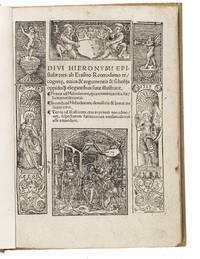
1518ABC_49875Cologne: Johann Gymnic 1518. Modern faux-leather-patterned paper with a grey paper label on the spine with the authors name lettered in silver Erasmus v. Rotterdam. 4to. With the title set with in a frame built up from 4 or possibly 6 woodcut illustrations including printer's initials and the date 1518 and 10 woodcut decorated initials. Selection of three letters by the Church Father Jerome of Stridon Saint Jerome ca. 342/47-420 CE edited and annotated by Erasmus. Erasmus felt a profound connection to Jerome. He saw in the ancient Church Father not only a kindred spirit but also a mirror for his own intellectual and spiritual journey. Included in this volume are three letters: first the epistle to Heliodorus on the praise of the solitary life de vita solitaria a stirring defence of ascetic withdrawal from the world; second the epistle to Heliodorus on the misery of human life de miseria vitae humanae a sombre reflection on the fleeting nature of earthly existence; and third the epistle to the monk Rusticus on avoiding familiarity with women de mulieribus evitandis a warning shaped by both monastic ideals and Jeromes personal convictions. Additionally a short fourth letter addressed to Onasus is included at the end of the volume though it does not appear on the title page. In this letter he satirically addresses the priest Onasus who had a deformed nose and his feeling of being unjustly attacked and being made a fool of in other letters and writings by Jerome.With early manuscript annotations corrections etc. of the printed text in the margins and occasional underlining of the text mainly concerning the third letter written in three different hands in both brown and black ink. With a 0.5 cm worm hole in the gutter margin not affecting the text. Occasional foxing and browning and some water staining in the fore-edge margin of several leaves. Overall a good copy.l BM STC German p. 440; USTC 640603 3 copies; Vander Haeghen II 29; VD 16 ZV 7938; not in Adams; De Reuck. Johann Gymnic, hardcover
1532748951Basileae per Iohannem Hervagium Johannes Herwagen 1532. Full leather. Sexto 22 532 207 5 Variae Lectiones 47 Annotationes 1 pagesBinding repair by J. Taylor Seton “successor to the late James Taylor 3 Mound Place Edinburgh†Recently rebacked. Margin notes and underlining throughout. Photos upon request. Basileae per Iohannem Hervagium [Johannes Herwagen] hardcover
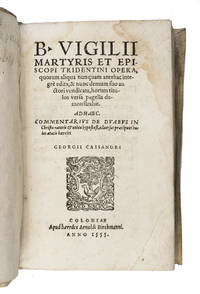
1535ABC_49895Cologne: printed by Jaspar von Gennep for Peter Quentel 1535. Limp overlapping vellum with ties. 8vo. With an elaborate woodcut border on the title page of ad 1 several decorated woodcut initials and Quentels woodcut device at the end. 2 works in 1 volume ad 2 in 2 parts. With bound before ad 1:2 VIGILIUS. Opera .Including: CASSANDER Georg. Commentarius de duabus in Christo naturis .Cologne Arnold Birckman 1555. A rare and significant edition of De veritate corporis et sanguinis Domini by Alger of Liège Algerus ca. 1060-ca. 1131 Benedictine monk of Cluny and one of the most influential medieval theologians on the Eucharist. This major treatise composed during the so-called second Eucharistic controversy defends the doctrine of the real presence of Christ in the Eucharist against the teachings of Berengarius of Tours. Admired by both medieval scholars and later by Erasmus Algers work remained central to Catholic theology well into the sixteenth century.This copy represents the Erasmian edition prepared under Erasmuss supervision with his corrections and editorial guidance. His involvement gave the text a new humanist form and authority making Algers theology newly relevant at a time when Eucharistic doctrine was again fiercely debated during the Reformation. Erasmuss careful attention to clarity and Latinity situates this edition within his broader humanist programme of restoring theological texts to philological precision and doctrinal coherence.Only a handful of copies of this edition are known and no record of it appears in recent sales databases underlining its rarity on the market. It is the second edition overall following the first printing in Freiburg im Breisgau 1530 and the first to be issued by Peter Quentel in Cologne.Bound together with the Opera of Vigilius 1555 and a Commentarius opposing the Christological views of Georg Cassander 1555 this important Sammelband reflects the continuing Catholic polemic against Reformation-era innovations in both Eucharistic theology and Christology.The vellum is slightly dampstained lacking part of the bottom closing tie on the front. Some stains and browning throughout. Otherwise in good condition.l Ad 1: BM STC German p. 20; USTC 626331; Vander Haeghen II 6; VD 16 A 1871; cf. Adams 173 1530 ed.; Ad 2: Adams V 748; BM STC German p. 893; USTC 615055; VD 16 V 1184. [printed by Jaspar von Gennep for] Peter Quentel, hardcover
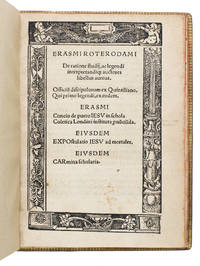
1516ABC_49694Colophon Strasbourg: Matthias Schürer 1516. Modern brown pigskin with a blind-tooled single fillet frame on both boards gold-tooled turn-ins red edges in a beige paperboard slipcase. 4to. With a woodcut decorated title frame and 3 woodcut decorated initials. Early edition of Erasmus seminal educational treatise De ratione studii here presented alongside several other influential pedagogical and devotional texts. It further includes: Officium discipulorum ex Quintiliano The duties of students according to Quintilian including a section on the first stages of learning to read also derived from Quintilian a sermon on the child Jesus by Erasmus intended for delivery at the Colet School in London a lament of Jesus addressed to mankind and a collection of school poems.The opening dedication addressed to Peter Viterius a professor of liberal arts sets the tone for this work: Erasmus praises his friends discernment and judgment in matters of education using vivid comparisons drawn from military strategy and classical mythology to underscore the importance of order and method in learning. Without it he argues even the most gifted minds may falter. Of particular note is Erasmus endorsement of an instructional technique that became central to Renaissance humanist pedagogy: the use of structured annotation. In De ratione studii he recommends that students classify selected passages under thematic headings a mnemonic device that aids both retention and retrieval. This principle would go on to shape the methods of early modern teaching and note-taking. It also reflects Erasmus' broader educational reforms where rhetoric and moral philosophy intersect. His engagement with progymnasmata preliminary rhetorical exercises especially those of Aphthonius favoured for their clear organisation into theory and examples demonstrates his commitment to practical and accessible instruction for young learners.With some contemporary and later underlining and annotations in red and brown ink mainly consisting of corrections additions to the text and markings of significant passages. Two minor worm holes througout barely affecting the text. The gutters between leaves V-VI; VII-VIII; XX-XXI; and after leaf XXIII have been reinforced in the gutter with linen tape slightly browned throughout. Otherwise in good condition.l Adams E 346; Bezzel 1709; USTC 653250 9 copies; Vander Haeghen I 169; VD16 E 3534; not in BM STC German; De Reuck; Kossmann. Matthias Schürer, hardcover
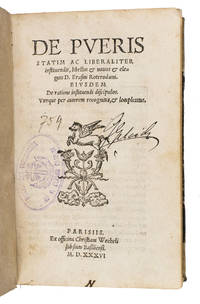
1536ABC_49637Paris: Chrétien Wechel 1536. Half vellum and brown sprinkled paper sides with the faded manuscript title on the spine red edges. 8vo. Ad 1 with Wechels woodcut device on the title page and 3 woodcut decorated initials. Ad 2 with Wechels woodcut device on the title page and the verso of the blank last leaf and 1 woodcut decorated initial. Ad 3 with a woodcut architectural frame on the title page and 2 woodcut decorated initials. Ad 4 with Frobens woodcut device on the title page and the verso of the last blank leaf. 4 works in 1 volume. With:2 IDEM. Responsio ad Petri Cursii defensionem nullo adversario bellacem.Paris Chrétien Wechel 1535.3 IDEM. Responsio ad epistolam paraeneticam clarissimi doctissimicque viri. Alberti Pii carporum principis. Paris Pierre Vidoux April 1529.4 IDEM. Purgatio adversus epistolam non sobriam Martini Luteri.Basel colophon: Hieronymus Froben and Nikolaus Episcopius April 1534. Together these four works capture the remarkable breadth of Erasmuss influence from his visionary humanist pedagogy to his forceful engagement in the theological controversies of the Reformation. Brought together in this volume they reflect both the moral urgency and intellectual sharpness that defined his contribution to early modern thought.Ad 1: First published in September 1529 De pueris statim ac liberaliter instituendis and De ratione instituendi discipulos represent Erasmus principal contribution to Renaissance pedagogy. He argues for the early and liberal education of children stressing mildness rather than severity moral formation alongside learning and the formative power of classical texts. Ad 2: An exceptionally rare edition of a polemic against the Louvain theologian Petrus Curtius in which Erasmus defends his humanist theology whilst ridiculing Curtius as a fighter without an adversary. First issued by Froben and Episcopius earlier that year with only that edition and the present Wechel edition extant; the text was not reprinted until the Opera omnia.Ad 3: A spirited reply to the accusations of Alberto Pio Prince of Carpi coupled with sharp extemporaneous notes against Edward Lee Beda. This double defence displays Erasmus wit and sharpness at the height of the Reformation debates. A very scarce edition; the editio princeps had appeared from Froben in March of the same year.Ad 4: An early witness to the high demand in 1534. Erasmus rejoinder to Luthers intemperate letter written in the wake of De servo arbitrio. Here Erasmus defends himself against charges of paganism whilst censuring Luthers furious and mendacious tone. After 1534 the text was no longer issued separately.With a manuscript owners inscription and a later purple stamp of the library of the Franciscan church and convent of Saint Clare in Kotor Montenegro on the title page of the ad 1. Further with a few manuscript annotations in the margins and some of the text underlined and crossed out throughout the work. The binding shows signs of wear the boards have been rubbed with some loss of material some occasional slight browning. Otherwise in good condition.l Ad 1: Adams 338; Inventaire chronologique des editions Parisiennes du XVIe siecle V no. 144; USTC 185690 1 copy; Vander Haeghen I 164; not in BM STC German; Ad 2: Inventaire chronologique des editions Parisiennes du XVIe siecle IV no. 1299; USTC 185562 1 copy lost; Vander Haeghen I 174; WorldCat 492052585 1 copy; cf. for the 1535 Froben edition see: Bezzel 1782; USTC 635442; VD16E3622; not in Adams; BM STC German; Ad 3: Adams 828; Inventaire chronologique des editions Parisiennes du XVIe siecle III no. 1758; USTC 181160; not in Vander Haeghen; BM ST C German; Ad 4: Vander Haeghen I 164; cf. Adams 809 later edition; USTC 635432 6 copies; VD 16 E 3481; not in BM STC German. Chrétien Wechel, hardcover
1557097858Paris: Robert Estienne 1557. Vellum. pp. 112 8; 128 16; 192 36 of 40: 2 leaves missing. 12mo. Vellum with hand-lettered spine and yapped edges with the ties missing. Each title shows the famous Estienne olive tree vignette on the title page first and last titles include a colophon. Very good. In "de Magistratibus" Fiocci lists and explains the offices of Roman priests and magistrates. This work was reprinted many times in the 15th-17th centuries. The second title which translates to "The Beauties of the Latin Language" was written in 1431 to praise the Latin language and advocate for its proper usage. The third is a reprint of Erasmus' Biblical paraphrases. All three titles were popular in the 16th century and these reprints are published by famous Parisien printer Robert Estienne who inherited the press from his father Henri in 1526: Francis I later made him the King's Printer. Robert Estienne unknown
15489932Colonia 1548. Handbeschriebener Einband in gotischer Schrift.Alterungsspuren Martinus Gymnicus Kl.-8°. Pgt. Alte Drucke unknown
152116988Colophon: Mainz: Johannes Schoeffer 1521. German contemporary blind-tooled calf sewn on 3 double cords in a panel design each board with a 15 mm-wide border roll with fillets on either side containing 4 different heads in medaillions separated by quatrefoils. The central panel on each board is filled with dozens of impressions of 3 floral stamps 1 on the front board and 2 on the back. Titles in ink written on the spine partly upside down and the fore-edge; later paper spine label; 2 holes near the fore-edge of each board from fastenings now lost. 8vo. Ad 1: with the title in woodcut architectural border with 3 coats of arms the Isenburg bars and Mainz wagon wheel above left and right and Schoeffer's device here with 2 stars above and a rosette below rather than 3 stars at the foot under his IS-monogram; 6 large beautiful woodcut initials the largest 45 mm with 2 human figures. Both works set throughout in italic types still with upright capitals as always at this date. With 1 initial coloured by hand. Ad 2: with the title in an elaborate woodcut border dated "MDXX" at the head first page of the dedicatory letter by Erasmus to Petrus Aegidius dated Basle 5 October 1514 on back of the title page with a border made of woodcut strips Froben's large woodcut device on the last page and 2 decorative woodcut initials 2 series the 30 mm Q with a scorpion. 2 works in 1 volume. With: 2 ERASMUS Desiderius. Parabolae sive similia.Colophon: Basel Johannes Froben July 1521. Ad 1: Good scholarly edition of Erasmus's famous guide to writing and speaking style in Latin designed to provide the student of Latin with a wide range of words and expressions. Ad 2: A collection of similes or comparisons composed along the same lines and with the same intentions as those that had brought Erasmus much success in his Adagia. In a sense the Parabolae are an addition to and continuation of the Adagia. With some contemporary annotations. In very good condition with only a few minor marginal smudges or chips. Binding lacking fastenings and with damage to the spine and edges but still in good condition with most of the tooling very clear.l Ad 1: VD 16 E 2656; Allen I 260; II 305 311; Bezzel 748; Vander Haeghen Bibl. Erasm. p. 66; Reedijk 95 97; De Reuck Bibl. Erasm. Bruxel. 135 with illus. of the title; ad 2: VD 16 E 3246 2 copies; Bezzel 1371; Vander Haeghen Bibl. Erasm. p. 138; for the binding: cf. K. von Rabenau Deutsche Einbände der Renaissance von Jakob Krause Berlin 1994 7 & 8 similar bindings using stamps with the same motifs. Johannes Schoeffer, unknown
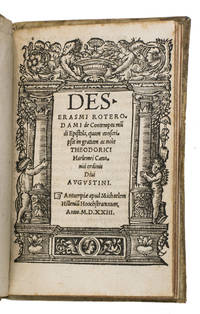
1523ABC_50124Antwerp: Michiel Hillen van Hoogstraten 1523. Later vellum with the manuscript title and year of publication on the spine red sprinkled edges. 8vo. With a decorative woodcut border on the title page and 2 decorated woodcut initials. Very rare early edition of Erasmus first written work a letter in praise of monastic life which was only published later in his career. Erasmus wrote it in 1488 or 1489 when he was 20 years old at the request of Theodoricus of Haarlem a fellow canon at the Augustine monastery at Steyn in order to persuade his nephew to join the order. It circulated in manuscript form for many years and was likely used to entice prospective candidates to enter the order of Canons Regular of St. Augustine.The work is divided into three parts: the first seven chapters focus on the evils of this world; chapter eight through eleven on the pleasures of the religious life; and chapter twelve on the ultimate choice between the material world or the religious state. This final chapter appears to counteract the rest of the work as it advises Theodoricus' nephew to carefully consider whether he truly wanted to enter a religious order since being a Christian is enough in itself. As such it has been suggested that Erasmus rewrote the text before its publication adding the 12th chapter but as he apologises for his adolescent writing style in the preface the work was likely mostly unedited.The first edition was published in Louvain in 1521 more than 30 years after it was written. The present edition is the first by Michiel Hillen van Hoogstraten and one of four printed in 1523. It is exceptionally rare on both the market and in institutions as only four copies have been recorded in libraries and we have not been able to find any others in sales records of the past century.The vellum is slightly soiled. The work is slightly browned throughout. Otherwise in good condition.l Adams E-569; Erasmus Online 1383; Nijhoff & Kronenberg 804; USTC 403708 4 copies; Vander Haeghen p. 64; WorldCat 71746606 2 copies; cf. De Molen R. "First fruits. The place of Antibarbarorum Liber and De contemptu mundi in the formulation of Erasmus Philosophia Christi" in: Colloque érasmien de Liège 1986 pp. 177-196; not in Bezzel; De Reuck; STCV. Michiel Hillen van Hoogstraten, hardcover
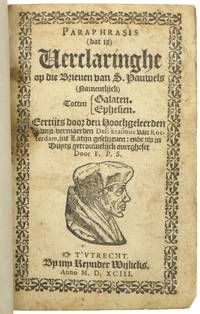
159312512Amsterdam Pieter la Burgh / T'Utrecht Reynder Wijlicks 1658/1593. 2 werken in 1 band 124 142 p. Origineel Perkament 8°. Twee werken van Erasmus in het Nederlands vertaald waarvan het tweede in deze uitgave uiterst zeldzaam is. Amsterdam, Pieter la Burgh / T'Utrecht Reynder Wijlicks unknown
1532V75865Cologne: Joannes Gymnicus Gymnich 1532 1533 1532. Hardcover. Good. Woodcut pictorial titlepages with borders of female deities etc to each of 3 works fine illustrated colophon to 2nd work. . Sammelband of 3 Works in one Volume. Small octavo pigskin on wooden boards front cover with floral marginal rolls central holy figures SS Peter & John and ownership stamp SVM IACOBI BVECSEN MDXXXIII. Back cover with border of dancing figures one dated 1528. Spine on 3 raised bands brass clasps missing but catches present. Some damage to head & foot of spine edges worn but stamped pigskin covers in excellent condition. Front & back endpapers present but pastedowns removed showing at gutters vellum strips with black & red MS lettering used to attach wooden boards to spine. Work I 16pp woodcut emblematic bordered titlepage Erasmus dedication to Beraldo dated Basel 8 June 1522 Index 385pp 1p blank collated complete except Lacks one leaf of text at Fii pp83-4. Titlepage has early ink ownership name Zielenski repeated at Aii verso of Work II in centre and partly erased MS library notes at foot. Some neat red ink underlining & marginal notes throughout light brown marks of former damp at top margins from start affecting up to 5 lines by end but all clearly readable. Small tears neatly repaired at top of last 2 sections without loss of text except on last leaf. Work II 2nd woodcut titlepage with Adam & Eve on either side nudity partly inked out 80 leaves unpaginated but collated complete with signatures A-K8 last page has full-page colophon of seahorse Gymnich's printer's mark Latin motto and Greek text round all 4 sides. Work III has 3rd woodcut titlepage with same Adam & Eve surround but no ink nudity defacement 127pp 1p blank collated complete but with tears at top margin some with minor paper loss neatly repaired. At end 12 marginally damaged blank leaves are bound in. Nice woodcut titlepages and very interesting early binding. Rare K lner Gymnich imprint Sammelband of 3 Works referenced I. Adams E558 VD 16 E 2514 Bezzel 609; II. VD 16 & van der Haeghen not in Adams; III. VD 16 not in Adams. Joannes Gymnicus (Gymnich) hardcover
153672393Parissiis: Simonem Colinaeum 1536. Simonem Colinaeum unknown
15741304040108Paris : Hieronymum de Marnef Gulielmum Cauellat Cavellat 1574-01-01. Hardcover. Good. 16mo 12 cm. Bound in 19th-century sheepskin. Scuff to rear board. Printer's device on title-page. 382 28 p.; Title soiled remounted. <br><br> Francesco Patrizi of Siena Franciscus Patricius Senensis 1413-1494 was an Italian political writer and humanist. In De Institutione reipublicae Patrizi discusses how public speaking may influence the civil discussion and the ability to manipulate people through eloquence and rhetoric to the ends of the state rather than simply by force alone. Patrizi served as governor of Foligno in the Papal States and bishop of Gaeta. His political writings on had influence on the ideas of civic Humanism and is considered a predecessor of Machiavelli. Paris : Hieronymum de Marnef Gulielmum Cauellat (Cavellat) hardcover
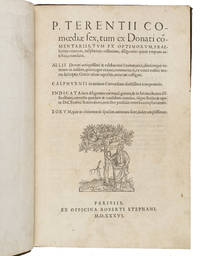
1536ABC_49923Paris: Robert Estienne 1536. Late 17th-century calf sewn on five supports with corresponding raised bands richly gold-tooled spine with the author title and year lettered in gold and red and-brown sprinkled edges. Small folio 20.2 x 30.3 cm. With Estiennes small woodcut device ona small woodcut the title page. Second edition of Terences Comoediae published by the French humanist and printer Robert Estienne 1503-1599. Publius Terentius Afer also known as Terence ca. 195-ca. 159 BCE was a Roman playwright of North African origin and one of the foremost authors of Latin comedy. The present work includes the commentary of Aelius Donatus 4th century CE based on a manuscript provided by Estiennes father-in-law Josse Bade 1462-1535. Donatus was a Roman grammarian and teacher of rhetoric best known for his grammatical works Ars Minor and Ars Maior. Building on Estiennes earlier 1529 folio edition this one was printed in the new Roman types and divided into acts and scenes a notable innovation. In addition Estienne incorporated Erasmus treatise on comedic metres which provided a scholarly analysis of the rhythmic and metric structures of classical comedies enhancing readers understanding of Terences original cadence and comedic effect.The boards are severely rubbed light foxing and staining throughout the title page is very slightly browned the head margin is cut slightly short. Otherwise in good condition.l Adams T 326; BM STC French p. 416; De Reuck 512; Inventaire chronologique des editions Parisiennes du XVIe siecle V 314; Renouard Estienne I 43 no. 15; Schreiber 52; USTC 147028 9 copies; Vander Haeghen II 55. Robert Estienne, hardcover
1562508219Petrus Horst 1562. Leather. GOOD. 8vo 3.75 x 6' 784pp. Later mottled sheep with ornate floral spine panels and burgundy morocco title label half perished. Tips worn joints rubbed and starting at tail ends but cords still intact title page repaired and some lettering restored by hand; occasional pen markings in multiple early hands one contemporary; with engraved portrait of Erasmus d. 1802 inlaid to flyleaf; owner's inscription 'Conrady . 1841' to FFEP. Petrus Horst unknown
15106221Hardcover. Fine. 4to. Bound in 20th-century 1/4-vellum over marbled boards. Strasbourg: Matthias Schürer <b>Jul</b><b>y 1510. Second Strasbourg</b> edition of Erasmus heavily annotated collection of Greek and Latin proverbs. Printed in Roman and Greek types. <br /><br />This is the original version containing 818 adages which is considerably shorter than the later expanded versions published under the title Adagiorum chiliades. Adams E-420; Bezzel Erasmusdrucke 50; Van der Haeghen Bibliotheca Erasmiana p.25-6; Bibl. Belgica II 276: no. E.61; Muller Strasbourg II p. 179 no. 45. <br /><br />The Adagia could only have been possible in the new world of European education in which careful attention to a broader range of classical texts produced a much fuller picture of the literature of antiquity. Its impact has been long lasting. Such popular expressions such as <i>one step at a time</i> <i>between a rock and a hard place</i> <i>break the ice</i> <i>an iron in the fire</i> l<i>ooking a gift horse in the mouth</i> and many other sayings can trace their origin to the Adagia. <br /><br />The printer Matthias Schürer published 15 works by Erasmus in over 70 editions. It is interesting to note that his relationship with Erasmus began with a rather rough start. In 1509 the year Schürer completed his apprenticeship and opened his own print shop he struck an unauthorized edition of Erasmuss Adagia purloined from the first edition of 1500. In spite of this commercial indiscretion Erasmus favored Schürer with a warm supportive and lasting friendship. The dedicatee of this celebrated work William Blount 4th Baron Mountjoy of Barton Blount Derbyshire was a wealthy English courtier and scholar. A pupil of Erasmus he called him inter nobiles doctissimus The most learned amongst the nobles. Having served since 1512 as Chamberlain to Queen Catherine of Aragon it fell to him to announce to her the intention of Henry VIII to divorce her. Boards slightly rubbed; signatures D-K with a small wormhole to outer margin without loss of text; some slight browning and soiling to some pages; a few leaves with faded manuscript marginalia in a neat 16th-century hand; index leaves with light water staining to upper portion; o/w a very nice unrestored wide-margined example of this rare early edition. Matthias Schürer hardcover
1566129831Lugduni (Lyon) apud Antonium Gryphium M.C.LXVI (1566). 682, (30 von 38) Seiten. Mit einer Titelvignette. Geprägter, brauner Ledereinband auf vier Bünden mit vergoldetem Rückentitel. (Die nicht nummerierten letzten 8 Seiten "Annotata fehlen! Titelblatt mit alten handschriftlichen Eintragungen. Mehrere Blätter an den Rändern etwas ausgefranst, jedoch ohne Textverlust. Papier teils gering fleckig. Einige Textunterstreichungen). 12,5x7,5x3,3 cm
1556LLV2641Lugduni Lyon:: Seb. Gryphium 1556. 1556. Small 8vo. Pagination: 473 23 pp. Signatures: a-z8 A-H8. Printer's device on the title page woodcut initials printed marginalia; editor's name on title and p. 2 are lined out in ink three small worm holes from title-page. Nineteenth century quarter gilt-ruled calf red paper board boards. Early ink name on title of "Carolus . . ." and occasional marginalia pp. 58 61 62 80-83 heavy notes - in the same hand. Very good. Beautifully printed early pocket edition printed by Sebastianus Gryphius 1493-1556 of Suetonius' most famous work and one of the few of his texts that survive with excellent annotations by Desiderius Erasmus of Rotterdam. Commonly known as The Twelve Caesars the work contains a set of twelve biographies of Julius Caesar and the first eleven emperors of the Roman Empire Augustus Tiberius Caligula Claudius Nero Galba Otho Vitellius Vespasian Titus Domitian. It is a primary source for the study of Roman history. <br /><br /> The first edition of Suetonius with Erasmus' annotation was issued in 1533. <br /><br /> Baudrier Henri L. Bibliographie lyonnaise VIII p. 284; Gultlingen V p. 215: I369; French Books III & IV: Books published in France before 1601 . . . edited by Andrew Pettegree Malcolm Walsby Leiden: Brill 2012 87100. <br /><br /> Locations: BYU lacks everything after p. 340 and title is damaged; NYPL. Seb. Gryphium, 1556. hardcover
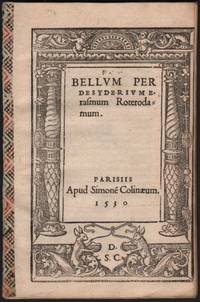
1530329Parisiis Paris: Apud Simonem Colinaeum Simon de Colines 1530. Reprint of the printer's edition of 1525. First printed by Johann Froben in 1517. Papered spine. In fine condition. Title within elaborate woodcut border with initials S.D.C. and Geoffroy Tory’s Lorraine cross. Title within elaborate woodcut border with initials S.D.C. and Geoffroy Tory’s Lorraine cross. Reprint of the printer's edition of 1525. First printed by Johann Froben in 1517. Papered spine. 8º a–c8 c8 blank; 23 1 blank leaves. <p><br /> Erasmus’ famous pacifist text on the adage “dulce bellum inexpertis" war is sweet to those who have not tried it. It was first published in the revised and enlarged edition of “Adages†called “Proverbiorum chiliades" 1515 Basel; Froben and published separately in 1517 also by Froben. <br /> <p><p><br /> “Bellum" is the first essay where Erasmus speaks of Jews contemporary to him praises them along with the Turks and the pagans as well as various peoples of Europe Asia and Africa for their virtuous living. He writes: “When has the sword murder arson plundering turned conquered people into good Christians! Openly to be a Turk or a Jew is lesser evil than to pretend to be a Christian. I prefer a real Turk to a false Christian.†<br /> <p><p><br /> The printer Simon de Colines 1480–1546 is most notable for his 1525 “Grandes Heures de Simon de Colines†the illustrator was the same Geoffroy Tory 1480–1533 who made the design of the woodcut border of this book.<br /> <p><p><br /> Bibl.: Markish Shimon: Erasmus and the Jews. Chicago. University of Chicago Press 1986.; Johnson Carina L.: Cultural hierarchy in sixteenth-century Europe. The Ottomans and Mexicans. Cambridge; New York. Cambridge University Press 2011.; Olin John C.: Six essays on Erasmus and a Translation of Erasmus' Letter to Carondelet 1523. New York. Fordham University Press 1979.<br /> <p><p><br /> Moreau III 2074. <br /> <p>. Apud Simonem Colinaeum (Simon de Colines) unknown