88 résultats
188237691Berlin, Verlag von Carl Habel, 1882. 8°, 64 S., Deutsche Zeit- und Streit-Fragen. Flugschriften zur Kenntniß der Gegenwart. Hg. Von Franz von Holtzendorf. Jahrgang XI. Heft 167 & 168 Bezahlung per PayPal möglich, we accept PayPal, Einb. ger. beschabt u. ger. bestoßen u. angeschmutzt, fingerspurig, Schnitte angeschmutzt, altersbed. Bräunungen, Gebr.sp., KEINE SCHÖNHEIT Interimsbindung
189361CBBayreuth, Ellwanger (= handgeschr. Programm-Nr. 9), 1893. 8°, 41 S., original Heft mit Papierrückenstreifen, Erstausgabe handgeschriebene Anmerkung (1893.bayr. Progr. No 9) und schöner alter Stempel der Lehrerbibliothek eines alteingesessenen Frankfurter Gymnasiums auf Titelseite, sonst gute, kaum altersspurige Broschur (Li1, Ordner4)
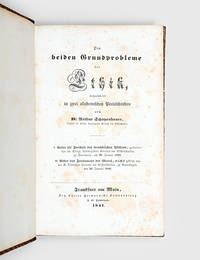
1840170880Frankfurt am Main: Joh. Christ. Hermannsche Buchhandlung 1841 i.e. 1840; 1854. I am read and I will be read First edition of the German philosopher's best and most focussed work on ethics outlining stinging attacks on both Kant and Hegel. In 1839 Schopenhauer wrote an essay titled On the Freedom of Human Will which won him the gold medal from the Royal Norwegian Society of Sciences. Buoyed he wrote a complementary essay one year later On the Foundations of Morality which did not fare as well. Although this was the only submission to a competition run by the Royal Danish Society it was rejected on the grounds that it was opinionated and brutally disrespectful to prominent philosophers - Hegel in particular. Schopenhauer responded by publishing the two papers as Two Fundamental Problems of Ethics original German - Die Beiden Grundprobleme der Ethik with a lengthy preface outlining some choice thoughts on both Hegel and the Royal Danish Society. Although the Two Fundamental Problems carries an 1841 date it was published late in 1840. This volume also includes the second edition of On the Will in Nature original German - Ueber den Willen in der Natur originally published in 1836 which aims to bring recent developments in 19th-century science in line with Schopenhauer's nascent theory of the will. By 1854 his intellectual isolation had begun to abate and as he confidently wrote in the preface to the second edition "legor et legar" "I am read and I will be read" - p. vi. Octavo 203 x 126 mm pp. xl 278 2; pp. xxiv 135 1. Near-contemporary brown quarter cloth spine ruled and lettered in gilt marbled paper sides and edges. Near-contemporary library ticket of Ad. Scheefer. Infrequent near-contemporary pencil annotations. Light bumping and rubbing minor foxing to outer leaves: a very good copy. Hübscher 33 & 37. hardcover
1860PHOeSCHO55Leipzig: F.V.Brockhaus 1860. 1860. 8vo. pp. xliv 275 1. with half-title. later cloth spine dull some foxing. Second Collected Edition first: 1841 of Schopenhauer's two essays on ethics and the problem of free will which he had sent in 1838-39 in competition for prizes offered by the Norwegian Academy of Sciences at Drontheim and the Danish Academy at Copenhagen respectively. The first essay was awarded the prize and the author elected a member of the society but the second although it was the only one in competition was refused on a number of grounds. Rand I p. 463. Hardcover. Leipzig: F.V.Brockhaus, 1860. Hardcover
1896183988Freiburg i. B. : Herder, 1896. VII, 103 Seiten. 22 cm. Originalhalbleinen.
1832950644Berlin: Ohne Drucker 1832. hardcover. Gut. Insgesamt über 550 Seiten. Geprägter Pappband der Zeit mit floralen Ornamenten und dreiseitigem Goldschnitt. Duodez 125 x 95 cm Einband etwas lichtspurig und fleckig leicht bestoßen und berieben Rücken knickspurig Schrift auf Vorsatz und der Rückseite des Frontispiz mit Tintendurchschlag es FEHLEN die Kupfer und das Verzeichnis der Kupfer im Ganzen aber ordentlich erhalten. Ein dekorativer eleganter hellrosa Biedermeier-Einband geprägt mit floralen Ornamenten. Ein Doppelblatt ist gelockert aber nicht lose. Auf der Rückseite des Frontispiz' mit dem Besitzeintrag einer Gräfin Wartensleben die auch den Vorsatz mit einem dreistrophigen Gedicht geschmückt hat. Die auf dem Titel erwähnten Kupferstiche fehlen in dem vorliegenden Band bis auf das Frontispiz mit dem Bildnis von Otto Prinz von Bayern ebenso wie die im Inhaltsverzeichnis erwähnte Beschreibung der Kupfer. Augenscheinlich wurden aus dem Band keine Blätter entfernt und das Buch wurde möglicherweise bei der Herstellung ohne die Kupfertafeln und deren Beschreibung aufgebunden. Johanna Henriette Schopenhauer geb. 9. Juli 1766 in Danzig; gest. 16. April 1838 in Jena war die Mutter des Philosophen Arthur Schopenhauer. Ihre Novelle "Die Reise nach Italien" erschien in Buchform erst 1836 bei Sauerländer in Frankfurt und der vorliegende Abdruck im Berliner Kalender von 1833 ist möglicherweise gekürzt. Die verwickelte Erzählung handelt von unglücklicher Liebe und vertauschten Kindern "Die Geisel der Literatur des 19. Jahrhunderts" - Arno Schmidt. "Ihre Romane spiegeln sehr stark ihre Gefühle in ihrer vergangenen von Tyrannei bestimmten Ehe wider. Die typische Johanna-Schopenhauer-Heldin verliert auf tragische Weise ihre wahre Liebe und findet sich dann aus nicht nachvollziehbaren Gründen mit einer unbefriedigenden Ehe ab was schon die zeitgenössische Kritik bemängelte." wikipedia. Sonst finden sich in dem Buch 13 Blatt mit Kalendarien; Seite 1-154: Mano "Die Geschichte des griechischen Befreiungskrieges. Fortsetzung und Schluß.": Seite 155-220: Friedrich Buchholz "Johann Graf von Capo d'Istrias oder die vier letzten Jahre der griechischen Revolution."; nach der Novelle folgt Seite 1-106 "Genealogie der regierenden hohen Häuser." und Seite 1-79 "Verzeichnis der Postcourse" i.e. die Fahrpläne der Postkutschen in Deutschland. Der Kalender ist äußerst selten die über KVK gefundenen Einträge verweisen zumeist auf eine "elektronische Resource". - Weitere Bilder auf Anfrage oder auf unserer Homepage. Wegen Urlaub kann Ihre Bestellung / Anfrage erst nach dem 21.06.2026 bearbeitet werden. - Because of holidays your order / question can be handled only after 06/21/2026. Ohne Drucker hardcover
182529181Wien, Chr. Fr. Schade, 1825. Kl.-8°. Zus. ca. 520 S., Ppbd. d. Zt. m. goldgepr. Rückentitel.
1859258810Leipzig: Brockhaus, 1859. XXXII; 634 Seiten. Originalleinen mit vergoldetem Rückentitel . 21 cm.
1888117576Leipzig, F. A. Brockhaus 1888. * Mit 1 Porträt, 1 Wappendarstellung 1 gefalteten Faksimile. 221 Seiten, 1 Blatt. 22,5 x 17,5 cm. Brauner Original-Halblederband über fünf falschen Bünden mit Buntpapierbezug, goldgeprägtem Rückentitel, hübscher Rückenvergoldung und Buntpapiervorsätzen.
188816375Leipzig, Brockhaus, 1888. 221 S., 1 Bl., 1 Bildtaf., 1 Faks. 4°, Pb. d. Zeit.
1888130176Leipzig: Verlag F. A. Brockhaus, 1888. 221 S. ; 26,5 x 20,5 cm ; Halbleinen.
1894765<p>Notes by Salomon Reinach. Paris: Félix Alcan Éditeur 1894. Bound. 212 pages. In French. Title page with small loss on the side and age stains. Size: 14 X 21 cm.</p> Feliz Alcan hardcover
1900103071900 Félix Alcan 1900 in-12,demi reliure,dos frotté, 212 pages, Bon état,
1891FB5707(1&2) /8<p>Brown calf spine with gilt banding and title. Brown marbled boards. dimensions are for one volume.</p><ul><li><strong>We provide an in-depth photographic presentation of this item to stimulate your feeling and touch. More traditional book descriptions are immediately available.</strong></li></ul><p>2 quality volumes of this prestigious work. Binding and contents are in good order.</p><p><strong><em>The World as Will and Representation</em></strong> <strong><em>WWR</em></strong>; <em>Die Welt als Wille und Vorstellung</em> <strong><em>WWV</em></strong> sometimes translated as <strong><em>The World as Will and Idea</em></strong> is the central work of the German philosopher Arthur Schopenhauer. The first edition was published in late 1818 with the date 1819 on the title page. A second two-volume edition appeared in 1844: volume one was an edited version of the 1818 edition while volume two consisted of commentary on the ideas expounded in volume one. A third expanded edition was published in 1859 the year before Schopenhauer's death. In 1948 an abridged version was edited by Thomas Mann. In the summer of 1813 Schopenhauer submitted his doctoral dissertation—<em>On the Fourfold Root of the Principle of Sufficient Reason</em>—and was awarded a doctorate from the University of Jena. After spending the following winter in Weimar he lived in Dresden and published his treatise <em>On Vision and Colours</em> in 1816. Schopenhauer spent the next several years working on his chief work <em>The World as Will and Representation</em>. Schopenhauer asserted that the work is meant to convey a "single thought" from various perspectives. He develops his philosophy over four books covering epistemology ontology aesthetics and ethics. Following these books is an appendix containing Schopenhauer's detailed <em>Criticism of the Kantian Philosophy</em>. Taking the transcendental idealism of Immanuel Kant as his starting point Schopenhauer argues that the world humans experience around them—the world of objects in space and time and related in causal ways—exists solely as "representation" <em>Vorstellung</em> dependent on a cognizing subject not as a world that can be considered to exist in itself i.e. independently of how it appears to the subject's mind. One's knowledge of objects is thus knowledge of mere phenomena rather than things in themselves. Schopenhauer identifies the thing-in-itself — the inner essence of everything — as <em>will</em>: a blind unconscious aimless striving devoid of knowledge outside of space and time and free of all multiplicity. The world as representation is therefore the "objectification" of the will. Aesthetic experiences release one briefly from one's endless servitude to the will which is the root of suffering. True redemption from life Schopenhauer asserts can only result from the total ascetic negation of the "will to life". Schopenhauer notes fundamental agreements between his philosophy Platonism and the philosophy of the ancient Indian Vedas. <em>The World as Will and Representation</em> marked the pinnacle of Schopenhauer's philosophical thought; he spent the rest of his life refining clarifying and deepening the ideas presented in this work without any fundamental changes. The first edition was met with near-universal silence. The second edition of 1844 similarly failed to attract any interest. At the time post-Kantian German academic philosophy was dominated by the German idealists—foremost among them G. W. F. Hegel whom Schopenhauer bitterly denounced as a "charlatan". <strong>Arthur Schopenhauer</strong> German: 22 February 1788 – 21 September 1860 was a German philosopher. He is known for his 1818 work <em>The World as Will and Representation</em> expanded in 1844 which characterizes the phenomenal world as the manifestation of a blind and irrational noumenal will. Building on the transcendental idealism of Immanuel Kant 1724–1804 Schopenhauer developed an atheistic metaphysical and ethical system that rejected the contemporaneous ideas of German idealism. Schopenhauer was among the first thinkers in Western philosophy to share and affirm significant tenets of Indian philosophy such as asceticism denial of the self and the notion of the world-as-appearance. His work has been described as an exemplary manifestation of philosophical pessimism. Though his work failed to garner substantial attention during his lifetime he had a posthumous impact across various disciplines including philosophy literature and science. His writing on aesthetics morality and psychology have influenced many thinkers and artists. Arthur Schopenhauer's paternal grandfather Andreas Schopenhauer de 1720–1793 was a wealthy merchant in Danzig. Arthur Schopenhauer's paternal grandmother Anna Renata Schopenhauer 1726–1793 was the daughter of a Dutch merchant and the Dutch ambassador to the Hanseatic city of Danzig Hendrik Soermans 1700–1775. Arthur Schopenhauer's maternal grandfather Christian Heinrich Trosiener de 1730–1797 was a merchant in Danzig and a councilor from the middle class. Arthur Schopenhauer's maternal grandmother Elizabeth Trosiener 1745–1818 was daughter of pharmacist Georg Lehmann died 1762 and his wife Susanna Concordia Lehmann née Neumann born 1718. Arthur Schopenhauer's paternal great-grandfather Johann Schopenhauer de 1670–after 1724 was the mentioned merchant in Gdansk. Arthur Schopenhauer's paternal great-grandfather through paternal grandmother Hendrik Soermans de 1700–1775 was a Dutch merchant and Ambassador of the Netherlands in Gdansk. Arthur Schopenhauer's paternal great-great grandfather Johann Schopenhauer 1630–1701 was a farmer in Petershagen and son of Simon Schopenhauer 1580–1660 and grandson of Salomon Schopenhauer born 1550.</p> F H Brohaus. hardcover
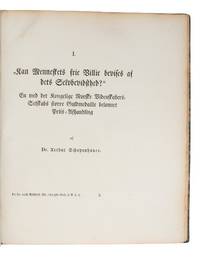
184038535Trondhjem Tønnes Andreas Høeg 1840. 4to. Entire volume present. Later very nice brown hcalf w. gilt spine Anker Kyster. Pp. 1 - 100. Entire volume: 2 127 3 pp. With the general title-page for the volume title-pages and prefaces for the two works contained in the present volume and the contents-leaf. The other work is: "Den Constitutionelle Statsform betragtet i dens Forhold til Samfundets høiere Interesser. Tale holden i det Kongl. Norske Videnskabers=Selskab paa hans Majestæt Kongens Fødselsdag den 26de Januae 1838 af Frederik Moltke Bugge Selskabets Præses." <br/><br/><em>The scarce first printing of Schopenhauer's "Prize Essay" "On the Freedom of Human Will" which constitutes one of Schopenhauer's greatest successes one of the works of which he was the most proud and the work that was awarded the large gold medal from the Royal Norwegian Society of Sciences being an answer to the proposed question from the Society "Is it possible to demonstrate human free will from self-consciousness". The following year Schopenhauer wrote his "On the Foundations of Morality" "Über die Grundlage der Moral" which he sent to the Royal Danish Society of Sciences but which was not honoured with an award although it was the only submission to the competition. It is these two works that together constitute his "Two Fundamental Problems of Ethics" "Die Beiden Grundprobleme der Ethik" which was published in 1941. The title-page and the preface are in Norwegian but the essay itself is in German "partly because a translation would undoubtedly be superfluous even unwelcome by anyone who possesses enough scientific education to lead the treatise with interest and knowledge partly because the copies that would be given to the author would probably lack all interest to him if they were printed in the Norwegian language and finally partly because the esoteric nature of the contents seem to make it preferable that the treatise as far as possible would not be made accessible to others than those who due to fairly thorough education are able to avoid misunderstandings as well as being able to properly appraise the value of the treatise with regards to its reality in general and partially own translation - Introduction pp. 2 - 3.Schopenhauer's work is generally accepted as being one of the most brilliant and elegant treatments of free will and determinism. He clearly and elegantly distinguishes between the freedom of acting and the freedom of willing. His conclusion is that human beings do have the freedom of acting whereas they do not have the freedom of willing since they are completely determined by the way that their bodies react to outside stimuli and causes. From the libraries of the two notable collectors Ejnar Christiansen and Esli Dansten. </em> unknown
188936115Paderborn: Schöningh 1889. XII, 414 (1) S. OHalbleinen m. Rückenvergold. 20x13 cm.
187811555Leipzig, Fues, 1878. 8°. XIII, 543 S., 1 Bl., Halblederband der Zeit. - Karl Eugen Dühring (1833 in Berlin - 1921 in Babelsberg) war Philosoph, Nationalökonom und Vertreter des deutschen Positivismus. Einband etwas bestoßen, innen gebräunt und stellenweise stockfleckig. Insgesamt schönes Exemplar.
1894100148679Félix alcan 1894 in12. 1894. Broché.
1880R110032077LIBRAIRIE GERMER BAILLIERE. 31 JUIL 1880. In-4. En feuillets. Bon état, Couv. convenable, Dos satisfaisant, Intérieur frais. Paginé de 97 à 120. Lecture en colonnes.. . . . Classification Dewey : 70.49-Presse illustrée, magazines, revues
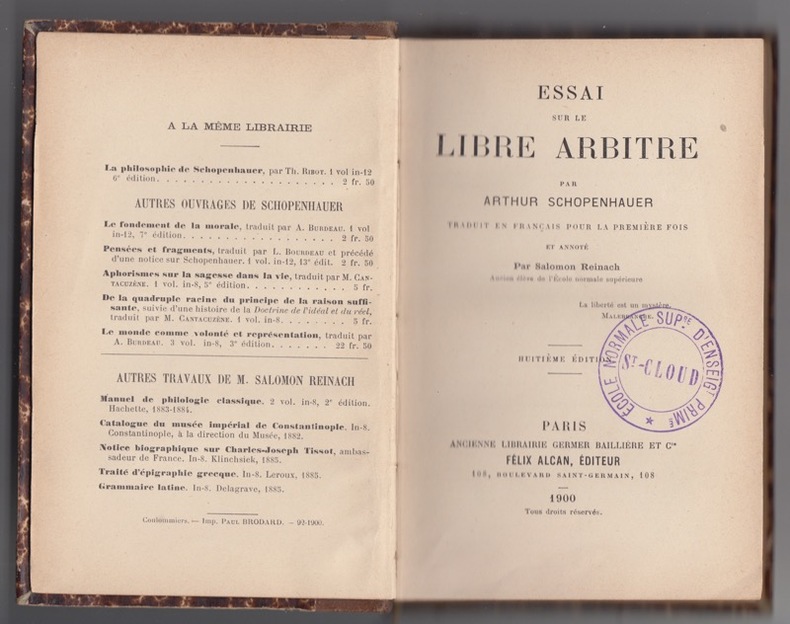
190077662Félix Alcan 1900. Book. Fair. Hardcover. 12mo - over 6¾" - 7¾" tall. 3 volumes In-12 reliés ensemble Moyen Etat reliure demi toile avec manques au dos Le fondement de la morale: Alcan 1907 neuvième édition traduit par A. Burdeau Pensées et fragments Les douleurs du monde l'amour la mort l'art et la morale Pensées diverses sur la religion la politique l'homme et la société le caractère des différents peuples: Alcan 1908 vingt-deuxième édition traduit par J. Bourdeau Essai sur le libre arbitre: Alcan 1900 huitième édition traduit par Salomon Reinach. Félix Alcan Hardcover
1891RO30047382FELIX ALCAN - 4° EDITION. 1891. In-12. Broché. Etat d'usage, Couv. convenable, Dos abîmé, Quelques rousseurs. 195 pages.. . . . Classification Dewey : 830-Littératures des langues germaniques
1879RO40253260Librairie Germer Baillière et Cie, Paris. 1879. In-12. Broché. Etat passable, Plats abîmés, Dos abîmé, Quelques rousseurs. 195 pages. Etiquette de code sur la couverture. Quelques tampons et annotations de bibliothèque. Dos très abîmé, avec quelques manques. 2e plat partiellement jauni et se détachant.. . . . Classification Dewey : 830-Littératures des langues germaniques
1885feb103875Socec 1885. Used. 1885; French Edition of LE MONDE COMME VOLONTE ET COMME REPRESENTATION ; For more details please contact me Socec unknown
1894RO40235956Félix Alcan. 1894. In-8. Broché. Etat d'usage, Plats abîmés, Dos abîmé, Intérieur acceptable. 325 pages. Dos fendu, séparant l'ouvrage en plusieurs parties. Petits manques sur les bords des plats.. . . . Classification Dewey : 830-Littératures des langues germaniques
1878111075Paris Librairie Hachette 1878 1 vol. relié in-12, bradel percaline noire, encadrements à froid sur les plats, (4) + III + 298 pp. (cartonnage fragilisé, tache à la page de garde). Edition originale avec un envoi autographe signé des initiales de l'auteur Bon état.