83 résultats
1873946Leipzig: E. W. Fritzsch 1873. First Edition. Hardcover. Very good. Nietzsche Destroys David Strauss <br /> <br />NIETZSCHE Friedrich. Unzeitgemässe Betrachtungen I: David Strauss Unconventional Observation I: David Strauss. Leipzig: E. W. Fritzsch 1873. TP 1-101 102 = advertisements Octavo. First Edition First Issue. Schaberg 23a <br /> <br />The first of Nietzsche's Unconventional Observations was an attack on David Strauss the writer who had made his reputation with his scandalous Life of Jesus in 1835. Here Nietzsche attacks his most recent book The Old and the New Faith which advocated the rejection of the Christian faith in favor of a Darwinian materialistic and patriotic world-view. Nietzsche accuses Strauss of being a "Cultural Philistine" and denounces him as an exemplar of pseudo-culture. Although erudite the essay is extremely intemperate and filled with references to many of Nietzsche's scholarly contemporaries. The climax is a literary tour de force in which Nietzsche cites a litany of malapropisms from Strauss interspersed with his own barbed comments. For Nietzsche Strauss's book was the incarnation of the Zeitgeist: unproductive smugness intellectual snobbery superficial assimilation of great works of art and new scientific theories myopic criticism and patronizing praise of even the greatest genius But what enraged him most was Strauss's comfortable and untroubled renunciation of Christianity coupled with an easy conviction that Darwin was one of mankind's greatest benefactors and that traditional values could of course be maintained. It is in the present work that Nietzsche first publicly addresses the problem of the derivation of moral values that would infuse so much of his most important work. <br /> <br />CONDITION: Very Good in recently rebound contemporary marbled paper over boards with new spine lettered in gilt. Internally bright and clean. A very good copy of one of Nietzsche s early works. <br/><br/> E. W. Fritzsch hardcover
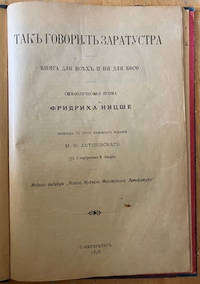
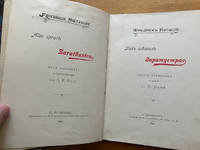
1899887<p>Petersburg: M.M. Stasyulevicha 1899. First Thus. Hardcover. Very good. First Bilingual German-Russian Edition of Nietzsches Zarathustra <br /><br />NIETZSCHE Friedrich Tak govoril Zaratustra / Also Sprach Zarathustra Bilingual edition in German and Russian M.M. Stasyulevicha Petersburg 1899. Blank leaf half-title TP 1 leaf = dedication vii - xiv = translators forward half title half-title 2 - 103 1 leaf = contents blank leaf octavo. First Russian-German Dual-Language. <br /><br />First edition of the second translation of Thus Spoke Zarathustra. Translated from German by S. Nani. Bilingual edition in both German and Russian of nine selected excerpts printed side-by-side: the Night-Song the Grave-Song the Academic Chairs of Virtue the Soothsayer the Three Metamorphoses Scholars the Way of the Creating One Reading and Writing and the Three Evil Things. <br /><br />Thus Spoke Zarathustra is one of Nietzsche's most famous works and Nietzsche regarded it as among his most significant. Thoroughly studied and re-studied by scholars throughout the 20th century the character of Zarathustra stands as a figure marking the end of Modernity by some i.e. Heidegger the beginning of Post-Modernity by others i.e. Derrida; the text a personal soteriological narrative of Nietzsches own self-overcoming and a parable for others towards the same transformation. Though Thus Spoke Zarathustra attempts to destroy and replace the Judeo-Christian world-view Nietzsches style borrows heavily from the Old and New Testament. Nietzsche also adopts myriad metaphors invoking animals earth air fire water celestial bodies plants all in the service of describing the spiritual transformation of Zarathustra a solitary reflective exceedingly strong-willed sage-like laughing and dancing voice of self-mastery who accompanied by a proud sharp-eyed eagle and a wise snake believed in a mode of being beyond the common human condition but without the need to posit a transcendent other world. Nietzsche refers to this higher mode of being as superhuman übermenschlich one that embraces the doctrine of eternal recurrence a doctrine for only the strongest who can love life in its entirety who embrace their suffering and would only again will it to be thus! <br /><br />The first translation of Zarathustra was done by Yu Antonovsky in 1898 just really a few months before this bilingual edition translated by Nani. With so much censorship in Russia any translation was really an art form creatively trying to communicate Nietzsches or any philosophers! ideas into a voice acceptable to the heightened sensitivities of the authorities under both Tsars Alexander III and Nicholas II. Hence the incomplete translations of both Antonovsky in 1898 and Nani in 1899. <br /><br />CONDITION: Very good in original quarter leather with marbled boards. Light edgewear. Former owners name in ink to top edge of half-title page. Text block coming loose from front cover along inner hinge but holding along bottom. Rear hinge firm. One leaf xiii - xiv loose. Blank rear endpaper with small tear in center. A very nice untouched copy all in original condition. <br /><br /></p> M.M. Stasyulevicha hardcover
1896COLLECTI014822INEW YORK NY: MACMILLAN AND CO. VERY GOOD NO D.J. 1896. FIRST EDITION. HARDCOVER. EDITED BY ALEXANDER TILLE / TRANSLATED BY THOMAS COMMON ALSO INCLUDES "THE ANTI-CHRIST"PAGES 233-351 . PUBLISHER'S LIGHT GREEN CLOTH-COVERED BOARDS WITH GILT SPINE TITLES AND 8 PAGE UNDATED CATALOG AT THE REAR OF TEXT. THE CLOTH OF THE SPINE IS DARKENED WITH SPINE TITLES A BIT DULLED BUT QUITE READABLE AND WITH FRONT AND REAR BOARDS' CLOTH SLIGHTLY DARKENED. A VERY NICE COPY BUT LACKING THE HALF TITLE. A VERY NICE COPY OF A RARE FIRST EDITION WITH NIETZSCHE'S "TWILIGHT OF THE IDOLS". . MACMILLAN AND CO. hardcover
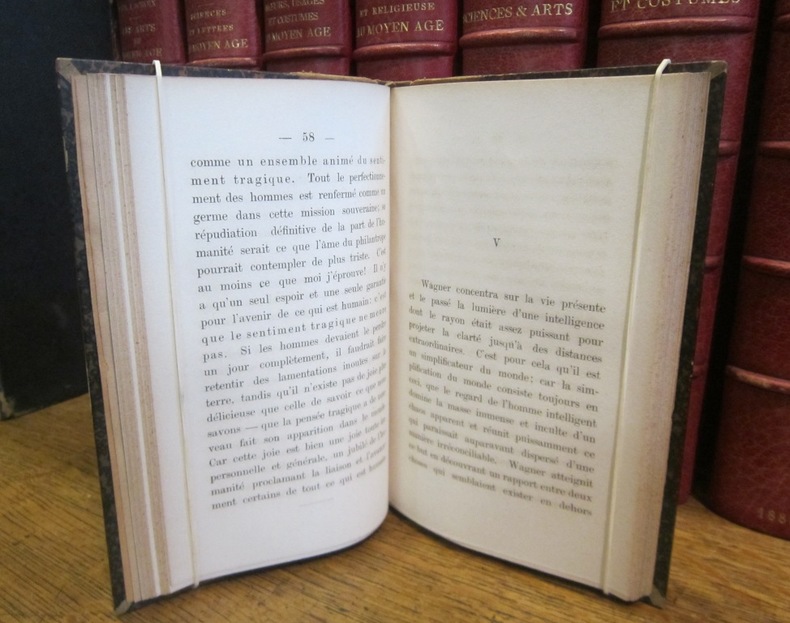
187788235Schloss-Chemnitz: Ernest Schmeitzner 1877. Fine. Ernest Schmeitzner Schloss-Chemnitz 1877 12.50 x 18.50 cm relié The rare first edition of Friedrich Nietzsche's first work translated into French. Light rubbing to head of spine small brown stains at foot of second cover some foxing. Full khaki cloth Bradel binding smooth spine decorated with gilt floral motif gilt date and double fillet at tail navy blue shagreen title-label covers preserved contemporary binding signed Carayon. Ernest Schmeitzner hardcover
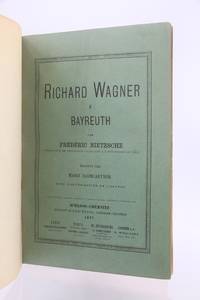
1886649Leipzig: E. W. Fritzsch 1886. first Edition second issue. contemporary boards. Very good. A Complete Set of the First Edition Second Issues <br />of the Four Unzeitgemässe Betrachtungen <br /> <br /> <br />NIETZSCHE Friedrich Unzeitgemässe Betrachtungen I-IV Untimely Meditations E. W. Fritzsch Leipzig 1886. TP 1-101 102 = Fritzschs original publishers ads TP III-VI = Vorwort 7-111 TP 3-113 TP 3-98 99 = Printers information Octavo. First Edition Second Issue Schaberg 46-49. <br /> <br />When Nietzsches first publisher Fritzsch bought back his remaindered stock from Schmeitzner in 1886 the inventory included 212 351 350 and 768 copies respectively of the original editions of the four Untimely Meditations. The first of these had originally been published by Fritzsch and remaindered to Schmeitzner when Fritzsch went bankrupt. These were reissued with new title pages and covers but without the addition of new Prefaces that were written for several others of these 1886/1887 reissues. <br /> <br />This copy has as usual the Richard Wagner in Bayreuth marked as "Second Edition" on the title page. <br /> <br />At the same time as Also sprach Zarathustra was being reissuedand with similar uncertainty regarding the specific release datethe four Unconventional Observations were reissued. Nietzsche claimed that he "wanted to leave them as they are" and Fritzsch agreed. They were published individually without changes or additions except for the new undated title pages. The fourth ObservationRichard Wagner in Bayreuthwas listed as a "Second Edition" on the cover and the title page NOTE: 800 of the original 1500 copies printed of this piece had been falsely marked Second Edition. <br /> <br />Schaberg The Nietzsche Canon pp. 135-136 <br /> <br />CONDITION: Very good in contemporary quarter leather with black boards. Gilt faded on spine. Minor edge wear especially to corners of boards. Moderate foxing to first few leaves. and title pages.Internally bright and clean. <br /> <br/><br/>PHOTOS AVAILABLE UPON REQUEST E. W. Fritzsch hardcover
1874416Leipzig: E. W. Fritzsch 1874. First edition. Hardcover. Good. Attacks German Historians NIETZSCHE Friedrich. Unzeitgemässe Betrachtungen II: Vom Nutzen und Nachtheil Unconventional Observation II: The Use and Disadvantage of History for Life. E. W. Fritzsch Leipzig 1874. TP III-VI 7-111 Octavo. First Edition First Issue. Schaberg 25a. There were approximately 650 copies of the first edition in the first issue state. The second Unconventional Observation attacked the then current faith in historical research that was one of Nietzsche's major complaints with contemporary German culture and a topic to which he returned with some regularity in his later works. Contrary to prevailing opinion Nietzsche argued that historical knowledge is valuable only when it has a positive effect on human beings sense of life contending that history can play only three positive roles which he termed the "monumental" the "antiquarian" and "critical" explaining each of these in some detail before going on to enumerate the dangers of the current scholarly fascination with "history for its own sake." Finally Nietzsche suggests an antidote to the psychologically and ethically devastating effects of the conventional approaches to history proposing an amalgam of what he terms the historical the unhistorical and the suprahistorical attitudes as the healthiest approach to the integration of a historical sense into the life of the individual and of course for Nietzsche this always means the exceptional individual. As he remarks in the present essay tellingly for the understanding of the Nietzschean philosophy as a whole: The goal of humanity cannot lie in the end Ende but only in its highest specimens. In the words of Walter Kaufmann: Perhaps there is no more basic statement of Nietzsches philosophy in all of his writings than this sentence. CONDITION: ." Contemporary drab boards with a hand written paper label on the spine which is worn and a bit chipped along the edges. Edges and covers rubbed. Seal of a previous owner Ludwig Seiber / Basel on the top of the front free end paper. On the whole a very respectable copy. <br/><br/>PHOTOS AVAILABLE UPON REQUEST E. W. Fritzsch hardcover
188720695Leipzig, Fritsch, 1887. XI, 363 (recte 361) S. 8°. HLdr. der Zeit mit Rückentitel (bestoßen und beschabt). [5 Warenabbildungen]
1877003244Paris, Turin, St. Pétersbourg, Londres, Schloss-Chemnitz (Carl Jahncke impr,Berlin), 1877
1872179413Leipzig: E. W. Fritzsch 1872. First edition of Rohde's contribution to the pamphlet war sparked by the publication of Nietzsche's Die Geburt der Tragödie aus dem Geiste der Musik. "The book caused a furor. Wagnerians embraced it while philologists were appalled. Among his colleagues only Nietzsche's friend Rohde was willing to praise the book in public and the first review he submitted to the Literarisches Centralblatt was rejected by the editors. A rewritten review was printed by the Norddeutsche Allgemeine Zeitung on 26 May. Four days later the young Ulrich von Wilamowitz-Möllendorff attacked the book savagely in a thirty-two page pamphlet entitled Future-philology! Zukunftsphilologie! which sold out quickly. Wagner replied on 23 June defending Nietzsche in an open letter published in the Norddeutsche Allgemeine Zeitung. Unfortunately Wagner's amateurish attempt at support did nothing more than confirm the worst fears of the scholarly forces lining up against Nietzsche. Rohde who was totally committed to the defence of his friend - although possibly against his better judgement at this point - counterattacked Wilamowitz-Möllendorff in a forty-eight page pamphlet entitled Pseudo-philology Afterphilologie which was published on 15 October. The final entry in this exchange occurred on 21 February 1873 when Wilamowitz-Möllendorff published his Future-philology! Part Two Zukunftsphilologie! Zweites Stück a twenty-four page rejoinder to both Rohde and Nietzsche" Schaberg. Octavo pp. 48. Recent stiff buff paper wrappers the original printed wrappers cut down and mounted. Original wrappers slightly soiled contents lightly browned title page with small chip at head and in the gutter; a good copy. W. Schaberg The Nietzsche Canon 1995. unknown
1898886<p>Petersburg: New Journal of Foreign Literature 1898. First Edition. Hardcover. Very good. First Russian Translation of Nietzsche <br /><br />NIETZSCHE Friedrich Tak govoril Zaratustra Also Sprach Zarathustra New Journal of Foreign Literature St Petersburg 1898. Blank leaf TP 3 - 5 = translators introduction 6 - 90 1 leaf = advertisements 1 blank leaf thin octavo. First Russian translation of Nietzsches Also Sprach Zarathustra translated by Yu Antonovsky. <br /><br />This is the very first translation of Zarathustra in Russian written by Yu Antonovsky in 1898 just really a few months before a second bilingual edition translated by Nani. With so much censorship in Russia any translation was really an art form creatively trying to communicate Nietzsches or any philosophers! ideas into a voice acceptable to the heightened sensitivities of the authorities under both Tsars Alexander III and Nicholas II. Hence the incomplete translations of both Antonovsky in 1898 and Nani in 1899. This first Russian translation based on the 10th German edition comprises all but part IV. Perhaps there were contents of part IV that ruffled the feathers of the censors; perhaps Antonovsky actually relied upon the 1886 German edition which only included parts I - III as part IV was not published publicly in Germany until 1892. <br /><br />Thus Spoke Zarathustra is one of Nietzsche's most famous works and Nietzsche regarded it as among his most significant. Thoroughly studied and re-studied by scholars throughout the 20th century the character of Zarathustra stands as a figure marking the end of Modernity by some i.e. Heidegger the beginning of Post-Modernity by others i.e. Derrida; the text a personal soteriological narrative of Nietzsches own self-overcoming and a parable for others towards the same transformation. Though Thus Spoke Zarathustra attempts to destroy and replace the Judeo-Christian world-view Nietzsches style borrows heavily from the Old and New Testament. Nietzsche also adopts myriad metaphors invoking animals earth air fire water celestial bodies plants all in the service of describing the spiritual transformation of Zarathustra a solitary reflective exceedingly strong-willed sage-like laughing and dancing voice of self-mastery who accompanied by a proud sharp-eyed eagle and a wise snake believed in a mode of being beyond the common human condition but without the need to posit a transcendent other world. Nietzsche refers to this higher mode of being as superhuman übermenschlich one that embraces the doctrine of eternal recurrence a doctrine for only the strongest who can love life in its entirety who embrace their suffering and would only again will it to be thus! <br /><br />CONDITION: Very good in original quarter cloth with purple boards. Light edgewear. Pages 11 - 14 with small erasure mark that wore through the paper. A few scattered pencil marks otherwise an excellent well-preserved copy all in original condition. <br /><br /><br /></p> New Journal of Foreign Literature hardcover
1876326Schloss-Chemnitz:: Schmeitzner 1876. First edition. Hardcover. Very Good. NIETZSCHE Friedrich. Unzeitgemässe Betrachtungen IV: Richard Wagner in Bayreuth 1876 Schloss-Chemnitz: Schmeitzner 1876 First Edition. TP 3-98 1 pp. Of the first edition only 700 copies were printed. Beautiful contemporary halfcloth with brown marbled boards. Minor browning as usual. Interior exceptionally clean and well preserved. Quite rare due to small printrun. The 1st copies became available just before the Bayreuther Festspiele. Wagner had invited Helen Zimmern based on his favorable opinion on her biography of Schopenhauer. Nietzsche also attended and their meeting resulted in later invitations. Zimmern spent a few weeks in Sils Maria in the summer of 1886 where Nietzsche used to reside in the summer months in those years. Their discussions in this summer must have helped Zimmern quite a lot when later translating Jenseits of which she got 2 presentation copies. The last favorable publication of Nietzsche on Wagner followed by bitter attacks in FALL WAGNER and NIETZSCHE CONTRA WAGNER. The 4th and last Observation a series originally. CONDITION: Beautiful contemporary halfcloth with brown marbled boards. Minor browning as usual. Interior exceptionally clean and well preserved. Very Good <br /><br />PHOTOS AVAILABLE UPON REQUEST Schmeitzner hardcover
189843879Leipzig, Naumann, 1898. Small 8vo. Uncut in the original green printed wrappers. Spine with a bit of wear and minor wear to extremities. A very fine and clean copy in the scarce original wrappers. A 4-line presentation-inscription by Friedrich Jodl to front free end-paper, dated ""23.8.98"".
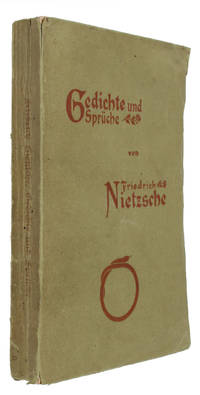
189843879Leipzig Naumann 1898. Small 8vo. Uncut in the original green printed wrappers. Spine with a bit of wear and minor wear to extremities. A very fine and clean copy in the scarce original wrappers. A 4-line presentation-inscription by Friedrich Jodl to front free end-paper dated "23.8.98". <br/><br/><em>The rare first edition of Nietzsche's poems and maxims the first complete collection of his poetry which furthermore constitutes the first appearance of all nine properly corrected "Dionysian Dithyrambs" in one volume.This one of 1.000 copies printed of the first run without "Second Edition" on the title-page as the other 1.000 copies of the first edition had. According to Elizabeth Förster-Nietzsche Nietzsche's sister who has assembled the present collection "this collection of poems and maxims shows the entire poetic development of my brother over a period of 30 years. It begins at a time when the earliest stuttering poetical expression has been overcome and ends with the highest rising of the poetic spirit who in order to find words can now only speak in dithyrambs." own translation from the Introduction p. XIII. Numerous of the poems have never been printed before and many are printed from the original manuscripts which Elizabeth had in her possession.Though Nietzsche is primarily understood and remembered as one of the greatest philosophers of all times his poems occupy a central place in his literary production and many of them e.g. the Dithyrambs are intimately linked with the philosophy for which he is so famous today. Furthermore the present volume underlines the popular modern view of Nietzsche as the not only philosophical but also literary and artistic genious. The first edition of the work is difficult to find and is rarely seen for sale.THE PRESENT COPY HAS BELONGED TO FREIDRICH JODL 1849-1914 the famous German philosopher and contemporary of Nietzsche and bears his signature as well as a 4-line dated presentation-inscription to front free end-paper. Jodl ranks as one of the most significant representatives of German expressionism and is still remembered for his original ontological works with their constant focus on empiricism as the only true strand of philosophy. He has also written a number of important works within the history of philosophy and ethics psychology and aesthetics which for decades counted as standard works and he is among the first to develop the intellectual environment that ultimately led to among many other things the founding of the Vienna Circle. His main task was to develop and spread a purely naturalistic ethics free of any religious or metaphysical elements and he is considered a modern "Enlightenment philosopher" whose consistent empiricism well-founded philosophical ideas optimistic theories of culture ethics the value of life & the progress of man inspired many later thinkers and furthermore helped promote important political and social ideas such as free popular education etc. His main works which are now standard works within ethics and psychology and which were printed over and over again are "Geschichte der Ethik als philosophischer Wissenschaft" in which he presents man's cultural development as the process of liberation from religious and metaphysical ideas and the change from a theocentric to an anthropocentric foundation of ethics. This work is followed up by his purely epirically founded "Lehrbuch der Psychologie" which grounds the same ideas psychologically. After having been Privatdzent in Munich he was named professor of philosophy at the German University in Prague and in 1896 he accepted a professorship of philosophy at the University of Vienna. He was greatly successful in Vienna and was considered the most prominent liberal professor here whose numerous lectures and articles against the reigning "Ultramintanismus" and the clerical influence in schools and universities found great resonance with scholars and students. He had a huge number of followers not only at the university but also in the public as a political figure as well. He is partly to thank for the emergence of an intellectual climate in Vienna in the 20th century which later led to Neopositivism and the founding of the Vienna Circle."We need no other mediator between us and nature except our understanding and a courageous will nor any mystery behind nature to console us for her; we are alone with nature and we feel secure because we possess intellect and she behaves according to laws" Jodl Vom wahren und vom falschen Idealismus p. 40. </em> unknown
189549025Pan Couverture souple Berlin 1895
1887927Leipzig: E.W. Fritzsch 1887. First Thus. Hardcover. Very good. First complete edition of one of Nietzsches most important texts! <br /> <br /> <br />NIETZSCHE Friedrich. Die Frohliche Wissenschaft "la gaya scienza". Neue Ausgabe mit einem Anhange: Lieder des Prinsen Vogelfrei The Gay Science . E.W. Fritzsch Leipzig 1887. III XII = Vorrede 1 leaf = Half-title 5 350 1 leaf = Berichtigungen; Octavo. First Edition Second Issue Definitive. Schaberg 51. <br /> <br /> <br />A must have for any Nietzsche collection. This Neue Ausgabe consisted of the 788 unsold sheets from the first edition of 1882 with the addition of a new title page Nietzsches new 10-page Vorrede Preface 2 new half-title pages and a new 5th book "Wir Furchtlosen" We Fearless Ones. Thus 75 new pages along with fourteen pages of poetry appear here for the first time. While the first edition appeared in 1882 it was incomplete. This is truly the first edition of the complete and definitive text of what is today read as The Gay Science. Nietzsche felt that the Vorrede to this and the other reissues of 1886/7 were among the best things that he ever wrote. <br /> <br />The Gay Science which is the final and culminating volume of Nietzsches aphoristic works contains the first instance of his famous statement Gott ist tot! God is Dead first in section 108 then more elaborately detailed in the Parable of the Madman in section 125 and for a third time in section 343. It also contains the first appearance of the doctrine of the "Eternal Return of the Same" which plays such a prominent role in Zarathustra and even includes the Nietzsches first mention of the Uebermensch. <br /> <br /> <br />CONDITION: Very good in a quarter leather contemporary binding with marbled boards gilt lettering to the spine. Some wear to spine leather. Minor rubbing to marbling on front cover. Small bookseller sticker to inside corner of rear free endpaper <br /> <br /> <br/><br/>PHOTOS AVAILABLE UPON REQUEST E.W. Fritzsch hardcover
1878928Chemnitz: Schmeitzner 1878. Second Edition. Hardcover. Very good. NIETZSCHE Friedrich Die Geburt der Tragödie The Birth of Tragedy. Schmeitzner Chemnitz 1878. TP III-IV 1-144 Octavo. The famous Second Edition First Issue of Nietzsche's first book. Schaberg 30. <br /> <br />The publication history of Nietzsche s Birth of Tragedy is about as complicated as any. The 143-page first edition appeared in 1872 published by E.W. Fritzsch. Shortly after its release Fritzsch printed a second edition that included Nietzsche s corrections extending the text to 144 pages. This was completed by March of 1874 yet because of some conflicts between Nietzsche and Fritzsch and the financial difficulties Fritzsch was experiencing the 750 copies of this 144-page second edition were never available for sale. They sat in a warehouse for 4 years until Schmeitzner Nietzsche s new publisher acquired the copies. Schmeitzner affixed his own label on top of the original publisher s information and made the books available for sale. Very few sold no more than 175. In 1886 the unsold copies of both the 143-page first edition and the 144-page second edition ended up back with the original publisher Fritzsch who added Nietzsche s new preface along with a new title page for the "Neue Ausgabe" edition the definitive edition if the 144-page copy!. Thus fewer than 175 copies in this state 144-pages with the original title page and Schmeitzner label extant. A rare find and a must-have for any Nietzsche collection to be complete.Printing and the Mind of Man notes "Nietzsche's principle work during the Wagner period 1868-1878 was Die Geburt der Tragodie aus dem Geist der Musik 1872. In this he adopted a tragico-pessimistic conceptions of Greek civilization like Burckhardt but contrary to Grote. This started his career as a critic of modern civilization based on disgust with imperial Germany Christianity bourgeois ethics and so on." PMM 224. In this his first book Nietzsche theorized that Greek tragedy was built upon a wedding of two principles that he associated with the deities Apollo and Dionysus. The Apollonian principle is the principle of order static beauty and clear boundaries. The Dionysian principle in contrast is the principle of frenzy excess and the demolition of boundaries. It is in the subtle interaction of these disparate principles that the greatness of Greek tragedy resides and by extension in which the creative spirit still finds its proper soil. The book ended with a long section devoted to Richard Wagner and the importance of his music. When first released it met with only limited success. Despite Nietzsche's eventual near contempt for the book - from the perspective naturally of his later unequalled masterpieces of German prose - it must be considered along with Aristotle and Hegel among the greatest contributions to the understanding of Greek tragedy and in fact to the Greek way of life in general. <br /> <br />CONDITION: Very Good in contemporary half-calf and marbled boards. Light wear. Gilt lettering. Light foxing. Former owners name neatly inscribed to upper corner of front free endpaper. As issued with Schmeitzner's label canceling out Fritzsch's imprint. A very good copy of a very rare book. <br/><br/> Schmeitzner hardcover
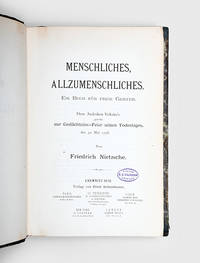
1878952Chemnitz: Schmeitzner 1878. First Edition. Hardcover. Very good. Nietzsches First Aphoristic Work and His Introduction of Perspectivism <br /> <br />NIETZSCHE Friedrich. Menschliches Allzumenschliches. Ein Buch für freie Geister Human all too Human. A Book for Free Spirits. Schmeitzner Chemnitz 1878. 1 blank leaf half title TP 1 leaf = Vorrede 1 leaf = Inhalt 1 leaf = half title 3 377 378= Printers information 1 leaf = publisher's advertisements 1 blank leaf. Octavo. First Edition First Issue Schaberg 29. <br /> <br /> <br />Includes initial half title before the full title page and the eere correction cut and pasted by Schmeitzner over menon a non-word to create meere sea on p290 aphorism 431 and advertisements. <br /> <br />Only 489 copies of this first edition first issue as the remaining 511 of the original 1000 first edition copies were sold to E. W. Fritzsch in 1886 for use in a new edition with new title page and without the ads. Thus this copy is extremely rare in any state. <br /> <br />This is the first book by Nietzsche where he is listed simply as Friedrich Nietzsche rather than as prof. In fact Human All Too Human constituted such a radical departure in style and content for Nietzsche that he first proposed to his publisher that it be released anonymously or with a pseudonym. Schmeitzner however would not allow it. <br /> <br />Reluctant to construct a philosophical system and sensitive to the importance of style in philosophic writing Nietzsche composed these works as a series of several hundred aphorisms a departure from his style up to this point. Much of the work is devoted to what one might now call "psychoanalytical" insights into the nature of common human experience and the origins of our human valuations. At the time serious inquiry into such things as the nature of dreams the meaning of pity or the phenomenon of laughter had no place in the field of philosophy. <br /> <br />Human All Too Human also contains Nietzsches reflections upon cultural and psychological phenomena in reference to individuals' organic and physiological constitutions. The idea of power sporadically appears as an explanatory principle but Nietzsche tends at this time to invoke hedonistic considerations of pleasure and pain in his explanations of cultural and psychological phenomena. It is here too that Nietzsche's famous epistemological "perspectivism" is first broached: the view that "truths" are nothing more than interpretations of reality formed from different perspectives and more or less successful in their struggle against competing "truths." <br /> <br />Like the four books to follow the present work is addressed to the "free spirits of Europe." It was the present work that finally divided Nietzsche from his greatest friend Richard Wagner more and more in Nietzsche's mind motivated by only the most simplistic greed for power and betraying the promise of his art. <br /> <br />CONDITION: Very good in somewhat later boards with cloth spine. Origiinal front wrapper affixed to front board slightly browned. Internally bright and clean with a couple pages of some spotting along edges. One page of publisher's ads present but seeminly repaired along fore edge . Sunning to rear board. <br/><br/>PHOTOS AVAILABLE UPON REQUEST Schmeitzner hardcover
18962002024London: H. Henry and Co. Ltd 1896. 1st. fine. First English edition 1896. Rebound in leather covers. Fine condition. Housed in a custom-made slipcase. H. Henry and Co. Ltd unknown books
1878170976Chemnitz: Ernst Schmeitzner 1878. The defining work of Nietzsche's positivist period First edition of Nietzsche's first major polemical and aphoristic work marking his transition "from the philologist and cultural critic he had been into the kind of philosopher and writer he came to be" Schacht p. vii. The work which is translated as Human All Too Human embraces positivist reason in opposition to the metaphysical idealism of Schopenhauer and Wagner. For Nietzsche a naturally grounded reason was the only viable option to secure the ultimate enhancement of human life. The Menschliches reflects on religion art and morality and its incisive attacks on conventional pieties foreshadowed the thought of Nietzsche's mature period. It includes early expressions of many major Nietzschian concepts including the "will to power" and the rejection of Christian morality. Menschliches expresses Nietzsche's final direct disillusionment with Wagner of whom he had been a devoted admirer. He even claimed to have begun writing the work in response to the first Bayreuth production of the Ring cycle. On receiving his copy Wagner remarked that "he would be doing the author a favor for which the latter would one day thank him if he did not read it" quoted in Schaberg p. 64. Octavo 216 x 143 mm pp. viii 377 3. Contemporary half roan spine lettered and ruled in gilt marbled sides yellow coated endpapers edges marbled. Without the small cancel slip to p. 290. Late 19th-century bookplate of the author Gerhard Ouckama Knoop 1861-1913 to front free endpaper and his ink signature to head of half-title. Twentieth-century armorial bookplate of one Dr Roman Wolf to front pastedown. Contemporary purple ink bookseller's stamp to title page. Extremities restored. Light bumping and rubbing minor browning foxing and chipping to otherwise clean contents: a very good copy. Schaberg 29. Richard Schacht "Introduction" in Human All Too Human. A Book for Free Spirits 1996. unknown
1878182922Chemnitz: Ernst Schmeitzner 1878. The defining work of Nietzsche's positivist period First edition of Nietzsche's first major polemical and aphoristic work marking his transition "from the philologist and cultural critic he had been into the kind of philosopher and writer he came to be" Schacht p. vii. The work which is translated as Human All Too Human embraces positivist reason in opposition to the metaphysical idealism of Schopenhauer and Wagner. For Nietzsche a naturally grounded reason was the only viable option to secure the ultimate enhancement of human life. The Menschliches reflects on religion art and morality and its incisive attacks on conventional pieties foreshadowed the thought of Nietzsche's mature period. It includes early expressions of many major Nietzschian concepts including the "will to power" and the rejection of Christian morality. Menschliches expresses Nietzsche's final direct disillusionment with Wagner of whom he had been a devoted admirer. He even claimed to have begun writing the work in response to the first Bayreuth production of the Ring cycle. On receiving his copy Wagner remarked that "he would be doing the author a favor for which the latter would one day thank him if he did not read it" quoted in Schaberg p. 64. Octavo 215 x 143 mm pp. viii 377 3. Contemporary half roan rebacked with original spine laid down spine lettered ruled and decorated in gilt marbled sides yellow coated endpapers edges marbled yellow silk bookmarker. With the small cancel slip to p. 290. Light bumping and rubbing minor browning and foxing to contents damp stain to foot of endpapers and preliminary leaves: a very good copy. Schaberg 29. Richard Schacht "Introduction" in Human All Too Human. A Book for Free Spirits 1996. unknown
188961353Leipzig, C.G. Naumann, 1889. 8vo. Bound in a contemporary red half cloth binding with red marbled paper over boards and single gilt lines. Gilt lettering and a single gilt ornamentation to spine. Lovely patterned irdiscent end-papers in blue with white flowers. Boards slightly faded at top. Front hinge a bit soiled. Spine a bit discoloured and a bit worn at capitals. A few leaves with light, scattered brownspotting, but overall very clean and fresh. A few minor pencil marks on several pages and some faint brown spots on the final page. (8), 144 pp.
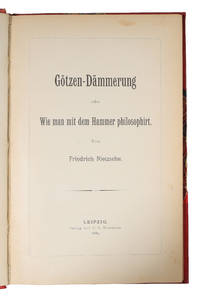
188961353Leipzig C.G. Naumann 1889. 8vo. Bound in a contemporary red half cloth binding with red marbled paper over boards and single gilt lines. Gilt lettering and a single gilt ornamentation to spine. Lovely patterned irdiscent end-papers in blue with white flowers. Boards slightly faded at top. Front hinge a bit soiled. Spine a bit discoloured and a bit worn at capitals. A few leaves with light scattered brownspotting but overall very clean and fresh. A few minor pencil marks on several pages and some faint brown spots on the final page. 8 144 pp. <br/><br/><em>First edition published in 1889 from Nietzsche's private press of the epitome of Nietzsche's final project -a re-valuation of all values "Eine Umwerthung aller Werthe" -his hugely interesting "declaration of war" preface p. 4: "Diese Schrift ist eine grosse Kriegserklärung" which was written during his last productive year just before his big breakdown in Turin. "Götzen-Dämmerung" "The Twilight of the Idols" arguably constitutes the culmination of the production of this giant of philosophy who turned mad after having finished it.Early in 1889 Nietzsche began to exhibit signs of serious mental illness; in Turin he finally broke down and was brought back to Basel by his friends. "The Twilight of the Idols" was released merely a few weeks after this collapse and Nietzsche never wrote again.Nietzsche had 1.000 copies of the work privately printed. The work is considered one of his most popular and it is here that we find some of the most frequently quoted passages from the works of Nietzsche e.g. "What does not kill me only makes me stronger" p.2.: "Was mich nicht umbringt macht mich stärker".The Twilight was meant as an introduction to or summary of Nietzshe's philosophy and as such it is one of his most interesting works. It is written almost as in a rage of fever - it took him no more than a week to write it - and he regarded it a world-changing magnum opus. As he states at the end of the preface: "Turin am 30. September 1888 am Tage da das erste Buch der Umwerthung aller Werthe zu ende kam." i.e. "Turin on September 30. 1888 on the day that the first book on the re-valuation of all value came to an end.". This highly polemical work makes clear reference to Wagner's opera "Götterdämmerung" and it presents us with a sharp critique of the most influential philosophers in history e.g. Kant and Plato and of Christianity in general but also the likes of Rousseau Hugo Renan Mill Darwin Dante etc. are attacked as the causes of cultural decadence in Europe. Giants like Caesar Napoleon Dostojevski Goethe and Thukydides are considered representatives of the opposite.The mental collapse of the author may not come as a surprise to anyone reading the work.Of the 1.000 copies 659 still remained unsold by October 1893.Twilight of the Idols: Schaberg: 56a </em> hardcover
188717423Leipzig, Naumann, 1887. XIV S., 1 Bl., 182 S., 1 Bl. 8°. HLwd. der Zeit (kl. restaurierte Läsuren). [5 Warenabbildungen]
188232173Chemnitz: Schmeitzner 1882. First edition first issue. 8vo 2 leaves 5-255 pp. Bound to period style in marbled boards with red morocco spine and black leather labels. Fine condition. From the library of Viennese bibliographer Dr Moriz Grolig with his circular stamp on the title page verso. Of 1000 copies originally printed 788 remainders were sold to E.W. Fritsch in 1886 and reissued with a new title page and additional material. Schaberg 35. <br/><br/> Schmeitzner hardcover books
188960004Leipzig, C.G. Naumann, 1889. 8vo. Bound with the original printed wrappers in a nice near contemporary brown half cloth with gilt lettering to spine. Lovely marbled end-papers. A bit of light soiling and brownspotting to wrappers, which are otherwise very well preserved. A few leaves with some very light brownspotting and a couple of leaves with small closed tears to blank inner margin, far from affecting text. Overall very nice. With the engraved book plate of Adolf Fischer to inside of front board. (8), 144 pp.