NIETZSCHE, FriedrichBiblio.com
72 résultats
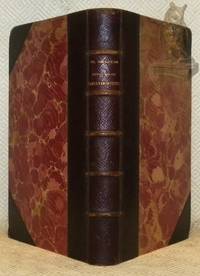
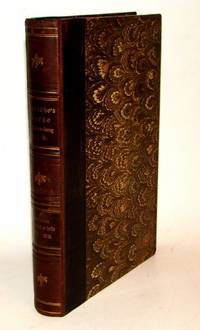
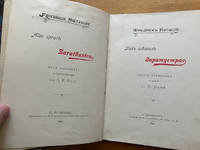
1899887<p>Petersburg: M.M. Stasyulevicha 1899. First Thus. Hardcover. Very good. First Bilingual German-Russian Edition of Nietzsches Zarathustra <br /><br />NIETZSCHE Friedrich Tak govoril Zaratustra / Also Sprach Zarathustra Bilingual edition in German and Russian M.M. Stasyulevicha Petersburg 1899. Blank leaf half-title TP 1 leaf = dedication vii - xiv = translators forward half title half-title 2 - 103 1 leaf = contents blank leaf octavo. First Russian-German Dual-Language. <br /><br />First edition of the second translation of Thus Spoke Zarathustra. Translated from German by S. Nani. Bilingual edition in both German and Russian of nine selected excerpts printed side-by-side: the Night-Song the Grave-Song the Academic Chairs of Virtue the Soothsayer the Three Metamorphoses Scholars the Way of the Creating One Reading and Writing and the Three Evil Things. <br /><br />Thus Spoke Zarathustra is one of Nietzsche's most famous works and Nietzsche regarded it as among his most significant. Thoroughly studied and re-studied by scholars throughout the 20th century the character of Zarathustra stands as a figure marking the end of Modernity by some i.e. Heidegger the beginning of Post-Modernity by others i.e. Derrida; the text a personal soteriological narrative of Nietzsches own self-overcoming and a parable for others towards the same transformation. Though Thus Spoke Zarathustra attempts to destroy and replace the Judeo-Christian world-view Nietzsches style borrows heavily from the Old and New Testament. Nietzsche also adopts myriad metaphors invoking animals earth air fire water celestial bodies plants all in the service of describing the spiritual transformation of Zarathustra a solitary reflective exceedingly strong-willed sage-like laughing and dancing voice of self-mastery who accompanied by a proud sharp-eyed eagle and a wise snake believed in a mode of being beyond the common human condition but without the need to posit a transcendent other world. Nietzsche refers to this higher mode of being as superhuman übermenschlich one that embraces the doctrine of eternal recurrence a doctrine for only the strongest who can love life in its entirety who embrace their suffering and would only again will it to be thus! <br /><br />The first translation of Zarathustra was done by Yu Antonovsky in 1898 just really a few months before this bilingual edition translated by Nani. With so much censorship in Russia any translation was really an art form creatively trying to communicate Nietzsches or any philosophers! ideas into a voice acceptable to the heightened sensitivities of the authorities under both Tsars Alexander III and Nicholas II. Hence the incomplete translations of both Antonovsky in 1898 and Nani in 1899. <br /><br />CONDITION: Very good in original quarter leather with marbled boards. Light edgewear. Former owners name in ink to top edge of half-title page. Text block coming loose from front cover along inner hinge but holding along bottom. Rear hinge firm. One leaf xiii - xiv loose. Blank rear endpaper with small tear in center. A very nice untouched copy all in original condition. <br /><br /></p> M.M. Stasyulevicha hardcover
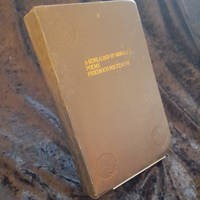
1896COLLECTI014822INEW YORK NY: MACMILLAN AND CO. VERY GOOD NO D.J. 1896. FIRST EDITION. HARDCOVER. EDITED BY ALEXANDER TILLE / TRANSLATED BY THOMAS COMMON ALSO INCLUDES "THE ANTI-CHRIST"PAGES 233-351 . PUBLISHER'S LIGHT GREEN CLOTH-COVERED BOARDS WITH GILT SPINE TITLES AND 8 PAGE UNDATED CATALOG AT THE REAR OF TEXT. THE CLOTH OF THE SPINE IS DARKENED WITH SPINE TITLES A BIT DULLED BUT QUITE READABLE AND WITH FRONT AND REAR BOARDS' CLOTH SLIGHTLY DARKENED. A VERY NICE COPY BUT LACKING THE HALF TITLE. A VERY NICE COPY OF A RARE FIRST EDITION WITH NIETZSCHE'S "TWILIGHT OF THE IDOLS". . MACMILLAN AND CO. hardcover
1873946Leipzig: E. W. Fritzsch 1873. First Edition. Hardcover. Very good. Nietzsche Destroys David Strauss <br /> <br />NIETZSCHE Friedrich. Unzeitgemässe Betrachtungen I: David Strauss Unconventional Observation I: David Strauss. Leipzig: E. W. Fritzsch 1873. TP 1-101 102 = advertisements Octavo. First Edition First Issue. Schaberg 23a <br /> <br />The first of Nietzsche's Unconventional Observations was an attack on David Strauss the writer who had made his reputation with his scandalous Life of Jesus in 1835. Here Nietzsche attacks his most recent book The Old and the New Faith which advocated the rejection of the Christian faith in favor of a Darwinian materialistic and patriotic world-view. Nietzsche accuses Strauss of being a "Cultural Philistine" and denounces him as an exemplar of pseudo-culture. Although erudite the essay is extremely intemperate and filled with references to many of Nietzsche's scholarly contemporaries. The climax is a literary tour de force in which Nietzsche cites a litany of malapropisms from Strauss interspersed with his own barbed comments. For Nietzsche Strauss's book was the incarnation of the Zeitgeist: unproductive smugness intellectual snobbery superficial assimilation of great works of art and new scientific theories myopic criticism and patronizing praise of even the greatest genius But what enraged him most was Strauss's comfortable and untroubled renunciation of Christianity coupled with an easy conviction that Darwin was one of mankind's greatest benefactors and that traditional values could of course be maintained. It is in the present work that Nietzsche first publicly addresses the problem of the derivation of moral values that would infuse so much of his most important work. <br /> <br />CONDITION: Very Good in recently rebound contemporary marbled paper over boards with new spine lettered in gilt. Internally bright and clean. A very good copy of one of Nietzsche s early works. <br/><br/> E. W. Fritzsch hardcover
1893823<p>Leipzig: Naumann 1893. Second Edition. Wraps. Very good. Second Edition of Nietzsches Twilight of the Idols in Original Printed Wraps <br /><br />NIETZSCHE Friedrich Götzen-Dämmerung Twilight of the Idols Naumann Leipzig 1893. Half title TP 1 leaf = Inhalt I-II = Vorwort 1-116. Second Edition Krummel XVIII a p. 120. <br /><br />Nietzsche began to write Twilight of the Idols at the end of June of 1888 and was finished by early Septemberanother lightning-quick production that he claimed to have been the "work of so few days that I am hesitant to mention exactly how many." His hesitancy becomes even more understandable when one remembers that part of July was devoted to the preparation of the final typescript of The Case of Wagner and that during August he produced two "Postscripts" and the "Epilogue" and then proofed the entire work. In the final analysiswhen the book was finally completedNietzsche bragged to Gast that "I could hardly have used ten days more efficiently for it certainly took me no longer to write the book." Yet another ten-day wonder! <br /><br />The new book was originally entitled A Psychologist at Leisure when Nietzsche mentioned it to Naumann on 7 September: <br /><br />I am about to give you a nice surprise. You probably think we are finished with printing but even now the cleanest manuscript I have ever sent to you is on its way. Regarding layout and design this new work should be a twin to The Case of Wagner. The title is A Psychologist at Leisure. It is imperative for me that we publish this now because by the end of next year we will have to begin the printing of my main work The Revaluation of All Values which will be a stern and serious book and I will not be able to publish anything cheerful and winsome right after it. <br /><br />This book though not very large may cause a few ears to be opened so that the main work will not be greeted with silence like my Zarathustra. <br /><br />The manuscript was mailed two days later and the single-page first draft for the Preface came three days after that. Nietzsche thought of this bookin conjunction with the Wagner bookas a light and brief respite before the publication of his masterwork: "In the final analysis both of these works are only recuperations in the midst of an immensely difficult and decisive task which when properly understood will split humanity in two." Unfortunately Nietzsche never recovered from these "recuperations" and The Revaluation of All Values was never completed <br /><br />Even as the book was being printed Peter Gast pleaded with Nietzsche to change the title: <br /><br />When I consider how other people will respond to this title I think A Psychologist at Leisure is much too unassuming. You have dragged your artillery to the highest mountains you have guns such as have never existed and even if you shoot blindly you will inspire terror all around. The stride of a Giant which can make the mountains shake to their core is hardly leisure . . . and so I pleadif an incompetent may make such a requestlet us have a more resplendent a more radiant title! <br /><br />Nietzsche immediately agreed and changed the title to Twilight of the Idols75 and three days later he penned the final version of the Preface which was dated 30 September 1888. <br />Schaberg The Nietzsche Canon pp. 166-167 <br /><br />CONDITION: Uncut copy in original wraps printed front and back as well as on the spine. The covers are very lightly chipped and have a 1½ closed tear on the right side near the center of the front cover. The rear cover has five number inked next to the advertisements for Nietzsches books presumably noting their issuing sequence in the then-in-the-press Collected Works. A bit worn but still a lovely affordable and collectible copy of this important work by Nietzsche. <br /><br />PHOTOS AVAILABLE UPON REQUEST</p> Naumann paperback
1893697Leipzig: C. G. Naumann 1893. Second Edition. Wraps. Very good. The Second Edition of Nietzsches Four Untimely Meditations <br /> <br />NIETZSCHE Friedrich Unzeitgemässe Betrachtungen Unconventional Observations I-IV. C. G. Naumann Leipzig 1893 Volume 1: Original front wrap TP III-XV 2 half titles 1-206 207-208= Publisher's ads; Volume 2: Original front wrap TP 2 half titles 3-205 206-208 = Publisher's ads Octavo. Second Edition Krummel II-V b p. 114 <br /> <br /> <br />This is the second volume of the soon to be aborted "Collected Works" edited by Nietzsche's closest friend Peter Gast whose introduction appears here as a Foreword. The second attempt to put out a complete edition was more successful - mostly because it was driven to completion by Nietzsche's harridan sister Elisabeth. <br /> <br />CONDITION: Two volumes bound with original front wraps and expertly matching but recent spines and rear covers. There are some scattered pencil underlinings and marginalia. Otherwise this is a really well-preserved and excellent copy of all four of Nietzsche's "Unconventional Observations" which are more usually but a bit inaccurately translated as the "Untimely Meditations". <br /> <br/><br/>PHOTOS AVAILABLE UPON REQUEST C. G. Naumann paperback
1892009362Leipzig: C.G. Naumann 1892. Book. Very Good. Hardcover. Second. 8vo - over 7¾" - 9¾" tall. xiv 182pp. Zweite Auflage marbled boards very little wear hinges and binding sound pages crisp and clean with no symptoms of 1890s-era paper rot. Very scarce. C.G. Naumann Hardcover
1894424Leipzig: C.G. Naumann 1894. Third edition. Hardcover. Very Good . NIETZSCHE Friedrich. Die Geburt der Tragödie The Birth of Tragedy 1894 C.G. naumann Leipzig: 1894. TP Half-title 1 172 I XII Octavo. THIRD EDITION. The third edition of Nietzsches look at art aesthetics and the aesthetic existence. Last leaves with three column register comparing the first three editions.CONDITION: Very good. Contemporary marbled boards with cloth spine. ORIGINAL FRONT WRAPPER affixed to front board. Clean pages throughout. <br /><br />PHOTOS AVAILABLE UPON REQUEST C.G. Naumann hardcover
1898116513Paris et Leipzig : Socit du Mercure de France et C. G. Naumann 1898. 235x150mm. frontispice sous serpentine 473 pages 2 ff. errata reliure de lÕpoque demi-basane coins avec titre et auteur dors au dos cinq faux-nerfs. Plat et garde papier marb. Tranche suprieure rouge. Couvertures conserves. Bel exemplaire. 812 Socit du Mercure de France et C. G. Naumann unknown
1899001274London: T. Fisher Unwin 1899. 1st Edition . Hardcover. Good. 1st UK Edition first English translation originally published in the USA1897. Large 8vo xix pp286 with introduction by Alexander Tille. Hardcover no dust jacket. Original publishers blue cloth binding with gilt titles to front board and blind tooled decorations to front board and spine in good condition. There are some old water marks to back board gilt titles to spine have rubbed off and a little shelf wear to top & tail of spine. Inside some yellowing to pages and sporadic foxing throughout otherwise all rough cut pages very good. Cracked to a few places but binding still solid. Very Scarce. <br/> <br/> T. Fisher Unwin hardcover
189557674Leipzig: Druck und Verlag von C. B. Naumann 1895. First edition 2 volumes 8vo pp. 13 4-369 1 6 ads; pp. 7 vi-ix 4 2-341 1 2 ads; photographic frontispieces of Nietzche's home and a portrait of Nietzsche; contemporary and likely original black cloth-backed pebble-grain boards manuscript paper labels on spines; rubbed corners bumped but sound. Ownership inscription of Isidor Rubel on front free endpapers stamp on title pages. This biography of Nietzsche was compiled by his sister Elisabeth Förster-Nietzsche 1846-1935. Both volumes were published prior to Nietzsche's death in 1900 but the mental illness that dominated the final decade of his life was so severe that he lost all autonomy. Elisabeth's work received significant criticism both from scholars as well as family and friends. As the sole editor of her brother's estate she garnered a reputation for altering and recontextualizing his life and work to complement her own ideology which was in line with the values of the Nazi Party. A third part was published in 1904 not present here. <br/><br/> Druck und Verlag von C. B. Naumann hardcover books
1899RNIECAS02ECT. Fisher Unwin 1899. Very Good. Nietzsche Friedrich. The Case of Wagner. Nietzsche Contra Wagner. The Twilight of the Idols. The Antichrist. Common Thomas. London: T. Fisher Unwin 1899. 354pp. Large 8vo. Book condition: Very good. Gently rubbed exposing boards at corners and wearing-down front cover. Slightly soft front hinge. In transparent book protector. Scarce. T. Fisher Unwin hardcover books
1895700Leipzig: C. G. Naumann 1895. Fourth Edition. Publisher's boards. Very good. NIETZSCHE Friedrich. Nietzsches Werke Band II: Menschliches Allzumenschliches: Ein Buch fur freie Geister Erste Band Human All too Human: A Book for free Spirits first volume. Leipzig: C. G. Naumann 1895. 1 blank leaf with half-title on verso TP folded facsimile of handwritten notes half-title 1 leaf = Inhalt 3 - 414 half-title 1 leaf = 2 poems i - xxix. Octavo. Fourth edition. <br /> <br />Volume two of the first collected edition of Nietzsches works presents the first volume of Human All Too Human first published in 1878 here in its fourth edition. <br /> <br />Human All Too Human also contains Nietzsches reflections upon cultural and psychological phenomena in reference to individuals' organic and physiological constitutions. The idea of power sporadically appears as an explanatory principle but Nietzsche tends at this time to invoke hedonistic considerations of pleasure and pain in his explanations of cultural and psychological phenomena. It is here too that Nietzsche's famous epistemological "perspectivism" is first broached: the view that "truths" are nothing more than interpretations of reality formed from different perspectives and more or less successful in their struggle against competing "truths." <br /> <br />CONDITION: Very good in original Naumann binding: half-leather with marbled boards. Some edge wear and scuffing. Marbled endpapers. Corners bumped. Pages clean and unmarked. <br /> <br/><br/> C. G. Naumann hardcover
1895699Leipzig: C. G. Naumann 1895. publishers boards. Very good. NIETZSCHE Friedrich. Nietzsches Werke Band I: Die Geburt der Tragodie Birth of Tragedy fourth ed.; Unzeitgemäße Betrachtungen Untimely Meditations third ed. Leipzig: C. G. Naumann 1895. 1 blank leaf with half-title on verso TP tissue guard and frontis-portrait 1 leaf = facsimile of handwritten note 1 leaf = inhalt TP = Geburt der Tragödie half-title 1 - 589 i - xxii. Octavo. Fourth and Third editions. <br /> <br />In the first collected edition of Nietzsches work his first two books combine to form the first volume: Birth of Tragedy originally published in 1872 revised in 1886 here in its fourth edition and Untimely Meditations originally published in four installments from 1874 - 1876 here in its third edition. <br /> <br />BIRTH OF TRAGEDY: Nietzsche argues that the tragedy of Ancient Greece was the highest form of art due to its mixture of both Apollonian and Dionysian elements into one seamless whole allowing the spectator to experience the full spectrum of the human condition. The Dionysian element was to be found in the music of the chorus while the Apollonian element was found in the dialogue which gave a concrete symbolism that balanced the Dionysiac revelry. Basically the Apollonian spirit was able to give form to the abstract Dionysian. <br /> <br />UNTIMELY MEDITATIONS 1 - 4: The first Untimely Meditation was David Strauss der Bekenner und der Schriftsteller David Strauss the Confessor and the Writer in which Nietzsche viciously attacked Strauss most recently published book Der alte und der neue Glaube The Old and the New Faith which advocated the rejection of the Christian faith in favor of a Darwinian materialistic and patriotic world-view. Nietzsche accuses Strauss of being a "Cultural Philistine" and denounces him as the exemplar par-excellence of pseudo-culture. The second book Vom Nutzen und Nachtheil Der Historie für das Leben The Use and Disadvantage of History for Life attacked the then current faith in historical research that was one of Nietzsche's major complaints with contemporary German culture and a topic to which he returned with some regularity in his later works. The third Untimely Meditation was entitled Schopenhauer als Erzieher Schopenhauer as Educator and it took up the topic of self-perfection and set up the philosopher Schopenhauer then one of Nietzsches philosophical heroes as a paradigm of self-direction. The last book in this series Richard Wagner in Bayreuth was released to coincide with the very first performance at the Bayreuth Festival in July of 1876. This is the last of Nietzsches works that mentions Wagner favorably and even here the picture presented of Wagner shows some signs of the troubles to come. In Nietzsches view the creation of Bayreuth was representative of The New Empire and had become one of the cultural centers. <br /> <br /> <br />CONDITION: Very good in original Naumann binding: half-leather with marbled boards. Some edge wear and scuffing. Marbled endpapers. Pages clean and unmarked. <br /> <br/><br/> C. G. Naumann hardcover
1895701Leipzig: C. G. Naumann 1895. Fourth Edition. publisher's boards. Very good. NIETZSCHE Friedrich. Nietzsches Werke Band III: Menschliches Allzumenschliches: Ein Buch fur freie Geister Zweiter Band Human All too Human: A Book for free Spirits second volume. Leipzig: C. G. Naumann 1895. 1 blank leaf with half-title on verso TP half-title 1 leaf = Inhalt 3 - 375 i - xxv. Octavo. Fourth edition. <br /> <br />Volume three of the first collected edition of Nietzsches works presents the appendix Anhang to Human All Too Human and Wanderer and His Shadow a third part of the three-part Human All Too Human first published in 1879 anhang and 1880 Wanderer here in its fourth edition. <br /> <br />The present work was conceived as an addendum Anhang to the previous book and it continues Nietzsches incisive observations and evaluations on any number of topics once again presented in the famous aphoristic style that characterizes these works of Nietzsches middle period the works for free spirits. A second sequel to Human All Too Human The Wanderer and his Shadow was published in the year following Nietzsches departure from academia. The title is perhaps autobiographical reflecting Nietzsche and his shadow heading off into the wilderness of the unknown. This third of Nietzsche's aphoristic volumes continues his appeal to the "free spirits" of Europe. <br /> <br />CONDITION: Very good in original Naumann binding: half-leather with marbled boards. Some edge wear and scuffing. Minor loss to head of backstrip. Marbled endpapers. Pages clean and unmarked. <br/><br/> C. G. Naumann hardcover
189565466[Berlin, F. Fontane & Co., 1895]. Plattengröße 29,6 x 22,8 cm, Blattgröße 36,9 x 27 cm.
189911769Leipzig 1899. 8.u. 9. Tsd./6.u.7.Tsd. Gr.-8°. Hldr. Literatur unknown
189953210London: T. Fisher Unwin 1899. Spine sprung gutters cracked and strained rear gutter particularly cracked exposing netting. Boards lightly rubbed with a few small stains base edges chipped with tearing to foot of spine. Titles foxed with the odd spot throughout otherwise pp generally clean and bright. Cloth. Fair/No Jacket. 8vo. T. Fisher Unwin Hardcover
1899189172London: T. Fisher Unwin. 1899. fair. Hardcover. binding copy. xxiii 488pp; 1 blank leaf half-title verso states "The Works of / Friedrich Nietzsche" with publisher's ads and information stating that this is the sole authorized translation; black free front end page is disbound but present back free ep is missing; pages toned with about 10 pp with ink notations; previous owner name & date on front ep; uncut fore & bottom edges; sewn binding is cracked in 2 halves; 9-1/8" tall; dark blue cover with gilt lettering front & spine; blind-stamped publisher's device on front & spine; heavy wear to edges of cover with boards in evidence at corners; tears along gutters . T. Fisher Unwin hardcover
189717290Leipzig, C. G. Naumann, 1897. Gr.-8vo. 2 Bl., 110 S. Schlichte Hlwd. d. Zt.
19001734Ohne Ort und Jahr. Um 1900. Gr.-8°. 2 Seiten auf einseitig beschriebenen Blättern.
1894103785Leipzig: Naumann 1894. 2 Bl. 292 S. 2 Bl. Reklame; 4. Aufl.; Papier altersgemäß leicht nachgedunkelt sehr wenige saubere Randanstreichungen in Bleistift Einband berieben u. fleckig kleinste äussere Läsuren. Halbleinen. Befriedigend. 225 cm. Naumann Hardcover
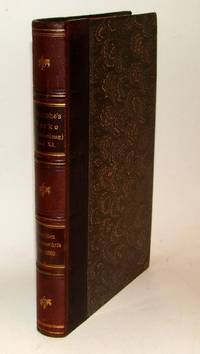
1898953605Leipzig: C.G. Naumann 1898. hardcover. Gut. XLI Seiten 2 Blatt 385 Seiten. Privates grünes Ganzleinen mit goldgeprägtem Lederrückenschilc. Oktav 223 cm Einband leicht fleckig und mit kleiner Druckstelle papierbedingt leicht gebräunt im Ganzen gut erhalten. EINZELBAND der frühen Werkausgabe. "Diese Gesammtausgabe der Werke Friedrich Nietzsche's wird im Auftrage seiner Angehörigen veranstaltet." Der "Nachbericht" des Herausgebers Koegel legt nahe dass einige Texte dieses Bandes hier im Erstdruck vorliegen da Koegel sie aus den Notizbüchern Nietzsches gezogen hat. "Friedrich Karl Adolf Koegel auch Fritz Kögel geboren 2. August 1860 in Hasserode; gestorben 20. Oktober 1904 in Jena war ein deutscher Schriftsteller Philologe Komponist und Unternehmer. . Vor 1889 zuerst auf Veröffentlichungen von Friedrich Nietzsche - 'für mich ein Fund fürs Leben' - gestoßen hielt Koegel Anfang 1892 in der Freien Literarischen Gesellschaft in Berlin einen Vortrag über Nietzsche der das Interesse an Leben und Werk des noch weitgehend unbekannten und nicht akzeptierten Philosophen wachsen ließ. Dessen Schwester Elisabeth Förster-Nietzsche wurde auf ihn aufmerksam und die Familie Oehler-Nietzsche gewann Koegel im Frühjahr 1894 als Herausgeber einer Nietzsche-Gesamtausgabe im Nietzsche-Archiv. Kurz nach Koegels Verlobung im Dezember 1896 mit Emily Gelzer die er bei Förster-Nietzsche kennengelernt hatte kam es zwischen ihm und der Archivherrin unter Beteiligung von Rudolf Steiner zu wachsenden Konflikten über die Frage der Herausgeberschaft und schließlich zu seiner Entlassung im Juni 1897. Seine heimlichen Abschriften aus Briefen und Briefentwürfen Nietzsches sind als Koegel-Exzerpte in die Wissenschaft eingegangen." Wikipedia. Der Band enthält: Homer und die classische Philologie. - Nachträge und Vorarbeiten zur Geburt der Tragödie. - Empedokles. - Homer als Wettkämpfer. - Über die Zukunft unserer Bildungsanstalten. - Bayreuther Horizontbetrachtungen. - Das Verhältnis der Schopenhauerischen Philosophie zu einer deutschen Cultur. "Friedrich Wilhelm Nietzsche geboren 15. Oktober 1844 in Röcken; gestorben 25. August 1900 in Weimar war ein deutscher klassischer Philologe und Philosoph. Nietzsche der im Nebenwerk auch Dichtungen und musikalische Kompositionen schuf sprengte mit seinem eigenwilligen Stil bis dahin gängige Muster und ließ sich kaum einer klassischen Disziplin zuordnen. Er gilt manchen als Begründer einer neuen philosophischen Schule der Lebensphilosophie. Er war zunächst preußischer Staatsbürger ab seiner Übersiedlung nach Basel 1869 wurde er auf eigenen Wunsch hin staatenlos. . Den jungen Nietzsche beeindruckte besonders die Philosophie Schopenhauers. Später wandte er sich von dessen Pessimismus ab. Sein Werk enthält scharfe Kritiken an Moral Religion Philosophie Wissenschaft und Formen der Kunst. Die zeitgenössische Kultur war in seinen Augen lebensschwächer als die des antiken Griechenlands. Wiederkehrendes Ziel von Nietzsches Angriffen sind vor allem die christliche Moral sowie die christliche und platonistische Metaphysik. Er stellte den Wert der Wahrheit überhaupt in Frage und wurde damit Wegbereiter postmoderner philosophischer Ansätze. Auch Nietzsches Konzepte des 'Übermenschen' des 'Willens zur Macht' oder der 'ewigen Wiederkunft' geben Anlass zu Deutungen und Diskussionen. Nietzsche schuf keine systematische Philosophie. Oft wählte er den Aphorismus als Ausdrucksform seiner Gedanken. Seine Prosa seine Gedichte und der pathetisch-lyrische Stil von Also sprach Zarathustra verschafften ihm Anerkennung auch als Schriftsteller." Wikipedia. - Weitere Bilder auf Anfrage oder auf unserer Homepage. Wegen Urlaub kann Ihre Bestellung / Anfrage erst nach dem 21.06.2026 bearbeitet werden. - Because of holidays your order / question can be handled only after 06/21/2026. C.G. Naumann hardcover
1897953623Leipzig: C.G. Naumann 1897. leather_bound. Gut. VII Seiten 1 Blatt 437 Seiten. Dunkelbraunes Orig.-Halbleder mit Goldprägung auf dem Rücken. Oktav 223 cm Einband leicht berieben und bestoßen papierbedingt leicht gebräunt dekoratives gepflegtes und gut erhaltenes Exemplar. EINZELBAND der frühen Werkausgabe. "Diese Gesammtausgabe der Werke Friedrich Nietzsche's wird im Auftrage seiner Angehörigen veranstaltet." Der "Nachbericht" des Herausgebers Koegel legt nahe dass einige Texte dieses Bandes hier im Erstdruck vorliegen da Koegel sie aus den Notizbüchern Nietzsches gezogen hat. Der Band enthält: Die Pflugschar. - Die Sorentiner Papiere. - Der neue Umblick. - Nachträge zu den "Vermischten Meinungen und Sprüchen". - Nachträge zu "Der Wanderer und sein Schatten". Vorarbeiten und Nachträge zur "Morgenröthe". "Friedrich Karl Adolf Koegel auch Fritz Kögel geboren 2. August 1860 in Hasserode; gestorben 20. Oktober 1904 in Jena war ein deutscher Schriftsteller Philologe Komponist und Unternehmer. . Vor 1889 zuerst auf Veröffentlichungen von Friedrich Nietzsche - 'für mich ein Fund fürs Leben' - gestoßen hielt Koegel Anfang 1892 in der Freien Literarischen Gesellschaft in Berlin einen Vortrag über Nietzsche der das Interesse an Leben und Werk des noch weitgehend unbekannten und nicht akzeptierten Philosophen wachsen ließ. Dessen Schwester Elisabeth Förster-Nietzsche wurde auf ihn aufmerksam und die Familie Oehler-Nietzsche gewann Koegel im Frühjahr 1894 als Herausgeber einer Nietzsche-Gesamtausgabe im Nietzsche-Archiv. Kurz nach Koegels Verlobung im Dezember 1896 mit Emily Gelzer die er bei Förster-Nietzsche kennengelernt hatte kam es zwischen ihm und der Archivherrin unter Beteiligung von Rudolf Steiner zu wachsenden Konflikten über die Frage der Herausgeberschaft und schließlich zu seiner Entlassung im Juni 1897. Seine heimlichen Abschriften aus Briefen und Briefentwürfen Nietzsches sind als Koegel-Exzerpte in die Wissenschaft eingegangen." Wikipedia. "Friedrich Wilhelm Nietzsche geboren 15. Oktober 1844 in Röcken; gestorben 25. August 1900 in Weimar war ein deutscher klassischer Philologe und Philosoph. Nietzsche der im Nebenwerk auch Dichtungen und musikalische Kompositionen schuf sprengte mit seinem eigenwilligen Stil bis dahin gängige Muster und ließ sich kaum einer klassischen Disziplin zuordnen. Er gilt manchen als Begründer einer neuen philosophischen Schule der Lebensphilosophie. Er war zunächst preußischer Staatsbürger ab seiner Übersiedlung nach Basel 1869 wurde er auf eigenen Wunsch hin staatenlos. . Den jungen Nietzsche beeindruckte besonders die Philosophie Schopenhauers. Später wandte er sich von dessen Pessimismus ab. Sein Werk enthält scharfe Kritiken an Moral Religion Philosophie Wissenschaft und Formen der Kunst. Die zeitgenössische Kultur war in seinen Augen lebensschwächer als die des antiken Griechenlands. Wiederkehrendes Ziel von Nietzsches Angriffen sind vor allem die christliche Moral sowie die christliche und platonistische Metaphysik. Er stellte den Wert der Wahrheit überhaupt in Frage und wurde damit Wegbereiter postmoderner philosophischer Ansätze. Auch Nietzsches Konzepte des 'Übermenschen' des 'Willens zur Macht' oder der 'ewigen Wiederkunft' geben Anlass zu Deutungen und Diskussionen. Nietzsche schuf keine systematische Philosophie. Oft wählte er den Aphorismus als Ausdrucksform seiner Gedanken. Seine Prosa seine Gedichte und der pathetisch-lyrische Stil von Also sprach Zarathustra verschafften ihm Anerkennung auch als Schriftsteller." Wikipedia. - Weitere Bilder auf Anfrage oder auf unserer Homepage. Wegen Urlaub kann Ihre Bestellung / Anfrage erst nach dem 21.06.2026 bearbeitet werden. - Because of holidays your order / question can be handled only after 06/21/2026. C.G. Naumann hardcover
1896953622Leipzig: C.G. Naumann 1896. leather_bound. Gut. IV Seiten 2 Blatt 478 Seiten 1 Blatt. Dunkelbraunes Orig.-Halbleder mit Goldprägung auf dem Rücken. Oktav 223 cm Einband leicht berieben und bestoßen papierbedingt leicht gebräunt dekoratives gepflegtes und gut erhaltenes Exemplar. EINZELBAND der frühen Werkausgabe. "Diese Gesammtausgabe der Werke Friedrich Nietzsche's wird im Auftrage seiner Angehörigen veranstaltet." Der "Nachbericht" des Herausgebers Koegel legt nahe dass einige Texte dieses Bandes hier im Erstdruck vorliegen da Koegel sie aus den Notizbüchern Nietzsches gezogen hat. Der Band enthält: Die Philosophie im tragischen Zeitalter der Griechen. - Über Wahrheit und Lüge im aussermoralischen Sinne. - Der Philosoph. - Die Philosophie in Bedrängniss. - Nachträge und Vorarbeiten zu den Unzeitgemässen Betrachtungen. - Prometheus. - Einzelne Gedanken und Entwürfe. "Friedrich Karl Adolf Koegel auch Fritz Kögel geboren 2. August 1860 in Hasserode; gestorben 20. Oktober 1904 in Jena war ein deutscher Schriftsteller Philologe Komponist und Unternehmer. . Vor 1889 zuerst auf Veröffentlichungen von Friedrich Nietzsche - 'für mich ein Fund fürs Leben' - gestoßen hielt Koegel Anfang 1892 in der Freien Literarischen Gesellschaft in Berlin einen Vortrag über Nietzsche der das Interesse an Leben und Werk des noch weitgehend unbekannten und nicht akzeptierten Philosophen wachsen ließ. Dessen Schwester Elisabeth Förster-Nietzsche wurde auf ihn aufmerksam und die Familie Oehler-Nietzsche gewann Koegel im Frühjahr 1894 als Herausgeber einer Nietzsche-Gesamtausgabe im Nietzsche-Archiv. Kurz nach Koegels Verlobung im Dezember 1896 mit Emily Gelzer die er bei Förster-Nietzsche kennengelernt hatte kam es zwischen ihm und der Archivherrin unter Beteiligung von Rudolf Steiner zu wachsenden Konflikten über die Frage der Herausgeberschaft und schließlich zu seiner Entlassung im Juni 1897. Seine heimlichen Abschriften aus Briefen und Briefentwürfen Nietzsches sind als Koegel-Exzerpte in die Wissenschaft eingegangen." Wikipedia. "Friedrich Wilhelm Nietzsche geboren 15. Oktober 1844 in Röcken; gestorben 25. August 1900 in Weimar war ein deutscher klassischer Philologe und Philosoph. Nietzsche der im Nebenwerk auch Dichtungen und musikalische Kompositionen schuf sprengte mit seinem eigenwilligen Stil bis dahin gängige Muster und ließ sich kaum einer klassischen Disziplin zuordnen. Er gilt manchen als Begründer einer neuen philosophischen Schule der Lebensphilosophie. Er war zunächst preußischer Staatsbürger ab seiner Übersiedlung nach Basel 1869 wurde er auf eigenen Wunsch hin staatenlos. . Den jungen Nietzsche beeindruckte besonders die Philosophie Schopenhauers. Später wandte er sich von dessen Pessimismus ab. Sein Werk enthält scharfe Kritiken an Moral Religion Philosophie Wissenschaft und Formen der Kunst. Die zeitgenössische Kultur war in seinen Augen lebensschwächer als die des antiken Griechenlands. Wiederkehrendes Ziel von Nietzsches Angriffen sind vor allem die christliche Moral sowie die christliche und platonistische Metaphysik. Er stellte den Wert der Wahrheit überhaupt in Frage und wurde damit Wegbereiter postmoderner philosophischer Ansätze. Auch Nietzsches Konzepte des 'Übermenschen' des 'Willens zur Macht' oder der 'ewigen Wiederkunft' geben Anlass zu Deutungen und Diskussionen. Nietzsche schuf keine systematische Philosophie. Oft wählte er den Aphorismus als Ausdrucksform seiner Gedanken. Seine Prosa seine Gedichte und der pathetisch-lyrische Stil von Also sprach Zarathustra verschafften ihm Anerkennung auch als Schriftsteller." Wikipedia. - Weitere Bilder auf Anfrage oder auf unserer Homepage. Wegen Urlaub kann Ihre Bestellung / Anfrage erst nach dem 21.06.2026 bearbeitet werden. - Because of holidays your order / question can be handled only after 06/21/2026. C.G. Naumann hardcover
189217262Berlin, F. Fontane, 1892-1901. 8vo. 3 Bl., 68 S.; 2 Bl., 64; 59; 48, 48; 30 S. Marmorierte Pp. m. RSchild. [2 Warenabbildungen]