5 123 résultats
1874416Leipzig: E. W. Fritzsch 1874. First edition. Hardcover. Good. Attacks German Historians NIETZSCHE Friedrich. Unzeitgemässe Betrachtungen II: Vom Nutzen und Nachtheil Unconventional Observation II: The Use and Disadvantage of History for Life. E. W. Fritzsch Leipzig 1874. TP III-VI 7-111 Octavo. First Edition First Issue. Schaberg 25a. There were approximately 650 copies of the first edition in the first issue state. The second Unconventional Observation attacked the then current faith in historical research that was one of Nietzsche's major complaints with contemporary German culture and a topic to which he returned with some regularity in his later works. Contrary to prevailing opinion Nietzsche argued that historical knowledge is valuable only when it has a positive effect on human beings sense of life contending that history can play only three positive roles which he termed the "monumental" the "antiquarian" and "critical" explaining each of these in some detail before going on to enumerate the dangers of the current scholarly fascination with "history for its own sake." Finally Nietzsche suggests an antidote to the psychologically and ethically devastating effects of the conventional approaches to history proposing an amalgam of what he terms the historical the unhistorical and the suprahistorical attitudes as the healthiest approach to the integration of a historical sense into the life of the individual and of course for Nietzsche this always means the exceptional individual. As he remarks in the present essay tellingly for the understanding of the Nietzschean philosophy as a whole: The goal of humanity cannot lie in the end Ende but only in its highest specimens. In the words of Walter Kaufmann: Perhaps there is no more basic statement of Nietzsches philosophy in all of his writings than this sentence. CONDITION: ." Contemporary drab boards with a hand written paper label on the spine which is worn and a bit chipped along the edges. Edges and covers rubbed. Seal of a previous owner Ludwig Seiber / Basel on the top of the front free end paper. On the whole a very respectable copy. <br/><br/>PHOTOS AVAILABLE UPON REQUEST E. W. Fritzsch hardcover
1903118<p>New York: The Macmillan Company 1903. First US edition. Octavo. Publisher's original navy cloth blind-stamped and gilt. Minor scuffing and spotting to boards; some bubbling to rear board cloth; faint toning to leaves else near-fine. Rare and uncommonly bright first U.S. edition of Friedrich Nietzsche's 1844-1900 classic polemical work The Dawn of Day also translated as Daybreak first published in the US by The Macmillan Company in 1903 translation by Johanna Volz after its initial publication in German in 1881 Morgenröthe: Gedanken über die moralischen Vorurtheile. In The Dawn of Day Nietzsche presents an early attack on moral systems commencing a sustained critique that would mature in his later works after he fully developed his concept of the "will to power." The work is also an early example of Nietzsche's skill in the aphoristic style which would garner worldwide renown in the decades following his death in 1900. Drawing upon the ascendant materialism of his day Nietzsche forcefully argues that moral and religious systems are ultimately the result of natural drives. Accordingly human action is at bottom devoid of agency and is rather the product of a complex competition among diverse natural processes-a line of thought Nietzsche would further develop in his following work The Gay Science 1882. The Dawn of Day contains the seeds of much of Nietzsche's later thought which would ripen into an anti-foundational critique of the modern age that claims few if any equals into the twenty-first century. The translation and publication of Nietzsche's works in the US was a landmark event in the history of American thought; The Dawn of Day would influence many prominent US intellectuals novelists and philosophers from H. L. Mencken to Jack London many of whom revered the works of Nietzsche as launching a revolution in human thought. This bright first US edition has been well-preserved and is increasingly scarce in this condition.</p> The Macmillan Company hardcover
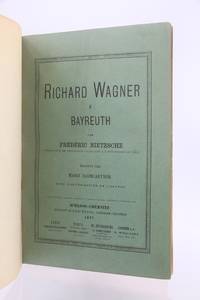
1886649Leipzig: E. W. Fritzsch 1886. first Edition second issue. contemporary boards. Very good. A Complete Set of the First Edition Second Issues <br />of the Four Unzeitgemässe Betrachtungen <br /> <br /> <br />NIETZSCHE Friedrich Unzeitgemässe Betrachtungen I-IV Untimely Meditations E. W. Fritzsch Leipzig 1886. TP 1-101 102 = Fritzschs original publishers ads TP III-VI = Vorwort 7-111 TP 3-113 TP 3-98 99 = Printers information Octavo. First Edition Second Issue Schaberg 46-49. <br /> <br />When Nietzsches first publisher Fritzsch bought back his remaindered stock from Schmeitzner in 1886 the inventory included 212 351 350 and 768 copies respectively of the original editions of the four Untimely Meditations. The first of these had originally been published by Fritzsch and remaindered to Schmeitzner when Fritzsch went bankrupt. These were reissued with new title pages and covers but without the addition of new Prefaces that were written for several others of these 1886/1887 reissues. <br /> <br />This copy has as usual the Richard Wagner in Bayreuth marked as "Second Edition" on the title page. <br /> <br />At the same time as Also sprach Zarathustra was being reissuedand with similar uncertainty regarding the specific release datethe four Unconventional Observations were reissued. Nietzsche claimed that he "wanted to leave them as they are" and Fritzsch agreed. They were published individually without changes or additions except for the new undated title pages. The fourth ObservationRichard Wagner in Bayreuthwas listed as a "Second Edition" on the cover and the title page NOTE: 800 of the original 1500 copies printed of this piece had been falsely marked Second Edition. <br /> <br />Schaberg The Nietzsche Canon pp. 135-136 <br /> <br />CONDITION: Very good in contemporary quarter leather with black boards. Gilt faded on spine. Minor edge wear especially to corners of boards. Moderate foxing to first few leaves. and title pages.Internally bright and clean. <br /> <br/><br/>PHOTOS AVAILABLE UPON REQUEST E. W. Fritzsch hardcover
187788235Schloss-Chemnitz: Ernest Schmeitzner 1877. Fine. Ernest Schmeitzner Schloss-Chemnitz 1877 12.50 x 18.50 cm relié The rare first edition of Friedrich Nietzsche's first work translated into French. Light rubbing to head of spine small brown stains at foot of second cover some foxing. Full khaki cloth Bradel binding smooth spine decorated with gilt floral motif gilt date and double fillet at tail navy blue shagreen title-label covers preserved contemporary binding signed Carayon. Ernest Schmeitzner hardcover
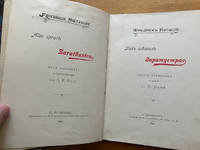
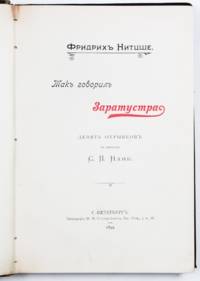
1899887<p>Petersburg: M.M. Stasyulevicha 1899. First Thus. Hardcover. Very good. First Bilingual German-Russian Edition of Nietzsches Zarathustra <br /><br />NIETZSCHE Friedrich Tak govoril Zaratustra / Also Sprach Zarathustra Bilingual edition in German and Russian M.M. Stasyulevicha Petersburg 1899. Blank leaf half-title TP 1 leaf = dedication vii - xiv = translators forward half title half-title 2 - 103 1 leaf = contents blank leaf octavo. First Russian-German Dual-Language. <br /><br />First edition of the second translation of Thus Spoke Zarathustra. Translated from German by S. Nani. Bilingual edition in both German and Russian of nine selected excerpts printed side-by-side: the Night-Song the Grave-Song the Academic Chairs of Virtue the Soothsayer the Three Metamorphoses Scholars the Way of the Creating One Reading and Writing and the Three Evil Things. <br /><br />Thus Spoke Zarathustra is one of Nietzsche's most famous works and Nietzsche regarded it as among his most significant. Thoroughly studied and re-studied by scholars throughout the 20th century the character of Zarathustra stands as a figure marking the end of Modernity by some i.e. Heidegger the beginning of Post-Modernity by others i.e. Derrida; the text a personal soteriological narrative of Nietzsches own self-overcoming and a parable for others towards the same transformation. Though Thus Spoke Zarathustra attempts to destroy and replace the Judeo-Christian world-view Nietzsches style borrows heavily from the Old and New Testament. Nietzsche also adopts myriad metaphors invoking animals earth air fire water celestial bodies plants all in the service of describing the spiritual transformation of Zarathustra a solitary reflective exceedingly strong-willed sage-like laughing and dancing voice of self-mastery who accompanied by a proud sharp-eyed eagle and a wise snake believed in a mode of being beyond the common human condition but without the need to posit a transcendent other world. Nietzsche refers to this higher mode of being as superhuman übermenschlich one that embraces the doctrine of eternal recurrence a doctrine for only the strongest who can love life in its entirety who embrace their suffering and would only again will it to be thus! <br /><br />The first translation of Zarathustra was done by Yu Antonovsky in 1898 just really a few months before this bilingual edition translated by Nani. With so much censorship in Russia any translation was really an art form creatively trying to communicate Nietzsches or any philosophers! ideas into a voice acceptable to the heightened sensitivities of the authorities under both Tsars Alexander III and Nicholas II. Hence the incomplete translations of both Antonovsky in 1898 and Nani in 1899. <br /><br />CONDITION: Very good in original quarter leather with marbled boards. Light edgewear. Former owners name in ink to top edge of half-title page. Text block coming loose from front cover along inner hinge but holding along bottom. Rear hinge firm. One leaf xiii - xiv loose. Blank rear endpaper with small tear in center. A very nice untouched copy all in original condition. <br /><br /></p> M.M. Stasyulevicha hardcover
1896COLLECTI014822INEW YORK NY: MACMILLAN AND CO. VERY GOOD NO D.J. 1896. FIRST EDITION. HARDCOVER. EDITED BY ALEXANDER TILLE / TRANSLATED BY THOMAS COMMON ALSO INCLUDES "THE ANTI-CHRIST"PAGES 233-351 . PUBLISHER'S LIGHT GREEN CLOTH-COVERED BOARDS WITH GILT SPINE TITLES AND 8 PAGE UNDATED CATALOG AT THE REAR OF TEXT. THE CLOTH OF THE SPINE IS DARKENED WITH SPINE TITLES A BIT DULLED BUT QUITE READABLE AND WITH FRONT AND REAR BOARDS' CLOTH SLIGHTLY DARKENED. A VERY NICE COPY BUT LACKING THE HALF TITLE. A VERY NICE COPY OF A RARE FIRST EDITION WITH NIETZSCHE'S "TWILIGHT OF THE IDOLS". . MACMILLAN AND CO. hardcover
1873946Leipzig: E. W. Fritzsch 1873. First Edition. Hardcover. Very good. Nietzsche Destroys David Strauss <br /> <br />NIETZSCHE Friedrich. Unzeitgemässe Betrachtungen I: David Strauss Unconventional Observation I: David Strauss. Leipzig: E. W. Fritzsch 1873. TP 1-101 102 = advertisements Octavo. First Edition First Issue. Schaberg 23a <br /> <br />The first of Nietzsche's Unconventional Observations was an attack on David Strauss the writer who had made his reputation with his scandalous Life of Jesus in 1835. Here Nietzsche attacks his most recent book The Old and the New Faith which advocated the rejection of the Christian faith in favor of a Darwinian materialistic and patriotic world-view. Nietzsche accuses Strauss of being a "Cultural Philistine" and denounces him as an exemplar of pseudo-culture. Although erudite the essay is extremely intemperate and filled with references to many of Nietzsche's scholarly contemporaries. The climax is a literary tour de force in which Nietzsche cites a litany of malapropisms from Strauss interspersed with his own barbed comments. For Nietzsche Strauss's book was the incarnation of the Zeitgeist: unproductive smugness intellectual snobbery superficial assimilation of great works of art and new scientific theories myopic criticism and patronizing praise of even the greatest genius But what enraged him most was Strauss's comfortable and untroubled renunciation of Christianity coupled with an easy conviction that Darwin was one of mankind's greatest benefactors and that traditional values could of course be maintained. It is in the present work that Nietzsche first publicly addresses the problem of the derivation of moral values that would infuse so much of his most important work. <br /> <br />CONDITION: Very Good in recently rebound contemporary marbled paper over boards with new spine lettered in gilt. Internally bright and clean. A very good copy of one of Nietzsche s early works. <br/><br/> E. W. Fritzsch hardcover
187788235Ernest Schmeitzner | Schloss-Chemnitz 1877 | 12.50 x 18.50 cm | relié
191911000Paris: Georges Cres et Cie 1919<br>. Translated by Henri Albert. Portrait frontispiece engraved after Aubert. Extra-illustrated with an additional hand-painted title page 8 full page hand-painted original designs in gouache and 2 full page hand-painted designs for the binding in gouache all by A.J. Powilewicz in 1962. Pp. x 448 2. 8vo. bound in full vellum painted on both sides and the spine in red green yellow blue and gilt by A.K. Powilewicz and with his hand-painted elaborate endpapers original wrappers bound in t.e.g. Boards a trifle bowed otherwise very good.On the verso of his hand-painted and written colophon Powilewicz writes in ink that the designs have been inspired by Persian miniatures and rugs from the Caucasus and Persia.<br>A delightful and playful extra-illustrated copy of a French edition of Nietzsche’s Also sprach Zarathustra apparently put together for the personal pleasure of the artist. Powilewicz 1886-1969 was an artist and illustrator known for his images for books in the 1920s and 30s including Charles Foix’s Promethee and Les Bassarides 1924 and 1926 and Albert Desbranche’s Clocheets et Grelots 1932.<br>A wonderful example of book-embellishment - an extreme form of grangerising. Book-embellishment in the 1960s with original hand-painted ornamentation illustrations and binding by the artist Powilewicz Georges Cres et Cie hardcover
1995RARIGRE00kwEaston 1995. Fine. Aristotle. The Great Philosophers. 12 vols. Plato; Kant Immanuel; Locke John; Descartes Rene; Kierkegaard Soren; de Spinoza Benedict; Nietzsche Friedrich; Hume David; Berkeley George; Mill John Stuart; Hegel Georg W. F. Norwalk: Easton 1995. 8vo. Book condition: Near fine. Easton Press Published expressly for the personal library of bookplate sticker laid in each vol. Easton unknown
192412248The MacMillan Company. Very Good in Good dust jacket. 1924. Hardcover. Green cloth cover has lightly turned in spine caps otherwise pristine. Boards and spine are straight. Binding is tight. Former owner's name on front end sheet. Pages lightly toned but clean and near pristine. Book has never been cracked open. Dust jacket has wear to the extremities and light soiling but in good condition. Publisher's price of $2.00 on DJ flap. DJ protected by a brand new clear acid-free mylar cover. We add mylar covers to all books with DJs to preserve the DJs and add luster to magnify their beauty. If pictured shown without the mylar cover for an accurate representation of dust jacket. . . The MacMillan Company hardcover
19962090202120411750Kodansha 1996. Soft Cover. Fine. Number of books: 1 Kodansha paperback
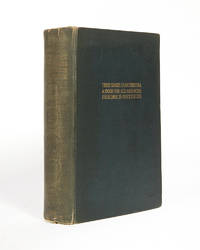
25<p>"Thus Spake Zarathustra: a Book for All and None" is a philosophical novel by German philosopher Friedrich Nietzsche composed in four parts written between 1883 and 1885 and published between 1883 and 1885. Much of the work deals with ideas such as the "eternal recurrence of the same" the parable on the "death of God" and the "prophecy" of the Übermensch German.</p> hardcover
71584CBBerlin de Gruyter 2004 - 2015. Oln. Bände 4 - 9 in Folio. Zus. Berlin, de Gruyter 2004 - 2015. unknown
albd53a70f60a005b82Nietzsche F. So Zaratustra used to say. A book for everyone and no one. In Russian /Nitsshe F. Tak govoril Zaratustra. Kniga dlya vsekh i ni dlya kogo Translation from German Y.M. Antonovsky. Fourth Edition of St. Petersburg Prometheus, 1911, VIII, 292 pp. We have thousands of titles and often several copies of each title may be available. Please feel free to contact us for a detailed description of the copies available. SKUalbd53a70f60a005b82.
albf06df6a167310671Nietzsche Friedrich. Complete collection of works. In 13 vol. (14 books) and letters In Russian /Nitsshe Fridrikh. Polnoe sobranie sochineniy. V 13 t. (14 kn.) i pisma Cultural Revolution 2006-2014. T.1. Part 1: The Birth of Tragedy. From Heritage (Works 1869-1873). T.1. Part 2: A Timely Reflection. From Heritage (Works 1872-1873). T.2. Human, Too Human. T.3. Morning Dawn. Messianic idyll. We have thousands of titles and often several copies of each title may be available. Please feel free to contact us for a detailed description of the copies available. SKUalbf06df6a167310671.
123210London T. Fisher Unwin 1908. . First edition stated second impression third printing overall; large 8vo 24 x 16.5 cm; ownership inscription in pencil to front fly-leaf moderate spotting endpapers toned; publisher's blind-stamped blue-green cloth upper-cover and spine lettered in gilt fore and bottom edges uncut spine slightly faded extremities a little rubbed very good;<br /> An early printing of the first English-language translation of Friedrich Nietzche's 1844-1900 philosophical novel Also Sprach Zarathustra.<br /><br />Like Nietzsche the translator Alexander Tille 1866-1912 had studied philology and philosophy at the University of Leipzig. Later in 1899 Tille took up a teaching position at the University of Glasgow where he lectured on German Studies and was an early proponent of the theory of Social Darwinism.<br /><br />This translation the first in English was initially published in 1896 in a joint endeavour between H. Henry and Co. Ltd. in London and Macmillan in New York. It performed poorly with sales of just 257 copies reported. The remaining unsold sheets were then acquired by T. Fisher Unwin who reissued the book with their own title-page in 1899. <br /><br />This the stated 'Second Impression' represents the second-printing of the translation with the T. Fisher Unwin imprint and thus the third printing of the title overall.<br /> London, T. Fisher Unwin, 1908. hardcover
1893823<p>Leipzig: Naumann 1893. Second Edition. Wraps. Very good. Second Edition of Nietzsches Twilight of the Idols in Original Printed Wraps <br /><br />NIETZSCHE Friedrich Götzen-Dämmerung Twilight of the Idols Naumann Leipzig 1893. Half title TP 1 leaf = Inhalt I-II = Vorwort 1-116. Second Edition Krummel XVIII a p. 120. <br /><br />Nietzsche began to write Twilight of the Idols at the end of June of 1888 and was finished by early Septemberanother lightning-quick production that he claimed to have been the "work of so few days that I am hesitant to mention exactly how many." His hesitancy becomes even more understandable when one remembers that part of July was devoted to the preparation of the final typescript of The Case of Wagner and that during August he produced two "Postscripts" and the "Epilogue" and then proofed the entire work. In the final analysiswhen the book was finally completedNietzsche bragged to Gast that "I could hardly have used ten days more efficiently for it certainly took me no longer to write the book." Yet another ten-day wonder! <br /><br />The new book was originally entitled A Psychologist at Leisure when Nietzsche mentioned it to Naumann on 7 September: <br /><br />I am about to give you a nice surprise. You probably think we are finished with printing but even now the cleanest manuscript I have ever sent to you is on its way. Regarding layout and design this new work should be a twin to The Case of Wagner. The title is A Psychologist at Leisure. It is imperative for me that we publish this now because by the end of next year we will have to begin the printing of my main work The Revaluation of All Values which will be a stern and serious book and I will not be able to publish anything cheerful and winsome right after it. <br /><br />This book though not very large may cause a few ears to be opened so that the main work will not be greeted with silence like my Zarathustra. <br /><br />The manuscript was mailed two days later and the single-page first draft for the Preface came three days after that. Nietzsche thought of this bookin conjunction with the Wagner bookas a light and brief respite before the publication of his masterwork: "In the final analysis both of these works are only recuperations in the midst of an immensely difficult and decisive task which when properly understood will split humanity in two." Unfortunately Nietzsche never recovered from these "recuperations" and The Revaluation of All Values was never completed <br /><br />Even as the book was being printed Peter Gast pleaded with Nietzsche to change the title: <br /><br />When I consider how other people will respond to this title I think A Psychologist at Leisure is much too unassuming. You have dragged your artillery to the highest mountains you have guns such as have never existed and even if you shoot blindly you will inspire terror all around. The stride of a Giant which can make the mountains shake to their core is hardly leisure . . . and so I pleadif an incompetent may make such a requestlet us have a more resplendent a more radiant title! <br /><br />Nietzsche immediately agreed and changed the title to Twilight of the Idols75 and three days later he penned the final version of the Preface which was dated 30 September 1888. <br />Schaberg The Nietzsche Canon pp. 166-167 <br /><br />CONDITION: Uncut copy in original wraps printed front and back as well as on the spine. The covers are very lightly chipped and have a 1½ closed tear on the right side near the center of the front cover. The rear cover has five number inked next to the advertisements for Nietzsches books presumably noting their issuing sequence in the then-in-the-press Collected Works. A bit worn but still a lovely affordable and collectible copy of this important work by Nietzsche. <br /><br />PHOTOS AVAILABLE UPON REQUEST</p> Naumann paperback
1893697Leipzig: C. G. Naumann 1893. Second Edition. Wraps. Very good. The Second Edition of Nietzsches Four Untimely Meditations <br /> <br />NIETZSCHE Friedrich Unzeitgemässe Betrachtungen Unconventional Observations I-IV. C. G. Naumann Leipzig 1893 Volume 1: Original front wrap TP III-XV 2 half titles 1-206 207-208= Publisher's ads; Volume 2: Original front wrap TP 2 half titles 3-205 206-208 = Publisher's ads Octavo. Second Edition Krummel II-V b p. 114 <br /> <br /> <br />This is the second volume of the soon to be aborted "Collected Works" edited by Nietzsche's closest friend Peter Gast whose introduction appears here as a Foreword. The second attempt to put out a complete edition was more successful - mostly because it was driven to completion by Nietzsche's harridan sister Elisabeth. <br /> <br />CONDITION: Two volumes bound with original front wraps and expertly matching but recent spines and rear covers. There are some scattered pencil underlinings and marginalia. Otherwise this is a really well-preserved and excellent copy of all four of Nietzsche's "Unconventional Observations" which are more usually but a bit inaccurately translated as the "Untimely Meditations". <br /> <br/><br/>PHOTOS AVAILABLE UPON REQUEST C. G. Naumann paperback
19288424London: The Fanfrolico Press 1928. Half-Leather. Collectible; Very Good. The 1928 lovely Fanfrolico Press edition of Nietzsche's "The Antichrist". Translated from the original German by P.R. Stephensen and lavishly illustrated by Norman Lindsay with 7 of his engravings complementing the text. Bound by Kelly & Sons in half-leather over navy-blue boards and limited to 550 copies. Solid tight and VG with light staining and wear at the panels. Elephant folio top-edge gilt deckled fore and bottom-edges. A very impressive uncommon rendering of one of Nietzsche's darkest texts originally published exactly 40 years earlier. The Fanfrolico Press unknown
19288424London: The Fanfrolico Press 1928. Half-Leather. Collectible; Very Good. The 1928 lovely Fanfrolico Press edition of Nietzsche's "The Antichrist". Translated from the original German by P.R. Stephensen and lavishly illustrated by Norman Lindsay with 7 of his engravings complementing the text. Bound by Kelly & Sons in half-leather over navy-blue boards and limited to 550 copies. Solid tight and VG with light staining and wear at the panels. Elephant folio top-edge gilt deckled fore and bottom-edges. A very impressive uncommon rendering of one of Nietzsche's darkest texts originally published exactly 40 years earlier. <br/><br/> The Fanfrolico Press hardcover books
2022St. Petersburg: tip. M.M. Stasyulevicha 1899. XIV 2 106 pp. Contemporary quarter-leather. Rubbed spine worn edges otherwise internally clean copy.<br /> <br /> Scarce. First edition of the second translation of Thus Spoke Zarathustra. Translated from German by S. Nani. Bilingual edition in German and Russian. With the translator's foreword. Original printed in 1883.<br /> One of the first Russian translations of Nietzsche's philosophical fiction Thus Spoke Zarathustra. The book features nine excerpts from the original work: the Night-Song the Grave-Song the Academic Chairs of Virtue the Soothsayer the Three Metamorphoses Scholars the Way of the Creating One Reading and Writing and the Three Evil Things. The text was translated from German by S. P. Nani and published in St. Petersburg in 1899. At the time Russian authorities subjected Nietzsche's works to substantial censorship prompting Nani to carefully choose passages for translation. Importantly Nani's rendition emerged just a few months after Yu. Antonovsky's "rather. poor translation" of Zarathustra first appeared in Russian print. This positioned Nani's translation as the second Russian interpretation of Nietzsche's masterpiece and one of the earliest Russian translations of anything by the German philosopher.<br /> Until the late-19th century Nietzsche who had published his first work in 1872 was unknown to the Russian audience. Nietzsche's books were prohibited by Russian censorship which had grown extremely strict under the reign of tsar Aleksandr III. Nietzsche's works were first translated into Russian in the late 19th century with Yu.<br /> Antonovsky's 1898 translation of Thus Spoke Zarathustra standing as the first contribution. However these early translations were subject to censorship resulting in selective adaptations to align with the prevailing ideologies of the time. This censorship persisted through the Soviet era forcing translators to navigate carefully through Nietzsche's texts to ensure compliance with official ideologies.<br /> <br /> Worldcat shows 2 copies of the edition at the Library of Congress and Cleveland Public Library. unknown
alb9b38faffbb3616daNietzsche F. Esse Homo. In Russian /Nitsshe F. Esse Homo. Translation by Ya. Danilin. City of Moscow. Zarya Book Publishing House. 1911. 134 p. We have thousands of titles and often several copies of each title may be available. Please feel free to contact us for a detailed description of the copies available. SKUalb9b38faffbb3616da.
alb79c8ca5714542472Nietzsche F. Jesse Nomo. In Russian /Nitsshe F. Esse Nomo. Translation of Ya. Danilin Moscow Book of Dawn 1911. 133 p. We have thousands of titles and often several copies of each title may be available. Please feel free to contact us for a detailed description of the copies available. SKUalb79c8ca5714542472.
albe68e7644904a624dNietzsche F. The Origins of the Tragedy: On the Antichrist In Russian /Nitsshe F. Proiskhozhdenie Tragedii. Ob antikhriste Moscow type. Chicherin 1900 A.D. 342 and A.D. 2 Antichrist was conceived as the first book Revaluation of All Values and was written almost in parallel with The Twilight of Idols. We have thousands of titles and often several copies of each title may be available. Please feel free to contact us for a detailed description of the copies available. SKUalbe68e7644904a624d.