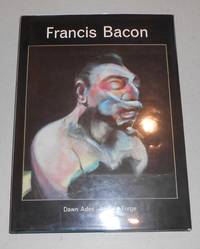
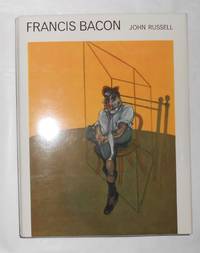
Bacon, FrancisBiblio.com
8 003 résultats
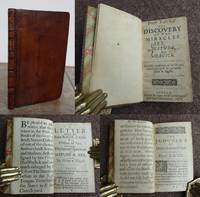
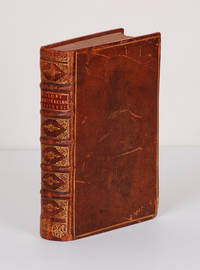
1639141492London: Henrie Tomes and Printed by Iohn Beale 1639. full 19th-century calf border stamped in gilt on boards gilt ornamentation on spine red leather spine label in second compartment five raised bands all edges stained red. square 8vo. full 19th-century calf border stamped in gilt on boards gilt ornamentation on spine red leather spine label in second compartment five raised bands all edges stained red. 2 blanks 45 121 leaves; 1 blank iv 340 pages. First edition of the "preparative or key for the opening of the instauration" Grolier/Horblit.<BR> <br /> <BR> <br /> First edition Pforzheimer 36; Gibson 81; Grolier Langland to Wither 12; Grolier/Horblit 8a; Norman 97; Norman Library 261; STC 1164 with the newly enlarged edition ESTC S100372; Gibson 17. Perez Zagorin Francis Bacon 1999. Early 20th-century ownership inscription in ink on front free endpaper. Lacking the errata Pforzheimer however Gibson states that they are "not often found". Scuffing to the leather binding rubbing to hinges and extremities minor loss to the first two blanks two pin-point worm holes on the title page near the publisher small dampstain to top corner of leaf 10 minor margin loss to the bottom gutter of leaf 107 of Twoo Bookesthe bottom fore-edge of page 207/208 of Essayes and small worm holes on the final leaf and subsequent free endsheet. Else a near fine copy and internally very clean and free of blemishes. The variant copy with page 11 line 5 reading 'maniable' rather than 'amiable'. Many of the pages of Twoo Bookes are inconsistently paginated with hand notations in ink but the book is complete. <BR> <br /> <BR> <br /> An excellent copy of the first published work of Francis Bacon with decorative woodcut initials. Exceptionally rare. Bound in full calf circa 1818.<BR> <br /> <BR> <br /> From the Haskell F. Norman Library Christie's sale Part II June 15 & 16 1998: "The Advancement of learning was the first of two works in which Bacon expounded his philosophy of scientific method. It was expanded and latinized as De augmentis scientiarum in 1623. "In the Twoo bookes Bacon concerned himself primarily with the classification of philosophy and the sciences and with developing his influential view of the relation between science and theology" Norman. It was the only work Bacon ever published in English."<BR> <br /> <BR> <br /> The second volume bound-in The Essayes or Covnsels Civill and Morall. 1639 has the title in a woodcut border. First published in 1597 this work is the enlarged edition and perhaps the most widely read work of Bacon. "Some of the essays deal with policy for princes and men in high position. A number however are written from the viewpoint of those seeking advancement in life. Bacon proffers concise advice and judgements on civil business situations conduct and the weighing of character and motives. The work's appeal is due to the pragmatic intelligence and knowledge informing its observations which are expressed in a style employing striking images apt examples and quotations and pithy aphorisms" Zagorin p. 141. Henrie Tomes (and) Printed by Iohn Beale unknown
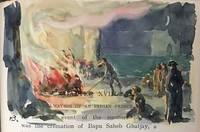
189500025591895. On offer is a wonderful copy of 'Etretat: Hamlet of the Setting Sun - a Norman Village and its Surroundings' by Henry Bacon 1839-1912 the American Impressionist artist. This smallish utterly charming book published by Brentano's in 1895 uniquely contains eleven original watercolor illustrations by Bacon as evidenced by his initials on a number of the drawings. This is a very unusual relic of Bacon's work beautifully executed. Overall VG. Good. 12mo - over 6¾" - 7¾" tall. Manuscript. unknown
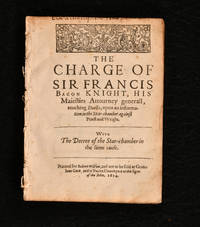
1614703L19London: Robert Wilson 1614. Disbound. Very Good. 7" by 5.5". None. A very scarce first edition of this important treatise by Francis Bacon. Here Bacon highlights his stance against duels which he deemed to be against the will of God. This work was published as a part of James I's anti-dueling campaign. Bacon's work was one of two major treatises published on this subject at the time. The campaign was prompted by a series of high profile combats between leading courtiers in late 1613. In October of 1613 James I issued a proclamation banning the publishing or writing of works on duels. He also made the offence punishable in Star Chamber to publicise any proceedings of duels. Henry Howard the Earl of Northampton lead the campaign initially and this then fell to Sir Francis Bacon the attorney general upon Northampton's death. This work is one of the major contributions to the Jacobean anti-dueling campaign. ESTC reference No: S121055. A disbound copy of this work which is closely trimmed to the head of the title. Collated lacking the initial and final blanks. Illustrated with woodcut head pieces and initials. Sir Francis Bacon was a leading intellectual figure of sixteenth and seventeenth century Britain. He served as both the Attorney General and Lord Chancellor and was of great influence in the scientific revolution. The father of empiricism Bacon's work in the fields of science history poetry and philosophy have shaped modern life. A very scarce and important work of this topic. Disbound. Externally very smart. Inscription to the top of title obscured from close-cropping. A few light spots to the externals. Internally firmly bound. Pages are bright with occasional scattered spots to pages. Very Good Robert Wilson unknown
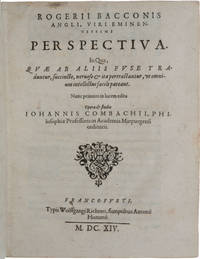
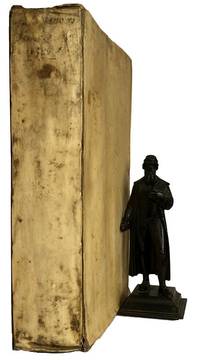
16145811Frankfurt: Wolfgang Richter for Anton Humm 1614. First edition. <p>First editions of these two rare works on optics by the 'Doctor Mirabilis' Roger Bacon. The Perspectiva deals with the physiology of the eye and the geometrical optics of mirrors and lenses while the Specula mathematica presents Bacon's theory of the propagation of light. "In the Specula Bacon "outlined a quantitative theory of any propagation along straight lines and so arrived at the inverse square law at least implicitly since he attributed the weakening of the action with distance to the decrease in the cone solid angle under which the acted-on body is seen by the agent" Russo.</p>. anticipated the inverse square law four centuries before Newton. <p>First editions of these two rare works on optics by the 'Doctor Mirabilis' Roger Bacon 1214/1220-1292 - 'perspectiva' for Bacon had a different meaning from today's 'perspective'. Bacon's "skill in mathematics experimental science and mechanical inventions was so remarkable for his time that . he acquired the reputation . of being a magician" Ferguson Bibliotheca Chemica I p. 65. It is appropriate that the Perspectiva and Specula mathematica are here bound together not only because they have the same publisher and date but because the subjects treated in the two works are complementary. The Perspectiva deals with the physiology of the eye and the geometrical optics of reflection and refraction while the Specula mathematica presents Bacon's theory of the propagation of light. Remarkably the latter work anticipates the inverse square law normally ascribed to Newton four centuries after Bacon. "Bacon's major claim to fame in science is that he is the first Latin Western thinker to comprehend and write on most of the ancient sources of optics. In brief he initiates the tradition of Optics/Perspectiva in the Latin world. This tradition would be formulated as teaching texts by his contemporaries Pecham and Witelo. Bacon's optics was also read and commented on in 14th century Italy especially by Lorenzo Ghiberti. It was known to and used by Leonardo Da Vinci. And it was part of the tradition of learning that led to Kepler and Descartes. In his Perspectiva and De scientia experimentali Bacon outlines a sketch for a scientific method one that takes optics as the model for an experimental science. In fact he succeeded in his endeavor in that perspectiva was added to the four traditional university subjects of the quadrivium: arithmetic geometry astronomy music" Stanford Encyclopedia of Philosophy. Part I 'Distinctio I' of the Perspectiva deals with the anatomy of the eye and the optic nerve. Bacon realised that seeing involved not just the eye but the brain and following Avicenna he divides the brain into 'cells'. In Part II Bacon recounts a whole range of optical phenomena - long sight near sight errors of vision clarity of vision on the moon on our perceptions of magnitude and so on all drawing on a wide variety of earlier sources and on experimentation. Part III deals with reflection and refraction discussing the geometry of the former in various sorts of mirrors showing a good understanding of focal point and focal plane. The Perspectiva concludes with Bacon's treatise De speculis comburentibus a commentary on the last proposition of Euclid's De speculis by means of an analysis of burning mirrors and the passage of light through small apertures. The Specula mathematica contains a long discussion of the usefulness of mathematics "the door and key to all knowledge" p. 2 but most importantly includes his treatise De specierum multiplicatione which "is acknowledged by him as the key to his Optics" ibid. It is in this work that Bacon discusses radiation. As Lindberg puts it "This is a complete physical and mathematical analysis of the radiation of force - and thus of natural causation." The Perspectiva and Specula mathematica formed parts V and IV respectively of Bacon's six-part Opus majus composed in 1266-67 but not published in its entirety until 1733. But both were soon disseminated as separate works and they served as important textbooks throughout the 14th to 16th centuries. The reason for their late publication is unknown.</p> <br /> <p>"Nobody contributed more to the development of the science of perspectiva in the West than Roger Bacon. On the methodological issues that separated Robert Grosseteste c. 1158-1253 and Albert the Great c. 1200-1280 Bacon dismissed Albert's opinion nearly as enthusiastically as he praised Grosseteste's. Although Bacon did not study under Grosseteste and may never even have met him he did have access to Grosseteste's library left to the Franciscan convent in Oxford and was clearly inspired by his example. However Bacon was also powerfully moved by sources that had been unavailable to Grosseteste principally the optical works of Ptolemy and Alhacen where the promise of geometrical optics had been much more completely fulfilled.</p> <br /> <p>"Thus Bacon even more than Grosseteste became an apostle of the application of mathematical method as the gate and key to all subjects claiming for example that 'no science can be grasped without this science mathematics and . nobody can perceive his ignorance in other sciences unless he is excellently informed in this one. Nor can things of this world be known nor can man grasp the uses of body and things unless he is imbued with the mighty works of this science' . Following Alhacen's lead Bacon applied geometrical analysis to optical phenomena wherever promising and possible given the conceptual framework and the mathematical techniques available to him thereby pushing the mathematization of light and vision as far as it would go before the seventeenth century .</p> <br /> <p>"Several examples will serve as illustrations. First the magnitude of Bacon's commitment to a mathematical analysis is superficially apparent from a glance at his Perspectiva which contains fifty-one geometrical diagrams or his On the Multiplication of Species which contains thirty-nine all fully integrated into the argument of their respective treatises. Second Bacon's works reveal a complete mastery of the geometry of reflection and image-formation in plane convex and concave mirrors" Lindberg & Tachau pp. 501-502.</p> <br /> <p>"Bacon fully understood and successfully communicated the basic geometrical principles governing reflection in plane concave and convex mirrors; the equality of the angles of incidence and reflection; location of the images of objects seen by reflection at the intersection of the rectilinear extension of the visual ray issuing from the eye or the reflected luminous ray entering the eye since Bacon could conceptualize the problem either way and the perpendicular drawn from the visible point to the reflecting surface the cathetus. He also dealt successfully with questions of the magnification and diminution and the inversion and reversal of images; and his analysis of image formation in convex spherical mirrors implicitly embodied the concepts of focal point and focal plane . Bacon's geometrical analysis of the phenomena of refraction was equally successful. He revealed no interest in the quantitative problem of discovering an algebraic or trigonometrical law of refraction. Ptolemy had already made a serious attempt in that direction and Bacon was undoubtedly familiar with it. Bacon aimed only to establish the geometrical and thus qualitative principles governing refraction at interfaces of various shapes separating media of different densities. He understood that radiation is refracted when passing from one medium to another in such a way as to fall closer to the perpendicular in the denser medium; he knew also that the image of an object seen by refracted rays is situated at the intersection of the rectilinear extension of the visual ray emerging from the eye or the luminous ray entering the eye and the perpendicular drawn from the visible point to the refracting interface; and he understood that the degree of refraction depended on the relative transparencies we would say 'optical densities' of the two media. To display these principles he offered a successful geometrical analysis of ten cases of refraction at plane and spherical interfaces each illustrated with a geometrical diagram.</p> <br /> <p>"There is a temptation for those of us who have received a modern education in the physical sciences to regard the successful geometrical analysis of reflection and refraction as obvious and inevitable. We must remind ourselves therefore that taking a geometrical approach to problems of the propagation of light seems self-evidently efficacious to us only because of our membership in or encounter with the tradition of geometrical optics on which Bacon was in the Latin world one of the founding fathers. There was nothing obviously efficacious about the geometrical mode of analysis until he and others made it obvious" Lindberg 1996 pp. xlv-xlvi. </p> <br /> <p>"We can see the depth of Bacon's commitment to the mathematization of optical phenomena in a third example - Bacon's remarkable supposition following Alhacen that the visual apparatus and the very act of vision will submit to geometrical analysis. According to Bacon all of the tunics and humors of the eye cornea crystalline lens aqueous and vitreous humors and retina are defined or enclosed by spherical surfaces the centers of which are situated on a straight line running from the center of the pupil at the front to the opening into the optic nerve at the back. He believed as Alhacen had taught that only rays incident on the eye perpendicularly which enter it without refraction are capable of stimulating the eye's visual capabilities. These perpendicular rays form a cone or pyramid extending from the visual object as base toward an apex which the rays never actually achieve at the center of the observer's eye. The rays that make up this visual cone pass without refraction through the cornea and front surface of the crystalline lens which are concentric so that a ray perpendicular to the one will be perpendicular to the other. At the rear surface of the crystalline lens they are refracted in such a way as to be projected through the opening of the optic nerve which conducts them to its point of union with the other optic nerve our optic chiasma. There the completion of vision occurs as the species from the two eyes join to form a single image. That image in turn continues to multiply itself into the three chambers of the brain that house the five inner senses defined in Avicenna's On the Soul. Although Bacon's theory contains much more detail a striking feature of his quest to understand the act of vision is his willingness following Al-kindi Grosseteste and especially Alhacen to extend mathematical analysis to something so apparently unmathematical as human anatomy" Lindberg & Tachau pp. 502-503.</p> <br /> <p>The Perspectiva also contains Bacon's treatise De speculis comburentibus p. 168 et seq. "The problem was the classic one of explaining how radiation from a spherical body such as the sun passing through a small triangular or rectangular aperture can produce a circular image . In the long run his analysis does not succeed as Kepler was to make clear but it was thorough intelligent influential and above all geometrical; it taught Bacon's successors that the solution to the problem was to be sought in a geometrical analysis of the modes of radiation" Lindberg 1996 pp. xlix-l.</p> <br /> <p>"Bacon's treatise De multiplicatione specierumcontained in the Specula mathematica his major later work on physics written before 1267 is closely related to the study of light vision and perception in the Perspectiva. Bacon takes Grosseteste's physics of light a development of Al-Kindi's universal radiation of force out of its metaphysical background and develops a universal doctrine of physical causation . What Bacon achieves is a comprehensive theory of physical force divorced from psychological moral and religious interpretation . The use of 'species' in this account . is 'the force or power by which any object acts on its surroundings' . As Bacon himself notes 'species force power is the first effect of an agent . the agent sends forth a species into the matter of the recipient so that through the species first produced it can bring forth out of the potentiality of matter of the recipient the complete effect that it intends. This is a universal theory of natural causation as the background for his philosophy of vision and perception. Most importantly species is a univocal product of the agent. The first immediate effect of any natural action is definite specific and uniform. This production is not the imparting or imposition of an external form. The effect of the species is to bring forth the form out of the active potency of the recipient matter' Lindberg 1983 pp. 6-7.</p> <br /> <p>Bacon "outlined a quantitative theory of any propagation along straight lines and so arrived at the inverse square law at least implicitly since he attributed the weakening of the action with distance to the decrease in the cone solid angle under which the acted-on body is seen by the agent Specula Distinctio III Caput II. Bacon calls multiplicatio secundum figuras the law of dependence on distance of an action that radiates in all directions along straight lines and he adds that the lines along which it radiates terminate in the concave surface of a sphere ibid. II III" Russo p. 377. Bacon applied his general theory of the propagation of species to optics: species - in this case light and colour - emanate in every direction from every point of the surface of a visible object and do this continuously; the path is represented by straight lines or rays.</p> <br /> <p>The Specula mathematica also deals as its title suggests "with mathematics and the applications of mathematics. Bacon presents reasons for a reduction of logic to mathematics a kind of reversal of modern logicism and sees mathematics as the key to an understanding of nature. Clearly he is proclaiming the 'usefulness' of mathematics for knowledge; he is not doing mathematical theory. And the branch of mathematics that is important here is geometry. Following his abbreviation of the De multiplicatione specierum in part four of the Great Work which shows how mathematics might be applied to physics he deals with the application of astronomy/astrology to human affairs the uses of mathematics in religious rites as in chronology music symbolism calendar reform and geographical knowledge and a resume of astrology . Bacon was very interested in the applications of astronomy/astrology to human events . Although committed to freedom of the will Bacon held to a deterministic notion of causation in nature based on the Introductorium Maius in Astronomiam of the Islamic authority on Astrology Albumassar on the De radiis of al-Kindi and on the Centiloquium by Pseudo-Ptolemy Ahmed Ibn Yusuf. And since he held to a doctrine of universal radiation in nature he had to account for the influence of the heavens on the human body and hence indirectly on the human mind. Much of the polemic in his later works consists of a justification of this interest in an astrologically necessitated universe in the face of traditional theological objections. These works play a big role as background for his natural philosophy in De multiplicatione specierum" Stanford Encyclopedia of Philosophy.</p> <br /> <p>"Bacon was a transitional figure of great importance who played a critical role in the transmission of Greek and Islamic learning to medieval Europe. It was he more than any other who introduced Latin Christendom to the mathematical optics of Euclid Ptolemy Alkindi and Alhacen; who synthesized their works clarifying and exhibiting their methodological achievement; and who consequently stood at the head of the European tradition in geometrical optics" Lindberg 1997 p. 273.</p> <br/> <br/> Two works bound in one volume 4to 200 x 155mm pp. viii 207 with four leaves of plates of woodcut diagrams printed on recto and verso between pp. 160 & 161 numerous woodcut diagrams in text last two pages misnumbered 204 & 189 as usual gathering c misbound but complete; pp. viii 83 woodcut diagrams in text light browning and foxing in both works. Contemporary blind-ruled vellum with later black lettering-piece on spine a bit soiled. Wolfgang Richter for Anton Humm unknown
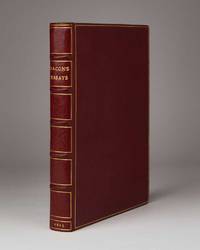
2124917London: John Haviland for Hanna Barret and Richard Whitaker. 1625. 4to. Twentieth-century crushed red morocco by Sangorski & Sutcliffe front turn-in signed in gilt ruled in gilt spine lettered directly in gilt and gilt-ruled in compartments raised bands edges gilt turn-ins richly gilt; pp. 9 1 blank 340; bound without blank leaf A1; A2-A4 a2 B-Z4 2A-2V4 2X2; hinges cracked but holding firm slight offsetting to endpapers; sporadic light spotting heavier to quires and 2K-2L uniform light toning small rust-mark to ff. O4-P2 with resultant hole to P2 touching two characters; else a handsome copy.Handsome first issue of the first complete edition of Bacon's Essayes enlarged 'both in Number and Weight . So that they are indeed a New Worke' the last edition of the work to appear in his lifetime.First published in 1597 as a modest octavo collection of ten texts Bacon's Essayes was successively enlarged and revised over nearly three decades. The present 1625 edition the twelfth overall is the first to contain the full complement of fifty-eight essays and represents the definitive form of one of the great monuments of English prose. This is the first issue with 'newly enlarged' on the title-page and Whitaker's name in the imprint. In addition to nineteen new essays this edition presents a completely revised version of the whole collection. Earlier essays were carefully reworked: phrasing was refined illustrative material drawn from his reading introduced and arguments expanded by the addition of sentences or whole sections. Several pieces were entirely recast in a more formal and structured manner while others retain or deliberately recover the spare and aphoristic character of the earliest essays. The work thus displays a deliberate variety of form reflecting both the evolution of Bacon's thought and his sustained experimentation with the genre.Across its successive versions the Essayes reveal an increasing preoccupation with civil life and public affairs shaped by changing political circumstances as well as by Bacon's own career as lawyer courtier statesman philosopher and moralist. Several of the new essays address matters of immediate relevance to the reign of James I including economic policy in 'Of Usury' and colonial enterprise in 'Of Plantations' while 'Of Revenge' reflects contemporary concern with duelling. Elsewhere existing essays are enlarged in ways that sharpen their political application: 'Of the true Greatness of Kingdoms and Estates' expands its consideration of military strength; 'Of Nobility' develops its treatment of the relationship between aristocracy and crown; and 'Of Empire' gains a substantial new section examining the prince's dealings with the various estates of the realm and the dangers attendant upon a failure of prudent governance.Bacon himself took a close interest in the production of the volume intervening in the printing process to make stop-press corrections. The 1625 edition 'is the text most commonly reprinted today. For this reason it ranks in importance with the first of 1597' Pforzheimer.Hanna Barret was seemingly the widow of William Barret; she 'published several works - notably the productions of Montaigne Bishop Hall Sandys and Bacon - between the years 1608 and 1624. Hanna Barret either retired from business or died in 1625 for we do not after that date meet with any examples of her publications' Shakesperiana V 1888 p. 479.Provenance: Thomas Burdett Money-Coutts 7th Baron Latymer 1901-1987 his sale Sotheby's 15 December 1988 lot 1 with loosely inserted catalogue cutting.ESTC S124226; Gibson 13; for the second issue see Pforzheimer 30 and Gibson 14. hardcover
16056318London: Henrie Tomes 1605. First edition. The only work Bacon ever published in English the "Advancement of Learning" was his first statement of the scientific method as a philosophical position and of his massive plan to survey all human knowledge paving the way for the great encyclopedias of the Enlightenment. The book was published into a world that considered "learning" a matter of memorization of Aristotelian texts. "The Advancement of Learning" changed that arguing that the only knowledge of importance was that which could be discovered by observation that is 'empirical' knowledge rooted in the natural world. . Small quarto 19cm; 1 45 118 i.e. 121 leaves without the final blank and added leaves of errata at end that are present in some copies "not often found" according to Gibson. Numerous errors in foliation. In recent tan calf tooled in blind in period style by Pat M. Bruno bookbinder's ticket. Pages evenly toned with light scattered foxing especially on first and last leaves. Marginal paper repairs in last two gatherings. Pages trimmed close affecting shoulder notes. Provenance: British antiquary Francis Kilvert 1793-1863 his signature mounted along with letter of presentation from Kilvert to his contemporary antiquary James Heywood Markland bound in "Knowing your taste for literary curiosities I venture to beg your acceptance of what I believe to be the editio princeps of Lord Bacon's Advancement of Learning." References: STC 2nd ed.; 1164; Gibson "Francis Bacon a bibliography" 81; Pforzheimer; 36p Norman 97. Henrie Tomes unknown books
16269176<p>Gilt paneled full red morocco; five raised bands; gilt particulars to spine. Marbled endpapers and heavily gilt dentelles. First edition first issue with printed title dated 1626. Rebacked portrait frontispiece and additional engraved pictorial title dated 1627. The "New Atlantis" bound to rear with its own pagination and title page. Edward Micholls Henriques' armoreal bookplate to front pastedown; John Crooks signature above frontis; Richard Rockliffe signature to second Title. Frontis portrait rebacked see images 1 & 5 with restoration to borders see image5. Light moisture marks to occasional page edges. 14 266 14 47 3 pages. This copy trimmed to 7 x 10.25 inches and five blank leaves as well as blank fly leaves removed at time of rebinding.</p><p>Blank Engraved 1626 Title Engraved 1627 Title Blank 1626 Title Blank Two page Dedication; A1-I4; K1-L2; L4-T4; V1-V4; X1-Z4; Aa2-Dd2; Dd4-Ll4; Mm2-Nn-2; a1-g3</p> Printed by J. H. [John Haviland] for William Lee at the Turkes Head in Fleet-Street hardcover
05025Oxford: Printed by Leon: Lichfield. for Rob: Young & Ed. Forrest 1640. First Complete English Edition of Bacon's "De Augmentis Scientiarum" <br/><br/>BACON Sir Francis. Of the Advancement and Proficience of Learning or the Partitions of Sciences IX Bookes Written in Latin by the Most Eminent Illustrious & Famous Lord Francis Bacon.Interpreted by Gilbert Wats. Oxford: Printed by Leon: Lichfield Printer to the University for Rob: Young & Ed. Forrest 1640. <br/><br/>First edition second issue with the colophon dated 1640 and with the penultimate line of the dedication on ¶2 verso without the quotation "his spacious spirit not thus bounded." the recto of C3 reading at foot "Fama Baconi" and with "Marginal Corrections" on the recto of Qqq2 occupying eight lines re-set in larger type but without any addition to text. <br/><br/>Folio 11 3/16 x 7 inches; 284 x 178 mm. 34 60 14 352 351-477 1 blank 20 pp. Engraved frontispiece portrait and engraved title by William Marshall. Engraved vignette head-piece and numerous woodcut head- and tail-pieces and initials. <br/><br/>Contemporary sprinkled calf covers ruled in blind. Spine with five raised bands ruled in blind decoratively gilt in compartments light brown morocco label lettered in gilt gilt ruled board edges all edges stained red. Front joint with 3 1/2 split at top but still quite sound. Some occasional spotting light browning and faint dampstaining in several outer margins. Armorial bookplate maybe of Edward Bligh Lord Clifton on front pastedown. Early ink signature "R. Wingate" on verso of engraved portrait. Old booksellers' printed description on rear pastedown Frank Hammond 1952 £15. A quite spectacular and totally untouched example of this great work.<br/><br/>"Bacon conceived a massive plan for the reorganization of scientific method and gave purposeful thought to the relation of science to public and social life. His pronouncement ‘I have taken all knowledge to by my province' is the motto of his work.His ambitious proposal was: ‘a total reconstruction of sciences arts and all human knowledge.to extend the power and dominion of the human race.over the universe'. The plan for this was to be set out in six parts" Printing and the Mind of Man 119 describing the 1620 Instauratio Magna or Novum Organum. <br/><br/>Of the Advancement and Proficience of Learning is the first complete English edition of the first part of Bacon's plan "a complete survey of human knowledge and learning which was expounded in the De Augmentis Scientiarum 1623 a greatly extended version of The Advancement of Learning 1605" Printing and the Mind of Man. <br/><br/>Francis Bacon 1561-1626 1st Viscount St Alban Kt PC QC also known as Lord Verulam was an English philosopher statesman scientist orator and writer who is considered one of the fathers of modern science. The scientific classification bacon sets forth in this work changed the way we look at the world serving as a basis for Denis Diderot's renowned eighteenth-century encyclopedia of the sciences arts and crafts. His written works continue to be extremely influential especially regarding the philosophy and practice of the scientific method. Of the translator Gilbert Watts Wood says that he had so smooth a pen in Latin or English that no man of his time exceeded him" D.N.B.<br/><br/>Gilbert Watts d. 1657 "translated Bacon's ‘De Augmentis Scientiarum' and his rendering called ‘Of the Advancement and Proficience of Learning of the Partitions of Sciences'. was of highly praised on its appearance" D.N.B. <br/><br/>Perhaps belonging to Edward Bligh Lord Clifton. Born in 1795 he attended Eton College and Christ Church Oxford and served as MP for Canterbury from 1818 until 1830. He was styled as Lord Clifton until 1831 when he succeeded his father as 5th Earl of Darnley. He was Lord Lieutenant of Co. Meath from 1831 until his death in 1835. The Darnley family seat of Cobham Hall in Kent was sold in 1955.<br/><br/>Gibson 141b; Honeyman 185 first issue; Madan I p. 217; STC 1167.3. Oxford: Printed by Leon: Lichfield... for Rob: Young, & Ed. Forrest, 1640 unknown books
16187294JUSTIFICATION FOR RALEIGH'S EXECUTION<br /><br /><b>BACON SIR FRANCIS and King James I. </b><i><b>A Declaration of the Demeanor and Cariage of Sir Walter Raleigh Knight as well in his Voyage as in and sithence his Returne; And of the true motives and inducements which occasioned His Maiestie to Proceed in doing Iustice upon him as hath bene done.</b></i><br /><br />Extra <b>illustrated </b>with full-page frontispiece portrait of Raleigh. 8vo. Bound in full modern calf gilt lettering on spine. London Printed by Bonham Norton and John Bill<b> 1618. First Edition. First Issue.</b> <br /><br /><b>With an early 17th-century inscription on the title page:</b> "<i>From his very much esteemed friend Raleigh</i>." It is thought that this might be an inscription by Raleigh's cousin George. The inscription is slightly faded from having been lightly washed. <br /><br />This is the official apologia for Raleigh's execution at the order of King James I. It was composed largely by Francis Bacon but also by the other commissioners who tried Raleigh and with additions by King James himself. It was published only a few months after the events it describes and as quickly as possible following Raleigh's beheading. <br /><br /><br />Starkey's article on the publication history of this book published in '<i>The Library'</i> in September of 1948 defined the first issue in conformity with this copy. His analysis is generally considered to supersede Pforzheimer's earlier analysis as well as that of the first edition of STC both of which identified a different first issue. Since Starkey's article STC has revised its entry assigning first issue priority to the issue offered here. <br /><br />Bacon began his prosecution by asserting that it was not ever a Sovereign's duty to justify himself to his people but that Raleigh's final speech had made it necessary to explain why his execution was deserved. Bacon then helpfully revised King James' assent to Raleigh's disastrous expedition to Guiana to conform to a magnanimous gesture. James had not it turned out believed in the existence as such of a 'City of Gold' but had humored and indulged Raleigh because of his influence and popularity. As it is written in this work probably by Bacon: "<i>Sir W. Rawleigh had so inchanted the world with his confident asseveration of that which every man was willing to beleeve as his maiesties honour was in a manner ingaged not to deny unto his people the adventure and hope of so great Riches to bee sought and atchieved at the charge of Voluntaries.</i>" <br /><br /><br />The work includes in full and for the first time in print the commission given to Raleigh for his Voyage and gives an account of how he betrayed this commission. Finally it gives a short account of Raleigh's voyage and supposed misdeeds as well as a detailed account of Raleigh's return and his purported attempts to escape. <br /><br />The volume is complete save the initial blank leaf which is absent from nearly all copies. The upper margin is trimmed a little closely touching some of the page numbers o/w a fine clean copy. <br /> Bonham Norton and John Bill hardcover
165952245<p>London printed for Simon Miller at the Starre in St Pauls Church-yard 1659. FIRST ENGLISH EDITION 1659 small book 12mo approximately 130 x 80 mm 5¼ x 3 inches pages: 12 1-51 plus 7 pages of publisher's adverts endpapers replaced at sometime collates as ESTC R10803. Bound in full calf rebacked using original spine gilt title marbled endpapers. Slight rubbing to hinges tips of corners worn with board just showing top margin slightly trimmed affecting running title on 9 pages pale browning to title page and following page tiny rust hole to second page of adverts affecting 1 word recto and 1 letter veso pages 17-19 have neat old ink name against the experiment otherwise a very good copy. A student of Aristotle Roger Bacon was one of the earliest European proponents of experimental research. His writings are also notable for including descriptions of vehicles flying machines diving bell etc. See: A Catalogue of Printed Books in the Wellcome Library Volume 2 page 83; George Thomason Catalogue of books relating to the English Civil War Volume 2 page 274 E. 1932 1. MORE IMAGES ATTACHED TO THIS LISTING ALL ZOOMABLE FURTHER IMAGES ON REQUEST. POSTAGE AT COST.</p> London, printed for Simon Miller at the Starre in St Pauls Church-yard, 1659. hardcover
197845158CARLSEN 1978. 1. softcover. CARLSEN paperback
1613319858London: John Beale for John Jaggard 1613. Beale piracy with "Aturney" on title-page. Title within border of printer's ornaments head- and tailpieces woodcut initials "Of the Colours" section title. 232 pp. Collation: A2-O8 P3 lacking blanks A1 and P4. Small 8vo. Contemporary vellum manuscript title on spine. Title and terminal leaf soiled and worn with some small chips at edges small void in the title touching the ornamental border two small voids in terminal leaf costing a couple letters. Beale piracy with "Aturney" on title-page. Title within border of printer's ornaments head- and tailpieces woodcut initials "Of the Colours" section title. 232 pp. Collation: A2-O8 P3 lacking blanks A1 and P4. Small 8vo. Beale Pirated Edition of Bacon's Essayes. There were three editions of Bacon's Essayes dated 1613 with a Jaggard imprint. The first printed by Jaggard after the 1612 Beale edition of the Essayes has the spelling "Atturny" for "Attorney" on the title-page. The other two printings which spell "Attorney" as "Aturney" as here and "Atturney" are in fact counterfeit editions printed by the same John Beale whose 1612 edition stood as the model for Jaggard's 1613 edition. There is some debate about Jaggard's right to print the Essayes as he never registered the work with the Stationers' Company see Pforzheimer 29 for the arguments.<br/><br/>The Essayes of statesman and philosopher Francis Bacon 1561-1626 treat moral and political topics in "a terse aphoristic style . which Bacon conceived as a genre setting down discrete observations on life and aspiring to some kind of objective validity" ODNB. "In an age of complicated and superficial verbiage Bacon turns the licence of imaginative and allusive expression into an instrument of accurate and chastened thought" Cambridge History of English and American Literature. The Essayes were originally circulated in manuscript among Bacon's friends - the threat of a pirated edition by Richard Seeger lead to Bacon entrusting the work to Humfrey Hooper for publication in 1597. ESTC S100361; Gibson 9; Pforzheimer 29 [John Beale] for John Jaggard unknown books
1613319858London: John Beale for John Jaggard 1613. Beale piracy with "Aturney" on title-page. Title within border of printer's ornaments head- and tailpieces woodcut initials "Of the Colours" section title. 232 pp. Collation: A2-O8 P3 lacking blanks A1 and P4. Small 8vo. Contemporary vellum manuscript title on spine. Title and terminal leaf soiled and worn with some small chips at edges small void in the title touching the ornamental border two small voids in terminal leaf costing a couple letters. Beale piracy with "Aturney" on title-page. Title within border of printer's ornaments head- and tailpieces woodcut initials "Of the Colours" section title. 232 pp. Collation: A2-O8 P3 lacking blanks A1 and P4. Small 8vo. There were three editions of Bacon's Essayes dated 1613 with a Jaggard imprint. The first printed by Jaggard after the 1612 Beale edition of the Essayes has the spelling "Atturny" for "Attorney" on the title-page. The other two printings which spell "Attorney" as "Aturney" as here and "Atturney" are in fact counterfeit editions printed by the same John Beale whose 1612 edition stood as the model for Jaggard's 1613 edition. There is some debate about Jaggard's right to print the Essayes as he never registered the work with the Stationers' Company see Pforzheimer 29 for the arguments.<br /> <br /> The Essayes of statesman and philosopher Francis Bacon 1561-1626 treat moral and political topics in "a terse aphoristic style . which Bacon conceived as a genre setting down discrete observations on life and aspiring to some kind of objective validity" ODNB. "In an age of complicated and superficial verbiage Bacon turns the licence of imaginative and allusive expression into an instrument of accurate and chastened thought" Cambridge History of English and American Literature. The Essayes were originally circulated in manuscript among Bacon's friends - the threat of a pirated edition by Richard Seeger lead to Bacon entrusting the work to Humfrey Hooper for publication in 1597. ESTC S100361; Gibson 9; Pforzheimer 29 [John Beale] for John Jaggard unknown
16183463<p>London: Bonham Norton and John Bill 1618. Rare first edition first issue of the defense of James Is execution of Sir Walter Raleigh written by Francis Bacon and with according to Bacon very material additions by the king himself. The work describes the circumstances surrounding Raleighs final voyage to America in 1618 with the purpose of locating a fabled gold mine and includes the text of Raleighs commission. In the event his expedition ended up seizing the island of St. Thomas and killing its Spanish governor an ostensible act of war against Englands ally. Back in England Raleigh who had already been sentenced to death in 1603 on another conviction was tried by a commission headed by Bacon and executed in October 1618. The English public was appalled: To sacrifice to a concealed enemy of England the life of the only man in the nation who had a high reputation for valor and military experience was regarded as meanness and indiscretion and the intimate connections which the king was now entering into with Spain being universally distasteful rendered this proof of his complaisance still more invidious and unpopular David Hume History of England. The present volume is the governments hasty attempt to justify the execution. Bacon as a member of the council that had sentenced Raleigh appears to have been the main author. In a letter to a friend he mentioned the work and the kings input: We have put the Declaration touching Raleigh to press with his Majestys additions which were very material and fit to proceed from his Majesty cf. Pforzheimer 819. The work is known in at least two issues a first issue of 63 pages and a second of 68. STC and Pforzheimer originally took the present to be the second issue but the STC has since revised its opinion based on the research by Starkey published in his Library article of 1948. STC 2nd ed. 20652.5; Gibson Francis Bacon 369c; Starkey The printing of a declaration of the demeanor and carriage of Sir Walter Raleigh 1618 The Library 5th series 3 1948 124-34. 4to. 16.6 x 11.4 cm 4 63 1 pp. including initial blank signed A in a woodcut tailpiece. Bound in later paneled calf title stamped on spine lower portion of spine damaged slightly worn at extremities. INTERNAL CONDITION Generally very good.</p> Bonham Norton and John Bill
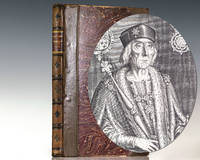
1622114526London: Printed by Stansby for Matthew Lownes and William Barret 1622. Scarce first edition first issue of Sir Francis Bacon's influential history of the reign of King Henry VII with "Highnesse" at the conclusion of the dedication and “souldiers†3 line 12 Pforzheimer 32; STC 1159. Quarto bound in three quarters calf over marbled boards with tooling to the spine in six compartments within raised bands red morocco spine label lettered in gilt all edges red woodcut frontispiece portrait of Henry VII elaborate architectural borders to the title page woodcut headpieces and initials. From the library of book collector Frederick Spiegelberg with his bookplate to the pastedown. In near fine condition exceptionally clean internally. Published shortly after the end of his career as Lord Chancellor and release from the Tower of London Bacon's Historie set a new standard for historical accuracy particularly in regards to its subject. “None of the histories which had been written before conveyed any idea either of the distinctive character of Henry VII or the real business of his reign. Every history that has been written since has derived all its light from this and followed its guidance in every question of importance; and the additional materials which come to light from time to time and enable us to make many corrections in the history of the events only serve to confirm and illustrate the truth of its interpretation of them†DNB. Printed by Stansby for Matthew Lownes and William Barret hardcover
419681689 1694 1696. thick Folio 33cm. pp.12 668 673-676 669-672 677-14021403-1406 1415-1584 & pp.130; & pp. 32 i.e. 64 11. Signatures: 6 A-2E6 2F2 2F4 2F3 2F5-316 3K4-3P4 3Q2 3Q3 3Ql 3Q4 3R- 4H4 I6; 2 2 A-2G2 l; 32 - 2 1. ~ ~ In contemporary full vellum over wood boards some dust soiling titles in red and black rubricated printed in double columns woodcut printer's devices on titles early ownership signatures on top and bottom title page margins head and tail pieces throughout rear past-down and fly-leaf have ink notations notes and small ownership stamp on front paste-down endpaper lower fold over vellum edges onto the boards open make the wood boards visible along those edges foxing throughout but text is readable clear throughout ms spine title somewhat worn a few dark dust staining on the spine which is common with early vellum a very good sound copy. ~ ~ Works separately located at." BL BNF DNB GBV and BVB; European Americana 696/104 Grosser. Francis Bacon described by DNB as "the British Socrates "was educated at Cambridge and studied law at Gray's Inn. He was elected to Parliament during the contentious period of religious division and he wrote many opinions on the issue which he hoped would bring him favour with Queen Elizabeth. He allied himself with the Earl of Essex but the friendship was tested many times over the years with both men having alternating high profiles at Elizabeth's court. Bacon was a prolific writer not only in parliamentary opinions and on works of law but he also wrote literary scientific and philosophical essays. ~ Simon Johann Arnold's edition of Bacon's collected works rendered in Latin from the original English. First published in 1665 this more complete edition features an array of Bacon's work concerning philosophy literature and science. ~~ Samuel Grosser was a classical scholar and member of the Berlin Academy of Sciences. He was rector of a school in Gorlitz Germany for more than 40 years and wrote a number of works related to political history. This work gives a synopsis of pre-18th century European and American geographical and political history. Christoph Schrader was an educator and inspector general of schools in the Duchy of Brunswick- Wolfenbiittel. He contributed in large measure to the pedagogical structure of the principality after the Thirty Years' War. This work is a chronological guide to historical events from the birth of Christ to 1688. 1689, 1694, 1696 unknown
16246319Paris: Pierre Mettayer 1624. Second Printing. Second printing after the London edition the previous year and the first European printing of Bacon's "De augmentis scientiarum." Effectively a greatly expanded version in Latin of his "Advancement of Learning" 1605 this is the book that in its Paris printing spread the word of the scientific method across Europe influencing Descartes and the philosophers of the Enlightenment Locke Leibniz Huygens and Voltaire. . Quarto 22 cm; 16 540 pages. Woodcut initials and ornaments. Roman and italic type. Woodcut printer's device on the title-page. In contemporary full brown plain leather boards spine with five raised bands panels decorated in gilt with title stamped in gilt directly on spine "Verulami de Augm. Sc.". Ownership inscriptions on title page dated 1724. Text unmarred. References: Gibson "Bacon" 130. Pierre Mettayer hardcover books
19752446London: Thames and Hudson 1975. First edition. Original stiff paper covers. Very Good. FIRST EDITION OF BACON'S MOST REVEALING BOOK AN ASSOCIATION COPY INSCRIBED BY BACON ON HALF-TITLE: "For Erica Spender / with all my best wishes / Francis Bacon". Interviews with Francis Bacon is the most important source we have for understanding Bacon's art and philosophy. Through Bacon's responses to the influential art critic and Bacon scholar David Sylvester's provocative questions we gain invaluable insight into the one of the greatest artistic minds of the twentieth century.<br /> <br /> An important association copy:<br /> <br /> This copy was given by Bacon to Erica Erika Haarman Spender. Erica Spender was the widow of Michael Spender 1906-1945 and sister-in-law of the poet Stephen Spender. Stephen Spender was a prominent figure in Francis Bacon's circle and Erica Spender was first introduced to Francis Bacon by him.<br /> <br /> Erica Spender later joined Marlborough Fine Art in London to run its the Antiquarian Book Department. At that time Francis Bacon was represented by Marlborough Fine Art and it was during this period that Erica Spender became Bacon's friend sharing a commonality of cultural artistic and philosophical interests. Bacon was represented by Marlborough Fine Art from 1958 until his death in 1992. The relationship was greatly beneficial to Bacon as Marlborough worked closely with the artist to successfully enhance his international reputation.<br /> <br /> Complete with 94 black-and-white illustrations. London: Thames and Hudson 1975. Quarto 8x11 in; 20.5x27.5 cm original pictorial stiff covers. A few tiny creases to cover a hint of toning to rear panel as often; generally a fine copy. RARE SIGNED. Thames and Hudson unknown books
16246319Paris: Pierre Mettayer 1624. Second Printing. Quarto 22 cm; 16 540 pages. Woodcut initials and ornaments. Roman and italic type. Woodcut printer's device on the title-page. In contemporary full brown plain leather boards spine with five raised bands compartments decorated in gilt with title stamped in gilt directly on spine "Verulami de Augm. Sc.". Ownership inscriptions on title page dated 1724. Text unmarred. References: Gibson "Bacon" 130. <br /><br />Second printing after the London edition the previous year and the first European printing of Bacon's "De augmentis scientiarum." Effectively a greatly expanded version in Latin of his "Advancement of Learning" 1605 this is the book that in its Paris printing spread the word of the scientific method across Europe influencing Descartes and the philosophers of the Enlightenment Locke Leibniz Huygens and Voltaire. Pierre Mettayer hardcover
1985TH253048Harry N Abrams New York 1985. 1st Edition. SOFTCOVER. Inscribed and signed by Francis Bacon in pencil on the half title leaf below his printed name. Large heavy Quarto size 4to. in colour printed stiff card covers 246pp including approx 110pp of finely printed large full page colour plates plus 21 large foldout leaves for the triptychs and an extensive bibliography at the rear. Bacon was almost always happy to sign books and catalogues but he was rarely asked so signed items are uncommon __CONDITION : An exceptionally well preserved AS NEW unread or barely read copy in an AS NEW complete Dust Jacket. An excellent copy. __NOTE Due to size and/or weight posting to some destinations outside the UK will cost more than the shipping price shown. If so orders made by card will only be completed after you have approved any extra cost. . . . . . . . . . . . . . To see more of our Art Monographs etc type DbbARTIST in the Keywords search box __We always ship in PROTECTIVE CARD PARCELS Harry N Abrams, New York paperback
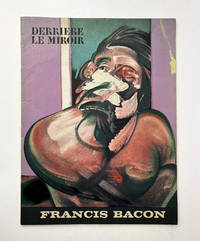
20341Paris: Maeght Editeur. 1966. First edition. First edition. Inscribed by Francis Bacon to the director of the Tate Gallery. Publisher's original colour lithograph card covers. The contents with five single sheet colour lithographs and one folding triptych colour lithograph loose as issued. Further illustrations throughout. The text by Michel Leiris and an interview with Bacon by David Sylvester is in French. An excellent near fine copy the covers without tears or creasing the contents bright throughout. A very attractive complete example of the Francis Bacon issue of Derriere Le Miroir. Inscribed by the artist in green pen on the inside cover "To Norman Reid / with all my best wishes / Francis Bacon". A fabulous association copy. The recipient Sir Norman Reid served as the Director of the Tate Gallery from 1964 to 1980. During his 16 years as Director through major acquisitions and ground-breaking exhibitions he transformed an English institution into an internationally acclaimed museum recognised as one of the leading museums of modern art in the world. A trained painter himself Reid formed strong relationships with several major artists that led to important works being donated to the Gallery. Mark Rothko's Seagram murals and work by Barbara Hepworth Ben Nicholson Naum Gabo and Henry Moore were all gifted to the Tate largely as a result of the personal respect the artists had for its Director. Notably the year of this publication and presumably Bacon's presentation inscription coincides with the Tate's first purchase of a Francis Bacon painting Portrait of Isabel Rawsthorne 1966. Further details and images for any of the items listed are available on request. Lucius Books welcomes direct contact with our customers. Paris: Maeght Editeur. 1966 unknown
1975BACONFRA001782Thames and Hudson London. 1975. First edition. Quarto. 128 pages. Numerous black and white illustrations. Colour pictorial card wrappers.Presentation copy from the artist inscribed on the half-title page: ''For Peter Owen with all best wishes - Francis Bacon''. Owen had a flat next door to Bacon's studio and the two men became friends and drinking partners at the French house in Soho. Bacon once described Owen with only slight exaggeration as ''the only publisher in England who produces anything interesting''.Head of spine slightly scuffed. Near fine. Thames and Hudson, London. unknown
19348376London: J. Weiner for Roadway Publications 1934. Quad royal station wall map 101.5 x 127 cms 40 x 50 inches printed in colours blank verso; an extremely detailed map of central London published for display in stations across the Underground network. The first edition of this map was printed in 1932 but the introduction of Beck's diagram in 1933 did not obviate the need for geographically accurate maps which pinpointed the location of Undergound stations in the central area in relation to the surface topography. The lines themselves though colour-coded are given minimal prominence so as not to disrupt the street plan. The red discs denoting stations are in the style of the earliest roundels introduced in 1908 and superseded by the modern bar and circle bullseye in 1917. In the context of this map even in minute form they prove a highly effective means of drawing the eye to the stations without intruding greatly on the surrounding cartography. The map was printed under licence from G.W. Bacon & Co Ltd a firm noted for its large-scale mapping of London whether in the form of folding maps or the detailed Atlases of London and Suburbs published from the 1880s onwards. Map J. Weiner for Roadway Publications, unknown
1971TH216649Thames & Hudson London 1971. 1st Edition. HARDCOVER. This copy boldly signed by Francis Bacon on the front blank fly-leaf no other marks or inscriptions. The first substantial monograph on Bacon. 1st printing. Heavy 4to. in dark brown cloth gilt lettering to spine gilt embossed motif to front cover 242pp including numerous frontispiece and fold-out colour plates index. Supplied with provenance __CONDITION : An extremely well preserved FINE very clean and tight copy still close to new hint of tanning to leaves in an very faintly tanned but otherwise AS NEW complete Dust Jacket. An excellent copy. . NOTE: Depending on destination this item may require an extra payment for insurance. If so orders made by card will be completed only after you have approved any such extra cost. __To see more of our Art Monographs etc type DbbARTIST in the Keywords search box __We always ship in PROTECTIVE CARD PARCELS Thames & Hudson, London hardcover
162524374London: Printed by John Haviland for Hanna Barret and Richard Whitaker 1625. Hardcover. First issue of the first complete edition of the Essays and the last edition to appear during Bacon's lifetime. It "contains fifty-eight essays and is the text most commonly reprinted today. For this reason the present edition ranks in importance with the first of 1597" Pforzheimer. Small quarto somewhat closely trimmed at upper margin; text block measures 18 x 13 cm. In an unsigned 19th century full red leather binding with purple satin ribbon bookmark bound in gilt floral borders spine gilt in six compartments all edges gilt gilt inner dentelles and marbled endpapers unfortunately marred by some uneven darkening to boards and top edge see accompanying images. Lacking original front blank but with added engraved portrait of Bacon by Alexander Bannerman created c. 1784 as frontispiece. Collation matches Pforzheimer 30 in all other respects. Ownership signature dated 1839 on front blank;small area of damage to leaf A3 no loss of text; dampstain visible--primarily on the first and last ca. 15 leaves--at gutter near the base of the spine; otherwise clean. Written in a concise aphoristic style the Essays take both a pragmatic and a philosophical approach to questions of civic and private life morality and the human condition and "can be read as his final comments on the contemporary world of politics" ONB. Printed by John Haviland for Hanna Barret and Richard Whitaker hardcover