[ANONYMOUS]Biblio.com
4 746 résultats
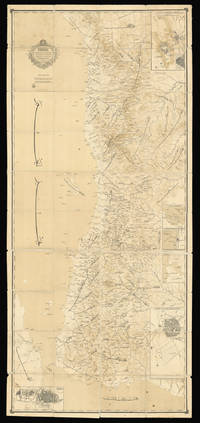
188615648Arabia 1886. 2435 by 1085mm. 95.75 by 42.75 inches. Lithograph dissected and mounted on linen in black and brown sea in sepia wash minor spotting or staining occasional wear to edges. A rare Arabic map of the Red Sea and Hejaz region. Despite the key role that the Arabian Peninsula and waters had played in Mediterranean trade for centuries European cartographers historically paid surprisingly little attention to the area. The lack of rivers and waterways made Arabia particularly difficult to chart but the exploration of the sixteenth and seventeenth centuries did see a number of new maps being produced. These however were generally littered with errors which were then compounded as later mapmakers drew on the inaccurate work of their predecessors. The eighteenth and nineteenth centuries however saw the rapid expansion of European empires giving rise to a renewed interest in foreign cultures and religions a trend that came to be known as 'Orientalism'. As a result explorers and cartographers began to venture further into the Arabian Peninsula undertaking expeditions to trace the deep-rooted incense trails and pilgrimage routes to the holy cities of Mecca and Medina. Maps began to appear showing the Hajj routes across the peninsula. After annexing Arabia during the sixteenth century the Ottoman Empire exerted various levels of influence; the emergence of Al Saud in the eighteenth century however introduced a rival power. In 1744 the founder of the dynasty Muhammad bin Saud had joined forces with the Wahhabi religious movement and their alliance soon lead to the rapid expansion of their territories and power. Although the first Saudi state was overcome by Mohammed Ali Pasha the Ottoman viceroy of Egypt in 1818 a second state continued to exist in the eastern region of Nejd. Al Saud rule over the Emirate of Nejd was contested throughout the nineteenth century by the Al Rashid dynasty. This map shows the southern portion of the Red Sea bordered on the east by the Arabian peninsula. The majority of the map is taken up by Hejaz the western region of Arabia where the two Holy Cities of Medina and Mecca are located. From 1845 Hejaz was under the direct control of the Ottomans governed by an appointed official known as the Sharif of Mecca. Ottoman influence persisted in the region until the early twentieth century when a popular revolt ousted them from power. In 1825 it was conquered by Ibn Saud who combined the kingdoms of Hejaz and Nejd in 1932 to form Saudi Arabia. Al Saud now controlled almost the entire Arabian peninsula with the exception of Yemen; Ibn Saud's attempts to claim Yemeni land sparked the war of 1934. Interestingly on the present map there is no national boundary drawn between Hejaz and Yemen probably because they were both subsumed under Ottoman control as part of the Egyptian Eyalet. The inset maps offer more detailed views of important cities and ports with two of the urban views depicting specific buildings and walls. Further inland where there were fewer significant settlements general areas are identified while towards the coast numerous towns rivers islands and harbours are labelled. At the bottom of the map the Horn of Africa is partially visible separated from Yemen by the Bab-el-Mandeb strait. We have been unable to trace any other examples of this map in institutions or at auction. unknown
1834000044<p>First volume of two 710 p. in later hard cover binding. the most rare and complete edition edited by Abdurrahman al Safti al Sharqawi. vol.1 contains 536 stories. 26.5 x 18 cm. printed in Bulak 1251 1834-1835.</p> Bulak hardcover
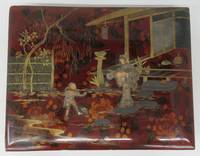
1880127847ca. 1880s-90s. Good. Forty 20.5 x 27 cm albumen hand-coloured photographs pasted into 28 x 35 cm laquer album. Each photo has number and short descriptive caption. Front board of album damaged where ivory was pried off. Board coming loose. Front free endpaper detached and chipped. Tissue guards between plates some detached and folded or chipped. Last three photos detached. Accompanied by one 11.5 cm photograph of woman Bernard & Co. mounted on 19 cm card as well as twenty-one 9 x 13.5 cm photos six with inscriptions on rear. Photos in very fine condition. <br/><br/>These tremendous photographs illustrate Japan during the Meiji Period 1868-1912. During this time period Japan abandoned its centuries-old isolationism and began a period of industrial growth and Westernization. Prince Meiji Mutsuhito encouraged his people to work or study abroad and also invited Westerners to tour his country. During this era Japanese photography began to blossom. A Greek photographer named Felice Beato went to Japan and started documenting the country's landscapes villages and people. When he started to delicately hand colour his black and white albumen prints the Japanese themselves began to take an interest in his work. Soon there were numerous practitioners of the art of handcolouring albumen prints for tourists. These prints are now eminently collectable. The scenes in this album show tea houses restaurants temples fishermen rice growers stores a lantern maker toy shop basket seller farm workers and domestic scenes. The richly decorated album once including ivory in its design was meant for tourists to fill with various personally chosen commercial photos available for purchase. unknown
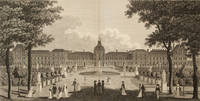
18161435761816. PARIS. Graphic Illustrations of the Most Prominent Features of the French Capital; with Characteristic Figures in the Foregrounds comprised in Twelve Stroke Engravings From Accurate Designs Taken in Paris during the Imperial Reign of Buonaparte. With Descriptive Notices and Interesting Anecdotes. 26 pp. illustrated with 12 double-page engravings. Folio 430 x 380 mm. bound in contemporary French three-quarter black morocco over marbled boards gilt title and floral vignettes on spine paper label with ms. number "20" on front cover and spine. London: Harper and Co. 1816. A fine copy of this extremely rare collection of views of Paris consisting of twelve artistically conceived views of Paris engraved by English artists. The large double-page engravings incorporate local Parisians participating in daily routines within the setting of each view. Panoramic views include: the Military School and the Church of the Invalides; View of Paris from the South Boulevard; View of Paris from Montmartre; South View of the Old and New Louvre; The Mint and The Façade of the Louvre; View of La Place de la Concorde; The Garden of the West Front of the Tuileries; Palace of the Tuileries Facing La Place du Carrousel; Garden of the Tuileries; The Luxembourg or Palais du Senat with the Gardens; The Elysian Fields Distant Gardens of the Tuileries; Entrance to Les Champs Élysées and La Place de la Concorde. Each plate is followed by two pages of text giving historical details and anecdotes about the site illustrated. Minor wear to outer edges of binding plates and text clean. Rare: OCLC lists 6 copies worldwide of which only one is held in America Bowdoin College. hardcover
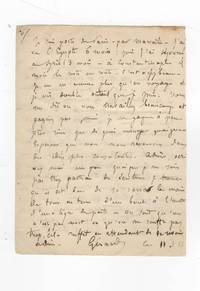
184475148Paris 1844. Fine. Paris 11 février 1844 10.40 x 13.60 cm quatre pages sur deux feuillets Three autograph letters signed by Gérard de Nerval 2 pages signed «Gérard» Théophile Gautier 1 page and a third unsigned letter 1 page penned by a certain «Robert» cf. Nerval's letter Louis Desessart Théophile Gautier's appointed publisher co-published Nervals play Léo Burckart with Barba in 1839. Following financial difficulties he was forced to take refuge «in that sad and charming city of Brussels». The three friends wrote this letter from Paris where they had reunited following Nervals long journey to the East: «I spent six months in Egypt; then three months in Syria four months in Constantinople and the rest en route. Its quite beautiful. I only enjoy myself while traveling and try to live twice as much as I can.» This journey deeply impressed Théophile Gautier who would only travel to Turkey and Egypt years later: «I am in Paris and wish I were in Cairo from where Gérard is returning.» The exoticism of distant lands starkly contrasts with the melancholy and severity of Europe: «How sad Paris is when one returns from sunlit countries.» Nerval And in Paris far from dreams of escape life means toil and melancholy: «We are like sick people who are never comfortable anywhere. I think the good times are gone and the golden hours of the past when we spoke such wise follies will never return. Whats the point of living if we must work and cannot see our friends or write to them or do anything we would like» Gautier The two writers express great compassion for their friends Belgian exile with Brussels appearing as the capital of spleen: «What! Youre still in that sad and charming city of Brussels! . Brussels is even darker poor fellow!» Nerval This joint letter was in fact initiated by «Robert»: «Isnt it true my dear friend that Im quite skilled at making you forget my faults . as a way of making it up to you Im sending you the autographs of two of your . comrades your fondest memories two men of fame who despite all their affection and friendship for you would never have written a word had I not trimmed their quills and handed them paper like sulky children and told them: write at once at once to the exile you love most.» unknown
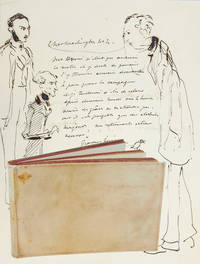
187089636No Location: Sans nom d'éditeur 1870. Fine. Sans nom d'éditeur No Location s. d. 1870 40.5 x 27.9 cm Relié Exceptional album comprising 54 original caricatures some captioned executed in India ink pencil and watercolour including three small pencil sketches on loose leaves together with several blank leaves.This entertaining and highly personal album evidently compiled by an amateur artist appears to chronicle the various adventures and misadventures of a small cast of recurring characters all seemingly connected in one way or another with the French Embassy to the Ottoman Porte as suggested by a piece of official letterhead inserted between two leaves.Contemporary full ivory vellum with yapped edges smooth spine ruled in red a restored split at the head of the spine red fillets framing the boards some marking to the covers comb-marbled endpapers red edges.The album also includes one autograph letter signed in black ink embellished with marginal caricatures addressed to Mr H. Fournier and opening with ""Cher Washington n°2"".The recipient of this satirical illustrated letter appears to be the diplomat Hugues Marie Henri Fournier 18211898 appointed ambassador to Constantinople in 1877.The adventures of the small group identified by captions in black pencil seem to begin in Florence in September 1872 and continue on to Rome.The album includes among other scenes a watercolour depicting the Temple of Vesta.In December 1872 according to an ink caption the groupcomprising the Vicomtes Bresson de Mareuil d'Hauterive and d'Hérissonis caricatured in Rome: at the theatre on the Capitoline Hill on horseback and so forth.A panoramic watercolour likewise satirises the Franco-Prussian War of 1870 and its protagonists.Also portrayed in pencil alongside Fournier are General de Castelbajac and the Baron de Talleyrand.The album further contains a fine pencil portrait of Khalil Bey.The renowned Ottoman diplomat and collector born in Cairo in 1831 and deceased in Istanbul in 1879 had indeed returned to Constantinople in 1872 after his ambassadorship in Vienna 1868 to marry the Egyptian princess Nazli Fazl. In addition to his role in the Crimean War he is remembered for his celebrated art collection which sold at auction in 1868 included works by Courbet among them L'Origine du monde Ingres Delacroix and others.The Comte d'Osmond and Alfred de Courtois are likewise caricatured.The album also features a view titled Pointe imaginaire du sérail and a watercolour depicting a game of lawn tennis.A unique ensemble. Sans nom d'éditeur hardcover
18161435761816. PARIS. Graphic Illustrations of the Most Prominent Features of the French Capital; with Characteristic Figures in the Foregrounds comprised in Twelve Stroke Engravings From Accurate Designs Taken in Paris during the Imperial Reign of Buonaparte. With Descriptive Notices and Interesting Anecdotes. 26 pp. Illustrated with 12 double-page engravings. Folio 430 x 380 mm bound in contemporary French three-quarter black morocco over marbled boards gilt title and floral vignettes on spine paper label with ms. number "20" on front cover and spine. London: Harper and Co. 1816. A fine copy of this extremely rare collection of views of Paris consisting of twelve artistically-conceived views of Paris engraved by English artists. The large double-page engravings incorporate local Parisians participating in daily routines within the setting of each view. Panoramic views include: the Military School and the Church of the Invalides; View of Paris from the South Boulevard; View of Paris from Montmartre; South View of the Old and New Louvre; The Mint and The Façade of the Louvre; View of La Place de la Concorde; The Garden of the West Front of the Tuileries; Palace of the Tuileries Facing La Place du Carrousel; Garden of the Tuileries; The Luxembourg or Palais du Senat with the Gardens; The Elysian Fields Distant Gardens of the Tuileries; Entrance to Les Champs Élysées and La Place de la Concorde. Each plate is followed by two pages of text giving historical details and anecdotes about the site illustrated. Minor wear to outer edges of binding plates and text clean. Rare: OCLC lists 6 copies worldwide of which only one is held in America Bowdoin College. hardcover books
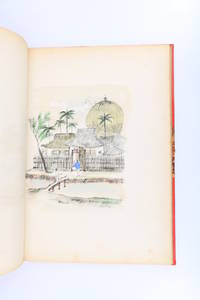
188589859No Location: s. n. 1885. Fine. Superb collection of 49 original watercolours offering a rare and valuable glimpse into Tonkin at the dawn of the French protectorate s. n. No Location s. d. 1885 23 x 32.5 cm Relié Exceptional collection of 49 original watercolours depicting daily life in Tonkin most illustrating rural scenes. These unsigned watercolours each measuring approximately 20 x 15 cm excluding margins are finely executed in Indian ink and watercolour with touches of gouache on paper sheetssome bearing the watermark ""Latune et Cie Blacons."" Contemporary half red cloth binding smooth spine covered in red shagreen some rubbing to the spine boards of marbled paper blue endpapers and pastedowns. Minor foxing to the margins of some watercolours. The scenes depict a variety of subjects: a military post guarded by four soldiers one standing sentry at the entrance; a guard in white uniform holding a rifle with a long bayonet his head covered by a salacco the traditional headgear of Indochinese riflemen; an elderly man seated at a table smoking a pipe while being fanned by a servant; a peasant ploughing with two oxen; a woman praying at a grave; another peasant tilling the soil; two villagers meeting near a small bridge; four people working in a paddy field; a man in formal dress before a temple; three peasants harvesting rice; a cockfight and more. Also depicted are villagers carrying goods or fishing wrestlers performing before a dignitary a child guiding a blind man two labourers transporting stones in a wheelbarrow a procession led by a mounted dignitary carrying a wild boar in a cage a prisoner being flogged another about to be beheaded a hunting scene musicians a woman at a loom villagers at play and so on. Western presence is alluded to only once: an Indochinese sailing vessel flies three tri-colour flags while a steamship probably French makes its way in the background Accompanied by a piece of light brown calfskin 4 x 32 cm blind-stamped with the inscription ""Souvenir du Tonkin 1885-90"". A rare and precious visual record of Tonkin at the beginning of the French protectorate. s. n. hardcover
1840038511United States: M.M. Noah & A.S. Gould 1840. First Edition Thus . Leather Bound. Good/NO Dustwrapper. 8vo - over 7¾" - 9¾" tall. Referred to in Joshua and Second Samuel & APOCRYPHA. Preface by M. M. Noah.THE BOOK OF JASHER or Sefer Hayashar: Faithfully Translated from the Original Hebrew into English. One of the Sacred Books of the Bible with Certificates of authenticity and several Prefaces. APOCRYPHA No title page Second text and also one of the many Sacred Books of the Bible lost hidden or suppressed and omitted from the Bible. Handwritten notes at the beginning of the Apocrypha "FW Briggs Eton College 1831; M.A. Hayes Windsor Cloisters 1834" seem to indicate that this is 2 books bound into one. First Edition Thus. M.M. Noah & A.S. Gould New York USA 1840. ii xxiv 268 232pp hb No Dust-wrapper ornate gilt full calf-leather with raised seams aeg front cover semi-detached covers rubbed & scraped pages browned part of title label missing contents sound scarce book. overall good <br/> <br/> M.M. Noah & A.S. Gould hardcover
183089604s. d. [1830] | 19 x 24.6 cm | Relié
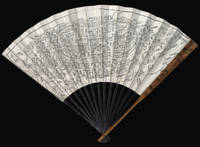
182214997Guangzhou c1822. 302 by 500mm. 12 by 19.75 inches. Woodcut on paper mounted on wooden sticks. A rare Chinese fan depicting the provincial city of Guangdong province which is now part of Guangzhou city. Guangzhoufu Guangzhou prefecture is depicted at the centre encircled by city wall. The names of streets bridges temples forts rivers and mountains are marked in Chinese and represented by two-dimensional diagrams. Several famous sites can be identified on the map for example immediately below the middle of the top rim is depicted a pagoda and marked in Chinese: Wucenglou Five-Storied Pagoda which now is known as Zhenhailou Sea-Guardian Building. It is located in Yuexiu Park in central Guangzhou and now houses the Guangzhou Museum. It was first built in 1380 at the beginning of the Ming dynasty by the Yongjia Marquis Zhu Liangzu . The tower is 92 feet 25 meters in height 102 feet 31 meters in width and 52 feet 16 meters in depth. Above the lower rim to the left is a house with two floors symbolising a temple marked as " ". Haitongsi is a Buddhist temple and monastery on Henan Island in Guangzhou. The official English form of the name is 'Hoi Tong Monastery' a transcription of the Cantonese pronunciation of the Chinese translation of the Indian Buddhist monk S garadhvaja. The monastery was first established as the Qianqiu Temple under the Southern Han a tenth century Tang successor state whose capital was at Xingwang now Guangzhou. The walled city lay north of the Pearl River while Henan Island and the monastery lay to its south. By the end of the Ming the temple operated within the private garden of Guo Longyue who was responsible for renaming it after the Buddhist monk S garadhvaja. The temple complex was particularly important to foreign visitors as it was one of the few locations in Guangzhou Canton open to them before the First Opium War. unknown
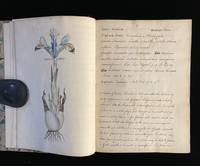
1822013470anonymously hand-printed and illustrated 1822. Hardcover. Near Fine. Replicas of the first 58 volumes of Curtis Botanical Magazine rendered in hand-colored floral illustrations and holographic text edited from and amended to the original text by an anonymous English artistic hobbyist and rebound likely early 20thC in 24 volumes. William Curtis' first volume was published in 1787; Curtis's volume 59 the last in this hobbyist's project is dated 1832 which coincides when the hobbyist concluded his or her work. The magazine continues still under the auspices of Kew Gardens. The hobbyist here started this ambitious undertaking in 1822 which is known from the notation "Commenced 1822" he or she leaves on the title page of the first volume. The ten-year project concluded sometime in 1832 which the last entry is dated. The monumental work results in replications of illustrations and text for 3024 species. The drawing and hand-coloring aspires to the original works of James Sowerby the first of Curtis's artists. The hobbyist here sometimes copies sometimes adapts Sowerby's style; the result though technically primitive in execution is consistently charming. The amateur's colors are not as vibrant as Sowerby's; supplies of high-quality natural pigments would have been limited to the amateurist. Bound-in after Curtis' Volume 42 is the actual published Part 1 of "General Indexes to the Plants contained in the First Forty-Two Volumed of the Botanical Magazine" printed by Stephen Couchman and published by Sherwood Neely & Jones 1816 40 pp and Part II 1817 pp 41 - 111. Most impressive is the hobbyist's holographed index to all Curtis's 53 volumes which runs approximately 200 double-sided pages. These 58 volumes were collected into 24 bound volumes presumably organized by the hobbyist thusly and were professionally rebound in polished black half leather - with five raised bandstitles and devices in gilt to the spine over green/salmon/ black marbleized boards with marbleized edges - by appearances sometime in the first quarter of the 20thC by an anonymous binder. The bindings are of highest quality. Laid-in to Volume 1 is the original bill of sale for the work from Henry A. Martin print dealer and publisher of Washington DC dated 11/24/1916. The original bindings were likely calf which with age would have called for some kind of rebinding here handsomely executed. anonymously hand-printed and illustrated hardcover
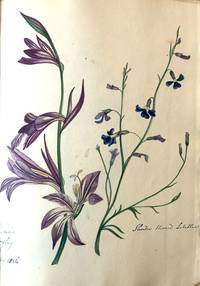
1812G7542<p><b>Original Watercolours of Plants Including American</b></p><p>Small folio; contemp. half calf with title on spine "drawings of plants". Small folio.On front pastedown: "M.H. Speirs 1820.</p><p>Beautiful album with 53 high-quality original watercolour drawings mostly with flower names in English or Latin and mainly dated from 1812 to April 1817. - 2 plates folded in the margins. Slightly foxed. Contemporary half leather spine rubbed.</p><p>Predominantly with flower names in English and Latin and Format ca. 14-24: 10-17 cm; on firm paper chamois format ca. 28 : 18 cm. Illustrations of lilies and aloe as well as <u>numerous American flowers </u>"Virginian Dragonhead" "American Atragen" "Virginian Platonica" and many more "Chinese Epidendrum". <b><br /></b></p>
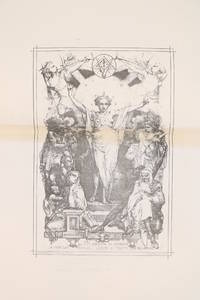
187090176Paris: Teissier et Cie 1870. Fine. ""Extremely rare and probably unique collection of 38 lithographed Masonic plates"" Teissier et Cie Paris s. d. 1870 32.5 x 49.5 cm Relié A probably unique copy comprising pulls of proofs of Masonic illustrations containing 38 plates the majority double-page numbered in red pencil from 1 to 40 discontinuous numbering with bis plates. Not recorded in Caillet or Dorbon. Bound in full black cloth smooth spine no lettering title label pasted onto the upper cover modern binding. A restored tear in the left margin of plate 10 two angular tears in the left margin of plate 12 without affecting the image. Published by the Masonic booksellers Teissier et Cie lithographed by J. Rigal et Cie and in some cases by A. Appert. A highly interesting document on nineteenth-century Freemasonry At the beginning of the volume several plates depicting allegories of Freemasonry are signed Rambert some dated 1862. Issued in folio format the usual issue being small quarto they were intended to illustrate Le Rameau d'or d'Eleusis a work by the Grand Master of the Rite of Memphis one of the Egyptian Masonic rites Jacques-Etienne Marconis de Nègre 1795-1868. The illustrator Charles-Désiré Rambert 1824-1877 is described by Alfred Fournier cited by Beraldi Les graveurs du XIXème siècle vol. XI pp. 167-169 as an ""Hercule à la physionomie singulièrement expressive et étrange : tête de mulâtre rappelant Alexandre Dumas . et des yeux absolument particuliers des yeux d'inspiré"" Other unsigned illustrations relate to models of Masonic diplomas: several plates concern the Grand Orient of Haiti others Rome or Venezuela. The mention ""à effacer"" has been added in pencil on certain lithographs. Bookseller publisher and dealer in Masonic regalia Charles-Adolphe Teissier 1801-1863 was an officer of the Grand Orient de France. After his death his widow and two sons continued the business under the name ""Teissier et Compagnie"" at 37 rue de Grenelle-Saint-Honoré which became 37 rue Jean-Jacques Rousseau in 1868. Both addresses are mentioned in the present collection which may be dated between 1860 and 1870. Teissier et Cie hardcover
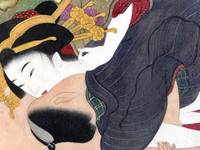
1880859371880. Fine. 1880 33.50 x 45.50 cm relié 12 large paintings on silk: 24 x 34.5 cm depicting couples embracing. These works seem very close to the style of Yamamoto Schoun. A folding collection covered with a patterned green silk fabric. The silk paintings are loosely inserted into movable paper frames. Label on the upper cover missing. Cloth is faded with a few perforations dampstains in the lower part of the upper cover and missing edges. First board is split at the head and foot of the joint. Although the colors are quite varied they all rest on and derive from a dominant pale green the color found on the boards. The palette mixes different shades of green with complementary colors in the clothing red blue-gray. Couples are always clothed with clothing playing a revealing role an integral part of Japanese eroticism. The decor shows a variety of everyday objects such as teapots and boxes. In each of the paintings elements frame and circumscribe the scene: screens sliding walls windows but beyond a perfectly balanced composition: the interiors participate in the unveiling in a staging intended for the gaze. hardcover
1880859371880 | 33.50 x 45.50 cm | relié
184545055Sunflower County Mississippi: Privately printed 1845-1869. 1845-1869. MISSISSIPPI BRAND BOOK. First edition. 12" x 8" quarter leather spine and blue paper over boards n. p. 36 pp. 4 pp. blank 4 pp. All brands and description are in manuscript. This is a most unusual brand book. Some actual brands are shown as drawn and others are described. Some writing on the covers mentions Sun Flower County Mississippi. Perhaps there were ranchers in the vicinity. This is the first and only manuscript brand book we have seen or heard about for Mississippi or a printed version. This manuscript brand book with reference to Sunflower County Mississippi presents numerous hand-drawn brands and descriptions. We are unaware of any printed or manuscript brand books from Mississippi. The period of 1845 to 1869 is very early for any brand book! Sunflower County was formed 15 Feb 1844 from Bolivar County. It was named for the Sunflower River which flows through it. One early settler B.G. Humphries later became the Govenor. Other notable settlers were: James J. Chenning Chewning G.B. Wilds Col. Eli Waits J.Y. McNeill mcMeal Col. Hezekiah McNabb Ezekiel McNabb Mayor Frank Hawkins and Capt John Hawkins. Research of an 1847 tax list and a list of federal land grants given to individuals in the area offer names of early landowners . Several of these names and brands are included in this brand book. lists included Not listed in Adams' Rampaging Herd. We feel this is a very rare brand book. Original blue cover paper is chipped else a very good copy housed in a cloth clamshell case with leather label on the spine and titles stamped in gilt. Privately printed, 1845-1869. hardcover
18209232London 1820. Engraving printed in bistre on linen with contemporary cloth edging tape. A beautiful ephemeral and very rare angling print on linen.<br/> <br/>At the centre of the print is a Hogarthian scene of an angler in his winter closed-season sitting-room. He is laid-up in his arm-chair with gout his foot rests on a gout stool a toddy warms on the grate above a blazing fire whilst he tries to re-live the long-gone halcyon days of summer by fishing for apples in a large coopered barrel full of water. Scattered around him are the accoutrements of his art: creels nets rods an open fly-case. This image is surrounded by a decorative border of scrolling stylised foliage. Beyond this is a surround of 13 ovals each with a picture of a different British freshwater fish giving the fish's name and the season when it can be fished joined to these ovals are shaped 'labels' that give brief details of where and when each fish is to be found what time of day it should be fished for and which hooks and flies/bait should be used. The outermost rectangular border includes the title an oval portrait of Sir Izaak Walton at each corner and a series of shaped boxes containing details of flies and baits under the headings 'Flies' 'Pastes' 'Worms' and 'Fishes and Insects'. Sir Izaak Walton 1595-1683 was the author of the most famous book on fishing and a classic of English literature: The Compleat Angler ; or the Contemplative Man's Recreation. It was written during the horrific English Civil War and was Walton's attempt to draw attention to the benevolence of a simple virtuous life. unknown books
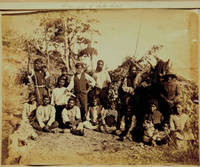
188815347Australia 1888. Wonderful photograph album of Victoria New South Wales and Tasmania with large photographs and manuscript titles. A total of 47 photos with 33 of Victoria 6 of New South Wales 5 of Tasmania 1 of New Zealand and 2 others. Each photograph is lightly tipped on to the album paper with blank verso. Most of the photographs are by an unknown photographer; there are also some signed by J.W. Beattie Thomas Foster Chuck Frank Arnold Coxhead C. Rudd and J.P. possibly John Paine.<br /> <br /> Beginning with a large photograph is of "Aboriginals of Lake Tyers". It is an outdoor view of a family group of aborigines from children to grand parents dressed in western clothing with spear boomerangs and lean-to behind them. Others include some rather poetic views of woodcutters at Black Spur & Fernshaw; a couple of gold mining at Bendigo including Garden Gully United Gold Mining Company with houses in fore and background. <br /> <br /> Melbourne 33 photos including the Empire Building Collins St. West; Prell's Building<br /> corner of Queen St. and Flinders Lane; Austral Chambers Queen St. with Austral Chambers sign and "Offices to Let" by Selby & Co. 97 Queen St.; Grand Hotel Spring St. with carriages at the front; Federal Coffee Palace Collins St. #102 showing electrical workers 3 of whom have climbed electrical poles; "Tuck's Buildings" or Luck's Elizabeth & Flinders St with the caption "Rent of Shop L 22.10 per week"; Government Public Offices Melbourne #48 with a dirt road in the foreground; Melbourne Hospital with a train moving past in the foreground; Centennial Exhibition Procession August 1st 1888 with Victorian Confectioner's Society banner in front; St. Kilda Jetty busy with people fishing; another showing neighboring jetty Hegerty's Railway Baths for Gentlemen and fishermen with the town behind them; The New Prince's Bridge with scattered construction debris; The Melbourne Hotel #10 with the #220 Carlton and Abbotsford tram in the foreground; Collins St. from Elizabeth St. looking east #73 with a busy street scene and a George & George flag flying; Modern Permanent Building Society offices with Kilpatrick & Co. Watchmakers & Jewelers a police box and Auchalps Sales Rooms; Bourke St. Melbourne full length looking west with trams a horse and cart Mayger's Imperial Hotel at the right and Old Whitehart Hotel at the left; Town Hall Melbourne a view looking down with 2 trams & Martin & Leasances Pharmacy sign visible; Elizabeth St. Melbourne a great snap shot view of people traffic a wagon and cart electric lights and a large Cullis Hill & Co. sign; Elizabeth St. Melbourne a snap shot view with street traffic a tram the Sunbeam Tea and Luncheon Rooms in the foreground and Lincoln Stuart & Co. in the distance; Bourke St. Melbourne a snap shot view toward E. A. Petherick Booksellers & Publishers with trams and traffic.<br /> <br /> There are three views of clipper ships - H. M. S. Calliope in Port Philip Hobson's Bay with 3 yachts a tender and row boat; The Liverpool largest sailing ship afloat sailing under the Red Ensign. Steamship Cavo Romano New Orleans Feb 26th 94 docked with several crew sitting on barrels with a tear. <br /> <br /> The NSW photographs are taken in and around Sydney mostly signed "J.P." possibly John Paine 1834 - 1915 including Manly Cove; Harbour from Neutral Bay with a building under construction in the foreground and harbour and ships in the distance; Harbour from Mr McMahon's Hill with flags ferries row boats and sailing ships; Farm Cove with ships and Government House in the distance; Coogee with a hut in the foreground; trams in a turning circle a beach and vacant land in the distance and an unidentified grand public building with a horse and carriage visible. <br /> <br /> The Tasmanian photographs are unsigned. "Port Arthur Tasmania" is a small panoramic view with the Penitentiary ruins of Church and Model Prison noted in the margins. Hobart from the lower slopes of Mt. Wellington overlooking the harbour River Derwent; a beautifully artistic photograph "Glimpse of Port Arthur shewing side entrance to Peninsula & ruined church in distance" is framed by trees and bushes the buildings visible in the distance. <br /> <br /> The photographs vary in size - the largest is 29 x 23 cm; the smallest 9.5 x 15 cm; most are approximately 20 x 15 cm. Most are bright and unfaded while some have some fading. The album is bound in red cloth with title in blue and gold gilt and black decoration at front cover. A little loose in binding with the last few pages blank. Overall a very interesting album in very good condition. Full details of each photo and size available on request. unknown
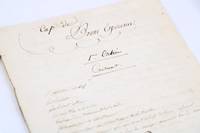
183091260n. l.: s. n. 1830. Fine. s. n. n. l. s. d. 1830 16.3 x 20.6 cm En feuilles sous chemise et étui Complete anonymous manuscript of 23 pages plus title page and table from the first half of the 19th century entitled: Cap de Bonne Espérance. 1er cahier.Our manuscript is presented in a navy blue half shagreen folder marbled paper boards housed in a slipcase edged with navy blue shagreen marbled paper boards.An account of a stopover at the Cape a city under British rule which according to the anonymous author retains many traces of its Dutch past.Description of the town its geographical setting its buildings churches and houses whose cleanliness contrasts with the dirt and the smell of meat prevailing in most of the streets.This is followed by the narrative of an excursion in the surrounding area to Constance where the author appreciates the wine of the proprietors he visits and then of the ascent of the famous Table Mountain overlooking the Cape. s. n. hardcover
1880840941880. Fine. 1880 21 x 24 cm autre Album bringing together 10 original paintings on beige silk in colors mounted on gold paper. The pastedowns of embossed and gold paper with flowers and leaves. The final work of the collection bears 2 red seals. The majority of these collections are never signed due to censorship so it is extremely rare to find a seal therefore the painter's signature. Each painting is a square of silk measuring 16.8x16.8cm. The erotic scenes contain no decor no background concentrating all attention on the couples. 3 however have drapery or a screen. The paintings are extremely stylized and finely executed of great quality. A few fine strokes draw the figures clothed in fabrics that partially cover them. With a few red touches the colors used are browns harmonizing with the beige background. It is almost impossible to date this type of work precisely and it is likely older by several decades although its very refined style seems to reflect the end of the nineteenth century in Japan. Accordion album covered in blue silk with gold motifs. Wooden case in 2 parts 24.5x28.5cm a base and a lid with manuscript writing on the lid. For the album: Rubbed manuscript label. Worn corners with fabric loss. The gold paper with rubbing. In the margins the paintings have some soiling or light dampstains. It is very rare that these collections always hidden from view have preserved their storage box. Compared to the well-known production of erotic prints the paintings while respecting a certain number of codes of Japanese eroticism size of genitals swooning women fabrics partially masking nudity sexual positions. show greater creativity and originality expressing more of the technique and vision of the painter. The series thus demonstrates extreme refinement and great purification especially when compared to shunga from the Edo period. Furthermore even if the erotic scenes respect the codes of shunga representation one can clearly distinguish an evolution in the vision of sexuality: women hold a more equal place and the whole tends more toward harmonious sexuality perfectly rendered in these paintings by the choice of brown gradations punctuated with touches of more violent colors thus representing a form of serenity inhabited by the violence of desire. Shunga is the generic Japanese term designating erotic art it literally means Spring Image spring being a euphemism and figure of speech expressing sexuality. The term Shunga having long been reserved for prints collections or albums have often been designated by the appellation Pillow Books or pillow notes etc. Utamaro: The Song of the Pillow 1788. Precious and rare ensemble. hardcover
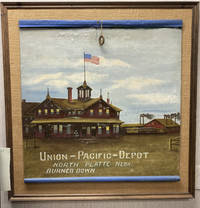
190039803North Platte: Artist Unknown n.d. ca 1900. 1900. First edition. 28" x 28" full color painting of the Union Pacific Railroad's Bailey Yard in North Platte Nebraska. It was named for the president of the Union Pacific Edd H. Bailey. It is the largest railroad classification yard in the world as it is 8 miles long and 2 miles wide. The yard covers 2800 acres and within it are 315 miles of track. Today every 24 hours Bailey Yard handles 10000 railroad cars 3000 of which are sorted in either the eastward or westward yards nicknamed "hump" yards with 120 - 140 trains a day that pass through Bailey Yard. The first train to enter North Platte was on December 3 1866. By January 2 1867 the main line of operations officially commenced in North Platte. From 1873 to 1913 "Buffalo Bill" Cody lived and organized his Wild West Show from his ranch north of the rail yard and transported his show via rail and wagon. In 1897 E. H. Harriman purchased the Union Pacific at an auction held in Omaha Nebraska. The construction of the second main line commenced through North Platte in 1910. This art is painted on a 28" x 28" linen window shade and depicts the Bailey Yard Railroad Depot and hotel both of which burned on November 17 1915. An important painting of the depot and hotel along with train cars and an iron worker's factory building prior to that fire. Minor flaking and an old small repair to the linen else a fine example of both window shade art and a depiction of the historically important Union Pacific Rail Road Depot at North Platte Nebraska. Artist Unknown, n.d. (ca 1900). unknown
18500000269Bretagne 1850. Contemporary pebbled green morocco. Very Good. Collection of 119 expertly pressed mounted and labeled marine algae from Bretagne coast circa. Mid 1800's. Small 4to24.5 x 17.2 cm. Contemporayry green morocco binding. Collation: 119 lv each leaf mounted on stub with single labeled specimen. Each specimen is identified with earlier Latin name in black ink and later additions in red ink. All specimens are well preserved and beautifully displayed on the page. Binding has raised bands; title in gilt in upper panel. There is sunning on the spine and along the hinges and edges of boards less so for the later. Minor wear to ends of spine. Monogram "SB" in calligraphic style in gilt in each corner of boards. The inner covers are elaborately detailed in gilt dentils and additional inner borders. Pastedowns and free end papers in fine marble paper. This private collection is the most elaborate that we have had and represents a personal collection of "SB" who has made the presentation of the algae growing along the coast of Britany most appealing and scientifically important. <br/><br/> unknown books
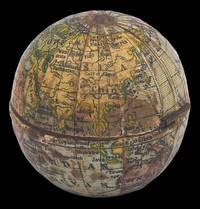
185015729c1850. Diameter: 51mm 2 inches. Sign on the meridian line Globe hand-coloured engraved gores on two concave brass hemispheres hinged containing internal glass inkwell spring mounted seal gilt finish to interior flattened base. With old paper label to base. One or two inkstains. Prior to the widespread use of fountain pens in the late nineteenth century it was common to carry ink while travelling. Portable inkwells also known as travel wells or travellers were devised for this purpose. It was of the utmost importance for the design to prevent the ink inside the travel wells from leaking and the well itself was usually made from glass and concealed within a case. These cases took on many decorative forms including the present example designed as a globe. Geography The cartography is typical of Victorian maps but simplified with no relief shown on the land. The continents and many of the countries are identified by name along with some major rivers. unknown
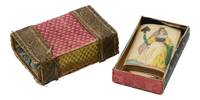
1880140949222France: Unknown publisher 1880. Very Good. A suggestive set of translucent erotic playing cards likely created in France in the mid-19th century. Set consists of 35 hand-colored playing cards 32 of which are from around 1840 featuring 11 court cards 3.25 x 2.25" and three slightly larger cards 3.5 x 2.5" possibly from the late Victorian period. Housed in a much earlier handmade late-18th century sliding box 4.5 x 2.75" made from thin plywood with pasted decorative paper wrapped in voided velvet and trimmed with gold and silver metal silk woven ribbon. They were once a part of The Stuart and Marilyn Kaplan Playing Card Collection. <p>Very Good. Cards are lightly bowed with general wear and light toning; four of diamonds is the most worn with creasing and small spot of loss to one of the corners.The box they are held in is quite fragile with tarnishing to the metal ribbon and slight soiling to velvet boards. <p>Popular in mid-1800s France and often associated with brothels these cheap seemingly innocuous risque novelties were crafted with two pasteboard layers. When held to light favorably candle light they reveal hidden sensual often pornographic images. While the cards inside were economically manufactured the little box they are held in is rather sumptuously bedecked in high quality velvet and expensive gilt metal thread ribbon. The average layman did not have access to trim or fabric as seen here indicating that this may have been owned by a rather wealthy individual. It should be added that sets as generously populated as this even when mixed are uncommon and desirable curiosa objects. [Unknown publisher] unknown