[Anonymous]Biblio.com
237 569 résultats
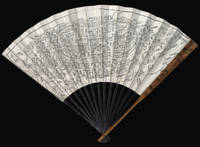
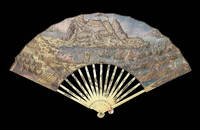
17802221Spain c1780. Folding paper fan with a fine large hand-coloured engraved view of the Siege of Gibraltar with Spanish ships and troops in the foreground the verso with engraved key in Spanish decorated with weapons of war on either side mounted on ivory sticks the ivory sticks decorated in silver and gilt with a fort ship and flag the gaurdsticks carved and pierced and with silver and gilt depicting a ship and drums. The unsuccessful siege of Gibraltar began in 1779 and lasted until February 1783 when the siege was lifted. This fan which it has been suggested belonged to the Earl of Minto is not in the Schreiber Collection. unknown
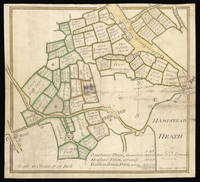
14549mid-18th century. 285 by 315mm 11.25 by 12.5 inches. Pen and ink and wash colour on vellum. A manuscript map of Golders Green extending from Cricklewood to Hampstead Heath now Golders Hill Park. This remarkable map shows the division Golders Green and the surrounding area during the mid to late eighteenth century. The area was divided into three farms: Cowhouse Farm green; Hodford Farm orange; and Golders Green Farm yellow. Each of the farms fields are meticulously laid out with their name and area in acres roods and perches marked. The largest landowners at the time were the Dean of Westminster and the Trustees of Eton College. To the lower right is a table of the total holdings of each farm Golders Green being by far the largest; with the total land of all three farms amounting to just over 470 acres. Common land is marked with a 'X' and amounts to just over six acres. Several buildings are marked on the plan including the Cowhouse Farm and The Cock and Hoop Ale House. In 1896 the authorities closed the Cock and Hoop when it was discovered that the named licensee Mr Robinson had been dead for four years! Eighteenth century manuscript plans of London boroughs are very rare especially on such a large scale. Scale: 10 chains to one inch or 1/8th a mile to one inch. Colloms W & M Kilburn and West Hampstead Past; Howkins F. The Story of Golders Green and its remarkable development London 1923. hardcover
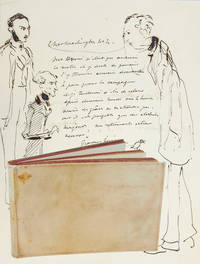
187089636No Location: Sans nom d'éditeur 1870. Fine. Sans nom d'éditeur No Location s. d. 1870 40.5 x 27.9 cm Relié Exceptional album comprising 54 original caricatures some captioned executed in India ink pencil and watercolour including three small pencil sketches on loose leaves together with several blank leaves.This entertaining and highly personal album evidently compiled by an amateur artist appears to chronicle the various adventures and misadventures of a small cast of recurring characters all seemingly connected in one way or another with the French Embassy to the Ottoman Porte as suggested by a piece of official letterhead inserted between two leaves.Contemporary full ivory vellum with yapped edges smooth spine ruled in red a restored split at the head of the spine red fillets framing the boards some marking to the covers comb-marbled endpapers red edges.The album also includes one autograph letter signed in black ink embellished with marginal caricatures addressed to Mr H. Fournier and opening with ""Cher Washington n°2"".The recipient of this satirical illustrated letter appears to be the diplomat Hugues Marie Henri Fournier 18211898 appointed ambassador to Constantinople in 1877.The adventures of the small group identified by captions in black pencil seem to begin in Florence in September 1872 and continue on to Rome.The album includes among other scenes a watercolour depicting the Temple of Vesta.In December 1872 according to an ink caption the groupcomprising the Vicomtes Bresson de Mareuil d'Hauterive and d'Hérissonis caricatured in Rome: at the theatre on the Capitoline Hill on horseback and so forth.A panoramic watercolour likewise satirises the Franco-Prussian War of 1870 and its protagonists.Also portrayed in pencil alongside Fournier are General de Castelbajac and the Baron de Talleyrand.The album further contains a fine pencil portrait of Khalil Bey.The renowned Ottoman diplomat and collector born in Cairo in 1831 and deceased in Istanbul in 1879 had indeed returned to Constantinople in 1872 after his ambassadorship in Vienna 1868 to marry the Egyptian princess Nazli Fazl. In addition to his role in the Crimean War he is remembered for his celebrated art collection which sold at auction in 1868 included works by Courbet among them L'Origine du monde Ingres Delacroix and others.The Comte d'Osmond and Alfred de Courtois are likewise caricatured.The album also features a view titled Pointe imaginaire du sérail and a watercolour depicting a game of lawn tennis.A unique ensemble. Sans nom d'éditeur hardcover
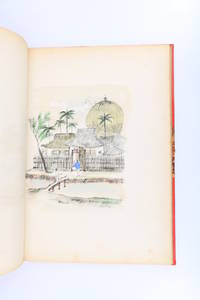
188589859No Location: s. n. 1885. Fine. Superb collection of 49 original watercolours offering a rare and valuable glimpse into Tonkin at the dawn of the French protectorate s. n. No Location s. d. 1885 23 x 32.5 cm Relié Exceptional collection of 49 original watercolours depicting daily life in Tonkin most illustrating rural scenes. These unsigned watercolours each measuring approximately 20 x 15 cm excluding margins are finely executed in Indian ink and watercolour with touches of gouache on paper sheetssome bearing the watermark ""Latune et Cie Blacons."" Contemporary half red cloth binding smooth spine covered in red shagreen some rubbing to the spine boards of marbled paper blue endpapers and pastedowns. Minor foxing to the margins of some watercolours. The scenes depict a variety of subjects: a military post guarded by four soldiers one standing sentry at the entrance; a guard in white uniform holding a rifle with a long bayonet his head covered by a salacco the traditional headgear of Indochinese riflemen; an elderly man seated at a table smoking a pipe while being fanned by a servant; a peasant ploughing with two oxen; a woman praying at a grave; another peasant tilling the soil; two villagers meeting near a small bridge; four people working in a paddy field; a man in formal dress before a temple; three peasants harvesting rice; a cockfight and more. Also depicted are villagers carrying goods or fishing wrestlers performing before a dignitary a child guiding a blind man two labourers transporting stones in a wheelbarrow a procession led by a mounted dignitary carrying a wild boar in a cage a prisoner being flogged another about to be beheaded a hunting scene musicians a woman at a loom villagers at play and so on. Western presence is alluded to only once: an Indochinese sailing vessel flies three tri-colour flags while a steamship probably French makes its way in the background Accompanied by a piece of light brown calfskin 4 x 32 cm blind-stamped with the inscription ""Souvenir du Tonkin 1885-90"". A rare and precious visual record of Tonkin at the beginning of the French protectorate. s. n. hardcover
2024Gyan-9788121256728Gyan Publishing House 2024. In 245 Bindings. Paperback. New. 21.59 x 27.94 x 579.719. English Gyan Publishing House paperback
2024Gyan-9788121256728Gyan Publishing House 2024. In 245 Bindings. Paperback. New. 21.59 x 27.94 x 579.719. English Gyan Publishing House paperback
1840038511United States: M.M. Noah & A.S. Gould 1840. First Edition Thus . Leather Bound. Good/NO Dustwrapper. 8vo - over 7¾" - 9¾" tall. Referred to in Joshua and Second Samuel & APOCRYPHA. Preface by M. M. Noah.THE BOOK OF JASHER or Sefer Hayashar: Faithfully Translated from the Original Hebrew into English. One of the Sacred Books of the Bible with Certificates of authenticity and several Prefaces. APOCRYPHA No title page Second text and also one of the many Sacred Books of the Bible lost hidden or suppressed and omitted from the Bible. Handwritten notes at the beginning of the Apocrypha "FW Briggs Eton College 1831; M.A. Hayes Windsor Cloisters 1834" seem to indicate that this is 2 books bound into one. First Edition Thus. M.M. Noah & A.S. Gould New York USA 1840. ii xxiv 268 232pp hb No Dust-wrapper ornate gilt full calf-leather with raised seams aeg front cover semi-detached covers rubbed & scraped pages browned part of title label missing contents sound scarce book. overall good <br/> <br/> M.M. Noah & A.S. Gould hardcover
3240France c. 1700. Two volumes complete. AN ENTIRELY UNKNOWN UNPUBLISHED AND COMPLETE EXEGETICAL MANUSCRIPT BY A CONTEMPORARY OF BOSSUET CALMET LE CLERC AUSTRUC RICHARD SIMON CAPELLUS GROTIUS AND GUYON. Volume I: 1 leaf; 592 pp. Volume II: 1 leaf; 360 pp; 2 blank leaves; 324 pp. Written in ink in a very fine accomplished almost calligraphic hand on extremely fine thick laid paper. Volume I and the first half of volume II is a verse-by verse commentary on Ezekiel; the second half of volume II is a commentary on selected chapters of Daniel. While this manuscript was created during an important period perhaps the most important period in the history of biblical exegesis it is entirely original and very different from all published exegeses. 4to. BEAUTIFULLY BOUND IN CONTEMPORARY FRENCH CALF SPINES RICHLY GILT IN SIX COMPARTMENTS morocco spine-labels. Marbled endleaves. Minimal wear to extremities of bindings else FINE AND BRIGHT. Unique and important. <br/><br/> France, c. 1700 unknown
171086508Edinburgh: Various. Very Good; Compilation Bound Together of 12 Books/Pamphlets Etc From . Early 1700's About Religious Persecution in Eng. & Scotland. 1710-1717. Leather. PROFESSIONALLY REBOUND IN FINE LEATHER WITH RAISED BANDS GILT LETTERING AND NEW MARBLED BOARDS AND ENDPAPERS. GORGEOUS!! VERY VERY SCARCE!! The title continues: "More particularly her approving of and going into the legal establishment of the Prelatic constitutions of England. The generality of ministers swearing in the Oath of Abjuration to maintain Erastianism Prelacy and English Popish Ceremonies. Non-Jurants joining with Jurants judicially approving that practice to be free of scandal. The Church's establishing tyranny in government against all who will not join in communion with her and approve her practices without redress of grievances. Wherein these and several other causes of withdrawing are proven to be justly chargeable on the Church demonstrated to be contrary to the Word of God and Reformed principles of this Church and just grounds of withdrawing and setting up judicatures distinct from her; and the objections of Jurants and others fully answered."This is a classic detailed statement of the old covenanted principles and the biblical attainments of the second Reformation like the Solemn League and Covenantthe Westminster standards etc. It is also an excellent defense against the modern malignants who counsel Christ's children to remain in the backsliding and covenant breaking denominations that abound in our day. This constitutes 264 pages. The next largest ones bound in this book is: SHIELDS ALEXANDER. A true and faithful relation of the sufferings of the Reverend and learned Mr. Alexander Shields minister of the Gospel.; 772 pages . Various hardcover
182214997Guangzhou c1822. 302 by 500mm. 12 by 19.75 inches. Woodcut on paper mounted on wooden sticks. A rare Chinese fan depicting the provincial city of Guangdong province which is now part of Guangzhou city. Guangzhoufu Guangzhou prefecture is depicted at the centre encircled by city wall. The names of streets bridges temples forts rivers and mountains are marked in Chinese and represented by two-dimensional diagrams. Several famous sites can be identified on the map for example immediately below the middle of the top rim is depicted a pagoda and marked in Chinese: Wucenglou Five-Storied Pagoda which now is known as Zhenhailou Sea-Guardian Building. It is located in Yuexiu Park in central Guangzhou and now houses the Guangzhou Museum. It was first built in 1380 at the beginning of the Ming dynasty by the Yongjia Marquis Zhu Liangzu . The tower is 92 feet 25 meters in height 102 feet 31 meters in width and 52 feet 16 meters in depth. Above the lower rim to the left is a house with two floors symbolising a temple marked as " ". Haitongsi is a Buddhist temple and monastery on Henan Island in Guangzhou. The official English form of the name is 'Hoi Tong Monastery' a transcription of the Cantonese pronunciation of the Chinese translation of the Indian Buddhist monk S garadhvaja. The monastery was first established as the Qianqiu Temple under the Southern Han a tenth century Tang successor state whose capital was at Xingwang now Guangzhou. The walled city lay north of the Pearl River while Henan Island and the monastery lay to its south. By the end of the Ming the temple operated within the private garden of Guo Longyue who was responsible for renaming it after the Buddhist monk S garadhvaja. The temple complex was particularly important to foreign visitors as it was one of the few locations in Guangzhou Canton open to them before the First Opium War. unknown
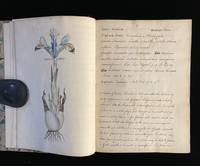
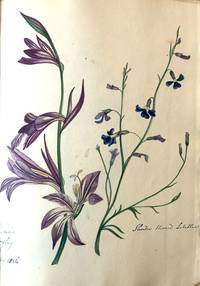
1822013470anonymously hand-printed and illustrated 1822. Hardcover. Near Fine. Replicas of the first 58 volumes of Curtis Botanical Magazine rendered in hand-colored floral illustrations and holographic text edited from and amended to the original text by an anonymous English artistic hobbyist and rebound likely early 20thC in 24 volumes. William Curtis' first volume was published in 1787; Curtis's volume 59 the last in this hobbyist's project is dated 1832 which coincides when the hobbyist concluded his or her work. The magazine continues still under the auspices of Kew Gardens. The hobbyist here started this ambitious undertaking in 1822 which is known from the notation "Commenced 1822" he or she leaves on the title page of the first volume. The ten-year project concluded sometime in 1832 which the last entry is dated. The monumental work results in replications of illustrations and text for 3024 species. The drawing and hand-coloring aspires to the original works of James Sowerby the first of Curtis's artists. The hobbyist here sometimes copies sometimes adapts Sowerby's style; the result though technically primitive in execution is consistently charming. The amateur's colors are not as vibrant as Sowerby's; supplies of high-quality natural pigments would have been limited to the amateurist. Bound-in after Curtis' Volume 42 is the actual published Part 1 of "General Indexes to the Plants contained in the First Forty-Two Volumed of the Botanical Magazine" printed by Stephen Couchman and published by Sherwood Neely & Jones 1816 40 pp and Part II 1817 pp 41 - 111. Most impressive is the hobbyist's holographed index to all Curtis's 53 volumes which runs approximately 200 double-sided pages. These 58 volumes were collected into 24 bound volumes presumably organized by the hobbyist thusly and were professionally rebound in polished black half leather - with five raised bandstitles and devices in gilt to the spine over green/salmon/ black marbleized boards with marbleized edges - by appearances sometime in the first quarter of the 20thC by an anonymous binder. The bindings are of highest quality. Laid-in to Volume 1 is the original bill of sale for the work from Henry A. Martin print dealer and publisher of Washington DC dated 11/24/1916. The original bindings were likely calf which with age would have called for some kind of rebinding here handsomely executed. anonymously hand-printed and illustrated hardcover
1812G7542<p><b>Original Watercolours of Plants Including American</b></p><p>Small folio; contemp. half calf with title on spine "drawings of plants". Small folio.On front pastedown: "M.H. Speirs 1820.</p><p>Beautiful album with 53 high-quality original watercolour drawings mostly with flower names in English or Latin and mainly dated from 1812 to April 1817. - 2 plates folded in the margins. Slightly foxed. Contemporary half leather spine rubbed.</p><p>Predominantly with flower names in English and Latin and Format ca. 14-24: 10-17 cm; on firm paper chamois format ca. 28 : 18 cm. Illustrations of lilies and aloe as well as <u>numerous American flowers </u>"Virginian Dragonhead" "American Atragen" "Virginian Platonica" and many more "Chinese Epidendrum". <b><br /></b></p>
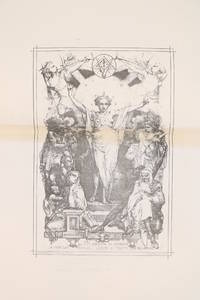
187090176Paris: Teissier et Cie 1870. Fine. ""Extremely rare and probably unique collection of 38 lithographed Masonic plates"" Teissier et Cie Paris s. d. 1870 32.5 x 49.5 cm Relié A probably unique copy comprising pulls of proofs of Masonic illustrations containing 38 plates the majority double-page numbered in red pencil from 1 to 40 discontinuous numbering with bis plates. Not recorded in Caillet or Dorbon. Bound in full black cloth smooth spine no lettering title label pasted onto the upper cover modern binding. A restored tear in the left margin of plate 10 two angular tears in the left margin of plate 12 without affecting the image. Published by the Masonic booksellers Teissier et Cie lithographed by J. Rigal et Cie and in some cases by A. Appert. A highly interesting document on nineteenth-century Freemasonry At the beginning of the volume several plates depicting allegories of Freemasonry are signed Rambert some dated 1862. Issued in folio format the usual issue being small quarto they were intended to illustrate Le Rameau d'or d'Eleusis a work by the Grand Master of the Rite of Memphis one of the Egyptian Masonic rites Jacques-Etienne Marconis de Nègre 1795-1868. The illustrator Charles-Désiré Rambert 1824-1877 is described by Alfred Fournier cited by Beraldi Les graveurs du XIXème siècle vol. XI pp. 167-169 as an ""Hercule à la physionomie singulièrement expressive et étrange : tête de mulâtre rappelant Alexandre Dumas . et des yeux absolument particuliers des yeux d'inspiré"" Other unsigned illustrations relate to models of Masonic diplomas: several plates concern the Grand Orient of Haiti others Rome or Venezuela. The mention ""à effacer"" has been added in pencil on certain lithographs. Bookseller publisher and dealer in Masonic regalia Charles-Adolphe Teissier 1801-1863 was an officer of the Grand Orient de France. After his death his widow and two sons continued the business under the name ""Teissier et Compagnie"" at 37 rue de Grenelle-Saint-Honoré which became 37 rue Jean-Jacques Rousseau in 1868. Both addresses are mentioned in the present collection which may be dated between 1860 and 1870. Teissier et Cie hardcover
1920845121920. Fine. 1920 15 x 869 cm autre 12 paintings on silk on a transparent silk band of 840cm mounted on paper and bordered in gold. Each painting 70x14cm. It seems plausible to attribute the work to Miyagawa Shunteï. Wooden scroll on which is wound a long ribbon of 869 cm of paper. The paintings are held essentially by the margins and constitute a long silk band of 840cm. The scroll is nestled in a large green silk fabric. Some worming and stains but superb overall condition. Late production of shunga and ultimate flowering of this creative genre these paintings reveal a new pictorial manner never dared before. Of greater purity and greater preciosity these paintings also reflect in these years another way of apprehending sexuality in which woman is more equal lover. The narrow height and very extended width of the paintings allows extremely tight shots of the couples thus conferring greater immersion for the voyeur and more subtle representation of intimacy. The palette of colors used is very rich ranging from pink to black passing through different shades of green. The scroll participates in the mystery of the progressive unveiling of the paintings. Early 20th-century Shunga are rather rare because the censorship exercised by the authorities was very repressive at this time shunga being considered a stain on Japanese civilization. unknown
1880859371880. Fine. 1880 33.50 x 45.50 cm relié 12 large paintings on silk: 24 x 34.5 cm depicting couples embracing. These works seem very close to the style of Yamamoto Schoun. A folding collection covered with a patterned green silk fabric. The silk paintings are loosely inserted into movable paper frames. Label on the upper cover missing. Cloth is faded with a few perforations dampstains in the lower part of the upper cover and missing edges. First board is split at the head and foot of the joint. Although the colors are quite varied they all rest on and derive from a dominant pale green the color found on the boards. The palette mixes different shades of green with complementary colors in the clothing red blue-gray. Couples are always clothed with clothing playing a revealing role an integral part of Japanese eroticism. The decor shows a variety of everyday objects such as teapots and boxes. In each of the paintings elements frame and circumscribe the scene: screens sliding walls windows but beyond a perfectly balanced composition: the interiors participate in the unveiling in a staging intended for the gaze. hardcover
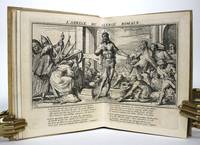
1695017087s.l.: s.n. 1695. 1st Edition. Hardcover. Near Fine/No Jacket. de Hooghe Romeyn; Dusart Cornelius. Small 4to 5.5" x 8". N.d. ca. 1695. S.l. likely printed in Amsterdam Dutch imprint reads "You will find them nowhere but they are sold everywhere in Holland by book and print sellers." Complete in two parts bound in one volume. Tweede Deel title page present lacking in many volumes. Parallel Dutch and French in Part 1 French quatrains and Dutch index in Part 2. Contemporary vellum over boards hand-lettered title to upper spine with spelling error. 4 19 1 104 pp. 25 numbered plates; 7 1 pp. 25 numbered plates. Features Romeyn de Hooghe's two-page frontispiece "L'Abrege du Clerge Romain" depicting Roman clergy torturing Jesus and collecting his blood which has turned to coins while his poor and infirm subjects look on. Contains a total of 50 mezzotint medallion caricature portraits attributed to Cornelius Dusart 1660-1704 by Landwehr. Binding tight but slightly tilted. A few stains to vellum. Light foxing else very clean and well-preserved. Comital bookplate with shelf number to front pastedown likely Belgian or German. Owner inscription of Hecht with their Latin inscription further pencil notations. Inscription of Cottet Oct 66. A rare desirable complete first edition of one of the most famous and remarkable examples of Dutch graphic caricature. The content is a scathing anti-Catholic and anti-monastic satire portraying monks and nuns as brutalized cruel malicious drunken lecherous avaricious and murderous. It was compiled and published by Huguenots during the diaspora and in reaction to the revocation of the Edict of Nantes by Louis XIV in 1685. With the mocking false privilege of Pope Innocent XI d. 1689. Brunet IV 1235; Cohen-de-Ricci 866; Landwehr Romeyn de Hooghe 70; Hollstein. Scarce. s.n. hardcover
17877France first half of the 15th century. Single column 21 lines of text written in black and red in a beautiful gothic book hand. Illuminated initial in gold red blue green and white; ruled in red rubrics in red an numerous initials in red and blue. Contemporary blind-stamped calf over wooden boards raised bands two brass fore-edge clasps missing. A very beautiful manuscript from the library of antiquary William Henry Blacking and of George Dunn of Woolley Hall near Maidenhead with their 2 bookplates with coat of arms on paste down. A very attractive collection of sermons and homilies preserved in its original panel-stamped binding with tools. Presumably the personal pocket manuscript of a preacher presbyter Johannes Venuto. Venuto is an Italian originally Tuscan name. The note on the front flyleaf is an invocation to the Lord for having the sins forgiven and removed. The big initial was clearly drawn later as it covers the original text. Originally it is assumed that a calendar occupied the first 77 pages and that calendar has been removed.<br /> <br /> George Dunn 1865-1912 of Woolley Hall near Maidenhead Berkshire was an English bibliophile and keen student of paleography and early printing. Throughout his life he built up an impressive library at Woolley Hall collecting early English law books medieval manuscripts early printed books including volumes from unusual towns and presses. After his death in 1912 his library was broken up and sold off at Sotheby's between 1913 and 1917 realising over £30000. unknown
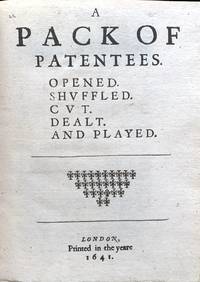
164117940London: n.p. 1641. FIRST EDITION. Type ornament device on title and woodcut headpiece. Polished calf signed “F. Bedford triple gilt fillet round sides spine gilt a.e.g. From the library of Lord Fairfax of Cameron with his armorial bookplate and the Huth bookplate lot 5630 Sotheby’s sale of July 17 1917. First edition of the very rare satire on the granting of monopolies. The anonymous author piles on the criticism of monopolies and patents granted on goods such as coal soap starch leather wine salt tobacco and butter. By the reign of James I patents had become so numerous and unfairly granted that they were considered oppressive and unjust to certain classes of people especially tradesmen and manufacturers. Except for “novel inventions†the King was finally forced to revoke all existing monopolies and declare that henceforth patents were only to be used for “projects of new invention.†This “Statute of monopolies†enacted in 1624 became the foundation for all later developments in patent law in England and elsewhere. It was a fundamental landmark in the transition of Britain’s economy from the feudal to the capitalist.<br /> <br /> Unfortunately James’s successor Charles I continued to abuse the patent system and it was only during the Restoration that the abuse was finally curtailed. The present work written during the reign of Charles I bitterly describes the injustices within certain trades and industries.<br /> <br /> Wing P156; ESTC locates 4 copies in North America Harvard Huntington NYPL McGill. n.p. unknown
201381725Valencia: Scriptorium S.L s. XIII - -2013. Scriptorium, S.L unknown
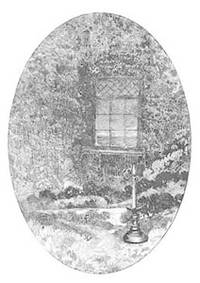
CNAP063bSan Francisco: The Arion Press 2002. First and Limited Edition. Hardcover. New. Conner Bruce. Octavo 10.25 by 7 inches. The type is English Old Style composed and cast in Monotype by Mackenzie & Harris San Francisco. The text paper is Ruysdael an all-cotton machine-made sheet. The paper for the prints is T. H. Saunders buff loan an all-cotton mouldmade sheet. The ink-blot drawings in gray beneath the folios and the rebus on the title page were printed from photopolymer plates. Printing of the type and plates was by letterpress. The book is bound in yellow cloth with an ink-blot pattern in black from a drawing by an anonymous artist that is continuous front to back interrupted by a black cloth spine. The book is enclosed in a black slipcase. Both book and slipcase have yellow spine labels. The six images are photogravures from collages of wood engravings. The original collages are ovals 6.5 by 4.5 inches. The scale of the images for the book is the same as the original collages. Book with suite of six larger photogravures by Conner on handmade paper with prose-poems by Todd. The book is octavo in format 10-1/4 by 7 inches. The six images in the extra suite are 17-1/4 by 12-3/4 inches. The edition of the suite of prints with the book is limited to 30 numbered sets for sale. . "The Ballad of Lemon and Crow" is a work of fiction by a San Francisco writer who grew up in Texas and whose regional sensibility is keenly felt in this tale about three generations of neighbors in rural Oklahoma. This limited edition is its first publication. <br /> <br /> The illustrations are by Bruce Conner a native of Kansas and longtime San Francisco artist whose distinctive vision has won him a large and devoted audience over more than forty years. The artist and author first met in Omaha in 1953 as members of a Midwestern literary and artistic circle that became associated with the Beat Generation. Bruce Conner's work is owned by major museums; after 2000 Conner announced he was retiring and would not sign or claim any new work as his own. Since then anonymous artists have collaborated to create additional work in a manner similar to that of Bruce Conner. <br /> <br /> ___POSTAGE: International customers please note that additional postage may apply as the standard does not always cover costs; please inquire for details. <br /> <br /> ___Swan's Fine Books is pleased to be a member of the ABAA ILAB and IOBA and we stand behind every book we sell. Please contact us with any questions you may have we are here to help. The Arion Press hardcover
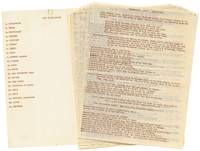
19405238661940. Near Fine. An original unpublished typescript of a mid-20th Century minstrelsy together with six mimeographed copies of the typescript. The original typescript consists of 12 quarto pages typed in orange on rectos only paginated in ink by hand and a one-page List of Characters. In fine condition. The six mimeographed copies consist of 12 folio sheets 9" x 14" stapled at the topedge onto a cardboard back cover accompanied by two mimeographed copies of the list of characters on separate quarto sheets. The mimeographed copies are lightly toned three or four copies have some slight staining one copy has an owner name in ink and one is lightly annotated near fine or better overall.<br /> <br /> The list of 21 characters includes: The Interlocutor Hambones Tambo Shakespeare of Harlem Seven-Up Jackson Suntan Cootie-Locks Dimwit Muskrat Geo. Washington Jones and others. The single-spaced typescript with about 50-60 lines per page is laced with racist language and stereotypes and includes dialogue musical cues stage directions and narration of the Interlocutor; it ends with one of two poems by Shakespeare of Harlem: “Honey dis am Rufus Tappin’ on yoh window-pane … †and a skit by Seven-Up Jackson: “the only known real live gold-fish swallowing act in history … .â€<br /> <br /> Internal evidence including references to an atomic bomb attack on Tokyo suggests that the play was likely written late in or soon after the Second World War. In 1953 two popular films with similar titles were released: Walt Disney’s Thanksgiving Day Mirthquakes and Merry Mirthquakes featuring a young Liberace as Master of Ceremonies. It is also possible that the character “Shakespeare of Harlem†is an allusion to Langton Hughes whose book of poems “Shakespeare of Harlem†was first published in 1942. An unpublished and unrecorded American minstrelsy well-preserved in near fine condition. The presence of multiple copies inveighs strongly that these scripts were actively used in a group production. unknown
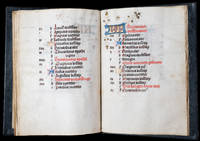
14250526><p>i 12 i leaves ruled in ink written in Gothic textualis in seventeen lines per page in brown and red ink; two-line KL initials in burnished gold on red grounds with blue borders and pen-drawn flourishing of geometric and foliate forms accented with liquid gold. Bound in modern black leather over boards the spine lettered in gilt capitals "16th Century Manuscript Calendar."</p><p>Dimensions: 147 × 110 mm.</p> Manuscript (Book of Hours) hardcover
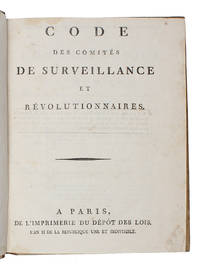
179360748Paris Impremerie du depot des lois An II 1793. 4to. In contemporary half calf with gilt lettering and ornamentation to spine. Wear to extremities. Upper part of back hinge split with minor loss of letters. Small dampstain to upper inner margin otherwise a nice copy. 2 VII 2-116 100 8 pp. <br/><br/><em>Exceedingly rare first edition of this highly interesting document being the Code of the Committees of Surveillance containing 106 regulations and guidelines for the functioning of these committees during the French Revolution. The Committees of Surveillance were established during the Reign of Terror September 5 1793 - July 27 1794 as part of the revolutionary government's efforts to identify and suppress counter-revolutionary activities. These committees were tasked with monitoring individuals' behavior enforcing revolutionary laws and ensuring loyalty to the revolutionary government. The document outlines the powers duties and procedures of these committees as well as the penalties for those found to be opposing the revolution providing a unique and fascinating insight into the legal and administrative framework of revolutionary France – arguable one of the most profound and radical moments in modern European history. The Committee of Surveillance in France during 1793 was established as a part of the radical phase of the French Revolution. Its function was to oversee and monitor the activities of suspected counter-revolutionaries and enemies of the Revolution as well as to enforce laws related to internal security and revolutionary principles. The committee was tasked with identifying individuals or groups deemed to be a threat to the revolutionary government often leading to arrests interrogations and in some cases executions by the Revolutionary Tribunal. It played a significant role in the Reign of Terror a period marked by extreme political violence and repression in France. The present work is of the utmost scarcity. We have not been able to trace a single copy at auction and OCLC only lists one copy in Paris. Nadaillac Catalogue d’une Collection Importante Sur la Revolution Francaise 724 </em> unknown
184545055Sunflower County Mississippi: Privately printed 1845-1869. 1845-1869. MISSISSIPPI BRAND BOOK. First edition. 12" x 8" quarter leather spine and blue paper over boards n. p. 36 pp. 4 pp. blank 4 pp. All brands and description are in manuscript. This is a most unusual brand book. Some actual brands are shown as drawn and others are described. Some writing on the covers mentions Sun Flower County Mississippi. Perhaps there were ranchers in the vicinity. This is the first and only manuscript brand book we have seen or heard about for Mississippi or a printed version. This manuscript brand book with reference to Sunflower County Mississippi presents numerous hand-drawn brands and descriptions. We are unaware of any printed or manuscript brand books from Mississippi. The period of 1845 to 1869 is very early for any brand book! Sunflower County was formed 15 Feb 1844 from Bolivar County. It was named for the Sunflower River which flows through it. One early settler B.G. Humphries later became the Govenor. Other notable settlers were: James J. Chenning Chewning G.B. Wilds Col. Eli Waits J.Y. McNeill mcMeal Col. Hezekiah McNabb Ezekiel McNabb Mayor Frank Hawkins and Capt John Hawkins. Research of an 1847 tax list and a list of federal land grants given to individuals in the area offer names of early landowners . Several of these names and brands are included in this brand book. lists included Not listed in Adams' Rampaging Herd. We feel this is a very rare brand book. Original blue cover paper is chipped else a very good copy housed in a cloth clamshell case with leather label on the spine and titles stamped in gilt. Privately printed, 1845-1869. hardcover
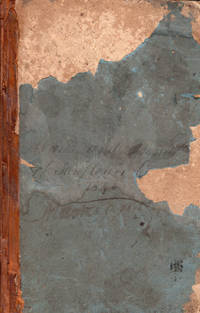
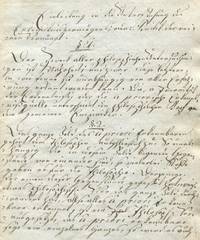
1790846<p>n/a: n/a 1790. First Edition. Cardboard covers. Very good. Early Manuscript Defense of the Critique of Pure Reason <br /><br />Original one-of-a-kind handwritten manuscript defense of Kants Epistemology. 196-page manuscript in clear German cursive with some deletions and corrections ink on clean paper. 1790 Quarto. <br /><br />An extensive presentation and defense of Kant's theory of knowledge probably written as the basis for a lecture or series of lectures. There are five main sections: <br /><br />Einleitung 34 paragraphs <br />Theorie des Vorstellungsvermögens überhaupt 30 paragraphs <br />Theorie der Sinnlichkeit 35 paragraphs <br />Theorie des Verstandes 64 paragraphs <br />Kritik der bisherigen Methaphisick 21 paragraphs <br /><br />Many of the paragraphs contain numbered Anmerkungen" further reflections. In these the author shows himself to be a stout defender of Kant's controversial new theories: "Vor Kant ist es keinem eingefallen die Gemüthsvermögen zu untersuchen die Erkenntniße aus dem Erkennbaren zu schöpfen und die Philosophie nicht von den so genannten Objeckten zu erbetteln. Man begehet keine tolle Freiheit wenn man behauptet daß es vor Kant wohl resonierende Köpfe und philosophische Versuche aber eigentlich keine Philosophie und Philosophen gegeben habe. <br /><br />The identity of the author remains unknown. Interestingly the final sentence announces a sequel: "Näher darüber in unseren zukünftigen moralischen Untersuchungen wo wir für das Ens Entium einen begreiflicheren Gott wieder finden werden. <br /><br />CONDITION: Very good or better in contemporary plain boards with minimal spotting edges untrimmed. <br /><br /><br />PHOTOS AVAILABLE UPON REQUEST</p> n/a