237 569 résultats
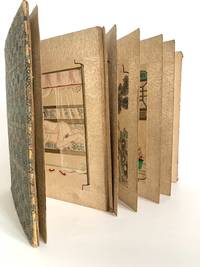
19301715341930. HAENZI Erich. Farbenlehre. 23 Original watercolour plates some with multiple images. Folio 340 x 240 mm. original cloth. N.p.: n.d. ca. 1930. A wonderfully executed manuscript on colour theory by a Swiss commercial artist whose objective was to enhance the work of decorators fashion designers graphic artists and set designers. Divided into ten sections comprising colour and achromatic antagonism colour values light-dark antagonism cold-warm antagonism quality contrast intensity contrast quantity contrast complementary contrast simultaneous contrast and successive contrast. According to the seller the work is by a Swiss commercial artist named Erich Haenzi. hardcover
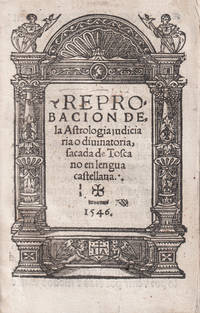
154610843Salamanca: Juan de Junta 1546. First Edition — Primera edición. Hardcover — Tapa dura. 134x94mm. 5¼x3¾". Salamanca Juan de Junta 1546. En 8º menor 134 x 94mm. TipografÃa gótica. 83 folios. Signaturas a-k<sup>8</sup> l<sup>4</sup>. Portada renacentista dentro de un tabernáculo arquitectónico xilográfico. Encuadernación del siglo dieciocho en pergamino. Primera y única edición de gran rareza de este libro publicado anónimo que ataca la astrologÃa judiciaria aquella que con sus predicciones se pueden declarar los efectos en las personas según la posición de los astros. Al tiempo que defiende la <em>astrologÃa natural</em> aquella que predice los fenómenos naturales según los movimientos del sol la luna y las estrellas denuncia el uso de la <em>astrologÃa judiciaria</em> para elegir el momento de las acciones como totalmente falsa y rechaza que la acción humana esté sujeta a la determinación de las estrellas debido a la existencia de la libre voluntad. No puede sacarse por ninguna parte de la obra ni el nombre del autor italiano ni el del traductor castellano si bien está generalmente admitido que el autor es Girolamo Savonarola. Nicolás Antonio menciona una obra de Antonio de Beja titulada <em>Tratado de astrologÃa judiciaria</em>. Buen ejemplar de este atractivo gótico castellano en su estado original. Pequeño taladro que afecta a una palabra de la última linea hasta mitad del volumen por lo demás perfecto. Juan de Junta hardcover
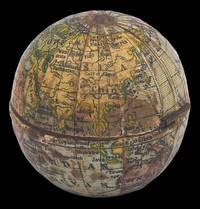
185015729c1850. Diameter: 51mm 2 inches. Sign on the meridian line Globe hand-coloured engraved gores on two concave brass hemispheres hinged containing internal glass inkwell spring mounted seal gilt finish to interior flattened base. With old paper label to base. One or two inkstains. Prior to the widespread use of fountain pens in the late nineteenth century it was common to carry ink while travelling. Portable inkwells also known as travel wells or travellers were devised for this purpose. It was of the utmost importance for the design to prevent the ink inside the travel wells from leaking and the well itself was usually made from glass and concealed within a case. These cases took on many decorative forms including the present example designed as a globe. Geography The cartography is typical of Victorian maps but simplified with no relief shown on the land. The continents and many of the countries are identified by name along with some major rivers. unknown
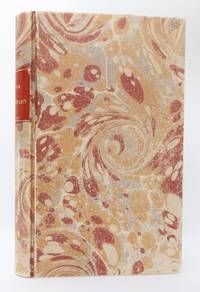
17271405949London: W. Mears 1727. First Edition. Hardcover. Octavo 192 pages. In Very Good condition. Spine marbled paper with red textblock and gilt lettering. Fully bound in later marbled boards. Minor shelfwear and soiling. Textblock toning consistent with age. Minimal soiling. Bookplate pasted to inside of front board. GH consignment. Shelved in Case showcase. This work of early English viticulture printed for W. Mears is presumed to be authored by the 18th century botanical writer Richard Bradley 1688-1732 whose work Mears had published before. This text is exceptionally scarce especially in the original form. 1405949. Shelved Dupont Bookstore. W. Mears hardcover
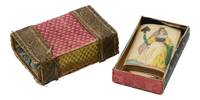
1880140949222France: Unknown publisher 1880. Very Good. A suggestive set of translucent erotic playing cards likely created in France in the mid-19th century. Set consists of 35 hand-colored playing cards 32 of which are from around 1840 featuring 11 court cards 3.25 x 2.25" and three slightly larger cards 3.5 x 2.5" possibly from the late Victorian period. Housed in a much earlier handmade late-18th century sliding box 4.5 x 2.75" made from thin plywood with pasted decorative paper wrapped in voided velvet and trimmed with gold and silver metal silk woven ribbon. They were once a part of The Stuart and Marilyn Kaplan Playing Card Collection. <p>Very Good. Cards are lightly bowed with general wear and light toning; four of diamonds is the most worn with creasing and small spot of loss to one of the corners.The box they are held in is quite fragile with tarnishing to the metal ribbon and slight soiling to velvet boards. <p>Popular in mid-1800s France and often associated with brothels these cheap seemingly innocuous risque novelties were crafted with two pasteboard layers. When held to light favorably candle light they reveal hidden sensual often pornographic images. While the cards inside were economically manufactured the little box they are held in is rather sumptuously bedecked in high quality velvet and expensive gilt metal thread ribbon. The average layman did not have access to trim or fabric as seen here indicating that this may have been owned by a rather wealthy individual. It should be added that sets as generously populated as this even when mixed are uncommon and desirable curiosa objects. [Unknown publisher] unknown
16356Italy: n.p. n.d. Ruled manuscript notebook with engraved frontispiece. Preface and discourse in two parts. Contemporary black roan and preserved in a black roan-backed box. The text is very clean. A handsome copy. With the bookplate of Roberto Gabbani engraved by Costante Costantini. A discourse in the form of a mock-address to an educated and learned public of women. The author is inspired to write this praise after he had accidentally stepped onto a pile of excrement. He addresses the ladies and in the first part theorizes the ancient and noble origins of defecation from the beginning of time with Adam and Eve. The object of his ode is universal and unites all peoples of the world. The second part is devoted to the usefulness and benefits of excrement: it’s healthy nourishes the trees and the soil and provides work to those that transport it from cities to villages. The author ends his tribute talking to ### directly inviting her/him not to blame humans that don’t appreciate her/him.<br /> <br /> Costantini Florence 1921-2006 was an Italian engraver illustrator and writer. His talent for drawing was sharpened by his studies and by trips abroad in his youth. In Vienna he became a friend of Kokoshka’s and in Paris he followed courses at the Grande Chaumière Academy. He is noted for his elegant woodcuts and his intaglio prints made from punched metal plates. He was awarded several prizes in both fields. n.p. unknown
1928002034Hvidore: s. n. 1928. Softcover. Original silver gelatin photographic postcard of the Empress sitting on a padded bench in her garden holding an umbrella and a bouquet of flowers; 5 x 3 1/4; minor wear to corners and image; a bit of age-toning and a manuscript note in pencil to verso; near fine condition. Signed in ink: "Maria Hvidore" in the lower half of the photo. Possibly one of Maria Feodorovna's last photographs the anonymous note on the back stated: "The Empress sent me this not long before she passed away at Hvidore." Empress Consort of Russia Maria Feodorovna 1847 – 1928 christened Dagmar was the wife of Tsar Alexander III and mother of Emperor Nicholas II of Russia whom she outlived by ten years. The second daughter of King Christian IX of Denmark and Louise of Hesse-Cassel she was bethroted to Tsarevich Nicholas Alexandrovich of Russia but after his death from meningitis in 1865 Maria honored his last wish and married his younger brother the future Alexander III. She converted to Orthodoxy and became Grand Duchess Maria Feodorovna of Russia. With Alexander II's assassination in 1881 she and her husband were crowned Emperor and Empress of Russia. After Alexander III's death in 1894 she became Dowager Empress and her son Nicholas II and his wife Alexandra were crowned the new rulers. The outbreak of the Revolution in 1917 forced her to travel to Crimea where she received the devastating news that her sons daughter-in-law and grandchildren had been murdered. She refused to believe it and declared it a rumor. Although the monarchy would be overthrown she would not leave Russia until 1919 - first to London and eventually to her native Denmark where she would settle in Hvidore a former country house near Copenhagen. Maria died on October 13 1928 at the age of 80 having outlived four of her six children. Hvidore: s. n. paperback
1798FLO147<p>Six volumes only of this rare eight-volume set. Vol. VIII was discontinued after only 4 issues with 12 plates.<br /><br />With 352 hand-coloured engraved plates of 360.<br /><br />Incomplete set of this rare handy pocket-sized edition of 18th century natural history describing many newly discovered species.<br /><br />Text and plates copied from accounts published by Count Buffon George Edwards George Shaw James Bruce Thomas Pennant Maria Sybilla Merian and others. <br /><br />Includes the extinct dodo and sukotyro endangered animals and birds Siau Island tarsier white rhinoceros polar bear Indian bustard great green macaw wild water buffalo banded cotinga Russian mink African grey parrot. <br /><br />Also notable for the early images of plants and animals discovered in New South Wales Australia short-beaked echidna kangaroo black swan eastern quoll waratah Banksia etc.<br /><br />Half contemporary calf with red and black morocco gilt spine labels marbled boards scuffed front board off Vol. VI. Some plates loose or trimmed foxing and finger-marks to text and plates.</p> Harrison, Cluse and Co. hardcover
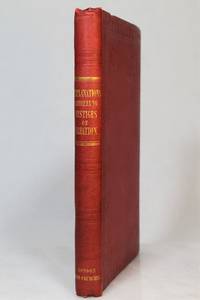
1845090820LSJohn Churchill London 1845. 1st Edition. Hardcover. Very Good. 8vo in original red cloth stamped in blind with gilt titling to spine. 198 pp. followed by 8 pp. of publisher's ads. First edition of 1500 copies subsequently appended to later editions of Vestiges. VG. Corners and spine ends bumped; small nick to edge of rear board. Light soiling to boards. Binding is strong. Text block is clean and tight. Faint foxing to endmatter and very sparsely in the text which is free of writing or any other markings. Ships packed with care in a box expedited and insured. John Churchill, London hardcover
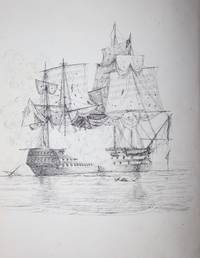
182020114England 1820. Half Calf. Marbled paper pastedown on boards. Very Good. A military-related manuscript rife with exquisite drawn and painted illustrations of ships cannon ammunition and other military equipment. 8vo. 25 by 21 cm. 10 223 pp. Not including the blank leaves following which constitute about one fourth of the leaves. In unpaginated pages at the beginning there are a calligraphic title page a full page pen-and-ink drawing of two warships -- basically serving as a frontis -- and a two page index. The illustrations appear throughout the manuscript as do numerous tables -- this being a manual of sorts how else to deal with the niceties of ammunition The illustrations can be renderings of simple geometric principles to realistic depictions of warships facing off. Many of the illustrations are small vignettes of hardware -- the utilitarian purpose of the artwork might not sound especially exciting but the precision of the drawing is such as to inspire awe. There are a number of pages given over to such small illustrations. Rather than a count of the total number of illustrations we would say that there are 40 pages in which there are illustrations that are ones that reflect artistic skill by the creator of this manuscript. The text is written in a very consistent and neat cursive -- one should have no trouble reading any of the text. We would not regard most of the handwriting as calligraphic. Only two title pages feature bona fide calligraphy. Alas we do not know who put together this book or exactly when. It has a resemblance to student notebooks and course summaries of the period both ones created in England but also the United States. But given the length and thrust of the thing we are inclined to see it as the effort of an instructor. Perhaps there was an ambition to publish as well. Not knowing the identity of the creator militates against having a conclusive answer to the mystery. Based on the warships depicted we pin the manuscript as circa 1820. The spine leather is torn rubbed rough. Scattered soiling of the leaves within with browning conspicuous along page edges. Still well-preserved and attractive. unknown
2024BIBHB0075071422024. Hardcover. New. Due to the very old age and scarcity of this book some pages are missing and may be hard to read due to the blurring of the original text.1901 census covered various aspects: Area Housing and Population; Population Variations; Classification of Towns and Villages by Population; Territorial Town Arrangements by Religion; Religious Demographics; Age Gender and Marital Status; Education; Education by Specific Caste Tribe or Race; Marital Status by Age for Selected Castes; Occupation and Livelihood; Secondary Occupations Alongside Primary Occupation; Caste Tribe and Race Linked to Traditional and Actual Occupations; Territorial Distribution of Christians by Sects and Race; Europeans Armenians and Eurasians by Age; Sects by Religion; Houses and Population; Aboriginals Identifying as Hindus or Animists; Age Gender and Marital Status; Education; Castes Tribes Races or Nationalities; and Means of Livelihood. The Title 'Census of India 1901 written/authored/edited by Anonymous' published in the year 2024. The ISBN 9788121271363 is assigned to the Hardcover version of this title. This book has total of pp. 26758 Pages. The publisher of this title is Gyan Publishing House. This Book is in English. The subject of this book is History Census India. Size of the book is 22.59 x 28.94 cms Vol: Volume 21 Vols. In 65 Bindings hardcover
2024BIBHB0331654302024. Hardcover. New. Due to the very old age and scarcity of this book some pages are missing and may be hard to read due to the blurring of the original text. The Title 'Census Of India 1891 written/authored/edited by Anonymous' published in the year 2024. The ISBN 9788121271301 is assigned to the Hardcover version of this title. This book has total of pp. 25321 Pages. The publisher of this title is Gyan Publishing House. This Book is in English. The subject of this book is History. Size of the book is 22.59 x 28.94 cms Vol: Volume 28 Vols. In 49 Bindings hardcover
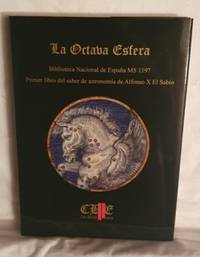
76492Club Bibliofilo Versol. Club Bibliofilo Versol unknown
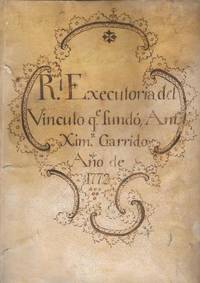
725741772. 32x22. Pergamino. Con sello Real. Sin paginar 154 pgs. XA0790 1772 unknown
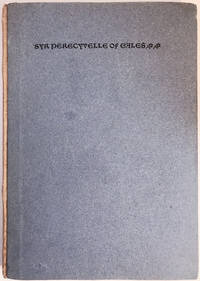
18951045London/Hammersmith: Kelmscott Press 1895. Limited First Edition. hardcover. Fine. 8vo: 8 5/16" x 5 5/8" x 5/8" 21.1 x 14.3 x 1.6 cm. Sir Edward Coley Burne-Jones. <p> <p>First Printing. Edited by Frederick Startridge Ellis after the edition printed by J. 0. Halliwell from the Cambridge manuscript with some additions and variations from the THORNTON ROMANCES manuscript in the Library of Lincoln Cathedral. Printed by William Morris. Bound in publisher's original quarter Holland-backed blue paper boards with white linen spine and black titles to cover. One of 350 at fifteen shillings paper copies plus 8 at four guineas on vellum. Printed on fine hand-made Batchelor with the second version of the Primrose watermark paper. Uncut deckled edges. Colophon and the smaller rectangular printer's device designed by Morris no. 1. 8 4 98 10 pp. <p>Printed in black and red throughout with the Chaucer type designed by Morris for his press. Two full-page ornamental borders 13a and 13 with a woodcut frontispiece designed by Sir E. Burne-Jones depicting young Perecyvelle embraced by his aging mother. Numerous 10- 3- and 6-line woodblock cut initials all designed by Morris engraved by William Harcourt Hooper. Titles and shoulder notes in red. Peterson A47<p>One of a series of three medieval metrical romances chosen by Morris to be printed at his Kelmscott Press along with SYR YSAMBRACE and SIRE DEGREVAUNT.<p>Finished on the 16th day of February 1895. <p>Faint spot to front cover. Some corners very slightly bumped. Internally immaculate and bright. Condition overall: Fine. Kelmscott Press hardcover
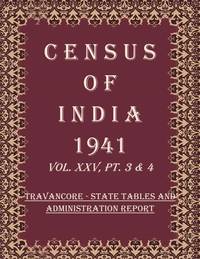
2024BIBHB0331651512024. Hardcover. New. Due to the very old age and scarcity of this book some pages are missing and may be hard to read due to the blurring of the original text. The Title 'Census of India 1951 written/authored/edited by Anonymous' published in the year 2024. The ISBN 9788121271202 is assigned to the Hardcover version of this title. This book has total of pp. 23403 Pages. The publisher of this title is Gyan Publishing House. This Book is in English. The subject of this book is History Census India. Size of the book is 22.59 x 28.94 cms Vol: Volume 27 Vols. In 58 Bindings hardcover
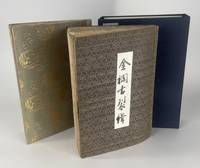
1890263Japan: publisher not identified 1890. <p dir="ltr">2 volumes 8.25" x 12.25" each volume 1: pp. 61 approximately 257 samples volume 2: pp. 41 approximately 237 samples; all collected in a blue cloth case. This is a stunning collection of Japanese Meiji-era gold brocade textile samples almost 500 samples in all. Textile swatches are bright and lively measuring from 1" to full-page in size; brilliant golds and metallic throughout silk bindings in the Japanese style. Very good; some samples exhibit wear or fray signs of use as sample books.</p> . [publisher not identified] unknown
2024Gyan-9788121271240Gyan Publishing House 2024. 28 Vols. In 52 Bindings. Hardcover. New. 22.59 x 28.94 x 208.78. English Gyan Publishing House hardcover
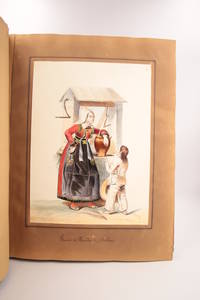
185089124s.l. : S.n. 1850. Fine. 44 coloured plates of Breton costumes S.n. s.l. s. d. ca 1850 30.5 x 40.5 cm Relié Album comprising 44 plates of Breton costumes the first two drawn in pencil the others delicately watercoloured mounted on heavy paper some with captions unsigned.Bound in contemporary half green sheep spine decorated with gilt and black fillets gilt garlands and fleurons some rubbing to the spine embossed cherry-red cloth boards bumped corners a few scuffs along the edges.A handsome album of Breton costumes in the manner of Hippolyte Lalaisse and his Galerie armoricaine of 1848.Particularly focused on the Breton-speaking departments Western Morbihan and Finistère: 1. Seated bagpipe player. 2. Peasant dance. 3. Woman from the Auray area Morbihan. 4. Young shepherd from Morbihan. 5. Woman from Plouay Morbihan. 6. Man from Faouët Morbihan. 7. Women from Josselin Morbihan. 8. Woman from Pluméliau Morbihan. 9. Women from Ploemeur Morbihan. 10. Woman from Ploërmel and nearby farmer Morbihan. 11. Woman from Auray Morbihan. 12. Woman from Lanzac Morbihan. 13. Man from Lanzac. 14. Woman from Guémené near Pontivy Morbihan. 15. Woman from Elven Morbihan. 16. Milkmaid from St-Paterne in Vannes Morbihan. 17. Woman from Douarnenez Finistère. 18. Man from Pont-lAbbé Finistère. 19. Woman from Pont-lAbbé. 20. Fisherman from Douarnenez Finistère. 21. Milkmaid from Douarnenez. 22. Bride from Kerfeunteun Finistère. 23. Man from Châteauneuf-du-Faou Finistère. 24. Women from Plougastel near Brest Finistère. 25. Man from Plougastel. 26. Woman from Locmaria near Quimper and farmer from Elliant Finistère. 27. Peasant from Riec Finistère. 28. Young girl from Bannalec Finistère. 29. Man from Saint-Thégonnec Finistère. 30. Women from the area of Pont-Lannay Finistère. 31. Bride and groom from Kerlouan Finistère. 32. Men and women from the area of Pontcroix Finistère. 33. Farmer from Saint-Évarzec Finistère. 34. Woman and two children. 35. Presentation of a newborn at a calvary. 36. Woman from Ploëne near Moncontour Côtes-du-Nord. 37. Woman from Antrain Ille-et-Vilaine. 38. Man and woman from Cancale Ille-et-Vilaine. 39. Woman from Saint-Servan and Dinan near Saint-Malo Ille-et-Vilaine. 40. Young ladies from Pornic Loire-Inférieure. 41. Man from Bourg-de-Batz in festive costume Loire-Inférieure. 42. Woman from Bourg-de-Batz in festive costume. 43. Bride and groom from Bourg-de-Batz. 44. Young salt-workers in working attire.Copy from the library of Léon Noël with his ex-libris label pasted on the front endpaper. S.n. hardcover
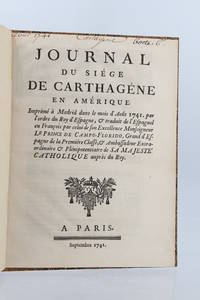
174182479Paris: S. n. 1741. Fine. S. n. Paris septembre 1741 19.50 x 25 cm relié Journal du siège de Carthagène en Amérique Diary of the Siege of Cartagena in America n.p. Paris September 1741 4° 195x25cm 16 pp. bound. First edition of the French translation. Originally published in Spanish a month before. Translated by Luis Reggio Branciforte and Colonna Prince of Campoflorido Spanish ambassador in France. Later half camel cloth binding boards in caillouté paper the first one with a gilt black morocco label. Spine-top a little rubbed white end-papers shaded. Contemporary handwritten notes on the upper part of the title page. Extremely rare copy of this diary about one of the greatest naval campaigns of the British Navy and its bitter defeat against the Spanish Treasure Fleet West Indias Fleet. S. n. hardcover
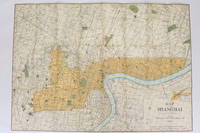
193367432Shanghaï Shanghai: North China Daily NewsHerald limited 1933. Fine. North China Daily News Herald limited Shanghaï Shanghai 1933 100 x 74 cm une feuille rempliée Rare original folding colored map of the city of Shanghai printed on heavy paper and including the street names in English as well as an extensive grid to find locations. It was published under the authority of the Shanghai city council in 1933. A skillfully repaired tear touching the index. There is a variation of this map in existence without the grid or the key of which an example is preserved in the University of Chicago library. We have not otherwise been able to find any other example of this map. This very detailed map still shows the old town under the name «Chinese City.» Each district or foreign concession particularly the French one is marked out and named in a miniaturization on the bottom right of the map these concessions will finally be returned in 1943. Significant places and places of interest are shown as well as the railway lines. Maps of Shanghai before the Battle of Shanghai are rare and sought after. North China Daily NewsHerald limited unknown
185073724Chine China 1850. Fine. Chine China 1850 S.d. 19 x 25.40 cm autre 12 Chinese erotic watercolors ink and colors on paper each painting depicting an erotic scene in an interior or garden. Accordion binding with cover of green silk embroidered in various colors. All leaves of the album are covered with damask raw silk. Each painting 16x19.2cm is mounted on silk. Some fabric losses at edges 2 small losses on the back cover. One of the accordion folds partially cut at the fold. All paintings are in very good condition. Chinese erotic games as represented in paintings appear extremely different from their Japanese neighbors. Furthermore Chinese erotic art remains relatively unknown compared to Japanese erotic art. There is undoubtedly a humorous atmosphere in these paintings whether we see a man examining a woman's genitals with a magnifying glass an old man seemingly supplicating a woman who carries a child on her back or the presence of children. The women are always wearing shoes and have very small feet as one was not supposed to see a woman's feet and small feet were a sign of beauty and eroticism. In drawing and execution the presence of line is characteristic whether it clothes the scene with a screen or represents the bodies strangely stylized. Primacy is given to lines and curves rather than volumes. The authors of these paintings are initially groups of students learning to create erotic images under a master's tutelage by copying masterpieces. The paintings are rarely signed so as not to compromise the artist's reputation. The date is given as an indication the collection possibly being earlier or later. hardcover
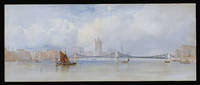
186112471c.1861. 240 by 600mm 9.5 by 23.5 inches. Watercolour on paper. The first modern bridge at Lambeth was a suspension bridge designed by Peter W. Barlow. Sanctioned by an Act of Parliament in 1860 it opened as a toll bridge in 1862 but doubts about its safety coupled with its awkwardly steep approaches deterring horse-drawn traffic meant it soon became used almost solely as a pedestrian crossing. It ceased to be a toll bridge in 1879 when the Metropolitan Board of Works assumed responsibility for its upkeep it was by then severely corroded and by 1910 it was closed to vehicular traffic. unknown
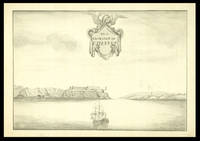
176011350c1760. 280 by 390mm. 11 by 15.25 inches. Manuscript map in pen and ink en grisaille on paper. View of the mouth of Havana Harbour taken from a shipboard vantage point emphasising the two forts that guarded the mouth: on the left the 'Castillo de los Tres Reyes Magos del Morro' Morro Castle and on the right 'Castillo de San Salvador de la Punta and marking the boom chain barrier stretched between the two. Havana was attacked by the British towards the end of the Seven Years' War and this would seem an appropriate date for this image. Seeing that Morro Castle presented a formidable challenge should it be attacked from the seaward the British simply landed troops on Cuba who approached from the landward side and commenced siege operations on 11th June gradually battering the walls into ruin. A breach was made on 30th July and the castle taken by storm. With the key to its defences lost Havana was quickly compelled to surrender. unknown