237 569 résultats
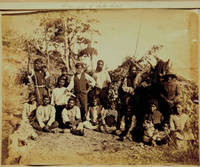
188815347Australia 1888. Wonderful photograph album of Victoria New South Wales and Tasmania with large photographs and manuscript titles. A total of 47 photos with 33 of Victoria 6 of New South Wales 5 of Tasmania 1 of New Zealand and 2 others. Each photograph is lightly tipped on to the album paper with blank verso. Most of the photographs are by an unknown photographer; there are also some signed by J.W. Beattie Thomas Foster Chuck Frank Arnold Coxhead C. Rudd and J.P. possibly John Paine.<br /> <br /> Beginning with a large photograph is of "Aboriginals of Lake Tyers". It is an outdoor view of a family group of aborigines from children to grand parents dressed in western clothing with spear boomerangs and lean-to behind them. Others include some rather poetic views of woodcutters at Black Spur & Fernshaw; a couple of gold mining at Bendigo including Garden Gully United Gold Mining Company with houses in fore and background. <br /> <br /> Melbourne 33 photos including the Empire Building Collins St. West; Prell's Building<br /> corner of Queen St. and Flinders Lane; Austral Chambers Queen St. with Austral Chambers sign and "Offices to Let" by Selby & Co. 97 Queen St.; Grand Hotel Spring St. with carriages at the front; Federal Coffee Palace Collins St. #102 showing electrical workers 3 of whom have climbed electrical poles; "Tuck's Buildings" or Luck's Elizabeth & Flinders St with the caption "Rent of Shop L 22.10 per week"; Government Public Offices Melbourne #48 with a dirt road in the foreground; Melbourne Hospital with a train moving past in the foreground; Centennial Exhibition Procession August 1st 1888 with Victorian Confectioner's Society banner in front; St. Kilda Jetty busy with people fishing; another showing neighboring jetty Hegerty's Railway Baths for Gentlemen and fishermen with the town behind them; The New Prince's Bridge with scattered construction debris; The Melbourne Hotel #10 with the #220 Carlton and Abbotsford tram in the foreground; Collins St. from Elizabeth St. looking east #73 with a busy street scene and a George & George flag flying; Modern Permanent Building Society offices with Kilpatrick & Co. Watchmakers & Jewelers a police box and Auchalps Sales Rooms; Bourke St. Melbourne full length looking west with trams a horse and cart Mayger's Imperial Hotel at the right and Old Whitehart Hotel at the left; Town Hall Melbourne a view looking down with 2 trams & Martin & Leasances Pharmacy sign visible; Elizabeth St. Melbourne a great snap shot view of people traffic a wagon and cart electric lights and a large Cullis Hill & Co. sign; Elizabeth St. Melbourne a snap shot view with street traffic a tram the Sunbeam Tea and Luncheon Rooms in the foreground and Lincoln Stuart & Co. in the distance; Bourke St. Melbourne a snap shot view toward E. A. Petherick Booksellers & Publishers with trams and traffic.<br /> <br /> There are three views of clipper ships - H. M. S. Calliope in Port Philip Hobson's Bay with 3 yachts a tender and row boat; The Liverpool largest sailing ship afloat sailing under the Red Ensign. Steamship Cavo Romano New Orleans Feb 26th 94 docked with several crew sitting on barrels with a tear. <br /> <br /> The NSW photographs are taken in and around Sydney mostly signed "J.P." possibly John Paine 1834 - 1915 including Manly Cove; Harbour from Neutral Bay with a building under construction in the foreground and harbour and ships in the distance; Harbour from Mr McMahon's Hill with flags ferries row boats and sailing ships; Farm Cove with ships and Government House in the distance; Coogee with a hut in the foreground; trams in a turning circle a beach and vacant land in the distance and an unidentified grand public building with a horse and carriage visible. <br /> <br /> The Tasmanian photographs are unsigned. "Port Arthur Tasmania" is a small panoramic view with the Penitentiary ruins of Church and Model Prison noted in the margins. Hobart from the lower slopes of Mt. Wellington overlooking the harbour River Derwent; a beautifully artistic photograph "Glimpse of Port Arthur shewing side entrance to Peninsula & ruined church in distance" is framed by trees and bushes the buildings visible in the distance. <br /> <br /> The photographs vary in size - the largest is 29 x 23 cm; the smallest 9.5 x 15 cm; most are approximately 20 x 15 cm. Most are bright and unfaded while some have some fading. The album is bound in red cloth with title in blue and gold gilt and black decoration at front cover. A little loose in binding with the last few pages blank. Overall a very interesting album in very good condition. Full details of each photo and size available on request. unknown
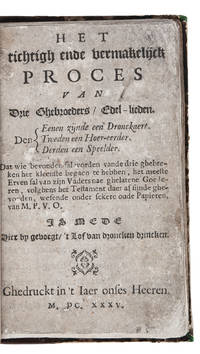
16351616Amsterdam 1635. Small 8vo 14.5 x 9 cm. Jacob Aertsz. Colom Half calf ca. 1830s with the binder's stamp on an endleaf F. DUQUESNE À GAND chemical marbled sides 2 black spine labels marbled endpapers. With 2 decorative initial letters castings made from woodcuts and a decoration made from cast fleurons on the title-page. The main text is set in roman type with long passages in italic and textura. 136 1 1 blank; 30 pp. Second known copy of the third edition 1635 of a rare satirical Dutch adaptation first and second editions 1634 of a moralistic story in Latin by Filippo Beroaldo 1453-1505 possibly intended in this adaptation to satirize the Princes of Orange. The quotations from classical sources are given in Latin each followed by a Dutch verse translation that takes some liberties with the text. Pieter Nootmans active 1627-1635 contributed a verse about the book printed on the back of the title-page. Following the main text is a drinking song by H. Rulant active 1632-1634 with its own part-title which had been published separately in 1632. We have located only one other copy of the present edition in the library of Tresoar in Leeuwarden.The British Library database of bindings includes one binding by this Ghent binder. The title-page is worn and dirty with a small abrasion obliterating the letter S in "Stichtigh" and the upper outside corner of the last leaf has been restored with the loss of a few words of the text of the added drinking song. The binding is good with some cracks in the hinges and minor damage along the edges.l KVK & WorldCat 1 copy; cf. Kruyskamp Jan Mommaert en het "Stichtelyck Proces" in: Het Boek XXX pp. 306-312 1640 ed. unknown
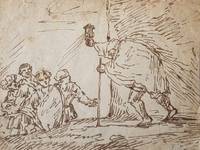
16502105Dutch mid-17th century drawing possibly by Rembrandt pupil Willem Drost. Depicted is Diogenes in robes with his lantern in his left hand and a staff in his right and a group of four figures. Diogenes the Cynic 4th cent. BC renounced material possessions and lived in poverty. He would go out with a lighted lantern in broad daylight to look for an honest man instead he would only find that everyone around him was morally corrupted. He would scare passersby with his lantern causing them to lose their mask and reveal their true intentions.In the present drawing the group of four is clearly scared by the lantern of Diogenes who seems to be towering over them. In fact the artist has placed Diogenes on a higher plane than the passersby an invention that effectively enhances the morality of the scene. This is not found in other contemporary depictions of the same story by artists like Rubens Sandrart Castiglione and Jordaens.The artistdisplays a masterful understanding and application of chiaroscuro. Not only does he use it for the composition he also applies it to benefit the narrative. Light is literally and figuratively at the center of the scene. The artist from the "Rembrandt school" who made most use of stark chiaroscuro in his drawings was Willem Drost 1633-1659. He became a student of Rembrandt around 1650 which corresponds with the dating of the watermark. The style of drawing is also close to drawings attributed to Drost. The facial type of Diogenes in particular the pointy nose corresponds with that found in each of Drost's drawings in the Rijksmuseum. Also the hatchingsmatch those in other works by Drost who made much use of individual lines instead of a continuous zig-zagging stroke and penstrokes of varying thickness to create depth in his compositions Bonny van Sighem 2000.<i>Condition: Number 3 in pencil at the bottom previous attribution to Ferdinand Bol written in pencil on the back. Several small brown spots and a couple minor defects including one on the face of the central figure in the group top edge slightly frayed and creaded. Old repair with tape on the back at the top.Literature: B. van Sighem 'attributed to Willem Drost David Prevents Abishai from Killing Saul Amsterdam c. 1650 - c. 1655' in J. Turner ed. Drawings by Rembrandt and his School in the Rijksmuseum online coll. cat. Amsterdam 2000 Bonny van Sighem 2000; for the watermark cf. Churchill fig. 305; Heawood 305 & 307.</i>
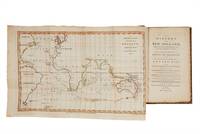
17875001050London: John Stockdale 1787. Octavo with two folding maps hand coloured in outline; a very good copy edges uncut in contemporary calf gilt spine neatly repaired. <p><p>An important book and a sometimes neglected precursor to the Australian First Fleet: this was one of the earliest descriptions of Australia published to coincide with the departure from England of the First Fleet. "It is an extremely interesting work and an essential inclusion in all comprehensive collections" Davidson. In discussing the fleet's imminent departure the anonymous compiler lists numbers and equipment as well as the principal officers and there is also material in both preface and text about transportation as well as an "Introductory Discourse" on the subject by William Eden which has often led to the misattribution of the whole book to him.</p> <p>This is an example of the important second edition published the same year as the first and after parliamentary approval of the Botany Bay plans and with a very significant new section: an additional ten prefatory pages appear for the first time in this edition discussing in detail the hopes for the new settlement. The anonymous writer reports that many of the convicts awaiting transportation have embraced the idea with excitement: "strange to tell! there have not been wanting voluntary candidates for banishment to that remote shore.".</p> <p>The "Eden" as it is often called was written "to present at one view a connected description of the whole country of New Holland". The book is clearly aimed at a public eager for information on the new colonial venture and for details of Botany Bay itself which is here described at length. This is the form in which many of the participants in the First Fleet must have absorbed what little information existed about conditions in Australia. The maps show the continent Botany Bay and most interestingly the "passage from England to Botany Bay in New Holland 1787" highlighting the route that the fleet must take.</p> <p>The book is of some importance too for its Cook material: as Cook's bibliographer Holmes points out "the greater part of the book is devoted to Cook's discoveries.". His charting of the east coast of Australia is here put into context in a form anticipating the actual settlement of the new coastline.</p> </p> . John Stockdale unknown
2006mon0000099883Public Health Institute 2006-01-01. Spiral-bound. Good. 0.2000 in x 8.9000 in x 6.9000 in. 2004 Spiral-bound Paperback. Pages are in nice condition. Some minor surface/edge wear to cover. Public Health Institute unknown
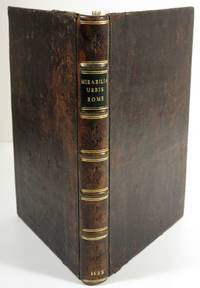
15229527Rome: Marcello Silber. Very Good with no dust jacket. 1522. Leather. Very scarce post-incunable edition of the famous marvels of the City of Rome bound as is common with a work on the indulgences of the churches of Rome. With 8 full page woodcuts papal arms and large initial. In two parts: 55 of 56 8 ff. A8-g8 missing a1 plus the 8 unnumbered leaves of the Mirabilia without signatures or catch phrases. Printing information on the Indulgentiae on g8 lacks title with image of wolf feeding the twins. Leaves have old hand-inked page numbers continuous through both parts. Small marks and occasional light stainsfirst few leaves have damp mark at bottom edge first leaf has marginal losses at bottom and stronger marks old neat ink notation at top of leaf date of 1522 written in top of leaf has papal seal of Hadrian VI 1522-1523. The Mirabilia has no title colophon nor illustration it is 22/23 lines with the only woodcut being the small first initial. In renewed leather boards with a new handsome spine with 5 raised bands and gilt. Renewed endpapers. Handsomely printed in Gothic type with 8 magnificent full page woodcuts plus the insignia on a2. The lines on the legendary Pope Joan have been neatly crossed out. The Mirabilia Romae is a rare text one of the first printed guide books to the marvels of the Eternal City. The tradition of the Mirabilia started in the medieval period as a guide for the use of Pilgrims combining Christian beliefs and the mythology and history of Rome. "Unhampered by any very accurate knowledge of the historical continuity of the city the unknown author has described the monuments of Rome displaying a considerable amount of inventive faculty" according to the Catholic Encyclopedia. The printer of this work is Marcello Silber who ran the family establishment in Rome until 1527. His father Eucharius Silber had printed a number of earlier editions of the Mirabilia including a 1491 incunable edition. This work with its wonderful woodcut illustrations is scarce in any edition. The Indulgentie conforms to G-250 of Rossetti's Rome I with 24 lines. We have not been able to identify which Mirabilia Rome Urbis this is: although the printing looks like Silber the paper is not the same as the Indulgentiae and as far as we can tell it does not conform to any of the Mirabilia in OCLC Rossetti Sander nor USTC. A very attractive copy inside and out. Provenance: the Joseph Mendham collection. ; Woodcut; 8vo 8" - 9" tall; 55 8 pages . Marcello Silber hardcover
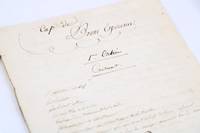
183091260n. l.: s. n. 1830. Fine. s. n. n. l. s. d. 1830 16.3 x 20.6 cm En feuilles sous chemise et étui Complete anonymous manuscript of 23 pages plus title page and table from the first half of the 19th century entitled: Cap de Bonne Espérance. 1er cahier.Our manuscript is presented in a navy blue half shagreen folder marbled paper boards housed in a slipcase edged with navy blue shagreen marbled paper boards.An account of a stopover at the Cape a city under British rule which according to the anonymous author retains many traces of its Dutch past.Description of the town its geographical setting its buildings churches and houses whose cleanliness contrasts with the dirt and the smell of meat prevailing in most of the streets.This is followed by the narrative of an excursion in the surrounding area to Constance where the author appreciates the wine of the proprietors he visits and then of the ascent of the famous Table Mountain overlooking the Cape. s. n. hardcover
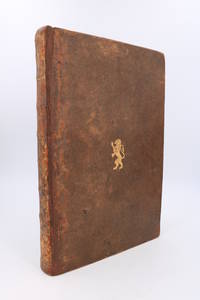
175090724n. l.: s. n. 1750. Fine. s. n. n. l. s. d. 1750 20.5 x 31 cm Relié Eighteenth-century manuscript second half comprising 258 foliated pages. Contemporary binding expertly restored in full tan calf with a smooth spine adorned with gilt compartments and decorative gilt tooling some now faded; signs of rubbing; title label missing; gilt rampant lion at the centre of both boards; handmade paper endpapers and pastedowns; gilt double fillets on board edges; corners slightly worn. Notable manuscript featuring extracts and summaries of orders and dispatches issued by the Ministry of the Navy during the Regency and the first year of Louis XVs reign. Collated from original documents carefully dated and with folio references these extracts are written in a highly legible hand. Topics covered include: general armament; the War of the Quadruple Alliance 1718 1719 1720; Barbary States; Guinea Coast; colonies; trade Spain Portugal Guinea Compagnie dAfrique Compagnie des Indes; justice police and discipline; munitions; goods and timber; fishing; ports and roadsteads; prizes and more. The manuscript is in excellent condition preserved in its original binding. Contemporary pencil note on the front endpaper: ""Aux armes du Maréchal Duc de Duras de lAcadémie française"" 17151789. s. n. hardcover
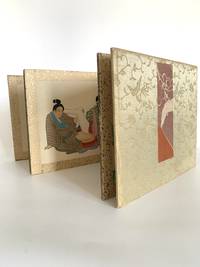
1880840941880. Fine. 1880 21 x 24 cm autre Album bringing together 10 original paintings on beige silk in colors mounted on gold paper. The pastedowns of embossed and gold paper with flowers and leaves. The final work of the collection bears 2 red seals. The majority of these collections are never signed due to censorship so it is extremely rare to find a seal therefore the painter's signature. Each painting is a square of silk measuring 16.8x16.8cm. The erotic scenes contain no decor no background concentrating all attention on the couples. 3 however have drapery or a screen. The paintings are extremely stylized and finely executed of great quality. A few fine strokes draw the figures clothed in fabrics that partially cover them. With a few red touches the colors used are browns harmonizing with the beige background. It is almost impossible to date this type of work precisely and it is likely older by several decades although its very refined style seems to reflect the end of the nineteenth century in Japan. Accordion album covered in blue silk with gold motifs. Wooden case in 2 parts 24.5x28.5cm a base and a lid with manuscript writing on the lid. For the album: Rubbed manuscript label. Worn corners with fabric loss. The gold paper with rubbing. In the margins the paintings have some soiling or light dampstains. It is very rare that these collections always hidden from view have preserved their storage box. Compared to the well-known production of erotic prints the paintings while respecting a certain number of codes of Japanese eroticism size of genitals swooning women fabrics partially masking nudity sexual positions. show greater creativity and originality expressing more of the technique and vision of the painter. The series thus demonstrates extreme refinement and great purification especially when compared to shunga from the Edo period. Furthermore even if the erotic scenes respect the codes of shunga representation one can clearly distinguish an evolution in the vision of sexuality: women hold a more equal place and the whole tends more toward harmonious sexuality perfectly rendered in these paintings by the choice of brown gradations punctuated with touches of more violent colors thus representing a form of serenity inhabited by the violence of desire. Shunga is the generic Japanese term designating erotic art it literally means Spring Image spring being a euphemism and figure of speech expressing sexuality. The term Shunga having long been reserved for prints collections or albums have often been designated by the appellation Pillow Books or pillow notes etc. Utamaro: The Song of the Pillow 1788. Precious and rare ensemble. hardcover
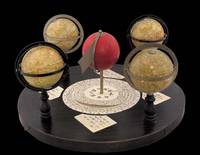
195015336Japan c1950. 280 by 230mm. 11 by 9 inches. Four small globes on turned stands surrounding a red sphere with a directional wind tail attached to a demi-meridian ring all mounted on a central metal pole fitted on a circular wooden base. Two manuscript paper disks overlapping on the wooden base with the top one movable and the bottom attached to the base. Four other manuscripts are attached to the base in between the stands. A unique fortune-telling astronomical instrument made in Edo Japan based on the "Nine-star Ki" ky seikigaku form of divination adapted and refined from traditional Chinese methods by Shinjiro Sonoda 1876-1961 in 1924. "Nine-star Ki" refers to nine-year and nine-month cycles of the Ki/Qi element on Earth which relate to the solar and seasonal cycles. These cycles are believed to have common effects across the planet on mental and physical development and life experiences. The 'stars' of "Nine-Star Ki" are numbers representing those cycles which can be calculated for anyone using their birthdates. This instrument was specifically designed to calculate the numbers of "Nine-Star Ki". Constructed on a circular wooden plate are four small terrestrial globes on turned stands which surround a red sphere mounted on a metal pole at the centre. A bronze signpost attached to the sphere is engraved with three characters " " " " " " "cold" "warm" and "hot" respectively referring to the seasons . Directly beneath the sphere are two circular manuscript charts. The smaller uppermost chart is rotatable bearing the title " " "Fortune-telling Nine astronomical bodies rotating chart". It shows three concentric rings radially divided into sixty sections. The first ring shows a cycle from " " one to " " sixty in anti-clockwise order and there are two characters " " "this year" marked in red above the former indicating the beginning of the cycle. In the second ring every consecutive nine characters represent the Navagraha or "nine celestial bodies of universe" in Hindu astrology. They represent different elements of nature as well as season personality family and direction. These are " " the Sun " " the Moon " " Mars " " Mercury " " Jupiter " " Venus " " Saturn " " Solar Eclipse and " " Lunar Eclipse. The third ring shows the names of Bagua the eight symbols of Taoist cosmology which are " " Heaven " " Earth " " under" "Water" "Mountain" "Wind" "Flame " " Lake. The larger chart beneath is attached to the plate showing two more rings. The first ring is an extension on the Bagua ring it encircles. It shows the sexagenary cycle which is a cycle of sixty terms each corresponding to one year used for reckoning time in China and other parts of East Asia. The outermost ring has thirty divisions each containing a character that represents one of the "Five Phases' " ": " " Wood " " Fire " " Earth " " Metal and " " Water. The system of five phases was used for describing interactions and relationships between phenomena including geomancy and astrology. Rotating the top chart to align the divisions on the five rings would give a combination of numbers and signs. Hence using one's date of birth one could rotate the chart to reveal a set of numbers and figures that signifies one's fortune according to the divination of the "Nine-Star Ki". Surrounding the main chart are four sheets of manuscript text. The top right sheet bears the date " " "May 9th Eleventh year of Bunsei era - 1828" yet this does not appear to be the year of publication since Korea is labelled as " " "Republic of Korea" and China " " "Republic of China" on the terrestrial globes. Given the establishment of the Republic of Korea in 1948 and the Republic of China in 1949 the instrument can be dated to roughly the following decade. This instrument is extremely rare and perhaps unique. We are unable to trace any other examples. unknown
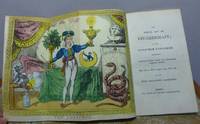
53218<p>Derby Thomas Richardson circa 1830. FIRST EDITION circa 1830 pamphlet approximately 185 x 100 mm 7¼ x 4 inches folding hand coloured plate as frontispiece pages: 4 5-24 last page not numbered original publisher's yellow printed wrappers. Spine neatly repaired frontispiece slightly trimmed with slight loss to border not affecting image pale offset to title page upper wrapper slightly dusty near spine otherwise a very good copy. See: Raymond Toole Stott A Bibliography of English Conjuring 1581-1876 page 236 No. 718; Some Printers & Publishers of Conjuring Books and other Ephemera 1800-1850 by Trevor Hall and Percy Muir page 54. MORE IMAGES ATTACHED TO THIS LISTING ALL ZOOMABLE FURTHER IMAGES ON REQUEST. POSTAGE AT COST AND ALL PARCELS SENT FULLY TRACKED AND FULLY INSURED.</p> Derby, Thomas Richardson, circa 1830.
1950019790New York 1950. Minor surface wear ink light at a few points with "Bill" on the dark portion of his suit but still visible. Near Fine. A scarce 8" x 10" Black-and-White Formal Photograph SIGNED by Bill Wilson: "To Martie C--/With affection/and thanks/Bill/NY -- 9/50." <br/><br/> unknown
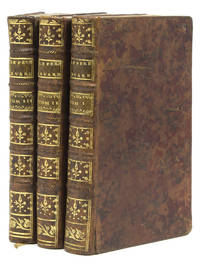
1770307572Paris: Desventes de Ladoué 1770. First edition. xvi 359 iii; 334; 360pp. 3 vols. 12mo. Bound in full contemporary mottled calf. With the bookplate of the Vicomte de Noailles engraved by Agry in each volume. Upper joint of vol. III with short start at foot otherwise a fine and fresh copy. First edition. xvi 359 iii; 334; 360pp. 3 vols. 12mo. A satirical response to Rousseau's Emile ou l'Education 1762. Where Émile is guided by a wise tutor the author of Le Père avare mocks from the outset Rousseau's dictum "le véritable précepteur est le père" for the narrator's father M. d'Erigny grew up poor and gained wealth through his friendship with a government minister; his child has been spoiled from infancy. <br /> While M. d'Erigny is drunk his mistress gets him to sign an order from her jeweler for 20000 francs of precious stones and skips out. The extravagance is discovered and the father becomes miserly in the extreme. The son now 15 years old is entrusted to a unscrupulous précepteur or tutor who involves the youth in a swindle and vanishes with the money. <br /> This is a confessional so we learn it all: the narrator soon discovers love and devotes himself to pleasure using the family name to run up accounts everywhere before being deceived and fleeced. M. d'Erigny is furious; Madame intercedes: his debts are paid and he is sent off to exile in a provincial town. He is befriended by a well-connected gentleman but repays this trust with deceit. Besotted with an actress he forges a criminal denunciation of a rival but his scheme is discovered and his in consigned to "une de ces maisons de force" a private prison for the reform of licentious youth. <br /> To escape this close confinement the narrator embarks with a flotilla of colonists bound for the island of C in the new world. His mother's continued good influence follows him across the ocean cushioning him from the worst excesses of a brutal colonial regime amply detailed. Florainville a mistress who has managed her money well comes to the colony to rescue him but falls afoul of the corrupt Intendant and her health fails her. She dies but not before she has made him her legatee. The narrator assists the colonial governor in prosecuting the Intendant and returns to France. He retires to a rural abbey and contemplates his experiences. Before long he becomes the benefactor of a village community and sees it thrive.<br /> Only edition of this little-known work of fiction set partly in the Americas. OCLC records two copies in N. America Princeton UCLA two in France and one at Trinity College Dublin Desventes de Ladoué unknown
6685N.p. but likely New York 1839. Lithograph 10.25†x 12†plus margins. CONDITION: Good narrow margins upper margin expertly extended lightly soiled paper pulp reinforcements on verso. <p>A rare and anonymously-produced political cartoon attacking Henry Clay’s duplicitous position on slavery the issue that was at the fulcrum of so many political moral and legal conflicts in antebellum America.</p> <p>Clay at the time a Senator from Kentucky and one of the country’s most popular politicians grew infamous for his attempts to play both sides of the slavery issue. This cartoon takes the opportunity of one of his 1839 Senate speeches to skewer his views on slavery as he angled for another presidential nomination. The text points out the hypocrisy and contradictions in his words and attitudes. Audiences above the Mason-Dixon Line hear Clay proclaim: “I consider Slavery as a Curse a curse to the Master and a grievous wrong to the Slave†insisting he was “no friend to slavery†while those in the South are assured that as an owner of three-score humans he “will continue to oppose any scheme whatever of emancipation gradual or immediate.â€Â The text also points out his contradictory views on dueling. An illustration of Mason & Dixon’s Line separates his views on slavery. South Carolina’s John Calhoun who with Clay was two-thirds of the Senate’s “Great Triumvirate†and was the country’s most prominent slavery advocate shakes Clay’s hand and promises his support. He assures Clay that abandoning his “‘folly & delusion’ about liberty†and endorsing slavery as the “‘most safe & stable basis for free institutions’†will also secure South Carolina’s support in his next presidential run: “you shall be made President for life.â€</p> <p>Both men are mindlessly standing with one foot upon a prone enslaved man. In addition Clay stands upon a torn portion of a Kentucky Convention Bill likely addressing the issue of fugitive slaves and Calhoun’s left foot stands on a torn part of a memorials and resolutions from Vermont and Massachusetts affirming that “All men are created equal and entitled to liberty &c.’†The afflicted and enslaved African-American man on which they trample to the viewer in a quote from the Old Testament Book of Micah 7:8 relating to the rise of Israel: “Rejoice not against me O mine enemy when I fall; I shall arise.â€</p> <p>Though this print bears no publication information the style and substance point toward the work of H.R. Robinson of New York who produced a number of sharp political attacks in the form of satirical prints in the 1830s.</p> <p>Not in Reilly. Rare with only three copies recorded in OCLC at the Library of Congress Boston Public Library and the American Antiquarian Society.</p> <p>REFERENCES: Weitenkampf p. 60; OCLC 741723538 and 1038126677.</p> [N.p., but likely New York, 1839] unknown
2024Gyan-9788121271363Gyan Publishing House 2024. 21 Vols. In 65 Bindings. Hardcover. New. 22.59 x 28.94 x 267.58. English Gyan Publishing House hardcover
2024Gyan-9788121271363Gyan Publishing House 2024. 21 Vols. In 65 Bindings. Hardcover. New. 22.59 x 28.94 x 267.58. English Gyan Publishing House hardcover
2024Gyan-9788121271301Gyan Publishing House 2024. 28 Vols. In 49 Bindings. Hardcover. New. 22.59 x 28.94 x 253.21. English Gyan Publishing House hardcover
2024Gyan-9788121271301Gyan Publishing House 2024. 28 Vols. In 49 Bindings. Hardcover. New. 22.59 x 28.94 x 253.21. English Gyan Publishing House hardcover
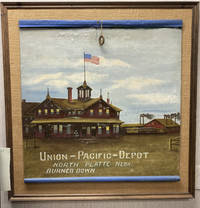
190039803North Platte: Artist Unknown n.d. ca 1900. 1900. First edition. 28" x 28" full color painting of the Union Pacific Railroad's Bailey Yard in North Platte Nebraska. It was named for the president of the Union Pacific Edd H. Bailey. It is the largest railroad classification yard in the world as it is 8 miles long and 2 miles wide. The yard covers 2800 acres and within it are 315 miles of track. Today every 24 hours Bailey Yard handles 10000 railroad cars 3000 of which are sorted in either the eastward or westward yards nicknamed "hump" yards with 120 - 140 trains a day that pass through Bailey Yard. The first train to enter North Platte was on December 3 1866. By January 2 1867 the main line of operations officially commenced in North Platte. From 1873 to 1913 "Buffalo Bill" Cody lived and organized his Wild West Show from his ranch north of the rail yard and transported his show via rail and wagon. In 1897 E. H. Harriman purchased the Union Pacific at an auction held in Omaha Nebraska. The construction of the second main line commenced through North Platte in 1910. This art is painted on a 28" x 28" linen window shade and depicts the Bailey Yard Railroad Depot and hotel both of which burned on November 17 1915. An important painting of the depot and hotel along with train cars and an iron worker's factory building prior to that fire. Minor flaking and an old small repair to the linen else a fine example of both window shade art and a depiction of the historically important Union Pacific Rail Road Depot at North Platte Nebraska. Artist Unknown, n.d. (ca 1900). unknown
158520907<p><b>1585 DUTCH History Chronicle Divisiekroniek Netherlands Holland Zealand Woodcuts</b></p><p><b><u>"The keystone work of Middle Dutch historiography!"</u></b></p><p>The "<i>Divisiekroniek</i>" was the first and most important 16th-century Dutch national chronicle. It was notable for containing some of the most famous descriptions of Dutch history providing insight into the Renaissance in Northern Netherlands – Holland Zealand and Friesland – first printed in 1517. According to Blok the '<i>Divisiekroniek'</i></p><p>"was the usual reading-book in the 16th- and 17th-centuries for the ancient history of the countship of Holland and may be reckoned as the keystone of Middle Dutch historiography."</p><p>While the contents of this work are indisputably important the in-text woodcuts of kings and Dutch royals with their coats-of-arms are highly desirable and make this already famous work highly coveted.</p><p>Item number: #20907</p><p>Price: $4950</p><p>anonymous</p><p><b><i>Die cronycke van Hollant Zeelant ende Vrieslant. Noch is hier byghevoecht een cort verhael vande regeringe totten jare 1584</i></b></p><p>Dordrecht: Pieter Verhaghen 1585.</p><p><br /></p><p><u>Details</u>: </p><p>· Collation: Complete with all pages; 2 parts</p><p>o 16 CCLXXXIIII 284 leaves; XCIIII 94 leaves</p><p>o 19 woodcut engravings</p><p>· References: Petrus Blok <i>History of the People of the Netherlands </i>p. 396</p><p>· Language: Dutch</p><p>· Binding: Leather; tight and secure</p><p>o Includes two clasps</p><p>· Size: ~12in X 8in 30.5cm x 20cm</p><p>· Exceedingly rare valuable and desirable with auction records and price comparisons at upwards of $7500-$10000</p><p>Our Guarantee:</p><p>Very Fast. Very Safe. Free Shipping Worldwide.</p><p>Customer satisfaction is our priority! Notify us with 7 days of receiving and we will offer a full refund without reservation!</p><p>20907</p><p>Photos available upon request. </p> Pieter Verhaghen hardcover
2024Gyan-9788121271202Gyan Publishing House 2024. 27 Vols. In 58 Bindings. Hardcover. New. 22.59 x 28.94 x 234.03. English Gyan Publishing House hardcover
2024Gyan-9788121271202Gyan Publishing House 2024. 27 Vols. In 58 Bindings. Hardcover. New. 22.59 x 28.94 x 234.03. English Gyan Publishing House hardcover
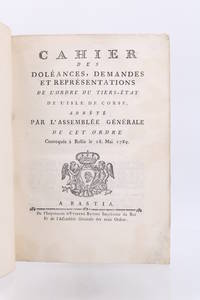
178989656Bastia: Batini 1789. Fine. Batini Bastia 2 juin 1789 16.3 x 22.4 cm Broché Very rare first edition bilingual quarto in format and printed on laid paper of the Corsican cahier de doléances.Cf. Starace 4747. Not in Roland Bonaparte. Conlon xxiv 89:1617 who notes only the 32-page octavo edition. No copy located in CCF or Worldcat.Our copy is preserved in a plain grey paper wrapper with minor internal flaws a few discreet paper restorations to the lower right margin of the opening leaves not affecting the text.""Les cahiers des Tiers en même temps que des mesures spécifiques exigent les mêmes réformes que le reste du royaume. Cette imbrication du régional et du national est jalonnée d'événements illustrant la dynamique révolutionnaire: agitation lors des assemblées primaires émeute de Bastia le 1er mai 1789 ""révolution municipale"" du mois d'août à l'annonce du 14 Juillet parisien et sous le signe de la cocarde tricolore."" Soboul Dict. hist. de la Révolution française.Among the specific measures requested are the following: authorisation for Corsican vessels to fly the Moors Head on the French white ensign as several towns and provinces of the kingdom already displayed their own arms; establishment of a university at Corte funded by the former revenues of the Carthusians Jacobins and Olivetans; establishment of a lazaretto to facilitate trade with the Levant; creation of a free port; preference in appointments to be given to Corsicans or to French inhabitants established on the island etc.Light foxing to the lower and upper right corners of the leaves not affecting the text.A well-preserved and appealing copy. Batini unknown
1920734821920. Fine. 1920 16 x 19 cm autre An album containing 14 gouaches on silk including 12 erotic paintings. The first painting on each side of the folding shows a bird and on the other side maple leaves thus masking on each of the first pages the erotic aspect of the collection. Shunga is the generic Japanese term that designates erotic art it literally means Spring Image spring being a euphemism and figure of style expressing sexuality. The term Shunga having been reserved for a long time for prints collections or albums have often been designated by the appellation Pillow Books or notes for the pillow etc. Utamaro: The Song of the Pillow 1788. Japanese accordion album covered with damask silk with flowers and birds in pale gold. Silk band on the first cover serving as a label but mute. Each painting 12.8x16cm is mounted on cardboard. The cardboard folding sections are covered with cream paper speckled with gold. Very fine condition edges rubbed with small lacks to fabric. The paintings respect the canons of Japanese erotic representation: oversized genitals body hair women with white skin and men of flesh color. No decorative element comes to distract the eye from the sexual act only one painting contains a mirror the bodies being most of the time clothed in rich kimonos. These collections were still in the modern era offered to newlyweds particularly to women. The whole is of fine workmanship the 2 introductory paintings the bird and the maple leaves are particularly successful. This type of representation was forbidden in Japan and therefore contains no signature it is however evident that there existed painters whose profession and specialty this was and whom one went to see for private commissions; it is also not forbidden to think that the painter made several on his own initiative and that he offered them for sale as was done with collections of colored photographs at the end of the 19th century. Precious and rare ensemble in superb condition. hardcover
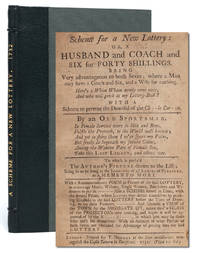
17326120London: Printed for T. Dormer 1732. First edition. Modern quarter morocco over cloth with gilt to spine. Measuring 180 x 111mm and collating complete including frontis folding game board and concluding woodcut: 2 62 2. From the collection of stage magician Ricky Jay with his bookplate to upper pastedown. Top margin trimmed close with consistent loss to running headers and occasional loss to page numbers with no other text effected. Pages somewhat toned with minor marginal chips but otherwise unmarked. A scarce satire playing both on the rising popularity of get-rich-quick schemes and on the economics of the marriage market the present is the only example to appear in the auction record. OCLC locates only twelve institutional copies. The present is the only example currently in trade.<br /> <br /> A Scheme for a New Lottery warns readers against the dangers posed by get-rich-quick schemes targeting large-scale scams like the recently burst South Sea Bubble sometimes called the world's first Ponzi scheme and the pawn-broking swindle of the so-called Charitable Corporation. These scams were appealing to ordinary people at a time when few were "successful in using wealth from trade to found a landed family" Rapp. Mocking both the conmen and the conned A Scheme satirically proposes "Another Lottery which may prove a general benefit to all concern'd; as there is no better Remedy for a Bite from a Mad Dog than the Liver of the Dog that bit." The proposed lottery filled with abstruse rules and convoluted promises ensures that the cycle continues.<br /> <br /> A Scheme also mocks marriage as a scam in which women could either make a wise match in a rich man or lose it all by marrying down. The lottery provides "Fifty Thousand tickets to be deliver'd to Maids or Widows or any that appear to be such" in the hopes of winning a financially stable husband represented by the tickets drawn. Such a match could be a good one: "A Ware-House Keeper with the Salary of a Hundred Pounds" or "the Governour." It could also by virtue of lottery be a loss: "2 Scotchmen both Pedlars 500 Broken Booksellers" and a range of other ruinous bounders are also listed as prizes. For those who desire an advance attempt the folding game bound in the book invites blindfolded women to stick a pin in the board to claim their prize. The present copy was played gently with pin marks revealing a Blacksmith and a Valet de Chambre among those husbands won<br /> <br /> The popularity of A Scheme resulted in a reissue the same year with a canceled title page as The Ladies Lottery and falsely attributed to Swift.<br /> <br /> ESTC N20921. Printed for T. Dormer unknown