[ANONYMOUS]Biblio.com
237 569 résultats
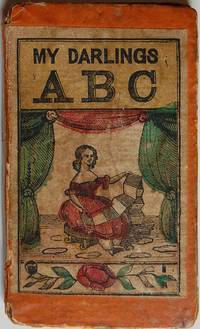
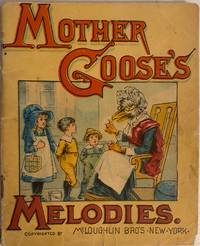
1890705New York: McLoughlin Brothers 1890. New Edition. Stiff wraps. Good. J.H. HOWARD design. 18mo; 48pp; color illustrated glazed paper wrappers; 43pp black and white illustrations; spine has ½"split at bottom 3 leaves have a crease soiling and creasing to back wrapper; colors remain bright; good. McLoughlin Brothers unknown
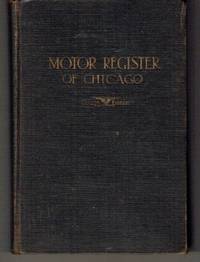
49312Chicago: Chicago Examiner. Good with no dust jacket. N.D. Hardcover. Black cloth binding rubbed at extremities; spine ends & corners lightly frayed;small chips along back gutter; boards & backstrip scuffed & soiled; owner's name & info in ink on front free endpaper; a few leaf edges & outer leaves smudged. No dust jacket. ; Black & white ad cuts.; 8vo 8" - 9" tall; 280 pages . Chicago Examiner hardcover
1870BB2421n.p. Neuhaus or Nurnberg: n.p. 1870. Card Covers. Near Fine. Sixth Edition of this popular pastime published in at least nine editions although few copies survive. Royal 8vo 331 x 249mm: six-page descriptive letter press with parallel texts in French German and English identifying each flower and giving its symbolic significance and 50 colored flower die-cuts to be inserted into the slots of four card plates to create bouquets and garlands. Original brown quarter linen and paperboard chemise with string ties color lithograph onlay to front board; handsome oval bookseller's ticket to front paste-down: "Cadlers. Fabrik u. Handlung v. Lehrmitteln. Hamburg. 4 Scholviens Passage 4." Light wear and soiling to chemise minor occasional soiling to four panels but a remarkable survival rarely found with all 50 flower die cuts and the text letter press. Osborne Coll. I p. 420 wanting the letterpress booklet. A charming floral arrangement toy or game. From the instruction booklet: “Rational entertainment by forming bouquets and garlands in endless variation from the most beautiful flowers. The several flowers are placed on one of the 4 Cartons in the incisions made for this purpose; thus the most elegant bouquets and garlands are produced either according to free choice of the flowers or the time of the year in which they bloom or their symbolic signification as given here." N. B. With few exceptions always identified we only stock books in exceptional condition. All orders are packaged with care and posted promptly. Satisfaction guaranteed. Fine Editions Ltd is a member of the Independent Online Booksellers Association and we subscribe to its codes of ethics. n.p. unknown
197036444New Delhi: S. Chand & Company 1970. First printing. Near fine. Scarce illustrated ABC of everyday objects from noted Indian textbook and educational publishing house S. Chand. S. Chand & Company was founded in the late 1930s as part of a national effort to support Indian authors and reduce dependence on imported books from the UK. Among this booklet's alphabetical nouns of childhood Apple Bicycle House Hockey is C for Carrom board the popular game of Indian origin. 10.5'' x 7.25''. Original glossy color pictorial wrappers. 6 glossy full-color illustrated pages. Trace wear. Bright. (S. Chand & Company) unknown
14345No place or printer but probably Philadelphia or New York circa 1835-1850. . 26 leaves as an accordion foldout each leaf 3¾ x 2 inches. Hand-colored woodcut illustrations throughout printed on one side only with the first and last leaves pasted to the boards as issued; a couple of minor splits at folds but sound. Original orange boards title label as above pasted to the upper board with a hand-colored woodcut of a girl in a red dress dangling the accordion ABC; some wear and edge-spotting. An anonymously-published issue of a charming and clearly popular toy-book; another issue with the same woodcuts though a different illustration on the title-label has the imprint of the Turner and Fisher firm with addresses in Philadelphia and New York. Each leaf has a large decorative initial and a word and illustration to represent the associated letter with overall a very American look with rich colors and unusually charming and primitive woodcuts of well-known animals and objects. [No place or printer, but probably Philadelphia or New York circa 1835-1850]. hardcover
19821507Los Angeles: Stealth Publications 1982. Velo-bound quarto in blue printed card stock wrappers. 122 pp. Mild soiling and toning; Very Good. Comprehensive guide to establishing fake identity documentation and practice clandestinely circulated and printed often advertised in the back of "Soldier of Fortune" magazine. Stealth Publications unknown
30352Hardcover. Black morocco marbled endpapers marbled edges brass clasp. Ninety-five handwritten leaves plus several blanks. The first twenty numbered leaves are verbatim excerpts from titles such as Principles of Human Physiology by William Benjamin Carpenter Outlines of Physiology in Its Relations to Man by John Gray McKendrick. The actual diary starts with the entry of Wednesday January 1st 1851 and continues through September 12 1851. It is followed by what appears to be a short section of notes on Gibraltar including a hand-drawn map. The diary then resumes on September 14 1851 until April 1853 interspersed with annotations on the life of painters and more. A glimpse of the daily life of a 19th Century Londoner. Very old photograph depicting two ladies laid in. Some wear to extremities and scuffs to covers. Very good. ; Manuscripts. hardcover
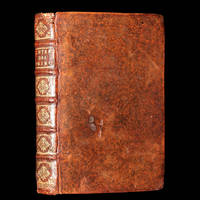
16881577212024827<p><strong>Author:</strong> Anonymous.<br /><strong>Title:</strong> Nouveaux Interêts des Princes de l'Europe selon l'état que les affaires font aujourd'hui. Troisième édition.<br /><strong>Publisher:</strong> A Cologne Chez Pierre Marteau 1688. Third Edition.<br /><strong>Language:</strong> Text in French.<br /><strong>Size:</strong> 6 x 4 inches.<br /><strong>Pages:</strong> 355 pages.<br /><strong>Binding:</strong> Good contemporary full mottled calf binding spine with raised bands and richly gilt compartments red morocco lettering piece hinges fine overall worn and scuffed - as shown noticeable wear and rubbing to boards with chips and losses to the rear cover - as shown under a protective removable mylar cover. <br /><strong>Content: </strong>Good content tight some foxing or staining - as shown. Early ink ownership signature to front blank.<br /><br /><strong> </strong></p><p><strong>The book: </strong>A rare late-seventeenth-century political treatise examining the shifting balance of power among the principal states of Europe during a period marked by dynastic rivalry and the emergence of modern diplomacy. The work surveys the interests and strategic maxims of the leading monarchies and republics—including France Spain England the Empire and the Dutch Republic—offering insight into contemporary perceptions of international relations at the close of the age of Louis XIV. Issued under the imprint "Pierre Marteau" a well-known pseudonymous Cologne address often used for politically sensitive works the book reflects the vibrant clandestine publishing culture of the period. Despite the wear to the rear cover this copy retains a pleasing contemporary binding and a complete readable text making it an appealing survival of an important genre of early modern political literature.</p> A Cologne, Chez Pierre Marteau, 1688. Third Edition. hardcover
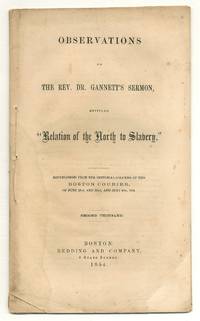
1854506176Boston: Redding and Company 1854. Softcover. Near Fine. Second thousand. Octavo. 29pp. Sewn self-wrappers. Early light dampstain at inner margin of most pages chips at the bottom of the wrappers else near very good copy. Redding and Company unknown
17539900037255London: Dan Browne et al. 1753. 1st edition. Hardcover. pp. 266 24. 12mo. Our copy has been recently re-backed with the original spine label laid down. Bookplate of famous bibliophone A. Edward Newton attached to inside front board. The hinges are strong. Boards show some wear to edges. Contents clean and tight: a good copy. The identity of the author is in dispute. The Gentleman's Magazine of 1848 suggests it might have been Tobias Smollett. Other suggest it was 'Sir' John Hill 1716-1775 an English author and botanist who edited the 'British Magazine' from 1746-1750 and for two years 1751-1753 wrote a daily letter 'The Inspector' for the London Advertiser and 'Literary Gazette' see Wikipedia. There is also an anonymous three page Preface to this book which a pencilled note on the front free endpaper which suggests the Preface 'is undoubtedly by Samuel Johnson'. However a typed card laid-in loose contradicts this assertion. Dan Browne et al. hardcover
166617940s. l. Bruxelles Brussels: S. n. F. Foppens 1666. Fine. S. n. F. Foppens s. l. Bruxelles Brussels 1666 8 x 13.50 cm relié Anonymous first edition. The work bears number 2023 in the catalogue of Elzevirian editions Willems Vol. II. For the author see Barbier Dictionnaire des ouvrages anonymes. Contemporary full vellum binding with flaps. Smooth spine. Title in faded red ink. Rolland Le Vayer de Boutigny 1627-1685 was Master of Requests to Louis XIV and one of his influential advisors. Author of novels plays and short stories as well as political and legal treatises this book reveals that Boutigny was trained as a jurist. Peculatus designates the theft of public funds by those who administer them; it was punished by death under Roman law but not under French law. ""Under the Ancien Régime how many ministers were condemned for peculatus and extortion! How many chambers of justice were instituted to make the financiers who pillaged the treasury disgorge their gains in complicity with the superintendents of finance!"" Dictionnaire de droit criminel Doucet. The treatise on peculatus caused scandal; Boutigny was accused of defending Fouquet who a few years earlier had been arrested and accused of embezzlement which is why he wrote these Observations in dialogue form where he discusses the validity of the death penalty banishment and the history of French law regarding peculatus. S. n.[ F. Foppens] hardcover
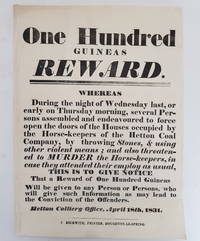
18319486Houghton-le-Spring; Printed by J. Beckwith 1831. 1831. Broadside approximately 28 cm x 20 cm. Single sheet with titles printed in bold and underlined. Clean and crisp with a very faint horizontal crease. A Near Fine copy. An appeal for information leading to conviction of offenders who attacked the property of Hetton Colliery on April 1831. In that year Thomas Hepburn founded a Union of Northumberland and Durham miners and in April the end of the bond term the miners put down their tools in a largely non-violent protest for better working practices and conditions. The mine owners were understandably concerned that the protest could escalate and they capitulated in the first major victory for unions in the coal trade resulting in a number of reforms including the reduction of working hours to 12 for boys. This broadside reports that "several Persons assembled and endeavoured to force open the doors of the Houses occupied by the Horse-keepers of the Hetton Coal Company by throwing stones & using other violent means; and also threatened to MURDER the Horse-keepers in case they attended their employ as usual". Similar acts were taking place around the coal mining districts of the North East and the high value of the reward is an indication of how seriously the authorities viewed the threats and feared that violence would spread at a time of political and industrial unrest. Houghton-le-Spring; Printed by J. Beckwith, 1831. unknown
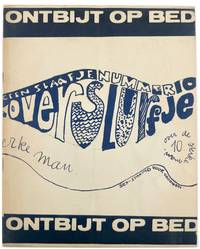
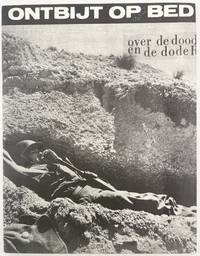
19673474Amsterdam: Laboratorium for Instant Art 1967. Saddle-stapled 6-1/8 x 7-7/8 inches in illustrated wraps. Multi-colored text and graphics offset printed. 24pp. Wraps toned and lightly soiled; vertical crease running throughout near middle; Good or better. From the many phoenixes found in the ashes of the Dutch anarchist movement Provo 1965-1967 came the radical art journal Ontbijt Op Bed "Breakfast in Bed" which kept the situationist / anarchist focus of Provo but tacked heavier into a visual arts focus. Laboratorium for Instant Art unknown
19673475Amsterdam: Laboratorium for Instant Art 1967. Saddle-stapled 6-1/8 x 7-7/8 inches in illustrated wraps. Multi-colored text and graphics offset printed. 22pp. Near Fine. From the many phoenixes found in the ashes of the Dutch anarchist movement Provo 1965-1967 came the radical art journal Ontbijt Op Bed "Breakfast in Bed" which kept the situationist / anarchist focus of Provo but tacked heavier into a visual arts focus. This is issue 8 the "Death Issue Laboratorium for Instant Art unknown
18602159Edinburgh and London: William Oliphant and Co.; Hamilton Adams and Co 1860. JUVENILE RELIGION. Edinburgh: William Oliphant and Co.; and London: Hamilton Adams and Co.<br /> Murray and Gibb Printers Edinburgh.<br /> <br /> First edition thus 16mo 6 7/16" x 4 7/16"; 95 1pp 2 3-16pp of publisher's ads; ornate blind-stamped design on maroon cloth over board gilt letters on front and spine; glazed yellow endpapers; engraved fp with tissue guard historiated first letter head and tail-pieces; illustrated rear publisher's ads; spine lightly sunned a few light fingerprints and scattered foxing; very good plus. OCLC locates one copy at Cambridge Univ. with these publishers. This appears to be the first edition with these two listed publishers. In addition to the two moralistic and religious stories "Order and Disorder" and "A Sabbath in the Country" Bible verses are inserted to impress the reader with a sense of doing what is morally and socially correct. William Oliphant and Co.; Hamilton, Adams, and Co unknown
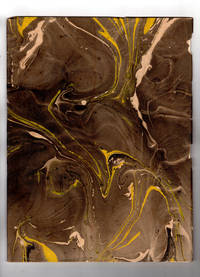
1950000710No Location: No Publisher 1950. Original Art . Soft cover. Near Fine. Folio - over 12" - 15" tall. anonymous. no place no publisher no date prob circa mid-late twentieth c. Original anonymous art in the form of a French Medieval Book of Months with miniature prints. See scans. Folio 14" x 10.75" 12 sheets bound in marbled wraps. Minor tattering of the marbled wraps as well as some bleed-through of the hand-marbling on each cover sheet else Near Fine. Each page has the name of a different month in orange script in French at the lower right corner with a gilt-embellished full-color miniature medieval print of unknown but probably modern origin tipped-in above in each case the subject of which corresponds to that page's particular month. Versos have large original pen-and-ink drawings in orange ink mostly bacchanalian in nature unsigned. Format is broken by December which is on the verso of November and which therefore lacks its own facing drawing and by an even larger two-page pen-and-ink drawing between June and July. Well-executed art striking in orange. Artist unknown but some of the drawings are reminiscent of some Emlen Etting sketches. See scans. lg7 <br/> <br/> No Publisher paperback
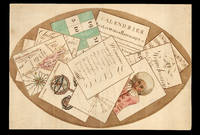
180217663Paris L'An XI de la Republique 1802. 355 by 515mm 14 by 20.25 inches. A manuscript medley featuring a map of Sicily Original pen and ink and colour wash. This design for a printer's trade card takes the form of the popular "medley" print in which as many examples of the kinds of printing that the firm is able to produce are displayed in ordered chaos spread out as if on a table for viewing. It includes quite a detailed map of Sicily the lyrics to the popular chansons 'Il pleut il pleut bergere' and 'Regne heureux' a rendering of Watteau's painting 'Pierrot' and a calendar for "L'An XI" i.e. 1802. unknown
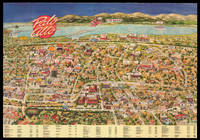
199015082San Francisco: City Designs Firm CA c1990s. 540 by 770mm. 21.25 by 30.25 inches. Chromolithograph plan. This map depicts an aerial view of Palo Alto with bold graphics and decorative detail. The view highlights the city with stylised depictions of local businesses landmarks and streets. Throughout the map there are small caricature depictions of figures and accompanying slogans as well as business logos and advertisements. The bottom of the map includes a key of the local businesses with addresses and phone numbers. Part of the Stanford University campus is shown in the lower left hand corner of the map. City Design a professional graphic art company was active in the 1980s and 1990s providing maps of various cities and areas across California with its characteristically playful designs. The firm also produced jigsaw puzzles of its maps which it advertised as 'a visual time capsule.' The same firm created another version of the Palo Alto map in 1989. We have been unable to trace another version of this map. The New York Public Library holds four maps by the firm while the Library of Congress holds one. City Designs Firm CA, unknown
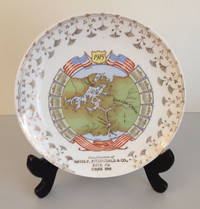
141930585Erie PA: Gately Fitzgerald & Co 1914-1915. Other. In excellent condition. The map was originally published folded so that the old folds are still slightly visible. . 190 by 190mm 7½ by 7½ inches. Porcelain dish datedxmas 1914 with an antique map of thePanama Canal surrounded by a calendar of 1915 and decorated at the top with the flag of the United States. Interesting collectors item showing the Panama Canal on a porcelain dish labeled at the bottomCompliments of Gately Fitzgerald & Co. Erie P.A. Xmas 1914. Gately, Fitzgerald & Co unknown
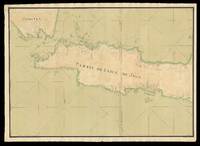
173317524Probably Paris: Dépôt des cartes et plans de la Marine c1733-1739. 530 by 1500mm. 20.75 by 59 inches overall. Manuscript chart pen and black ink and colour wash on two separate sheets of paper watermarked with Strasburg Lily within a shield initials "VDL" beneath and countermark "IV" closest to Churchill 405 dated to 1733 from the mill of Pieter van der Ley son of Gerrit Pieters van der Ley who worked De Wever - the Weaver - and De Bonsem - the Polecat - mills at Koog aan de Zaan Holland from 1674 onwards. The conquest of Jakarta by the Dutch who immediately renamed the port Batavia in 1619 gave the VOC its Asian headquarters from which it commanded a vast trading empire eventually extending from southern Africa to Japan that lasted for nearly two hundred years. By the end of the 1730s the British and French had begun to flex their seafaring muscles in the area and were publishing their own maps. This large-scale and detailed French chart of Java is clear evidence of a hostile interest that is directed at the very the heart of the Dutch empire. It is very similar to Francois Valentyn's large chart 'Nieuwe en zeer naaukeurige kaart van t Eyland Java Major of Groot Java' published in his 'Oud en Nieuw Oost-Indien vervattende een Naaukeurige en Uitvoerige Verhandelinge van Nederlands Mogentheyd in die Gewesten' 1724-1726 based on his own research correspondence and from previously unpublished material secured from the VOC officials. Some of this information must also have been available to the Chatelain family who published their 'Carte de l'Ile de Java: Partie Occidentale Partie Orientale.' 1719 which included details of inland topography not found on this manuscript chart nor on Valentyn's. The Chatelain map is avowedly based on Hadriaan Reland's work which was not published by the Dutch until Johannes van Keulen issued it as 'Insulae Iavae pars Occidentalis edente Hadriano Relando' in 1728. Interestingly this manuscript chart includes soundings that are not expressed on the Chatelains' chart implying some more recent knowledge of the coastline. However it does not reflect VOC knowledge of the southern coastline of Java dating from 1739 when Paulus Paulsz. in the sloop de Valk went on a surveying expedition there. His report and much more detailed chart which "remained the best sea chart of this area until the end of the VOC rule" Schilder page 173 survive. In 1513 Francisco Rodrigues sailed with the "Portuguese expedition from Malacca to find the unknown source of the rich trade in nutmeg mace and other spices. They sailed along the north coast of Java a trip from which Rodrigues prepared the first European map of Java's basic outline only of the north coast from direct observation. The Dutch who followed the Portuguese also ignored the interior in their mapping. In 1619 when the VOC established Batavia present-day Jakarta as a trading entrepot the south coast remained relatively unknown: it did not lie on the route to the valuable Molucca Spice Islands. The interior lands away from Batavia were ignored as long as the Javanese kingdoms remained quiescent; the VOC was intent only on ensuring a profitable return for its investors. Pursuit of these immediate economic goals restricted the exploration and associated topographic cartography of Java for nearly a century. A trivial cartographic misunderstanding reveals much about the stagnant state of mapping in Java at that time. The VOC sent Cornelius Coops by ship in 1698 to update the charts of the south coast; until this time charting was largely restricted to the northern coast where the Dutch ports and trading centres were located. Several schematic manuscript maps of the whole island appeared in Isaak de Graaf's 'Atlas Amsterdam' compiled by the VOC at the end of the seventeenth century but not published until the 1980s chiefly showing unnamed rivers and several VOC strongholds in the island's interior. At the beginning of the eighteenth century further mapping of the interior was conducted in a spasmodic and uncoordinated manner. The maps mostly by anonymous cartographers are in manuscript form and are held by the Netherlands National Archives The Hague. They were prepared internally by the VOC as administrative planning and strategic documents for circulation and use by VOC officials. VOC maps were closely guarded trade secrets; however commercial maps of the whole of Java and the neighbouring island of Madura were becoming readily available in Europe by the second decade of the eighteenth century" Simpson. This anonymous manuscript chart was probably prepared by the Dépôt de la Marine known more formally as the Dépôt des cartes et plans de la Marine the central charting institution of France. The centralization of hydrography in France began in earnest when Jean-Baptiste Colbert became First Minister of France in 1661. Under his watch the first Royal School of Hydrography began operating as did the first survey of France's coasts 1670-1689. The Dépôt itself began as the central deposit of charts for the French Navy. In 1720 the Navy consolidated its collection with those government materials covering the colonies creating a single large repository of navigation. By 1737 the Dépôt was creating its own original charts and from 1750 they participated in scientific expeditions to determine the accurate calculation of longitude. In 1773 the Dépôt received a monopoly over the composition production and distribution of navigational materials solidifying their place as the main producer of geographic knowledge in France. Dépôt-approved charts were distributed to official warehouses in port cities and sold by authorized merchants. The charts were of the highest quality as many of France's premier mapmakers worked at the Dépôt in the eighteenth century including Philippe Bauche Jacques-Nicolas Bellin Rigobert Bonne Jean Nicolas Buache and Charles-François Beautemps-Beaupré. The Dépôt continued to operate until 1886 when it became the Naval Hydrographic Service. In 1971 it changed names again this time to the Naval and Oceanographic Service SHOM. Although its name has changed its purpose is largely the same to provide high quality cartographic and scientific information to the France's Navy and merchant marine. Simpson 'Java Emerging Unfolding Cartographic Views' The National Library Magazine December 2010. Dépôt des cartes et plans de la Marine,
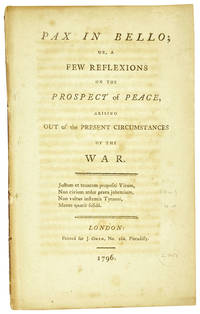
179612796London: J. Owen 1796. Very Good. London: J. Owen 1796. First Edition. Octavo; removed; 488pp. A2 B-M4. Leather remnants along spine title page a bit toned else Very Good and sound.<br /> <br /> Political tract first published in an unspecified "Morning Paper" delineating a path for peace between France and England in the midst of the French Revolutionary Wars. The anonymous author is especially concerned with the effect of the war on British trade arguing at one point that "Having reduced all the French Settlements on the Continent of Asia and masters as we are of the Cape and Trincomalé with a superior Naval Force I may fairly assume that should the present War be protracted we shall remain invulnerable in that quarter." pp. 57-8. <br /> <br /> ESTC T43799. J. Owen unknown
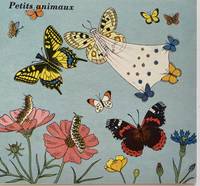
19701028Zurich: Max Künzli Verlag 1970. Stiff wraps. Near fine. 12mo 6 5/16" x 7"; 12pp; chromolithographed pictorial of anthropomorphic insects on stiff wrapper a butterfly wedding on the front and a queen bee riding on a flower petal on the rear; 2 staple binding; produced as a coloring guide book with text color pictorial to one page and the facing page in black outline; light crease to bottom corner; near fine. Not recorded. The publisher Max Künzli of Zurich Switzerland had a long history of high quality chromolithography. The family was in the printing business from before 1880 and established several companies in Zurich. After his father's death Max took over the management of the business Carl Künzli-Tobler and changed the name to Max Künzli. Max's son Raymond took over the business in 1965 and it closed in 1974. Alan Petrulis Metropostcards dot com. During its heyday it was known as a printer of viewbooks greeting cards and postcards most notably what became known as the Mainzer Cat series after Alfred Mainzer Inc of New York acquired the rights of these humorous drawings by artist Eugen Hartung. The dressed anthropomorphic cats continue to be a highly collected postcard series today. Following in this vein of humorous anthropomorphic animals this little coloring book features insects reptiles birds and small mammals involved in play. Not in any WorldCat library and not found in the marketplace. Max Künzli Verlag unknown
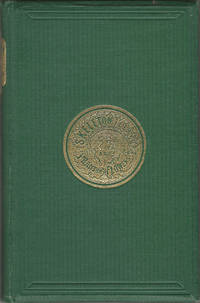
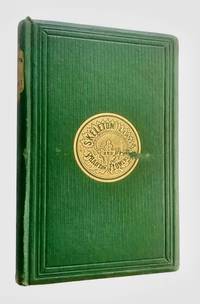
18649700Boston: J. E. Tilton and Company 1864. Octavo 19 x 12 cm. 96 pages. Illustrated with six tissue-guarded plates head pieces and historiated initials. FIRST EDITION with this title; originally published in 1863 by Edward Parrish of Philadelphia under the title Phantom Bouquet: Skeletonizing Leaves and Seed Vessels. Producing skeletonized leaves was a fashionable Victorian pastime which involved removing chlorophyll from leaves to create intricate designs which imitated those left by insects and larvae. The designs were used as borders on photographic portraits and for other decorative purposes. Original dark green textured cloth with beveled edges; covers blind-paneled with gilt vignettes to spine and front panel. Fine. J. E. Tilton and Company hardcover
1864BB2767Boston: J. E. Tilton and Company 1864. Decorative Cloth. Fine-. First Edition under this title see below of this early work on a fashionable Victorian pastime. 8vo 191 x 119mm: 96pp with six tissue-guarded plates head pieces and historiated initials. Original dark green ribbed and beveled cloth covers paneled in blind gilt vignettes to spine and front cover chocolate brown end papers illustrated title page. Gift inscription to Mary D. Ballou perhaps the Rhode Island suffrage pioneer dated 1865 and her manuscript ex-libris in elegant script with "Providence" to front fly leaf. Slight scuff to cover vignetteelse tightly bound and virtually pristine tissue guards lightly foxed but plates generally bright with interesting provenance. First published in Philadelphia in 1863 by Edward Parrish under the title Phantom Bouquet : Skeletonizing Leaves and Seed Vessels. Producing skeleton leaves involved removing chlorophyll from leaves to create intricate designs in imitation of those left by insects and larvae. The designs were used as borders on photographic portraits and for other decorative purposes. N. B. With few exceptions always identified we only stock books in exceptional condition carefully preserved in archival removable mylar sleeves. All orders are packaged with care and posted promptly. Satisfaction guaranteed. Fine Editions Ltd is a member of the Independent Online Booksellers Association and we subscribe to its codes of ethics. J. E. Tilton and Company unknown
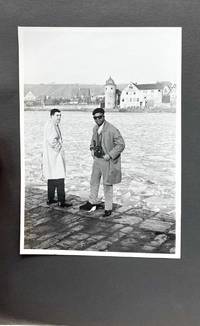
195940770Schweinfurt Germany: n.p. 1959. Contents near fine housed in very good album. Affectionate photo album memorializing the mostly harmless exploits of an Army coterie of proto-Beatniks stationed in peacetime Europe and making the most of it. Photo album of a young man in the most fortunate of midcentury micro-generations coming of draft age after the war in Korea and before the American war in Vietnam: able to treat their tour of duty as a lark an adventure; an excuse to drink Bavarian beer and go to motorcycle shows; wear Converse and coke-bottle glasses and sign each other's good-bye cards like an affectionate graduating class. This album records the work and play of soldiers and locals in and around U.S. Army Garrison Schweinfurt: home to several thousand U.S. soldiers and personnel in the years after 1945 and clearly remembered with great affection by those lucky enough to see no combat a little adventure and a lot of hanging out.<br /> <br /> A good decade younger than the iconic Beats who wrote the formative texts and dreamed the formative dreams for their disciples and imitators the soldiers pictured here are just the right age to be formed by the late '50s popular notion of carefree bohemian youth so sternly corrected by the Beat originals in question: The "foul word Beatnik" wrote Ginsberg is nothing but a "journalistic sneer." Kerouac meanwhile expressed a dour miserablism over the whole business: "Nothing can be more dreary than coolness . a kind of sociological coolness soon to become a fad up to the mass of middle class youth." Well: they were both right but they were both over 30 by then. The Beat ethos and vestiges of a Beat aesthetic could not be contained; as the album proves even in barracks even under Army discipline and orders the youth with their shabby blazers and glasses of absinthe-substitute knew what cool was.<br /> <br /> Shot by a remarkably skilled amateur photographer or photographers with a fine eye for composition the photographs are technically accomplished with a fine sense of contrast and a keen sensitivity to the opportune moment. At a uniformed military exercise he captures some curious civilian onlookers; out in the surrounding town he takes sensitive candid photos of an impish local toddler strangling her brother. More than this though is the tone of bohemian youth captured both real and aspirational. The heart of the album documents a core group of friends: smoking wearing sunglasses indoors drinking Pernod taking photos reading French newspapers. Throughout the photographer finds time to hunt beauty: men silhouetted against a bleak sky; a young and grim-faced pregnant woman gazing at a leafless tree; cynical children clambering over tank; and of course European women. A captivating series of moments as perfectly framed as any film still. 11'' x 16''. Original oblong photo album lacking original string ties otherwise intact. Paper label mounted to front cover: "Schweinfurt - 1959 / Boudreaux Kites" in pen. 36 album leaves laid in each with black and white photographs mounted to rectos and versos and intact spiderweb tissue guards. Bayonet receipt card for a Francis C. Welch mounted beneath a portrait photo. One greeting card also mounted to first leaf and one additional large 10'' x 8'' photograph laid in. 181 photographs in total. Wear and some warping to album cover; interior leaves largely unaffected. Photos fine. n.p. unknown