[Anonymous]Biblio.com
237 569 résultats
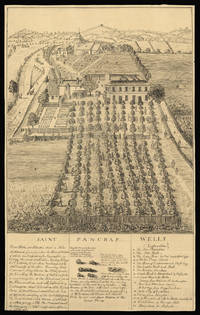
175012465c.1750-1800. 494 by 310mm 19.5 by 12.25 inches. Drawing in ink with visible pencil guide lines. A drawing of Saint Pancras Wells. The area around what is now King's Cross was famous for its medicinal springs and there were several wells in the area where Londoners could go to take the waters. The stones illustrated in the caption below the image were supposedly voided by people who had drunk the waters at St Pancras: they were also claimed as a cure for scrofula leprosy and scurvy. The wells were named after the church thought to be one of the oldest in England which is visible in the background. The Wells grew into a destination for daytrippers as well as invalids: there were two pump rooms tree-lined avenues for walking and a dining hall that could seat 200 people. A public house the Adam and Eve was built next to the church itself visible in the print. This drawing or one similar was amongst those reproduced by the forger Peter Thompson. The British Museum holds two variants but the present copy has most in common with the earlier variant. BM 19271126.1.24.1. unknown
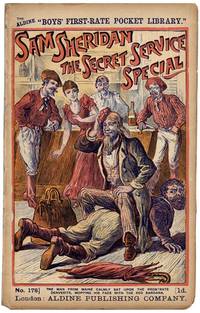
47489London: Aldine Publishing Company n.d. 1893. ORIGINAL PAMPHLET. Octavo pp.32. In original colour illustrated paper covers. Text browned and brittle. Some chips to leaf edges. Covers less brittle also chipped in places. Spine reinforced with archival tape. Good considering paper stock. London: Aldine Publishing Company, n.d. [1893] unknown
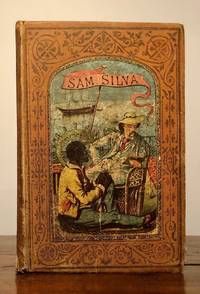
18778814Edinburgh: William Oliphant & Co 1877. Hardcover. Very Good. 12mo. Pp. 63 8pp. of publisher's ads. Color frontispiece. Decorated orange cloth with color illustration affixed to front board. Printed by Murray and Gibb. Very Good faint gift inscription wear to spine front hinge weak rubbing to boards. Story of a black slave child's journey on a ship from Jamaica to England. Uncommon. William Oliphant & Co hardcover
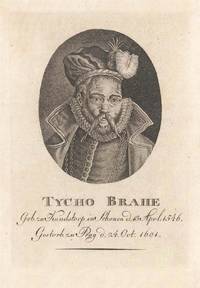
181017780Weimar: Friedrich Justin Bertuch c1810. 120 by 84mm. 4.75 by 3.25 inches. Prints""Tycho Brahe Geb. zu Kundstorp in Tycho Brahe Stipple-engraved portrait. Published in one issue of the German geographical journal 'Allgemeine geographische Ephemeriden' was the present portrait of renowned Danish astronomer Tycho Brahe 1546-1601 who laid the foundation for the later invention of the telescope. The portrait is based on an engraving by Jacques de Gheyn II who had drawn Brahe at the end of the sixteenth century. Most of Gheyn's details are retained including the high collar and the chain of the Order of the Elephant but an elaborate feathered beret has also been added. Brahe's famous false nose which was rumoured to be made of gold is also prominent. The portrait which originally showed Brahe's whole upper body is cut to just a bust beneath which his name and dates of birth and death are given in German. Interestingly a larger version of the present portrait was published by Jacob van Meurs who was active from 1650 onwards. Friedrich Justin Bertuch, unknown
1970128543Grove Press Inc. 1970. Very Good. No. X-1013 First Edition hardcover 8vo 286pp jacket photo by Cloud Studio. Vintage erotic Victorian underground novels two stories in one volume and reprinted at least once 1984. Very Good overall slight lean light foxing rubbing toning; jacket with same and with a few short tears. Uncommon edition. For mature audiences. Grove Press Inc. hardcover
19701544New York: Grove Press Inc 1970. First Edition First Printing. Cloth and boards. Fine/Fine. Tomi Ungerer. 8vo black cloth with white lettering on spine and blue paper over boards Mylar-protected photographic dust jacket unclipped illustrated with salacious pornographic line drawings by Tomi Underer 104 pages & 105-286 pages. These two volumes of Victorian porn are illustrated by Tomi Ungerer a master of the Farthest-Out most grotesque kinkiest and unacceptable illustrations though often humorous in their outlandishness. At other times Ungerer made a career illustrating offbeat and somewhat more wholesome children's books. We offer this volume with trepidations but do so out of respect for freedom of expression and because no one seems to be hurt or damaged by sending on its way this outrageously written and very questionably illustrated volume. Grove Press, Inc hardcover
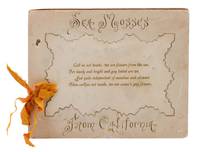
1920140949212California c. late 19th-early 20th century. Very Good. A lovely sea moss souvenir album with six pressed and mounted specimens from the coast of California. 6 pp. Bound in a commercially produced gilt lettered die-cut booklet with poetical onlay and yellow silk picot ribbon tie. <p>Very Good. Lacking a ribbon fastener extant ribbon is slightly stained and creased covers soiled and lightly worn with tarnishing to gilt lettering. First specimen is crumbling but mostly intact. The other specimens are remarkably bright and sound unusual given the delicate nature of these objects. <p>Souvenir albums of pressed sea mosses or "sea flowers" were sought after keepsakes vended along beach towns and coasts the globe over in the late 19th-century. Though commercially produced this would have likely been made in small quantities and sold to a fashionable Victorian lady. A delightful token from a bygone era in decent condition. unknown
6685N.p. but likely New York 1839. Lithograph 10.25†x 12†plus margins. CONDITION: Good narrow margins upper margin expertly extended lightly soiled paper pulp reinforcements on verso. <p>A rare and anonymously-produced political cartoon attacking Henry Clay’s duplicitous position on slavery the issue that was at the fulcrum of so many political moral and legal conflicts in antebellum America.</p> <p>Clay at the time a Senator from Kentucky and one of the country’s most popular politicians grew infamous for his attempts to play both sides of the slavery issue. This cartoon takes the opportunity of one of his 1839 Senate speeches to skewer his views on slavery as he angled for another presidential nomination. The text points out the hypocrisy and contradictions in his words and attitudes. Audiences above the Mason-Dixon Line hear Clay proclaim: “I consider Slavery as a Curse a curse to the Master and a grievous wrong to the Slave†insisting he was “no friend to slavery†while those in the South are assured that as an owner of three-score humans he “will continue to oppose any scheme whatever of emancipation gradual or immediate.â€Â The text also points out his contradictory views on dueling. An illustration of Mason & Dixon’s Line separates his views on slavery. South Carolina’s John Calhoun who with Clay was two-thirds of the Senate’s “Great Triumvirate†and was the country’s most prominent slavery advocate shakes Clay’s hand and promises his support. He assures Clay that abandoning his “‘folly & delusion’ about liberty†and endorsing slavery as the “‘most safe & stable basis for free institutions’†will also secure South Carolina’s support in his next presidential run: “you shall be made President for life.â€</p> <p>Both men are mindlessly standing with one foot upon a prone enslaved man. In addition Clay stands upon a torn portion of a Kentucky Convention Bill likely addressing the issue of fugitive slaves and Calhoun’s left foot stands on a torn part of a memorials and resolutions from Vermont and Massachusetts affirming that “All men are created equal and entitled to liberty &c.’†The afflicted and enslaved African-American man on which they trample to the viewer in a quote from the Old Testament Book of Micah 7:8 relating to the rise of Israel: “Rejoice not against me O mine enemy when I fall; I shall arise.â€</p> <p>Though this print bears no publication information the style and substance point toward the work of H.R. Robinson of New York who produced a number of sharp political attacks in the form of satirical prints in the 1830s.</p> <p>Not in Reilly. Rare with only three copies recorded in OCLC at the Library of Congress Boston Public Library and the American Antiquarian Society.</p> <p>REFERENCES: Weitenkampf p. 60; OCLC 741723538 and 1038126677.</p> [N.p., but likely New York, 1839] unknown
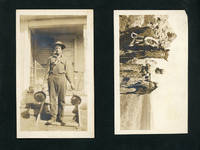
151948641Sentinel Butte: 1915-1916. 1915-1916. NORTH DAKOTA. Eighty-one black and white photographs most sized 4 1/2" x 2 3/4" and glued directly to pages of the album. Also includes one postcard also mounted directly to the page. It appears that several of the photographs have writing on the back. Also it does not seem that it would be too difficult to removed the photos to see exactly what is written. Gently lifting the edges of the first photograph in the album I can see "Cook for the G.H. Triangle outfit." Below the statement is a hand-drawing of the ranch's brand. Only a couple of the photos are labeled on the face of the photograph but the album for the most part involves the ranching life at the turn of the 19th century in North Dakota. The album was most likely compiled by an eastern gentleman by the name of Fred who traveled to Sentinel Butte in 1915. One of the photos states he arrived at the Sentinel Butte's train station on March 9 1915. Many of the photos are of cowboys wearing "woolies" leather cuffs carrying rifles shooting a cow saddles with lariats the ranch bugler a cowboy with a Navajo Indian blanket around him holding a rifle the train station at Sentinel Butte feeding a calf cowboys holding cattle on free range steam thresher being pulled by horses a large group of mounted cowboys watching some sort of competitions and several scenes of a quarry. Another photo shows a cowboy wearing wrist cuffs and caring a gun and holding coyote pelts while still another shows two cowboys unloading grain from a buckboard. There is a long range photo showing the ranch house the silo windmill and barns and another labeled "The First Harvest in Golden Valley N.D. - Sentinel Butte." The post card is labeled Dedication of St. Joseph's Hospital Dickenson N.D. March 31 1912 and then written over the card is "This is where Fred was when he had Typhoid Fever while out West in 1916." In a photo showing the main street of Sentinel Butte is the Blazed Trail Store with several cowboys on horses in front of it along with a lone gas pump. It is scarce to find North Dakota ranching albums featuring the actual day to day operations of a cattle ranch. Founded in 1902 along the transcontinental rail line of the Northern Pacific Railway the town in the 2010 census only had 56 residents. Its name comes from the prominent butte three miles to the south which had been named in honor of two Arikara sentinels killed nearby in 1864 by the Sioux. A rather remarkable cowboy photo album giving a sense of how desperate ranching was and still is in the western part of North Dakota. Most photos having very good contrast. 1915-1916. hardcover
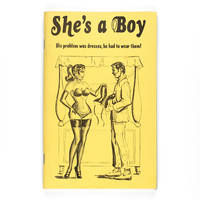
002931Soft cover. Very Good. Chicago: Rose-Lee circa 1975. 72pp. Saddle-stapled in illustrated wraps. Very good or better with light rubbing and wear to wraps. An anonymous but substantial piece of crossdressing erotica fairly chaste with elements of forced feminization and light s&m. Though the only OCLC holding of this title Yale cites Lee's Mardi Gras as publisher based on rear cover ad we find here instead a rear cover ad for crossdressing supply distributor Rose-Lee in Chicago. <br/> <br/> paperback
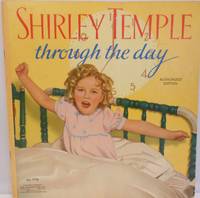
193645Akron Ohio: The Saalfield Publishing Company 1936. Staplebound wraps. Very good . 8vo; 32pp; color photographic illustration wrapper with Shirley Temple waking up in bed; 2 staple binding holding tight; black and white photographic illustrations with text; bumping to wrapper corners; very good plus. Shirley Temple was a childhood star of screen radio and television. She later was the Ambassador to Ghana and Czechoslovakia. As a child star she was Hollywood's number one box office draw from 1935-38. The Saalfield Publishing Company unknown
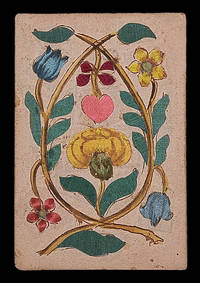
168021834Germany c1680. 93 by 65mm. 3.75 by 2.5 inches. A luxury silk and brocade deck 36 playing cards coloured silk and brocade laid between paper. The Maker There is no information on the present deck of cards about its maker but the nature of the materials used demonstrate that he or she must have been working for some extremely wealthy clients. The Cards The present cards are uniquely luxurious each one being comprised of layers of coloured silk and brocade laid between two sheets of paper. The different layers of fabric give the images added depth which reinforces the sense of meticulous craftsmanship. The janiform eagle which had been a symbol of the German emperors since the fifteenth century points towards a German origin for these cards. Indeed Hargrave records another deck of silk trappola cards from the seventeenth century which appear to have been made in Germany. It has been tentatively suggested that hearts represent France with Louis XIV as King; spades Russia with Peter the Great as Tsar - the jack bears the double headed-eagle of the Russian Empire; clubs the Holy Roman Empire with Leopold I as Emperor - he holds a shield bearing the imperial eagle; and diamonds the Ottoman Empire with - possibly - Mehmed IV as Sultan; the jack holds a falcon: falconry was one of the most popular pastimes in the Ottoman court. unknown
60818London: J. Duncombe 1848 circa 1885. London VINTAGE COPY a later reprint. Octavo 19 x 13cm pp.131 1. With an advertisement for 'Annals of Fashionable Gallantry' 1885 at rear. With a folding colour frontispiece as well as numerous in-text woodcuts by Cruikshank. Publisher's crocodile skin-effect tan cloth with gilt titles to spine and yellow coated endpapers. A lovely crisp clean copy with light handling only. Near fine. London: J. Duncombe, 1848 [circa 1885] unknown
63649London: J. Duncombe 1848 circa 1885. London VINTAGE COPY a later reprint. Octavo 19 x 13cm pp.131 1. With an advertisement for 'Annals of Fashionable Gallantry' 1885 at rear. With a folding colour frontispiece as well as numerous in-text woodcuts by Cruikshank. Publisher's crocodile skin-effect tan cloth with gilt titles to spine. Fore-edge untrimmed. Interior bright and clean with rare foxing. Light pencil annotations to one or two pages. Guttering is visible in various spots moderate reading lean. Toning to endpapers. Ownership inscription in black ink to flyleaf bookplate to paste-down. Toning to top edge. Cloth binding is slightly rubbed with toning to spine. Slight wear to headcap. Still a tight well-preserved copy. Very good. As stated by the British Library this manual belongs to a 19th century literary movement in which British middle-class authors would travel to poorer neighbourhoods and write about the lives of those facing poverty crime and urban violence. Rather than lending a sympathetic pen the resulting books tended only to give a sensationalised gothic account of London's darker underbelly. London: J. Duncombe, 1848 [circa 1885] unknown
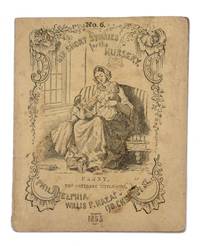
1853338154Philadelphia: Willis P. Hazard 178 Chesnut St 1853. First edition. 12mo. Covers have moderate wear with early uneven foxing and tanning to covers and text else a very good copy. First edition. 12mo. An uncommon American children's book; OCLC locates only two holdings University of Connecticut and Florida which has an imperfect copy lacking outer wrappers.<br /> <br /> issued as "No. 6" in the series "Six Short Stories for the Nursery"; also published simultaneously in a collected clothbound edition under the title 'Infant Prattle: Or Six Short Stories for the Nursery in Words of One and Two Syllables by A Mother for the Use of Her Own Children'. not in Rosenbach; not in Osborne Willis P. Hazard, 178 Chesnut St unknown
68222Unpublished ca 1930-1960. Two leaves 21.0 x 13.5 cm with handwritten text and one small drawing. = Two leaves with detailed descriptions of the beetles Lebistina flavomaculata and L. picta with illustration from Senegal West Africa. The notes are in pencil on ruled paper. Apparently these are field notes. The paper suggests that they were made in the early to mid 20th century. The writer however is unknown and it would be interesting to find out who were active in West African descriptive taxonomical entomology during that period. unknown
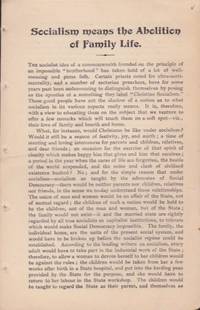
19011202<p>London: Liberty and Property Defence League ca. 1901-05. First Edition. <br /><br />A wonderfully lurid warning against socialism by an organization devoted to laissez-faire economics.</p><p>The anonymous author suggests that socialism would lead to the breakup of families: "There would be no such place as home under socialism. Everyone would live in the State barracks. There would be no breakfasts dinners or teas with one's family at one's own table as in the first place meals in private would not be permitted as it would be against the socialist idea of equality.In other words everybody when hungry would be reduced to the necessity of repairing to the common swine-trough and eating the hogwash the State had placed therein. No roast beef turkey and plum pudding no smiling faces of children and friends around the table on Christmas Day. Indeed there would not be any Christmas Day under socialism."</p><p>This pamphlet carries no publication date but it appears to have been issued sometime between 1901 and 1905. It refers to "the late Mr. Oscar Wilde" who died in late 1900. In 1906 the Liberty and Property Defence League issued a book Socialism: Its Fallacies and Dangers which included the text of this pamphlet.</p><p>OCLC lists 8 institutional holdings under two different accession numbers: Syracuse Stanford Amherst Harvard Texas Wisconsin Historical Society Michigan and the London School of Economics. No other copies in commerce.</p><p>PHYSICAL DETAILS: Single sheet measuring 8 x 5 1/4 inches 205 x 132 mm when folded creating a 4-page unbound pamphlet.</p><p>CONDITION: Paper lightly toned old stab holes along the gutter tiny check mark to front wrapper a couple small closed tears small ink stamp at the end of the text general handling wear. A Very Good copy of an uncommon publication.</p> Liberty and Property Defence League paperback
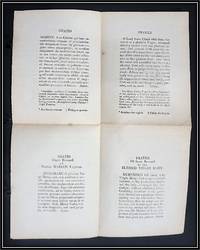
21396Fine/No Jacket. Letterpress Proof Sheet of St. Bernard's Memorare Latin & English<br /> No imprint: No publisher no place likely 18th-early 19th century. 9.75 by 12.75 inches<br /> <br /> A letterpress-printed proof or trial sheet of St. Bernard's Memorare presenting parallel Latin and English texts imposed four-up on a single sheet. The text is printed with sufficient pressure to leave a clear relief impression on the verso indicating careful presswork rather than later offset reproduction. The absence of imprint combined with the imposed layout suggests a working typographic sheet rather than a finished devotional leaflet.<br /> <br /> Physical description: Single sheet of wove paper measuring approximately 25 × 32.4 cm 9.8 × 12.75 inches. Printed on one side only arranged in four quadrants each containing a paired Latin and English setting of the prayer. Letterpress text with pronounced impression visible on the verso. No binding; untrimmed sheet.<br /> <br /> Condition: Sheet remains sound and intact. Text is clear and fully legible. Light even age-toning consistent with age; no losses tears or repairs observed. Overall well-preserved for a working proof sheet. Letterpress impression remains crisp.<br /> <br /> Scarcity note: Letterpress proof or trial sheets of devotional texts were typically examined and discarded during production. Survival rates are low particularly for bilingual settings lacking publisher or imprint information. The Memorare attributed to St. Bernard of Clairvaux is among the most widely circulated Marian prayers in Catholic devotional history. This sheet reflects a moment in the production process where typography translation and layout were actively tested. The four-up imposition indicates preparation for cutting or folding into smaller devotional units. The bilingual presentation highlights the prayer's continued use in both clerical Latin contexts and vernacular devotion making the sheet relevant to studies in translation print culture and religious pedagogy.<br /> <br /> Contextual / historical significance:<br /> The indulgence note referencing Pope Boniface VIII and Philip IV of France reflects a long-standing tradition of associating the Memorare with ecclesiastical authority often reiterated in later devotional printings. Such references were frequently carried forward centuries beyond their medieval origins offering insight into the transmission of religious authority through print. As a typographic artifact this sheet documents devotional printing practices rather than personal piety alone.<br /> <br /> Subjects: Catholic prayers; Marian devotion; Letterpress printing; Bilingual texts; Ecclesiastical typography; Proof sheets; Indulgences; St. Bernard of Clairvaux Religious printing; Typography; Devotional literature; Printing history. unknown
70904's-Gravenhage Algemeene Landsdrukkerij 1829. 8vo 22.6 x 13.7 cm. Hal title and title 157 43 pp. many tables including several large and multi folded. Contemporary limp marbled boards. = A detailed review of the crops harvests weather influences live stock - including for instance exact numbers of cows and horses - in the Low Countries in the year 1828. As well as a long table with weather records including temperature pressure wind direction precipitation etc. Very interesting also in view of the recent climate debate. Uncut. Covers rubbed and with some repairs cancelled stamp in lower margin of the title page date stamp on the rear wrapper verso otherwise a very good clean copy. Rare. hardcover
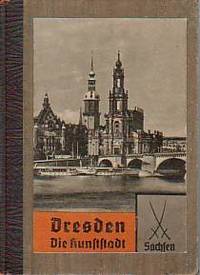
8580Berlin: Universum Verlagsanstalt. Hardcover. Very Good. Boards with light rubbing to extremities; Nd late 1930's. Including a 16 page chapter at front "Eine Stadtrundfahrt mit der Strassenbahn durch Dresden" with small tram map. The rest of the book is fully illustrated with b&w photographs of sights of the city with picture legens in German and English. Including the picture of the "German Museum of Hygiene" with a huge swastica on its facade - described as "the only collection of its kind in the world" ! The references of "Adolf-Hitler Platz" is nicely corrected into "Schlossplatz" what suggests that the previous owner was not exactly a fan of the Third Reich ; 16mo 6" - 7" tall; 16 48 pages . Universum Verlagsanstalt hardcover
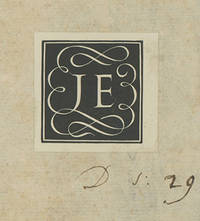
168928493London: Printed in the Year 1689 1689. First edition. ESTC R10117; Wing S5329; NCBEL I 1223 A. Marvell. Edges rubbed with some loss at the end and foot of the spine; hinges starting but sound; some spotting and small stains; very good copy. Folio contemporary sprinkled calf blind rules and decorations red morocco spine label gilt lettering "State / Tracts / Vol. / I" 28 tracts on English affairs during the reign of Charles II written mostly as anonymous pamphlets during the decade 1671-1681 and compiled here as an act of preservation "for the sole use of some particular Gentlemen who set an extraordinary value and estimate upon them." Politics and life under Charles II are the primary subjects with an emphasis on anti-Catholicism including poet Andrew Marvell's An Account of the Growth of Popery first published in Amsterdam in 1677. There was a second volume in 1692 and both volumes were reprinted together in 1693. See ESTC R17906 and R28848. From the library of prominent Englishman of the era John Evelyn 1620-1706 with the later JE bookplate on the front paste-down and contemporary ink manuscript shelf mark. Evelyn Library Part III Christie Manson & Woods March 16 1978 lot 1414; sold again at Sotheby's London December 3 1979 lot 35. A foolish modern owner has clumsily written in ink on the front free endpaper "Sotheby-London December 3 1979 Lot 35 - 1 of 4 all for . . . " The amount paid has been excised. London: Printed in the Year, 1689 unknown
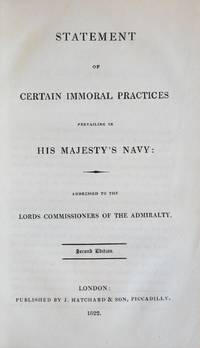
12816London: Published by J. Hatchard & Son Piccadilly 1822. . viii 40pp. 8vo. With the half-title. Nice copy in modern wrappers. Second edition with some additional material and a preface noting that the measures advocated in the first edition were deemed "inexpedient" by the Lords of the Admiralty. The "Immoral Practices" were the invitations as soon as warships arrived in port to "as many prostitutes as the men and in many cases the officers may choose to entertain." Specific details of vessels are given and the authors note that one of the results of the practice is that young midshipmen are surrounded by prostitutes that the families of married sailors are completely unable to avoid them and that these children live "in the sight and hearing" of the "unrestrained indulgence of every licentious propensity." London: Published by J. Hatchard & Son, Piccadilly, 1822. unknown
70907Padang C. Nieuwenhuis Ca. 1915. Oblong folio 21.9 x 27.9 cm. Original printed limp boards. 24 heliographures with printed captions numbered 25-48. = This is the second part of a suite of 48 photos showing the landscape and people of the western coast of Sumatra facing the Indian Ocean. It includes pictures of steams pagodas railway lines people in their local dresses etc. etc. The work is not dated but the Collection KITLV Leiden has the original photo of plate 37 dated Nov 1912- Aug 1914. It should be noted however that Nieuwenhuis was active from the 1880's onwards and some photos may have been made much earlier. Slight chipping to the spine cover; first plate a bit irrgularly toned otherwise a very good clean and unmarked copy. We have never seen the first suite; both most be very rare. hardcover
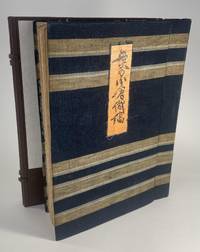
1955260Kitakyushu Japan: publisher not identified 1955. <p dir="ltr">10" x 13.75" pp. 35 including preface text in Japanese language. A stunning collection of 275 fabric swatches measuring as small as 1" and as large as 7" – all striped and plaid in shades of blue the common Kokura-Ori fabric used in garments and Japanese school uniforms. Bound Japanese style with blue and tan striped fabric covered boards. Very good; cover fabric is bright inside pages exhibit slight toned though sound. Fabric samples are largely bright and neat though a few outliers have small tears 3 samples have insect holes that appear to exist prior to construction of the sample book. </p> . <p dir="ltr">"Heirloom of the Tada Tosaburo family of Kokura" / "After the 16th century cultivating cotton grew all around Japan and cotton cloth spread widely. In the Edo era women of the samurai families began weaving using cotton yarn and the weaving culture became attached in Buzen Kokura currently Kitakyushu City Fukuoka. Durable and thick Kokura-ori warp density is more than double weft known for unique stripes. Buzen Kokura became well known for Kokura-ori. Kokura-ori was highly valued for Hakama traditional Japanese pant-like garment and Obi traditional Japanese sash among samurai and said that impervious to spears. Then its use increased among ordinary people as well. By the time of the Meiji era a new textile 'Salt and Pepper' made of gray mottled yarn plied with black and white threads were produced. The fabric was mainly used for summer uniforms of boy students and spread all over Japan. Salt and Pepper has even been mentioned in Soseki Natsume and Katai Tayama etc. Early days of the Showa era the Kokura-ori industry faded once but it came back to life after a long time." kokura-shimashima dot com.</p> . [publisher not identified] unknown
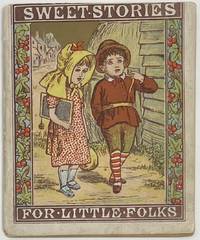
18861739New York and London: Thos. Nelson & Sons and S.W. Partridge & Co 1886. Wraps. Very good . New York: Thos. Nelson & Sons 42 Bleeker St. and London: S.W. Partridge & Co. 9 Paternoster Row <br /> <br /> 48mo 3 ½" x 2 15/16"; 22pp; stiff color pictorial wrapper title on front series and publisher on rear wrapper; gift inscription on verso front wrapper dated 1886; color illustrated fp small silhouette vignette on title page; text and 12 illustrations printed in green; light crease to front wrapper light hand soiling; very good plus. OCLC locates 5 copies. A small sized book containing eleven blurbs with corresponding illustrations on the facing page. Two of the themes are religious. Three of the illustrations are silhouettes. Most likely written and first published in the U.K. as some of the text has British subject matter. Thos. Nelson & Sons and S.W. Partridge & Co unknown