1 237 résultats
187531070NY: Dodd Mead 1875. 12mo pp. 62. Illustrated. Red cloth stamped in black with a small paper picture in full color. Cover faded and moisture-stained corner torn off flyleaf but o/w a VG tight copy. A story of a young girl's trip on a steamship. For children. Dodd, Mead unknown books
196735553NY: Weathervane 1967. 8vo pp. 202. Maroon paper over boards. A nice copy. How mediumistic tricks are performed. Weathervane unknown books
1976144419Boston: Gregg Press 1976. Octavo cloth. First hardcover edition first printing. Reset from the rare paperbound 1887 G. W. Dillingham edition. 257 copies printed. New introduction by Lyman Tower Sargent. This utopian novel predicting an interplanetary war and the formation of a universal government based on the principles of Henry George is an important work of early science fiction for its early use of the interplanetary war motif and its fascinating exploration of information control as a mechanism for social change. "The earliest example of conflict between different planets -- i.e. the space opera -- so far located." - Locke Voyages in Space 16. Bleiler Science-Fiction: The Early Years 1434. Sargent British and American Utopian Literature 1516-1985 p. 77. Bleiler 1978 p. 6. Reginald 09616. Reprint of Wright III 3594. Several very faint spots to front cover else a fine copy without dust jacket as issued. An uncommon Gregg Press title. #144419 Gregg Press unknown books
1976143126Boston: Gregg Press 1976. Octavo cloth. First hardcover edition first printing. Reset from the rare paperbound 1887 G. W. Dillingham edition. 257 copies printed. New introduction by Lyman Tower Sargent. This utopian novel predicting an interplanetary war and the formation of a universal government based on the principles of Henry George is an important work of early science fiction for its early use of the interplanetary war motif and its fascinating exploration of information control as a mechanism for social change. "The earliest example of conflict between different planets -- i.e. the space opera -- so far located." - Locke Voyages in Space 16. Bleiler Science-Fiction: The Early Years 1434. Sargent British and American Utopian Literature 1516-1985 p. 77. Bleiler 1978 p. 6. Reginald 09616. Reprint of Wright III 3594. A fine copy without dust jacket as issued. An uncommon Gregg Press title. #143126 Gregg Press unknown books
197697199Boston: Gregg Press 1976. Octavo cloth. First hardcover edition first printing. Reset from the rare paperbound 1887 G. W. Dillingham edition. 257 copies printed. New introduction by Lyman Tower Sargent. This utopian novel predicting an interplanetary war and the formation of a universal government based on the principles of Henry George is an important work of early science fiction for its early use of the interplanetary war motif and its fascinating exploration of information control as a mechanism for social change. "The earliest example of conflict between different planets -- i.e. the space opera -- so far located." - Locke Voyages in Space 16. Bleiler Science-Fiction: The Early Years 1434. Sargent British and American Utopian Literature 1516-1985 p. 77. Bleiler 1978 p. 6. Reginald 09616. Reprint of Wright III 3594. Rear cover just a bit warped a near fine copy. An uncommon Gregg Press title. #97199 Gregg Press unknown books
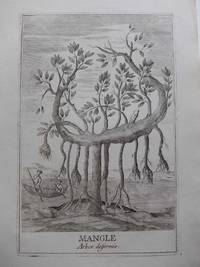
289070unbound. very good. Uncolored copper engraving. Image measures 10.25" x 6.75" sheet measures 13.75" x 9.5". In very good condition.<br/><br/> An image of a fruit-bearing mangrove tree being visited by two visitors in a canoe.<br/><br/> unknown books
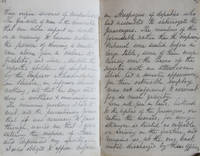
30637<p>12mo 68 manuscript pages plus blanks and 8 pages of notes bound in contemporary embossed leather backed flexible stiff wraps entries written in English in pencil in a clear and legible hand.</p><p> The journal is an excellent highly literate well written account of the author's impressions of Russian society and his keen observations on all aspects of life in Russia which the author refers to as "<i>the Empire of Fear</i>." The diarist who describes himself as a Russian prince is anonymous although he identifies his companions. He takes a business trip to the part of Russia which is now in present day Poland. The purpose of his trip was to draw up a statement of account for the manufactory of Messrs Palin & Dunlop in Nowogrodek. Afterwards he visits the different silk and cotton manufactories in the town and also the place where Russe serge cloth is manufactured. The book only mentions business in passing. Mostly the author is concerned with describing the people and the regime of the country. </p><p> <b>Sample Quotations:</b></p><p> "Wednesday April 24 1872 </p><p> Left Windermere at 8.15 a.m. for Preston meeting at the latter place Thomas Hatch Margaret Hatch; James Ainscough; and Robert Sale proceeded from thence to Hull via Leeds arriving at 4.40 p.m. Went to Foreign Consulate for colltn of Passports; thence Granville Temperance Hotel. Left the Humber Dock Wall by steamship <u>Cyclone</u> at 10.50 same evening for Hamburg…"</p><p> After a rough passage our author and his party arrived in Hamburg after passing through customs they left Hamburg by rail at 11:30 a.m. for Perleburg making several stops along the way they arrived in Berlin shortly before 9 p.m. and stayed overnight at the Café Imperial. They departed Berlin by rail the next morning and arrived at the border of Poland that afternoon:</p><p> "… on the boundary line of Poland where we first encountered the numerous annoyances travelers of all descriptions are subjected to and to which even Russian Princes like myself were obliged to submit during our transit through the Custom House but on arriving at <u>Warsaw</u> I had the mortification of seeing them released in three minutes whilst I had to struggle with every species of trickery for the space of three hours. At four o'clock we succeeded in penetrating that land which is blessed with all the amenities attached to Russian Government which was announced by the Russian Eagle floating over the miserable apology for a building yclept the <u>Groche</u> Custom House Groche being <u>a</u> town of some dozen or so of dilapidated wooden erections which serve not only as shelters but also as dwellings and of which the Customs House is chief Winding by the banks of the river Vistula … the line threaded by the river bank to Nieszawa which seemed to be a busy place for the shipment of sundry descriptions of goods and merchandize; some loading for others unloading from the Baltic; we next came to Bobrownik another port of the same river & from whence two canals diverge; after this we reached Biskepia; where we stayed upwards of 20 minutes and then proceeded to Wyrzogrod at which place we left the Vistula on the right & proceeded by way of Biaski & Takrodzin and reaching Warsaw at 9.20 p.m. at which place a multitude of little superfluous precautions engender a population of deputies and sub-officials each of whom acquits himself with an air of importance and a rigorous precision which seems to say though everything is done with much silence "Make way I am one of the members of the grand machine of state."</p><p> Such members acting under an influence which is not in themselves in a manner resembling the wheel-work of a clock are called men in Russia! I say Russia though I am in reality speaking of Poland which is virtually and tyrannically a part and portion of the Great Empire. The sight of these voluntary automata inspires me with a kind of fear: there is something supernatural in an individual reduced to the state of a mere machine. If in lands where the mechanical arts flourish wood and metal seem endowed with human powers under despotisms human beings seem to become as instruments of wood. We ask ourselves what can become of their superfluity of thought And we feel ill at ease at the idea of the influence that must have been exerted on intelligent creatures before they could have been reduced to mere <u>things</u>. In Russia I pity the human beings as in England I feared the machines: in our own country England the creations of man lack nothing but the gift of speech; in Russian Poland the gift of speech is a thing superfluous to the creatures of the state.</p><p> These machines clogged with the inconvenience of a soul are however marvelously polite it is easy to see they have been trained to civility as to the management of arms from their cradle. But of what value are the forms of urbanity when their origin savours of compulsion The free will of man is the consecration that can alone impart a worth or a meaning to human actions; the power of choosing a master can alone give a value to fidelity; and since despite the reported abolition of serfdom by the Emperor Alexander in Russia an inferior chooses nothing all that he says and does is worthless & unmeaning – The numerous questions I had to meet and the precautionary forms that it was necessary to pass through warned me that I was entering the empire of Fear and depressed my spirits. – I was obliged to appear before an Areopagus of deputies who had assembled to interrogate the passengers. The members of this formidable rather than the imposing tribunal were seated before a large table; some of them were turning over the leaves of the register with an attention which had a sinister appearance for their ostensible employ was not sufficient to account for so much gravity. </p><p> Some with pen in hand listened to the replies of the passengers or rather the accused for every stranger is treated as culpable on arriving on the frontier and remains so at the very least until discharged by these officious notables; during the scrutiny six or a dozen ragged men half covered with sheepskins the wool turned within and the filthy skin appearing without will appear from time to time at the entrance to satisfy their curiosity by a prolonged and vulgar stare at the luckless beings undergoing the ordeal of officious examination. These arrivals and departures though they did not accelerate our matters at least gave me leisure to reflect on the species of filthiness peculiar to the people of the north who for the most part are shut up within doors and have a greasy dirtiness which appears to me far more offensive than the neglect of a people destined to live beneath the open heaven & born to bask in the sun.</p><p> The tedium to which these Russian formalities condemned us gave me also an opportunity of remarking that the great lords of the country were little inclined to bear patiently the inconveniences of public regulations when those regulations proved inconvenient to themselves.</p><p> "Russia is the land of useless formalities" they murmured to each other – but in French that they might not be overheard by the subaltern <u>employ</u><u>ès</u>. I have retained the remark with the justice of which my own experience has only too deeply impressed me. As far as I have been hitherto able to observe a work that should be entitled <u>The Russians judged by Themselves</u> would be severe. The love of their country is with them only a mode of flattering its master; as soon as they think that master can no longer hear they speak of everything with a frankness which is the more startling because those who listen to it become responsible.</p><p> It was a perfect relief to the tortured mind to find the sic such things as gags were not in use as it allowed me to expound a number of invectives which might have brought me into no end of trouble had my hearers been even possessed of an inadequate knowledge of the English language. </p><p> The cause of all our delay was at length revealed. The chief of chiefs the director of the directors of the custom-house again presented himself: it was this visit we had been waiting so long without knowing it. At first it appeared as if the only business of the great functionary was to play the part of the man of fashion among the few ladies who had been subjected to the same indignities as those of the sterner sex. He reminded one of their rencontre in a house where the lady had never been; he spoke to her of balls she had never seen: but while continuing to dispense these courtly airs our drawing room officer of the customs would now and then gracefully confiscate a parasol stop a portmanteau or recommence with an impartable <u>sang froid</u> the researches already conscientiously made by his subordinates. </p><p> In Russian administration minuteness does not exclude disorder. Much trouble is taken to obtain unimportant ends and those employed believe they can never do enough to show their zeal. The result of this emulation among clerks and commissioners is that the having passed through one formality does not secure the stranger from another. It is like a pillage in which the unfortunate might after escaping from the first troop may yet fall into the hands of a second & a third.</p><p> The chief turnkey of the empire having at length concluded his scrutiny graciously permitted us to depart at about half past twelve and time being an object I thought it desireable not to chance the accommodation offered for the night in a city where I had already been subjected to a sufficiency of inconveniences & in opposition to the desires of those under my charge I determined to proceed at the earliest chance which occurred and accordingly on the morning of the 28th Sunday we moved from the neighbourhood of the city of Warsaw at a little past four o'clock and at half past seven reached a large and apparently prosperous town called Praga…"</p><p> Our writer and his party stopped in Praga for about 40 minutes where excellent coffee but detestable food were procured. They resumed their journey and passed Misorent and Kamienezyk a small town on the river Narew. They then reached "a long straggling town" with the"somewhat short name of Nur" on the River Bang. Then the large village of Wysokie and afterwards the town of Surasz an extensive manufacturing place twelves miles further they reached Boralystok and at length arrived at Gradnau where the party stopped for the night at the Hotel de Coulon:</p><p> "… and found it to be under the management of a degenerate French innkeeper. The house was nearly full at that time owing to the marriage of a Duchess which was about to take place; indeed the landlord appeared almost annoyed at being obliged to receive other guests … gave himself little trouble to accommodate us… Having seen their immediate wants attended to I joined the company at the <u>Table d'hote</u> which consisted of a mixture of Russians Poles French Spaniards and a couple of Englishmen and curiously enough not a single lady was present – Amongst those natives of High blood were a Prince & two young Counts. The first named is of an illustrious family and may be taken as a fair specimen of the general swelldom of the country. He is as I was informed the only son of a very rich individual and a character worthy of observation. The tavern is his empire: it is there that he reigns eighteen hours out of the twenty-four; on that ignoble theatre he displays naturally & involuntarily noble & elegant manners; his countenance is intellectual and extremely fascinating; his disposition is at once amiable and mischievous; many traits of rare liberality & even touching sensibility are recounted of him. He is remarkably well informed; his mind is quick and endowed with great capacity; his wit is unequalled but his language and conduct are such as would not be tolerated elsewhere except in the most depraved society. Profligacy has impressed upon his contours the traces of a premature decay; still these ravages of folly not of time have been unable to change the almost infantile expression of his noble and regular features … In no other land could a man be found like the young Prince Leuchtenberg but there are more than one such here.</p><p> He is surrounded by a group of young men his disciples and competitors who without equaling him in disposition or in mind all share with him a kind of family resemblance it may be seen at the first glance that they are and only can be Russians. It is for this reason that I am about to give some details connected with their manner of life … But I know not or rather fear how to begin; for it will be necessary to reveal the connection of these libertines not with women of the town but with the youthful sisters of religious orders – with nuns whose cloisters as it will be seen are not very securely guarded. It may be asked why lift a corner of the veil that shrouds scenes of disorder which ought to remain carefully covered Perhaps my passion for the truth obscures my judgment but it seems to me that evil triumphs so long as it remains secret whilst to publish it is to aid in destroying it and since these incidents may at some future time be submitted to the scrutiny of the public this one particularly is noted here as a memorandum; besides I have resolved to draw a picture of this country as I see it – not a composition but an exact and complete copy from nature. … As for the man whom I select for a specimen of the most unbridled among libertines he carries his contempt of opinion to the extent of desiring me to describe him as I see him. A story of the death of a young man killed in the convent of - by the nuns themselves he told at the full table d'hôte before several grave and elderly personages employès and placemen who listened with an extraordinary patience to this and several other tales of a similar kind all very contrary to good manners. The story in question … relates to a young man who after having passed an entire month concealed within the convent of - began at last to weary of his course of happiness to a degree that wearied the holy sisters also… whereupon the nuns wishing to be rid of him but fearing the scandal that might ensue should the sic send him to die in the world concluded that it would be better to make an end of him themselves. No sooner said than done – The mangled remains of the wretched being were found a few days after at the bottom of a well. The affair was hushed up. …As I have imposed upon myself the duty of communicating the ideas that I have hurriedly formed of this land I feel called upon to add to the picture already sketched a few minor specimens of the conversation of the parties already referred to.</p><p> One boasted of himself & his brothers being the sons of the footmen and the coachmen of their reputed father; & he drank and made the rest drink to the health of all his unknown parents. Another claimed the honour of being brother on the father's side of all the waiting maids of his mother.</p><p> Many of these evil boasts are no doubt made for the sake of talking: but to invent such infamies in order to glory in them shows a corruption of mind that proves wickedness to the very core – wickedness worse even than that exhibited in the mad actions of these libertines. According to them the wives of the middle classes are no better than the women of rank.</p><p> During the months that their husbands go to the fair of Nijni the officers of the neighboring garrisons take care not to leave the vicinity of the deserted wives. This is the season of easy assignations. The ladies are generally accompanied to the place of rendezvous by some <u>respectable</u> relation to whose care their absent husbands have confided them. The goodwill and silence of these family duennas have also to be paid for. Gallantry of this kind cannot be excused as a love affair there is no love without bashful modesty – such is the sentence pronounced from all eternity against women – who cheat themselves of happiness and who degrade instead of purifying themselves by tenderness. The defenders of the Russians pretend that the women have no lovers; I agree with them other term must be employed to designate the <u>friends</u> whose intimacy they seek in the absence of their husbands. … </p><p> Scarcely was I installed in my abode for the night than overcome by fatigue I lay down wrapped in a rug on an immense leather sofa & slept profoundly during – 3 minutes. At the end of that time I awoke in a fever and in casting my eyes upon the rug what a sight assailed them! – a brown but living mass: things must be called by their proper names – I was covered I was devoured with bugs in a place too where I was obliged to remain imprisoned with the enemy and the war was consequently more sanguine. … A Russian waiter appeared. I made him understand that I wished to see his master. The master kept me waiting a long time and when he at length did come & was informed of the nature of my trouble he began to laugh & soon left the room telling me that I should soon become accustomed to it for that it was the same everywhere in Russia. … The town generally is not of a prepossessing appearance; a few yards only to the rear of the inn I came to a guard house full of Cossacks whose stiff bearing and severe gloomy air would impart to foreigners the idea of a country where no one dares to laugh even innocently. In the neighbourhood of the canal wharves all was busy with life whilst a few drowskas were already slowly traversing the streets the drivers dressed in the costume of the country The singular appearance of these men their horses and carriages struck me more than anything else on this my first view of a Russian town or city. The ordinary costume and general appearance of the lower classes by which I mean the workmen coachmen small trades people is as follows – On the head is worn either a cap formed somewhat in the shape of a melon or a narrow brimmed hat low crowned & wider at the top than the bottom. This headdress slightly resembled a woman's turban. It becomes the younger men. Both young & old wear beards. Those of the beaux are silken and carefully combed; those of the old and careless appear dirty and matted. Their eyes have a peculiar expression strongly resembling the deceitful glance of the Asiatic. … The movements of the men whom I met were stiff and constrained; every gesture seemed to express a will which was not their own. The morning is the time for commissions and errands and not one individual appeared to be walking on his own account. I observed very few good-looking women and heard no girlish voices; everything was dull and regular as a barrack. There are scarcely any buildings worthy of note in this busy mart except the Kremlin a building which is indigenous to every Russian town of importance. … Shortly after 9 0'clock we took our departure from <u>Gradnow</u> through a dead flat & muddy district stopping only at 3 insignificant towns or large villages viz: <u>Goja</u> <u>Perschevelka</u> & <u>Onlekha</u>; and about a couple of miles from the last named we reached <u>Novogrodek</u> a large manufacturing town and here terminated our journeying by rail though we were still 21 miles distant from our destination <u>Novogrodka</u> and in order to accomplish this distance I succeeded after some difficulty in securing a team of horses & a rude description of dray minus springs with driver for the sum of half Impl or about 16/1 English in this rude machine we were conveyed at the risk of our necks owing to the badness & unevenness of the road in a trifle under two hours; and shortly after 4 o'clock I presented myself Mssrs Palin and Dunlop's manufactory along with T. Hatch…Mr. Hebden the manager was greatly surprised to see us as he had not been apprised of our coming: though a letter had been forwarded from Manchester a fortnight previously to inform him of our coming but owing to the irregularity of the Russian postal arrangements it had not been delivered although it arrived safely on the following morning."</p><p> "Tuesday April 30th 17th Russian I arose early finding Novorogodka in every way an exact repetition of my first nights experiences in the great Muscovite nation. I have often in my travels had reason to remember the sagacious observations of Pestalozzi the great practical philosopher the preceptor of the classes before Fourier & the St. Simonians. According to his observations on the life of the lower orders of two men who have the same habits of life one will be dirty the other clean. … Among the Russians there reigns a high degree of sordid negligence it seems to me they must have trained their vermin to survive the bath. Notwithstanding my ill humour I went carefully over the interior of the patriotic convent of the Trinity… This is one of the principal convents in the empire and at this season of the year is much sought by pilgrims even from the most remote parts of the country. All the names of note in Russian history have taken pleasure in enriching the convent which overflows with gold pearls and diamonds. … Czars Empresses nobles libertines and true saints have vied with one another in enriching the treasury of Novogrodka. Amid so many riches the simple dress and the wooden cup of St. Sergius shine by their very rusticity. … The convent would have furnished a rich booty to an enemy; it has not been taken since the fourteenth century. It contains nine churches. The shrine is of silver gilt; it is protected by silver pillars and canopy the gift of the Empress Anne. The image of St. Sergius is esteemed miraculous. Peter the Great carried it with him in his wars against Charles XII. </p><p> Not far from the shrine under shelter of the virtues of the hermit lies the body of the usurping assassin Boris Godounoff surrounded by many of his family. The convent contains various other famous but shapeless tombs… The number of monks is now only one hundred… Notwithstanding my persevering request they would not show me the library. "It is forbidden" was always the answer. This modesty of the monks who conceal the treasures of science while they parade those of vanity strikes me as singular. I argue from it that there is more dust on their books than on their jewels. …"</p><p> "… The town of Novogrodka is an important entrepot for the interior commerce of Russia. By it Petersburg communicates with Persia the Caspian & all Asia. The Volga that great national & moving road flows by the town which is the central point of the interior navigation of the country – a navigation wisely directed much boasted of by the subjects of the Czar and one of the principal sources of their prosperity. It is with the Volga that the immense ramifications of canals are connected that create the wealth of Russia.</p><p> The town of Novogrodka is like all other provincial towns in the empire vast in extent and appears empty. The streets are immensely broad the squares very spacious and the houses in general stand far apart. The same style of architecture reigns throughout. The painted and gilded towers which are numerous shine at a distance and gives the idea of a place resplendent with wealth and the town altogether presents a picturesque appearance…. Notwithstanding it's commercial importance the town is empty dull and silent. From the height of the terrace is to be seen the yet more empty dull & silent surrounding country with the immense river its hue a somber iron-grey its banks falling straight upon the water and forming at their top a level with the leaden-tinted plain here and there dotted with forests of birch & pine. The soil is however as well cultivated as it is capable of becoming; it is boasted of by the Russians as being with the exception of the Crimea the richest & most smiling tract in this empire. The primitive droshky is to be seen in this town. It consists of a little board on four wheels entirely concealed under the occupant and looks as though the horse were fastened to his person… The females generally go barefoot. The men most frequently wear a species of sandal made of rushes rudely platted which resembles those of antiquity. The leg is clothed in a wide pantaloons the folds of which drawn together at the ankle by a little fillet are covered with the shoe. This attire is precisely similar to the Scythian statues of the Roman sculptors. </p><p> Upon a long float of timber I observed several men descending the course of their native Volga they managed to guide the raft skillfully the while singing a Russian melody in the vague plaintive strain peculiar to the country. On reaching near to where I stood they wished to land which they eventually did and passed close before me without taking any notice of my foreign appearance; without even speaking to each other. The Russian peasants are taciturn and devoid of curiosity; I can understand why: what they know disgusts them with all of which they are ignorant.</p><p> To a certain point the want of a charitable disposition in the Russians towards strangers appears to me excusable. Before knowing us they lavish their attentions upon us with apparent eagerness because they are hospitable but they are also easily wearied. In welcoming us with a forwardness which has more ostentation than cordiality they scrutinize our slightest words they submit our most insignificant actions to a critical examination; and as such work necessarily furnishes them with much subject for blame they triumph internally saying "These then are the people who think themselves superior to us!" …"</p><p> "… One of the peculiar laws relating to strangers in this country is that on entering the empire in addition to answering the multitudinous and frivolous questions put as to your object &c it is also necessary to mention if the visit or stay on Russian soil is to extend over five days for if so it will be found necessary for the foreigner to advertise not less than twice at intervals of three days his intention of departure in the local newspapers stating the precise time of leaving &c. Also to make an affidavit to the Governor of the province that all debts are duly discharged a note to that effect is given by the Governor for the moderate sum of half a rouble 1/6 ¾ in exchange for his autograph this is then countersigned by the sub-governor who also expects a <u>tip</u>for his condescension. No one can leave Russia under any pretence until he has forwarded all his creditors of his intention in the manner above quoted. This is strictly enforced unless at least you pay the police to shorten the prescribed time and even then the insertion <u>must</u> be made once if not twice. No one can obtain post horses or a railway ticket without a document from the authorities certifying he owes nothing. … The Russian police so alert to torment people is slow to help or enlighten them when they have recourse to its aid in doubtful situations…" </p><p> "… It will by this be seen how the subaltern agents of the Russian police perform their duties. These faithless servants gained a double advantage by selling the body of the murdered woman; they obtained a few rubles & they also concealed the murder which would have brought upon them sever blame if the noise of the event had got abroad. …"</p><p> "… I safely reached <u>Warsaw</u> shortly before 9 at night and entered a Russian or I might perhaps more properly call it a Polish coffee house adjacent to the Railway. … Here I determined to take up my quarters for the night. The waiters were dressed in white shirts girded round the middle and falling like a tunic over loose white pantaloons. The teas served was excellent so is the coffee & liqueurs at this establishment but it is served with a silent solemnity very different from the gaiety which suffuses houses of entertainment in our own country. … About ten o'clock I sallied forth into the city without guide or companion strolling at hazard from street to street. I first traversed several long and wide streets laid out with great regularity. It was only at this time that the sun sank and the moon rose. The turrets of the convents the spires of the chapels the towers the battlements and all the irregular and frowning masses of buildings were swathed with wreaths of light … my eyes were filled with the dust of the streets kept in continual motion by the number of vehicles moving about at a gallop in all directions. It was not until 12 o'clock that I repaired to my lodgings where I slept soundly happily without the aid of the multitudinous bugs which I had experienced previously in Russia." </p> books
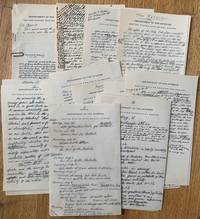
19240289701924. Manuscript. Good. octavo 51 pages written on letterhead of the Department of the Interior United States Geological Survey rectos only neatly inscribed in pencil and ink very good. This account appears to have been a draft and may have been intended for publication there are numerous corrections changes and emendations throughout the work. The unidentified author traveled by rail from Yellowstone to Seattle and from there to Alaska by steamer. The author visited Ketchikan Seward Anchorage Fairbanks where time was spent with the Mayor Valdez Juneau Prince William Sound Cordova Columbia Glacier etc. The author comments upon the events of the trip and gives interesting information on accommodations for tourists describes the scenery and topography a twelve page description of Columbia Glacier and also describes the towns and cities visited. "Valdez represents the tragedy of mining towns. It is really a dead mining town & it is a real tragedy to walk through and see the great number of vacant houses. Really it is hard to understand the lure of such a place." "Anchorage was created as an operating base for the construction of the railroad and has large permanent railroad yards & shops. It is the youngest and most up to date town in Alaska. For the tourist however it has little of interest." "Fairbanks a town almost exclusively of log cabins. the city is isolated because of its great distance from anywhere and people of the States do not care to spend so much time in traveling to reach the place." <br /> books
005298Full Vellum. Very Good. N.d. but late 18th century after the publication of the original work in 1760 published in Venezia by Remondi. Large 8vo 25 by 20 cm. 25 pen and ink pages of illustration. These begin with the elaborate pen and ink Baroque title page with architectural decoration followed by page showing drawings of hands a second title with what we presume the one more fully original work by the copyist of seraphs holding up drapery with the title and a woman painter working before an easel and other illustrative decoration a broken sculpted head on the ground etc. Then 23 pages of pen and ink nude male studies the figures very Michelangelo-esque in the musculature and their overall sculptural quality. We would speculate that this copyist was in fact a woman based on the second title illustration. This particular illustration is delightful if the human figure itself doesn't have quite the polished execution of the copied material. Inked title on the vellum spine. The vellum is quite soiled. Otherwise the paper within is of high quality and clean. <br/><br/> hardcover books
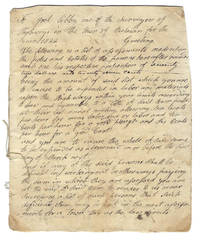
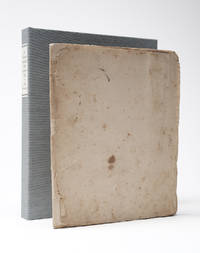
1822002763Baldwin ME: By the author 1822. Very good. Manuscript; 7 1/2 x 6; laid paper folded and sewn with a string to form a notebook; pp. 8; text and tables to pp. 1-4 in brown ink; fore-edge unevenly trimmed; light spotting mostly to margins; in very good condition. An early 19th century document it addressed Joel Libby one of the surveyors of highways in the town of Baldwin for the year 1822 and presented him with a list of assessments of estates in the form of large detailed tables of the people in the town and their respective proportions of seventy two dollars and twenty seven cents "to be expended in labor and materials upon the highways" within their limits. It listed allotments of ten cents per hour for men's labor and ox labor and ten cents per hour for a good plough and six cents per hour for a good cart. The manuscript also stated that any deficiencies from people not paying would be put in the next assessment for a town tax. The town of Baldwin now part of the Portland-Biddeford metropolitan area was originally known as Flinstown and was founded by a grant to the survivors of the Company of Captain Flint of Concord Mass in 1774. It was incorporated in 1802 and named after one of its earliest settlers Loammi Baldwin. At the time the town was said to be "destitute of a meeting house and minister" and that the first roads constructed through it were in a "dangerous condition for teams carriages and horses." Apparently in the following years efforts had been made to improve the condition of the roadways. By the author unknown books
183520091835. First Edition. Softcover. Very good. Small 4to. Manuscript on paper. 2 53 pp. Complete. Stitched plain paper wrappers torn and frayed along spine with loss edges untrimmed. Minor blemishes to the text but unsophisticated. Preserved in a protective cloth case. Highly curious and apparently unpublished German Romantic play concerning the "Death of Lottchus" in Part 1 and his ghost in Part 2 "The Happiness of Marriage." The action takes place in Rubeland Saxony-Anhalt. Other performers include Flanko Wolf Fritzus and his wife Perdestalla Liebling and Maloss. Despite extensive searching we have been unable to find any reference to a play such as this. unknown books
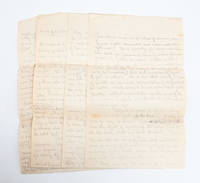
4060N.P. Late 19th century. Comprised of four manuscript pages on four unlined legal sheets composed in a single hand in pencil. Trifold lines on each. Text incomplete. Possibly an essay the use of brackets and underlining for emphasis heavily imply that the present work was intended for public reading. Anonymous in nature the writer's gender geography and age remain unknown. What becomes clear however in the document left behind is that logical arguments for women's rights were becoming mainstream and familiar across the country and were being used widely in grassroots efforts.<br/><br/>As the National Woman Suffrage Association geared up for the next phase of its campaign at the turn of the century its rising leader Carrie Chapman Catt increased the number of pamphlets and printed materials being distributed on the organization's behalf. These provided pro-suffrage activists with rhetorical responses phrases arguments and a vocabulary that was unified and shared across the cause. Many of them are present throughout this speech suggesting Catt's success in reaching and shaping grassroots activity. "Taxation without representation" "Will the balloy benefit the working woman is the question of the hour" and "'The exercise of the right of the franchise will degrade woman' is a narrow minded coward's device" are only a few examples of how this piece links to a more national movement. <br/><br/>Susan B. Anthony Elizabeth Cady Stanton and their protege Catt were also aligned in using reason logic law and economics as the basis for women's equality arguments. The present speech occasionally departs into broader praise for women's contributions -- for example to the Cotton State International Exhibition and to the World's Fair at Chicago -- but it leans most directly into an economic argument. Tackling the misguided anti-suffrage claim that giving women the vote or giving women equal pay will threaten male power the writer shows how equality in both fields will be to the benefit of all parties. Income inequality the writer reasons is a root cause of poverty. "A man will set his price upon his labor and if he cannot get it will fold his hands and say 'I can't afford to work for less wages and will not' and if there is no woman who will come to the rescue and take the position for less the employer pays the man his price; but it is no unusual thing for the wife and daughters of the man to support him through the interim or even longer on half wages." Ultimately "women who can do as efficient work as man and as much of it and are faithfull in the discharge of their duties deserve as much pay." The same argument is then applied to the franchise to the combining of men and women's voices to create political change and to shape the future.<br/><br/>A research rich opportunity for studying activist rhetoric the spread and use of activist vocabularies grassroots versus national campaigns and the connection of economic and employment concerns to the vote. unknown books
30333<p>small quarto 84 pages plus blanks entries written on lined paper in ink bound in half black leather marbled paper covered boards worn at tips of spine corners and edges of boards boards scuffed outside hinges of binding mostly open but boards attached text block good. Volume was printed by "R.C. Root Anthony & Co. Stationers Printers & Lithographers No. 16 Nassau St. cor. Pine New York." Front board contains paper label with "Estimate Book" written on it Includes index in front of book with names of 24 different individuals or companies.</p><p>The first 84 pages of text consists of the "Estimate Book" of the contractor recording various contracts that he appears to have bid on given estimates and perhaps in some cases eventually secured the contract. Some pages have "entered" with a circle around it as if to say that this bid was accepted. Other estimates show changes or monies subtracted. </p><p>After the entries for the contractor's estimate book there are two other sections with entries as well as a number of blank pages. Just after the Estimate Book there is a 5 page section of diary entries which are dated 1 Jan. - 3 Feb 1909 written in pencil and in a legible hand. At the rear of the volume there is another 5 page section which has one page written in ink the others in pencil and is dated 1911. It is unclear what the relationship of these two small sections to the larger contractor's Estimate Book. It's possible they are related but they differ in dates by forty to fifty years. These two smaller sections appear to be related. The first 5 page section is a diary presumably kept by a woman and she mentions doing seamstress work. The section small section of 5 pages is of accounts where the product being shipped is shawls. These sections also appear to have some sort of Philadelphia PA connection.</p><p> <b>Description of "Estimate Book"</b></p><p>While the volume is not signed and the name of the contractor is not known the volume does include an index at the beginning and records 24 different contracts that our contractor either carried out or bid on. If he carried out a project and since the name and street is given of the property to be worked on it could be possible with further research in old newspaper databases to find out who built these "new" structures perhaps in the classified sections of the papers. Some of these projects were:</p><p> M & S Steinberger on White St. where he repaired beams worked on flights of stairs ran ventilation to a water closet etc. J.C. Hamilton - Barclay St. where he put in steam pipes laid a floors hung wainscoting installed various hardware etc. He did considerable work for Hamilton covering over fifteen pages of this volume. Abbott & Fuller had some work done fitting up offices in the "Hamilton Building."</p><p>One entry 6 pages long is for the "rebuilding of Apollo Hall 28th St. & B'Way." The theatre sat at 31 W. 28th Street near Broadway. The theatre was originally built in 1868 and was named Gilsey's Apollo Hall. In 1870 it was renamed the St. James Theatre. Its capacity was approximately 1530 seats. In its early years it offered lectures in the upstairs hall and musical entertainment in the main auditorium. When Augustin Daly's former Fifth Avenue Theatre on 24th Street burned down in 1873 Daly moved his company to the St. James remodeled it and renamed it the New Fifth Avenue Theatre where he continued as proprietor until 1877. It was this remodeling of the theatre in June 1873 that is recorded in this volume. The entire estimate for remodeling by this contractor came to $19939.94. This theatre was the first theatre to introduce air conditioning. It was destroyed by fire in 1891 and finally demolished in 1939.</p><p>In an entry from June 1868 our contractor bids on construction of five new houses at the corner of 52nd Street and 8th Avenue for a Mr. Walton. The estimate is laid out over five pages with a total cost to be $29352.15. At about this same time our contractor bid on another five house project this time for a Mr. Edward N. Saylor Jr. totaling $34789.00. Messrs. L.W. & T.M. Andrews also had a contract taken out for four houses on 42nd Street between 5th & 6th Avenues two large houses $20789.26 and two smaller houses $12761.56. </p><p>Another project he appears to have bid on was the Gilsey Hotel at the corner of Broadway and 29th Street coming in at an estimate of $32750.00. It is unclear if he was the eventual contractor on the job. The building still exists today and is on the historical register.</p><p>All of these estimations give the amount of lumber and other material needed as well as labor costs by the day. Sometimes the contract appears to show either the material cost separately or combined with labor. Other times labor is specifically separated out. Some bids were updated or stated to have been "entered."</p> books
004862London: John Murray 1817. First Edition. 16mo - over 5¾" - 6¾" tall. Second state with three advertisements at rear of book. April 12 1817 issued 18 days prior to the apparent second state which was issued on April 30 1817. "Louis Fr. Baum" in ink on front papers title page. Purportedly written by Napoleon but wrongfully attributed to Constant or Mme. de Stael. The actual author was Jacob-Frederic Lullin de Chateauvieux. Librairie Bellanger has the original manuscript from which this was drawn. 109 pp. Bound in recent marble boards backed in brown leather red morocco label. A handsome copy of a scarce item. London: John Murray, 1817 unknown books
1928002034Hvidore: s. n. 1928. Softcover. Original silver gelatin photographic postcard of the Empress sitting on a padded bench in her garden holding an umbrella and a bouquet of flowers; 5 x 3 1/4; minor wear to corners and image; a bit of age-toning and a manuscript note in pencil to verso; near fine condition. Signed in ink: "Maria Hvidore" in the lower half of the photo. Possibly one of Maria Feodorovna's last photographs the anonymous note on the back stated: "The Empress sent me this not long before she passed away at Hvidore." Empress Consort of Russia Maria Feodorovna 1847 â 1928 christened Dagmar was the wife of Tsar Alexander III and mother of Emperor Nicholas II of Russia whom she outlived by ten years. The second daughter of King Christian IX of Denmark and Louise of Hesse-Cassel she was bethroted to Tsarevich Nicholas Alexandrovich of Russia but after his death from meningitis in 1865 Maria honored his last wish and married his younger brother the future Alexander III. She converted to Orthodoxy and became Grand Duchess Maria Feodorovna of Russia. With Alexander II's assassination in 1881 she and her husband were crowned Emperor and Empress of Russia. After Alexander III's death in 1894 she became Dowager Empress and her son Nicholas II and his wife Alexandra were crowned the new rulers. The outbreak of the Revolution in 1917 forced her to travel to Crimea where she received the devastating news that her sons daughter-in-law and grandchildren had been murdered. She refused to believe it and declared it a rumor. Although the monarchy would be overthrown she would not leave Russia until 1919 - first to London and eventually to her native Denmark where she would settle in Hvidore a former country house near Copenhagen. Maria died on October 13 1928 at the age of 80 having outlived four of her six children. Hvidore: s. n. paperback books
186042329NY: Appleton 1860. 12mo pp. 129. Frontis illustration. Green cloth blind stamped with gilt design and lettering. Cover little spotted and worn o/w a VG tight copy. Possibly intended for children; a religious tract about a family facing hard times. Appleton unknown books
1908226900New York: McLoughlin Bros 1908. hardcover. very good. Slim 4to 6 magnificent chromo lithographs 1 inch tear in 1 inner margin and many black & white illustrations. Glossy pictorial boards edges rubbed and slightly soiled green cloth spine. New York: McLoughlin Bros. 1908. Scarce. Very good .<br/><br/> McLoughlin Bros unknown books
193851785Springfield MA: MCLoughlin 1938. Small 8vo pp. not numbered. Illustrated. Pictorial paper over boards. Little color classics. Cover little chipped at spine and lightly scuffed at corners o/w a VG tight copy. MCLoughlin unknown books
1848265355Boston: Strong & Brodhead 1848. hardcover. good. Frontis. 157pp. 18mo original brown cloth with gilt decorated spine spine ends and edges of corners worn corners bumped some pages with light foxing to margins front endpaper and cloth lightly soiled. Boston: Strong & Brodhead 1848.<br/><br/> Wright I 1826.<br/><br/> Strong & Brodhead unknown books
1991197851New York: Masquerade Books 1991. Paperback. 232p. very good first mass-market paperback edition in pictorial wraps with tiny tear in cover. Some lesbian content in this SM erotic novel. Masquerade Books paperback books
008990Tashkent: Gotlitizdat of the UzSSR 1958. First Edition. Hard Cover. Very Good. 8vo - over 7¾" - 9¾" tall. 191 pp. Tashkent: Gotlitizdat of the UzSSR, 1958 unknown books
008312Moskva: Izdatel'stvo Akademii Nauk SSSR 1959. First. Cloth. Very Good. 4to - over 9¾" - 12" tall. 271 pp. Russian text. Moskva: Izdatel'stvo Akademii Nauk SSSR, 1959 unknown books
186139837NY: Carlton & Porter 1861. 12mo pp. 153. Two illustrations. Blind-stamped purple cloth. Cover faded and slightly bumped on corners front flyleaf missing o/w a VG tight copy. For children with a religious message. Carlton & Porter unknown books
1893S13228Paris: 1893. 1893. Spine title: Arts & Metiers :: Mecanique I. Three books in one possible 2nd volume not known but implied by the spine title. 4to. 208; 324; 542 pp. Numerous mathematical diagrams. Facsimile of original handwritten manuscript. Early quarter maroon calf backed red & black marbled boards; extremities rubbed. Occasional minor tears some repaired foxing. Ownership signature of Garde. Very good. THE ENTIRE TEXT IS PRINTED IN MANUSCRIPT FACSIMILE. No person or organization shows their name as being responsible for this deeply scholarly and detailed work on all facets of analytical mechanics. Some possible clues for its origin might possibly be a part of the history of the Ecole Nationale de Cluny Descartes's system of mechanical force or possibly the work of Alfred Flamant engineer & professor at l'Ecole Nationale des Ponts et Chaussees & l'Ecole Centrale who wrote a treatise Mecanique Generale 1888. I could not find a match for the text to identify this item but it is for someone else to discover. See possibly: H. Carteron "L'idee de la force mecanique dans le systeme de Descartes." Revue Philosophique de la France et de l'Etranger T. 94 JUILLET A DECEMBRE 1922 pp. 483-511. 1893[?]. hardcover books
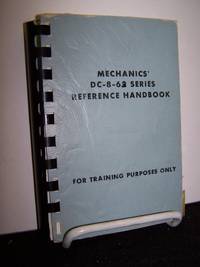
1968243569Technical Training Publications. 1968. . Black comb binding stiff blue covers. . Some highlighting previous owner’s tape tabs still a good readable copy. . 16mo. Illustrated with charts and diagrams. Technical Training Publications. unknown books