HUGO, VictorLivre Rare Book
30 636 résultats
LCS-18030Édition originale de cet ouvrage « peu commun et très recherché » (Clouzot, 144). Paris, Mame et Delaunay-Vallée, 1830. In-8 de : I/ (2) ff., vii pp., (1) p. de personnages, 154 pp., 12 pp. Demi-maroquin rouge à grain long à coins, dos lisse orné en long, non rogné, couvertures beige imprimées conservées. Reliuré signée de Mercier succ. de Cuzin. 225 x 139 mm.
187766761Cinquième édition, 1 vol. in-8 reliure postérieure demi-basane marron, dos à 5 nerfs, couverture conservée, Calmann-Lévy, Ancienne Maison Michel Lévy Frères, Paris, 1877, 2 ff., 323 pp.
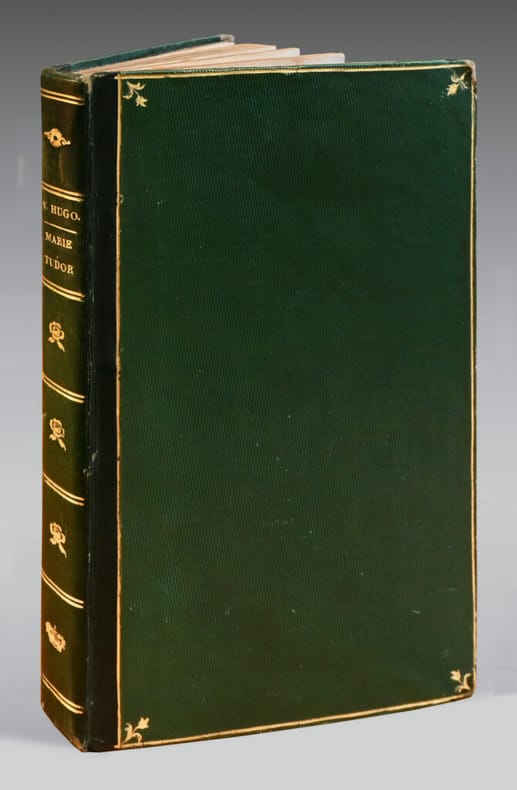
LCS-186388Précieux exemplaire grand de marges conservé dans son demi-maroquin vert de l’époque. Paris, Eugène Renduel, 1833. In-8 de (3) ff. y compris le frontispice gravé, IV pp., 214 pp. Relié en demi-maroquin vert à coins de l'époque, filet doré encadrant les plats avec fleurons d'angles, dos lisse orné de fleurons et doubles filets dorés, couronne dorée dans le caisson inférieur, tranches jaunes sur témoins. Reliure de l'époque. 211 x 129 mm.
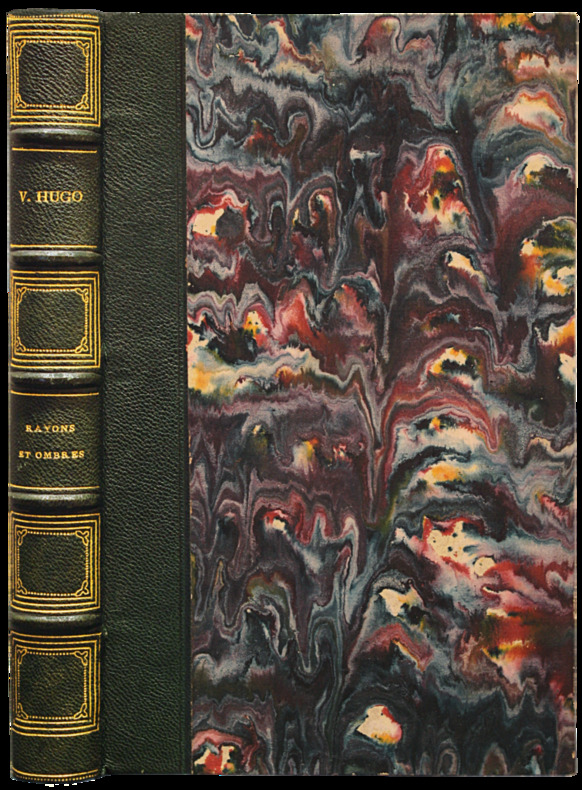
LCS-18360Exemplaire très pur, conserve dans son demi-chagrin vert de l’époque, de cette originale littéraire rare et recherchée. Paris, Delloye, Libraire, 1840. In-8 de (2) ff., xiii pp., (1) f., 389 pp. Relié en demi-chagrin vert de l’époque, dos à nerfs orné de filets dorés, caissons avec encadrements de 4 filets dorés, tranches jaspées. 210 x 133 mm.
76323Paris Michel Lévy Frères Editeurs 1872 Auflage: 1. Halbleder gebunden; marmoriertes Überzugspapier roter goldgeprägter Rücken Lesebändchen / Anz. Seiten: 220 / 118 x 181 cm / Zustand: gut leichte Gebrauchsspuren; Einband minimal berieben Papier leicht gebräunt und durchwegs leicht bis mässig stockfleckig Mit handschriftlicher Widmung des Verfassers an den Juristen Emile Accollas auf dem Vortitel signé par l'auteur - Signiert Paris, Michel Lévy Frères, Editeurs, 1872, Auflage: 1. unknown
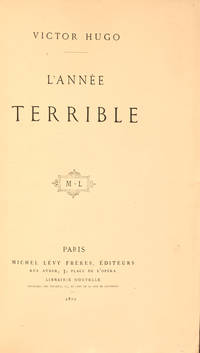
TR17<p>Paris Michel Levy Frères 1872.</p><p>Large 8vo 243 x 153 mm of 4 ll. 427 pp. bound in red half-morocco with corners smooth spine decorated with gilt fillets forming boxes untrimmed covers and spine preserved. <i>Early 20th century binding signed Alfred Farez</i>.</p><p><b>First edition of this "capital work" by Victor Hugo Carteret i 423 one of 150 numerous copies on Holland </b>the only large paper after 25 Chine.</p><p>Clouzot p. 151.</p><p>This one is number 53.</p><p>"<i>25 Chine and 25 Hollande now rare</i>" Clouzot.</p><p>"<i>It was printed in a buff cover 25 copies on chine and 150 on Hollande laid paper</i>.</p><p><i>A capital work</i>". Carteret.</p><p>"<i>First edition published on 20 April 1872. In the original edition lines of dots replace some verses that the censorship of the state of siege did not allow to be published pp. 282; 286 and 292. These verses were only reinstated in the definitive edition of 1880</i>". Talvart IX 46.</p><p>"A collection of poems by Victor Hugo 1802-1885 published in 1872. In the cycle of his great patriotic commemorations the author evokes the fall of the Second Empire and the advent of the Third Republic a decisive moment in which France once again set out towards freedom. From august 1870 to July 1871 the nation experienced the shame of slavery the defeat of its army and the struggle of political parties. But its martyrs and exiles showed it the path to glory: the one that leads to the brotherhood of peoples and to Latin union. <b>The whole history of this time is reviewed in a fiery and powerful style that bears the author's mark</b>. In 'Sedan'<i> he laments the bitterness of defeat: the sword of the heroes and all the illustrious leaders who have done honour to France is returned to the enemy by a 'bandit' by the weak and vain Napoleon III. 'Choix entre les deux nations' humiliated France victorious Germany tells us of the filial love that the poet has for his country. the poems dedicated to the months of September and October 1870 are gripping: the siege of Paris and the fierce fighting in the city. then come the poems of may: struggles against the partisans of freedom the burning of Paris the expulsion of the poet from Brussels; the verses here have a biblical tone; personal facts and historical events are symbolically intertwined. On the whole this collection recalls months of pain blood and horrors the fruit of blind trust and tyranny. The responsibility for so much suffering and death falls on Napoleon III and those who tried to restore absolute power after him. After having condemned the old crumbling world to execration the 'epilogue' underlines <b>the highly civic and political meaning of the book consecrated to the renaissance of civilization</b></i><b>". </b>Dictionnaire des Œuvres I 181.</p><p><b>A precious copy on Hollande binding with covers and spine preserved.</b></p><p><br /></p><p><u>FRENCH</u><br /></p><p>Paris Michel Levy Frères 1872.</p><p>Grand in-8 de 4 ff. 427 pp. Relié en demi-maroquin rouge à coins dos lisse orné de filets dorés formant des caissons non rogné couvertures et dos conservés. <i>Reliure du début du XXe siècle signée Alfred Farez.</i></p><p>243 x 153 mm.</p><p><b>Édition originale de cet " ouvrage capital " de Victor Hugo Carteret I 423 l'un des 150 exemplaires numérotés sur Hollande</b> seuls grands papiers après 25 Chine.</p><p>Clouzot p. 151.</p><p>Celui-ci porte le numéro 53.</p><p>" <i>25 Chine et 25 Hollande devenus rares</i> " Clouzot.</p><p>" <i>Il a été tiré sous couverture chamois 25 exemplaires sur chine et 150 sur vergé de Hollande.</i></p><p><i>Ouvrage capital</i>. ". Carteret.</p><p>" <i>Edition originale parue le 20 avril 1872. Dans l'édition originale des lignes de points remplacent certains vers que la censure de l'état de siège n'a pas permis de publier pp. 282 ; 286 et 292. Ces vers n'ont été rétablis que dans l'édition définitive de 1880</i> ". Talvart IX 46.</p><p>" <i>Recueil de poèmes de Victor Hugo 1802-1885 publié en 1872. Dans le cycle de ses grandes commémorations patriotiques l'auteur évoque la chute du Second Empire et l'avènement de la Troisième République instant décisif où la France s'élance à nouveau vers la liberté. Du mois d'août 1870 au mois de juillet 1871 la nation connait la honte de l'esclavage et voit la défaite de son armée la lutte des partis politiques. Mais ses martyrs et ses exilés lui montrent le chemin de la gloire : celui qui mène à la fraternité des peuples et à l'union latine. </i><b>Toute l'histoire de ce temps est passée en revue dans un style fougueux et puissant qui porte la marque de l'auteur</b>.<i>Dans 'Sedan' il déplore l'amertume de la défaite : l'épée des héros et de tous les chefs illustres qui ont fait honneur à la France est rendue à l'ennemi par un 'bandit' par le faible et vaniteux Napoléon III. 'Choix entre les deux nations' la France humiliée l'Allemagne victorieuse nous dit l'amour filial que le poète voue à sa patrie. Les poèmes dédiés aux mois de septembre et octobre 1870 sont prenants : c'est le siège de Paris et les combats acharnés dans la ville. Viennent ensuite les poèmes du mois de mai : luttes contre les partisans de la liberté l'incendie de Paris l'expulsion du poète qui est chassé de Bruxelles ; les vers ont ici un ton biblique ; faits personnels et événements historiques y sont symboliquement entremêlés. Dans l'ensemble ce recueil rappelle des mois de douleur de sang et d'horreurs fruits d'une confiance aveugle et de la tyrannie. Sur Napoléon III et sur ceux qui après lui ont tenté de rétablir le pouvoir absolu retombe la responsabilité de tant de souffrances et de morts. Après avoir voué à l'exécration le vieux monde croulant l''Epilogue' souligne</i> <b>le sens</b> <b>hautement civique et politique du livre consacré à la renaissance de la civilisation</b> ". Dictionnaire des Œuvres I 181.</p><p><b>Précieux exemplaire sur Hollande relié avec les couvertures et le dos conservés.</b></p> hardcover
1985bj1611Faksimile Verlag Luzern Reliure 1985 Magnifique fac-similé du manuscrit de La Grande Chronique bourguignonne de Schilling Le Vieux (de Berne), conservé à la Bibliothèque Centrale de Zürich (Nr. A 5), qui, réalisé vers 1480 est le 3ème et dernier tome de l'Histoire Officielle de la ville de Berne et représente la plus importante source d'informations sur les guerres de Bourgogne. Les miniatures, particulièrement belles et intéressantes, décrivent des scènes très détaillées de sièges, de combats et de la vie de camp. La reliure plein-cuir (25 * 39 cm.) cousue main correspond exactement à l'original, avec ses empressages à froid et ses deux fermoirs en métal, les cahiers ont été coupés puis cousus ensemble à la main, tout comme pour l'original. Le tirage de cette édition a été limité à 980 exemplaires, celui-ci portant le numéro 529. On retrouve l'habituel volume de commentaire, co-écrit par plusieurs spécialistes ; le texte est en allemand et fait 306 pages, il est relié en demi-cuir et toile d'éditeur. Très bel exemplaire. Livraison a domicile (La Poste) ou en Mondial Relay sur simple demande.
188392049Calmann-Lévy | Paris 1883 | 14.5 x 24 cm | Relié
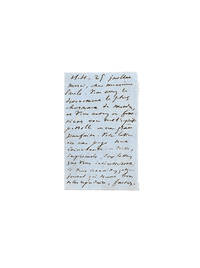
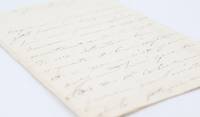
1862Hugo16<p><strong>HUGO Victor 1802-1885</strong></p><p>"Mini" autograph letter signed " V. " to Émile Allix<br />Hauteville Hhouse 25th July 1862 2 p. small in-24° 43 x 68 cm on blue laid paper<br />With autograph envelope tear see scan<br />Slight trace of unimportant oblique fold on the second page<br />Dry stamp: S. Barset / June / 25 / High Street / Guernsey<br />Post mark: 28 July 1862 / Angleterre – Calais</p><p><strong>An unpublished "thumbnail" letter to his personal doctor announcing his departure for Belgium after the exhausting work of writing <em>Les Misérables</em></strong></p><p><em>" Merci cher Monsieur Émile. Vous avez le dévouement le plus charmant du monde et vous entrez en fonctions avec tout l'esprit possible et une grâce parfaite. Votre lettre est une page toute étincelante. – Voici imprimées deux lettres qui vous intéresseront si vous connaissez quelque journal qui trouve bon de les reproduire faites. <strong>Je vais voir mon Charles dans quelques jours. Ce sera une joie profonde et je la mérite un peu après ce lourd labeur.</strong> Quel dommage que vous ne soyez pas de cette clef des champs là ! – Est-ce que vous voudrez jeter à la poste ces trois billets. Je fais mon sac de nuit et je vous serre les deux mains<br />V. "</em></p><p>A letter to Paul Meurice sent the day before gives us a detailed account of the journey that Victor Hugo was about to undertake: "We will leave on Monday the 28th with M. Lacroix the publisher of Les Misérables we will spend Tuesday in London. On Wednesday 29th we will be in Brussels via Ostend Thursday 30th in Liège since you like Liège. So try to get there you and Charles on July 31st" and then added at the end of the letter apparently anticipating his doctor's recommendations:<br />"To moderate the rain of letters during my absence will you have something published in Le Siècle or La Presse like this: 'On the advice of the doctors who advised him to change his air after the great work of <em>Les Misérables</em> M. Victor Hugo has left Guernsey for a journey of a few weeks'</p><p>Émile Allix 1836-1911 was a French medical doctor specializing in pediatrics. It was during a holiday in Jersey that the young medical student then 19 years old met the writer through his brother Jules and his sister Augustine who were close to the Hugo circle. His republican convictions his opposition to the regime of Napoleon III his kindness and his very gentle nature were all arguments that allowed the doctor to seal the beginning of an unfailing friendship with the writer. In 1868 Allix assisted Adèle Hugo who was very ill in her last moments. A close friend of Victor Hugo and his family he was a constant believer like any other son. With his colleagues Alfred Vulpian and Germain Sée he signed the last certificates that preceded the declaration of Victor Hugo's death on 22 May 1885.</p><p>When Victor Hugo signed with only the initial of his first name it meant above all a very close relationship with his correspondent usually reserved for his closest circle. The regret expressed here by the writer at not being able to meet his doctor friend for his Belgian journey testifies all the more to the ties that united them.</p><p><u>Provenance:</u><br />Private collection</p>
16791402270066Joannis Blaeu 1679-01-01. First Edition. Hardcover. Good. 3 volumes in 4. Thick folios. Contemporary mottled calf boards rebacked with modern spines. 6 raised bands red and gold spine labels. A handsome set. Engraved title in red and black. Text in double column. Latin and Greek. Seminary bookplates and stamps. Brunet II p. 1765; Wing G2081. Ter Meulen 920. tom. 1. Annotationes ad vetus testamentum -- Joannis Blaeu hardcover
185186794s. l. Paris 1851. Fine. ""Tu es le soleil de mon âme et la joie de mes yeux"" You are the sun of my soul and the joy of my eyes s. l. Paris 12 juin 1851 11.50 x 17.90 cm 4 pages sur un bifeuillet Autograph letter most probably unpublished signed addressed by Juliette Drouet to her lover Victor Hugo four pages written in black ink on a bifolium. Transverse folds inherent to mailing fold joining the two leaves reinforced with a fine strip of pasted paper barely perceptible. Absent from the very complete online edition of Juliette Drouet's letters to Hugo by the Centre d'Études et de Recherche Éditer/Interpréter University of Rouen-Normandy. Very beautiful declaration of love and admiration by Juliette Drouet the day after Hugo's plea defending his son. Charles Hugo had been brought before the assizes and condemned despite his father's intervention for having valiantly castigated the execution of Claude Montcharmont. Hugo's great love addresses this letter in troubled times where father and son find themselves at the forefront of the scene for their abolitionist positions. Scandalized by the execution of Montcharmont a 29-year-old poacher from Morvan Charles Hugo publishes an article in l'Événement which earns him a trial for contempt of respect due to the laws: the Second Republic already exists only in name and the press is subject to frequent attacks further aggravated here by the notoriety of the Hugos. Victor wants to defend his son and delivers a plea that remains famous: ""Mon fils tu reçois aujourd'hui un grand honneur tu as été jugé digne de combattre de souffrir peut-être pour la sainte cause de la vérité. A dater d'aujourd'hui tu entres dans la véritable vie virile de notre temps c'est-à-dire dans la lutte pour le juste et pour le vrai. Sois fier toi qui n'est qu'un simple soldat de l'idée humaine et démocratique tu es assis sur ce banc où s'est assis Béranger où s'est assis Lamennais !"" My son you receive today a great honor you have been judged worthy to fight perhaps to suffer for the holy cause of truth. From today you enter into the true virile life of our time that is to say into the struggle for the just and the true. Be proud you who are but a simple soldier of the human and democratic idea you are seated on this bench where Béranger sat where Lamennais sat! Despite Hugo's historic intervention Charles is condemned to six months in prison and 50 francs fine - a decision that Juliette bitterly castigates overwhelmed by anguish at the outcome of the trial: ""J'ai beau savoir que cet arrêt inique est non seulement supporté avec courage par vous tous mais accepté avec orgueil et avec joie par le plus directement intéressé dans cette malheureuse condamnation la fatigue et l'inquiétude que j'ai éprouvé pendant toute cette interminable journée d'hier m'a laissée une douloureuse courbature physique et morale"" However much I know that this iniquitous verdict is not only borne with courage by all of you but accepted with pride and joy by the one most directly concerned in this unfortunate condemnation the fatigue and anxiety I experienced during all that interminable day yesterday has left me with a painful physical and moral ache. 12 juin jeudi matin 7h unknown
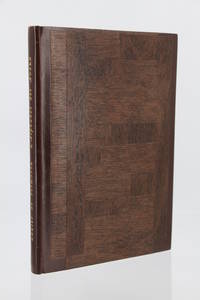
195486056Paris: Gallimard 1954. Fine. Gallimard Paris 1954 15.50 x 21.30 cm relié sous étui First edition one of 48 copies on pur fil the only deluxe copies. Work decorated with illustrations by Jean Hugo. Light rubbing to extremities of the slipcase. Superb binding in dark exotic wood marquetry signed Pierre-Lucien Martin dated 1962. Binding in chocolate brown box leather with bands smooth spine gilt title lengthwise first cover formed of a mosaic arrangement of dark wood pieces with grain arranged in opposite directions bearing the title engraved vertically and the author's name revealed in acrostic second cover formed of a large panel of the same wood with unfolded grain bordered in chocolate box leather endpapers and pastedowns of chocolate paper top edge gilt over deckled edges covers and spine preserved slipcase of chocolate paper bordered in chocolate box leather interior lined with brown felt elegant ensemble signed Pierre-Lucien Martin and dated on the rear pastedown 1962. ""Maintaining to the end the rigor of the practitioner he is guided by an uncompromising love of the craft as much as by a profound taste for the search for forms. Martin despite his modesty is a great creator. He binds contemporary literature that attracts him as well as books where word and image blend. He aims for sobriety even purity. Geometry inhabits him. He plays admirably with materials and colors."" Yves Peyré Gallimard hardcover
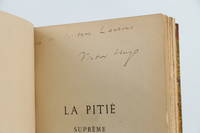
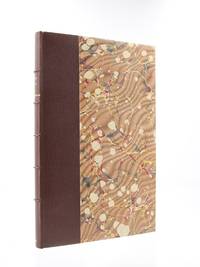
187977555Paris: Calmann Lévy 1879. Fine. Calmann Lévy Paris 1879 15 x 23.50 cm relié First edition. Half caramel morocco with small corners spine with four raised bands decorated with black fillets marbled paper boards marbled endpapers and pastedowns bookplate pasted on one pastedown top edge gilt covers and spine sunned and with some lacks preserved. Discreet restorations to joints. Fine copy handsomely bound. Precious autograph inscription signed by Victor Hugo to Constant Laurent. Calmann Lévy hardcover
188276750Paris: Calmann Lévy 1882. Fine. Calmann Lévy Paris 1882 15 x 25 cm relié First edition one of 10 numbered copies on Japan paper deluxe copy. Contrary to what bibliographers indicate Clouzot Carteret and Vicaire the print run on this paper does not appear to be 15 copies but indeed 10 as mentioned on the justification page. This paper was moreover upon publication at 40 francs the most expensive China paper being only 20 francs and Holland 15. Half chocolate brown morocco binding spine with five raised bands gilt date at foot pebbled paper boards combed paper endpapers and pastedowns bookplate pasted on a pastedown original wrappers preserved top edge gilt binding signed P. Goy & C. Vilaine. Handsome copy. Calmann Lévy hardcover
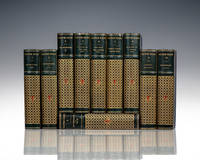
1894283788Philadelphia: Barrie & Jenkins 1894. hardcover. 41 volumes small 8vo 3/4 blue morocco marbled boards gilt spine with fleur de lys design top edges gilt. Philadelphia: Barrie & Jenkins 1894. Limited Edition. Edition Definitive. Near Fine.<br/><br/> Number 128 of 1000 sets.<br/><br/> Barrie & Jenkins unknown books
1900149034New York: The Nottingham Society c. 1900. The Nottingham Society Edition De Luxe of the Works of Victor Hugo. Octavo 10 volumes bound in three quarter contemporary royal blue crushed levant morocco over watered silk covered boards with gilt titles and elaborate gilt tooling with red fleur-de-lis gilt onlays to the spine in two compartments marbled endpapers top edges gilt with others untrimmed and occasionally uncut illustrated tissue-guarded frontispiece to each volume. In near fine condition with some light rubbing to the extremities. Ownership name. An exceptional set. Victor Hugo 1802–1885 remains one of France's most celebrated writers renowned for his contributions to literature during the Romantic era. His works which included novels plays and poetry often explored themes of justice social inequality and human resilience. Hugo's masterpiece Les Misérables 1862 delved into the lives of marginalized individuals weaving a powerful narrative of redemption and revolution. Similarly Notre-Dame de Paris 1831 known in English as The Hunchback of Notre-Dame combined Gothic elements with a critique of societal flaws. Hugo’s poetry collections such as Les Contemplations 1856 revealed his lyrical genius and personal reflections on love loss and spirituality. The Nottingham Society hardcover
1853104749Signed inscribed and dated: J Hetzel et Cie Editeurs. Very Good. 1853. 1st Printing 1853. Full leather. First edition 1853. Isncribed signed and dated by Victor Hugo: "a M.Berton. 1er Novembre 1870. Victor Hugo" Bound in bright red crushed morocco with gilt titles to spine as well as end paper floral bordering. In very good to near fine overall condition with minor toning to interior. small 8vo. 328pp. ; 328 pages . J Hetzel et Cie Editeurs hardcover
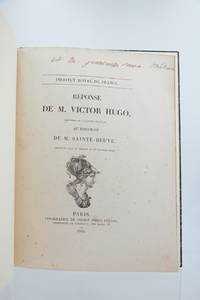
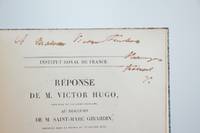
184575954Paris: Typographie de Firmin Didot frères 1845. Fine. Typographie de Firmin Didot frères Paris 1845 20.50 x 27 cm relié First edition. Autograph inscription from Victor Hugo to Mélanie Foucher: ""à ma précieuse soeur Mélanie"" ""to my precious sister Mélanie"" Bradel binding in full paste paper smooth spine decorated with a black morocco label title lengthwise binding signed Thomas Boichot. Inscription slightly trimmed. Some very minor worming. Typographie de Firmin Didot frères unknown
184575953Paris: Typographie de Firmin Didot frères 1845. Fine. Typographie de Firmin Didot frères Paris 1845 20.50 x 27 cm relié First edition. Signed autograph inscription from Victor Hugo to Mélanie Foucher: ""A Madame Victor Foucher Hommages V."" ""To Madame Victor Foucher Respects V."" Bradel binding in full pebbled paper smooth spine decorated with a burgundy morocco label title lengthwise binding signed Thomas Boichot. Some very minor worming. Handsome copy. Typographie de Firmin Didot frères unknown
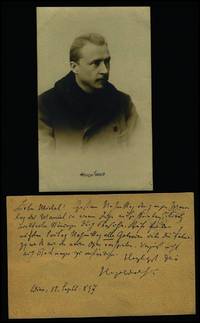
10889Used; Like New/Used; Like New. Autograph letter 1 page to Michael Haberlandt. Vienna 15 September 1897. The letter reports that Wolf has yesterday afternoon completed the monologue to Manuel despite the disturbance of numerous visits and reads in part: "Gestern Nachmittag den ganzen Monolog des Manuel in einem Zuge aufgeschrieben trotz vielfacher Storungen durch Besuche. Rufe fur den nachsten Sontag Nachmittag alle Getreuen unter die Fahne. Ich werde aus der neuen Oper vorspielen." 14 x 9 cm and in fine condition. Sold together with a vintage postcard photograph of the composer. <br><br><br />The Austrian folklorist and Indologist Michael Haberlandt 1860 - 1940 was an important supporter of Hugo Wolf and was one of the founders of the Hugo Wolf Society. <br><br><br />The Austrian composer died tragically young of syphilis while committed to an asylum for the insane and autograph material is uncommon. At the end of July 1897 Wolf had begun feverishly working on his opera "Manuel Venegas" and "despite interruptions the opera's opening began to take shape as Wolf's swings from manic gaiety to irascibility became more pronounced. In mid-September his boast that he had been appointed director of the Vienna Court Opera and had sacked the current director Gustav Mahler signaled the onset of madness. Inviting his friends to hear his new opera and congratulate him on September 20 he played through the 50 completed pages of vocal score blissful raving and wholly insane as his friends clustered around him in stunned misery -- a scene famously adapted by Thomas Mann in his novel Doktor Faustus 1947. Wolf's polished fragment introduces characters and motifs without reaching the great dramatic moments that had tempted him though the opening Spring Chorus is one of the freshest most evocative and inspired in his entire oeuvre." Adrian Corleonis All Music unknown books
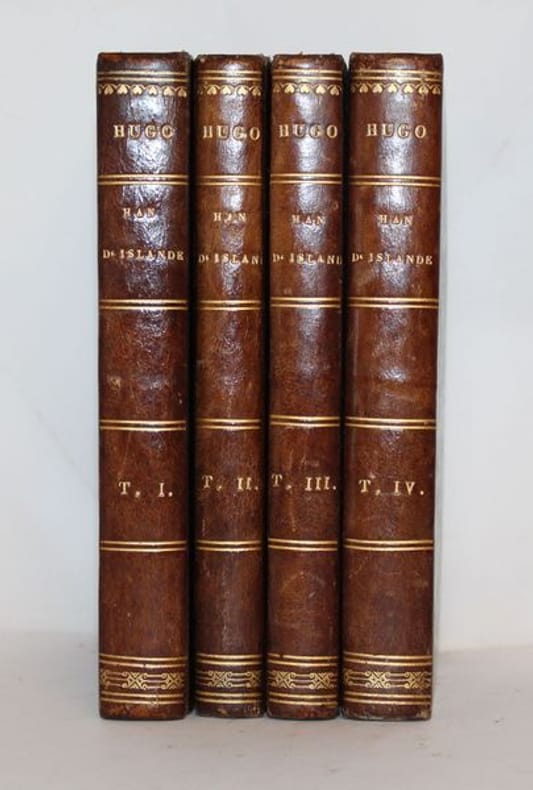
23393Paris, Persan, 1823. Quatre volumes in-12 de : I/ viii pp., 316 ; II et III/ (2) ff. et 237 pp. ; IV/ (2) ff., 347 pp. ( 163 x 98 mm). Un angle de bas de page refait sans atteinte au texte (I, p. 111), rousseurs. Demi-veau à coins aubergine, dos plat orné de filets et roulettes dorées, gardes changées. Reliure d'époque en bon état.
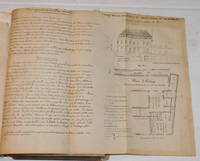
182897115Paris: impr. Dezanche and impr. Pihan Delaforest and Delangle Freres 1828-1835. 1828-1835. Fair. - Octavo 8-1/4 inches high by 5-1/4 inches wide. Four pamphlets bound into early brown calf with an elaborate floral device embossed in blind at the center of both the front and rear covers within an elaborate outer gilt ruled frame with formal decorations. All edges are marbled. The rubbed & worn covers are detached and the spine has perished and thus lacking. The pagination is as follows: i-xii 1-96 pp.; 5 6-45 1 pp.; 5 folding plates; 5 6-66 pp.; 4 pp. 1-82. There is foxing throughout.<p>The ownership name of James Stewart and the faded date of "1881" is penned on the front blank. In what appears to be his hand the statement "From Pierre Soule" is penned along the top of the verso of the front endpaper. Additionally the attractive sienna-toned ex-libris bookplate of "R.G.S." is mounted on the front pastedown. <p>Stated to be from the library of Pierre Soule with his name signature at the head of the first pamphlet. Soule 1801-1870 was the French-born New Orleans attorney and Louisiana Senator.<p>The lawyer involved in these 4 cases Gustave Louis Chaix d'Est-Ange 1800 - 1876 was the son of the attorney general at the court of criminal justice of Reims. As a lawyer his oratorical talent was noted at the Paris bar where he practiced. He was entrusted with a number of important cases and from 1842-1844 was president of the Paris Bar Association.<p>1 Plaidoyer et réplique de Me Chaix-d'Est-Ange dans le procès d'Émile de La Roncière précédés d'une Note de M. le lieutenant-général Clément de la Roncière d'Esquisse préliminaire de M. Eugène Roch et d'une lettre de M. Émile de La Roncière adressée à "l'Observateur des tribunaux". Paris: De L'Imprimerie De Dezauche 1835. The sensational trial of Emile de La Ronciere 1803 - 1874 was most recently memorialized by John Fowles in his novel "The French Lieutenant's Woman". In chapter 28 of the novel he discusses the trial of the young cavalry officer who was accused of raping Marie the sixteen-year-old daughter of his commanding General Baron de Morell. The trial itself revolved around a series of anonymous letters threatening the Morell family and signed "E. de La R.". La Ronciere was found guilty and sentenced to ten years in prison. The verdict was controversial and has been debated for many years. In the pamphlet at hand is included the text of a letter to the l'Observateur des Tribunaux written by La Ronciere's father Clement de La Ronciere on August 25 1835 and one written by the imprisoned La Ronciere himself on September 10 1835. These are followed by a preliminary outline by Eugene Roch. The text from the trial is based on reporting in l'Observateur des Tribunaux journal des documens judiciaires. It begins with the plea of La Ronciere's attorney Chaix d'Est-Ange. Although misbound later in this collection of pamphlets facsimiles of items used as evidence in the trial are included. These include 4 folding facsimiles on which are printed 8 samples of handwriting of La Ronciere and of Marie de Morell. Also included on a fifth folding plate is a remarkable plan of the home of the Morells with a view of the floor where Marie's room was located.<p>2 Plaidoyer de Me Chaix-d'Est-Ange pour M. le ministre du Commerce et des Travaux publics intervenant contre M. Victor Hugo. Paris: Imprimerie De Pihan Delaforest 1832. Victor Hugo's play "Le Roi s'amuse" was the basis for the libretto of Verdi's opera Rigoletto. The opening of the play on November 22 1832 was highly anticipated. The opening night box office receipts were an enormous success but the play was not. Both the audience and the critic's responses were negative. However the most devastating response came from the Minister of the Interior. He saw the play as an attack on the royal family and ordered it suspended i.e. banned. In the Charter of 1830 censorship was stipulated to "never be re-established". This conflict led to a trial on December 19 1832. Odilon Barrot represented Hugo and Chaix d'Est-Ange represented the Ministry of Commerce. He took the unpopular stand that the State had the authority to examine dramatic works before production. His plea is published here. Hugo lost this free-speech debate and the play was banned for 50 years.<p>3 Plaidoyer de M. Chaix d'Est-Ange pour le sieur Auguste Labauve et les sieur et dame Formage plaignans et parties civiles contre Frédéric Benoît accusé. Paris: Imprimerie De Pihan Delaforest Morinval 1832. A VIVID ACCOUNT OF MATRICIDE! Frederic Benoit 1810 - 1832 known as "Le Parricide" was executed by the guillotine at the Place St. Jaques in the 14th arrondisement of Paris on August 30 1832. The story of Benoit's killing of his mother in November 1829 and that of his male lover seventeen-year-old Joseph Formage on July 22 1831 is well documented and need not be repeated here. In this civil plea of June 14 1832 on behalf of the butcher Auguste Labauve and also on behalf of Joseph Formage's parents Chaix d'Est-Ange outdoes himself in painting with vibrant colors the slaughter by Benoit of his own mother. Labauve was the second victim of this crime. In January of 1830 an anonymous letter was found threatening Benoit's father a justice of the peace as well as Labauve with the same fate as that of Madame Benoit. The letter was said to be in the hand of Labauve. He was brought to trial for murder and was acquitted by a divided jury. However he was sentenced to a 5 year prison term for having written the threatening letter.<p>4 Procès fait à la lettre adressée au duc d'Orléans par Cauchois-Lemaire. Paris: Delangle Freres Libraires 1828. In December 1827 the editor of the Constitutionnel Louis Francois Auguste Cauchois-Lemaire 1789 - 1861 published a notorious 69 page pamphlet "Sur la crise actuelle lettre a S.A.R. le duc d'Orleans". The pamphlet addressed to Louis-Philippe the Duke of Orleans was a powerful attack on the ultra-royalist government of Joseph de Villele and a denunciation of the so-called "massacre" that took place on the rue Saint-Denis on July 27 1827. Cauchois-Lemaire concludes his essay paraphrasing the French "Thus liberty awaits the day which should let it emerge from its prison. And we who are tired of the long wait together we call for a favorable star to hasten it." The result was that Cauchois-Lemaire was accused of trying to persuade the duc d'Orleans the "favorable star" to lead the opposition to the government and have it overthrown. He and the two publishers Ponthieu and Schubart were brought to trial on January 12 1828. Cauchois-Lemaire was sentenced to 15 months in La Force prison in addition to a fine. In defense of Cauchois-Lemaire Chaix d'Est-Ange given that the facts of the matter were difficult to vindicate delivered a brilliant thesis on constitutional law. The press at the time praised his eloquence. Cauchois-Lemaire himself was so impressed that he wrote Delangle Freres from prison on January 28 1828 requesting that they publish a transcript of the trial. That letter together with the proceedings of the trial are published here. Paris: impr. Dezanche, and impr. Pihan Delaforest, and Delangle Freres, 1828-1835. unknown
1862332564Paris: J. Hetzel 1862. First Edition Thus; First Printing. Hardcover. All 4 volumes Very Good in boards. Published in French. Shelfwear on spines and corners of all four volumes.; Ouvres Completes De Victor Hugo. J. Hetzel hardcover
1968260881968. Black and white photograph from the late 1960s of the Warren Court mounted to board signed by each member. The justices are John Marshall Harlan Hugo Black Earl Warren William O. Douglas William J. Brennan Jr. Potter Stewart Abe Fortas Potter Stewart Byron R. White and Thurgood Marshall. Light wear and crease to the bottom left corner. Matted and framed. The entire piece measures 15.5 inches by 18.5 inches. Rare and desirable. The Warren Court is best known for its landmark decisions which outlawed segregation in public schools and transformed many areas of American law especially regarding the rights of the accused ending public school-sponsored prayers and requiring "one man-one vote" rules of apportionment of election districts. He made the Supreme Court a power center on a more even basis with Congress and the Presidency especially through four landmark decisions: Brown v. Board of Education 1954 Gideon v. Wainwright 1963 Reynolds v. Sims 1964 and Miranda v. Arizona 1966. unknown books
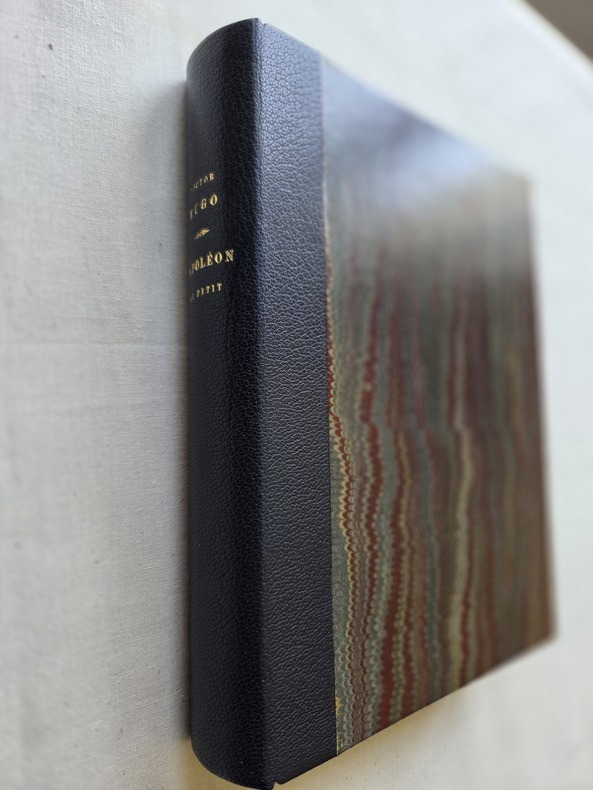
1852509Londres-Bruxelles Jeffs, J.Mertens 1852 DEVAUCHELLE Alain In-18 (152x103mm.), maroquin noir : dans la partie supérieure de chacun des plats, un tout petit 'N' majuscule est poussé dans une couronne de lauriers or, sur le dos sans nerf, le titre de l'ouvrage est poussé or à la chinoise, en lettres de grosseurs décroissantes, doublures et gardes de soie moirée bleu ciel, absolument non rogné, couverture imprimée. L'ouvrage est conservé dans une boîte in-8 (205x160mm.), en demi-maroquin noir, plats de papiers peigne avec en doublure intérieure un portrait de Napoléon III empereur, en velours de gêne en soie bleue, crème et noir exécuté par R. BURLATON et Cie. Reliure d'Alain DEVAUCHELLE. 385 pages, les 7 premières non numérotées, plus une page non chiffrée avec l'adresse de l'imprimeur.