[HUGO] Juliette DROUETBiblio.com

31 339 résultats
1846DrouetHugo1<p><strong>HUGO DROUET Juliette 1806-1883</strong></p><p>Autograph letter signed " Juliette " to<u> Victor Hugo</u><br />N.p Paris 9th December 1846 " Wednesday morning " 10 h ½ " 4 p. in-4°<br />Central fold reinforced with Japan paper two letters affected two words crossed off by Juliette Drouet<br />Dry stamp "BR" on top left corner</p><p><strong>Superb unpublished letter to her lover Victor Hugo passionately evoking the reading that the latter gave her the previous evening of a chapter of his novel <em>Les Misères</em> which fifteen years later would become <em>Les Misérables</em></strong></p><p><em>" Bonjour mon cher bien aimé bonjour mon adoré petit Toto bonjour mon amour comment vas-tu ce matin as-tu eu bien froid cette nuit en rentrant chez toi j'ai bien regretté d'avoir éteint mon feu hier par distraction et dans un but d'économie. Si j'avais pu penser que tu rentrerais avec tes pauvres pieds mouillés j'aurais fait tout le contraire au risque de mettre le feu à la maison. Je te promets que la nuit prochaine tu auras du bon feu. <strong>Mon</strong> <strong>Dieu que c'est beau ce que tu m'as lu hier soir. J'en ai encore le cœur tout ému. Tu n'as jamais rien fait de plus grand de plus vrai de plus douloureux de plus doux de plus généreux et de plus consolant que ces premières pages de ton Jean Trejean. Tout y est</strong>. Depuis les plus grandes choses de la nature jusqu'aux plus petits détails de la toilette empire de Mlle Sylvanie depuis la dureté de cœur des bourgeois jusqu'à l'ineffable bonté du vieil évêque </em>M. Myriel<em> depuis les féroces préjugés du monde jusqu'à la morale si généreuse et si douce de Jésus-Christ</em>1<em>. <strong>Tu n'as rien omis rien oublié rien dédaigné. Et tout cela dans ton plus beau style et</strong> de ta <strong>plus sublime poésie</strong>… pardon mon Victor adoré pardon pour la ridicule page d'admiration que je viens de t'écrire. Il est permis au ciron</em> espèce d'acarien. Pascal dans sa pensée sur " Les deux infinis " le prend comme exemple de l'infiniment petit <em>d'admirer Dieu dans sa petite âme de ciron mais il n'est donné qu'aux aigles de s'en approcher parce qu'ils ont des ailes. J'aurais dû me borner ce matin à t'exprimer ma reconnaissance pour le bonheur immense que tu m'as donné cette nuit sans chercher à te traduire tout ce que j'ai éprouvé en t'écoutant </em>…<em>. Il y a une sorte d'ivresse du cœur qui fait que l'âme et l'esprit ont leur vertige comme le corps. C'est ce qui m'arrive dans ce moment-ci. </em>…<em> Laissez-moi donc vous dire en toute hâte que vous êtes mon cher petit toto que j'aime et que j'adore. Que je baise sur toutes les coutures que je désire et que j'attends de toutes mes forces et à qui je recommande de m'être bien fidèle de venir tout de suite et de m'aimer toujours.<br />Juliette. "</em></p><p>This letter allows us to fully appreciate the emotion experienced by Juliette following the visit the previous evening of her lover Victor who came to give her a reading of what was still only <em>Jean Tréjean</em> the novel that she has been recopying since the previous year. We can also guess at certain characters whose names were later changed. Thus without the final version of the novel Mademoiselle Sylvanie sister of Monseigneur Myriel here the "old bishop" becomes Mademoiselle Baptistine: "Mademoiselle Sylvanie sweet thin frail a little taller than her brother dressed in a puce silk dress a fashionable color in 1806 which she had bought at the time in Paris and which still lasted her …. Mademoiselle Sylvanie's dress was cut according to the 1806 patterns short waist narrow sheath sleeves with epaulettes with tabs and buttons."<br />As for Juliette if the analogies between her own youth and the character of Fantine are speculative we know with more certainty that she sensitized the writer to the question of poverty. She also contributed to collating the manuscripts copying them and participated in documenting Hugo particularly on life in convents. It was also Juliette who on December 13 1851 just a few days after Napoleon III's coup d'état joined Victor in Brussels with the famous "manuscript trunk" which contained all of the writer's works including the future <em>Les Misérables</em> two-thirds of which were completed.</p><p>The development of <em>Les Misérables</em> is well documented. Victor Hugo began the first drafts a year earlier in November 1845. The first title considered by the writer was then <em>Jean Tréjean</em> taken from the name of the main character who later became Jean Vlajean then Jean Valjean. In December 1847 the novel already largely written became <em>Les Misères</em>. The events of 1848 Hugo's activity as a politician during the Second Republic and the tribulations of exile were all obstacles to the completion of the work. Hugo was at the same time in the middle of writing<em> Les Contemplations</em>. Twelve years later in 1860 while he was in exile in Guernsey Hugo took up his pen again to complete his novel. Moreover there are no two different versions between the manuscript before the Revolution of 1848 and that of exile. The manuscript of <em>Les Misérables</em> is in this respect a manuscript of<em> Les Misères</em> corrected and expanded. The first volume was published on March 30 1862 by Albert Lacroix Verboeckhoven et Cie and four days later in Paris. Parts two and three were published on May 15 parts four and five on June 30. Although reactions were mixed success was immediate.</p><p>1 The bourgeois of Senez mock Monseigneur Myriel who rides a donkey. "Mr. Mayor" said the bishop "and gentlemen bourgeois I see what scandalizes you you find that it is indeed pride for a poor priest to ride a mount that was that of Jesus Christ." Monseigneur Myriel invents examples and "parables going straight to the point with few sentences and many images which was the very eloquence of Jesus Christ convinced and persuasive." <em>Les Misères</em></p><p><u>Provenance:<br /></u>Private collection</p><p><u>Sources:<br /></u><em>Les Misérables </em>éd. Maurice Allem Pléiade 1951 VIII-XVII<br /><em>Les Misères</em> éd. de Guy Rosa consultée sur son site à <em>groupugo.div.jussieu.fr</em></p><p>We thank Florence Naugrette for the information she kindly provided to us.</p>
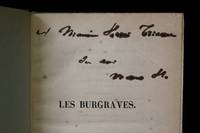
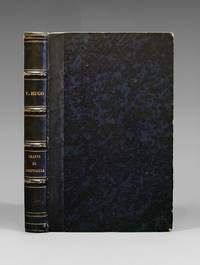
184348262Paris: E. Michaud 1843. Fine. E. Michaud Paris 1843 14.50 x 23.50 cm relié First edition. Half blue-grey cloth Bradel binding over marbled paper boards by Champs spine with gilt stylized floral motif date and double gilt fillet to foot navy blue shagreen title-piece with a small angular lack to top covers preserved. Autograph inscription signed by Victor Hugo to his friend the literary critic Henri Trianon. Small manuscript correction to the first page of the introduction a few small wormtracks to the title and half-title. Provenance : Morizet collection collection of Raymond Boueil with his engraved ex libris Maurice Escoffier Le mouvement romantique N°1557 Robert Schumann manuscript initials 1965 N°207 and Philippe Zoummerouff 2001 N°62. E. Michaud hardcover
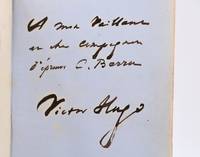
186489316Paris: A. Lacroix Verboeckhoven & Cie 1864. Fine. A. Lacroix Verboeckhoven & Cie Paris 1864 14 x 22.8 cm Relié First edition. Some light foxing. Contemporary half aubergine sheep binding smooth spine decorated with gilt and blind fillets gilt friezes at head and foot marbled paper boards marbled endpapers and pastedowns. Our copy is enhanced with a photographic portrait of Victor Hugo Souvenir du 16 septembre 1862 which he has countersigned in ink serving as frontispiece; as well as an autograph inscription signed by Victor Hugo added on a blue paper leaf: ""A mon vaillant et cher compagnon d'épreuve C. Berru"" Camille Berru 1817-1878 French journalist was editor at l'Indépendance belge a Brussels daily newspaper directed since 1856 by the Marseillais Léon Bérardi 1817-1897 who later made him his private secretary. He was closely connected to the Hugo family not only to Victor but also to his son Charles and to Adèle Foucher. During his stays in Brussels it was at Berru's home that the exile from Guernsey regularly stayed with his wife who died there of a cerebral congestion on August 27 1868. A. Lacroix, Verboeckhoven & Cie hardcover
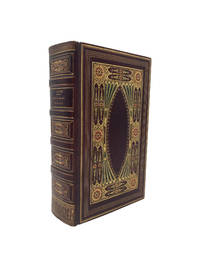
1836001578Paris: Eugene Renduel 1836. Three volumes bound in one. Contemporary full straight grain morocco binding by Kleinhans in the cathedral style with his name pallet to spine raised bands spine in six panels author and title to second panel remaining panels think line border and thin line frame volute centre and corner pieces with red and green onlays covers with a thick and thin line border surrounding a four line frame with a central panel comprising of a gothic architectural ornament with red and green morocco onlays gilt dentelles a.e.g. with orange endpapers. Slightly rubbed to extremities corners gently bumped outer joints with some Japanese tissue repairs endpapers lightly discoloured page edges lightly browned. Housed in a later drop back box by Roger Devauchelle lettered to spine in gilt with blind panels covers with blind panels and gothic ornaments in gilt. Joints of the box repaired with Japanese tissue with scrape to upper panel. Bookplate of former owner to front pastedown and a book label of Pierre van der Rest to front endpaper. With half titles steel engraved additional title in volume one and eleven plates by E. Finden W. Finden R. Staines and others. The text is that of the 'huitième edition' Renduel 1832; i.e. the first complete edition with the additional Preface dated 20 October 1832 and with three new chapters. French text. Kleinhans was a Parisian bookbinder fl. 1814-1855 who employed Trautz when he came to Paris in 1830 see Flety page 99. Devauchelle was a bookbinder and bookbinding historian see Flety page 58. Vicaire IV: 259-60. Signed Binding. Reprint. Hardback. Good. Illus. by Finden E.; Finden W.; Staines R. 8vo. Eugene Renduel Hardcover
1915239530Philadelphia: Barrie 1915. hardcover. fine. 10 volumes 8vo handsomely rebound in 3/4 brown morocco over marbled boards; gilt-ruled and lettered spine with raised bands. all edges gilt. Philadelphia: Barrie 1893.<br/><br/> Part of the Complete and Unabridged Novels. Edition de Bibliophile limited to 250 sets on Japanese vellum. Containing 519 etchings in two printings one in black and one in bistre and 75 double page etchings in black all on Japanese vellum.<br/><br/> Barrie unknown books
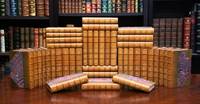
1892108436Boston: Estes & Lauriat 1892. Limited edition one of 500 copies of the Holland Paper edition. Octavo 30 volumes bound in contemporary three quarters morocco gilt titles and tooling to the spine top edge gilt frontispiece to each volume numerous plates. In near fine condition. Victor Marie Hugo was a French poet novelist and dramatist of the Romantic movement. He is considered one of the greatest and best known French writers. In France Hugo's literary fame comes first from his poetry but also rests upon his novels and his dramatic achievements. Among many volumes of poetry Les Contemplations and La Légende des siècles stand particularly high in critical esteem. Outside France his best-known works are the acclaimed novels Les Misérables 1862 and Notre-Dame de Paris 1831. Estes & Lauriat unknown books
LCS-186464
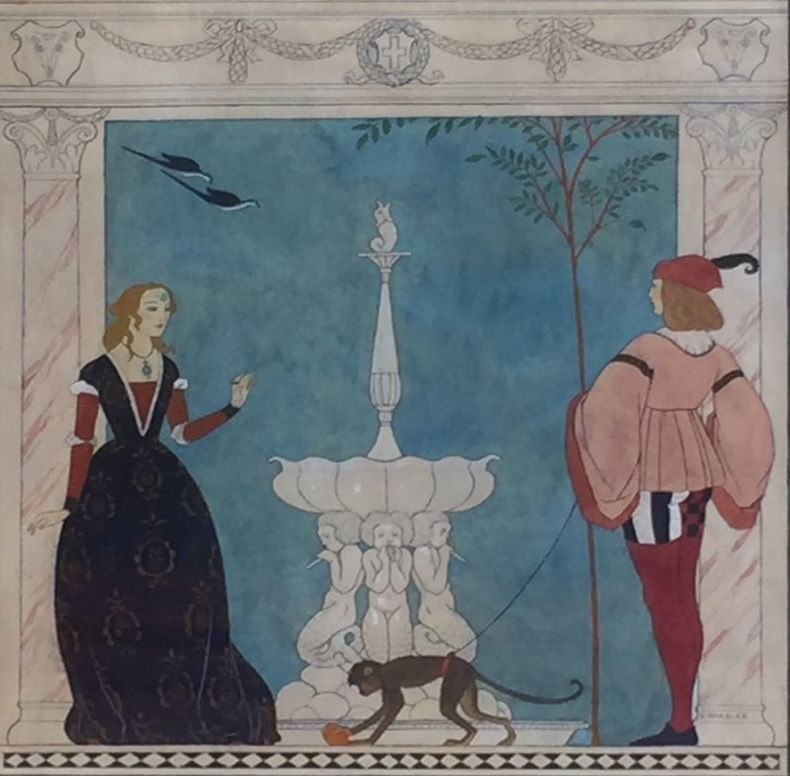
1912217381912 Aquarelle sur papier greige signée en bas à droite, (1912), 32 x 29.5 cm., encadrée.
18928095Gussstahlfabrik Von Fried. Krupp 33 x 25 Essen 1892 Deux albums oblongs, reliures de percaline rouge, dotées de quatre picots de laiton au dos, titres doré, gardes à motifs, tranches dorées. L'album II s'articule autour de deux grandes parties avec des textes en allemand, en français et en anglais : La première partie traite des "Festungs- und Belagerungs-Geschütze" (Canons de siège et place / Garrison- and siege-guns) et comporte une table des matières (3 pages), des pages de titre suivies par 44 planches photographiques montées sur onglets avec mention en bas à froite "Photogr. der Gussstahlfabrik von Fried. Krupp, Essen", datées selon les matériels, en situation avec servants, présentant des "Kanonen mit gewöhnlichen Kartuschen" (Canons avec gargousses ordinaires / Guns with ordinary cartridges), "Kanonen mit Messingpatronen" (Canons avec cartouches en laiton / Guns with brass cartridges), "Haubitzen" (Obusiers / Howitzers), "Mörser" (Mortiers / Mortars), "Transportgeräthschaften" (Ustensiles de transport / Implements for transport). La deuxième partie, avec la même présentation, comporte 23 planches photographiques, traitant les "Küsten-Geschütze" (Pièces de côte / Coast-ordnances), articulés autour de trois types d'armement et d'équipement : les "Kanonen" (Pièces - Ordnances), les "Haubitzen" (Obusiers / Howitzers) et les "Hebezeuge, Krahnen und Transportwagen" (Grues roulantes, mâtures, chariots porte-canon / Gins, sheers and gun-transporting-wagons). L'album III s'articule également autour de deux parties : la première traite des "Schiffs-Kanonen" (Canons de navire / Naval-guns), c'est à dire des "Kanonen mit gewöhnlichen Kartuschen" (Canons avec gargousses ordinaires / Guns with ordinary cartridges), "Kanonen mit Metallpatronen" (Canons avec gargousses métalliques / Guns with metal cartridges), et comporte 54 planches photographiques sur onglets, avec mention en bas à froite "Photogr. der Gussstahlfabrik von Fried. Krupp, Essen". La deuxième partie traite des "Boots- und Landungs-Kanonen (Canons d'embarcation et de débarquement / Boat- and landing-guns) et comporte 6 planches photographiques sur onglets. Les deux albums, peu fréquents, ne comportent aucune marque d'appartenance, mais nous pouvons attester qu'ils faisaient partie de la bibliothèque du général Alexis Brialmont (1821-1903), surnommé le "Vauban belge". Ces albums témoignent des négociations de Brialmont des années 1880-1890 avec la firme allemande afin d'équiper les forts de la Meuse, de Liège et de Namur, et du débat stratégique qui agitait la Belgique indépendante, entre France et la puissante Allemagne, après la guerre franco-prussienne. Pour mémoire dans le même temps Brialmont négociait l'achat de canons auprès de la firme anglaise Maxim-Nordenfelt. Notons également que Krupp fut un des premiers à utiliser la photographie, y compris pour du matériel de guerre, comme support commercial auprès des gouvernements européens. Cette tâche fut confiée au photographe Hugo van Werden (1836-1911). Exceptionnel album en très bon état. Manque à cet ensemble l'album I, qui présentait la gamme des "Gebirgs und Wusten-Kanonen" et des "Feldkanonen". PHOTOS NUMERIQUES DISPONIBLES PAR EMAIL SUR SIMPLE DEMANDE-DIGITAL PHOTOGRAPS MAY BE AVAILABLE ON REQUEST
18928095Gussstahlfabrik Von Fried. Krupp 33 x 25 Essen 1892 Deux albums oblongs, reliures de percaline rouge, dotées de quatre picots de laiton au dos, titres doré, gardes à motifs, tranches dorées. L'album II s'articule autour de deux grandes parties avec des textes en allemand, en français et en anglais : La première partie traite des "Festungs- und Belagerungs-Geschütze" (Canons de siège et place / Garrison- and siege-guns) et comporte une table des matières (3 pages), des pages de titre suivies par 44 planches photographiques montées sur onglets avec mention en bas à froite "Photogr. der Gussstahlfabrik von Fried. Krupp, Essen", datées selon les matériels, en situation avec servants, présentant des "Kanonen mit gewöhnlichen Kartuschen" (Canons avec gargousses ordinaires / Guns with ordinary cartridges), "Kanonen mit Messingpatronen" (Canons avec cartouches en laiton / Guns with brass cartridges), "Haubitzen" (Obusiers / Howitzers), "Mörser" (Mortiers / Mortars), "Transportgeräthschaften" (Ustensiles de transport / Implements for transport). La deuxième partie, avec la même présentation, comporte 23 planches photographiques, traitant les "Küsten-Geschütze" (Pièces de côte / Coast-ordnances), articulés autour de trois types d'armement et d'équipement : les "Kanonen" (Pièces - Ordnances), les "Haubitzen" (Obusiers / Howitzers) et les "Hebezeuge, Krahnen und Transportwagen" (Grues roulantes, mâtures, chariots porte-canon / Gins, sheers and gun-transporting-wagons). L'album III s'articule également autour de deux parties : la première traite des "Schiffs-Kanonen" (Canons de navire / Naval-guns), c'est à dire des "Kanonen mit gewöhnlichen Kartuschen" (Canons avec gargousses ordinaires / Guns with ordinary cartridges), "Kanonen mit Metallpatronen" (Canons avec gargousses métalliques / Guns with metal cartridges), et comporte 54 planches photographiques sur onglets, avec mention en bas à froite "Photogr. der Gussstahlfabrik von Fried. Krupp, Essen". La deuxième partie traite des "Boots- und Landungs-Kanonen (Canons d'embarcation et de débarquement / Boat- and landing-guns) et comporte 6 planches photographiques sur onglets. Les deux albums, peu fréquents, ne comportent aucune marque d'appartenance, mais nous pouvons attester qu'ils faisaient partie de la bibliothèque du général Alexis Brialmont (1821-1903), surnommé le "Vauban belge". Ces albums témoignent des négociations de Brialmont des années 1880-1890 avec la firme allemande afin d'équiper les forts de la Meuse, de Liège et de Namur, et du débat stratégique qui agitait la Belgique indépendante, entre France et la puissante Allemagne, après la guerre franco-prussienne. Pour mémoire dans le même temps Brialmont négociait l'achat de canons auprès de la firme anglaise Maxim-Nordenfelt. Notons également que Krupp fut un des premiers à utiliser la photographie, y compris pour du matériel de guerre, comme support commercial auprès des gouvernements européens. Cette tâche fut confiée au photographe Hugo van Werden (1836-1911). Exceptionnel album en très bon état. Manque à cet ensemble l'album I, qui présentait la gamme des "Gebirgs und Wusten-Kanonen" et des "Feldkanonen". PHOTOS NUMERIQUES DISPONIBLES PAR EMAIL SUR SIMPLE DEMANDE-DIGITAL PHOTOGRAPS MAY BE AVAILABLE ON REQUEST
LCS-1864011
186277887A. Lacroix, Verboeckhoven & Cie | Bruxelles 1862 | 14.50 x 22 cm | 10 volumes reliés
188175902Calmann Lévy | Paris 1881 | 14 x 19.50 cm | relié
1862009119New York: Carleton 1862. 1st Edition 1st Printing. Hardcover. Very good plus. First American Edition and the first edition in English. Complete five-volume set in the publisher's original multi-colored cloth: blue burgundy tan green and brown. Rare to find a set featuring all five colors; most sets are uniformly tan or brown. Very good plus with light wear to spine ends and corners and minor rubbing to boards. Bindings firm with no cracking to hinges. Each volume with ownership name lightly stamped on front pastedown and bookseller embossment at top corner of flyleaf. Interior pages mostly clean with occasional foxing or soiling. Light stain two-inch by quarter-inch to fore-edge of Saint Denis which slightly bleeds over to interior edge of about 60 pages not affecting text and one-inch by quarter-inch stain within text of six pages. A very attractive example of this scarce first printing of Les Miserables a massively popular and renowned 19th century bestseller that has subsequently been the basis for countless stage and film adaptations. <br/> <br/> Carleton hardcover
194877759Sous coffret en moire vert pâle. Reliure plein maroquin grenat. Belle composition courant sur les plats et le dos de motifs géométriques mosaïqués en veau, box et maroquin vert, tilleul, turquoise, rouge, saumon, jaune, vert émeraude, sertis de filets à froid et de filets dorés. Dos lisse avec auteur et illustrateur en lettres dorées. Gardes en agneau velours grenat et vert émeraude avec listels de veau vert et orange. Toutes tranches dorées. Couverture et dos conservés. Reliure signée Nicole FOURNIER, médaille d'Or des Métiers de France, dorure par Pierre Marseleix. Illustré de 113 gouaches de Jean HUGO gravées sur bois en couleurs.
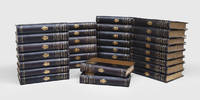
18931024Philadelphia: W.H. Campion & Co 1893. Cabinet Edition Printed on Holland Paper Limited to One Thousand Copies No. 172. Fine Leather Bound by Bradstreet's. Near Fine. A complete 41 volume set in near fine condition beautifully bound by Bradstreet's in 3/4 leather with six compartments and five raised bands to spines with bright gilt details and title. Spines sunned. Binding and hinges are excellent internally remarkably bright and clean without marks and no foxing. Nicely illustrated. Cabinet limited edition #172 of 1000 copies. Books measure 7"x4.5". A beautiful set in excellent condition. W.H. Campion & Co unknown
LCS-1864013
LCS-1864010
TR15<p>Paris Eugène Renduel 1835.</p><p>8vo 205 x 127 mm of xviii pp. 1 l. 334 pp. with the table p. 334 is misnumbered 354. A few foxing. Bound in contemporary dark blue half-morocco blue and black marbled paper covers spine ribbed and decorated with gilt fillets. <i>Contemporary binding.</i></p><p><b>Sought-after first edition of which 2 500 copies were printed of one of victor Hugo's most beautiful poetry compilations.</b></p><p>Carteret I 407.</p><p><b>This copy belongs to the first issue with the misprint page 70 not corrected</b> "salèvre" instead of "sa lèvre".</p><p>The compilation gathers poems composed from 1830 to 1835 essentially during fall 1835 when Hugo was staying at the Roches at the Bertins. It contains political pieces in which the poet breaks away from the Bourbons monarchy and even praises the Emperor.</p><p>The majority of the compilation is actually composed of pieces of verse concerning the sentimental crisis the poet is going through torn between his marital obligations married since 1822 to Adèle Foucher and his passion for his mistress Juliette Drouet in 13 poems XIV XXI to XXIV XXVI to XXXIII.</p><p>Sainte-Beuve jealous of this conjugal acknowledgement made fun of these poems which affected Adèle.</p><p><i>" Compilation of poems by Victor Hugo 1802-1885 published in 1835. It follows the "Feuilles d'automne" but the obvious intention of the author is to stand from an opposite point of view. We sense this typical figure of the patriotic-poet that will be more precise in the two following volumes that will somehow complete this trilogy: "Les Voix intérieures" and "Les Rayons et les Ombres". The title of the compilation warns us that the poet senses in people's lives and in Europe's history the worrisome calm of a 'crepuscular moment'. But is this the evening or morning twilight: 'Don't we see anymore Don't we see yet' He naturally tends to this second hypothesis. Half-journalist half-poet as he was named with no harm intended. Hugo will tackle all the big problems of history or contemporary politics inspiring sometimes from the most resounding events and sometimes from simple details noticed in the chronicles. Napoleon I's grave Napoleon III' destiny the suicide of a young man a vote at the Chamber Canaris' Greece oppressed Poland a ball at the City Hall to him everything is an opportunity to compose these long poems in an apocalyptic and lyric tone and to satirize the customs. ….</i></p><p><i>The second part of the compilation is dedicated to the poet's love for Juliette Drouet; by getting back to personal themes Hugo comes up with more absorbing accents and with an exquisite grace he composes delicate little poems. Some images are of a rare beauty ….</i> " Dictionnaire des Œuvres I 675.</p><p><b>Very pure copy preserved in its contemporary dark blue half-morocco of this first edition of a masterpiece of French poetry.</b></p><p><br /></p><p><u>FRENCH</u></p><p>Paris Eugène Renduel 1835.</p><p>In-8 de xviii pp. 1 f. 334 pp. avec la table la p. 334 est chiffrée par erreur 354. Quelques rousseurs. Relié en demi-maroquin bleu nuit de l'époque plats de papier marbré bleu et noir dos à nerfs orné de filets dorés. <i>Reliure de l'époque</i>.</p><p>205 x 127 mm.</p><p><b>Edition originale recherchée tirée à 2 500 exemplaires de l'un des plus beaux recueils de poésies de Victor Hugo.</b></p><p>Carteret I 407.</p><p><b>Exemplaire de tout premier tirage avec la faute page 70 non corrigée</b> " <i>salèvre</i> " au lieu de " <i>sa</i> <i>lèvre</i> ".</p><p>Le recueil réunit des poèmes composés de 1830 à 1835 essentiellement pendant l'automne 1835 alors qu'Hugo séjournait aux Roches chez les Bertin. Il contient des pièces politiques dans lesquelles le poète se détache de la monarchie des Bourbons et chante même l'empereur. </p><p>L'essentiel du recueil est en fait composé de pièces en vers relatives à la crise sentimentale que traverse le poète déchiré entre ses devoirs d'époux marié depuis 1822 avec Adèle Foucher et sa passion pour sa maitresse Juliette Drouet dans 13 poèmes XIV XXI à XXIV XXVI à XXXIII. Sainte-Beuve jaloux de cette reconnaissance conjugale se moqua de ces poèmes ce qui affecta Adèle.</p><p>" <i>Recueil de poèmes de Victor Hugo 1802-1885 publié en 1835. Il fait suite aux 'Feuilles d'automne' mais l'intention évidente de l'auteur est de se placer à un point de vue opposé. On pressent cette figure caractéristique de poète-patriotique qui se précisera dans les deux volumes suivants qui complèteront en quelque sorte cette trilogie : 'Les Voix intérieures' et 'les Rayons et les Ombres'. Le titre du recueil nous avertit que le poète pressent dans la vie des peuples et dans l'histoire de l'Europe le calme angoissant d'un 'moment crépusculaire'. Mais est-ce le crépuscule du soir ou celui du matin : 'N'y voit-on déjà plus N'y voit on pas encore ' Il tend naturellement vers cette seconde hypothèse. Mi-journaliste mi-poète ainsi qu'on l'a nommé sans aucune mauvaise intention. Hugo va aborder tous les grands problèmes de l'histoire ou de la politique contemporaine en s'inspirant tantôt des événements les plus retentissants et d'autres fois de simples détails relevés dans les chroniques. Le tombeau de Napoléon Ier le destin de Napoléon III le suicide d'un jeune homme un vote à la Chambre la Grèce de Canaris la Pologne opprimée un bal à l'Hôtel de ville tout est pour lui une occasion de composer ces longs poèmes sur un ton apocalyptique et lyrique et de faire une nouvelle satire des mœurs. ….</i></p><p><i>La seconde partie du recueil est consacrée à l'amour du poète pour Juliette Drouet ; en revenant à des thèmes personnels Hugo trouve des accents plus prenants et avec une grâce exquise il compose de délicats petits poèmes. Certaines images sont d'une rare beauté ….</i> " Dictionnaire des Œuvres I 675.</p><p><b>Exemplaire très pur conserve dans son demi-maroquin bleu nuit de l'époque de ce monument de la poésie française en édition originale.</b></p><br /> hardcover
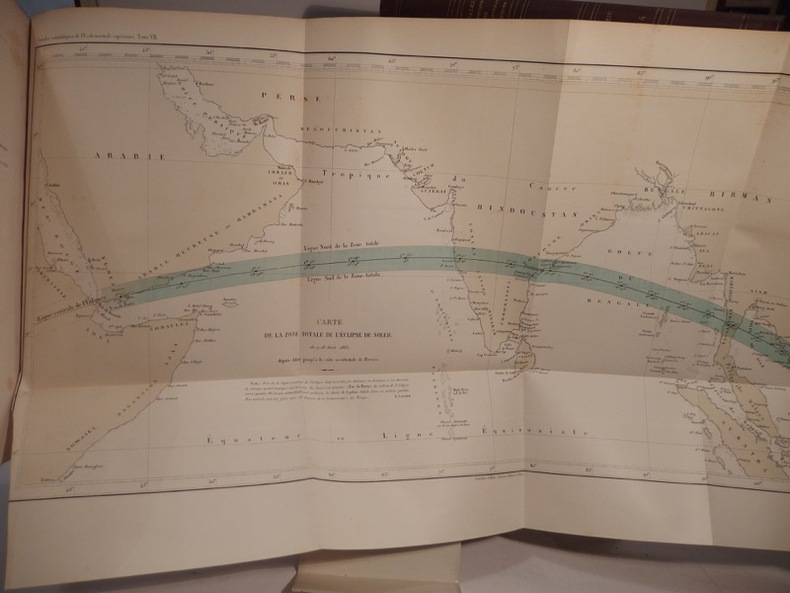
13592Paris, Gauthier-Villars, 1864-1884. 20 tomes in-4 reliés en 17 volumes, 39 planches dépliantes hors-texte (certaines en couleurs), quelques figures dans le texte, reliure de l'époque demi-basane, dos ornés (dos frottés, manques à quelques coiffes, rousseurs). Exemplaire du mathématicien Victor Puiseux (1820-1883), un des membres du comité de rédaction de la revue (notes de relieur).
184348262E. Michaud | Paris 1843 | 14.50 x 23.50 cm | relié
186489316A. Lacroix, Verboeckhoven & Cie | Paris 1864 | 14 x 22.8 cm | Relié
1892170181Boston: Estes and Lauriat 1892. The first uvres complètes The Holland Paper Edition number 463 of 500 sets the first collected edition to include all the romances travels poems and dramas. The volumes are "blessed with two hundred etchings and photogravures by French artists most of the plates being reproduced by Goupil and Company of Paris" the leading art dealership Kilgour p. 165. Diogène Maillart Georges Rochegrosse and Pierre-Georges Jeanniot are among the distinguished artists whose work is included. 30 vols octavo. Frontispieces 172 plates all with captioned tissue guards vignette title pages printed in red and black. Original brown straight-grain quarter morocco spines and front board lettered and decorated with l'aigle de drapeau in gilt brown boards top edge gilt others untrimmed. Spine ends occasionally bumped subsequent short splits affecting lettering in 2 cases small loss to vol. 6 headcap gilt bright contents clean. A near-fine set. Raymond L. Kilgour Estes and Lauriat a history 1872-1898 1957. hardcover
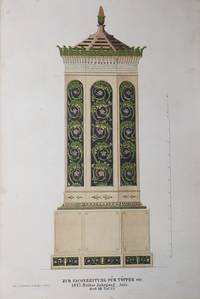
1847006823Leipzig: Böhme. Plates printed by Halle & Walther Weimar 1847. First Edition. Contemporary Half Green Calf. Marbled paper pastedown on boards. Very Good Minus. Complete three year run of Biedermeier period beautiful plate or illustration-oriented German decorative arts publication. Styles promoted include neo-classical Greek and Gothic Revival -- in other words the full range of styles associated with the Biedermeier period. While this was a German publication and Biedermeier was most tightly associated with the German-speaking world the designs shown here are very much in keeping with the designs coming out of other parts of Europe and America. 4to. 28.5 by 19 cm. 108 plates most of which are color plates depicting ovens urns bowls other porcelain ware mantels friezes cornices other ornament and architectural features. Explanations of the plates are pasted onto the backs of some of the plates several plate explanations running on a single sheet which is cut smaller than the plates. Plates are numbered in three series essentially. The plates were issued four at a time. Original wrappers bound in. The publication is scarce with no institutional copies found outside of Europe and all but two of these in Germany. The magazine was published concurrently or slightly later in Weimar by a different publisher. Condition: foxing throughout sometimes heavier in darkness. Binding worn along edges and marbling surface sometimes rubbed. Spine calf darkened. Böhme. Plates printed by Halle & Walther, Weimar unknown
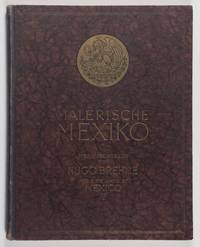
192354555Mexico City: Hugo Brehme Fotografia Artistica 1923. First edition & Original Photographs. Hardcover Photographs. Very good. Small Folio. xxvii pp. 197 plates. Original brown quarter leather over textured brown paper-covered boards with gilt emblem lettering and ruling on cover gilt lettering on spine. Brown endpapers. Title page with b/w emblem and black triple ruling. Foreword and text by Hugo Brehme. <br /> <br /> With descriptive table of photogravure plates published in the book following the text including photographic series on the capitol the capitol's surroundings volcanos the inner part of the country archaeology and the various ethnicities of Mexico. An attempt to enrich the vast number of publications on "the land of promise" as it was perceived in the early part of the century with a photographic survey presenting the beauty and cultural richness of Mexico its abundance and variety of settings ranging from tropic areas along its coasts to the regions of perpetual snow. This extraordinary collection of photographs is accompanied by an introductory text on Mexico. The photographs are taken from the vast collection of the editor and were available separately as art prints. Cover design by Max Krause Berlin. <br /> <br /> WITH<br /> <br /> 10 original photographs; eight signed and titled in negative one is stamped and titled on verso one just titled on verso. Three of them No. 1 2. and 3a below are reproduced in the publication in.<br /> <br /> 1. "285 El Pico de Orizaba" 10 3/4 x 13 3/4". Title and "H. Brehme Mexico Prop." manuscript annotations in lower left corner of print. Published. Small chips at three corners and slight creasing upper left and lower right corners.<br /> <br /> 2. Two photographs<br /> <br /> a "No. 5950. Mexico D.F. Parque de Chapultepec Hugo Brehme Mexico- Es propiedad" printed to lower right corner of photo. 11 3/4 x 9 1/2". Published. Minor wear along white frame and very light waving at left and right edges.<br /> <br /> b "No. 5832 Lago de Chapala Hugo Brehme Mexico- Es propiedad" as above 9 1/2 x 11 3/4". This spectacular photograph depicts a sail boat on Lake Chapala; not published. Very light wear in white edges photograph near fine.<br /> <br /> 3. Five Photographs 7 3/4 x 9 7/8". Photos b through d stamped Hugo Brehme Mexico D.F. with company address and copyright remark on upper left corner of versos. Photo described under a is blank on verso.<br /> <br /> a "1273 Los Volcanes desde el San Miguel" and Hugo Brehme company detail stamped to lower left and right corner. Published.<br /> <br /> b "220 La Piramide Del Sol San Juan Teotihuacan" printed to left "HBrehme Prop." to right lower corner. Showing a variant of the published photograph. Small light smudge at center of upper edge.<br /> <br /> c "No. 1897 El Desierto De Los Leones printed to left lower corner.<br /> <br /> d "17926 Cholula La Piramide" printed to lower left corner.<br /> <br /> e "252 El Pico de Orizaba" printed to lower left Brehme's company detail to right.<br /> <br /> 4. Two photos 5 x 7" without descriptors on image.<br /> <br /> a Orizaba volcano "74. Desde el San Miguel" in pencil at top left of verso Brehme company stamp in blue at lower left corner.<br /> <br /> b Mexican farmer crossing river on a mule carrying large basket with fruit. Penciled to verso the number 2359 and Oaxaca. Hugo Brehme 1882-1954 emigrated to Mexico in 1908. He established his photo studio "Fotografia Artistica Hugo Brehme" in 1912. He was successful for some forty years with photographs depicting rural Mexico scenic landscapes modern monuments and archeological sites. Brehme's photos were published in tourist guides magazines and on postcards. He was a mentor of noted Mexican photographer Manuel Alvarez Bravo. Hugo Brehme Fotografia Artistica hardcover