ZOLA (Emile).Livre Rare Book

6 559 résultats
187820819Paris Charpentier 1878 1 vol. Relié in-12, demi-maroquin rouge à coins bordé de filets à froid, dos plat à faux nerfs orné de deux caissons décorés de filets et guirlandes à froid avec cartouche central mosaïqué de maroquin vert, tête dorée, couvertures conservées, non rogné (René Kieffer), VII + 406 pp. Edition originale bien complète de l'arbre généalogique dépliant des Rougon-Macquart. Un des 100 exemplaires numérotés sur Hollande, seul tirage en grand papier (n°15), dans une agréable reliure signée d'inspiration art nouveau. Ex-libris Franchetti.
92Le roman lui plaît « infiniment », et d’abord « cette gaieté débordante, outrée, roulant comme un ruisseau après une pluie d’orage », puis ce « défilé de caboches extraordinaires » : « l’originalité est dans ce côté caricatural, dans le déhanchement des personnages, auxquels on ne demande plus dès lors un équilibre dont ils font fi eux-mêmes »… Il relève plusieurs scènes « très réussies, d’un grand relief », dont le mérite est dans « la vérité du document, qui se trouve sous les moindres détails ». L’auteur a dû connaître tous les personnages et toutes les scènes : « c’est à peine si vous avez inventé les transitions nécessaires. Rien ne remplace cela, la chose vue, surtout lorsqu’on la rend avec votre sincérité, votre crânerie qui ne recule devant rien. Ah ! vous n’y allez pas de main morte, dans les faits et dans les mots ! Jamais encore on n’avait si carrément vidé ses tripes et fait la bête à deux dos, comme dit Rabelais ». Cependant il critique la composition du roman : il n’y a ni relief, ni perspective, tout est sur le même plan, chaque épisode a la même valeur, et « on n’a plus qu’un défilé de pages, on n’a pas un tout. – Hein ? Suis-je assez Boileau et La Harpe ! ». Passant au style, il se fait « pion », et critique sévèrement « le mot incorrect inutile, l’épithète de couleur qui va contre l’image, la torture de chic imposée à la phrase, et qui la rend obscure ». La prose est factice, affectée. « Saint-Simon dégorgeait sa bile, sans mettre des malices dans son écriture (…).Tandis que vous, avec vos disloquements, vous vous fichez du public, vous faites des effets. – Je suis pour toutes les audaces, pour toutes les intensités ; mais je les veux en bronze, solides et impeccables, autant que franches et colorées ». Mais il voit là « un fameux bouquin de début. Dites à votre collaborateur que je vous trouve deux gaillards d’avenir (…). Travaillez et n’écoutez les conseils de personne : le travail seul doit achever de vous faire ».
188685002Reliure postérieure plein chagrin bleu. Dos à nerfs, date dorée au talon. Tête dorée. Couvertures et dos conservés. Reliure non signée de Devauchelle.
187183990Reliure demi-maroquin bordeauxà coins. Dos à nerfs finement décoré avec date dorée au talon. Tête dorée. Couverture et dos conservés. Reliure signée H. BLANCHETIÈRE. Salissures et quelques tâches à la couverture. Rousseurs éparses.
189381849Reliure demi-maroquin corail à coins. Dos lisse orné de losanges et de pointillés dorés et pièce de titre de maroquin noire. Toutes tranches dorées. Couverture et dos conservés. Non rogné.
188082008Reliure demi-maroquin marron à coins. Dos à nerfs orné de caissons dorés. Tête dorée. Couvertures conservées. Non rogné. Reliure signée Trioullet. Mors intérieur légèrement ouvert. Infimes frottements d?usage.
188286096Charpentier | Paris 1882 | 12.50 x 19 cm | relié
189983368Reliure demi-maroquin citron à coins (Fécondité), orange (Travail) et prune (Vérité). Dos à nerfs avec date dorée en queue. Tête dorée. Couverture couleur et dos conservés. Reliure signée Blanchetière-Bretault.
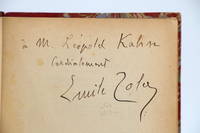
189284801Paris: Charpentier 1892. Fine. Charpentier Paris 1892 12.50 x 19 cm relié First edition. Half red morocco binding spine with five raised bands date gilt at foot restoration to head of one joint marbled paper boards endpapers and pastedowns of combed paper bookplate mounted at head of one pastedown top edge gilt contemporary binding. Occasional light foxing. A handsomely bound copy. Autograph inscription signed by Emile Zola to Léopold Kahn who was Calmann-Lévy's principal collaborator. Charpentier hardcover
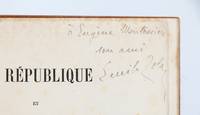
187987597Paris: Charpentier 1879. Fine. Charpentier Paris 1879 14 x 23 cm relié First edition on ordinary paper. Full tawny morocco binding spine with four raised bands set with black fillets bearing small stains at foot gilt fillet frame on burgundy morocco pastedowns brown watered silk endpapers following endpapers of marbled paper original wrappers preserved all edges gilt elegant signed binding by Georges Cretté. Scattered foxing covers marginally and lightly faded. Autograph inscription signed by Emile Zola to the painter and photographer Eugène Montrosier at the head of the title page. Charpentier hardcover
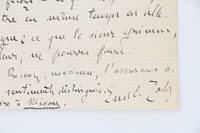
510490 Une lettre manuscrite de 12 lignes signée par Emile Zola, datée Paris 11 mars 1898, adressée à '' Mon cher confrère '. Feuillet double de format: 205mm x 130mm, papier vergé, petite trace de pli central horizontal. Lettre de remerciements à un confrère, écrite 2 mois après le '' J'accuse '', publié dans le quotidien L'Aurore, du 13 janvier 1898, et qui s'inscrit avant la réponse favorable du 2 avril à une demande de pourvoi en cassation de sa condamnation à un an de prison, et son départ pour l'exil vers l'Angleterre avant la fin du procès. Précieux document, on y relève ces très belles lignes: '' Mais il ne faut pas désespérer de la France, qui se retrouvera et qui donnera au monde la justice comme elle lui a donné la liberté ''
188785006Reliure demi-maroquin carmin à coins. Dos à nerfs, date dorée au talon. Tête dorée. Couvertures et dos conservés. Reliure signée Affolter.
163071 volume in-12° relié demi-chagrin à coins marron, tête dorée, dos lisse, auteur, titre et date (en queue) dorés, Couverture et dos conservés. Faux titre, titre et 598 p. - Un des 340 exemplaires numérotés (N°27) sur papier de Hollande. Édition Originale. Rome. Paris. Charpentier et Fasquelle. 1896. 1 volume in-12° relié demi-chagrin à coins marron, tête dorée, dos lisse, auteur, titre et date (en queue) dorés. Couverture conservée. Faux titre, titre et 751 p. - Un des 300 exemplaires numérotés (N°58) sur papier de Hollande. Édition Originale. Paris. Paris. Charpentier et Fasquelle. 1898. 1 volume in-12° relié demi-chagrin à coins marron, tête dorée, dos lisse, auteur, titre et date (en queue) dorés. Couverture conservée. Faux titre, titre et 608 p. - Un des 300 exemplaires numérotés (N°20) sur papier de Hollande. (Petite déchirure en marge inférieure de la couverture supérieure habilement restaurée). Édition Originale. Seul défaut notoire de cette belle série traces blanchâtres sur le chagrin. Sinon très bon état d’ensemble en reliure uniforme. Carteret. II, 492-493.
189076845Reliure postérieure demi-maroquin lavallière avec coins. Dos à nerfs avec date dorée en queue. Tête dorée. Couverture conservée. Non rogné. Petites taches sur les angles des pages 244-245.
189276911Reliure demi-maroquin marron à coins. Dos à nerfs orné de caissons dorés. Tête dorée. Couverture et dos conservés. Non rogné. Est ajouté in fine "Retour de Voyage, réponse au capitaine Tanera." Un des 40 exemplaires sur Hollande. Coins frottés.
188881650Reliure demi-maroquin corail à coins. Dos lisse orné de losanges et de pointillés dorés et pièce de titre de maroquin noire. Toutes tranches dorées. Couverture et dos conservés.
187981825Reliure demi-maroquin rouge à coins. Dos à nerfs avec date dorée au talon et caissons borde?s de multiples filets a? froid. Tête dorée. Couverture conservée. Reliure signée DEVAUCHELLE.
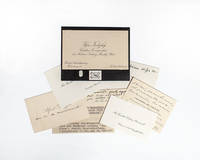
146844Rare collection of seven printed visiting cards. The collection includes: Alfred Dreyfus inscribed by him in ink "avec tous les remerciements" n.d. 2.25 inches by 3.8 inches; Colonel De Gaulle as Commandant le 507e Regiment de Chars inscribed by him in ink "Merci mon cher ami." n.d. but after December 1937 when he was promoted to Colonel 2.5 inches by 3.5 inches; Theodore Roosevelt at Sagamore Hill Oyster Bay L.I. inscribed by him in ink "Mr Roosevelt greatly regrets that he can not accede to your courteous request" n.d. 1.5 inches by 3 inches; Emile Zola at Rue de Bruxelles Paris inscribed by him in ink "Avec mon bien vifs remerciements" and dated in pencil in another hand "29 avril 1887" bearing collection label numbered '329' 2.5 inches by 4 inches; Mr. Theodore Delano Roosevelt at Forty-nine East Sixty-fifth Street n. d. 2 inches by 3.3 inches; Mrs. Franklin Delano Roosevelt Eleanor Roosevelt at the Executive Mansion n. d. 2.5 inches by 5 inches; Ilya Trotzky 'Redakteur-Correspondent der Moskauer Freitung 'Russkoje Slowo' at Berlin-Charlottenburg bearing collection label numbered '346' n.d. 2.6 inches by 4.3 inches. In near fine to fine condition with a closed tear to Theodore Roosevelt's inscribed card which has been expertly repaired slight scuffing to the top right corner of Dreyfus' card where it had been mounted by a previous owner. Accompanied by a typed information card about Ilya Trotzky's card. Visiting cards also called calling cards were small decorative cards carried by individuals to present themselves to others in the 18th and 19th centuries. It was a common practice among the upper classes to leave a visiting card when making a social call at their house or workplace. unknown
1890RFERPAG00twCirca 1890. Very Good. Ferris Jean Leon Gerome. Page of Love. 20 framed prints of watercolors by Jean Leon Gerome Ferris for Emile Zola's novel Une Page d'Amour. Zola Emile. NP: NP Circa 1890. 10x15 cm images in 29x34 cm frames. Framed illustration prints. Book condition: Very good. 20 delicate watercolors depicting scenes from Zola's novel. Beautifully reproduced and matted in buff and moss green in gold-painted wooden frames. Jean Leon Gerome Ferris 1863-1930 was an American painter. unknown
1867314779Paris 1867. In French. 1 page. 8vo. Faint soling remnant of mounts to verso at corners. In French. 1 page. 8vo. Regarding his first major novel. Zola writes that he has rewritten the beginning of Un marriage d'amour requesting that proofs be sent soon that he convey to Arsène Houssaye thanks for proposing to advertise the novel's publication suggesting that the work be published in two installments and in a postscript adding: "It is understood that Mr. Houssaye has in his hand half the novel. I will send him the balance around August 20th." "Un marriage d'amour" was published serially in Houssaye's review "L'Artiste" in the summer and fall of 1867. It appeared in book form later that year under the title Thérèse Raquin and is considered Zola's first major novel. Published: Émile Zola Correspondance XI eds. Morgan and Speirs Montréal-Paris: Les Presses de l'Université de Montréal & CNRS Éditions 2010 47-48 unknown books
1871elala172Paris Brussels : Librairie Internationale A.Lacroix Verboeckhoven Et Cie. 1871. 1871. 18mo. pp. 360. A fine copy untrimmed in original printed wrs. preserved in slipcase with morocco-backed chemise. First Edition issue with publication date 1872 on front wrapper. There was no limited issue on large paper. Variously translated into English as The Rush for the Spoils The Hounds Fee and more recently The Kill La Curée is the scarce second novel from Zolas great twenty-volume Rougon-Macquart series the chief monument of the French Naturalist Movement which explores the scientific theme of the determing influence of heredity on character. The book was immediately censored upon publication. Vicaire VII 1202. 1st Edition. Soft cover. Fine. Paris, Brussels : Librairie Internationale, A.Lacroix, Verboeckhoven Et Cie., 1871. Paperback
19090008050LOS ANGELES CALIFORNIA. Good. 1909. On offer is an outstanding travel journal written by a young girl in California in the early years of the 20th century. This well-written journal measures 9.25 inches by 7.5 inches and contains 60 pages. It is 60% complete. The cover and pages are in good condition and the handwriting is legible and quite easy to read. Also included is a black and white photograph a map/itinerary and a number of newspaper clippings - all in very good condition. The author is Zola Grace Strawser a 14 year old school girl. Born in 1895 she grew up in Los Angeles where her father Bert was a successful businessman. She had 3 sisters - Nellie Merle and Bertie. Casual research has not discovered any additional biographical information. In July of 1909 she left on a long train trip from Los Angeles to the Worlds Fair in Seattle. Along the way she makes stops in Las Vegas and Salt Lake City amongst other places. She is a keen observer and her descriptions are detailed and well-written. "The train slowly pulled out of the Salt Lake City Station and our long hoped for journey began. Nellie Merle Bertie Papa and Daisy Clark were there to say "goodbye." Daisy Clark gave us our first box of candy and also a beautiful bunch of carnations. The ride to Pomona was not so interesting as we made so many trips to San Bernardino before. Our next stop was Ontario. From Ontario you have a very beautiful view of the mountains which is very interesting. We next passed through Riverside and Coulton and arrived in San Bernardino 12:12. Between Los Angeles and San Bernardino can be seen orange trees and mountains while from San Bernardino is a vast stretch of desert. We then went to lunch and from the window you could see right down between the mountains on which were some snow. I saw an automobile filled with men and for a long time had great fun waving back and forth. They at last got ahead of us. We had to go so slow up a high incline . the rest of the landscape was desert desert desert. ." July 8. In Salt Lake City she visited a number of sites: ". we saw all the important buildings the temple tabernacle the Lion House Bee Hive grave of Brigham Young and the "Eagle Gate" July 9. She goes out to visit Saltair - an amusement park and resort built at the south end of Great Salt Lake. At one time Saltair was the largest and most popular family resort west of New York. Today it is abandoned a victim of shrinking water and the ravages of a changing climate. Each day's entry is accompanied by a small pen and ink drawing representing some remark in the entry. She writes an excellent description of a wedding accompanied by a drawing of wedding bells and music notes and the inscription "No Wedding Bells For Me.: "THE WEDDING: Talk about your presents you ought to have seen Bessie's. Cut glass china silverware well it was enough to make anyone wish it was them getting married. She also received four chairs three tables bedding and linen. The few people assembled to see her married arrived about half past seven. Bessie who was naturally nervous broke right down and cried but as soon as the ceremony was over she was as happy as a lark and was receiving many congratulations. Well while we are waiting for the guests to arrive I will describe the appearance of the house. The rooms were all decorated in carnations roses ferns palms and small trees. On the electric lights were twined smilax and over the globes were different color flower shades. The long porch was made beautiful with small green palms and at the father end a Hawaiian orchestra played the whole evening. The yard which was very large was strung with lanterns of all manner and shapes. There was a wall of canvas all around so as to keep intruders out. The guests have now arrived and the air was sweet with lavender and violet perfume. Ladies with low neck chiffon dresses; with white satin evening coats; ladies with the tight fitting empire ladies in simple white ladies in red pink blue and every imaginable color. In the evening lunch was served and while the bride and groom were eating they threw handfuls of rice at them. Of course their dinner was spoilt and they had to get more dinner. About an hour after the bride and groom were missed and the whole party set out to look for them. The bride was found and the girls who were quite rough drew her across the bed and a hat pin stuck in her and hurt her. Mrs. Brook fought them and Bessie got free again and escaped in the crowd and hid in the cellar. She was so scared and sick that she could hardly stand. She then slipped in the back bedroom and changed her wedding dress for her brother's clothes. There she slipped in the automobile barn until the crowd had gone around the front and slipped over the fence and went in the house next door and mingled with the crowd who did not know her dressed as a boy. Cora the girl next door put on a long black coat and put something over her head. Her brother was waiting in a buggy outside. With one jump Cora was in the buggy and was driving away as fast as possible. The whole party thought it was Bessie and Vic and started after the buggy. Cora's brother had heart trouble and when they were about a block away he fainted and Cora had to drive home with her brother in her arms. When she reached home she fainted and they had an awful time. Of course the crowd found it was not the bride and groom. The bride and groom left for the canyon 20 min. to one. While all the excitement was going on the groom was next door asleep." July 14. After a number of adventures she continues her trip to Seattle and the World's Fair: "In the morning Irene mother and I went to the fairgrounds. I can't very describe how they look only by showing you postcards. They have an imitation geyser which goes up and down all the time. "The Cascades" are simply beautiful. You can stand at the top and look right over the falls and the geyser and see Mt. Rainier. The buildings are all white and the flowers are beautiful. In the evening we went to a show and saw the smallest woman in the world "Princess Checita" July 31. We again went to the fair and visited many buildings. Our feet were just covered with blisters from all the walking up the hills. Mama isn't feeling well. She is lonesome for papa. Aug 1 "As this was to be our last day at the fair we visited all the buildings we had not seen before. In the government building were articles from the "Dead Letter Office." Skulls snakes a pig's tail money jewelry a bustle the hair of a woman who had been scalped guns swords and all manners of weapons beads small funny statues locks of hair old books and dirty table covers pencils and everything imaginable. We had a nice time at the fair and had our pictures taken several times."Aug 6. Before they return to Los Angeles they travel up to Portland on August 8th and on the 9th take a boat trip up the Columbia River all the way to The Dalles. There are two brochures included from this trip and two pages of wonderful descriptions. On Aug 11th they board their train for their return trip. She arrived back in San Francisco on Aug 12th and met her father the next day: ". In the evening we took dinner at the Cafe Bismark a German-influenced restaurant in San Francisco in the 1900s. It was called "the largest and finest café in the city." and then went to the Orpheum a long-vanished vaudeville theatre. After the theatre we met papa on his way to Chicago. Aug 13. Her trip ends when she reaches home on Aug 17th. Following her account of the trip are 4 pages with some notes made in 1910 and 1911. "Nellie and I gave a masquerade party" Dec 3 1910 "Merle Bertie and Mother and I start for Catalina to spend the month."Aug 3 1911. A historian looking at the early history of California would find this journal simply rich in local detail. The descriptions are excellent and her keen eye misses nothing. There are interesting observations about the towns she visits and the people she encounters. It is clear that she comes from a well-to-do family and this would be an interesting contrast to the majority of people living in California at this time.; Manuscript; 4to - over 9¾" - 12" tall; KEYWORDS: HISTORY OF EARLY 20TH CENTURY 1900S PROGRESSIVE ERA UNITED STATES CALIFORNIA LOS ANGELES ZOLA GRACE STRAWSER; BERT STRAWSER; ACME LAUNDRY; SAN BERNARDINO; SEATTLE WORLD FAIR 1909 BISMARK CAFE; ORPHEUM THEATRE DEAD LETTER OFFICE DLO TRAVEL JOURNALS TRAVEL BY RAIL EXPOSITIONS FAIRS TRAIN JOURNEYS TRAIN TRIPS WEDDING CEREMONIES BLACK AND WHITE PHOTOS MAPS DRAWINGS SOCIAL HISTORY AMERICANA HANDWRITTEN MANUSCRIPT DOCUMENT LETTER AUTOGRAPH WRITER HAND WRITTEN DOCUMENTS SIGNED LETTERS MANUSCRIPTS DIARY DIARIES JOURNALS PERSONAL HISTORY SOCIAL HISTORY HISTORICAL HOLOGRAPH WRITERS AUTOGRAPHS PERSONAL MEMOIR MEMORIAL ANTIQUITÉ CONTRAT VÉLIN DOCUMENT MANUSCRIT PAPIER ANTIKE BRIEF PERGAMENT DOKUMENT MANUSKRIPT PAPIER OGGETTO D'ANTIQUARIATO ATTO VELINA DOCUMENTO MANOSCRITTO CARTA ANTIGÜEDAD HECHO VITELA DOCUMENTO MANUSCRITO PAPEL . hardcover
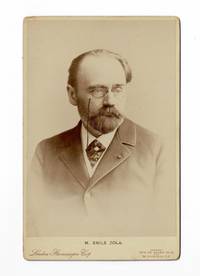
190073358Londres London: London Stereoscopic Company 1900. Fine. London Stereoscopic Company Londres London 1900 10.70 x 16.60 cm une photographie au format carte cabinet Handsome original photographic portrait of Emile Zola in cabinet card format period print on albumen paper mounted on cardboard from the London Stereoscopic Company and taken by an unidentified photographer. The writer poses there rosette of the Legion of Honor at his buttonhole. Condemned for defamation after the publication of his famous ""J'Accuse!"" on the front page of L'Aurore and to escape prison Zola secretly fled to London on July 18 1898. On July 26 1898 the Legion of Honor was withdrawn from him. A snub to this France that did not understand him this ""rosette"" photograph was most likely taken after his removal from the order of the Legion of Honor. Exceptional state of conservation. London Stereoscopic Company unknown
188379106Bénodet 1883. Fine. Bénodet 10 septembre 1883 13.20 x 20.30 cm 2 pages sur un double feuillet Signed autograph letter by Emile Zola - apparently unpublished - addressed to an unknown correspondent written in black ink on a double sheet. Folds inherent to mailing. Interesting letter relating the translation of Emile Zola's works and the legal disputes inherent to their clandestine distribution. This missive is visibly addressed to a correspondent considered for the German translation of La Joie de vivre: ""I would ask you to give me the promptest possible response regarding the translation of La Joie de vivre; for I am already receiving proposals from Germany and I would like to know where I stand."" In this autumn of 1883 Zola - though vacationing in Brittany - is very occupied with managing the translation of his works which he handles directly with publishers. We see here the determination with which he conducts negotiations: ""I repeat that I will only accept a fixed sum paid in advance. It is simpler and without possible surprises."" But things are not simple and Zola whose works already enjoy great success must fight against the clandestine publication of his novels. Completely overlooked by biographers the disputes with Hungarian publisher Gustav Grimm are nonetheless a leitmotif of Zolian correspondence: ""Monsieur Grimm of Budapest is a simple thief who has my novels translated as they are published in French newspapers without any authorization. Already the Neue Freie Presse of Vienna has sued him in my name. But it appears we have no treaty with Hungary. I await the signing of a treaty which they say is imminent."" Indeed Grimm had already published without Zola's authorization German translations of two novels: Nana 1881 and Pot-Bouille Der häusliche Herd 1882. These illegal publications discouraged German publishers Curt Busch and George Kuhr who very interested in distributing the novel to German-speaking readers declared forfeit. Gustav Grimm who finally agreed to respect commercial treaties won the battle and published the very first German translation of La Joie de vivre in 1889 under the title Die Lebensfreude. The man whom Zola here calls a ""simple thief"" would finally obtain authorization to distribute the German translation of the entirety of the twenty volumes of the Rougon-Macquart between 1892 and 1899. Interesting letter revealing the editorial mechanisms of the Rougon-Macquart and testifying to the ardor with which Zola conducted negotiations inherent to the translation of his great hereditary fresco. unknown
1878D1854Paris: G. Charpentier 18781880 1881. Hardcover. Very Good. Three volumes. "Roman Experimental" and "Le Naturalisme" are inscribed by Zola. Decorative fabric over cloth gilt-stamped lettering in leather spine labels. Spine tips and corners gently bumped and a little frayed otherwise a lovely little set. <br/><br/> G. Charpentier hardcover books