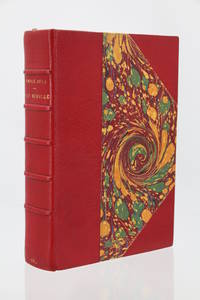
6 559 résultats
186452158J. Hetzel & A. Lacroix | Paris 1864 | 11 x 18 cm | relié
188087792Benque & Cie | Paris s.d. (ca 1880) | 10.50 x 16.50 cm | une feuille
20184482018 Paris, Alphonse Derenne puis Richard Lesclide, 20 décembre 1875-3 juin 1877 ; 55 num. en 5 vol. in-8, bradel demi-toile indigo, couvertures de livraison conservées, étui commun (reliures modernes).
23407Paris, A. Lacroix, 1871. In-8, 360 pp., maroquin rouge d'Huser, filets dorés en encadrement sur les plats, dos à nerfs orné de caissons dorés, doublure de maroquin gris à encadrement de maroquin rouge, gardes de soie moirée, tranches dorées, couverture conservée (couverture empoussiérée).
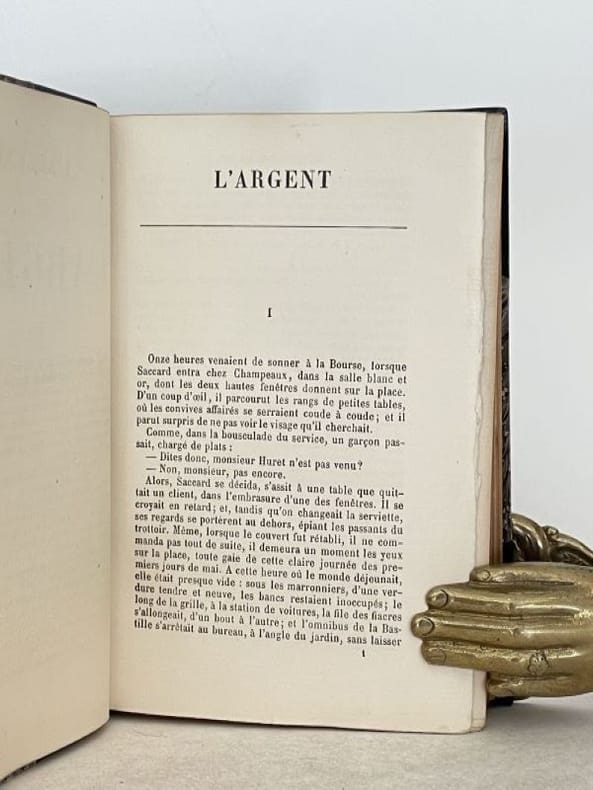
1891116382Paris Bibliothèque-Charpentier 1891 1 vol. relié in-12, demi-maroquin bleu nuit à coins bordé d'un filet doré, dos à nerfs soulignés de pointillés dorés, double filet doré en encadrement des caissons décorés d'entrelacs, guirlandes et fleurons dorés, tête dorée, couvertures et dos conservés, non rogné (Bernasconi), 445 + 14 pp. (extrait du catalogue de l'éditeur). Edition originale. Un des 250 exemplaires numérotés sur Hollande (n°248). En belle condition dans une parfaite reliure signée, avec trois ex-libris gravés (Richard Anacréon, J.C.F. Jacobi et A.B.).
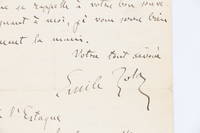
187779046L'Estaque - Marseille Marseille 1877. Fine. L'Estaque - Marseille Marseille 22 septembre 1877 13.30 x 20.80 cm 3 pages 1/2 sur un double feuillet Autograph letter signed by Emile Zola addressed to Louis-Edmond Duranty written in black ink on a double leaf. Some deletions and corrections; folds inherent to postal transmission. This letter has been transcribed in the complete correspondence of Emile Zola published by the CNRS and the Presses of the University of Montreal. Long letter evoking the heat wave at L'Estaque Une page d'amour and Edouard Manet. ""Il y a quatre mois que nous sommes ici et je vous avais promis de vous écrire. Mais j'ai tant travaillé et j'ai eu si chaud que vous m'excuserez de mon apparente paresse. Imaginez-vous que jusqu'au 15 août la température a été très agréable ; il faisait beaucoup moins chaud qu'à Paris et nous respirions chaque soir une brise de mer délicieuse. Puis voilà que brusquement lorsque je nous croyais hors de toutes mauvaises plaisanteries de la chaleur le thermomètre est monté à 40 degrés et s'y est maintenu nuit et jour. Nous avons ainsi passé deux semaines intolérables. Aujourd'hui la fraîcheur est revenue et nous allons rester jusqu'aux premiers jours de novembre pour jouir des charmes d'un bel automne."" ""We have been here for four months and I had promised to write to you. But I have worked so much and have been so hot that you will excuse my apparent laziness. Imagine that until August 15th the temperature was very pleasant; it was much less hot than in Paris and we breathed each evening a delicious sea breeze. Then suddenly when I thought we were safe from all the nasty tricks of the heat the thermometer rose to 40 degrees and stayed there night and day. We thus spent two unbearable weeks. Today the coolness has returned and we will stay until the first days of November to enjoy the charms of a beautiful autumn."" In this summer of 1877 Zola left the tumultuous capital for a five-month stay at L'Estaque ""banlieue de Marseille"" ""suburb of Marseille"" in the company of his wife Alexandrine and his mother Emilie Aubert. This long southern interlude reminded him of his youth in Aix: ""Je suis d'ailleurs enchanté de mon été. Les pays est splendide et me rappelle toute ma jeunesse."" ""I am moreover delighted with my summer. The country is splendid and reminds me of all my youth."" ""Pour finir avec moi j'ajouterai que j'ai travaillé vigoureusement à mon roman sans pourtant l'avancer autant que je l'aurais voulu. Ce roman doit paraître dans le Bien Public à partir du 14 novembre. J'en serai quitte pour donner encore un vigoureux coup de collier à Paris."" ""To finish with myself I will add that I have worked vigorously on my novel without however advancing it as much as I would have liked. This novel must appear in the Bien Public starting November 14th. I will have to give another vigorous push in Paris."" The new novel in question here is Une page d'amour whose plot and style contrast completely with the previous volume of the Rougon-Macquart: ""Je ne sais vraiment pas ce que vaut mon travail. J'ai voulu donner une note absolument opposée à celle de L'Assommoir ce qui me déroute parfois et me fait trouver mon roman bien gris. Mais je vais tout de même bravement mon chemin. Il faudra voir."" ""I really don't know what my work is worth. I wanted to give a note absolutely opposite to that of L'Assommoir which sometimes disconcerts me and makes me find my novel quite gray. But I am nonetheless bravely going my way. We will have to see."" But this ""page of love"" conceals another and during this stay in the Marseilles furnace Emile Zola was already thinking about the following volume: ""What is simmering in his southern pot is nothing less than a new bomb. Not Une page d'amour: 'it is a work too gentle to excite the public.' But Nana is already announced: 'I dream here of an extraordinary Nana. You will see that.' letter to Marguerite Charpentier of August 21 1877"" Henri Mitterrand Zola Even t unknown
188279109Médan 1882. Fine. Médan 16 novembre 1882 13.60 x 21.40 cm 2 pages sur un double feuillet - enveloppe jointe Autograph letter signed by Emile Zola - apparently unpublished - addressed to Léon Carbonnaux written in black ink on a double sheet. Folds inherent to mailing. Envelope included. Important testimony to the colossal documentation work and the capital role of Emile Zola's informants in depicting his immense natural and social fresco. This letter was sent to Léon Carbonnaux department head at Bon Marché who transmitted precious information to Emile Zola for the creation of the eleventh volume of the Rougon-Macquart series: Au Bonheur des Dames. Only two letters from Léon Carbonnaux to Emile Zola are known: they can be consulted in the digitization of the preparatory file for Bonheur des Dames made available online by the Bibliothèque nationale de France. However we know thanks to this same file which contains a long section entitled ""Notes Carbonnaux"" that this department head at Bon Marché provided a significant amount of information to Zola particularly about employee customs and their remuneration. The two men undoubtedly met when Emile Zola eager for information about the functioning of department stores conducted field research in February and March 1882. ""J'ai pris l'inventaire comme cadre à un de mes chapitres. D'ailleurs je n'ai spécialement besoin que du travail dans le rayon des confections et dans le rayon des soieries. Il est inutile de me renseigner sur les autres rayons."" ""I have taken the inventory as the framework for one of my chapters. Moreover I specifically only need the work in the ready-to-wear department and in the silk department. It is unnecessary to inform me about the other departments."" Thanks to this important letter we understand that it was Léon Carbonnaux who provided the essential information to Emile Zola for writing his very beautiful eleventh chapter devoted to the inventory: ""Vous avez eu l'obligeance de me donner certains détails sur l'inventaire. Vous m'avez dit qu'on choisissait le premier dimanche d'août qu'on fermait les portes et que tous les employés s'y mettaient. On vide toutes les cases n'est-ce pas on jette les marchandises sur les comptoirs ou à terre et l'inventaire n'est terminé que lorsqu'il n'y a plus absolument rien en place."" ""You were kind enough to give me certain details about the inventory. You told me that the first Sunday in August was chosen that the doors were closed and all the employees set to work. All the compartments are emptied aren't they The merchandise is thrown onto the counters or on the ground and the inventory is only finished when there is absolutely nothing left in place.""The final version of Bonheur des Dames contains all the precious information provided by the department head of Bon Marché: ""Le premier dimanche d'août on faisait l'inventaire qui devait être terminé le soir même. Dès le matin comme un jour de semaine tous les employés étaient à leur poste et la besogne avait commencé les portes closes dans les magasins vides de clientes. . Neuf heures sonnaient. . Dans le magasin inondé de soleil par les grandes baies ouvertes le personnel enfermé venait de commencer l'inventaire. On avait retiré les boutons des portes des gens s'arrêtaient sur le trottoir regardant par les glaces étonnés de cette fermeture lorsqu'on distinguait à l'intérieur une activité extraordinaire. C'était d'un bout à l'autre des galeries du haut en bas des étages un piétinement d'employés des bras en l'air des paquets volant par-dessus les têtes ; et cela au milieu d'une tempête de cris de chiffres lancés dont la confusion montait et se brisait en un tapage assourdissant. Chacun des trente-neuf rayons faisait sa besogne à part sans s'inquiéter des rayons voisins. D'ailleurs on attaquait à peine les casiers il n'y avait encore par terre que quelques pièces d'étoffe. La machine devait s'échauffer si l'on voulait finir le soir même. unknown
1888334721888. Fine. 1888 27 x 35 cm autre Oil on wood signed lower right This original work was used to illustrate a scene from The Earth in the first illustrated edition of Emile Zola's work published by Marpon & Flammarion in 1889. unknown
1888334731888. Fine. 1888 27 x 35 cm autre Oil on wood signed lower right This original work was used to illustrate a scene from The Earth in the first illustrated edition of Emile Zola's work published by Marpon & Flammarion in 1889. unknown
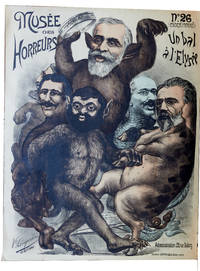
190080343Paris: Imprimerie Lenepveu 1900. Fine. Imprimerie Lenepveu Paris s. d. mai 1900 49.80 x 65.20 cm une affiche Musée des horreurs Original colour lithographed poster n° 26 exceptionnel Un bal à l'Elysée Imprimerie Lenepveu Paris May 1900 498 x 652 cm one poster Original colour lithographed poster depicting Émile Loubet as a bear holding a tambourine marked Panama Émile Zola as a pig Dreyfus as a hydra Joseph Reinach as a monkey the rabbi Kadoc Kahn as a donkey and Georges Picquart as a dromedary. This imposing poster featuring several people already caricatured in the previous issues is a direct reference to the Panama Scandal. This large-scale corruption affair which saw the resignation of Émile Loubet then Minister of Finance is re-referred to here because of the Judaism of some of is protagonists. It is Drumont through his magazine La Libre Parole who revealed the Panama Scandal denouncing the alleged alliance between the secular Republic and the Jewish high bank and thus contributing to the strengthening of the stereotype of the Jew eager for money: The deputy Joseph Reinach cousin and son-in-law of the baron Jacques de Reinach compromised in the scandal focuses the hatred of the polemicist. A republican close to the business world a free thinker Reinach is undoubtedly with Alphonse de Rothschild the man most attacked by the anti-Semites of the time. His wealth the vast networks of influence available to him his early involvement with Gambetta the memory of his campaigns against Boulangism and his equivocal role in the Panama affair make him the man to slaughter in order to return France to the French. Grégoire Kauffmann Rothschild & Cie. La bourgeoisie juive vue par Édouard Drumont in Archives Juives 2009 As for Émile Zola his novel L'Argent published in 1891 denounces the misappropriation of this financial scandal but his support for Alfred Dreyfus earned him his place in this nightmarish animal circle. Circulated between October 1899 and December 1900 in a France set ablaze by the Dreyfus Affair these immense colour portraits are the work of Victor Lenepveu who announced the publication of 150 and then 200 drawings before finally producing only around fifty. Despite the 1881 law on the freedom of press allowing the dissemination of a politically subversive image the publication of this nightmarish pantheon was interrupted by order of the Ministry of the Interior. The fragility of the paper and the imposing size of these very violent posters as well as their almost immediate seizure by the police contributed to the disappearance of these caricatures which strongly left a mark on public opinion. These horreurs were widely promoted by anti-Semitic newspapers that announced a fantasised print of 300000 copies thus insinuating the success of anti-Semitic ideas in the population. On 1st October 1899 L'Intransigeant announced the publication of the Musée des horreurs in its columns: Un dessinateur de beaucoup d'esprit au coup de crayon d'un comique intense M. V. Lenepveu a eu l'heureuse idée d'inaugurer une série de portraits des vendus les plus célèbres de la tourbe dreyfusarde. Le titre de cette série « Musée des Horreurs » est suffisamment suggestif et indique bien ce qu'il promet. . C'est la maison Hayard qui mettra en vente à partir d'aujourd'hui le numéro 1 de cette désopilante série. An artist of great spirit with an intense comical pencil stroke M. V. Lenepveu had the happy idea of inaugurating a series of portraits of the most famous sellouts of the Dreyfusard rabble. The title of this series Musée des Horreurs is sufficiently suggestive and is a good indicator of what it promises. . It is Maison Hayard that will put up for sale from today issue number 1 of this hilarious series. First a peddler then a bookseller-publisher Napoléon Hayard known as Léon Hayard specialised in the marketing of anti-Dreyfusard and anti-Semitic ephemera and advertisem Imprimerie Lenepveu unknown
189085016Reliure demi-maroquin vermillon à coins. Dos à nerfs, caissons ornés, date et éditeur dorés au talon. Tête dorée. Exemplaire à grands témoins. Couvertures et dos conservés. Bien complet des pages de catalogue éditeur in fine. Reliure signée Yseux sr de Thierry-Simier.
188279108Médan 1882. Fine. Médan 23 juin 1882 13.40 x 21.60 cm 1 page 1/2 sur un double feuillet - enveloppe jointe Autograph letter signed by Emile Zola - apparently unpublished - addressed to Léon Carbonnaux written in black ink on a double sheet. Folds inherent to mailing. Envelope included. Important testimony to the colossal documentation work and the capital role of Emile Zola's informants in depicting his immense natural and social fresco. This letter was sent to Léon Carbonnaux department head at Bon Marché who transmitted precious information to Emile Zola for the creation of the eleventh volume of the Rougon-Macquart series: Au Bonheur des Dames. Only two letters from Léon Carbonnaux to Emile Zola are known: they can be consulted in the digitization of the preparatory file for Bonheur des Dames made available online by the Bibliothèque nationale de France. However we know thanks to this same file which contains a long section entitled ""Notes Carbonnaux"" that this department head at Bon Marché provided a significant amount of information to Zola particularly about employee customs and their remuneration. The two men undoubtedly met when Emile Zola eager for information about the functioning of department stores conducted field research in February and March 1882. This response would therefore be the very first that the writer addressed to the department head in reply to his letter of June 19 1882. Far from imagining the keen success that this new novel would achieve Zola even seems to take it lightly: ""Je désire simplement toucher au sujet dans mon livre pour le besoin du petit drame commercial qui me sert de fable. Vos notes sont excellentes. . Enfin me voilà au travail. Le sujet est à la fois bien vaste - et bien ingrat pour un roman. On devra me tolérer un peu de fiction car il faut bien que je passionne la matière. Mais je tâche de m'en tenir le plus strictement possible à mes notes."" ""I simply wish to touch on the subject in my book for the needs of the little commercial drama that serves as my fable. Your notes are excellent. . Finally here I am at work. The subject is both very vast - and very thankless for a novel. One will have to tolerate a bit of fiction from me for I must make the material passionate. But I try to stick as strictly as possible to my notes."" It must be said that Carbonnaux takes his role as informant very much to heart and having no doubt about the book's success he writes: ""Dans le bâtiment chez nous d'ailleurs partout on attend votre livre. Les lecteurs ne vous manqueront pas. Soyez-en sûr. Vous n'en êtes plus à compter les succès celui-là s'annonce comme devant dépasser les autres."" letter of June 19 1882 For another work on the same subject has just appeared: ""J'ai lu le volume de Pierre Giffard. Il me paraît comme vous injuste et même faux dans plusieurs parties. C'est bâclé. Il aurait fallu pour un pareil ouvrage de documents purs une entière exactitude. Moi qui écris une uvre d'imagination je ne me permettrai pas de tels écarts."" ""I have read Pierre Giffard's volume. It seems to me like you unjust and even false in several parts. It is hastily done. For such a work of pure documents complete accuracy would have been necessary. I who write a work of imagination would not allow myself such deviations.""It was Carbonnaux who had pointed out the work to Zola: ""Pierre Giffard du Figaro vient de faire paraître chez Havard un vol de 300 pages intitulé « Les Grands bazars de Paris ». . On sait que le Figaro est inféodé au Louvre magasin concurrent au Bon Marché & on peut assurer que ce livre a été commandé et bâclé dès que votre intention de traiter le même sujet a été connue. . Il fallait déguiser un peu la réclame pour le Louvre."" letter of June 19 1882 We can clearly see here how much department stores fascinate and we understand the immense success that this novel by Zola describing their advent and supremacy would achieve. unknown
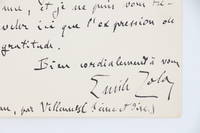
188879098Paris 1888. Fine. Paris 11 février 1888 13.20 x 20.50 cm 2 pages sur un double feuillet Autograph letter signed by Emile Zola addressed to Henry Fouquier written in black ink on a bifolium. Usual folds from mailing. This letter was transcribed in the complete correspondence of Emile Zola published by the CNRS and the Presses de l'Université de Montréal. A fine letter evoking La Terre and Tolstoy's The Power of Darkness. Henry Fouquier 1838-1900 was a literary critic and columnist for numerous newspapers. A close friend of Guy de Maupassant he supported Emile Zolas candidacy for the Académie française. This letter was written to him the day after the performance of Tolstoy's The Power of Darkness at the Théâtre-Libre. We have not found evidence of an article in which the journalist explicitly drew a parallel between the Russian drama and Zolas La Terre but Zola here addresses his thanks: « Merci mon cher Fouquier de ce que vous voulez bien dire de « la Terre » si attaquée. J'en suis touché vivement et croyez à toute ma gratitude. » It must be said that the fifteenth volume of the Rougon-Macquart cycle was harshly received unleashing passions from the moment of its serial publication in Gil Blas. On 18 August 1887 even before the conclusion of the novel was revealed to the public Le Figaro published the Manifeste des Cinq written by Paul Bonnetain J.-H. Rosny Lucien Descaves Paul Margueritte and Gustave Guiches. These young authors issued a severe verdict: « La Terre a paru. La déception a été profonde et douloureuse. Non seulement l'observation est superficielle les trucs démodés la narration commune et dépourvue de caractéristiques mais la note ordurière est exacerbée encore descendue à des saletés si basses que par instants on se croirait devant un recueil de scatologie : le Maître est descendu au fond de l'immondice. . Nous répudions ces bonshommes de rhétorique zoliste ces silhouettes énormes surhumaines et biscornues dénuées de complication jetées brutalement en masses lourdes dans des milieux aperçus au hasard des portières d'express. De cette dernière uvre du grand cerveau qui lança L'Assommoir sur le monde de cette Terre bâtarde nous nous éloignons résolument mais non sans tristesse. Il nous poigne de repousser l'homme que nous avons trop fervemment aimé. » Zola who had been developing the idea of a peasant novel for a decade was deeply affected. Though he never responded publicly to these accusations his correspondence is strewn with clarifications about the work whose sheer brutality alone seemed to occupy readers minds: « Mais vous ajoutez que notre thèse à Tolstoï et à moi est la même et peut se résumer en ceci : le travail de la terre est corrupteur. Tolstoï il me semble protesterait bien haut et quant à moi je vous affirme que je n'ai jamais voulu prouver une telle chose radicalement fausse à mon avis. Ce que je pense c'est que la petite propriété telle qu'elle existe chez nous c'est que la suite de faits sociaux qui ont abouti à notre forme sociale nous ont donné notre paysan d'aujourd'hui avec ses qualités et ses vices. Notre paysan est le prisonnier de sa terre et non l'homme libre qu'il devrait être. Comment voulez-vous qu'il n'y étouffe pas dans son ignorance et sa passion unique Labourer est très sain mais à la condition qu'on sera le maître de son champ au lieu d'en être le forçat. Je me suis exténué à faire sortir cette vérité de mon livre si l'on ne m'a pas compris la faute en est sans doute à moi. » A remarkable letter from the master of Naturalism shedding new light on one of the most brutal volumes of the Rougon-Macquart series. unknown
187583515Paris: Charpentier & Cie 1875. Fine. Charpentier & Cie Paris 1875 11 x 17.50 cm relié First edition of which no copies were printed on deluxe paper. Half red shagreen binding smooth spine decorated with triple gilt fillets gilt roll at foot marbled paper boards marbled paper endpapers and pastedowns rubbed corners contemporary binding. Some light foxing. A fine and very rare copy. Charpentier & Cie hardcover
187181820Reliure demi-maroquin rouge à coins. Dos à nerfs avec date dorée au talon et filets à froid. Tête dorée. Couverture conservée. Reliure signée Semet & Plumelle.
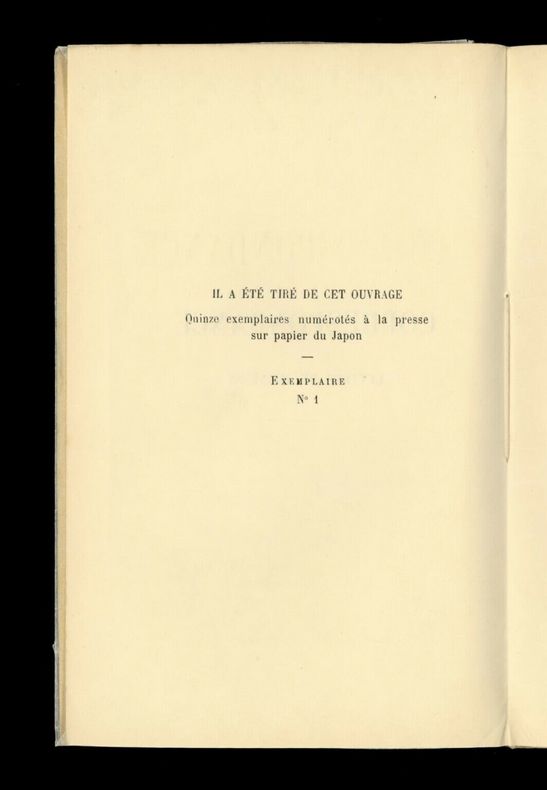
1907AMO-41561 volume in-18 (18,5 x 12 cm), broché, de (6)-300-(1) pages. Couverture jaune imprimée. Exemplaire non coupé. Exemplaire à l'état proche du neuf. Un petit choc en pied du dos et du premier plat (léger manque de papier de couverture). Petite fissure en bordure extérieure du premier plat de couverture, petites fentes du papier du dos. Splendide état par ailleurs. Edition originale. Un des rarissimes exemplaires du tirage de tête à 15 exemplaires sur papier du Japon. Il porte le numéro 1 (imprimé). Il a été tiré en outre 50 exemplaires sur Hollande (formant avec les exemplaires sur Japon le tirage en grand papier). Ce premier volume de Correspondance contient les lettres de jeunesse, celles que l'écrivain, alors à ses débuts, écrivait à trois de ses amis et condisciples (Jean-Baptistin Baille, Paul Cézanne et Marius Roux). Au collège Bourbon à Aix-en-Provence, Zola, Baille et Cézanne deviennent des amis que l'on appelle les « trois inséparables ». Ils se retrouveront d'ailleurs tous les trois à Paris en 1861. On estime également que Jean-Baptistin Baille servit ainsi de modèle à Émile Zola pour un personnage des Rougon-Maquart, Louis Dubuche, tout comme Paul Cézanne lui inspira la trame de l'ouvrage et son personnage principal, Claude Lantier (voir L'Œuvre). Précieux volume, rarissime imprimé sur Japon, digne d'entrer dans les plus belles bibliothèques consacrées au chef de l'école naturaliste.
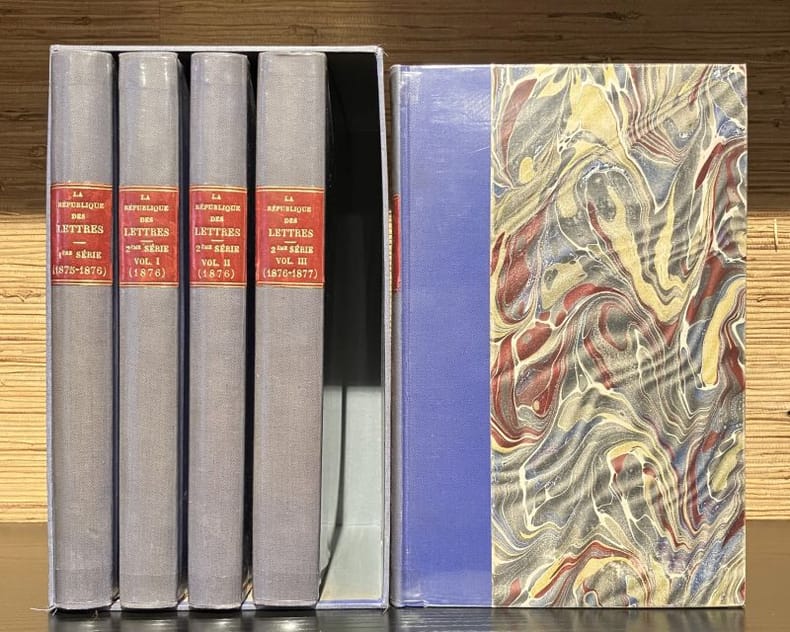
188582293Reliure demi-maroquin long grain prune à coins. Dos à nerfs. Tête dorée. Couverture et dos conservés. Reliure signée C. Septier.
189185018Reliure demi-maroquin corail à coins. Dos lisse orné de quatre caissons à losanges et semés de points dorés, pièce de titre de maroquin noire. Tête dorée. Couvertures et dos conservés. Bien complet du catalogue Charpentier et du feuillet promotionnel La Nouvelle Collection. Manque la mention de la justification de tirage au revers du faux-titre. Reliure signée Michel Richard.Ancienne bibliothèque Jean-Maurice de Montremy, ex-libris sur contreplat.
188885012Sous étui bordé. Reliure maroquin janséniste vert de chrome. Dos à nerfs, date dorée au talon. Double filet doré sur coupes et coiffes. Doublures de maroquin gris encadrées d?un filet dorée, gardes de soie brochée bleue turquin. Toutes tranches dorées. Couvertures et dos conservés. Bien complet des pages de catalogue éditeur in fine. Reliure signée Noulhac et datée 1913.
187779046L'Estaque - Marseille 22 septembre 1877 | 13.30 x 20.80 cm | 3 pages 1/2 sur un double feuillet
190187263Paris 1901. Fine. ""I have finished my crushing task and I am going to rest a little because I am exhausted"" Paris 4 Mars 1901 13.50 x 20.50 cm deux pages sur un bifeuillet Autograph letter signed by Emile Zola addressed to Octave Mirbeau dated in his hand March 4 1901. Two pages in black ink on a bifolium. Horizontal fold mark inherent to postal delivery. Published in his Correspondence vol. X p. 242. Precious letter from Zola to his great supporter Octave Mirbeau who had paid his fine at the end of his second trial for ""J'accuse!"". Now amnestied the writer attempts - in vain - to recover the sum to reimburse him. After his historic cry from the heart in l'Aurore Zola was first condemned by the Seine jury on February 23 1898 to one year in prison and a three thousand franc fine. The judgment was overturned on appeal and the case was referred to the Versailles assizes which retained only three lines out of the eight hundred that make up ""J'accuse!"" as grounds for accusation. To avoid accepting such a stifling of the debates Zola's defense decided to default and the conviction was confirmed on July 18 - Zola left that very evening for London to avoid prison. The tribunal also demanded 7555 francs from him which Mirbeau spontaneously decided to pay from his own funds. It was also Octave Mirbeau who prevented the seizure of Zola's furniture by obtaining from Joseph Reinach the 40000 francs in damages that Zola had been condemned to pay to the three pseudo-experts in handwriting that he had ""defamed"" in J'accuse!. Following the amnesty law that ended judicial proceedings for ""all criminal or delictual acts connected to the Dreyfus affair"" Zola was acquitted but was not reimbursed. This letter attests to the writer's desire to compensate Mirbeau for his act of generosity: ""Labori his lawyer will attempt an approach to try to recover the seven thousand and some francs that you paid on my behalf for the Versailles affair. He simply wishes to have a letter from you in order to show it and thus be authorized to speak in your name. You certainly do not have down there the receipt that was issued to you. Perhaps you remember its terms. In any case if we must wait we will wait for nothing is urgent after all. The important thing today is only to test the ground to see if they will return the money to us"". However the prosecutor's office refused his request. Furious Zola wrote two days later a letter to Labori asking him to give up claiming the slightest cent - he published it in L'Aurore under the title ""Let them keep the money"": ""they torture the text of the law and the State too keeps the money. If the prosecutor's office persists in this interpretation it will be yet another monstrosity in the unworthy way they have refused me all justice . I do not want to be complicit by accepting anything whatsoever from their amnesty ."". According to Pierre Michel these unsuccessful recovery attempts of which this letter bears witness ""incited Zola to adopt an attitude that emphasizes even more his disinterestedness and that of his 'friend' who is not named in the L'Aurore article probably at Mirbeau's request."" Dreyfus's pardon and the amnesty of his supporters did not satisfy the writer but nevertheless marked the end of long years of struggle: ""I have finished my crushing task and I am going to rest a little because I am exhausted"". Struck down in full glory the following year he would not be able to witness Captain Dreyfus's rehabilitation. Beautiful lines from Zola to Mirbeau who gave him the means to continue his fight for justice. unknown
188286096Paris: Charpentier 1882. Fine. Charpentier Paris 1882 12.50 x 19 cm relié First edition one of 250 numbered copies on Holland paper the only deluxe copies after a few rare China paper copies. Half red morocco binding with corners spine with five raised bands set with blind fillets marbled paper boards combed paper endpapers and pastedowns bookplate pasted on one pastedown original wrappers preserved top edge gilt on deckled edges signed binding Pétrus Ruban. Fine bookplate engraved by Provost-Blondel and pasted on one pastedown. It depicts a helmet adorned with a feather a medallion and a phylactery bearing the motto ""Toujours en face"". It would have belonged to Victor Coué second lieutenant killed in action during World War I. Handsome copy nicely bound. Charpentier hardcover
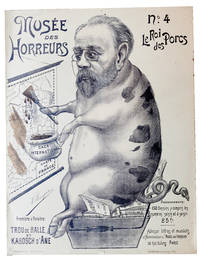
189980330Paris: Imprimerie Lenepveu 1899. Fine. Imprimerie Lenepveu Paris s. d. novembre 1899 49.80 x 65.20 cm une affiche Musée des horreurs Original colour lithographed poster n° 4 Le Roi des Porcs Imprimerie Lenepveu Paris November 1898 498 x 652 cm one poster Original colour lithographed poster depicting Émile Zola in the shape of a pig sitting on a tub containing his fictional works and smearing international poop on the map of France. Transverse folds some tiny tears two small holes above Zola's head without affecting the image. The representation of Émile Zola as a pig does not date back to Lenepveu as Guillaume Doizy highlights in his article dedicated to pig caricatures Le porc dans la caricature politique 1870-1914: une polysémie contradictoire in Sociétés & Représentations n°27 2009: For the end of the 19th century we also think of the many caricatures of which Zola was the victim and which associate excrement symbols of naturalism with pigs. Dozens of images could be mentioned. In the 1880s Sapeck imagined the naturalist naked a vine leaf hiding his genitals a veiled reference to the supposed pornography of his writings sitting astride a pig feeding on his excrement a long-lasting symbol called to stigmatise the new literary school. In a caricature dated 1898 Alfred Le Petit shows a Zola-pig defecating on the tricolore flag. Barely a month after the publication of his famous J'accuse the writer defending the Dreyfusard cause is accused of defiling France and especially its Army by defending the traitor Dreyfus and Prussia considered the eternal enemy. The pig is dirty but above all it dirties defiles by the effect of its harmful will. The same year Caran d'Ache portrayed the weapons of the Dreyfusard press as a big pig sprawled in muck and covered with mud. . In his series Le Musée des horreurs the very right-handed Lenepveu violently attacks Zola. The writer is depicted as a piglet sitting on a box of waste containing his own works the fruit of his defecations prominently including La Terre and Nana. He soils a map of France with his international poop contained in a chamber pot that he spreads with a small brush. The artist is of course aiming at the Dreyfus defender through his famous J'accuse and Jewish cosmopolitanism smearing France with his support for treason. The soiling-pig association seems obvious and primordial. As for Napoleon III the pig's dirt reinforced here by the visible excrement stigmatises the target's political choices. Lenepveu defines Zola's ideas as works of unworthiness intestinal and dripping products. Although this is not the first porcine representation of Émile Zola the one that features prominently in Lenepveu's Musée is undeniably by its realism the most violent. Circulated between October 1899 and December 1900 in a France set ablaze by the Dreyfus Affair these immense colour portraits are the work of Victor Lenepveu who announced the publication of 150 and then 200 drawings before finally producing only around fifty. Despite the 1881 law on the freedom of press allowing the dissemination of a politically subversive image the publication of this nightmarish pantheon was interrupted by order of the Ministry of the Interior. The fragility of the paper and the imposing size of these very violent posters as well as their almost immediate seizure by the police contributed to the disappearance of these caricatures which strongly left a mark on public opinion. These horreurs were widely promoted by anti-Semitic newspapers that announced a fantasised print of 300000 copies thus insinuating the success of anti-Semitic ideas in the population. On 1st October 1899 L'Intransigeant announced the publication of the Musée des horreurs in its columns: Un dessinateur de beaucoup d'esprit au coup de crayon d'un comique intense M. V. Lenepveu a eu l'heureuse idée d'inaugurer une série de portraits des vendus les plus célèbres de la tourbe Imprimerie Lenepveu unknown
188675914Reliure postérieure demi-maroquin rouge à coins. Dos à nerfs et date dorée en queue. Tête dorée. Reliure signée DEVAUCHELLE. Couverture et dos conservés.