3 001 résultats
1888334721888. Fine. 1888 27 x 35 cm autre Oil on wood signed lower right This original work was used to illustrate a scene from The Earth in the first illustrated edition of Emile Zola's work published by Marpon & Flammarion in 1889. unknown
1888334731888. Fine. 1888 27 x 35 cm autre Oil on wood signed lower right This original work was used to illustrate a scene from The Earth in the first illustrated edition of Emile Zola's work published by Marpon & Flammarion in 1889. unknown
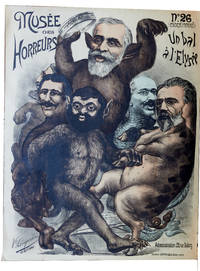
190080343Paris: Imprimerie Lenepveu 1900. Fine. Imprimerie Lenepveu Paris s. d. mai 1900 49.80 x 65.20 cm une affiche Musée des horreurs Original colour lithographed poster n° 26 exceptionnel Un bal à l'Elysée Imprimerie Lenepveu Paris May 1900 498 x 652 cm one poster Original colour lithographed poster depicting Émile Loubet as a bear holding a tambourine marked Panama Émile Zola as a pig Dreyfus as a hydra Joseph Reinach as a monkey the rabbi Kadoc Kahn as a donkey and Georges Picquart as a dromedary. This imposing poster featuring several people already caricatured in the previous issues is a direct reference to the Panama Scandal. This large-scale corruption affair which saw the resignation of Émile Loubet then Minister of Finance is re-referred to here because of the Judaism of some of is protagonists. It is Drumont through his magazine La Libre Parole who revealed the Panama Scandal denouncing the alleged alliance between the secular Republic and the Jewish high bank and thus contributing to the strengthening of the stereotype of the Jew eager for money: The deputy Joseph Reinach cousin and son-in-law of the baron Jacques de Reinach compromised in the scandal focuses the hatred of the polemicist. A republican close to the business world a free thinker Reinach is undoubtedly with Alphonse de Rothschild the man most attacked by the anti-Semites of the time. His wealth the vast networks of influence available to him his early involvement with Gambetta the memory of his campaigns against Boulangism and his equivocal role in the Panama affair make him the man to slaughter in order to return France to the French. Grégoire Kauffmann Rothschild & Cie. La bourgeoisie juive vue par Édouard Drumont in Archives Juives 2009 As for Émile Zola his novel L'Argent published in 1891 denounces the misappropriation of this financial scandal but his support for Alfred Dreyfus earned him his place in this nightmarish animal circle. Circulated between October 1899 and December 1900 in a France set ablaze by the Dreyfus Affair these immense colour portraits are the work of Victor Lenepveu who announced the publication of 150 and then 200 drawings before finally producing only around fifty. Despite the 1881 law on the freedom of press allowing the dissemination of a politically subversive image the publication of this nightmarish pantheon was interrupted by order of the Ministry of the Interior. The fragility of the paper and the imposing size of these very violent posters as well as their almost immediate seizure by the police contributed to the disappearance of these caricatures which strongly left a mark on public opinion. These horreurs were widely promoted by anti-Semitic newspapers that announced a fantasised print of 300000 copies thus insinuating the success of anti-Semitic ideas in the population. On 1st October 1899 L'Intransigeant announced the publication of the Musée des horreurs in its columns: Un dessinateur de beaucoup d'esprit au coup de crayon d'un comique intense M. V. Lenepveu a eu l'heureuse idée d'inaugurer une série de portraits des vendus les plus célèbres de la tourbe dreyfusarde. Le titre de cette série « Musée des Horreurs » est suffisamment suggestif et indique bien ce qu'il promet. . C'est la maison Hayard qui mettra en vente à partir d'aujourd'hui le numéro 1 de cette désopilante série. An artist of great spirit with an intense comical pencil stroke M. V. Lenepveu had the happy idea of inaugurating a series of portraits of the most famous sellouts of the Dreyfusard rabble. The title of this series Musée des Horreurs is sufficiently suggestive and is a good indicator of what it promises. . It is Maison Hayard that will put up for sale from today issue number 1 of this hilarious series. First a peddler then a bookseller-publisher Napoléon Hayard known as Léon Hayard specialised in the marketing of anti-Dreyfusard and anti-Semitic ephemera and advertisem Imprimerie Lenepveu unknown
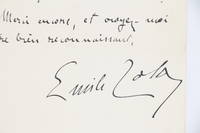
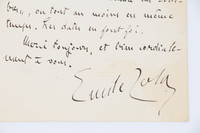
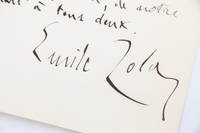
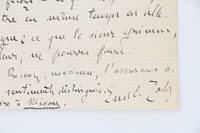
188279108Médan 1882. Fine. Médan 23 juin 1882 13.40 x 21.60 cm 1 page 1/2 sur un double feuillet - enveloppe jointe Autograph letter signed by Emile Zola - apparently unpublished - addressed to Léon Carbonnaux written in black ink on a double sheet. Folds inherent to mailing. Envelope included. Important testimony to the colossal documentation work and the capital role of Emile Zola's informants in depicting his immense natural and social fresco. This letter was sent to Léon Carbonnaux department head at Bon Marché who transmitted precious information to Emile Zola for the creation of the eleventh volume of the Rougon-Macquart series: Au Bonheur des Dames. Only two letters from Léon Carbonnaux to Emile Zola are known: they can be consulted in the digitization of the preparatory file for Bonheur des Dames made available online by the Bibliothèque nationale de France. However we know thanks to this same file which contains a long section entitled ""Notes Carbonnaux"" that this department head at Bon Marché provided a significant amount of information to Zola particularly about employee customs and their remuneration. The two men undoubtedly met when Emile Zola eager for information about the functioning of department stores conducted field research in February and March 1882. This response would therefore be the very first that the writer addressed to the department head in reply to his letter of June 19 1882. Far from imagining the keen success that this new novel would achieve Zola even seems to take it lightly: ""Je désire simplement toucher au sujet dans mon livre pour le besoin du petit drame commercial qui me sert de fable. Vos notes sont excellentes. . Enfin me voilà au travail. Le sujet est à la fois bien vaste - et bien ingrat pour un roman. On devra me tolérer un peu de fiction car il faut bien que je passionne la matière. Mais je tâche de m'en tenir le plus strictement possible à mes notes."" ""I simply wish to touch on the subject in my book for the needs of the little commercial drama that serves as my fable. Your notes are excellent. . Finally here I am at work. The subject is both very vast - and very thankless for a novel. One will have to tolerate a bit of fiction from me for I must make the material passionate. But I try to stick as strictly as possible to my notes."" It must be said that Carbonnaux takes his role as informant very much to heart and having no doubt about the book's success he writes: ""Dans le bâtiment chez nous d'ailleurs partout on attend votre livre. Les lecteurs ne vous manqueront pas. Soyez-en sûr. Vous n'en êtes plus à compter les succès celui-là s'annonce comme devant dépasser les autres."" letter of June 19 1882 For another work on the same subject has just appeared: ""J'ai lu le volume de Pierre Giffard. Il me paraît comme vous injuste et même faux dans plusieurs parties. C'est bâclé. Il aurait fallu pour un pareil ouvrage de documents purs une entière exactitude. Moi qui écris une uvre d'imagination je ne me permettrai pas de tels écarts."" ""I have read Pierre Giffard's volume. It seems to me like you unjust and even false in several parts. It is hastily done. For such a work of pure documents complete accuracy would have been necessary. I who write a work of imagination would not allow myself such deviations.""It was Carbonnaux who had pointed out the work to Zola: ""Pierre Giffard du Figaro vient de faire paraître chez Havard un vol de 300 pages intitulé « Les Grands bazars de Paris ». . On sait que le Figaro est inféodé au Louvre magasin concurrent au Bon Marché & on peut assurer que ce livre a été commandé et bâclé dès que votre intention de traiter le même sujet a été connue. . Il fallait déguiser un peu la réclame pour le Louvre."" letter of June 19 1882 We can clearly see here how much department stores fascinate and we understand the immense success that this novel by Zola describing their advent and supremacy would achieve. unknown
188879098Paris 1888. Fine. Paris 11 février 1888 13.20 x 20.50 cm 2 pages sur un double feuillet Autograph letter signed by Emile Zola addressed to Henry Fouquier written in black ink on a bifolium. Usual folds from mailing. This letter was transcribed in the complete correspondence of Emile Zola published by the CNRS and the Presses de l'Université de Montréal. A fine letter evoking La Terre and Tolstoy's The Power of Darkness. Henry Fouquier 1838-1900 was a literary critic and columnist for numerous newspapers. A close friend of Guy de Maupassant he supported Emile Zolas candidacy for the Académie française. This letter was written to him the day after the performance of Tolstoy's The Power of Darkness at the Théâtre-Libre. We have not found evidence of an article in which the journalist explicitly drew a parallel between the Russian drama and Zolas La Terre but Zola here addresses his thanks: « Merci mon cher Fouquier de ce que vous voulez bien dire de « la Terre » si attaquée. J'en suis touché vivement et croyez à toute ma gratitude. » It must be said that the fifteenth volume of the Rougon-Macquart cycle was harshly received unleashing passions from the moment of its serial publication in Gil Blas. On 18 August 1887 even before the conclusion of the novel was revealed to the public Le Figaro published the Manifeste des Cinq written by Paul Bonnetain J.-H. Rosny Lucien Descaves Paul Margueritte and Gustave Guiches. These young authors issued a severe verdict: « La Terre a paru. La déception a été profonde et douloureuse. Non seulement l'observation est superficielle les trucs démodés la narration commune et dépourvue de caractéristiques mais la note ordurière est exacerbée encore descendue à des saletés si basses que par instants on se croirait devant un recueil de scatologie : le Maître est descendu au fond de l'immondice. . Nous répudions ces bonshommes de rhétorique zoliste ces silhouettes énormes surhumaines et biscornues dénuées de complication jetées brutalement en masses lourdes dans des milieux aperçus au hasard des portières d'express. De cette dernière uvre du grand cerveau qui lança L'Assommoir sur le monde de cette Terre bâtarde nous nous éloignons résolument mais non sans tristesse. Il nous poigne de repousser l'homme que nous avons trop fervemment aimé. » Zola who had been developing the idea of a peasant novel for a decade was deeply affected. Though he never responded publicly to these accusations his correspondence is strewn with clarifications about the work whose sheer brutality alone seemed to occupy readers minds: « Mais vous ajoutez que notre thèse à Tolstoï et à moi est la même et peut se résumer en ceci : le travail de la terre est corrupteur. Tolstoï il me semble protesterait bien haut et quant à moi je vous affirme que je n'ai jamais voulu prouver une telle chose radicalement fausse à mon avis. Ce que je pense c'est que la petite propriété telle qu'elle existe chez nous c'est que la suite de faits sociaux qui ont abouti à notre forme sociale nous ont donné notre paysan d'aujourd'hui avec ses qualités et ses vices. Notre paysan est le prisonnier de sa terre et non l'homme libre qu'il devrait être. Comment voulez-vous qu'il n'y étouffe pas dans son ignorance et sa passion unique Labourer est très sain mais à la condition qu'on sera le maître de son champ au lieu d'en être le forçat. Je me suis exténué à faire sortir cette vérité de mon livre si l'on ne m'a pas compris la faute en est sans doute à moi. » A remarkable letter from the master of Naturalism shedding new light on one of the most brutal volumes of the Rougon-Macquart series. unknown
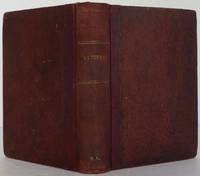
187583515Paris: Charpentier & Cie 1875. Fine. Charpentier & Cie Paris 1875 11 x 17.50 cm relié First edition of which no copies were printed on deluxe paper. Half red shagreen binding smooth spine decorated with triple gilt fillets gilt roll at foot marbled paper boards marbled paper endpapers and pastedowns rubbed corners contemporary binding. Some light foxing. A fine and very rare copy. Charpentier & Cie hardcover
190187263Paris 1901. Fine. ""I have finished my crushing task and I am going to rest a little because I am exhausted"" Paris 4 Mars 1901 13.50 x 20.50 cm deux pages sur un bifeuillet Autograph letter signed by Emile Zola addressed to Octave Mirbeau dated in his hand March 4 1901. Two pages in black ink on a bifolium. Horizontal fold mark inherent to postal delivery. Published in his Correspondence vol. X p. 242. Precious letter from Zola to his great supporter Octave Mirbeau who had paid his fine at the end of his second trial for ""J'accuse!"". Now amnestied the writer attempts - in vain - to recover the sum to reimburse him. After his historic cry from the heart in l'Aurore Zola was first condemned by the Seine jury on February 23 1898 to one year in prison and a three thousand franc fine. The judgment was overturned on appeal and the case was referred to the Versailles assizes which retained only three lines out of the eight hundred that make up ""J'accuse!"" as grounds for accusation. To avoid accepting such a stifling of the debates Zola's defense decided to default and the conviction was confirmed on July 18 - Zola left that very evening for London to avoid prison. The tribunal also demanded 7555 francs from him which Mirbeau spontaneously decided to pay from his own funds. It was also Octave Mirbeau who prevented the seizure of Zola's furniture by obtaining from Joseph Reinach the 40000 francs in damages that Zola had been condemned to pay to the three pseudo-experts in handwriting that he had ""defamed"" in J'accuse!. Following the amnesty law that ended judicial proceedings for ""all criminal or delictual acts connected to the Dreyfus affair"" Zola was acquitted but was not reimbursed. This letter attests to the writer's desire to compensate Mirbeau for his act of generosity: ""Labori his lawyer will attempt an approach to try to recover the seven thousand and some francs that you paid on my behalf for the Versailles affair. He simply wishes to have a letter from you in order to show it and thus be authorized to speak in your name. You certainly do not have down there the receipt that was issued to you. Perhaps you remember its terms. In any case if we must wait we will wait for nothing is urgent after all. The important thing today is only to test the ground to see if they will return the money to us"". However the prosecutor's office refused his request. Furious Zola wrote two days later a letter to Labori asking him to give up claiming the slightest cent - he published it in L'Aurore under the title ""Let them keep the money"": ""they torture the text of the law and the State too keeps the money. If the prosecutor's office persists in this interpretation it will be yet another monstrosity in the unworthy way they have refused me all justice . I do not want to be complicit by accepting anything whatsoever from their amnesty ."". According to Pierre Michel these unsuccessful recovery attempts of which this letter bears witness ""incited Zola to adopt an attitude that emphasizes even more his disinterestedness and that of his 'friend' who is not named in the L'Aurore article probably at Mirbeau's request."" Dreyfus's pardon and the amnesty of his supporters did not satisfy the writer but nevertheless marked the end of long years of struggle: ""I have finished my crushing task and I am going to rest a little because I am exhausted"". Struck down in full glory the following year he would not be able to witness Captain Dreyfus's rehabilitation. Beautiful lines from Zola to Mirbeau who gave him the means to continue his fight for justice. unknown
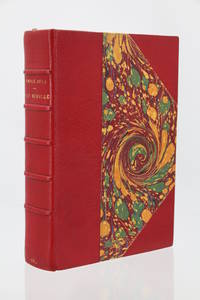
188286096Paris: Charpentier 1882. Fine. Charpentier Paris 1882 12.50 x 19 cm relié First edition one of 250 numbered copies on Holland paper the only deluxe copies after a few rare China paper copies. Half red morocco binding with corners spine with five raised bands set with blind fillets marbled paper boards combed paper endpapers and pastedowns bookplate pasted on one pastedown original wrappers preserved top edge gilt on deckled edges signed binding Pétrus Ruban. Fine bookplate engraved by Provost-Blondel and pasted on one pastedown. It depicts a helmet adorned with a feather a medallion and a phylactery bearing the motto ""Toujours en face"". It would have belonged to Victor Coué second lieutenant killed in action during World War I. Handsome copy nicely bound. Charpentier hardcover
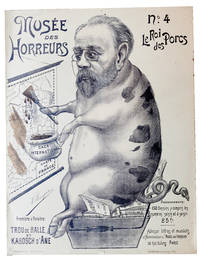
189980330Paris: Imprimerie Lenepveu 1899. Fine. Imprimerie Lenepveu Paris s. d. novembre 1899 49.80 x 65.20 cm une affiche Musée des horreurs Original colour lithographed poster n° 4 Le Roi des Porcs Imprimerie Lenepveu Paris November 1898 498 x 652 cm one poster Original colour lithographed poster depicting Émile Zola in the shape of a pig sitting on a tub containing his fictional works and smearing international poop on the map of France. Transverse folds some tiny tears two small holes above Zola's head without affecting the image. The representation of Émile Zola as a pig does not date back to Lenepveu as Guillaume Doizy highlights in his article dedicated to pig caricatures Le porc dans la caricature politique 1870-1914: une polysémie contradictoire in Sociétés & Représentations n°27 2009: For the end of the 19th century we also think of the many caricatures of which Zola was the victim and which associate excrement symbols of naturalism with pigs. Dozens of images could be mentioned. In the 1880s Sapeck imagined the naturalist naked a vine leaf hiding his genitals a veiled reference to the supposed pornography of his writings sitting astride a pig feeding on his excrement a long-lasting symbol called to stigmatise the new literary school. In a caricature dated 1898 Alfred Le Petit shows a Zola-pig defecating on the tricolore flag. Barely a month after the publication of his famous J'accuse the writer defending the Dreyfusard cause is accused of defiling France and especially its Army by defending the traitor Dreyfus and Prussia considered the eternal enemy. The pig is dirty but above all it dirties defiles by the effect of its harmful will. The same year Caran d'Ache portrayed the weapons of the Dreyfusard press as a big pig sprawled in muck and covered with mud. . In his series Le Musée des horreurs the very right-handed Lenepveu violently attacks Zola. The writer is depicted as a piglet sitting on a box of waste containing his own works the fruit of his defecations prominently including La Terre and Nana. He soils a map of France with his international poop contained in a chamber pot that he spreads with a small brush. The artist is of course aiming at the Dreyfus defender through his famous J'accuse and Jewish cosmopolitanism smearing France with his support for treason. The soiling-pig association seems obvious and primordial. As for Napoleon III the pig's dirt reinforced here by the visible excrement stigmatises the target's political choices. Lenepveu defines Zola's ideas as works of unworthiness intestinal and dripping products. Although this is not the first porcine representation of Émile Zola the one that features prominently in Lenepveu's Musée is undeniably by its realism the most violent. Circulated between October 1899 and December 1900 in a France set ablaze by the Dreyfus Affair these immense colour portraits are the work of Victor Lenepveu who announced the publication of 150 and then 200 drawings before finally producing only around fifty. Despite the 1881 law on the freedom of press allowing the dissemination of a politically subversive image the publication of this nightmarish pantheon was interrupted by order of the Ministry of the Interior. The fragility of the paper and the imposing size of these very violent posters as well as their almost immediate seizure by the police contributed to the disappearance of these caricatures which strongly left a mark on public opinion. These horreurs were widely promoted by anti-Semitic newspapers that announced a fantasised print of 300000 copies thus insinuating the success of anti-Semitic ideas in the population. On 1st October 1899 L'Intransigeant announced the publication of the Musée des horreurs in its columns: Un dessinateur de beaucoup d'esprit au coup de crayon d'un comique intense M. V. Lenepveu a eu l'heureuse idée d'inaugurer une série de portraits des vendus les plus célèbres de la tourbe Imprimerie Lenepveu unknown
1867B-16-060011<b>Ed Manet.</b> <b>With a wood engraving by Manet.</b> Zola Emile. Dentu Paris 1867. With one etching "Portrait of Manet" by Bracquemond and a wood engraving after a drawing by Manet "Olympia" by Moller. Rebound with the original paper blue cover inside. In very good condition trace of moisture plates in very good condition without stains. More pictures on request Dentu paperback
18872507025G. Charpentier et Cie 1887. first. hardcover. very good. INSCRIBED by Zola on half-title page. First edition in French. Book very good edges of first page have been cut a little smaller minor rubbing and wear two small stains to bottom of rear paste-down. G. Charpentier et Cie unknown
1927elala1677Paris: François Bernouard 1927-29. 1927. 50 Volumes. 8vo. with half-titles. contemporary half morocco t.e.g. original printed wrs. bound in spines sunned & a few with rubbing or small nicks on raised bands. One of 5000 numbered copies on Vergé dalfa. Paris: François Bernouard, [1927-29]. hardcover
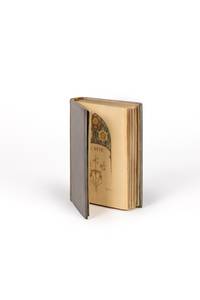
28517Paris Charpentier 1888. 1 vol. 120 x 180 mm de 2 f. 310 p. et 10 p. de catalogue. Bradel veau gris dos lisse titre doré date en pied tête dorée premier plat orné d'un décor estampé à èfroid couvertures et dos conservés chemise à rabats étui bordé reliure signée de Buer - Drevet. . Édition originale. Un des 250 exemplaires sur hollande n° 177 - après 25 sur japon. . Exemplaire enrichi de 29 compositions en couleurs par Henry Varade : 14 dessins à la plume en noir et or en fin de chapitre et 15 miniatures aquarellées en tête de chapitre. Montée en tête dessin en sanguine signé qui a servi à la plaque estampée du décor de la reliure. La reliure a été établie vers 1920 dans l'atelier du 58 rue Sala à Lyon qui fut par la suite l'atelier bien connu de Patrice Goy et Carine Vilaine Atelier Moura. Elle est ornée d'un singulier décor de Joannès Drevet peintre et graveur lyonnais issu d'une lignée de graveurs renommés composé en estampant directement le cuir. L'on a répertorié seulement quatre autres reliures signées de son association avec E. Buer - toutes avec des décors estampés - en majorité pour des exemplaires uniques enrichis d'aquarelles dont Henry Varade fut dans les années 1920 l'un des meilleurs représentants. Varade donna également plusieurs éditions illustrées de renom dont celle pour l'Ile au trésor de R. L. Stevenson. Quant au texte de Zola c'est le seizième titre du cycle des Rougon-Macquart : « je voudrais faire un livre qu'on n'attende pas de moi » méditait son auteur. L'époque était aux envolées mystiques et à la piété sulpicienne. Le naturalisme de Zola se trouva donc supplanté par ce que l'histoire littéraire appellera la « réaction idéaliste ». En composant son roman dans cette veine l'auteur devait en surprendre plus d'un. Quand le livre fut mis en vente le 15 octobre 1888 s'éleva parmi la critique la voix acerbe de Jules Lemaître qui résume assez bien ce qu'il avait d'imprévu n'est-ce-pas là ce que l'auteur voulait et de manqué : « Ceci est un conte bleu tout ce qu'il y a de bleu. . Seulement il fallait l'écrire comme un conte bleu. Oserai-je dire que ce n'est pas précisément ce qu'a fait M. Emile Zola . Lisez Le Rêve et vous verrez que ce conte ingénu sue l'impureté parfaitement ! Et que cette histoire irréelle est écrite dans le même style opaque et puissamment matériel et avec les mêmes procédés de composition et de développement que la Terre ou l'Assommoir. L'effet est ahurissant ». Et pour finir l'éreintement « l'auteur a bien tenu à marquer que ce conte bleu est un épisode de l'histoire des Rougon-Macquart. Il s'est cru obligé de rattacher sa petite vierge à cette horrible famille par quelque lien de parenté . ». Paris, Charpentier, 1888. 1 vol. (120 x 180 mm) de [2] f., 310 p. et 10 p. de catalogue. Bradel veau gris, dos lisse, titre dorà unknown
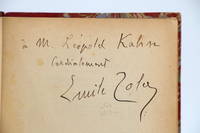
189284801Paris: Charpentier 1892. Fine. Charpentier Paris 1892 12.50 x 19 cm relié First edition. Half red morocco binding spine with five raised bands date gilt at foot restoration to head of one joint marbled paper boards endpapers and pastedowns of combed paper bookplate mounted at head of one pastedown top edge gilt contemporary binding. Occasional light foxing. A handsomely bound copy. Autograph inscription signed by Emile Zola to Léopold Kahn who was Calmann-Lévy's principal collaborator. Charpentier hardcover
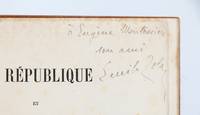
187987597Paris: Charpentier 1879. Fine. Charpentier Paris 1879 14 x 23 cm relié First edition on ordinary paper. Full tawny morocco binding spine with four raised bands set with black fillets bearing small stains at foot gilt fillet frame on burgundy morocco pastedowns brown watered silk endpapers following endpapers of marbled paper original wrappers preserved all edges gilt elegant signed binding by Georges Cretté. Scattered foxing covers marginally and lightly faded. Autograph inscription signed by Emile Zola to the painter and photographer Eugène Montrosier at the head of the title page. Charpentier hardcover
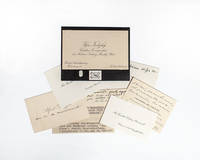
146844Rare collection of seven printed visiting cards. The collection includes: Alfred Dreyfus inscribed by him in ink "avec tous les remerciements" n.d. 2.25 inches by 3.8 inches; Colonel De Gaulle as Commandant le 507e Regiment de Chars inscribed by him in ink "Merci mon cher ami." n.d. but after December 1937 when he was promoted to Colonel 2.5 inches by 3.5 inches; Theodore Roosevelt at Sagamore Hill Oyster Bay L.I. inscribed by him in ink "Mr Roosevelt greatly regrets that he can not accede to your courteous request" n.d. 1.5 inches by 3 inches; Emile Zola at Rue de Bruxelles Paris inscribed by him in ink "Avec mon bien vifs remerciements" and dated in pencil in another hand "29 avril 1887" bearing collection label numbered '329' 2.5 inches by 4 inches; Mr. Theodore Delano Roosevelt at Forty-nine East Sixty-fifth Street n. d. 2 inches by 3.3 inches; Mrs. Franklin Delano Roosevelt Eleanor Roosevelt at the Executive Mansion n. d. 2.5 inches by 5 inches; Ilya Trotzky 'Redakteur-Correspondent der Moskauer Freitung 'Russkoje Slowo' at Berlin-Charlottenburg bearing collection label numbered '346' n.d. 2.6 inches by 4.3 inches. In near fine to fine condition with a closed tear to Theodore Roosevelt's inscribed card which has been expertly repaired slight scuffing to the top right corner of Dreyfus' card where it had been mounted by a previous owner. Accompanied by a typed information card about Ilya Trotzky's card. Visiting cards also called calling cards were small decorative cards carried by individuals to present themselves to others in the 18th and 19th centuries. It was a common practice among the upper classes to leave a visiting card when making a social call at their house or workplace. unknown
1890RFERPAG00twCirca 1890. Very Good. Ferris Jean Leon Gerome. Page of Love. 20 framed prints of watercolors by Jean Leon Gerome Ferris for Emile Zola's novel Une Page d'Amour. Zola Emile. NP: NP Circa 1890. 10x15 cm images in 29x34 cm frames. Framed illustration prints. Book condition: Very good. 20 delicate watercolors depicting scenes from Zola's novel. Beautifully reproduced and matted in buff and moss green in gold-painted wooden frames. Jean Leon Gerome Ferris 1863-1930 was an American painter. unknown
1871elala172Paris Brussels : Librairie Internationale A.Lacroix Verboeckhoven Et Cie. 1871. 1871. 18mo. pp. 360. A fine copy untrimmed in original printed wrs. preserved in slipcase with morocco-backed chemise. First Edition issue with publication date 1872 on front wrapper. There was no limited issue on large paper. Variously translated into English as The Rush for the Spoils The Hounds Fee and more recently The Kill La Curée is the scarce second novel from Zolas great twenty-volume Rougon-Macquart series the chief monument of the French Naturalist Movement which explores the scientific theme of the determing influence of heredity on character. The book was immediately censored upon publication. Vicaire VII 1202. 1st Edition. Soft cover. Fine. Paris, Brussels : Librairie Internationale, A.Lacroix, Verboeckhoven Et Cie., 1871. Paperback
19090008050LOS ANGELES CALIFORNIA. Good. 1909. On offer is an outstanding travel journal written by a young girl in California in the early years of the 20th century. This well-written journal measures 9.25 inches by 7.5 inches and contains 60 pages. It is 60% complete. The cover and pages are in good condition and the handwriting is legible and quite easy to read. Also included is a black and white photograph a map/itinerary and a number of newspaper clippings - all in very good condition. The author is Zola Grace Strawser a 14 year old school girl. Born in 1895 she grew up in Los Angeles where her father Bert was a successful businessman. She had 3 sisters - Nellie Merle and Bertie. Casual research has not discovered any additional biographical information. In July of 1909 she left on a long train trip from Los Angeles to the Worlds Fair in Seattle. Along the way she makes stops in Las Vegas and Salt Lake City amongst other places. She is a keen observer and her descriptions are detailed and well-written. "The train slowly pulled out of the Salt Lake City Station and our long hoped for journey began. Nellie Merle Bertie Papa and Daisy Clark were there to say "goodbye." Daisy Clark gave us our first box of candy and also a beautiful bunch of carnations. The ride to Pomona was not so interesting as we made so many trips to San Bernardino before. Our next stop was Ontario. From Ontario you have a very beautiful view of the mountains which is very interesting. We next passed through Riverside and Coulton and arrived in San Bernardino 12:12. Between Los Angeles and San Bernardino can be seen orange trees and mountains while from San Bernardino is a vast stretch of desert. We then went to lunch and from the window you could see right down between the mountains on which were some snow. I saw an automobile filled with men and for a long time had great fun waving back and forth. They at last got ahead of us. We had to go so slow up a high incline . the rest of the landscape was desert desert desert. ." July 8. In Salt Lake City she visited a number of sites: ". we saw all the important buildings the temple tabernacle the Lion House Bee Hive grave of Brigham Young and the "Eagle Gate" July 9. She goes out to visit Saltair - an amusement park and resort built at the south end of Great Salt Lake. At one time Saltair was the largest and most popular family resort west of New York. Today it is abandoned a victim of shrinking water and the ravages of a changing climate. Each day's entry is accompanied by a small pen and ink drawing representing some remark in the entry. She writes an excellent description of a wedding accompanied by a drawing of wedding bells and music notes and the inscription "No Wedding Bells For Me.: "THE WEDDING: Talk about your presents you ought to have seen Bessie's. Cut glass china silverware well it was enough to make anyone wish it was them getting married. She also received four chairs three tables bedding and linen. The few people assembled to see her married arrived about half past seven. Bessie who was naturally nervous broke right down and cried but as soon as the ceremony was over she was as happy as a lark and was receiving many congratulations. Well while we are waiting for the guests to arrive I will describe the appearance of the house. The rooms were all decorated in carnations roses ferns palms and small trees. On the electric lights were twined smilax and over the globes were different color flower shades. The long porch was made beautiful with small green palms and at the father end a Hawaiian orchestra played the whole evening. The yard which was very large was strung with lanterns of all manner and shapes. There was a wall of canvas all around so as to keep intruders out. The guests have now arrived and the air was sweet with lavender and violet perfume. Ladies with low neck chiffon dresses; with white satin evening coats; ladies with the tight fitting empire ladies in simple white ladies in red pink blue and every imaginable color. In the evening lunch was served and while the bride and groom were eating they threw handfuls of rice at them. Of course their dinner was spoilt and they had to get more dinner. About an hour after the bride and groom were missed and the whole party set out to look for them. The bride was found and the girls who were quite rough drew her across the bed and a hat pin stuck in her and hurt her. Mrs. Brook fought them and Bessie got free again and escaped in the crowd and hid in the cellar. She was so scared and sick that she could hardly stand. She then slipped in the back bedroom and changed her wedding dress for her brother's clothes. There she slipped in the automobile barn until the crowd had gone around the front and slipped over the fence and went in the house next door and mingled with the crowd who did not know her dressed as a boy. Cora the girl next door put on a long black coat and put something over her head. Her brother was waiting in a buggy outside. With one jump Cora was in the buggy and was driving away as fast as possible. The whole party thought it was Bessie and Vic and started after the buggy. Cora's brother had heart trouble and when they were about a block away he fainted and Cora had to drive home with her brother in her arms. When she reached home she fainted and they had an awful time. Of course the crowd found it was not the bride and groom. The bride and groom left for the canyon 20 min. to one. While all the excitement was going on the groom was next door asleep." July 14. After a number of adventures she continues her trip to Seattle and the World's Fair: "In the morning Irene mother and I went to the fairgrounds. I can't very describe how they look only by showing you postcards. They have an imitation geyser which goes up and down all the time. "The Cascades" are simply beautiful. You can stand at the top and look right over the falls and the geyser and see Mt. Rainier. The buildings are all white and the flowers are beautiful. In the evening we went to a show and saw the smallest woman in the world "Princess Checita" July 31. We again went to the fair and visited many buildings. Our feet were just covered with blisters from all the walking up the hills. Mama isn't feeling well. She is lonesome for papa. Aug 1 "As this was to be our last day at the fair we visited all the buildings we had not seen before. In the government building were articles from the "Dead Letter Office." Skulls snakes a pig's tail money jewelry a bustle the hair of a woman who had been scalped guns swords and all manners of weapons beads small funny statues locks of hair old books and dirty table covers pencils and everything imaginable. We had a nice time at the fair and had our pictures taken several times."Aug 6. Before they return to Los Angeles they travel up to Portland on August 8th and on the 9th take a boat trip up the Columbia River all the way to The Dalles. There are two brochures included from this trip and two pages of wonderful descriptions. On Aug 11th they board their train for their return trip. She arrived back in San Francisco on Aug 12th and met her father the next day: ". In the evening we took dinner at the Cafe Bismark a German-influenced restaurant in San Francisco in the 1900s. It was called "the largest and finest café in the city." and then went to the Orpheum a long-vanished vaudeville theatre. After the theatre we met papa on his way to Chicago. Aug 13. Her trip ends when she reaches home on Aug 17th. Following her account of the trip are 4 pages with some notes made in 1910 and 1911. "Nellie and I gave a masquerade party" Dec 3 1910 "Merle Bertie and Mother and I start for Catalina to spend the month."Aug 3 1911. A historian looking at the early history of California would find this journal simply rich in local detail. The descriptions are excellent and her keen eye misses nothing. There are interesting observations about the towns she visits and the people she encounters. It is clear that she comes from a well-to-do family and this would be an interesting contrast to the majority of people living in California at this time.; Manuscript; 4to - over 9¾" - 12" tall; KEYWORDS: HISTORY OF EARLY 20TH CENTURY 1900S PROGRESSIVE ERA UNITED STATES CALIFORNIA LOS ANGELES ZOLA GRACE STRAWSER; BERT STRAWSER; ACME LAUNDRY; SAN BERNARDINO; SEATTLE WORLD FAIR 1909 BISMARK CAFE; ORPHEUM THEATRE DEAD LETTER OFFICE DLO TRAVEL JOURNALS TRAVEL BY RAIL EXPOSITIONS FAIRS TRAIN JOURNEYS TRAIN TRIPS WEDDING CEREMONIES BLACK AND WHITE PHOTOS MAPS DRAWINGS SOCIAL HISTORY AMERICANA HANDWRITTEN MANUSCRIPT DOCUMENT LETTER AUTOGRAPH WRITER HAND WRITTEN DOCUMENTS SIGNED LETTERS MANUSCRIPTS DIARY DIARIES JOURNALS PERSONAL HISTORY SOCIAL HISTORY HISTORICAL HOLOGRAPH WRITERS AUTOGRAPHS PERSONAL MEMOIR MEMORIAL ANTIQUITÉ CONTRAT VÉLIN DOCUMENT MANUSCRIT PAPIER ANTIKE BRIEF PERGAMENT DOKUMENT MANUSKRIPT PAPIER OGGETTO D'ANTIQUARIATO ATTO VELINA DOCUMENTO MANOSCRITTO CARTA ANTIGÜEDAD HECHO VITELA DOCUMENTO MANUSCRITO PAPEL . hardcover
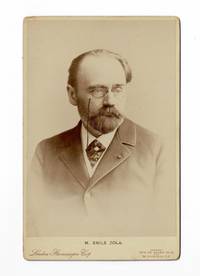
190073358Londres London: London Stereoscopic Company 1900. Fine. London Stereoscopic Company Londres London 1900 10.70 x 16.60 cm une photographie au format carte cabinet Handsome original photographic portrait of Emile Zola in cabinet card format period print on albumen paper mounted on cardboard from the London Stereoscopic Company and taken by an unidentified photographer. The writer poses there rosette of the Legion of Honor at his buttonhole. Condemned for defamation after the publication of his famous ""J'Accuse!"" on the front page of L'Aurore and to escape prison Zola secretly fled to London on July 18 1898. On July 26 1898 the Legion of Honor was withdrawn from him. A snub to this France that did not understand him this ""rosette"" photograph was most likely taken after his removal from the order of the Legion of Honor. Exceptional state of conservation. London Stereoscopic Company unknown
188379106Bénodet 1883. Fine. Bénodet 10 septembre 1883 13.20 x 20.30 cm 2 pages sur un double feuillet Signed autograph letter by Emile Zola - apparently unpublished - addressed to an unknown correspondent written in black ink on a double sheet. Folds inherent to mailing. Interesting letter relating the translation of Emile Zola's works and the legal disputes inherent to their clandestine distribution. This missive is visibly addressed to a correspondent considered for the German translation of La Joie de vivre: ""I would ask you to give me the promptest possible response regarding the translation of La Joie de vivre; for I am already receiving proposals from Germany and I would like to know where I stand."" In this autumn of 1883 Zola - though vacationing in Brittany - is very occupied with managing the translation of his works which he handles directly with publishers. We see here the determination with which he conducts negotiations: ""I repeat that I will only accept a fixed sum paid in advance. It is simpler and without possible surprises."" But things are not simple and Zola whose works already enjoy great success must fight against the clandestine publication of his novels. Completely overlooked by biographers the disputes with Hungarian publisher Gustav Grimm are nonetheless a leitmotif of Zolian correspondence: ""Monsieur Grimm of Budapest is a simple thief who has my novels translated as they are published in French newspapers without any authorization. Already the Neue Freie Presse of Vienna has sued him in my name. But it appears we have no treaty with Hungary. I await the signing of a treaty which they say is imminent."" Indeed Grimm had already published without Zola's authorization German translations of two novels: Nana 1881 and Pot-Bouille Der häusliche Herd 1882. These illegal publications discouraged German publishers Curt Busch and George Kuhr who very interested in distributing the novel to German-speaking readers declared forfeit. Gustav Grimm who finally agreed to respect commercial treaties won the battle and published the very first German translation of La Joie de vivre in 1889 under the title Die Lebensfreude. The man whom Zola here calls a ""simple thief"" would finally obtain authorization to distribute the German translation of the entirety of the twenty volumes of the Rougon-Macquart between 1892 and 1899. Interesting letter revealing the editorial mechanisms of the Rougon-Macquart and testifying to the ardor with which Zola conducted negotiations inherent to the translation of his great hereditary fresco. unknown
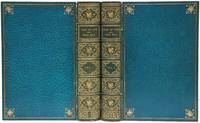
1897143835Philadelphia: George Barrie & Son 1897. Hardcover. Near fine. Edition Magnifique of Chefs-d'Oeuvre du Roman Contemporian Realists. Limited to five copies. viii 319; viii 361 pp. unpaginated plates. 2 Volumes. Octavo hardcover. Bound in full teal levant morocco leather boards designed with impressed gilt decorations double ruled in gilt. Spines with 5 raised bands each divided in six compartments decorated and lettered in gilt slightly darkened. All edges trimmed and gilt. Each volume with a vertical fore-edge painting. Inner side of the boards covered with terra cotta levant morocco doublures elaborately decorated impressed in gilt designed in green blue and white. Joints starting as usual to the fore-edge painting books. Pale blue moiré silked free endpapers; the majority of the blue silk has become detached and is laid-in in incomplete pieces. Free endpapers toned with light pencil notations. Small gallery labels to rear free endpapers recto. Illustrated with monochrome copper etchings each with a hand-coloured douplicate some guarded with tissue paper. Leaves bright and charming tight binding. Near fine condition. 2 volumes each with a fore-edge painting. vol. 1 depicting a couple standing together vol. 2 depicting a nude woman holding a child.</p><p>Limited edition of five copies of which this is number one. Printed only for subscribers. </p><p>Hammer Galleries typed letter signed on their stationary laid in dated March 1941 </p><p>From the Estate of Randall J. Moskovitz MD Memphis Tennessee. 1897 George Barrie & Son hardcover
1923346844Paris : Bibliotheque-Charpentier 1923. Various Edition. Hardcover. Finely and uniformly bound set in gilt blocked aniline calf over marble boards. Raised band gilt cross bands with gilt titles to the spines. A fine set. Includes previous owner's inscriptions. Physical description; 34 volumes. Contents; La Joie de Vivre: tome premier & tome second bound in one ; Les Soirées de Médan ; Germinal: tome premier & second bound in one ; Le Voeu D'Une Morte ; Contes a Ninon ; Pot-Bouille: tome premier & deuxieme bound in one ; Nouveaux Contes a Ninon ; Le Ventre de Paris ; Thérese Raquin ; Son Excellence Eugene Rougon: tome premier & deuxieme bound in one ; Nana: tome premier & deuxieme bound in one ; La Débacle: tome premier & deuxieme bound in one ; L'Argent: tome premier & deuxieme bound in one ; Les Mysteres de Marseille: tome premier & deuxieme bound in one ; Une Page D'Amour ; La Confession de Claude ; Le Docteur Pascal ; Vérité: tome premier & deuxieme bound in one ; La Faute de L'Abbé Mouret ; Madeleine Férat ; Paris: tome premier & deuxieme bound in one ; La Terre: tome premier & deuxieme bound in one ; Fécondité: tome premier & deuxieme bound in one ; La Fortune Des Rougon ; La Conquete De Plassans ; L'Assommour: tome premier & deuxieme bound in one ; Lourdes: tome premier & deuxieme bound in one ; Rome: tome premier & deuxieme bound in one ; La Bete Humaine ; Le Reve ; Le Capitaine Burle ; Travail: tome premier & deuxieme bound in one ; La Curée ; Les Personnages des Rougon-Macquart. Subjects; Zola Émile 1840-1902. French Literature. Paris : Bibliotheque-Charpentier hardcover
1899feb1187421899. Used. For more details please contact me unknown
186428266Paris: J. Hetzelet A. Lacroix 1864. Fine. J. Hetzel et A. Lacroix Paris s. d. 1864 12 x 18 cm relié First edition of which there were no large paper copies. Contemporary half red shagreen spine slightly faded in five compartments with triple blindruled fillets. A few spots but otherwise a very good and rare copy of the first work by Emile Zola in a very satisfactory contemporary binding. Rare and sought-after. J. Hetzelet A. Lacroix unknown