Emile ZOLABiblio.com

3 001 résultats
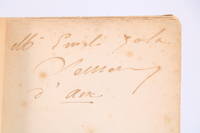
188145284Paris: Charpentier 1881. Fine. Charpentier Paris 1881 12 x 18.50 cm relié First edition. Contemporary red cloth Bradel binding by Pierson spine with gilt floral motif date and double gilt fillet to foot black shagreen title label. A little light spotting principally affecting the first and final few leaves. Ex libris of Adolphe Racot on inside upper cover. Concerning Victor Hugo Alfred de Musset George Sand François-René de Chateaubriand Théophile Gautier Alexandre Dumas fils and so on Autograph inscription from Emile Zola to Adolphe Racot. Charpentier hardcover
189023990Paris: La Vie Populaire 1890. Fine. La Vie Populaire Paris 1er Janvier 1888 au 28 Décembre 1890 24.50 x 32.50 cm 312 fascicules reliés en 6 volumes First edition of this bi-weekly illustrated review publishing in serial form either unpublished texts or previously published texts by the most illustrious authors of this end of century. Half cherry red shagreen bindings spine with five raised bands decorated with blind fillets showing slight traces of rubbing marbled paper boards marbled endpapers and pastedowns illustrated front covers preserved contemporary bindings. Rich literary contributions including those of G. de Maupassant with notably the unpublished ""Fort comme la mort"" and also ""Pierre et Jean"" and ""Notre coeur"" E. Zola with the unpublished ""La bête humaine"" and also ""Le voeu d'une morte"" ""Le rêve"" ""La terre"" and ""Une page d'amour"" P. Loti with an unpublished novel ""Le roman d'un enfant"" J. Clarétie with an unpublished novel ""Puy Joli"" J. Richepin with an unpublished novel ""Le cadet"" and ""Césarine"" 2 unpublished works by H. Malot but also A. Daudet C. Monselet E. Renan L. Dierx E. Goudeau J. Barbey d'Aurevilly O. Mirbeau with notably ""L'abbé Jules"" M. Beaubourg C. Mendès P. Arène T. de Banville F. Mistral J. Bois G. Courteline J. Barbey d'Aurevilly Villiers de l'Isle Adam S. Masoch A. Scholl J. Gautier. Illustrated covers with portraits of the principal contributors. A marginal restoration at foot of page 213 of the first volume a small lack at foot touching text on page 383 of the second some occasional light foxing. Handsome and rare set. La Vie Populaire hardcover
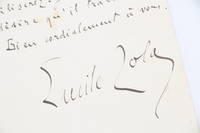
189384893Paris 1893. Fine. Paris 5 Avril 1893 13.50 x 20.50 cm une page et demie Autograph letter dated and signed by Emile Zola 23 lines in black ink on a page and a half addressed to press baron Arthur Meyer Folds inherent to postal delivery. Emile Zola intervenes with Arthur Meyer proprietor of the high-circulation newspaper ""Le Gaulois"" on behalf of his friend Louis de Robert: ""Vous sentirez comme moi que c'est un garçon d'avenir et je suis convaincu que vous l'utiliserez. Je le connais et je désire qu'il travaille."" ""You will feel as I do that he is a young man with a future and I am convinced that you will make use of him. I know him and I want him to work."" in whom he recognizes a talented writer: ""Me permettrez-vous de vous recommander un de mes jeunes confrères Louis de Robert dont j'ai lu les chroniques charmantes. Je crois que vous devriez l'encourager le mettre à l'essai car vous trouveriez en lui un excellent rédacteur pour ""Le Gaulois""."" ""May I recommend to you one of my young colleagues Louis de Robert whose charming chronicles I have read. I believe you should encourage him put him to the test for you would find in him an excellent editor for 'Le Gaulois'."" unknown
188970523E. Plon Nourrit Et Cie. Very Good. 1889. Hardcover. FREE UPGRADE to Courier/Priority Shipping Upon Request - IN STOCK AND IMMEDIATELY AVAILABLE FOR SHIPMENT - Text pristine & unmarked - Text in French. Vii 162pp. Profusely illustrated with black & multi-color text illustrations & 10 heliogravure plates by Jean-Francois Raffaelli. Text by 22 well-known contributors including Edmund de Goncourt Alphonse Daudet Emile Zola Guy de Maupassant Octave Mirabeau J. K. Huymans Stephen Mallarme Albert Wolff Henri Greville Jean Richepin Paul Bonnetain Roger Marx and others. -- with a bonus offer-- . E. Plon, Nourrit Et Cie hardcover
2015115471Pallas Athene. New. 2015. Paperback. 1843680904 . FREE UPGRADE to Courier/Priority Shipping Upon Request - IN STOCK AND IMMEDIATELY AVAILABLE FOR SHIPMENT - IN STOCK AND IMMEDIATELY AVAILABLE FOR SHIPMENT - Flawless copy brand new pristine never opened - -- with a bonus offer-- . Pallas Athene paperback
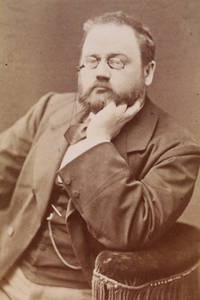
187072935Paris: Ernest Ladrey 1870. Fine. Ernest Ladrey Paris 1870 6.50 x 10.50 cm une photographie Very rare original albumen photograph in carte-de-visite format mounted on yellow cardboard with red border. Manuscript annotation on verso. The address at Passage des Princes on the back of the photograph indicates that the photograph was taken before 1875. Handsome copy of this photograph of the writer with his lorgnette and beard. Ernest Ladrey unknown
189084423Paris 1890. Fine. Paris 20 Février 1890 13.50 x 20.50 cm une page Autograph letter dated and signed by Emile Zola 12 lines in black ink addressed to librettist Louis Gallet concerning the operatic adaptation by Alfred Bruneau of the novel ""Le rêve"". Folds inherent to postal dispatch. Emile Zola was to meet jointly with Alfred Bruneau who had adapted the novel ""Le rêve"" for the opera and Louis Gallet the librettist of this adaptation. ""Je vous attends demain matin. pour causer des trois derniers tableaux. J'écris également à Bruneau pour lui donner rendez-vous"" ""I await you tomorrow morning. to discuss the last three tableaux. I am also writing to Bruneau to arrange a meeting with him"" and shows himself very satisfied with this prospect: ""Tout va bien."" ""All goes well."" unknown
189386093Paris 1893. Fine. An appointment with Gilles de La Tourette Paris 15 octobre 1893 13.50 x 20.50 cm une page 1/4 sur un bifeuillet Autograph letter dated and signed by Emile Zola addressed to his friend the physician Maurice de Fleury dated in his hand October 15 1893. 1 page 1/4 19 lines in black ink on a double sheet. Horinzontal and vertical folds due to mailing. Stain on verso not affecting the text. A most unusual invitation from the master of Naturalism who wishes to organize a luncheon with two eminent specialists in nervous diseases: ""Vous êtes bien aimable de m'inviter à déjeuner. Mais cela va vous faire perdre du temps et à moi aussi . pourquoi ne prendriez-vous pas un rendez-vous pour deux heures et demie par exemple avec M. Gille de la Tourette soit jeudi soit vendredi. Nous irions chez lui simplement ."" ""You are very kind to invite me to lunch. But this will make you lose time and me as well . why wouldn't you make an appointment for two-thirty for example with M. Gille de la Tourette either Thursday or Friday. We would go to his place simply ."" Zola relied on the expertise and scientific knowledge of Maurice de Fleury a student of Charcot to nourish his writing work on the Rougon-Macquart. De Fleury particularly shared publications from his library relating to heredity a subject at the heart of Zola's great social series of novels - most particularly the generational transmission of nervous diseases fits of violence and alcoholism. Maurice de Fleury is also famous for having made ten years after this letter a medico-psychological study of Zola himself through the prism of his working habits: ""De dix heures à midi Zola rédige encore - moins facilement et moins bien que pendant l'heure initiale - et c'est fini pour toute la journée il ne sera plus bon qu'à écrire des lettres. C'est là la puissance du plus puissant cerveau dans le domaine littéraire à la fin du siècle. Avec ce tout petit traintrain modeste trois heures par jour en deux séances cet homme dont l'attention est modique . trouve moyen de nous donner tous les dix mois un de ces livres où ne manquent ni la solidité de la charpente . ni rien de ce qui constitue la force créatrice le génie pour dire le mot"" ""From ten o'clock to noon Zola still writes - less easily and less well than during the initial hour - and it's finished for the whole day he will only be good for writing letters. This is the power of the most powerful brain in the literary domain at the end of the century. With this very modest little routine three hours a day in two sessions this man whose attention is modest . manages to give us every ten months one of those books which lack neither the solidity of the framework . nor anything that constitutes creative force genius to say the word"". ""Maurice de Fleury maintained close relations with Émile Zola and Joris-Karl Huysmans with whom he corresponded in the years 1880-1890. Fervent admirer of the author of the Rougon-Macquart Fleury advised Zola for ""Le Docteur Pascal"" 1893 and confided his admiration in an article in Le Figaro in 1896. Very 'fashionable' among the 'intellectuals' according to Victor Segalen the young physician also appears in the list of symbolist authors - alongside Paul Adam Henri de Régnier and Gustave Kahn - in an essay by André Barre in 1911"" Lola Kheyar Stibler Autograph letter dated and signed by Emile Zola addressed to his friend the physician Maurice de Fleury dated in his hand October 15 1893. 1 page 1/4 19 lines in black ink on a double sheet. Transverse folds inherent to mailing. unknown
1892008454Paris 1892 Letter. Very fine. No Binding. Signed by Authors. ZOLA Emile 1840-1902. Autographed letter signed. One page. 8x5 inches. In French. 10 lines. With original addressed and postmarked envelope. Two minor creases to letter where folded. Both items beautifully and professionally matted and framed along with a color lithographed portrait of the author the whole measuring 23x25½ inches. English translation taped to verso. Very fine. Paris: January 16 1892. . unknown
188395884Paris: G. Charpentier 1883. Rare first edition of Zola's novel exploring human weakness and desire written at the height of his career. Octavo bound in three quarters morocco over marbled boards gilt titles and tooling to the spine marbled endpapers top edge gilt. Association copy inscribed by the author on the half-title page "a Edouard Noel mon de'voue confrere Emile Zola." The recipient Edouard Noel was a lawyer writer and playwright and secretary general of the Opéra-Comique between 1880 and 1891. In 1894 he was made Knight of the Legion of Honor for his action as captain during the campaign 1870-1871. In very good condition. Rare and desirable signed and inscribed by Zola. The most prominent French novelist of late 19th century French novelist and critic Emile Zola became the best-known practitioner of the literary school of naturalism and an important contributor to the development of theatrical naturalism. Also a major figure in the liberalization of France Zola was nominated for the first and second Nobel Prize in Literature in 1901 and 1902. Written at the height of Zola's career Le Capitaine Burle follows the downfall of a disciplined French military officer who becomes involved in a scandal to support his mistress. G. Charpentier hardcover
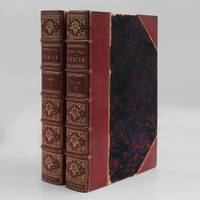
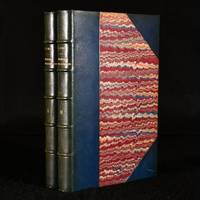
1903375024Paris: Bibliothèque-Charpentier. Eugene Fasquelle Édieeur 1903. First edition no. 14 of 30 copies on papier de Japon. 2 vols. Tall 8vo. Half red morocco spines gilt with floral onlays patterned silk sides preserving wrappers t.e.g. fore edge untrimmed. Some rubbing to silk at edges. Book label of Robert Hoe and another bookplate. Very good plus. First edition no. 14 of 30 copies on papier de Japon. 2 vols. Tall 8vo. The concluding work in Zola's final narrative cycle published posthumously. Bibliothèque-Charpentier. Eugene Fasquelle, Édieeur unknown
189186092Paris 1891. Fine. Paris 22 octobre 1891 13.30 x 20.50 cm une page sur un bifeuillet Autograph letter dated and signed by Emile Zola addressed to his friend the physician Maurice de Fleury dated in his hand October 22 1891. 16 lines in black ink on one page. ""Mon cher de Fleury je crois bien que j'ai trouvé quelque chose pour le supplément du Figaro. Venez donc causer entre cinq et dix heures . Si vous étiez au Théâtre libre samedi soir je songe que nous pourrions en causer dans un entr'acte ce qui vous éviterait de vous déranger ."" ""My dear de Fleury I do believe I have found something for the Figaro supplement. Do come to chat between five and ten o'clock . If you were at the Théâtre Libre Saturday evening I think we could discuss it during an intermission which would save you the trouble of making a special trip ."". Fleury indeed held the medical column at Le Figaro - it is perhaps following this letter and their ""conversations"" that Fleury writes these lines in the supplement of October 31 1891: ""toute l'école naturaliste ayant fait de la médecine les médecins logiquement ont fait de la littérature"" ""the entire naturalist school having practiced medicine doctors logically have practiced literature"". Zola relied on the expertise and scientific knowledge of Maurice de Fleury a student of Charcot to nourish his writing work on the Rougon-Macquart. De Fleury particularly shared publications from his library relating to heredity a subject at the heart of Zola's great social fresco - most particularly the generational transmission of nervous diseases fits of violence and alcoholism. Maurice de Fleury is also famous for having made ten years after this letter a medico-psychological study of Zola himself through the prism of his working habits: ""De dix heures à midi Zola rédige encore - moins facilement et moins bien que pendant l'heure initiale - et c'est fini pour toute la journée il ne sera plus bon qu'à écrire des lettres. C'est là la puissance du plus puissant cerveau dans le domaine littéraire à la fin du siècle. Avec ce tout petit traintrain modeste trois heures par jour en deux séances cet homme dont l'attention est modique . trouve moyen de nous donner tous les dix mois un de ces livres où ne manquent ni la solidité de la charpente . ni rien de ce qui constitue la force créatrice le génie pour dire le mot"" ""From ten o'clock to noon Zola still writes - less easily and less well than during the initial hour - and it's finished for the whole day he will only be good for writing letters. This is the power of the most powerful brain in the literary domain at the end of the century. With this very modest little routine three hours a day in two sessions this man whose attention is modest . manages to give us every ten months one of those books which lack neither the solidity of the framework . nor anything that constitutes creative force genius to say the word"". ""Maurice de Fleury entretient des relations étroites avec Émile Zola et Joris-Karl Huysmans avec lesquels il correspond dans les années 1880-1890. Fervent admirateur de l'auteur des Rougon-Macquart Fleury conseille Zola pour Le Docteur Pascal 1893 et confie son admiration dans un article du Figaro en 1896. Très « à la mode » parmi les « intellectuels » selon le mot de Victor Segalen le jeune médecin figure également dans la liste des auteurs symbolistes - aux côtés de Paul Adam Henri de Régnier et Gustave Kahn - dans un essai d'André Barre en 1911"" ""Maurice de Fleury maintains close relations with Émile Zola and Joris-Karl Huysmans with whom he corresponds in the years 1880-1890. Fervent admirer of the author of the Rougon-Macquart Fleury advises Zola for Le Docteur Pascal 1893 and confides his admiration in an article in Le Figaro in 1896. Very 'fashionable' among the 'intellectuals' according to Victor Segalen the young physician also appears in the list of symbolist authors - unknown
188283518Paris: Charpentier & Cie 1882. Fine. Charpentier & Cie Paris 1882 11 x 17.50 cm broché First edition one of 250 numbered copies on Holland paper the only deluxe copies after a few rare copies on China paper. First cover skillfully restored printed library stamp with numbering on the half-title page. Copy as issued. Charpentier & Cie unknown
42969sending his best wishes 4" x 2½" Rue de Bruxelles 21bis no date Zola was a French novelist journalist playwright and the best-known practitioner of the literary school of naturalism and an important contributor to the development of theatrical naturalism. He was a major figure in the political liberalisation of France and in the exoneration of the falsely accused and convicted army officer Alfred Dreyfus which is encapsulated in his renowned newspaper opinion headlined J'Accuse.! Zola was nominated for the first and second Nobel prizes in literature in 1901 and 1902. unknown
0199675961New. Brand new and still unused unknown
0143124706New. Brand new and still unused unknown
187590869Paris: Ernest Leroux 1875. Fine. Ernest Leroux Paris 1875 1879 12.2 x 11.8 cm Broché Second edition the dedication to Pierre Laffitte is dated 1879. A study of madness from a positivist perspective based on the work of Auguste Comte. The dedicatee Pierre Laffitte was the editor of the review ""Le Positivisme"". Spine cracked with small losses occasional foxing and a horizontal crease at the foot of the upper cover small marginal tears on the cover firts cover reattached. With a fine signed presentation inscription from Emile François Eugène Sémérie to Émile Zola on the half-title: ""A Mr. Émile Zola. Sémérie d'Aix"" the final word underlined. The close connections between positivism and naturalism the literary doctrine developed in the 1860s1880s are well known: positivist philosophy the observation of reality and the primacy of experience influenced naturalist writers in their concern to depict reality with strict objectivity. Zola made an essential contribution to the movement with his study ""Roman expérimental"" 1880. Ernest Leroux unknown
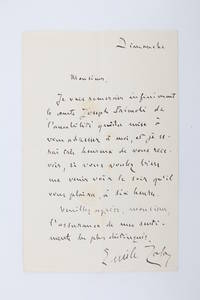
189480728s. l. Rome Rome 1894. Fine. s. l. Rome Rome Dimanche 4 novembre 1894 13.20 x 20.50 cm une page sur un double feuillet et une enveloppe Autograph letter signed by Emile Zola addressed to Ugo Ojetti. One page written in black ink on the first page of a double sheet. Folding inherent to postal transmission. Envelope included. This letter was addressed by the father of naturalism to journalist Ugo Ojetti when he had just arrived in Rome: ""Monsieur je vais remercier infiniment le comte Joseph Primoli de l'amabilité qu'il a mise à vous adresser à moi et je serai très heureux de vous recevoir si vous voulez bien me venir voir le soir qu'il vous plaira à six heures."" ""Sir I wish to thank Count Joseph Primoli infinitely for the kindness he has shown in directing you to me and I shall be very happy to receive you if you would be so good as to come and see me any evening that suits you at six o'clock."" Having arrived a few days earlier in the eternal city to conduct research for Rome Emile Zola hoped to meet Count Joseph Primoli there. The latter was unfortunately in Paris but he sent him this young journalist from La Tribuna who would serve as his guide but also as secretary. The two men clearly got along well and Zola even authorized Ojetti to adapt an opera libretto from his famous Nana. The project would unfortunately never come to fruition. Joseph Napoléon Count Primoli 1851-1927 was the great-great-nephew of Napoleon Bonaparte. Very close to the imperial family under the Second Empire he subsequently remained faithful to the salon of his beloved aunt Princess Mathilde in her private mansion on rue de Berri. His refined and witty conversation worked wonders there and he met as a passionate bibliophile some of the greatest writers of his time: Gustave Flaubert Théophile Gautier the Goncourts and Guy de Maupassant. unknown
1886803R45Paris: Librairie L. Conquet 1886. Leather. Near Fine. 8.5" by 5.5". None. A lovely illustrated limited edition of Emile Zola's short story collection in the original French language and bound in delightful leather. 'Contes de Ninon' was amongst Zola's earlier works a collection of short stories which first appeared in 1864 to which 'Nouveaux Contes a Ninon' was a sequel. First published in 1870 this collection includes works such as 'Le Grand Michu' 'Les Fraises' 'Lili' 'Le Forgeron' 'Le Chomage' and 'Le Jeune' amongst countless others. Illustrated with a frontispiece to volume I and thirty illustrations throughout by Ed. Rudaux.Limited edition of five hundred copies this being one of the 350 on Marais vellum and out of series. Presentation copy exemplaire offert hence out of series. Signed by the publisher to the limitation page. With the original wraps bound in. Written by Emile Zola a French novelist and writer known for his role in the political liberalization of France. He was nominated for Novel Prizes in Literature in both 1901 and 1902 the first two years of the prize.Bound by G. Rykers. Rel.Containing the ownership bookplate of E. L. B. with a delightful cockerel. In the original French language. In a half crushed morocco binding. Externally lovely with just the slightest general wear. Ownership bookplate to the front pastedown of each volume. Internally firmly bound. Pages are just slightly spotted to the first and final leaves but otherwise bright and clean. Near Fine Librairie L. Conquet hardcover
1892feb1187461892. Used. For more details please contact me unknown
1889046694Paris: E. Plon Nourrit etc. 1889. First Edition. Hardcover Half Leather. Near Fine Condition. Jean-Francois Raffaelli. Half green morocco over marbled boards spine a bit sunned original wrappers bound in. Black and white and hand colored illustrations throughout and 10 heliogravure by Raffaelli - number 29 of 40 on Japan and with an additional folding etching a version of the frontis signed in pencil by Raffaelli tipped in before the frontis. A lovely production. Size: Quarto 4to. Illustrator: Jean-Francois Raffaelli. Quantity Available: 1. Shipped Weight: Under 1 kilo. Category: Literature & Literary; Inventory No: 046694. E. Plon, Nourrit etc. hardcover
19272091202133209665Francois Bernouard 1927. Soft Cover. Fine. Number of books: 48 Francois Bernouard paperback
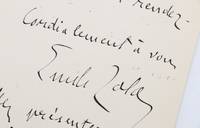
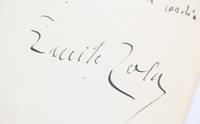
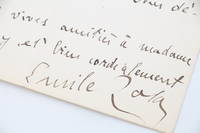
267670Paris n.d. 5 lines in ink on his engraved calling card Rue de Bruxelles 21 bis. 1 vols. 2-1/2 x 4 inches. Toned adhesive residue on verso. 5 lines in ink on his engraved calling card Rue de Bruxelles 21 bis. 1 vols. 2-1/2 x 4 inches. A bold signature from the great French novelist Emile Zola 1840-1902: "Merci mille fois de l'aimable prêt des deux volumes que je rendrai à mon confrère Schneider dès que je n'en aurai plus besoin. <br /> Cordialement Emile Zola". unknown
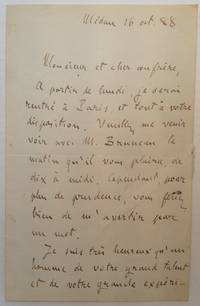
1888215987Median 1888. unbound. 2 full pages 8.5 x 5.25 inches Median France October 16 1888. In this letter Zola invites a colleague for a visit and conversation in part: ".Je suis tres heureux qu'un homme de votre grand talent et de votre grande experience veuille bein se charger d'un travail qu ne sera pas commode je le crains. " Slight creasing and natural folds; still very good condition.<br/> <br/> unknown
26932Médan 23 juillet 1882. 1 f. 135 x 215 mm de 2 p. encre noire. . « Mon cher confrère Je vous approuve vivement d'avoir renoncé pour votre journal au titre de Pot-Bouille qui ne signifiait rien …. Je me suis retiré de la presse je suis résolu à ne pas y rentrer ; dès lors pourquoi me poserais-je en donneur de conseils … Ce serait là jouer au personnage et je ne veux pas courir le risque de ce ridicule. Allez donc bravement de vous-même. Vous n'avez pas besoin de moi. Quand vous lanciez Pot-Bouille il fallait bien que Zola vous autorisât. Mais vous lancez Rabelais et Zola n'a ici que faire Rabelais étant de force à s'expliquer tout seul ». . Pot-Bouille paraît d'abord sous forme de feuilleton dans Le Gaulois entre le 23 janvier 18823 et le 14 avril 1882 aussitôt acclamé par Guy de Maupassant dans son article “ L'adultère â€. La publication en un volume chez Charpentier a lieu le 15 avril 1882 au moment où le feuilleton se termine : le public y découvre une critique au vitriol de la bourgeoisie logée chronologiquement au coeur du cycle et qui forme un diptyque avec Au bonheur des dames dont il partage le personnage central l'entreprenant Octave Mouret. Cette missive de juillet est adressée à Adrien Farge i.e. Joséphine Guéroult la directrice du Journal Le Rabelais publié à partir de cette année 1882 à Rouen. Maupassant y donnera deux textes Garçon un Bock ! et Au bois et citait volontiers ce journal dans ses lettres : “ en province c'est souvent dans les petits journaux qu'on trouve ainsi l'amour désintéressé des arts et l'audace qu'il faut pour entreprendre des oeuvres pieuses de cette nature qui ne rapporteront point d'argent †écrira-t-il en 1883 quand Le Rabelais organisa une petite fête locale en l'honneur de Louis Bouilhet organisée à Cany sa ville natale. Médan, 23 juillet [18]82. 1 f. (135 x 215 mm) de 2 p., encre noire. unknown