109 124 résultats
0012264Colchester Laurens Delaware County New York Rural New York. Fair with no dust jacket. Hardcover. On offer is a fascinating piece of Delaware County New York history held in one ledger book. The book contains the unique combination of a 1916 ledger kept by the staff of an auto mechanic garage in Colchester New York and the 1917-1918 personal diary of a young Colchester man who may have worked at the shop for a time. The book was used as a mechanic shop ledger between January 24 and July 30 1916. We believe the shop may have been owned by H. M. Barnhart. The ledger contains a ton of names from Delaware County along with notes on the services each person purchased from the shop the cost of gas oil labour car parts rides to and from their destinations and more. A large note at the bottom of the page following entries from June 29 reads: Gorse Gray left today June 29 1916 for Cleveland Ohio. There are then another 1.5 pages of mechanic shop ledger entries ending July 30 1916. The book then jumps to Sept 13 1917 and in Gorse Grays hand is written: Bought car 13 day of Sept 1917. The ledger book then continues as Grays detailed daily diary until December 31 1918. Gorse Simmons Gray 1892-1964 born in Downsville Delaware County New York to Charles and Mary Woodard Gray. Theirs was a farming family and along with his siblings Gorse was actively involved in farming operations. He married Anna Boyd 1900-1980 on Christmas Day 1918. Together they had six children five of whom lived to adulthood. Gorse became a machinist and woodworker. He was also elected to Laurens New York town office on the Republican ticket as collector town clerk and highway superintendent. A mystery of this ledger book is how it came into Gorse Grays possession. While the Gray family are listed as frequent customers at the shop particularly the patriarch Charles Gray and his farmhand Edwin J. Foote our diarist Gorse was still working in his family farming business in 1916 and did not become a mechanic until after he was married in 1918 so it is unclear how he ended up with the business ledger to use as his personal diary. Since he ultimately became a mechanic he may have been apprenticing at the shop in 1916. Grays diary provides insight into life in Delaware County in the early 20th century. In the course of his daily life and tasks Gray discusses Walton Delhi Shavertown Union Grove Ilion Clapton Pepacton Hobart and other nearby towns. He is working on his family farm and discusses the minutiae of that lifestyle as well as discussing the comings and goings of his siblings and other locals. He is dating Anna Boyd 1800-1880. Anna was a teacher who would later become a columnist for the Oneonta Star. As a whole this book is an absolute goldmine of information on the citizens and lifestyle in Delaware County. Some excerpts give the flavour of both the ledger and Grays diary: Geo Hoyt - 5 gallon gas 1.30 1 Gal T. Oil .50 . Archie Campbell - Bushings 0.55 . Ed. Smith 5 Gal Gas Paid 1.30 Gray and Foote 2 Gas Gal. .52 Chas Warren Vulcanising .30 C. E. Gray 1 Gal. Gas 0.26 April 24-26 1916. Took Mama Lydia Edna to Kingston used about 10 gal gas 2.80 Oct 18 1917. Very warm boiled sap all day and did not run much. Lee and I went down town I called on Anna a while she is much better. I went up to barber shop till Lee came played pool we got stuck coming home had to get a horse to pull us out was 12 when we got in March 21 1918. Nice day. Sap did not run much. I drilled all day. Took off some. Dad and Mother went to town. I got a letter from Anna going to assist tonight. We heard that the Kaiser has been captured March 25 1918. Washed car AM. WEnt down and got Anna. We went up back of School house for walk. She stayed to supper. Went down to go to Church but was late so we went for a walk. Lee went down to Church. We came home after. Lee came from Church April 7 1918. Worked at Jim Rutherford car most of day. Lee and I went down town. I saw Anna. Lee took Dr. Holmes up to Pepacton Sept 1 1918. Worked at corn & Threshing. Went down and got Anna. Les Edna and Papa went up to a Liberty Loan. I wrote Sam a letter Oct 11 1918. Stayed all night at Boyds got up about 8. Commenced to get read about 10 the wedding was about noon we had a good dinner we left for Laurens and arrived here about 8PM They were just read to have supper Edna had a Xmas tree Dec 25 1918. The account book is a ledger-style volume measuring approximately 11.25x5.25 inches. The covers are intact but show signs of wear. The binding is stitched and taped and is in good condition as are the pages. The handwriting is legible. Overall Fair. ; Manuscripts; 8vo 8" - 9" tall; Signed by Author . hardcover
18450002116London England. Good. 1845. On offer is a sensational original manuscript relic of Victorian times being the 1845 - 1855 handwritten diary and journal of a British officer as he settles in to retirement in London something he has wished for and who details his life and times with family and friends in great detail. Lt. Col H. Mitchell as stated on a front cover sticker 'Diary of Lt. Col. H. Mitchell 1845-1855' appears to be an old India hand keeping up with the gossip writing letters to Government meeting boats with friends and acquaintances returning from India. This intelligent and observant man a Senior Officer with a hint of the rogue allows the reader to see the elements of his life: family politics friends relations all the while there is a back drop of tensions; from the first pages about finances gone wrong especially with the Bank of Australia and how the impact of world politics would also affect his pocket book and also his seemingly unending interest in India. He also copies some verse and there is a most interesting letter copy to the Earl of Ripond regarding India. Here are some snippets: "Jan 1846 How little I have written in 1845! It has not been a fertile year of events it is true beyond the birth of our daughter. The one we are entering upon with I fear be more eventful for it can hardly fail deeply to affect my money affairs either for good or for ill. I find my incomes amount to 1200 pounds; were misfortunes to befall them I may be reduced to 500 pounds! Were the bank of Australia to recover its prosperity .and should we be forced into a war with America and it seems difficult to see how the Oregon question can be settled without war so overbearing are the pretensions and the conduct of the Americans my income may be reduced to less than 500 pounds without the house!" He notes in one of the last entries how the Queen saw fit to raise his rank to Colonel and while mostly ceremonial he was quite pleased. The 9½ x 7¾ inch half calf marbled boards contains 59 pages of narrative is overall G.; Manuscript; 8vo - over 7¾" - 9¾" tall; KEYWORDS: HISTORY OFLT. COL. H. MITCHELL 19TH CENTURY VICTORIAN ERA VICTORIAN GENTLEMAN LONDON ENGLAND INDIA EAST INDIA COMPANY THE AUSTRALIAN BANK BANK OF AUSTRALIA BRITAIN BRITANNICA UNITED KINGDOM COLONIAL INDIA HANDWRITTEN MANUSCRIPT AUTOGRAPHED AUTHORS DOCUMENT LETTER AUTOGRAPH KEEPSAKE WRITER HAND WRITTEN DOCUMENTS SIGNED LETTERS MANUSCRIPTS HISTORICAL HOLOGRAPH WRITERS AUTOGRAPHS PERSONAL MEMOIR MEMORIAL PERSONAL HISTORY ARCHIVE DIARY DIARIES JOURNAL LOG PRIMARY SOURCE FIRST HAND ACCOUNT SOCIAL HISTORY PERSONAL STORIES LIVING HISTORY ANTIQUITÉ CONTRAT VÉLIN DOCUMENT MANUSCRIT PAPIER ANTIKE BRIEF PERGAMENT DOKUMENT MANUSKRIPT PAPIER OGGETTO D'ANTIQUARIATO ATTO VELINA DOCUMENTO MANOSCRITTO CARTA ANTIGÜEDAD HECHO VITELA DOCUMENTO MANUSCRITO PAPEL . hardcover
19130007022AMHERST MASSACHUSETTS. Good. 1913. On offer is a very detailed diary of a woman living in Massachusetts in the early 20th century. Leatherbound this diary measures 4.75 inches by 3.75 inches. It has 365 pages and is 100% complete. The light tan-coloured cover is in very good condition and the handwriting is quite legible. Maud Arnold Bridges was born in 1878 and married William Lawson Bridges. They lived in Amherst MA where they raised their family. Her husband William worked in a creamery/ice house. Maud had been ill following unspecified injuries sustained from saving the life of a child according to a news clipping in the diary. She is 35 years old when she writes this diary. She passed away in 1918 at the age of 40.The diary is packed with the small everyday details of a woman running her busy household. From context it also appears that she and her husband take in boarders which adds to her busy days. It is replete with references to family and friends and the many tasks that fill her hours. . Swept the bedroom thoroughly and did a lot of general work. D washed the diningroom windows for me. Carried Lillian a piece of squash. She came in here for few minutes. Rec'd paper from Mrs. Maltz. Went up to sew with D. Got a lot done in my dressing sack. Just as pretty as it can be. Felt very much better today and accomplished a lot . Feb 21 Cloudy very windy Horrid day. I washed and did quite a little general work. Will feels some better but coughs badly. Wrote to Blanche. Received lovely Easter cards from Jessie and her Ma and from Blanche and one from Mildred and Eva. Went in to call on Lillian's cousin Mrs. Jones - very pleasant but nothing brilliant and about as homely as Lillian not quite such a mouth. Wrote to Jessie Mar 24 Such a treat to see the sun. Will got our back room in order again and we got our things back in our room. Worked all day getting settled. Lillian and John came in twice after church hinting and expecting an invitation to dinner which they didn't get. After dinner Will and I read and it seemed so good to have it quiet again . May 25 And so it goes -her diary is filled with daily chores and interactions with people. She mentions excursions in the Amherst and to nearby places such as Northampton Springfield and Holyoke MA. Her days are simply jammed with housekeeping tasks baking sewing etc. She records births sicknesses and deaths within her circle as well as a constant back and forth with visitors. Her focus is home family and friends. There are no references to events in the larger world such as Woodrow Wilson's becoming the 28th President of the United States or the 50th anniversary of the Battle of Gettysburg which attracted thousands of veterans. This is an excellent glimpse into the working of an ordinary American urban home in early 20th century America. It provides a very clear and detailed picture of the life of a married woman at that time and would be of interest to students of women's studies or urban history.; Manuscript; 32mo - over 4" - 5" tall; KEYWORDS: HISTORY OF MAUD ARNOLD BRIDGES; WILLIAM LAWSON BRIDGES; AMHERST MASSACHUSETTS; GENDER STUDIES WOMENS STUDIES NEW ENGLAND AMERICANA HANDWRITTEN MANUSCRIPT DOCUMENT LETTER AUTOGRAPH WRITER HAND WRITTEN DOCUMENTS SIGNED LETTERS MANUSCRIPTS DIARY DIARIES JOURNALS PERSONAL HISTORY SOCIAL HISTORY HISTORICAL HOLOGRAPH WRITERS AUTOGRAPHS PERSONAL MEMOIR MEMORIAL ANTIQUITÉ CONTRAT VÉLIN DOCUMENT MANUSCRIT PAPIER ANTIKE BRIEF PERGAMENT DOKUMENT MANUSKRIPT PAPIER OGGETTO D'ANTIQUARIATO ATTO VELINA DOCUMENTO MANOSCRITTO CARTA ANTIGÜEDAD HECHO VITELA DOCUMENTO MANUSCRITO PAPEL . hardcover
19430001255BLACKPOOL LANCASTER ENGLAND UK. Good. 1943. On offer are two 2 original manuscript World War II RCAF diaries handwritten by T.J.F. Cross of the RCAF 423 Squadron. These diaries are uncommon in a number of ways: T.J.F. Cross was both an Airman as well as a Flight Mechanic; his Squadron flew in coastal patrols of the British Channel in the famed Sunderland Flying Boats whose responsibilities were numerous: missions in search of crews in the water searching for U-Boat submarines or dropping bombs etc. etc. The son of Cross once stated: "Dad was an Airman not a Pilot. He flew shore patrol in the British Channel in Sunderlands Flying Boats .the son knew of a miraculous event he experienced when their Sunderland went down in the stormy Channel. They jettisoned their Load of depth Charges and then the Pilot was able to take-off from the turbulent Sea by riding the Plane along a wave until they were airborne. When they landed they found that the wings had been twisted by the force of the water such that they said that the Plane should not have been able to Fly!" That particular Mission is noted in the 1942 Diary on Wednesday September 23rd 1942." Here are snippets: 1942 RAF Blackpool Lanchester: January 7th: Worked on kite all day. "A" cracked up on take-off this morning. Couldn't get up flying speed so pilot retracted undercarriage and came down on belly. January 17th: "L" crashed in sea. Squadron Leader Keddy Canadian pilot lost. Only two men of crew of six of "L" picked up. February 25th: Paraded at 7:30am. Went to school in the afternoon. Learned stress and strain and draughting. April 16th: Started in third week of metal repairs today. Making patch repair on tubular Hurricane fuselage. August 4th: Jack and I were interviewed by C.O. about flight engineer. I'm trying to get flight rigger. September 5th: We launched "D" at 4:00pm. Johnny Wharton pilot Lofty Ryder rigger and myself stayed on board until 7:30pm. September 17th: Up at 0330 hrs. Took off at 0600 on air sea rescue. Four men from a Hudson that crashed about 300 miles out in the Atlantic. Looked for them for over six hours but couldn't find them. Landed at Oban again at 5:30pm. September 23rd: Rain. On board at 9-30. Took off at 11-25. Met convoy in North Atlantic. A little excitement over a box in sea. We forced landed on sea at 7-10. Two port engines quit. Rough sea and I was sick. Took off at 8:00pm. In Oban 9-30. "B" pretty badly battered. September 24th: Went to Dungallon at 1000 hrs. Investigation about "B". Went aboard and cleaned up in afternoon. Flight Commander inspected the damage. September 30th: Took my logbook to Dungallon. We're flying "B" to South Hampton. Took off at 1430. Flew down west coast. No guns in turrets. I done mid upper turret watch. Flap motor burned up. Landed at Pembroke Doch Wales. November 14th: Up at 0400 hrs. Off at 0605 hrs. We're on anti-sub patrol and looking for dingy. I done two watched in mid-upper and one in front. Mistook whale for sub bags of panic. Fired at whale. I fired U.G.O. in front turret. Landed at Pembroke Doch at 1655. November 16th: On board at 0900 hrs. Took off at 1040 hrs. We saw two subs and heavy cruiser they were all ours. November 21st: Cloudy. Went on board at 1000 hrs. Took off at 1110 hrs. We went after a life boat with about fourteen people in it. Contacted them o.k. We directed a destroyer to them and it picked them up at 2000 hrs. "D" attacked by Junkers 88. Came out o.k. November 23rd: On anti-submarine patrol 600 miles out in Atlantic and straight back. Didn't see a thing. November 27th: On anti-sub patrol but bad weather. So just straight out and back. Done three turret watches two in front and one in mid-upper. Fired U.G.O. at flame float. November 30th: On convoy escort. Took off at 0345 hrs. Sighted convoy o.k. 65 ships southbound. I sighted a water spout and thought it was a sub. I fired mid-upper guns at white caps. I cleared four stoppages. December 29th: Cold windy snow. Take off at 0445 hrs. We were out 2 hrs. approximately 300 miles. When starboard inner started to miss and backfire so we came back. Only out 4 hrs. 1943 Blackpool Lanchester: January 11th: Took off at 1350 on air test. We flew to Donegal Bay and dropped four depth charges. Very rough today. New 2nd pilot on board so ropey landing. One civilian drowned at "P" when barge turned over. January 13th: Up at 0400 hrs. Take off at 0600. On anti-sub sweep. "F" running swell. Saw barrage balloon about four hours out. Must be attached to some ship that was sunk. Done four hours in front turret. All kinds of weather today sun rain sleet and snow. We were 150 miles south of Iceland. January 27th: Called at 0600 hrs. Take off at 0745 hrs. Got airborne when port outer engine quit. Linkage of throttle control came off. Managed to get back alright but nearly crashed into island. February 27th: Reported to Flight Commander. I'm still flying with F/O Howell. March 3rd: Reported to work in rigger's shop. Went out to "F" and got my mae west and helmet. Turned all my flying kit into stores. Went out to "H" she's got a hole in her keel. Helped Corp. Norton and F/O Whitbeck put plastercine on hull. March 15th: Went to work at 1330 and worked on "F" all afternoon. 201 Squadron pranged a sub yesterday. March 19th: Our "E" pranged a sub today and a boat of 228 Sqdn. attacked one. March 20th: My old kite "F" attacked two subs today and our "H" sighted another. April 15th: Down to crew room at 0900 hrs. Went out and done d.i. on "J" and "G". "G" supposed to swing compass but didn't. Out to "J" at 1400 hrs. Take off at 1410 on local bombing. Dropped about 40 bombs. Hewitt of 201 Squadron committed suicide over Donegal Bay by jumping out of aircraft. May 6th: Took off at 1450. Weather clear. We're on anti-sub patrol around the Queen Mary. She was escorted by one cruiser one carrier and three destroyers. She was really moving going in a westerly direction at about 15 knots. July 22nd: Went to early tea because our "J" for Jesus shot up by Focke Wolf Condor over Bay of Biscay. Worked til 2130 getting her up slip. Tail gunner Sgt. Sullivan got slivers and shrapnel in his face and Second Pilot hurt in shoulder and leg. Kite has common shell holes in hull wings cockpit and float. Leaking pretty bad. I got piece of shell out of bilge. F/Lt. Musgrave Captain. They sure were lucky to get out alive. October 20th: Arrived in London 1330 hrs. Had dinner at Beaver Club and then went to Lou's. Air raid "alert" at 0100 hrs. tonight. "All clear" went 1:30am. Bombs dropped somewhere on London. November 12th: Our "D" crashed while landing in a flare path last night. One man trapped inside when she sank. Three drowned and one was F/O Hill. Another man died in hospital from skull fracture. Fl./Lt. Lee Skipper o.k. November 13th: "J" went down with engine trouble 2 hrs. from base just outside Donegal Bay. Kites from here on search but no signs of survivors. December 27th: 26000 ton German battleship "Scharnehorst" sunk off coast of Norway by our battleships. We've been after her a long while too." Included is the Airman's Pay Book with entries from 1943. Overall G.; Manuscript; 12mo - over 6¾" - 7¾" tall; CANADIANA RCAF RAF ROYAL CANADIAN AIR FORCE SUNDERLAND FLYING BOATS WWII WORLD WAR II HANDWRITTEN MANUSCRIPT DOCUMENT LETTER AUTOGRAPH DIARY JOURNAL LOG KEEPSAKE WRITER HAND WRITTEN DOCUMENTS SIGNED LETTERS MANUSCRIPTS HISTORICAL HOLOGRAPH WRITERS DIARIES JOURNALS LOGS AUTOGRAPHS PERSONAL MEMOIR MEMORIAL PERSONAL HISTORYantiquité contrat vélin document manuscrit papier Antike Brief Pergament Dokument Manuskript Papier oggetto d'antiquariato atto velina documento manoscritto carta antigüedad hecho vitela documento manuscrito Papel . unknown
18960008072NEW BRUNSWICK CANADA. Good. 1896. On offer is a unique and valuable informal log of a sailing ship from the age of the great clipper ships. This small paperback volume measures 8 inches by 5.25 inches. It contains 84 pages and is 65% complete. The body of the journal has separated from the cover but both are none-the-less in good condition. The handwriting is clear and legible. Siddartha is a commercial sailing ship sailing between Cape Tormentine New Brunswick Canada and Manchester UK. She departs August 19th 1896 and the journal ends on September 12th 1896 while she is still at sea. Siddartha is a barque which means she carries three or more masts. The sails are square rigged except for the aft-most or mizzen mast which is rigged fore and aft. Ships rigged in this manner required less crew and were generally faster than schooners and similar fully square-rigged vessels. The author is unknown. However context suggests that he is a passenger as both 1st and 2nd mates are referred to and crew would not have this leisure time. He seems well-acquainted with the Captain. Unlike a ship's officer he does not stand regular watches and spends much time either drawing or working on a ship model. However the author displays a comfortable familiarity with sailing and sailing ships. He is obviously literate and his writing is very good. The journal details a passage made by Siddartha between Canada and the UK. Casual research has not turned up much information on the vessel. The earliest reference to her indicates that she was in service at least as early as 1882. The last mention of her notes that she was abandoned off the Azores in 1899 and was reported as a floating derelict. The journal gives an excellent account of life on a commercial sailing ship.: "Sailed Wednesday AM Aug 19/96. Towed out by the tug William Aitken of Charlottetown . Breeze light. After casting off from tug set all sail and steered a straight-course for Pictou Isld. Light shower about 11 A.M. Dinner. Breakfast. Went on deck found sun shining brightly and the ship sailing along with all sail set before a stiff breeze from the North . Rolling slightly. Sighted Cape George about 8:00. The wind being smooth the Captain decided to run through the Straits of Canso. Ships course has been changed and we are heading a little to the east of Cape George. Sighted the Cape Breton shore about 9:00. Passed a steamer steering a course for the Island probably for Charlottetown from Halifax. Could not make out her name. Talk with the Captain. He says that late last night after I left the deck that the wind again failed and we dropped away under the Amet Island ." Aug 20 "Lat 40.10 Long 57.27 Course South by South Distance Run 140 miles" Aug 22. He notes passing fishing boats: ". 2nd Mate Kelly says we passed through a fleet of 14 fishing schooners last night. This morning there are 10 or 12 in sight and we can see the men out in their dory's fishing their trawls. The 1st Mate Mr. Hair rigged up a line and caught 2 nice sized cod fish . "Aug 23. Throughout their crossing he notes other ships that come within view including a small schooner a four-masted passenger liner and a Norwegian ship named 'Neptun'. As they approach the English Channel traffic picks up and he notes many other vessels - 19 in one day. As they pass the Skerries they pick up their pilot for the run to Liverpool. The voyage ends at the canal docks in Liverpool as the authors is preparing to take a canal boat to Manchester. This is an excellent example of a routine passage for a sailing ship across the Atlantic. A naval historian would find confirmation of the many details in the day-to-day operations of a large civilian passenger ship. A writer interested in this naval time period would find the daily routines rich in detail. From changing weather patterns to repairs made underway the notes are a quiet understated depiction of life on board.; Manuscript; 8vo - over 7¾" - 9¾" tall; KEYWORDS: HISTORY OF SIDDARTHA; BARQUE; SAILING VESSELS OF THE 19TH CENTURY; OCEAN GOING TRADE COMMERCE MARINE NAUTICAL ATLANTIC OCEAN GRAND BANKS; CAPE GEORGE CAPE TORMENTINE NEW BRUNSWICK CANADA NOVA SCOTIA STRAITS OF CANSO LIVERPOOL UK ENGLAND BARQUES OCEAN TRAVEL SEA VOYAGES NAVAL HISTORY SAILS SAILBOATS BOAT CANADIANA HANDWRITTEN MANUSCRIPT DOCUMENT LETTER AUTOGRAPH WRITER HAND WRITTEN DOCUMENTS SIGNED LETTERS MANUSCRIPTS DIARY DIARIES JOURNALS PERSONAL HISTORY SOCIAL HISTORY HISTORICAL HOLOGRAPH WRITERS AUTOGRAPHS PERSONAL MEMOIR MEMORIAL ANTIQUITÉ CONTRAT VÉLIN DOCUMENT MANUSCRIT PAPIER ANTIKE BRIEF PERGAMENT DOKUMENT MANUSKRIPT PAPIER OGGETTO D'ANTIQUARIATO ATTO VELINA DOCUMENTO MANOSCRITTO CARTA ANTIGÜEDAD HECHO VITELA DOCUMENTO MANUSCRITO PAPEL . paperback
0012231Nebraska France. Good with no dust jacket. Softcover. On offer is a superb diary of a 27-year-old farmer from Nebraska serving in Europe during WWI as the war came to its end. The author of the diary is Walter John Smith 1891-1950 of Holdrege Nebraska. He worked his entire adult life at his own farm where he died at age 58. Smith married Judith Anderson in June of 1920. Together they had two children Marilyn and Martha. Smith was registered for the army draft in August of 1917 and called up in October 1917. During the First World War Corporal Walter John Smith was attached to the 314th Supply Train 89th Division. The 89th Infantry Division was formed in Aug 1917. After training at Camp Funston it was shipped overseas where the Division saw action at St. Mihiel and participated in the Meuse-Argonne Offensive. Following WWI it was reconstituted as a Reserve army unit until being reactivated in WWII. In WWII the Division nicknamed the Rolling W served in north west Europe taking part in the drive into Germany. The 89th liberated Ohrdruf a sub-camp of the notorious Buchenwald concentration camp. Following WWII the 89th was reactivated as a reserve unit a role it continues to fill today. Smiths diary covers the period June 1918 to June 1919. He begins writing on June 4 1918. He is leaving his training camp to head to Europe and he writes Camp Funston. Left at 11: 30 A. M. . On June 28th he shipped out writing Aboard the Lapland. Left port at 9: 30 17 ships left at same time. Everything gone lovely so far June 28 1918. Prior to being requisitioned as a troopship SS Lapland was a passenger liner. She was the ship that brought the surviving members of the Titanics crew back to England after the U. S. Investigations into the sinking were completed. Once in France his entries describe his daily work and movements: Got our cars ready in morning. Started out 1 oclock. Traveled 65 miles. Roads are real dusty. Landed at Navgon July 22 1918. Started from Navgon 6. Drove 200 miles. Landed at Ville France 7: 30. Stayed all nite July 23 1918. Started from Ville France 7: 30. Arrived Dijon 3: 30. Stationed at camp all nite July 24 1918. Fixed a place for our pup tents in the morning. Fixed my truck in afternoon. Ready to go out at 7 oclock. Brought Bat from 355 back ten miles from trenches Aug 23 1918. The big drive started at 1 A. M. . Reported to 355 Hospital Got a load of flour and oats and moved to the front. Drove all night Sept 12/13 1918. Note: This entry refers to the Battle of St. MiheilLeft for 7 A. M. Got a load of soldiers brought to Bouillonville Seen Oscar Swanson Back at railhead to Bouillonville with load of blankets Sept 23 1918. Didnt do anything all day. Had my truck fixed. Peace signed 11 oclock" Nov 11 1918. On May 21 1919 he shipped out for home. His last entry reads: Got my discharge one oclock. On the train leaving for home. Finish June 12 1919. Interestingly at the back of the diary there are an additional four pages of diary content two of which cover December 12 and 15 of 1918. Two are undated. These pages are very long entries that must have needed the extra space. There are also a few pages of names and addresses that he kept from his time overseas. For a historian this is an excellent first-hand account of day-to-day life in a unit supporting troops in the trenches. It is rich in detail mentioning other soldiers by name places where he was posted or stayed and work that he was doing. It paints a very clear picture of life behind the lines. The diary measures 5.5 inches by 3.25 inches and contains 95 pages. It is 95% complete. The cloth cover is in good condition. The spine is undamaged but the binding had cracked along the inside cover. The pages and binding are in good condition and the handwriting is legible. ; Manuscripts; 8vo 8" - 9" tall; 95 pages; Signed by Author . paperback
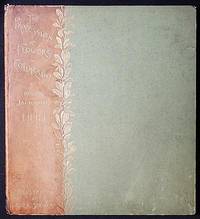
1886003136Boston: Roberts Brothers 1886. Hardcover. Very Good. 30 4 p.: hand-painted water color floral illustrations on 13 pages; 29 cm. Original wide cream calf spine with gilt-stamped cover title; light green paper over remainder of boards with gilt-stamped floral decoration running along leather-paper border. White moire endpapers. Lacking original slipcase. This is no. 47 of a limited edition of 100 copies each numbered and signed by the artist Alice Stewart. There are two or more binding variants. The illustrations vary in each of the 100 copies of this beautiful book. In Very Good Condition: edges are rubbed; binding lightly soiled; front free endpaper detached but present lacking lower gutter corner; first blank leaf following front endpapers also detached but present; a few small spots of light discoloration as is typical of this book; otherwise clean and bright. Roberts Brothers hardcover
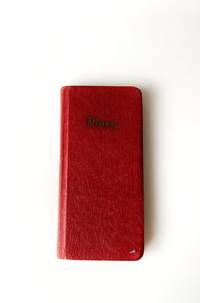
0011014Austria Germany: Royal Artillery Britain Austria. Very Good. N.D. Full-Leather. On offer is a very interesting pocket notebook carried by a British Army officer during WWII. The author of this notebook is Major H. A. Hansen. Hansen served in the Royal Artillery during WWII. Following the war Hansen was part of the British contingent serving on the Allied Commission for Austria which assumed control over Austria following the defeat of Germany in 1945. Specifically Hansen served in the Economic Division. Although our informal research has not been able to discover any additional biographical information there is an apparent home address from Liverpool UK. This is a fascinating notebook. It is his jottings of information that he felt was important to note as he carried out his duties in Austria after the fall of Hitler's Germany. One long section deals with an overview of the country itself and major economic sectors. For example: "Clothing : 1938 a self-supporting i. E. 'making up" industries especially in knit wear which was of high grade quality and there was quite considerable of this style of goods. Mostly restricted in Vienna to pre-1938 men under Jewish control. Latest evidence factories still in existence under Nazi control. Present products not known. Chemicals : Chemical industry controlled almost exclusively by I. G. Farbenindustrial Development an issue of great complexity. Pharmaceutical branch will be of great importance. Domestic supplies of will be inadequate. Majority of chemical works vicinity of Vienna Moosbierbaum in Oberdonau and in Steimach." Another section contains a list of fuels and natural resources available. He includes a list of German abbreviations their full meaning and a translation. He talks about the objectives of their mission: "Objectives : Basic objective to ensure controlled development of Austrian mineral resources. : a to the extent necessary to maintain an industrial activity at level approved by Allied High Command b to the further extent necessary to supply fuel and raw materials for essential Austrian needs and to the additional extent necessary to provide such supplies ass shall be approved for international transfer or international requisitions". For a historian of WWII and the immediate reconstruction period following the war this is an outstanding primary source document. It is one thing to read the dry reports and records of such administrations but it is another thing entirely to see the private notes of someone who was intimately involved. This notebook is a small ring binder measuring 6.25 inches by 4.0 inches. It contains 108 pages held by a 6-ring binder clip. The notebook is 75% complete. It is in very good condition. While the leather cover shows some signs of wear its in completely intact. The binding and pages are in good condition and the handwriting is legible. ; Manuscripts; 8vo 8" - 9" tall; 108 pages; Keywords: handwritten manuscript document letter autograph writer hand written documents signed letters manuscripts historical holograph writers autographs personal memoir memorial antiquité contrat vélin document manuscrit papier antike brief pergament dokument manuskript papier oggetto d'antiquariato atto velina documento manoscritto carta antigüedad hecho vitela documento manuscrito papel post war Germany World War Two WW2 British Royal Artillery Austria soldier notes front lines British Army; Signed by Author . Royal Artillery, Britain, Austria hardcover
0011140WAYNE COUNTY NEW YORK BUTLER WOLCOTT. Very Good. Softcover. On offer are two diaries written just over a decade apart by a Wayne County New York farmer and his wife. The pair of diaries present the busy and thankless lives of early 20th century farmers from both the male and female perspective. The authors of these diaries are a husband and wife duo John Nelson Pitts 1875-1961 and Minnie R. Pitts nee Wells 1874-1957. John was born in Butler New York and lived near Wolcott New York for his entire life dying in Huron. Minnie was also born and spent her life in Wayne County. They married in 1904 and did not have any children. The 1913 diary was written by John when the couple is in their late-30s. The 1924 diary was kept by Minnie when they are in their late-40s. Johns 1913 diary details the day-to-day workings of his farm. His entries are short and sweet but very consistent. He writes every single day in 1913 and adds additional notes about his work days in the Memoranda section. Some excerpts of Johns diary follow: Cloudy & squally. I picked up around the A. M. And we cut wood this P. M. Snowy in the eve Jan 27 1913. Fine and cool. I sowed grass seed this A. M. And helped Elmer cut wood P. M. Apr 9 1913. Fine and cool. I the orchard and helped Elmer in P. M. We Minnie and I went and got the new rake. Fine eve July 15. Fair and warm. I cut corn today for myself. Minnie helped this P. M. Cool eve Sept 19 1913. Fine and cool. I husked corn and chores. Min washed and is cross Nov 25 1913. Minnies 1924 diary is equally as consistent as Johns. She writes every single day and her entries are very detailed. She is the quintessential farmers wife and it is plain to see that she is a very busy hard-working woman. Some excerpts follow: Cold this morn 6 above zero. Bright all day. Cold west wind. We over to G. Fowlers this A. M. And I washed this P. M. - J cleaned out smoke house Feb 18 1924. Snow squalls and flurried all day. Wet and nasty time. I made birthday cake for John on his birthday tomorrow. M and Lewie here in P. M. And I passed a lunch. Fire in furnace felt good Apr 20 1924. 46 degrees this morn fair today and cool. I washed picked cucumbers and stuff from garden. Wella boys called at noon. Deetzs goods came this P. M. 5 truck loads. J. Plowing and drew some hay. Still cool this eve Sept 4 1924. Rained all day today J choring around & he & Chas fixed she to put roosters in J put hogs in pen in P. M. And I crocheted. Chas laid down in P. M. Dixie cow has a little calf this eve Sept 30 1924. For a social historian these two diaries give an excellent look at how this couple managed their farm. It also shows very clearly the division of labour and the clear gender roles of the people involved. For a Gender Studies program this would be a very good illustration of how these played out at this time in rural America. The 1913 diary measures 5x3 inches and contains 182 pages. It is 100% complete and is in overall Fair condition. The 1924 diary measures 5.5x2.5 inches and contains 52 pages. It is 100% complete and in overall Good condition save for some staining on the pages. ; Manuscripts; 8vo 8" - 9" tall; Signed by Author . paperback
18660012209Chicago Europe. Fair with no dust jacket. 1866. Softcover. On offer is a fine detailed record of an American businessmans travels and business dealings in Europe in the 19th century. The author of the record is unknown. However from context he is an American well educated and a successful businessman. Whether he is an entrepreneur or working for a firm he is clearly working at a high level having earned wealth and the respect of those around him. We know that when not traveling he lives outside of Chicago With his wife Belle and children. The journal opens with our diarist already in Paris. His subsequent travels take him first to Spain Portugal Algiers and Italy. He then travels across Europe to Britain and Ireland and then home. His diary begins on January 1 1866 and continued until his return home on May 8th 1866. Along the way he recounts numerous sights describes meeting with agents in various cities and his own insights and opinions on his experiences. His interests range from produce to wines to machinery. He opens his diary with a sweet descriptive entry which sets the tone for the rest of his diary: Commencement of a new year and under circumstances far different from any heretofore in my life. Away from family from Home in a foreign land. Also just commenced a Christian life. Hope to grow in grace. The change must come naturally. The morning of the day passed in looking up courier for the trip to Spain. The nobility of Paris all out in splendid equipages calling at the 2 milleries on the Superior. Beautiful day. Called on Mrs. Isham Mrs. Farmain Mr. Bigelow Mr. Samson and Bishop Whitehouse. Dined with Mr. And Mrs. Schley and their family. Mr. Peck included. Have a bad head cold Jan 1 1866. All of his entries are equally long and detailed as the above and the following excerpts are tiny snippets of each entry from which they are excerpted: . Called in at the American Consul Mr. Davidson formerly of Chicago. Going with him to see Extensive Wine Cellars Jan 3. .All well & happy Wish I knew that my family were as well. I can only hope & pray that they are Jan 26 written on board streamer from Algiers to Marseilles. Called on American Consul Mr. Monti. Inquired about wines. Finally arranged with a Mr. Morrison to ship some to New York. Next to Monte Peregrino which is about 2ó miles from the City ed note: Palermo. Feb 9. As he travels across Europe he diligently keeps a record of what he sees and visits. A man who appreciates culture he visits cathedrals museums and art galleries enjoys opera and dines well. He is a keen observer of what he sees while travelling by train. .Took car for Munich . Country as far as could see was beautiful. The RR Route being a little off from the valley of the Danube on the left hand side through a fine agricultural country Mar 16. .Recd letter from Frankfurt about wine and purchased it. Called on Mr. C agent for Woods NY. who went with me to see agents of Howards to Fowlers Steam Plows. Made arrangement to go in county to see them work Apr 16. At the back of the dairy our author has done a spectacular job noting his expenses. His expense accounting is extensive and detailed covering a range of services and items not unlike a business traveller today. This small journal is excellent source material for a historian looking at the efforts of American business to work with and expand international contact at the very time the country is beginning to recover from the Civil War. More than a dry recitation of meeting information it presents Europe through the eyes of an American business executive. The expense ledge gives a good idea of the actual costs of goods and services in various places across the continent. This small notebook measures 7.25x3.0 inches and contains 42 pages. It is 100% complete. The covers are missing from the notebook. However the sewn binding is intact and all of the pages are in good condition. The handwriting is legible. Overall Fair. ; Manuscripts; 12mo 7" - 7½" tall; 42 pages . paperback
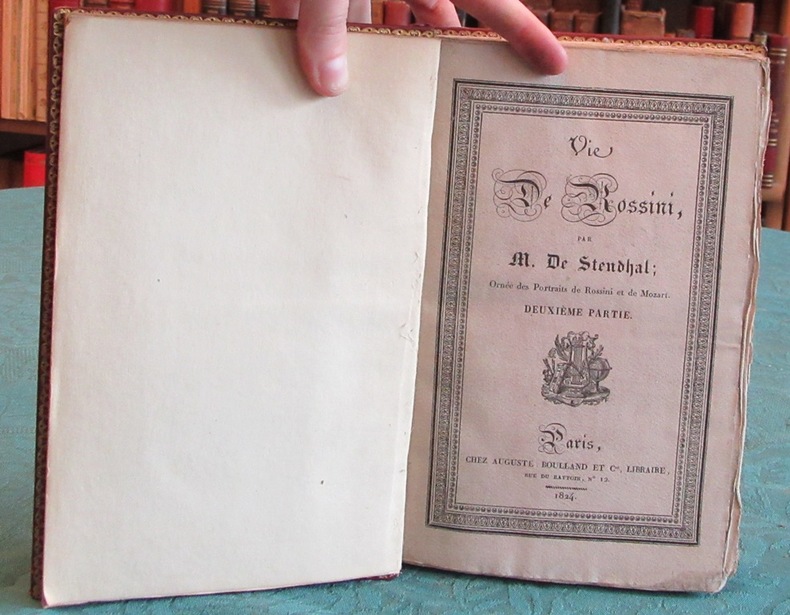
182418927Par Stendhal (Henry Beyle de). Ornée des portraits de Rossini et de Mozart.Edition originale. Paris, chez Auguste Bouland et cie, libraire, - 1824. - viii pp + 623 pp.en continue.Somptueuse reliure plein maroquin cerise de l'époque signée Sim. Kra. Rel. Dos à nerfs orné de caissons et de fleurons dorés. Filets dorés encadrant les plats. Dentelles dorées sur les contreplats. Couvertures et dos conservées. Quelques légères rousseurs éparses. Très bon état. Format in-8°(22x15).
19520010018On offer is a small diary where young American Army MP Charles A. White recorded his experiences in Korea during the war. <br /><br />White was from St. Louis Missouri. He enlisted in the United States army in 1948 and served in the 95th Military Police Battalion. This battalion was the largest most geographically dispersed military police battalion in the United States Army. The unit fell under the command of the 18th Military Police Brigade. The 95th was activated in June 1945 in Germany and operated until its inactivation in June 2014. It served in post-war Germany the Korean War the Vietnam War Iraq and Afghanistan. <br /><br />White's diary begins with him preparing to board the troop carrier USNS General Hugh J. Gaffey leaving from Fort Leonard Wood and bound for Korea. "Went aboard USNS Gen. Hugh J. Gaffey at 1300. Cold nasty day. Ship large nice. Sposed to be best troop ship. Pacific. Movies crowded. Food not bad. Weather warming. Do nothing today but police. Am enjoying trip a lot. Wish was in Navy. Ship 16000 tons. 608 feet 23 knots. Said to be in tail of hurricane. Weather worsening. Little sleep tonight almost tossed out top bunk. Still stormy; ships paper reports 60 foot waves still supposed in hurricane. Dependents topside. Certainly going first class" April 2. <br /><br />On April 14 the ship arrived in Japan. "Weather nasty. Word passed we have guard tomorrow for debarkation. Rainy. Passed Yokosuka dropped hook. Still raining cold. Guard debarked ship. Jap train to Camp Drake. Processed. First views of Japanese and buildings. Little wooden hovels and some US type buildings. People smile seem very friendly to US G. I.' s. Drake's buildings 450 ft. Long. Jap prep school. PX fabulous. Thru processing. Hope I get G. H. Q. Find M-1 for zero. Japanese are interesting bunch. All smiles and little bows. Beginning to realize a little of what people like about this place." <br /><br /> White's April 30th entry discusses the Bloody May Day riots for which he was present. By June he had arrived in Korea. "We pull CQ here every fifteen days and it gets rather tiresome after awhile. Have a lot of planes. Red and Yellow for air and ground attack several air alerts but no enemy planes. The Han Bridge is blocked out as is a great deal of the area surrounding it which makes it a glorious black target in the midst of the lited area in case of a possible raid. Won is supposedly sold legally at 6000 to the dollar but the value fluctuates with the time of the month near or far from payday on the black market and who buys it legally The usual range is from 7000 right after payday to maybe 110000 toward the end of the month. You are continually besieged by little boys who look to be about 7 but are probably nearer 17 who want to 'changyamung' or invite you to a 'Horahora' where they assure you the girls are all clean well educated and Japanese" June 9. <br /><br />Measuring approximately 2.5 inches by 5.75 inches the diary contains 52 pages and is approximately fifty percent complete. The cover and binding are in good condition as are the pages. The handwriting is legible. This is an excellent perspective of the Korean War seen through the eyes of an MP who was there on the ground. A military historian would find this valuable in cross-referencing other information. White's comments add a human note to this very grim war experience. hardcover
1862000789New York New York NY USA Oneida Chenango county. Good. 1862. On offer is a super detailed Civil War era diary by a circuit-rider school teacher who we believe was a Charles J. Peterson of Philadelphia who details his visits stays 'scholars' and local events of the area he serviced in central New York state. The author has connections to the area as he mentions births and funerals specifically related to him and his family. This diary will prove a wealth of genealogical and historical first hand information in central New York State specifically Oneida and Chenango counties. Each day begins with where our author will sleep that night. He also records the number of students daily and then makes a separate note in the margin. Research suggests he is paid by the number of students he teaches per day. The writer is also very involved in the communities - singing schools assisting in farm chores; hauling wood taking up carpet tapping sugar bush cleaning up etc. being nominated at 'Caucus' to be a constable meetings with the Teacher's Association a child dying from diphtheria his own bout with Scarlet Fever and so on. It seems teaching duties end in the spring when the weather improves and though he travels around a bit still our writer settles with one family for the summer and does farm labor for the most part. Diary is a small size measures 4" x 2 ½" & is all intact & clean with supple pages some wear on spine.; Manuscript; 48mo - over 3" - 4" tall; HANDWRITTEN MANUSCRIPT DOCUMENT LETTER AUTOGRAPH DIARY JOURNAL LOG KEEPSAKE WRITER HAND WRITTEN DOCUMENTS SIGNED LETTERS MANUSCRIPTS HISTORICAL HOLOGRAPH WRITERS DIARIES JOURNALS LOGS AUTOGRAPHS PERSONAL MEMOIR MEMORIAL PERSONAL HISTORY AMERICANA antiquité contrat vélin document manuscrit papier Antike Brief Pergament Dokument Manuskript Papier oggetto d'antiquariato atto velina documento manoscritto carta antigüedad hecho vitela documento manuscrito Papel CIVIL WAR WAR BETWEEN THE STATES UNION REBELS NEW YORK TEACHER TEACHING EDUCATION ONEIDA CHENANGO DIPTHERIA SCARLET FEVER GENEALOGICAL . unknown
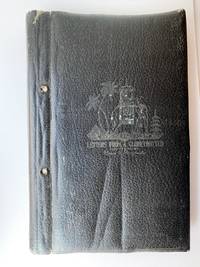
1925000043Arctic Europe North Africa: Round-The-World Society. Very Good. 1925. Full-Leather. On offer is an amazing vintage book of letters from 1925 to 1926. One of only a handful still in circulation "Letters from a Globetrotter" is a travelogue in the form of a series of subscription letters written by Elmer D. Raymond founder and president of the Round-the-World Society. Included in the book are approximately 150 pages describing Raymond's voyages photo plates a fold-out map of the world and approximately 140 real stamps all with postmarks dated 1925 and 1926. The return address of the letters is the Round-The-World Society in New York NY. There are more than 45 letters contained within this book each addressed to Mrs. Harriet H. Hale of New Haven Connecticut. The letters include stamps with postmarks and cancels on the front some letters with one stamp and some with up to five or ten and about three pages of typed text inside. Every letter is titled eg "ON THE TRAIL OF BARENTS" and includes a location at the top before the greeting of "Dear Friend: -" In addition to the typed letters there is a sketch of a ship by Raymond himself and some 16 black and white plates with photographs capturing images from the various locations Raymond visited. The first 13 letters are not numbered but the 14th is labelled XXVII. All the letters that follow are similarly labelled with Roman numerals in sequence. Some appear to be missing--for example the numbers skip from XXX to XXXIII. The travelogue begins at the North Cape Norway where Raymond describes seeing Europe from where he sits: "There beyond the thick dull curtain of fog lies the most interesting and colorful continent of the world Europe." The author states that this is the first of his Arctic letters. He goes on to write from Greenland Bear Island Spitzbergen and the North Pole. Next he sails to Antwerp and visits various locations in Germany France and Monaco. Then he moves on to North Africa where he describes places including Tunisia Algeria and Morocco. The descriptions are colorful and entertaining and provide an interesting look at these various communities through the eyes of a man who is likely American or English. He writes of a visit to Ruisseau des Singes in Algeria saying "Some of the monkeys get so bold as to put their hands into our pockets searching for hidden peanuts. One of them finds a shiny coin and steals it. He climbs a tree and sits on a branch. Fingering the coin he examines it carefully." The letters conclude with a flight from Tangier to Gibraltar and a trip into Spain where the letters end with letter number LXIV: "A Bullfight in Seville". The leatherette two-hole binder measures 6" x 9". The screw posts used for binding are missing but could easily be replaced. There is some general wear to the leather. The letters map plates and stamps within are in great condition. This well-written detailed collection of letters paints a vivid picture of one mans travels from Norway to the North Pole and south to North Africa. The photo plates give us a beautiful visual of what Raymond describes with words. For a collector there is a wealth of stamps mailed to the United States from numerous fascinating locations. This is one of two volumes of "Letters from a Globetrotter" in our collection. Both are relatively unique with overlap of only twelve letters and three photograph plates. ; Manuscript; 8vo - 6" x 9"; KEYWORDS: ELMER D. RAYMOND ROUND THE WORLD TRAVEL LOG BOOK VADE MECUM HANDWRITTEN MANUSCRIPT DOCUMENT LETTER AUTOGRAPH DIARY JOURNAL LOG KEEPSAKE WRITER HAND WRITTEN DOCUMENTS SIGNED LETTERS MANUSCRIPTS HISTORICAL HOLOGRAPH WRITERS DIARIES JOURNALS LOGS AUTOGRAPHS PERSONAL MEMOIR MEMORIAL PERSONAL HISTORY AMERICANA Travel Globetrotters Philatelic StampsANTIQUITÉ CONTRAT VÉLIN MANUSCRIT PAPIER ANTIKE BRIEF PERGAMENT DOKUMENT . Round-The-World Society hardcover
18920001354Shustoke Warwickshire England 1892. On offer is a super original 19th Century manuscript travel diary in a premium leather bound notebook of about 200 pages of lined paper. Signed and dated 1892 by Henry A. Whitehead on the first page. Research suggests Whitehead was vicar of the village in the mid nineteenth century. The journey starts from Shustoke in Warwickshire via Birmingham to Liverpool where the author with his companion McWilliams boards his first boat The Mareotis at Huskisson Dock bound for Gibraltar Tangiers Algeria Malta Alexandria Ramleh Cairo Aden Zanzibar Mozambique Durban and beyond. This is a very languid look at the life and experiences of a leisured Victorian tourist in North Africa who receives invitations to Governor's parties meets and calls on Colonels and Majors with important jobs who knows the HMS Thunderer and HMS Camperdown when he sees them in harbour visiting the 'Armoury' mentions making many sketches interesting commentary regarding other passenger particulary the German officers after Cairo interesting copy of a King Neptune broadside a guest of the Consul time spent with Churchill and much much more. Whitehead arrived back in England in September the last few months of the diary being devoted to his daily home life. Only the last six pages of the notebook are unused. Covers rubbed at edges. Spine splitting. Internally fine. These daily entries vary in length from just a few lines to several pages and run from January 29th to 31st December of the same year. Overall G. Autograph. Hard Cover. Good. 12mo - over 6¾" - 7¾" tall. Hardcover
0012286Kossuth County Iowa Anderson Swea City Grant Township. Good with no dust jacket. Softcover. On offer is the diary of a rural Iowa seamstress turned wife and mother covering the year she was 21 and the year she was 26 allowing a peek at her life as the eldest daughter of a pioneering farming family and then her equally challenging life as a doting wife and mother. This diary was kept by Nola Grace Thackrey Mayne 1888-1926. Nola was the oldest of six children born to William Salathiel Thackrey 1864-1924 and Margaret Hockett Thackeray 1869-1965. The Thackreys were pioneering farmers of Swea City Iowa. When Margaret and William settled on a farm in Grant Township north of Swea City in 1892 Margaret was one of only three women in the entire township. The Thackreys moved slightly west to the Armstrong Iowa area in 1913. Nola married Howard Dwight Mayne on Feb 18 1913 in Martin Minnesota. They had three children together at their home near Ledyard Kossuth County: Laurence Dale Mayne 1913-1977 Evelyn Fay Mayne later Rose 1919-2014 and Deloris Fern Mayne later Anderson 1926-1997. Tragically Nola died of childbirth complications at age 37 one month after Deloris birth. Deloris and Evelyn would be raised not by Howard but by Nolas sister Inez Ellen Thackrey Kelly 1891-1981 and her husband Frank Thomas Kelly 1888-1955. Howard would remarry twice. His son Wallace 1932-2008 was born during his second marriage. Nola keeps her diary from July-December 1908 February-June 1909 and then from November 1914-November 1915. In 1908-1909 Nola is 20-21 years old. She is living at home with her parents and siblings working unbelievably hard both on her tasks in the household and as a seamstress hired by endless Kossuth community members. She keeps careful track of her siblings her peers and her neighbours activities. Some excerpts: Made two waists Archer and Howard Two dresses for Deva and a mother hubbard for Sarah all but putting in sleeves and braid July 28 1908. Mama phoned to me this eve that Grandpa Thackrey was awful sick she got a card from Jessie. I talked with Inez this evening Aug 17 1908. Mr. And Mrs. And the children went away this morning. Clinton took them to the train. I churned. Moped the floor and got dinner Cora came up in after-noon to stay with me. All four went down the bus tonight us girls all sped down home Aug 20 1908. Morning work. Mixed the bread stiff. I churned. Meda and Clinton cleaned ducks. Meda and I was dressing the ducks when she got a telegram that her father was dead. We baked the bread got us a bit to eat. She and the children went down to Bells. Howard came and we went down home Papa was fishing had 14 fish. Inez walked over home we fooled around and came back got home at eleven Oct 11 1908. .I went home with Mrs. Powell on Fri eve helped her paper the front room Annie brought me home Sun morn. Art and Bell came in evening stayed for supper. Papa broke out with small pox Oct 21 1908. .Got it over to the school house to the basket supper. Howard Roscoe and Ruth got it but us girls didnt take it. Been sewing this week and helping with scrubbed the upstairs Oct 22 1908. The big day. The day we was guaranteed for small pox Haent written in this book for a long time. Have all had the small pox. But had it light Has been the same old thing the past four weeks. Had a Xmas dinner at home. We all got a Xmas present Charles Kelly came home Xmas Nothing doing now days on account of small pox Smallpox announcement written Nov 30 1908 and then further writing undated but likely January 1909. I came down to Woolstock to work for Mrs. Wallen Jan 19 1909. Went home Feb 16th for Joe and Leonas wedding the 18th on Wednesday night at eight oclock. 68 people there Feb 1909. I sailed for the sunny south. Joe Leona and Mr Mayne come as far as Algona Howard came to Bancroft. I got back to Woolstock all OK. Mr. Wallen meet me at the corner store Feb 22 1909. Nola returns to her diary following her transition to independence. We meet her again when her firstborn Laurence is about to turn one. She records many of his milestones and paints a tremendously clear picture of the challenges of raising a baby in the early 20th century. She writes of a terrible couple weeks of illness. First Howard gets sick and the doctor thinks it is appendicitis then baby Laurence gets sick and Nola keeps close track of his condition calls to the doctors treatments support received from friends and family and more. While Laurence likely had a simple virus the complexity of assessing and caring for an ill infant without the benefits of todays technology is truly remarkable. Nolas pages of record keeping really give credence to the term It takes a village to raise a child. Some excerpts: Washed in forenoon Joes came in after noon. I helped Lenona with her dress. Laurence is 1 year old today. He can walk a few steps alone Took his first steps alone last Tues He weighs 26 pounds Nov 2 1914. Baby had fever and Tues didnt get any better Wed was better until noon then begins to get worse at 6-30 his fever was 104 2/10 we phoned for Doctor Devine but couldnt get him so Howard went over to Bert Kellys and phoned for Mattison he got in about two hours . Roy come over and Emma and I set up with him all night Jan 28 1915. .Howard and I get up at 3-30 his mother is lots worse can hardly hear her breathe and breath is short and missed a breathe now and then. Keeps getting worse and passes away at 430. Howard calls his Father and Roscoe but she is gone when they get down stairs I phone to Joes just after we call the rest. We stay till about 7 oclock. Emma comes just before we leave faints away when she looks at her Mother we go back after breakfast I fix Joes coller sic on his shirt. Aunt Esther and I got to Ledyard. Howard and his father go to Bancroft with the undertaker Roscoe and Joe take the nurse to the train. I start to fix Howards Mothers dress but dont get it quite finished Mr. And Mrs John Miller Mr. And Mrs. Harry Curtis sit up tonight Sept 10 1915 though it seems Nola wrote this as a summary of events of the day after the fact. My twenty seventh Birthday Howard goes to Ledy and sent order to Sears sends for dishes for my birthday. I make Baby dresses and have sick headache Oct 18 1915. This diary is interesting for many reasons. It is an in-depth exploration of rural Iowa specifically Kossuth county as well as a treasure trove of information about the Mayne and Thackrey farming families both with deep roots in the region. They provide a detailed look at the role of a young woman raised in a farming family who then begins raising her own farming family. This diary would be of interest to specialists in womens studies Iowa pioneering farmers and early 20th century Americana. This diary measures approximately 7.5x11.5 inches. The cloth-covered notebook contains 50 pages filled on both sides for a total of 100 pages completely packed with diary entries. There are some marks on the covers and some rips on the label. The spine is in-tact though coming loose in places. Overall Good. NOTE: Nola does not record her name in the diary. Extensive research and context clues confirm authorship. ; Manuscripts; 4to 11" - 13" tall; 100 pages . paperback
1867000659NEW YORK. Good. 1867. On offer is a super diary handwritten we believe by Mrs. Electa J.K. Penny. Living in New York City Electa has used an 1866 diary for the year 1867 and writes extensively of activities and events. Enclosed in the diary is a calling card for Mrs. Penny and as she makes numerous references to 'Electa' and activities more suited to a younger person we conclude that her daughter was named after her. A great look at life for one family living in New York City immediately after the Civil War. Here are some snippets: "February 14th Oscar came for us. Was there to dinner and fetched us to Otisville. Came to Middletown. G.M. came with us. Took tea at the Ogden House. Came to New York on express. Got home at 11 p.m all right." "March 13th Karen called. Eliza came and we went to Mrs. Brown's. She went with us to Canal Head. Looked in cloak store for short sagues. Eliza came home and stayed all night." "March 14th Eliza here and spent the day. We went down to B. Way Broadway to Ford and Taylor's bought 3 collars. Visited studio and saw pictures. Went down town and up to the depot with John L. Eliza stayed all night." "March 20th Sarah here to spend the day. Came early and staid until 4 o'clock. I went with her to Broadway to look for cloth for those children. Came home in the train. Eliza first called to Mr. Grants and came home again." "May 1st Eliza at Grants. Electa's school dismissed at noon. Arose at 5 o'clock in the morning. Eliza and Electa took hoop and went to park. Returned at 7 for breakfast. I wrote to mother and Russell. Received a letter from John L. Paid one months rent in advance up to June 1st." "May 3rd Wash woman here. I made ginger cracks. Eliza and Electa went out in morning to park. Had a pleasant time. Called at Mrs. Bogart with Eliza at eve. Charley Plumb spent the evening. Paid washwoman seventy five cents. Wrote Mrs. Plumb." "June 12th Went to Brooklyn. Spent the day. Sarah and I without other company took clock to be repaired. Came home East Broadway road with John. Finished Sarah tatting for babies shirts. Eliza at the Backman's mending lace." "July 11th John on cars. Louisa and Carrie came in morning at 7 o'clock. Houghton called. Sailed for California at noon. Louisa and Carrie myself and E. went to B. Way. Got Louisa a dress. We all called at 11th street." "July 23rd Came to the plantation in afternoon. Jabaeth fetched us. Took breakfast and dinner there and tea with Mrs. Evans. Sylva called in the evening." "July 24th At home. Slept in dining room with Electa. Rose ½ past five. Took breakfast with Mrs. Evans. Baked bread. Swept the house and made up the beds. Libbie C. spent forenoon with Electa then she went home with Libbie. Picked some berries in garden. Called at Mrs. Oakley." "August 17th All went to Yankee Pond. Mr. Alcott drove over and spent the day with us. Took tea kettle and cider took provisions and cooked fish and took dinner on the bank of the pond. A party of fifteen. John Betsy Jake Jep Russell Wilber Bell Tanner Hattie Kate Electa Libbie John and myself. Came home at 5." "September 7th John Emma Electa self took the Dan ____for Newburgh at half past seven a.m. Arrived at Newburgh ¼ past 11 took dinner at Demanthon . All went to Washington head quarters saw the ancient affairs of the place. Walked around the place some stayed all night." "September 10th Electa commenced school. Emma Magnena myself went to Coney Island. Took dinner at Lew Coleman's came home at eight in the evening. Wash woman here. John on car." "October 16th John on cars. Lett Eliza Dora myself went to Washington market got some vegetables. Called at Dora's went to Trinity Church. Lett and I went over town with John came home about 4." "November 7th George went home after breakfast. Eliza home worked on brown dress. John applied for a situation on Erie Roads." "November 23rd John home in afternoon. Mrs. Allen Electa and self took car went to Canal St. Went to Lord and Taylor's to Ball and Blake's and in many other stores from there to tenth street." Cover has some nibbles.; Manuscript; HANDWRITTEN MANUSCRIPT DOCUMENT LETTER AUTOGRAPH DIARY JOURNAL LOG KEEPSAKE WRITER HAND WRITTEN DOCUMENTS SIGNED LETTERS MANUSCRIPTS HISTORICAL HOLOGRAPH WRITERS DIARIES JOURNALS LOGS AUTOGRAPHS PERSONAL MEMOIR MEMORIAL PERSONAL HISTORY AMERICANA Civil War Confederate Conscription Civil war Americana Williamsburg Yonkers New YorkWOMEN'S STUDIES PRE SUFFRAGE SUFFERAGE GENEALOGY . hardcover
Signed and inscribed by Spiro Agnew upon half-title page. 288 pages. Index. "A powerful book in which Mr. Agnew challenges the widely held beliefs about his alleged involvement in bribery and extortion while in office. His testimony provides a detailed, well-documented, week-by-week account of the whirlwind of events leading to his resignation and unsnarls the tangle of distorted and wilfully contrived evidence that has burdened his life for the past six years." - from dust jacket. Clean and unmarked with light wear. Dust jacket now preserved in archival-grade Brodart. A handsome copy. Book
186741Pise, Giacomo Grazzoli, 1784 2 tomes en un vol. in-4, VIII-233-[3]-399 pp., maroquin cerise, dos à nerfs, double filet doré sur les coupes, tranches dorées sur marbrure, large dentelle intérieure (Pagnant).
Signed by Frank Zappa beneath his photo on page 116. 352 pages. Black and white illustrations and reproductions of photos. "The legendary Frank Zappa, one of the most influential, innovative, and controversial musicians of the past twenty years, takes us on a wild, funny, outrageous trip through his life and times. Here is how he became the state of the art in weirdness, as only he can tell it." - from dust jacket. Unmarked. Average wear and soiling. Board tips rubbed open. Binding intact. Narrow 2.5" faded patch along dust jack spine corresponds to security strip on verso. A wonderful Zappa memento. (Bonus: includes ticket stub for Zappa's May 10, 1980 concert at the Tower Theater in Upper Darby, PA) Book
viii, 416 pages. Heiden "has drawn on a large quantity of information obtained over a period of 15 years from the men closest to Hitler, besides the confidential records of the authorities in Munich and Berlin and a mass of pamphlets, books and obscure newspapers stored in public libraries and archives. It can safely be said that this is the most authoritative account of Hitler's life that has reached the public." - from dust jacket (not included). Contents clean and unmarked with mild age-toning. Average wear to original brown cloth, lettered orange on spine. Binding intact. Includes replica dust jacket copied from a heavily-worn original. Bibliographic References: Kehr and Langmaid 671, Madden pp 68. Book
BELLE LEGATURE OTTOCENTESCHE IN MEZZA PELLE VERDE CON NERVI, DECORI E FREGI IN ORO, PIATTI MARMORIZZATI. OGNI VOLUME E' DIVISO IN DUE PARTI, QUINDI PRESENTI DUE FRONTESPIZI E 40 TAVOLE A COLORI DI DOLFINO, PER UN TOTALE DI 278 RITRATTI (DEI 280 PREVISTI) POICHE' SONO MANCANTI LA TAVOLA DI MAZZONI AL QUARTO VOLUME E BACONE AL QUINTO. PRESENTE UNA MAPPA DELL'EUROPA PIU' VOLTE RIPIEGATA. OPERA MOLTO RARA COMPILATA DA MOLTI LETTERATI ITALIANI, AMPLIATA E CORREDATA DI NOTE STORICHE E GEOGRAFICHE numero pagine: MEDIA DI 800 A VOLUME formato: 23X16 stato conservazione: BUONO, FIORITURE SPARSE E LIEVI TRACCE D'USO
Due voll. In -8°, pp. 246, (2); 495, (1); brossura editoriale. È l’opera principale del marchese Amico Ricci, di Macerata, nella quale si ricostruiscono minuziosamente vita e opere degli artisti marchigiani a partire dal Medioevo; si tratta del primo studio sistematico di questo tipo, relativamente alla Regione: agli studi di Ricci si deve fra l’altro una consistente messa in luce dell’importanza di Gentile da Fabriano. It’s the main book of Amico Ricci, with a meticolous description of life and works of the major artists from the Marche, since the Middle Age.
2 tomi in un volume in-8, pp. (16), 238, (20), 122, legatura coeva p.pelle, bordura oro con filetti e fiori sui piatti, dorso a nervi con fregi oro. Impresa di Giolito sui due titoli e in fine, fregi e inizili silografici. Dedica di Oratio Toscanella ''della famiglia di maestro Luca Fiorentino'' a Monsignore Francesco Loredano della Badia di Vangaticcia. Prima edizione (si conoscono esempl. con la data 1567 nella prima parte) di dottissima curiosa opera storica basata sulle Vite di Plutarco, cioè ''una riunione di tavole o repertori analitici'' (Bongi) tratti dalle Vite: Feste dei romani, Invenzioni militari, Bagni et esercitii, Navigatoria, Biografie, Costumi, Fortuna, Vittoria, Monete, Nomi propri, etc. Trattasi di una profonda analisi del Plutarco corredata di ricchi indici e richiami. Fa parte della Collana ''Anello'' di Giolito: il suo complesso piano editoriale prevedeva di raccogliere sistematicamente traduzioni dal greco e dal latino di argomento principalmente storico. Il Porcacchi nei preliminari del Ditte e Darete del 1570, nella dedica a Silvio Torelli e ne Il Frutto e Utilità che si cava dalla lettione dell'Historie et di qui si comprende l'ordine della collana, volle esporre l'ambizioso piano editoriale. Cercò quindi di dare forma alla collana, basandosi sui testi già stampati dal Giolito e su quelli che avrebbe dovuto pubblicare. La discrepanza tra le opere realmente edite e quelle annunciate, e la complessa concatenazione dei testi, diedero adito a non pochi fraintendimenti. Magnifico esemplare, assai fresco.. Bongi, Annali di Giolito, II, 248-249 e 264-265. BM STC, p.677..
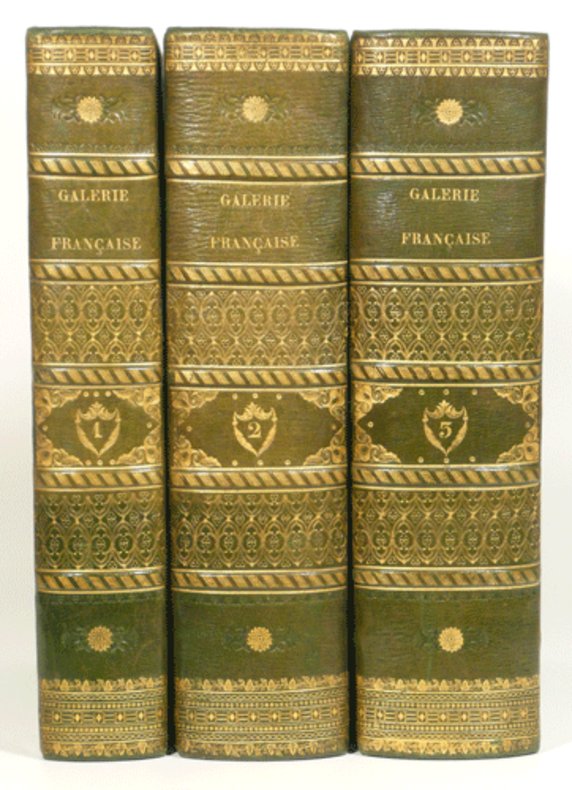
18210026941821 Paris, Firmin Didot, 1821-1823. Trois volumes grand in-quarto (235 X 297) demi-cuir de Russie vert empire à petits coins, dos cinq nerfs plats ornés de hachures et sertis de filets dorés, compartiments ornés de rosaces dorées, fleurons et roulettes dorés et à froid, fers spéciaux à décor de lobes dorés, titre et tomaison dorés (reliure de l'époque) ; TOME I : (1), faux-titre, titre, 1 feuillet non chiffré (commentaire du frontispice), frontispice, VIII (avis au relieur et avertissement des éditeurs), 65 pages (introduction), 288 pages, 62 portraits et 30 fac-simile hors-texte, (1) ; TOME II : (1), faux-titre, titre, 598 pages, 55 portraits et 43 fac-simile, (1) ; TOME III : (1), faux-titre, titre, 549 pages, 60 portraits et 16 fac-simile, (1).