Honoré de BalzacLivre Rare Book
15 176 résultats
1931189571931 Editions Mornay Collection les beaux livres Reliure plein maroquin, in-8, étui, couverture et dos conservés, tête dorée, non rogné, 442p + suite. Très bon état.
1942195131942 Chez Jean Porson libraire Reliure demi chagrin, couvertures et dos conservés, têtes dorées, suite reliée dans le 2e volume, 296p + suite. Très bon.
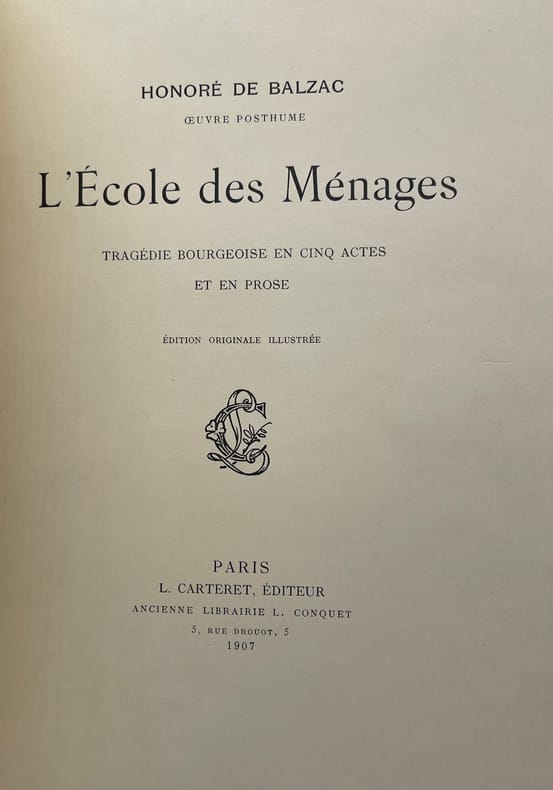
016447Honoré de Balzac, L'école des ménages.Tragédie bourgeoise en cinq actes et en prose. Paris, Carteret, 1907. Grand in-8, II-240p. Edition originale posthume, illustrée d'un portrait, d'après Berthall, et d'en-têtes, lettres ornées et culs-de-lampe de Robaudi gravés par Manesse. Tirage unique à 300 exemplaires, un des 75 « de grand luxe » sur japon, n°10, contenant les illustrations en trois états (état définitif dans le texte et deux suites supplémentaires). Reliure signée Champs-Stroobants, demi-maroquin aubergine à coins, couvertures et dos conservés, étui bordé. Très bel exemplaire.
164151041Chez Cardin Besongne | à Paris 1641 | 10.50 x 16.80 cm | relié
184685577Jules Hetzel | Paris 1846 | 12 x 18.50 cm | broché
1953R320100608IMPRIMERIE NATIONALE - ANDRE SAURET. 1953. In-8. Broché. Bon état, Couv. convenable, Dos satisfaisant, Intérieur frais. 12 VOLUMES (in-8) d'environ 250 pages chacun - Augmentés d'un frontispice sous serpente - (ouvrages protégés d'un papier cristal transparent, legerement jauni au dos) sous Emboitage cartonnée rigide, pour chacun d'eux - OUVRAGE EN TRES BON ETAT. EXEMPLAIRE N°2929. // 5 PHOTOS DISPONIBLES.. . Sous Emboitage. . Classification Dewey : 840.08-XIX ème siècle
1952R300271573Imp. Nationale/André Sauret. 1952. In-8. Broché. Bon état, Couv. légèrement passée, Dos satisfaisant, Intérieur frais. 372 pages - Lithographie originale de Picasso en frontispice, sous serpente. Plats contrepliés en trois rabats. Emboîtage correct.. . Sous Emboitage. . Classification Dewey : 94.4-Editions numérotées
1949R200135336Albert Guillot. 1949. In-8. Broché. Etat d'usage, Coins frottés, Coiffe en pied abîmée, Non coupé. 266 + 300 + 295 + 363 + 398 + 312 + 297 + 333 + 341+ 317 pages, couvertures à 3 rabats, nombreuses illustrations en couleur hors texte dont une en frontispice pour chaque volume, tomes X et XI sous emboitage cartonné - papier jauni, rousseurs sur les plats et pages, dos pliés.. . . . Classification Dewey : 840.08-XIX ème siècle
180925345Paris: Imprimerie Impériale 1809. Fine. Imprimerie Impériale Paris 1809-1829 70 x 53.50 cm une feuille Original unshaved full-page etching from the Imperial edition of the Description de l'Égypte or Recueil des observations et recherches faites en Égypte pendant l'expédition française publié par les ordres de Sa Majesté l'Empereur Napoléon le Grand A Collection of the observations and research carried out in Egypt during the French expedition published on the orders of his Majesty the Emperor Napoleon the Great'.Produced between February 1802 and 1830 on the orders of Naopleon Bonaparte and published between 1809 and 1828 1000 copies were printed and distributed to institutions on vergé paper with an 'Égypte ancienne et moderne' watermark visible when held up to the light. Light marginal spotting not touching image otherwise in very fresh fine condition. An engraving from the Description de l'Egypte one of the masterpieces of French printing and the birth of a new field: Egyptology. A gigantic survey of Egypt at the time of Bonaparte's conquests in 1798 and 1799 the work is divided into 13 volumes of engravings making up 892 plates of which 72 colored as well as presenting the splendors of the Egypt of the Pharaohs in 9 volumes. The other volumes discuss natural history and present a fascinating portrait of Coptic and Islamic Egypt as it was seen by Bonaparte's Eastern Armies. The Egyptian campaign' militarily a disaster demonstrates through the engravings of the Description d'Egypte the scientific success it nonetheless became thanks to the 167 expert members of the Commission of the Sciences and Arts of the Institut d'Egypte Egyptian Institute who followed Napoleon's army. The Institut gathered together in Egypt the mathematician Monge the chemist Berthollet the naturalist Geoffroy Saint-Hilaire as well as numerous artists engineers architects and doctors. They were tasked with re-discovering modern and ancient Egypt and displaying its natural treasures as well as the know-how of its inhabitants.This edition the so-called Imperial edition of the plates for the Description de l'Egypte was printed in four large formats two of which were specially created for it and christened Moyen-Egypte and Grand-Egypte. A special press was built to print it the process extending over 20 years from 1809 to 1829. The Imperial edition proved so popular that a second edition this time in black and white and without the Egypte ancienne et moderne watermark known as the Royal Edition was published during the Restoration by the printing house of C.-L.-F. Panckoucke Paris.The engravings of the Description d'Egypte owe a great deal to Baron Dominique-Vivant Denon illustrator diplomat collector and later Director of the Musée Napoléon the Louvre. His exploration of the South of Egypt gave Bonaparte the idea of sending the experts of the Institut there thus creating a faithful and complete portrait of the area. This was the research gathered together from 1802 in the mammoth Description de L'Egypte.Denon embarked on this story of archeological exploration at the age of 51 reaching first Alexandria and then Cairo before exploring Upper Egypt. Along with the members of the Institut d'Egypte the Natural History Museum's painter H.J. Redouté brother of Pierre-Joseph Redouté author of Roses the mineralogist Dolomiue and the draughtsman Joly Denon then explored the Nile Delta and Lower Egypt. When however he joined the 21st Light Infantry Regiment as it marched across Upper Egypt in pursuit of the retreating Mameluks in November 1798 he found himself the only civilian. In the very midst of the battle itself he reeled off sketches of the works of art that peppered his path right up to the threshold of the Sudan. He said that he had crossed a country that is apart from its name entirely unknown to Europeans and therefore everything was worth describing Voyages dans la Basse et la Haute Egypte pendant les campagnes Imprimerie Impériale unknown
180925931Paris: Imprimerie Impériale 1809. Fine. Imprimerie Impériale Paris 1809-1829 71 x 54 cm une feuille Original unshaved full-page etching from the Imperial edition of the Description de l'Égypte or Recueil des observations et recherches faites en Égypte pendant l'expédition française publié par les ordres de Sa Majesté l'Empereur Napoléon le Grand A Collection of the observations and research carried out in Egypt during the French expedition published on the orders of his Majesty the Emperor Napoleon the Great'.Produced between February 1802 and 1830 on the orders of Naopleon Bonaparte and published between 1809 and 1828 1000 copies were printed and distributed to institutions on vergé paper with an 'Égypte ancienne et moderne' watermark visible when held up to the light. Light marginal spotting not touching image otherwise in very fresh fine condition. An engraving from the Description de l'Egypte one of the masterpieces of French printing and the birth of a new field: Egyptology. A gigantic survey of Egypt at the time of Bonaparte's conquests in 1798 and 1799 the work is divided into 13 volumes of engravings making up 892 plates of which 72 colored as well as presenting the splendors of the Egypt of the Pharaohs in 9 volumes. The other volumes discuss natural history and present a fascinating portrait of Coptic and Islamic Egypt as it was seen by Bonaparte's Eastern Armies. The Egyptian campaign' militarily a disaster demonstrates through the engravings of the Description d'Egypte the scientific success it nonetheless became thanks to the 167 expert members of the Commission of the Sciences and Arts of the Institut d'Egypte Egyptian Institute who followed Napoleon's army. The Institut gathered together in Egypt the mathematician Monge the chemist Berthollet the naturalist Geoffroy Saint-Hilaire as well as numerous artists engineers architects and doctors. They were tasked with re-discovering modern and ancient Egypt and displaying its natural treasures as well as the know-how of its inhabitants.This edition the so-called Imperial edition of the plates for the Description de l'Egypte was printed in four large formats two of which were specially created for it and christened Moyen-Egypte and Grand-Egypte. A special press was built to print it the process extending over 20 years from 1809 to 1829. The Imperial edition proved so popular that a second edition this time in black and white and without the Egypte ancienne et moderne watermark known as the Royal Edition was published during the Restoration by the printing house of C.-L.-F. Panckoucke Paris.The engravings of the Description d'Egypte owe a great deal to Baron Dominique-Vivant Denon illustrator diplomat collector and later Director of the Musée Napoléon the Louvre. His exploration of the South of Egypt gave Bonaparte the idea of sending the experts of the Institut there thus creating a faithful and complete portrait of the area. This was the research gathered together from 1802 in the mammoth Description de L'Egypte.Denon embarked on this story of archeological exploration at the age of 51 reaching first Alexandria and then Cairo before exploring Upper Egypt. Along with the members of the Institut d'Egypte the Natural History Museum's painter H.J. Redouté brother of Pierre-Joseph Redouté author of Roses the mineralogist Dolomiue and the draughtsman Joly Denon then explored the Nile Delta and Lower Egypt. When however he joined the 21st Light Infantry Regiment as it marched across Upper Egypt in pursuit of the retreating Mameluks in November 1798 he found himself the only civilian. In the very midst of the battle itself he reeled off sketches of the works of art that peppered his path right up to the threshold of the Sudan. He said that he had crossed a country that is apart from its name entirely unknown to Europeans and therefore everything was worth describing Voyages dans la Basse et la Haute Egypte pendant les campagnes de Imprimerie Impériale unknown
180925834Paris: Imprimerie Impériale 1809. Fine. Imprimerie Impériale Paris 1809-1829 71 x 54 cm une feuille Original unshaved full-page etching from the Imperial edition of the Description de l'Égypte or Recueil des observations et recherches faites en Égypte pendant l'expédition française publié par les ordres de Sa Majesté l'Empereur Napoléon le Grand A Collection of the observations and research carried out in Egypt during the French expedition published on the orders of his Majesty the Emperor Napoleon the Great'.Produced between February 1802 and 1830 on the orders of Naopleon Bonaparte and published between 1809 and 1828 1000 copies were printed and distributed to institutions on vergé paper with an 'Égypte ancienne et moderne' watermark visible when held up to the light. Light marginal spotting not touching image otherwise in very fresh fine condition. An engraving from the Description de l'Egypte one of the masterpieces of French printing and the birth of a new field: Egyptology. A gigantic survey of Egypt at the time of Bonaparte's conquests in 1798 and 1799 the work is divided into 13 volumes of engravings making up 892 plates of which 72 colored as well as presenting the splendors of the Egypt of the Pharaohs in 9 volumes. The other volumes discuss natural history and present a fascinating portrait of Coptic and Islamic Egypt as it was seen by Bonaparte's Eastern Armies. The Egyptian campaign' militarily a disaster demonstrates through the engravings of the Description d'Egypte the scientific success it nonetheless became thanks to the 167 expert members of the Commission of the Sciences and Arts of the Institut d'Egypte Egyptian Institute who followed Napoleon's army. The Institut gathered together in Egypt the mathematician Monge the chemist Berthollet the naturalist Geoffroy Saint-Hilaire as well as numerous artists engineers architects and doctors. They were tasked with re-discovering modern and ancient Egypt and displaying its natural treasures as well as the know-how of its inhabitants.This edition the so-called Imperial edition of the plates for the Description de l'Egypte was printed in four large formats two of which were specially created for it and christened Moyen-Egypte and Grand-Egypte. A special press was built to print it the process extending over 20 years from 1809 to 1829. The Imperial edition proved so popular that a second edition this time in black and white and without the Egypte ancienne et moderne watermark known as the Royal Edition was published during the Restoration by the printing house of C.-L.-F. Panckoucke Paris.The engravings of the Description d'Egypte owe a great deal to Baron Dominique-Vivant Denon illustrator diplomat collector and later Director of the Musée Napoléon the Louvre. His exploration of the South of Egypt gave Bonaparte the idea of sending the experts of the Institut there thus creating a faithful and complete portrait of the area. This was the research gathered together from 1802 in the mammoth Description de L'Egypte.Denon embarked on this story of archeological exploration at the age of 51 reaching first Alexandria and then Cairo before exploring Upper Egypt. Along with the members of the Institut d'Egypte the Natural History Museum's painter H.J. Redouté brother of Pierre-Joseph Redouté author of Roses the mineralogist Dolomiue and the draughtsman Joly Denon then explored the Nile Delta and Lower Egypt. When however he joined the 21st Light Infantry Regiment as it marched across Upper Egypt in pursuit of the retreating Mameluks in November 1798 he found himself the only civilian. In the very midst of the battle itself he reeled off sketches of the works of art that peppered his path right up to the threshold of the Sudan. He said that he had crossed a country that is apart from its name entirely unknown to Europeans and therefore everything was worth describing Voyages dans la Basse et la Haute Egypte pendant les campagnes de Imprimerie Impériale unknown
180925898Paris: Imprimerie Impériale 1809. Fine. Imprimerie Impériale Paris 1809-1829 71 x 54 cm une feuille Original unshaved full-page etching from the Imperial edition of the Description de l'Égypte or Recueil des observations et recherches faites en Égypte pendant l'expédition française publié par les ordres de Sa Majesté l'Empereur Napoléon le Grand A Collection of the observations and research carried out in Egypt during the French expedition published on the orders of his Majesty the Emperor Napoleon the Great'.Produced between February 1802 and 1830 on the orders of Naopleon Bonaparte and published between 1809 and 1828 1000 copies were printed and distributed to institutions on vergé paper with an 'Égypte ancienne et moderne' watermark visible when held up to the light. Light marginal spotting not touching image otherwise in very fresh fine condition. An engraving from the Description de l'Egypte one of the masterpieces of French printing and the birth of a new field: Egyptology. A gigantic survey of Egypt at the time of Bonaparte's conquests in 1798 and 1799 the work is divided into 13 volumes of engravings making up 892 plates of which 72 colored as well as presenting the splendors of the Egypt of the Pharaohs in 9 volumes. The other volumes discuss natural history and present a fascinating portrait of Coptic and Islamic Egypt as it was seen by Bonaparte's Eastern Armies. The Egyptian campaign' militarily a disaster demonstrates through the engravings of the Description d'Egypte the scientific success it nonetheless became thanks to the 167 expert members of the Commission of the Sciences and Arts of the Institut d'Egypte Egyptian Institute who followed Napoleon's army. The Institut gathered together in Egypt the mathematician Monge the chemist Berthollet the naturalist Geoffroy Saint-Hilaire as well as numerous artists engineers architects and doctors. They were tasked with re-discovering modern and ancient Egypt and displaying its natural treasures as well as the know-how of its inhabitants.This edition the so-called Imperial edition of the plates for the Description de l'Egypte was printed in four large formats two of which were specially created for it and christened Moyen-Egypte and Grand-Egypte. A special press was built to print it the process extending over 20 years from 1809 to 1829. The Imperial edition proved so popular that a second edition this time in black and white and without the Egypte ancienne et moderne watermark known as the Royal Edition was published during the Restoration by the printing house of C.-L.-F. Panckoucke Paris.The engravings of the Description d'Egypte owe a great deal to Baron Dominique-Vivant Denon illustrator diplomat collector and later Director of the Musée Napoléon the Louvre. His exploration of the South of Egypt gave Bonaparte the idea of sending the experts of the Institut there thus creating a faithful and complete portrait of the area. This was the research gathered together from 1802 in the mammoth Description de L'Egypte.Denon embarked on this story of archeological exploration at the age of 51 reaching first Alexandria and then Cairo before exploring Upper Egypt. Along with the members of the Institut d'Egypte the Natural History Museum's painter H.J. Redouté brother of Pierre-Joseph Redouté author of Roses the mineralogist Dolomiue and the draughtsman Joly Denon then explored the Nile Delta and Lower Egypt. When however he joined the 21st Light Infantry Regiment as it marched across Upper Egypt in pursuit of the retreating Mameluks in November 1798 he found himself the only civilian. In the very midst of the battle itself he reeled off sketches of the works of art that peppered his path right up to the threshold of the Sudan. He said that he had crossed a country that is apart from its name entirely unknown to Europeans and therefore everything was worth describing Voyages dans la Basse et la Haute Egypte pendant les campagnes de Imprimerie Impériale unknown
180923391Paris: Imprimerie Impériale 1809. Fine. Imprimerie Impériale Paris 1809-1829 71 x 54 cm une feuille Original unshaved full-page etching from the Imperial edition of the Description de l'Égypte or Recueil des observations et recherches faites en Égypte pendant l'expédition française publié par les ordres de Sa Majesté l'Empereur Napoléon le Grand A Collection of the observations and research carried out in Egypt during the French expedition published on the orders of his Majesty the Emperor Napoleon the Great'.Produced between February 1802 and 1830 on the orders of Naopleon Bonaparte and published between 1809 and 1828 1000 copies were printed and distributed to institutions on vergé paper with an 'Égypte ancienne et moderne' watermark visible when held up to the light. Light marginal spotting not touching image otherwise in very fresh fine condition. An engraving from the Description de l'Egypte one of the masterpieces of French printing and the birth of a new field: Egyptology. A gigantic survey of Egypt at the time of Bonaparte's conquests in 1798 and 1799 the work is divided into 13 volumes of engravings making up 892 plates of which 72 colored as well as presenting the splendors of the Egypt of the Pharaohs in 9 volumes. The other volumes discuss natural history and present a fascinating portrait of Coptic and Islamic Egypt as it was seen by Bonaparte's Eastern Armies. The Egyptian campaign' militarily a disaster demonstrates through the engravings of the Description d'Egypte the scientific success it nonetheless became thanks to the 167 expert members of the Commission of the Sciences and Arts of the Institut d'Egypte Egyptian Institute who followed Napoleon's army. The Institut gathered together in Egypt the mathematician Monge the chemist Berthollet the naturalist Geoffroy Saint-Hilaire as well as numerous artists engineers architects and doctors. They were tasked with re-discovering modern and ancient Egypt and displaying its natural treasures as well as the know-how of its inhabitants.This edition the so-called Imperial edition of the plates for the Description de l'Egypte was printed in four large formats two of which were specially created for it and christened Moyen-Egypte and Grand-Egypte. A special press was built to print it the process extending over 20 years from 1809 to 1829. The Imperial edition proved so popular that a second edition this time in black and white and without the Egypte ancienne et moderne watermark known as the Royal Edition was published during the Restoration by the printing house of C.-L.-F. Panckoucke Paris.The engravings of the Description d'Egypte owe a great deal to Baron Dominique-Vivant Denon illustrator diplomat collector and later Director of the Musée Napoléon the Louvre. His exploration of the South of Egypt gave Bonaparte the idea of sending the experts of the Institut there thus creating a faithful and complete portrait of the area. This was the research gathered together from 1802 in the mammoth Description de L'Egypte.Denon embarked on this story of archeological exploration at the age of 51 reaching first Alexandria and then Cairo before exploring Upper Egypt. Along with the members of the Institut d'Egypte the Natural History Museum's painter H.J. Redouté brother of Pierre-Joseph Redouté author of Roses the mineralogist Dolomiue and the draughtsman Joly Denon then explored the Nile Delta and Lower Egypt. When however he joined the 21st Light Infantry Regiment as it marched across Upper Egypt in pursuit of the retreating Mameluks in November 1798 he found himself the only civilian. In the very midst of the battle itself he reeled off sketches of the works of art that peppered his path right up to the threshold of the Sudan. He said that he had crossed a country that is apart from its name entirely unknown to Europeans and therefore everything was worth describing Voyages dans la Basse et la Haute Egypte pendant les campagnes de Imprimerie Impériale unknown
182918206Paris: J.P. Roret 1829. Fine. J.P. Roret Paris 1829 9.50 x 14 cm broché The rare first edition of one of Balzac's last anonymous collaborations published the same year as ""Le dernier Chouan"" his first signed novel. Work illustrated with a frontispiece vignette. Significant lack to first board and spine of cover restored at the time joints cracked at head and foot of second board pleasant interior condition. Rare like all of Balzac's early works. J.P. Roret unknown
183985640Paris: Charpentier 1839. Fine. Charpentier Paris 1839 11.20 x 18.60 cm relié First duodecimo edition with a revised version following the 1833 original. Regarding the Charpentier editions which form a kind of first collected edition Clouzot states: ""A collection of very great interest because for all texts it presents a revised version and often profoundly so. Increasingly sought after they have nevertheless remained for how much longer very reasonably priced."" Guide du bibliophile français. XIXe siècle. Contemporary half red glazed calf binding. Smooth spine decorated with a large mosaic mirror tool in red and black in the Restoration style. Series of fillets monastic rolls at head and foot. Moiré and glazed red paper on boards. Signs of rubbing particularly on boards corners and edges. Scattered browning. A handsome copy of this edition which is very rarely found well bound. NB: This work is available at the bookshop on request within 48 hours. Charpentier hardcover
185039246s. l. Paris: Chez Les principaux libraires 1850. Fine. Chez Les principaux libraires s. l. Paris 1850 S.d. 18 x 27 cm relié First edition richly illustrated with 75 hors-texte plates principally by Gavarni including 4 music plates framed with wood engravings by Bertall and several compositions by Bertall. Very numerous vignettes by Monnier Français Daubigny. The compositions with multitudes of vignettes by Bertall on subjects such as evenings at the opera Paris by night. which constitute the ensemble of Paris comique are particularly delightful. This edition is rarer than le Diable à Paris. Contemporary green half-shagreen. Smooth spine decorated with series of romantic tools in compartments. Green corsillonné paper boards. Borders rubbed and corners slightly bumped. Some scattered foxing principally in the outer margins on good white paper. The text jumps from p. 5 to 41 without loss the text continuing. Good copy. Portrait of Paris in all its aspects at the beginning of the Second Empire Le tiroir du Diable sails on the success of le Diable à Paris with the same collective for texts and illustrations. One notes the presence of Balzac's text: Physiologie des boulevards two texts by Sand and one by Musset. The other collaborators being celebrated litterateurs of this period Edouard Ourliac Frédéric Soulié. At the beginning of the work Lavallée's text on the geography of Paris which was also present at the beginning of le Diable à Paris. At the end of the work statistics of Paris the work always wanting to be both entertaining and informative. In this regard all the texts satirical or not of the work are more or less of journalistic character but as journalism was then practiced under the Second Empire. The work concludes with the statistics of Paris. Chez Les principaux libraires hardcover
195085263Paris: José Corti 1950. Fine. José Corti Paris 1950 12.50 x 19 cm broché First edition one of 35 numbered copies on Holland paper deluxe issue. Very handsome copy. José Corti unknown
166448092à Amsterdam: Chez Daniel Elzevier 1664. Fine. Chez Daniel Elzevier à Amsterdam 1664 7.50 x 13.50 cm relié Elzevirian edition illustrated with a handsome unsigned frontispiece title after the first Elzevirian edition of 1651; the original collected edition dating from 1644 in Paris. Near-contemporary full vellum binding. Spine with four raised bands decorated with a red morocco title label. All edges speckled red. Handsome copy well printed. The Elzevirian editions consecrate the success of the work of Guez de Balzac and the great renown of the author at that time. The various works are composed of the different discourses dissertations and letters of the writer. Chez Daniel Elzevier hardcover
4234Tomes 1-2-3-4 sur 5.en quatre volumes grand in 8 demi-cuir vert,titre,tomaison,roulette dorés.non rogné.Tome 1:faux-titre,frontispice,titre,XVI,380 pages,4 feuillets de table des matières ornée de vignettes.Tome 2 faux-titre, frontispice,titre, XVIII,376 pages 4 feuillets de table des matières,ornée de vignettes.Tome 3 faux-titre, frontispice,titre,XL,352 pages,4 feuillets de table des matières,ornée de vignettes..à signaler une pâle mouillure à l’angle supérieur droit de la page 345 à la fin.5 lignes ont été censurées à la plume page 351 Le commissaire de police"il dispose en vrai pacha de toutes les femmes sauvages,jaunes,noires ou cuivrées,qui….on les lui habille, ou on les lui déshabille… " Tome 4 faux-titre,frontispice,Titre,392 pages,5 feuillets de table des matières,ornée de vignettes.CURMER éditeur 1840-1841.édition originale premier tirage des illustrations..Nombreuses illustrations, hors-texte en noir par DAUMIER,GRANDVILLE, GAVARNI,H MONNIER,TRIMOLET, DAUBIGNY,etc…Texte de Honoré de BALZAC,de la BEDOLLIERE MERY,Taxile DELORD,F SOULIE etc. ;quelques plats légèrement frottés, rousseurs éparses habituelles à certains volumes. Bon état d’ensemble,à grandes marges
2004BN112898Insel Verlag Gmbh Insel Verlag 2004. 2004. Softcover. Glanz und Elend der Kurtisanen <br/><br/>Glanz und Elend der Kurtisanen Insel Verlag Gmbh, Insel Verlag paperback
1921000175Paris: Editions Rene Kieffer 1921. Limited Edition. Hardcover. Good/No Jacket. 4to. Orange Shagreen morocco binding with illustrated colour title on front board. This is a limited edition of 580 copies printed on velin de cuve. This is copy No. 384. 81 p.p. 1 p.p. publishers note. Full colour illustrations throughout by Jean-Paul de Quint. Heavy staining on front board with two slight tears to head and tail of spine connecting to front board with rubbing to extremities. Some pages have been coloured with pink marker over text and illustrations. Otherwise in good condition. Editions Rene Kieffer hardcover
1855145459Paris: Ez Bureaux de la Societe Generale de Librairie 1855. Fifth Edition. Hardcover. VG Average wear and age to outer surfaces and edges; "extra" title block on spine is lifting slightly; hinges are only a tad loose; some limited foxing throughout the book; otherwise this one's in great shape for its age. Tan boards with brown leather spine gilt letters and decoration on spine blue marbled flyleaves 614 pp. 425 BW illus. housed in a library's custom archival box. An early and very nice edition of Balzac's "droll stories" well illustrated by French artist Gustave Dore 1832-1883. An old book in terrific shape and protected by a library's archival box. Ez Bureaux de la Societe Generale de Librairie hardcover books
1855145459Paris: Ez Bureaux de la Societe Generale de Librairie 1855. Fifth Edition. Hardcover. VG Average wear and age to outer surfaces and edges; "extra" title block on spine is lifting slightly; hinges are only a tad loose; some limited foxing throughout the book; otherwise this one's in great shape for its age. Tan boards with brown leather spine gilt letters and decoration on spine blue marbled flyleaves 614 pp. 425 BW illus. housed in a library's custom archival box. An early and very nice edition of Balzac's "droll stories" well illustrated by French artist Gustave Dore 1832-1883. An old book in terrific shape and protected by a library's archival box. Ez Bureaux de la Societe Generale de Librairie hardcover
1895SKU1012757George Barrie & Sons 1895. Hardcover. Good. 11 volumes. All 11 books have normal shelfwear around the edges bumping at the spine tops/bottoms and age toning to the pages. A little foxing here and there. The paper onlay on the spine is discolored on several copies--looks to be from moisture though no moisture damage apparent. Overall the set is well read but will still make a nice addition to any collection. Pictures are available upon request. George Barrie & Sons hardcover
1634339024London: Printed by Nicholas Okes for Richard Clotterbuck 1634. Hardcover. Good. First English edition. Translated by William Tyrwit. Quarto. 24 410 4 pp. Small bookplate of Charles Whibley: "Sum Caroli Whibley" on the front pastedown. Full speckled calf professionally re-backed. Lacks the first preliminary leaf before the title page frontispiece: only the stub remains with an early ink signature; small paper repair at the bottom edge of the title page with loss of the first three numbers of the date only else good. From the library of the collector Charles Whibley best known today for bringing T.S. Eliot to the attention of Geoffrey Faber. ESTC S103512. Printed by Nicholas Okes, for Richard Clotterbuck hardcover