[ANON]Biblio.com
6 954 résultats
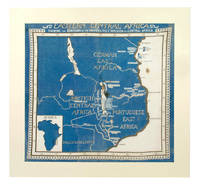
76833London 1904. . Printed in blue and brown on white cotton. In very good condition.<br /> Following the return of David Livingstone from Africa in 1857 a coalition of groups from the Universities of Oxford Cambridge Durham and Dublin established the The Universities' Mission the first missionary society representing the high church end of the Anglican Church. The Mission existed from 1859 to 1909. This map covering British Central Africa German East Africa and Portuguese East Africa parts of modern South Africa Zimbabwe Zambia Mozambique and Tanzania is presumed to have been produced as part of the fund-raising activities of the society. A highly unusual and interesting map.<br /> BLMC Maps 66115.1. [London, 1904]. unknown
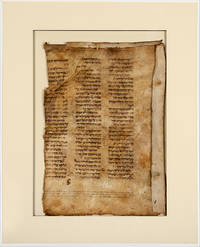
113795Continental Europe 13th-14th century. . Hebrew manuscript on vellum in old black ink; sheet size: 32 x 21.5 cm mount size: 45 x 35 cm; browning staining creases and marginal tears; mounted.<br /> Fragment from the Writings' Book of Psalms with Masorah containing Psalms 112 to 114. Psalm 113 also known in the Christian Latin liturgy as 'Laudate pueri Dominum' beginning in the King James' version: 'Praise ye the Lord O ye servants of the Lord'. In Judaism it is the first of the six Psalms comprising the Hallel prayer which is recited on 'Rosh Chodesh' the first day of the Hebrew month and on Jewish holidays. In Roman Catholicism it is one of the Psalms included in the Vespers service the evening prayer. It has been set to music often notably by Claudio Monteverdi in his 'Vespro della Beata Vergine' in 1610. In Hebrew the psalm has several famous melodies typical to each community's place of settlement which were passed trough generations in Sephardi Mizrachi and Ashkenazi communities and dating back to the middle ages and possibly prior.<br /><br />It seems that this leaf was used in what is known in Hebrew as 'Gnizat Krichot' the use of the leaves from old books' for binding newer books at a time when bookmaking materials were scarce. Many Jewish books that were confiscated by the Catholic Church during the Inquisition were also repurposed as binding material.<br /> [Continental Europe], [13th-14th century]. hardcover
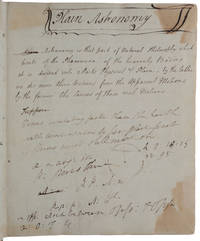
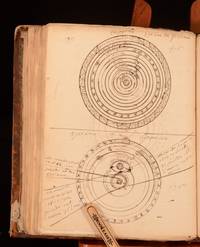
17805309N.p.: N.p. 1780. <p>A fascinating manual of astronomy particularly as it relates to the form of the motions of the heavens. The manuscript is in three parts: the first part covers the elementary parts of 'spherical astronomy' the second and third parts are more advanced covering sections of the Principia dealing with lunar theory and the inverse-square law of attraction. </p>. EIGHTEENTH-CENTURY MANUSCRIPT NOTEBOOK ON ASTRONOMY. <p>A fascinating manual of astronomy particularly as it relates to the form of the motions of the heavens dating from the period 1780-1825 probably from the beginning of that range. It is in a single hand with the exception of one page though with some variations indicating that different parts of the MS were written at different times. The MS could have been prepared for personal use or as part of public tuition probably the former. The writer summarizes the subject matter of the manual on the first leaf: 'Astronomy is that part of Natural Philosophy which treats of the Phenomena of the heavenly Bodies. It is divided into 2 Parts Physical and Plain: by the latter we discover their Motions from the Apparent Motions; by the former the Causes of these real Motions.' The MS is in three parts which are distinct in terms of subject matter. The first part covers the motion of the Earth around the Sun and its rotation about its axis with the consequences for the apparent motions of the Sun and the heavens; with the Moon and its phases and motion; and with lunar and solar eclipses. There are several references to John Keill's An Introduction to the True Astronomy London 1721 and subsequent editions. The second part principally consists of a discussion of section 11 of Newton's Principia 1713 or later editions in particular as it relates to the motion of the moon. This part ends with a short section on algebra particularly polynomials which seems to have been composed more haphazardly than the remainder of the text. The third part which runs backwards starting from the end of the notebook gives demonstrations of various results in Book I of Principia notably the theorem that the orbits of the bodies in the solar system do not precess if and only if the central attractive force operating on them is exactly inverse-square. This is an important result not only for Newton's system of universal gravitation but also for the observational astronomy of the solar system which is discussed in the opening section of the book. Between the end of the second part and that of the third there are a few blank leaves and others have been torn out but the text appears complete.</p> <br /> <p>The MS appears to be a working through of at least two different texts beginning with Keill's on astronomy. The first part of the MS refers particularly to the material in chapters 7-14 of Keill. It begins with the geometry of the sphere of the Earth and its orbit great circles and poles the plane of the ecliptic equinoctial points and the Tropics of Cancer and Capricorn. Then comes a section on the different systems of the world Ptolemaic Tychonic and Copernican illustrated by a diagram. The arguments supporting each system are given including the aberration of the fixed stars discovered by James Bradley in 1729 which supports Copernicus. It is noted that the Sun's apparent diameter varies according to the time of year which is explained by the fact that the Earth's distance from the Sun is not constant. Kepler's laws are stated with a long discussion of the area law and a statement that the Earth's orbit is an ellipse. The consequences of the fact that the plane of the Earth's orbit is inclined at an angle to the plane of the ecliptic are discussed the seasons. There is a section devoted to the precession of the equinoxes - the author notes that "Sir Isaac Newton has demonstrated that it arises from the broad spheroidal figure of the Earth." The author then turns to sunspots and the arguments for and against their being on the surface of the Sun. Then comes a long discussion of the planets: the planes and periods of their orbits phases conjunctions retrograde motions apparent brightness and their distances from the Sun. Special attention is given to the phases of Venus the varying appearances of Mars and Saturn's rings. This is followed by an extensive discussion of the Moon: its phases and motion and the fact that the same face is always turned to the Earth which implies that the Moon turns on its axis in the same time as it takes to orbit the Earth. This first part concludes with a fairly detailed account of lunar and solar eclipses.</p> <br /> <p>The second and third parts are notably more mathematical in nature than the first. The second works through Section 11 Prop. 66 of Principia and its corollaries which presents the perturbations of a remote body on a two-body system such as the Sun on the Earth-Moon system. This is one of the most difficult parts of Principia and one with which Newton was never completely happy and which is not entirely correct. The language used by the author of the notebook is reminiscent of the Principia but is primarily directed at following through Newton's working. There is a reference to a numbered figure '80' which does not appear to be numbered in any edition of the Principia. But it seems likely that the language and form of this discussion derives from familiarity with Robert Thorp's edition of Book 1 of the Principia 1777; cf. the notes published in Latin in 1765: pp. 266-90 in 1777 although Thorp is not referenced explicitly as Keill is. Thorp does have a figure 80 but it is not clear that he is the author being used at that particular point. There is then a discussion of algebra and the solution of equations which is fragmentary and incomplete followed by a number of blank and torn-out pages.</p> <br /> <p>The third part of the manuscript consists of a reading of various sections of Newton's Principia 1713 or later editions. Again it appears to take the form of working through and in some cases repeating the proofs of Newton's work rather than representing a translation or paraphrase. It is not based on Motte's translation nor does it correspond with the partial translation and edition of Thorp. It does not appear to be based on any other intermediary between Newton and the writer e.g. Pemberton but to rely on Newton's Latin original here rendered in places pretty exactly into English. It renders propositions 43 to 59 of section 9 of book 1 of the Principia which concern the motion of bodies in moveable orbits and the motion of the apsides. This is a topic which is still of some considerable interest to astronomers and historians of astronomy. Here Newton introduces what has come to be called Newton's 'rotating ellipse proposition' in which a rotating or precessing ellipse is described by a body for which the central force includes a term proportional to the cube of the distance from the focus; this rotating ellipse is compared with a similar stationary ellipse in which another similar body rotates about the same centre of force. Careful analysis leads to expressions for the extra inverse cube force depending on the number of upper and lower apses found in the moving ellipse. This part of the notebook includes the demonstration of the important proposition that the extra inverse cube force is absent i.e. the central force is exactly inverse-square if and only if the orbits of the bodies in the solar system do not precess.</p> <br /> <p>From the hand which seems constant throughout the book although with some considerable variation which might indicate a second writer or more likely the same writer at a different time or with a different pen and the paper we can with some confidence date the notebook to the period 1750-1825. If our supposition that it was Thorp's edition of Principia which was being used we might be able to narrow its date down to 1780-1825. The section of the planets in the first part does not mention Uranus Georgium sidus discovered by William Herschel in 1781 which appears to place this as an upper bound. This would therefore suggest a composition date in the late 1770s.</p> <br /> <p>We are indebted to Scott Mandelbrote for his assistance with the description of this notebook.</p> <br/> <br/> 4to 196 x 162 mm manuscript in ink on Dutch paper with Maid of Dort watermark without countermark. 101 and 26 leaves of text and diagrams 39 blank leaves in the middle last 26 leaves reversed illustrated with several astronomical and mathematical diagrams including one of a solar system. Late 18th century half calf marbled sides. N.p. unknown
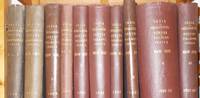
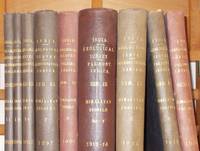
1901014451Calcutta: Geological Survey Office 1901. Geological Survey of India. New Series. 17 volumes. Books measure 36.5x27.5.cm. Published between 1901-1944. Volume 1. 1357378pp 29 plates. Volume 2 40pp x plates 154pp viii plates 58iipp ix plates 183ppxx plates. Volume 3 xix 83pp viii plates 254pp xxi plates 74pp vii plates. Volume 4 29pp v plates 83pp xxx plates 10pp III plates 57pp viii plates. Volume 5 iii1133pp xiii plates 135pp xi plates iii52pp xvi plates. Volume 6 vii 98pp xii plates v 134pp xvi plates iii 69pp viii plates viii 134pp x plates. Volume 7 ii 41pp vii plates 24pp vii plates 78pp xxxii plates 13pp iii plates. Volume 8 iii 73pp iv plates 59pp vii plates 28pp I plate 65pp xx plates. Volume 9 29pp vii 945pp cxxx plates. Volume 10 291pp xx plates vi631pp iv plates 728-73pp xi plates75pp ix plates. Volumes 12 & 13 ii 42pp iv plates 2 maps 4 39pp iv plates. Volumes 1416 & 17 24pp I plate 37pp iv plates ii 56pp viii plates. Volume 15 222pp xxii plates. Volumes 18 & 19 iii 232pp x plates iii 391pp iv plates. Volume 20 ii 79pp xiii plates 19pp ii plates19pp iii plates 39pp vi plates ii 27pp ii plates 34pp I plate. Volume 21 74pp xxiv plates 38pp ii plates x 130pp vii plates 49pp vi plates. Volume 23 xiv 596pp lxv plates. Bound in cloth with gilt lettering. Cloth rubbed worn some joints split library labels and stamps. Generally bindings in good condition. Internally occasional library stamp or mark about 10 in each volume . Pages and plates clean. . Cloth. Very Good. Small Folio. Geological Survey Office Hardcover
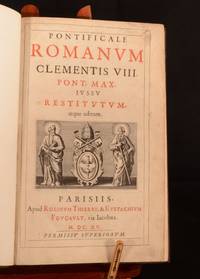
1615629L18Parisiis: Rolinum Thierry; Eustachium Foucault 1615. Cloth. Very Good. 13.5" by 9.5". None. A very scarce and well preserved Roman Pontifical being the Clement VIII version. A lovely folio work which is a piece of Catholic history. In the original Latin. The Roman Pontifical contains the rites of Bishops and is a Catholic liturgical book. Under Clement VIII 1536-1605 a standard version of this work was issued for the use of the entire Roman Rite for the first time. Therefore this is an early edition of this text. This work is in red and black across two columns per page. There are several psalms to which is printed the sheet music. In a lovely condition. Has been rebound without the endpapers. Rebound in a full calf binding. Externally generally smart. Damp staining to the boards. Internally firmly bound. Prior owner's contemporary inscription to the head of title page. Internally firmly bound. Pages are slightly cockled. Pages are bright. Small worm hole to pages 70-236 only affecting the margin. Very Good Rolinum Thierry; Eustachium Foucault hardcover
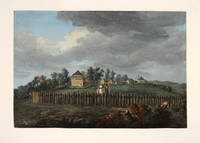
72611ca. 1800. . Gouache on card.<br /> Attractive early American topographical view with a family and others in the foreground painted in fresh thick colours.<br /> ca. 1800]. unknown
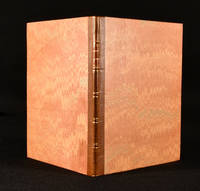
1667704L23Anon: Anon 1667. First edition. Leather. Near Fine. 7.5" by 6". None. A very scarce first edition copy of this critical work on the economics of England and the monies devoted to the Church of England. The title page quotes Francis Bacon and states 'The treasure and moneys in a state be not gathered into a few hands for otherwise a state may have a great Stock and yet starve' in addition to 'Money is like muck not good except it be spread'. ESTC reference no: R218579. Only seen once at auction in the last fifty years in 1976. This critical pamphlet discusses the cause of impoverishing the nation as being the 'pomp pride luxury exaction and oppression of the prelates'. There are many statistics of different clergymen their revenues and all sources of income concluding that 'the money that before ran currant in trading is damned up in their coffers'. A sequel was written by Slingsby Bethel which was released the following year. Bethel was an MP with republican sympathies. A very scarce and important work giving opinions against the Church and the landscape of England's economic climate in the seventeenth century. Rebound in a quarter calf binding with paper covered boards. Externally excellent with minor shelfwear. Internally firmly bound. Pages are slightly age toned. Small contemporary ink mark to the title page. Just the odd spot to pages. Near Fine Anon hardcover
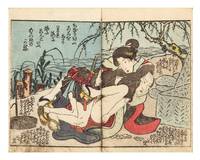
7716Seven double-page one of which has flaps & folds out into a four-panel scene and two single-page woodcuts all finely color-printed and nine double-page black & white woodcuts. One color-printed title-page pasted down on inner upper wrapper 24 folding leaves. Small 8vo orig. color-printed upper wrapper with embossing decorated lower wrapper new stitching. Edo: Preface dated 1864.<br/> <br/> First edition and very rare; we find no copy in WorldCat. The Preface was written by Tanekiyo Ryusuitei 1823-1907 using his pen name “Insuitei.†<br/> <br/> Following one of the frequent fires in the famous pleasure quarters of Yoshiwara often started by the prostitutes in an effort to free themselves many brothels temporarily re-established themselves in other locations throughout Edo. This book was issued as sort of a guide to the newly relocated brothels and very much reflects the changes that shunga books were going through during the end of the Edo period.<br/> <br/> The first double-page woodcut depicts the exterior of a thriving brothel in Edo with many prostitutes within looking out to the numerous passing men and women on the bustling street. This opens up into a four-panel image of the interior of the brothel showing men being entertained and engaging in several sexual activities. The following six double-page woodcuts depict the “star†prostitutes all engaged in sex with the names of the brothels where they worked. All the rooms shown are very luxuriously furnished with silk screens ornate fabrics and beautiful furniture. These woodcuts are all printed in richly saturated colors including silver and gold pigments and with complex embossing.<br/> <br/> The cult of sex organs where phalluses are objects of veneration and worship is also exhibited here in a most uncommon image. The final color-printed woodcut — single-page — depicts an altar inside the brothel where a phallus is the center of worship. Envelopes containing cash left by clients are piled in front. See Suzuki Kenko’s most fascinating “Popular Cults of Sex Organs in Japan: Guardian Deities Auspicious Objects and Votive Paintings†in Timothy Clark et al. eds. Shunga. Sex and Pleasure in Japanese Art British Museum: 2013 pp. 364-67.<br/> <br/> The text section contains nine very interesting double-page black-and-white woodcuts showing elaborate scenes of entertainment men and women having “intimate moments†the aftermath of sex with copious dribbling secretions used napkin wipes on the floor etc. These scenes can be described as “action-packed.â€<br/> <br/> Fine and fresh copy. One black-and-white woodcut has two small holes. unknown
1899014450Calcutta: Geological Survey Office 1899. Survey of india. Memoirs of the Geological Survey of India. Series 15. 9 volumes. Books measure 36x27.cm. Published between 1899-1915. Volume 1 part 1 101001pp xvi plates. Volume 1 part 2 695pp viii plates. Volume 1 part 5 iv 2043pp ix plates. Volume 2 viii 181pp xxiii plates 4120pp xxxi plates. Volume 3 iii 157pp xxii plates iii76pp xii plates. Volume 4 text starts at page 133-511pp civ plates. Volume 5 7 201pp xvii plates 140pp xvii plates 157pp xxiv plates. Volume 6 ii 186pp xxxi plates 39pp v plates. Volume 7 70pp vi plates 168pp xx plates. Bound in cloth with gilt lettering. Cloth rubbed minor abrasion wear some hinge joints spilt but boards holding library stamp on spine and top boards. Generally bindings in good clean condition. Internally occasional library stamp or mark about 10 to each volume a few pages repaired on margins. Pages and plates in very good clean condition. . Cloth. Very Good. Small Folio. Geological Survey Office Hardcover
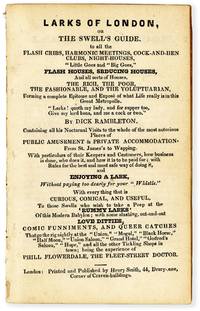
183988235London UK: Henry Smith 44 Drury Lane 1839-1840. First Thus. 12mo. 14.5cm. Disbound retaining buff rear wrap stitched possibly at some point removed from a sammelband. 36pp. Clean and bright with a 1" closed tear to the lower spine edge of the title page; internally fresh lacking the frontispiece plate depicting "The Marquis and His Molls at The Union and Mother Emerson's". A very good clean copy indeed of a vanishingly scarce publication. <br /> <br /> Published under two identifiable imprints; one by "John Wilson" of Long Acre actually the rather shady Edward Duncombe and this volume by "Henry Smith" who was actually notorious smut peddler William Dugdale. Wilson's imprint is the one from the Madeline Kripke Collection currently residing at the Lilly Library in Bloomington Indiana and was long thought to be the only surviving copy. Another copy of the Wilson/Duncombe surfaced in trade in a catalog from the luminous and erudite Karen Thomson in the mid 20-teens and presumably disappeared into a private collection. This copy is the only traceable copy of the Henry Smith imprint with no visibility in OCLC at all. <br /> <br /> Precedence is undeniably difficult to establish; Dugdale was trading at 94 Drury Lane in 1837-1838 and was next door or more likely downstairs at 94 ½ Drury Lane in late 1839 after a brief few months over on Wych Street. He was verifiably printing and publishing work under the "Henry Smith" shingle in 1838 and was presumably still using it in 1839 but in 1840 he was over on Holywell St. off The Strand. <br /> Duncombe on the other hand can be placed at 78 Long Acre having taken a rental on a shop in what was most likely late 1839 it is recorded that in 1841 he hung the name "John Wilson" over the door apparently to the surprise of his landlord who testified in court that there was no such person at that address although there is scant evidence to suggest he wasn't publishing under Wilson prior to that. Purely for amusement purposes it should be noted that during the time this work was printed neither of these two piratical gentlemen was further than 4 minutes walk from each other. <br /> Ms. Kripke stuck to a date of 1840 for her "Wilson" copy and a date of 1840 can be applied to the Smith imprint via a periodical advertisement discovered by the publisher of "The Penny Bibliography"; Mr. John Adcock https://john-adcock.blogspot.com/2009/03/penny-bibliography.html. <br /> The fact that it bears the 94 Drury Lane address suggests a printing date of late 1839 although seeing as both Dugdale and Duncombe were perpetually in and out of court and jail for various crimes against decency throughout their entire careers any accuracy in the timeline can be ascribed to accident rather than intention.<br /> <br /> This copy rather sadly lacks the frontispiece which presumably would have looked much like the one Duncombe/Wilson used in his publication although his has a rather proprietorial publisher's imprint across it depicting a virile young rake cavorting through a number of the establishments mentioned within. <br /> <br /> A significant link in a long chain of bawdy guides rake's progressions and "Gentlemen's Kalendars" that owes much to Harris's Lists of half a century earlier; "Larks of London" occupies a clearly rather cramped space alongside "The Swell's Night Guide Through The Metropolis" by "F.L.G." and the "Man of Pleasure's Illustrated Pocket Book" and their ilk. Stopping short of active descriptions of sexual acts but making no bones about their availability and the addresses where they could or should be purchased it also expands into discussions of the relative quality of food drink and gaming facilities whether the company can be construed to be "Low" or of a more elevated nature and a certain strategic interest in how to get the very best from a night on the most irredeemably vice-ridden town in the Empire. Henry Smith, 44 Drury Lane unknown
191541758Shanghai 1915. 8vo. 18 pp. text and 13 pp. pamphlet. Folding color map. Accordion-fold b/w lithograph plates. <br /><br />First edition. Each of the 85 pagoda images has a description in Chinese and English with a detailed Index on pastedowns. Laid in as issued is a 13 page pamphlet in English titled "Chinese Pagodas." The images were taken from models made by Chinese boys in Shanghai's Tushanwan orphanage. No copies online and none at auction for the past 30 years. Bound in publisher's red cloth. Very good condition. hardcover books
771516 double-page & four single-page color-printed woodcuts. 13; 11; 9 folding leaves. Three vols. Small 8vo orig. speckled semi-stiff boards boards rubbed orig. block-printed title labels on upper covers new stitching. Japan probably Edo: manuscript inscription dated “1832†at end of each volume.<br/> <br/> First edition and very rare; we do not find this book listed in WorldCat or in the Union Catalogue of Japanese Books. The Preface is signed by Akikei or Akikage Higashikuni.<br/> <br/> This work is an erotic version of Shiki no en an 18th-century group of songs on the four seasons of love from the Yamada ryu school of the Japanese harp koto. The poems of Haku Rakuten or Bai Letian 772-846 the Chinese poet of the mid-Tang dynasty are sources for the songs along with Japanese waka poems. Haku Rakuten “became the favorite poet of Heian times…He was the Chinese poet to whom allusions and from whom recollections were most frequent in Heian Japan. His verses were often used for kudai waka and he epitomized Chinese poetry.â€â€“Earl Miner et al. The Princeton Companion to Classical Japanese Literature p. 160.<br/> <br/> The first color-printed woodcut depicts a woman preparing to play the koto. There follows a series of erotic double-page woodcuts: kabuki actors young samurai Chinese characters and women of various social classes are shown engaged in sex through the changing seasons. It is fascinating to see the various rooms and their furnishings the participants’ costumes and the landscapes in the background.<br/> <br/> The fine woodcuts were clearly created by a member of the Utagawa school however we are unable to establish their artistic authorship.<br/> <br/> Very good set but with some thumbing. The second and third volumes have some worming touching several of the woodcuts. unknown
1780EXP2-F-7Anon: Anon c1780. Leather. Good. 9" by 7". Anon. A unique handwritten volume covering predominantly Astronomy and the Use of Globes. Handwritten in a neat and legible hand across 400 pages numbered 1-90 and 1-300. Occasionally with blank page breaks but continuous numbering. An interesting specimen this volume contains exercises diagrams and notes on science geography and astronomy. Primarily focusing on the Use of Globes it contains four diagrams of celestial movements and pages of charts and lists relating to the planets and stars. Written in French with one passage in English describing the fixed stars of the Lion's Tale and Virgin's Spike. The first 90 pages are concerned with broader geography and written in a question and answer style. The second section contains explanations on the use of Globes both terrestrial and celestial and the information that can be gleaned from a practical application of this knowledge. Similar in style to 'Introduction to the Use of Globes' by W Field the text follows an instructive pattern whereby the information is transcribed and then applied to a series of problems. The author seems to have been working through Thomas Hood's 'The Use of both the Globes Celestial and Terrestrial' and making a practical collection of notes for personal or educational use. One section is titled 'Responses aux Questions de ''appendix qui est a la suite de l'introduction a l'usage des Globes par mr Molineux' that is 'responses to questions in the appendix to the introduction of the use of Globes by Molyneux'. Emery Molyneux was an English Elizabethan maker of Globes and his terrestrial and celestial globes were the first to be made in England. Though Molyneux published his own treatise on Globes entitled 'The Globes Celestial and Terrestrial Set Forth in Plano' it has now been lost. In the same year Thomas Hood published 'The Use of Both the Globes' which referenced Molyneux's works. Because of this we believe it is Hood's work to which the author of this manuscript is referring. The work has been dated based on the predictions of celestial movements made in the text up to the year 1800. In a full mottled calf binding wiith gilt detailing. Externally worn with loss to leather at extremities and spine. Worn spine label reading 'usage de globes'. Front pastedown with ridge as quirk of binding. Marbled endpapers and pastedowns. Personal label to front pastedown. Internally generally firmly bound. Approx 100 smaller pages bound in to front and 304 full sized pages follwoing 300 numbered. 2 pages loosening to rear block. Pages bright generally clean with marginal age toning and handling marks. Occasional scattered spots. Creasing to foredge. Good Anon hardcover
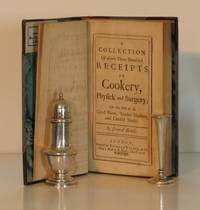
17147280London: For Richard Wilkin 1714. Octavo 19 x 12.5 cm. 16 218 13 pages. FIRST EDITION. “Mary Kettilby’s collection of cookery recipes and medicinal and home remedies from a tasty “green-pease soop without meat†to gooseberry wine. Households that could not afford French cooks or French cooking came to form a growing audience for books by women that contained unpretentious recipes cut to suit a less costly cloth for pickling and collaring rather than ragouts. Where Hannah Woolley had led plenty of female cooks with their eye on the profitable middle market followed with books like Mary Kettilby’s collection of recipes 1714 and Eliza Smith’s Compleat Housewife 1734†Colquhoun Taste: The Story of Britain through its Cookery 2015. Kettilby’s book purported to be a collective effort: the preface stating that ‘a Number of very Curious and Delicate House-wives Club’d to furnish out this Collection’. Maclean however pages 79-82 doubts this and notes that evidence from later editions indicate Kettilby to be the main author. Apart from the Preface there is no introduction of any sort: the recipes follow immediately after the chapter headings. The book is clearly divided into chapters of recipes for food and for remedies but within the chapters there is no definite structure. For example the first chapter begins with six recipes for soups followed by recipes for collared beef ‘French-Cutlets’ collared mutton stewed pigeons broiled pigeons dressed turbot and then patties ‘for a Dish of Fish’. The recipes are given either as goals as ‘To make Hogs-Puddings’ or as titles sometimes with descriptions as ‘A very good Tansy’. Quantities are given in whichever units are convenient as ‘a Gallon of grated Bread’ ‘three Pounds of Currants’ or ‘nine Eggs’. Often quantities rely on the cook’s judgment as ‘as much Sugar as will make it very sweet’. Temperatures and timings are given when necessary as ‘a cool Oven: Half an Hour bakes it’. Later binding in 19th century style. Half-calf gilt-decorated spine marbled endpapers. The front paste-down contains the bookplates of two significant culinary collections: Thomas Scruggs & Margaret Cook and Marian Hatch. The Hatch bookplate was designed and engraved by British engraver Alfred J. Downey. With the bookseller's ticket of Philip C. Duschnes to the rear pastedown. Ink ownership mark to half-title "1718 Eliseab; and inscription on final page of text "illeg. near New College Oxford". OCLC locates eighteen copies; Bitting page 258; Cagle 789; Maclean pages 79-82; Oxford page 54; Wellcome II page 389. For Richard Wilkin hardcover
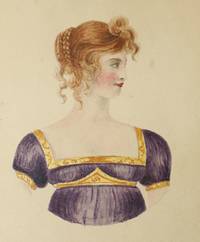
007299Cloth portfolio. Very Good. Fabulous Regency fashion including its affinity for the exotic shown in seven overlay metamorphics. N.d. circa 1816. Based on paper watermark of that date. Thus these were executed then or shortly afterward as fashions shown are very much of the Regency period. The base leaf is 16.5 by 13.5 cm. The overlays are captioned: "Turkish Dress" "Spanish Dress" "Winter Dress" "Virgin of the Sun" "Ball Dress" "Shepherdess" and "Queen's Dress". The overlays a variable in size and they have to be and moved just so to fit correctly with the base head. One of the overlays has a small amount of tissue reinforcement. The group is housed in a modern custom cloth portfolio with flaps to hold the paper in and a ribbon tie to seal the portfolio. unknown
17147280London: For Richard Wilkin 1714. Octavo 19 x 12.5 cm. 16 218 13 pages. FIRST EDITION. "Mary Kettilby's collection of cookery recipes and medicinal and home remedies from a tasty "green-pease soop without meat" to gooseberry wine. Households that could not afford French cooks or French cooking came to form a growing audience for books by women that contained unpretentious recipes cut to suit a less costly cloth for pickling and collaring rather than ragouts. Where Hannah Woolley had led plenty of female cooks with their eye on the profitable middle market followed with books like Mary Kettilby's collection of recipes 1714 and Eliza Smith's Compleat Housewife 1734" Colquhoun Taste: The Story of Britain through its Cookery 2015. Kettilby's book purported to be a collective effort: the preface stating that 'a Number of very Curious and Delicate House-wives Club'd to furnish out this Collection'. Maclean however pages 79-82 doubts this and notes that evidence from later editions indicate Kettilby to be the main author. Apart from the Preface there is no introduction of any sort: the recipes follow immediately after the chapter headings. The book is clearly divided into chapters of recipes for food and for remedies but within the chapters there is no definite structure. For example the first chapter begins with six recipes for soups followed by recipes for collared beef 'French-Cutlets' collared mutton stewed pigeons broiled pigeons dressed turbot and then patties 'for a Dish of Fish'. The recipes are given either as goals as 'To make Hogs-Puddings' or as titles sometimes with descriptions as 'A very good Tansy'. Quantities are given in whichever units are convenient as 'a Gallon of grated Bread' 'three Pounds of Currants' or 'nine Eggs'. Often quantities rely on the cook's judgment as 'as much Sugar as will make it very sweet'. Temperatures and timings are given when necessary as 'a cool Oven: Half an Hour bakes it'. Later binding in 19th century style. Half-calf gilt-decorated spine marbled endpapers. The front paste-down contains the bookplates of two significant culinary collections: Thomas Scruggs & Margaret Cook and Marian Hatch. The Hatch bookplate was designed and engraved by British engraver Alfred J. Downey. With the bookseller's ticket of Philip C. Duschnes to the rear pastedown. Ink ownership mark to half-title "1718 Eliseab; and inscription on final page of text "illeg. near New College Oxford". OCLC locates eighteen copies; Bitting page 258; Cagle 789; Maclean pages 79-82; Oxford page 54; Wellcome II page 389. For Richard Wilkin hardcover books
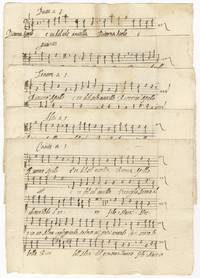
39321Large oblong octavo ca. 175 x 235 mm. 10 pp. Notated in ink on 5 staves per page each voice on both sides of a leaf. Watermark of a small crown and 6-pointed star. <br /> <br /> Slightly worn and soiled; creased at folds. We have not located any other sources of the present work either manuscript or printed. unknown
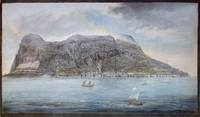
52115c.1800. Fine gouache painting of the Rock of Gibraltar with ships in the foreground 39 x 65.5 cm to outside black neat line. Indecipherabe signature to bottom right obscured by black ink border line. c.1800 unknown
60957France: c.1820-1850. Oblong folio 23 x 29 cm. 85 leaves of Whatman wove paper watermarked 1820. Contemporary straight-grained brown morocco sides ruled with blind and gilt borders gilt lettering to upper cover spine with raised bands and gilt rules gilt inner dentelles pink-coated endpapers all edges gilt. Comprising 27 original sketches and watercolours of a variety of subjects including views botanicals caricatures romantic scenes etc. plus one loose leaf of arabic design richly gilt with manuscript caption "A bord de l'Euphrate" and dated 1850. Generally a charming album in a handsome binding. [France: c.1820-1850.] hardcover
66354N.p. London. 1750. Folio. pp. 53 i. Uncut in modern cloth the title with the lower margin repaired with tape recto and several small marginal tears taped verso no loss of text some marginal spotting the top half of the blank verso of the final leaf heavily dusty old fold vestiges in the text photos available. COPAC-JISC gives 5 locations for 1750 issue including BL and WELLCOME INST.; ESTC #T12377. We also have a small collection of ACTS OF PARLIAMENT going back to the reign of Queen Anne relating to the slave trade please enquire. N.p. London. 1750. Folio. hardcover
1814V74766London printed L. Harrison & J.C. Leigh.: R. Ackermann 1814. Hardcover. Very Good-. Hand-coloured plates 81 uncoloured portrait of the dedicatee by Westall Pugin Nash Mackenzie Turner & Sir J. Reynolds costume plates by Unwins. Large quarto 36x28.5cm page size/binding height 38cm contemporary sugar paper covered boards rebacked with printed labels tips worn & lower edge somewhat shelf worn/corners a bit bumped. Half title coloured frontisplate title uncoloured Grenville portrait dedication leaf vi-xiv subscribers & plate list 1-xxv the city 275pp 6p index; Vol.II half title colour frontisplate title 262pp 6pp index. Without the Founders' portraits which are not called for in the plate list and which Tooley notes were 'not issued till a later date' so the book is complete without these. Some off-setting of plates to adjacent text leaves but not affecting legibility. More than a dozen plates carry the watermark of WHATMAN 1812 and most plates are uncut ie not trimmed thus with slight narrow edge tanning. Ex Library with circular blind stamps 1.6cm throughout. The verso of both titlepages have 3x4mm stamp with accession & shelf number and "enf.trans.4/70" filled in neatly. It does not show through to recto of leaf and there is now a gift book plate tipped over this. The pastedown has bookplate of F.W. Searle initials & 1" red ink circle. Newer free endpaper watermarked 1833 and is not part of the pastedown or next free sheet. Beautiful and very clean copy with large margins clean unsmudged coloring on thick crisp paper Abbey Scenery 278. R. Ackermann hardcover
18300046431830. Full Straight-Grained Morocco. Very Good. An exquisite manuscript copy of plates from the 1644 work by Wencelaus Hollar. While a copy the pen-and-ink work here is absolutely exceptional requiring a loupe or magnifying glass to fully appreciate the niceties of detailing achieved by the artist copier. It is also clear that this copier did not merely trace the original work. Heightening the pen-and-ink work are touches of watercolor. 8vo. 173 by 117 mm. Unpaginated half-title page with a handwritten copy of the verse from "The Merchant of Venice entitled "The Folly of Fashion the Deceit of Ornament or Appearance" second title copied from the 1644 work followed by 36 mounted pen and ink copies of fashion etchings from the 1644 work and a final page with a drawing of a trophy and two musings written out. The drawings besides being meticulous with near-microscopic detail are austere with the pen and ink work heightened with only touches of flesh color for the women's faces and tiny dabs of gold for jewelry buttons and the like. The austerity we would stress is befitting the fashions represented as the early and mid-17th century was a time that garments tended to be more monochromatic and sober meant to suggest piety as any student of portraits from this era coincident with the Puritan Revolution and religious wars on the continent would have absorbed. And we would add the austerity is not just of the dress but also the expression on the women depicted here. The flesh color applied to the faces and also hands is just as nuanced as everything else about these portraits. There is a gradient of coloration capturing very realistically the actual pigment of human flesh. The one exception to the limited color usage is a depiction of a woman from Virginia a Native American whose bare garment is painted red and who is wearing jewelry that is captured with bolder applications of gold. This exotic specimen also shows a woman with a tattoo on her arms something that was completely alien from European cultures at the time. The Virginian is not the only non-European depicted however as there is a woman from Algiers a Moresco woman an Argentinian. Also shown is a Turkish woman and the dress shown is from different strata of the societies represented. Short cursive handwritten captions identify for us where the model is from. All the handwriting including on the title the poem etc. is rendered in a tight minute script. Unfortunately there is no indication who the artist copyist was other than the initials PC by several of the drawings. In the front there is an ownership inscription of an Elizabeth Cobbett. There is a watercolored bookplate with the Hillman family crest. unknown
18300046431830. Full Straight-Grained Morocco. Very Good. An exquisite manuscript copy of plates from the 1644 work by Wencelaus Hollar. While a copy the pen-and-ink work here is absolutely exceptional requiring a loupe or magnifying glass to fully appreciate the niceties of detailing achieved by the artist copier. It is also clear that this copier did not merely trace the original work. Heightening the pen-and-ink work are touches of watercolor. 8vo. 173 by 117 mm. Unpaginated half-title page with a handwritten copy of the verse from "The Merchant of Venice entitled "The Folly of Fashion the Deceit of Ornament or Appearance" second title copied from the 1644 work followed by 36 mounted pen and ink copies of fashion etchings from the 1644 work and a final page with a drawing of a trophy and two musings written out. The drawings besides being meticulous with near-microscopic detail are austere with the pen and ink work heightened with only touches of flesh color for the women's faces and tiny dabs of gold for jewelry buttons and the like. The austerity we would stress is befitting the fashions represented as the early and mid-17th century was a time that garments tended to be more monochromatic and sober meant to suggest piety as any student of portraits from this era coincident with the Puritan Revolution and religious wars on the continent would have absorbed. And we would add the austerity is not just of the dress but also the expression on the women depicted here. The flesh color applied to the faces and also hands is just as nuanced as everything else about these portraits. There is a gradient of coloration capturing very realistically the actual pigment of human flesh. The one exception to the limited color usage is a depiction of a woman from Virginia a Native American whose bare garment is painted red and who is wearing jewelry that is captured with bolder applications of gold. This exotic specimen also shows a woman with a tattoo on her arms something that was completely alien from European cultures at the time. The Virginian is not the only non-European depicted however as there is a woman from Algiers a Moresco woman an Argentinian. Also shown is a Turkish woman and the dress shown is from different strata of the societies represented. Short cursive handwritten captions identify for us where the model is from. All the handwriting including on the title the poem etc. is rendered in a tight minute script. Unfortunately there is no indication who the artist copyist was other than the initials PC by several of the drawings. In the front there is an ownership inscription of an Elizabeth Cobbett. There is a watercolored bookplate with the Hillman family crest. <br/><br/> unknown books
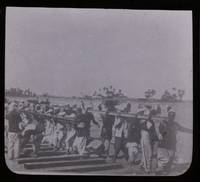
1898763L6N/A: N/A c1898. Unbound. Very Good Indeed. N/A. N/A. A scarce box of ten photographic glass slides depicting the Anglo-Egyptian Sudan Campaign commanded by Kitchener. The images include a group picture of the 21st Lancers two of whom received the Victoria Cross for actions at the Battle of Omdurman. There are also images of British soldiers in Khartoum Guards at Shabluka and military railway construction. The Sudan Military Railroad was constructed from 1896-1897 by Kitchener to supply the Anglo-Egyptian army prosecuting the Mahdist War. This railway was the predecessor line for the present-day Sudan Railway. The Kitchener campaign was from 1896-1898. And was a reconquest of territory lost by the Khedives of Egypt in 1884 and 1885 during the Mahdist War. The plates are in a relatively good condition with some tape repairs to the edges of some. Housed in a wooden box. These images are an original source from this historical campaign. In a wooden box. All but one of the plates are paper taped at the edges. There are a few small cracks to the edges of the plates with the image mostly unaffected. Very Good Indeed N/A unknown
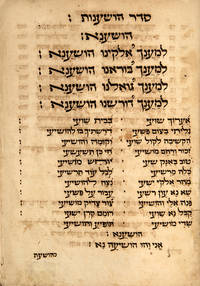
113791Italy 19th century. . Hebrew manuscript on paper 27.8 x 20.6 cm rebacked contemporary blind-tooled calf; 17 ll. last leaf blank.<br /> The Hosha'anot prayers are recited every day during the holiday of Sukkot as a reminder of the holiday ceremonies that were performed in the days of the Temple. Instead of circling the altar raising willow branches the willow being one of the Four Species of Sukkot the worshipers circle around the 'bimah' in the synagogue while holding the Four Species and reciting the Hosha'anot. The Torah Scrolls are taken out from the ark and also carried around the 'bimah' during the ceremony.<br /> [Italy], [19th century]. unknown