Balfour, The Earl of [Arthur James]; Cohen,Israel [Editor]; Samuel, Sir Herbert [Foreword]MareMagnum

29 774 résultats
"Whatever place its author may ultimately occupy in future histories of England, one thing is certain, that in the history of the Jewish people the name of Balfour will enjoy unchallenged immortality, evoking comparison with that of Cyrus, for the issue of the Balfour Declaration marked the opening of a new epoch in the annals of Jewry which will be recognised as such even in the remotest centuries to come. In this little book have been gathered together all the utterances of Lord Balfour on the interpretation and implications of his Declaration, on its political aspects and its practical realisation, made during the last ten years." - Preface. [4], 5-128 pp. 7" x 4.75". Original spine label present and intact. Front free endpaper professionaly replaced. Tanning to central portion of half-title. Prior owner's ink stamp upon title page. Duplicate spine label bound at p.128. Average external wear. Binding intact with moderate forward lean. No dust jacket, presumably as issued. Quarter inch notch from top of backstrip. A sound copy of this jewel of Zionist history. EMANUEL p.48. [ASIN B000852UV4] Book
1st edition. All original paper wrappers, 4to, each copy is 1 leaf folded in half, making [4] pages. Included are: No.50 (September 17, 1940), No. 52 (October 1, 1940), No. 62 (December 30, 1940), No. 71 (March 3, 1941), Nos. 74-80 (March 24 -May 5, 1941), No. 82 (May 19, 1941), Nos. 84-151 (June 2- September 21, 1942), Nos. 153-223 (October 5-February 7, 1944), Nos. 226-234 (February 28-April 24, 1944), Nos. 236-305 (May 8, 1944-December 15, 1945). The numbering system then changed and continues as Vol. VII, Nos 1-19 (January 1-October 1, 1946), all present. 249 issues total, nearly complete and uninterrupted from March 1941-October 1946. Fascinating exile publication, published weekly to alert other refugees, and American decision makers as well, about Nazi abuses in Czechoslovakia and resistance to them, from the great ("Sokol Property Seized: Nazis Destroy Great Czech National Monument) to the small ("Czech Farmers Refuse to Breed Pigs") . Some material on Jews. "News Flashes From Czechoslovakia Under Nazi Domination" ran 1939-1945, then, following the end of the war, continued as simply "News Flashes from Czechoslovakia, " through 1946. The Czechoslovak National Council was established during WWI to help with war efforts. Headlines include, Over 50,000 Czechs in Nazi Torture Chambers, (no. 50) New Persecution of Czech Catholics, (no. 52) Nazis admit Invasion of Czechoslovakia Before Dr. Hacha signed Agreement, (no. 74) German Refugees in Czechoslovakia, (no. 77) Nazis Selling Out in Protectorate, (no. 95) President F.D. Roosevelt on American-Czechoslovak Relations, (no. 115) New Nazi Government for Czechs, (no. 119) Every Seventh Worker in Hitlerland a Foreigner, (no. 120 Nazis Discover Sabotage in Czech Literature and Art, (no. 128) Just Retribution to Nazis Pledged by Czechoslovaks, (no. 139) Czechoslovak Labor Under Nazism, (no. 205) and Religious Situation in Czechoslovakia (Vol VII, no. 19). SUBJECT(S): History. 1938-1945 Czechoslovakia. Also included a publisher's notice about new name and printing schedule. OCLC: 2449105. A few issues have minor tearing and chipping, some are sunned, some have additional creasing from mailing. All are legible and intact. Majority are in Near Perfect Condition. Very Good Condition. (HOLO2-159-10)
1st edition. Period-style half leather with marbled boards, 12mo, 93 pages. In German. Singerman 1749. The David Einhorn Hymnal. Title translates as Songs for Jewish Public Worship. The Kneseth Israel (Philadelphia) board minutes from May 4, 1862, note that: A communication from Dr. Einhorn was handed in and reads as follows: To the respectable board of directors of Keneseth Israel! Since there is a decided shortage of hymn books not only in our reform congregation but in all the others in America, I am determined to put together a collection of songs, about 80-90 pages. They should be put to use during the service, and I will give them to the congregation if the congregation is wiling to undertake the printing....I suggest to the respectable board to take over the publication of the hymn collection and let me know soon, that the printing can start. Philadelphia, April 28, 1862. Dr. Einhorn. Decided, to accept the communication from Dr. Einhorn and make preparations for the printing [translation of minutes located at KI and at HUC in Cincinnati]. Then, according to the minutes of the next meeting, the board decided to fund the printing, which included 100 bound volumes. Reform Liturgy Scholar Judah Cohen has noted that the hymnal was almost entirely Einhorn, at least based on these records, and created in his view as a service to the growing reform movement. Rabbi Dr. Lance Sussman, Senior Rabbi at Kenesseth Israel in Philadelphia and a scholar on the history of the Synagogue and on 19th Century American Jewish history, reported on the H-Judaic internet listserv that I believe from the time Einhorn arrived in Baltimore from Europe in 1855, KI was in touch with him about its music program. KI had a gentile organist, William Fischer, who partnered with Einhorn both before and during Einhorn's time in Philly. Einhorn had fled Baltimore on April 19, 1861, following his delivery of an anti-Slavery sermon; a mob sought to tar and feather and he fled to Philadelphia where he became spiritual leader of Congregation Keneseth Israel. SUBJECT(S) : Jewish hymns. Reform Judaism -- Liturgy -- Texts. Jewish hymns. Reform Judaism Liturgy and ritual. OCLC: 9033019 OCLC lists only 6 copies worldwide (HUC, Gratz, Penn, Princeton, Princeton Theological, LBI). Far scarcer than famous first American Jewish hymnal published 20 years earlier in Charleston, which shows up with 9 holdings in OCLC. Institutional perforation stamp to title and final leaf, one other margin stamp. Otherwise very clean, an attractive copy of this exceedingly scarce and important American Jewish Hymnal by one of the 2 most import leaders of American Reform in the 19th Century (the other being Isaac Wise) . (AMR-51-15-BD)
1st edition, Original orange printed paper wrappers bound into later cloth, 12mo, 107+ 4 pages. The necessity for Jews to maintain the laws of ritual slaughter. In Hebrew and some English plus three different subtitles. Singerman 2503 (listing 7 copies) , Deinard 335. A Response to the First Anti-Shechitah Campaign in America. Aaron Zebi Friedman (1822-76) , served as shohet, or ritual slaughterer, in his native Poland before immigrating to New York in 1848, where he found employment in one of the citys largest kosher slaughterhouses. In 1866 the Society for the Prevention of Cruelty to Animals launched the first anti-Shehitah campaign in America. The president of the Society, Henry Bergh, dispatched a letter to the proprietor of a kosher abattoir in New York accusing him of engaging in "barbarous, revolting, and wicked" practices. Bergh further called on him to desist from violating the laws of New York and of God by "mangl[ing] and tortur[ing] his creatures. " In 1875, Aaron Zebi Friedman, renowned for his piety, composed a sharp rejoinder entitled, Tub Taam, to refute Bergh's accusations. He not only succeeded in silencing Bergh, but even in convincing him: In 1885, Bergh defended shechitah against charges of cruelty leveled by the Philadelphia branch of his Society. (Goldman, 1092; JE, Vol. V, p. 518) . Apropos of the current culture wars, animal rights organizations and activists, within and outside of the Jewish world, continue to criticize kosher slaughtering practices on the grounds of animal cruelty. The orange wrappers present here are not noted by (perhaps unknown to? ) Goldman. A copy sold at auction in 2013 for over $4900 (with commissions) . The 2nd edition from 1876, translated into English, sold at auction 2 years later, in 2015, for over $8, 000 (with commissions) . The present copy, here: Ex-library with usual marks. Some old staining and toning, otherwise Very Good Condition. Rare and important. (KH-8-58)
15294012[Paris], Gilles de Gourmont, 1529. 36 nn. Bll. (linksläufig kollationiert). Mit breiter figuraler Titelbordüre in Holzschnitt sowie einer figuralen Initiale und einer großen Holzschnittvignette am letzten Bl. verso. Mod. Pergamentband. 4to.
1st edition. Later boards, 12mo, 16 pages ; 23 cm. In Hebrew with some English on title page. Cited by Freirnann, Mishkin and Rosenfeld as the first Hebrew book printed in Chicago. See: Leah Mishkin, "Defuse Shikago Be-'ivrit Ube-Yidish" (Chicago Imprints in Hebrew and Yiddish; this work is item #1) , 1952, p. 79. Singerman 2639. Goldman 689. Deinard 60. In his early groundbreaking work, History of the Jews in America: From the Period of the Discovery of the New World to the Present Time, Wiernik cites the work as an example of Rabbinical works published in America (New York, 1912, p. 407) . Lewinson, a native of Vilna, lived in Chicago by 1877, when he published his Ha-Emet Ha-`Ivriyah . An opponent of pilpul, he argued that Midrashim should be understood according to peshat (plain, literal exegesis) (pp. 9-10) . Lewinson published Ha-Emet Ha-`Ivriyah to demonstrate that statements by various individuals found in the Midrash and Talmud could be understood only within the context of what the individuals had said elsewhere (pp. 3-9) . Ha-Emet Ha-`Ivriyah also contains (pp. 10-150 annotations that Lewinson did not include in his [Sefer Hayi LeBavot] (Vienna: Bet Harnirlra h. 1872) , a critical study of Bahya ibn Paquda's Hovot ha-Levavot based on textual variants . Freirnann, Mishkin (#1) and Rosenfeld (#1016) record Ha-Emet Ha-`Ivriyah as the first work published in Chicago with Hebrew type though Goldman and Wachs also indicate that another Hebrew work was also published in Chicago that same year (Goldman, p. 615) SUBJECT(S) : Aggada. OCLC: 19154360. OCLC lists 8 copies worldwide. Very Good Condition. Scarce and very important. (KH-8-62-DF)
16442011Nürnberg, Simon Halbmayer, 1644. (Gest., ill. Vortitel), (Titel), (12), 512, (24) SS. - [Vorgebunden] II: Crinesius, Christoph. [Babel] sive Discursus de confusione linguarum, tum orientalium [...]. Nürnberg, Simon Halbmayer, 1629. (Titel), (14), 144, (4) SS. Mit Holzschnittdruckermarke am Titel, 3 ganzs. Textkupfern (Schriftproben) sowie zahlr. ornamentalen Initialen und Vignetten in Holzschnitt. - [Vorgebunden] III: Hackspan, Theodor. Disputationum theologicarum & philologicarum sylloge [...]. Nürnberg, Johann Andreas Endter & Wolfgang Endter, 1663. (Titel in rot und schwarz), (6), 616, (43) SS. Mit einigen ornamentalen Vignetten und Zierstücken in Holzschnitt. Zeitgenössischer Pergamentband mit hs. Rückentitel. 4to.
In-16 (113 x 71 mm), plein veau grège retourné, dos gothique à 3 nerfs, plats ornés d'un jeu de filets gras d'encadrement estampés à froid (reliure postérieure dans le goût de l'époque), 82 [i.e. 80] feuillets [sign. A-K8], 5 planches gravées sur bois dont 3 dépliantes et une à volvelle mobile. "Le plus rare et le plus recherché des ouvrages de Raymond Lulle" (Caillet): 'De l'enseignement kabbalistique', ici dans sa troisième édition illustrée de 5 planches, dont trois dépliantes et une avec volvelle, montée avec ses deux parties mobiles conservées (les célèbres "roues kabbalistiques"), ainsi que 2 figures dans le texte. Lettrines et ornements typographiques gravés sur bois. La réputation de Lulle kabbaliste repose tout entière sur cet ouvrage que la recherche moderne a réattribué au médecin et humaniste véronais Pietro Mainardi (1456-1529), docteur de l'université de Ferrare en 1490, grand connaisseur de l'oeuvre de Lulle. Son nom figure d'ailleurs dans l'explicit de la première édition de l'ouvrage (Venise, 1518) pour disparaître des éditions suivantes et être remplacé par celui de Lulle. L'auteur eut l'ambition, par ce traité, d’accomplir l'idéal de Pic de la Mirandole: harmoniser l'art Lullien avec celui de la Kabbale. C'est encore en tant qu'oeuvre de Raymond Lulle que le livre a été lu et commenté par Giordano Bruno qui le rendit célèbre, pour être ensuite repris au sein des anthologies de Lulle éditées par Lazare Zetzner. Le succès et l'influence de ce traité ne se démentirent pas aux XVIe et XVIIe siècles, au long d'une réception qui s’étend de Giordano Bruno, Claude Duret, Athanasius Kircher jusqu'à Leibniz (cf. Eva Broner, 'Doctor Illuminatus: A Ramon Llull Reader', Princeton U. Press, 1993). Le livre est considéré par les catalogues de Stanislas de Guaïta (qui ne possédait qu'une édition de 1601) et par celui de Caillet, comme "le plus rare et le plus recherché des ouvrages de Raymond Lulle". (Caillet, 6846. Duveen, 'Alchimie', 370. Guaïta, n°530 et 1565. Palau, 143.864. Renouard, n° 376 pour la marque au titre. Rogent & Duràn, 'Bibliografía de les impressions Lullianes', Barcelona, 1927, n°120). Quelques piqûres d’humidité éparses. Cachet en pied du titre: "A.L.L.R". Très bon exemplaire, bien relié, bien conservé.
1710DIV012in 8 ( 18x 12 cm) 201 Fol / pages 5470 (H) 1710 (c) frontispice gravé ,papier en bel état ,tranches dorés reliure sur haies de bois ,fermoirs métalliques présent . Un plat parfaitement séparé du volume En portugais Very rare 2nd second edition of the only treatise on Hebrew laws and customs written in Portuguese language and printed for the Portuguese Sephardic communities in Northern Europe. Treasure of Jewish Laws that the people of Israel must know and observe composed by Rabbi Hacham Menasseh ben Israel in Amsterdam, 1st edition 1647; and this 2nd edition in 1710. In 8. º (18x12 cm) (v) -201 - (iv) folium. Binding (worn out at edges) contemporary full calf gilt at spine. Engraved frontispiece. Contains title page to Third Part (Of feasts and fasts throughout the year, the people of Israel must know and observe) and the Last part (in which contains all the precepts, rites and ceremonies concerning to a perfect economy dedicated to the very noble and magnificent lords Abraham and Ishak Israel Pereyra). MENASSEH BEN ISRAEL was born in Lisbon in 1604. Very young of age he went to Amsterdam with his father, Joseph ben Israel, and became a disciple of Haham Yshac Uziel. In 1622 he was appointed professor of the Portuguese Jewish community in Amsterdam and, four years later, he founded the first Hebraic typography in Amsterdam; printing small books in Portuguese, Spanish and Hebrew languages. Menasseh had a decisive contribution in reopening England to the Jewish people, closed since the time of King Edward Ist. He went personally to London and had talks with Cromwell who gave him an honorific pension he never profit of. Menasseh died in 1658 after returning from London. He was portrait by Rembrant. Inocêncio VI, 211. 'In a book dealer which trade was new and old books, I found a complete copy of the Treasure. I've never seen another. '
1782395221782 In-12 (162 x 95 mm), demi-basane brune à petits coins, dos lisse orné dune roulette dorée en place des nerfs, titre doré, tranches mouchetées (reliure de lépoque), xii, 255 pages, (2) feuillets derrata. Dessau, dans la librairie des auteurs et des artistes [colophon: à Hale, de l'Imprimerie de Chr. Gottl. Taeubel], 1782.
1782PHO-1140Dessau, Librairie des auteurs et des artistes, 1782, XII-255pp.-2ff, relié demi basane postérieure, dos à nerfs avec auteur, titre et date en pied.
1527952460Basel: Johannes Froben. 1527. Oktav, 19,7 x 15 cm. (Fehlstellen am Rücken fachmännisch mit Pergament hinterlegt, leicht bestoßen und etwas fleckig, 7 fehlende Blätter durch hervorragende Faksimiles ersetzt, fliegender Vorsatz fehlt hinten, wenig gebräunt oder fleckig, vereinzelt zeitgenössische Marginalien) [13 Warenabbildungen] 4 Blatt, 200 Seiten, 8 Blatt. Lagenzählung: a-z 4, A-E 4. Ganzpergament der Zeit oder etwas jünger,
152742528Basileae (Bâle), Johann Froben, 1527. Petit in-4 (154 x 204 mm) de (8)-434-(2) pp. (sign. a-z4 A-Z4 Aa-Hh4 Ii6), titre avec encadrement gravé, demi-basane blonde à petits coins, dos lisse orné de roulettes et palettes dorées, pièce de titre verte, tranches mouchetées (reliure du XIXe siècle).
Later half calf. 8vo. 88; 116; 64; 80; 72; 64; 48; 24; 40 pages. 22 cm. First edition. A collection of Joanna Southcotts last writings. Nine volumes, from the same printer, same writer (s) , bound together, including: The book of wonders, marvellous and true 1813; The second book of wonders, more marvellous than the first, 1813; The third book of wonders, announcing the coming of Shiloh: with a call to the Hebrews, from Isaiah xi, And there shall come forth a rod out of the stem of Jesse, and a branch shall grow out of his roots. Revelation xxii. 16, 17, I am the root and the offspring of David, and the bright and morning star. Here is the call to the Jews, to answer, how they will expect the branch, without the root, whom they cut off, and set at nought 1814; The fourth book of wonders: being the answer of the Lord to the Hebrews, 1814; The fifth book of wonders: announcing the event having taken place, which was promised in the fourth book should be in May: with a further explanation of the four former books ; also an answer to the address of the Rev. James Hearn, Curate of Brixham, Devon; and to the mockery of others, 1814; and four pamphlets: Copies of letters sent to the clergy of Exeter, from 1796 to 1800, with communications and prophecies put in the newspapers in 1813; Wisdom excelleth the weapons of war: and herein is shewn that judgments are the strange works of the Lord, but mercy His darling attribute, 1814; A communication sent in a letter to the Reverend Mr. P. In 1797, with an explanation thereon now given, 1814; Prophecies announcing the birth of the Prince of Peace, 1814. All publications Printed by W. Marchant, Ingram Court, and end on this note "The above taken from Joanna Southcott's mouth, by me, Ann Underwood. " Nine publications by Joanna Southcott (1750-1814) , prophet and writer, who started the Southcottian movement with her phrophecies, gaining many adherents from Richard Brothers after his arrest: One of the most significant of her London converts was Jane Townley, who not only invited Southcott, in April 1804, to become part of her household, but also did all she could to promote Southcott's writings and cause, including providing her maidservant, Ann Underwood, to act as Southcott's accomplished and devoted amanuensis. With the steadfast assistance of Foley, Sharp, and others, the three women became the nerve centre for the Southcottian movement, which generated an astonishing degree of interest, correspondence, and debate regarding Southcott's prophetic claims. Between 1801 and 1814, Southcott published some sixty-five pamphlets, totalling almost 5000 pages; moreover, her unpublished manuscripts amount to twice the number of pages in print. By one conservative estimate, a total of 108, 000 copies of her various works were published and circulated from 1801 to 1816, making her one of the most popular writers of her time (Hopkins, 84) . One reason for the immediate appeal of her texts is their unique mix of apocalyptic optimism with down-to-earth narratives about everyday life, which she converts to spiritual account. In 1814 Southcott carried the claim to a new level when she announced that she was about to become the mother of Shiloh, the name given to the expected divine incarnation. The revelation was made explicit in The Third Book of Wonders, Announcing the Coming of Shiloh (1814) , and Prophecies Announcing the Birth of the Prince of Peace (1814) , which collected extractions from earlier writings that seemed to anticipate this new revelation. After Southcott's death the movement splintered and prophets of Shiloh proliferated, among which John Ward's Shilohites and John Wroe's Christian Israelites were the most prominent. A core of her inner circle kept the faith quietly, remaining loyal to Southcott's work, as signified by their protection of the great box, which contained the sealed prophecies that were to be opened some time in the unspecified future by the bishops. (Oxford National Biography, 2004) . Bound in half calf with marbled boards, with gilt title on spine. Subjects: Prophecies. Southcott Movement Prior to 1815. OCLC lists less than 23 copies per each of these publications included in this bound collection. Light wear to leather. Light foxing and light soiling to a few pages throughout, overall, fresh and clean. Very good + condition. (KH-1-46)
First Edition. Original board with paper label on front, as issued, 8vo, 54 pages ; 22 cm. In English with Hebrew. Singerman 564; Rosenbach 368; Bruntjen 21148; Goldman-Kinsberg 183. Goldman notes, Joshua Seixas, the son of Gershom Mendes Seixas (the minister of New York's Shearith Israel congregation), was born in New York in 1802....He taught in Shearith Israel's Hebrew school in the mid-1820s and he established the congregation's first choir. Seixas moved to Charlestown, MA, in the early 1830s and gave lessons in Hebrew. Among his pupils were Harvard students. Seixas began referring to himself as James while in Charlestown...Seixas then settled in Hudson, OH. He offered private Hebrew classes to students at Oberlin College, and later at Western Reserve University...He also taught groups of Mormons- the center of the movement at the time was in Kirtland, OH- and among his students were Joseph Smith, the founder of Mormonism, and Orson Hyde, another early leader of the movement." This is presumably the very edition of his book that he would have used with his Mormon students there. "Seixas left Ohio in 1836 and he was living in Staten Island, NY, by 1838.....a few of his many children remained within the community; others did not....Seixas's grammar was reviewed favorably in its time (Goldman, 'Joshua/James Seixas," 72), though Chomsky later criticized it (Chomsky [1958], 133-4). In addition, the printer, Gould, was a relative of Joseph Smith, who is descendant of Zaccheus Gould by the marriage of Samuel Smith and Priscilla Gould. The Smiths came from Topsfield, near Andover, where Gould had his press. For detailed analysis of Seixas' relationship with the founders of the Mormon church, see Rick Grunder's 2015 essay "A Teacher for the Temple: The Infectious Exuberance of Joshua Seixas" (www.rickgrunder.com/seixas.pdf). SUBJECT(S): Hebrew language -- Grammar. OCLC: 4821518. Period ownership signiture. Bookplate on rear pastedown. Lacks backstrip. Some foxing and staining, Good Condition (AMR-65-31A)
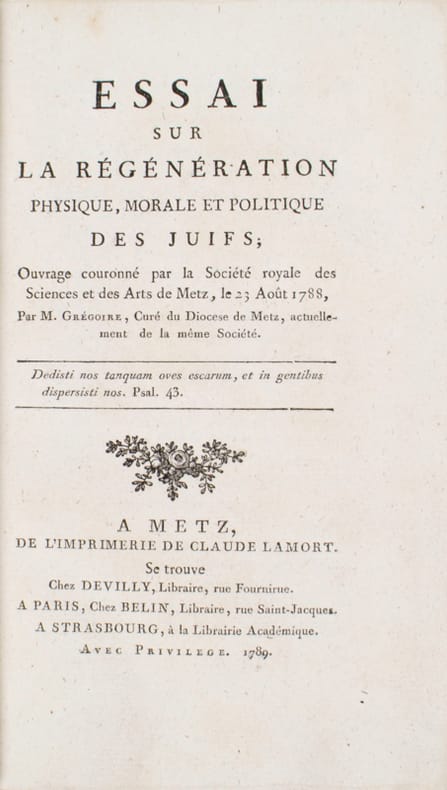
178910409A Metz, de l'Imprimerie de Claude Lamort, 1789. In-8 de (8)-262-(2) pp., demi-basane brune à petits coins, dos lisse orné, entièrement non rogné (relié vers 1810).
Signed and briefly inscribed by Kahane upon front free endpaper. xii, 338 pages. Index. "The inside story, by its founder, of the militant organization determined to defend Jews in whatever manner necessary." - dust jacket. "I am not ashamed to admit it. I do not understand the Jew. I am at a loss to understand a man so clever in business, so keen in science, so intellectually bright in debate - and so incredibly stupid when it comes to saving himself." - dust jacket. Book tight and square with moderate wear and bump to upper corner of front board. Average wear to dust jacket which is now preserved in archival-grade Brodart. Book
1st edition. Quarter leather, 8vo, 268 (Discourses) + 99 (Claims), . Singerman 0745. Rosenbach 476. Leesers first major work. Its difficult to overestimate the impact of Leesers work on American Jewish communal life, religious education, and culture . Leesers first major work was a rebuttal to an attack on Jews which was published initially in the London Quarterly Review and then re-circulated in American newspapers. Leesers piece appeared in 1828 in the Richmond Whig, and was re-printed in 1841 as a book entitled The Claims of the Jews to an Equality of Rights. This writing earned Leeser an invitation to become Hazan of the Congregation Mikveh Israel in Philadelphia (Penn Libraries, 2008) . Chips to foot and crown of spine, otherwise Very Good Condition in beautiful original full butter leather binding with tooled spine, a Very Nice copy. (AMR-39-4A)
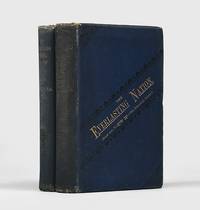
1889146767London: Abraham J. Lev & Co.; John Snow & Co. 1889-90. First and only editions of the first two years of Reverend Isaac's periodical for the Jewish people gathering issues from May 1889 to December 1890. This rare publication includes the complete story of "The Star of Peace" by "Ben Abram" in which the adventures of Isaac Da Costa in Jamaica and in England were those of Isaacs's own father. We were unable to trace any copy in commerce and only six in institutions; Library Hub locates three copies only Edinburgh UCL BL and WorldCat adds a further three Harvard Hebrew Union College National Library of Israel. The Everlasting Nation was published between 1889 and 1892 and comprised four volumes in total. "There is no periodical in existence which professes to start from the stand-point and to comprehend a like variety of topics as those which are enumerated in the Programme of 'The Everlasting Nation'. The magazines which are connected with existing missionary work are necessarily of a missionary character. But here our attitude is that of the Hebrew-Christian" introduction. Albert Augustus Isaacs 1826-1903 was a 19th-century historian and anthropologist specializing in the history of the Middle-Eastern Jewish and Arabic people. His travels familiarized him with Palestine and he wrote among others The Dead Sea 1857 and A Pictorial Tour in the Holy Land 1858 which is illustrated with the many photographs he took himself. Born and baptised into the Church of England in Jamaica Isaacs was of Jewish parentage and "throughout his long life he identified himself with every movement for the welfare of his brethren according to the flesh. In 1866 he was appointed by Lord Berners vicar of Christ Church Leicester in his old diocese of Peterborough where for more than 25 years he laboured in season and out of season carrying on his ministry on staunch Protestant and evangelical lines and being surrounded by a large band of fellow-workers who heartily appreciated his teaching and work. Mr. Isaacs was known as 'the Jew of Leicester' and continued his great interest in all efforts for the conversion of his brethren to Christianity" Bernstein. 2 vols octavo. 1 plate occasional in-text illustration decorative initials. Original dark blue cloth titles in gilt to spines and front boards decorations to boards blocked in black and blind dark brown coated endpapers. Housed together in a custom dark blue cloth slipcase. Slight wear to corners spines sunned rubbed the bindings otherwise sound hinges repaired front hinge of vol. 2 tender between title and index internally fresh; a very good set. Rev. A. Bernstein "Some Jewish Witnesses For Christ" 1909 pp. 281-8. hardcover
Sm. folio in sixes, with wood-engraved title-vignette and several fine wood-engraved head- and tail-pieces throughout; seventeenth century calf, expertly rebacked in calf to style, back with five raised bands, second compartment with original red leather label ruled and lettered in gilt, boards moderately age-marked, corners strengthened, a very good, bright, crisp copy. With nineteenth century inscription on front paste-down and corresponding signature on title. The work comprises: (1) A Historie in twenty books, wherein the Antiquity of the Jews is discovered; (2) Seven Books of the Wars of the Jews; (3) Two Books against Appion the Grammarian, in Justification of the Antiquity of the Jews; (4) A Book as touching the memorable Martyrdom of the Machabees; (5) Josephus Life. Written by himself. [Note that the composition of the work differs; the printed order is 1-5-2-3-4]. APPARENTLY AN UNRECORDED VARIANT. The style of the title is similar to Allison 7 (see plate 8): this copy carries the same text but with considerable variations in typography, and the title-vignette (McKerrow 335) is unframed. IMPERFECTIONS: THIS COPY WANTS THE GENERAL TITLE, DEDICATION TO LORD HOWARD OF EFFINGHAM, AND PP.3-10 (4 leaves); it retains Lodge's dedication to Anthony Palmer and his address 'To the Courteous Reader'. This copy also retains the misprinted pages (715-716 for 719-720; 522 for 555) of Allison 7. In the absence of the general title it is difficult to be certain, but it appears to be a variant dated 1609 but conforming more closely to the first edition of 1602. VERY SCARCE.
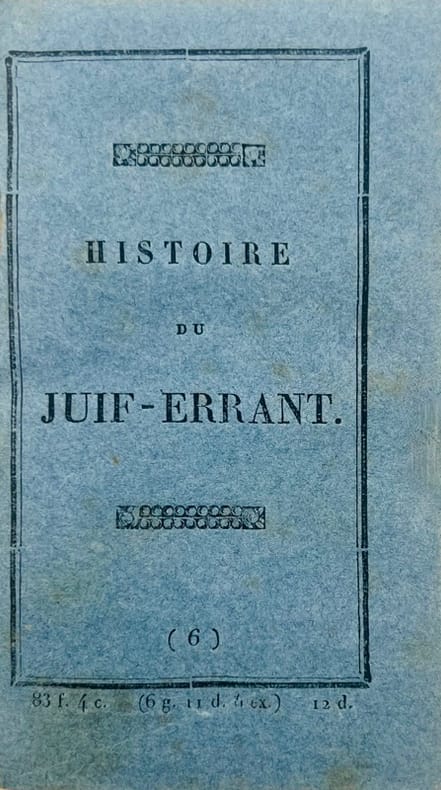
182744385Montbéliard, Imprimerie de Th.-Fréd. Deckherr, sans date, (1827). In-12 (100 x 144 mm) de 24 pp. sur papier bleu, entièrement interfolié, percaline Bradel moutarde, pièce de titre en long de maroquin rouge, couverture bleue imprimée conservée (reliure postérieure du XIXe siècle).
Oil on Canvas, laid down on board, framed. 14 ½ X 10 ½ inches. Attributed to Count Amadeo Preziosi (1816 1882) the "Maltese painter known for his watercolours and prints of the Balkans, Ottoman Empire and Romania. " (Wikipedia, 2017) Painted circa 1865, this work relates very closely to Preziosis celebrated lithograph of the same subject (Rubens no. 2425) which is held in the permanent collection of the Jewish Museum. This painting sold in 1999 at Sothebys for $3250. Frame shows some wear. About very good condition. (PAINT-1-23)
No Date (1860) 1st edition. No cover, as issued, with simple caption title at top, 8vo, 32 pages. The first Jew to serve in the U. S. Senate who did not renounce his Judaism, and future secretary of State for the Confederacy, Louisiana Senator Benjamin levels both barrels at Senator Stephen A. Douglas and his Popular Sovereignty doctrine. An important marker in the dismantling of the National Democratic Party. Signaling Southern repudiation of the Illinois Senator as the Democratic Party's presidential candidate, Benjamin argues that the South will be satisfied only by guarantees for the protection of slavery-- regardless of popular feeling-- in the Territories. In the course of arraigning Douglas, Benjamin discusses in some detail the former's debates with Abraham Lincoln in the Illinois senatorial contest two years earlier (the famous the Lincoln-Douglas Debates) . Sabin; 4701. SUBJECT(S) : Campaign literature -- United States. Slavery -- United States -- Extension to the territories. Presidents -- United States -- Election -- 1860. Campaign literature. Politics and government Presidents -- Election. Slavery -- Extension to the territories. Though several editions of the speech were published, this is the longest (32 pages) and scarcest edition, with only 15 copies listed in OCLC/Worldcat. Tiny notches in spine from earlier binding, Good+ Condition. (kh-5-59)
1st edition. Period boards. 8vo. 416 pages, 25 cm. In Yiddish. Issues 1-52. Title translates to Literary Suppliment to the Workers Friend. Arbeter Fraynd was a London-based weekly Yiddish radical paper founded in 1885 by socialist Morris Winchevsky. After the emigration of Saul Yanovsky to the United States in 1894, Woolf Wess became the editor in 1895. In 1898, Rudolf Rocker, a German non-Jewish anarchist who had immersed himself into the Yiddish radical culture of London's East End, became the editor of the paper. The paper was suppressed at numerous times by the British government (Wikipedia, 2018) . Prager p125. Also listed in John Pattens Yiddish Anarchist Bibliography Periodicals. SUBJECTS: Yiddish literature - England - Periodicals. OCLC lists 9 copies worldwide (OCLC: 174120785) . Binding repaired and spine rebacked. Paper brown but solid, occational margin wear, Overall good condition. Important. (YID-40-97)
1st edition. Mixed period and later boards. 8vo. 745 pages; 550, 16, 24, 24, 24 pages; 690 pages. 23 cm. In Yiddish. Title translates to The New Life. The complete first three years of this important Yiddish monthly. Zhitlowsky, an immigrant socialist revolutionary, sought to synthesize socialism with nationalism as early as 1883. He demanded for Jews "national equal rights with all peoples" and asserted that only through the Yiddish language could the social and national revival of the Jewish people be effected. He maintained that one could remain identified with the Jewish nationality even if abandoning the Jewish religion. He urged the Jewish masses to participate in the class struggle as a national unit. Alone among the cosmopolitan Jewish socialists he favored national socialism. In 1897 he began publishing philosophical studies in Jewish history and a comprehensive program of action which later appeared in book form as Pisma o starom I novom yevreystvie ("Letters on Old and Modern Judaism, " 1907) . His main thesis was that national consciousness consists mainly of spiritual-cultural determinants and that these national characteristics can be maintained by the Jews in the future in the lands of their dispersion, just as they have survived the lack of territory or unity of language since the end of the second commonwealth. After emancipation of the individual the Jews as a group should be granted national self-government within the framework of the state along with other national minorities. His secularization of the national idea as opposed to those who saw the essence of Judaism in religion, and his optimistic view of the future of Judaism in the Diaspora, were the main underpinnings of his insistence on national cultural autonomy. Zhitlowsky was "in favor of the centrality of Yiddish in the national Jewish experience and labored toward the recognition of that language, and of those who lived out their lives in it, as one of the several cultural linguistic communities of Eastern Europe, and of the Western world as a whole" (Isaac Levitas, et al, in EJ) . Includes Zhitlowskys original, first volume, 16 page prologue entitled This program and the dissemination of the monograph The New Life. Some internal binding repair, but solid, paper toning as expected but nice and clean, a Good, solid complete set. (YID-30-8)