26 629 résultats
1736168964Tübingen, Cotta, 1736. 3 Teile in 1 Bd. Mit gestochenem Frontispiz, 1 Faltkarte und 8 Tafeln in Kupferstich, 3 Bl., 28, 20, 736; 212; 178, 12, 34 S. Fol., Pergamentband der Zeit mit Blindprägung.
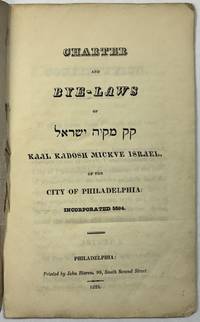
182440227Philadelphia: John Bioren 1824. 24pp. Stitched in original plain wrappers lightly dusted. Very Good.<br /> <br /> Kestenbaum calls this the "First printing of a Charter and official incorporation of a synagogue in America." The pamphlet prints the "Constitution" which is evidently considered the "Charter." Official certifications by the Commonwealth Attorney General Judges of the Supreme Court the Governor and the Secretary all printed here affirm the validity and recording of this "written instrument." <br /> The pamphlet begins with the Congregation's constitution and interspersed Hebrew text. This was a Sephardic congregation. "The fixed prayers shall always be read in the original Hebrew language according to the custom of the Portuguese Jews." The membership included prominent Philadelphia Jewish families: Gratz Phillips Levy Cohen De Cordova Pollok Seixas and others. Bye-Laws are printed at pages 14-24. <br /> Rosenbach 262. Singerman 0399. not in Goldman. AI 17613 2- NNAJHi PPDrop. OCLC records about twelve locations under several accession numbers as of July 2024. John Bioren unknown
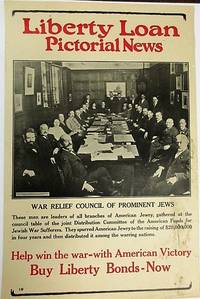
191835880New York Washington 1918. Folio broadside printed in red and black inks photo illustration of about thirty-five middle-aged and elderly gentlemen including Felix Warburg sitting around a long table on which rest many documents. Light soil to a portion Very Good.<br /> <br /> At the outbreak of World War I 60000 Jews in Ottoman Palestine faced starvation. The Joint Distribution Committee was organized at the instance of U.S. Ambassador to Turkey Henry Morgenthau and Jacob Schiff to alleviate the suffering. They raised the necessary funds and turned their attention to the nine million Jews along the Eastern Front. Felix Warburg was chairman; he and his colleagues were kept busy all during the War and thereafter. <br /> Not located on OCLC. unknown
190716003JBoston: John W. Luce & Co 1907. First American Edition. Signed by Max Nordau with a revealing inscription dealing with anti-Semitism: “This play is called Doctor Kohn in the German original. The American editor insisted upon the change of title alleging an outspoken Jewish name would have a repulsing effect on the American reader and buyer. This shows remarkably an American publishers judgment of the degree of racial prejudice among his countrymen. Paris May 3d 1909 Dr. M. Nordau.†Max Nordau was a Hungarian-born doctor who settled in Paris in 1880 where he because a best-selling author not for his controversial works of social and artistic criticism and was a co-founder with Theodore Herzl of the Zionist Movement. Nordau helped draft the Basle Program at the first Zionist Congress in 1897 and played a major role in subsequent congresses. This book is the first translation in English which was originally published in German in 1898 and it concerns the question of intermarriage of Jews and Christians. Bookplate of writer Stephen Caplin. Very good plus to near fine copy in decorated gilt-stamped cloth. A remarkable copy. John W. Luce & Co hardcover
AN OUTSTANDING COPY OF THE MOST BEAUTIFUL EDITION OF LUCRETIUS, ONE OF THE MOST BEAUTIFUL LIVRES D'ARTISTE OF THE TWENTIETH CENTURY. Illustrated with 41 original etchings (most with drypoint) by LEOPOLD-LEVY, an Alsatian Jewish artist associated with the School of Paris. From a total edition of 99 numbered copies, all printed on fine wove paper, this is ONE OF ONLY 30 WITH A SECOND SUITE OF THE ETCHINGS, PRINTED ON JAPON NACRE, EACH ETCHING SIGNED AND JUSTIFIED (19/30) BY THE ARTIST. This copy, furthermore, features an affectionate signed presentation inscription from the artist to the collector who convinced him to undertake this project. Three prospectuses are laid in (two on wove paper, one on Japan). Folio. Loose as issued in original wraps. FINE AND BRIGHT, WITH NO DEFECTS, in the original vellum-packed chemise and (lightly worn) board slipcase. AN OUTSTANDING BOOK, AND VERY RARE WITH THE COMPLETE SIGNED SUITE.
AN OUTSTANDING HORS-COMMERCE COPY ON JAPANESE PAPER. A sardonic look at the French bourgeoisie on the eve of economic collapse and world war, illustrated with 10 original full-page lithographs (and numerous drawings) by Jacob himself, a French Jew who would later be murdered by the Nazis. From a total edition of 348 copies, this is AN HORS-COMMERCE COPY PRINTED ON IMPERIAL JAPANESE PAPER. 4to. Original wraps. Uncut. FINE AND BRIGHT. Copies on Japanese paper are extremely rare.
First collected edition of Messiaen's detailed accounts of each of Mozart's piano concertos, which had appeared individually in concert programs. Olivier Messiaen (1908-1992) was the pre-eminent French composer of the second half of the 20th century. From a total edition of 100 numbered copies, this is ONE OF ONLY 50 COPIES WITH A LOOSE COLOR LITHOGRAPH BY BALTHUS. The lithograph, in soft colors, depicts a bay with a smoking volcano in the background. Balthus (Balthazar Klossowski de Rola, 1908-2001) was one of the great French artists of the 20th century. In theory, the book is supposed to be signed by Messiaen and the lithograph by Balthus, but in fact neither is signed. The publication of this book was carried out in the most chaotic possible way: Messiaen ended up signing only presentation copies, and Balthus ended up signing only a few impressions of the lithograph. Large folio (56 x 38.5 cm). Loose as issued in printed wraps and publisher's cloth portfolio/clamshell box. FINE AND BRIGHT, with no defects.
FIRST EDITION of this extremely important book on Jewish culture, customs, and rituals. [52], 300, [8] pp, complete. Partially a translation of Leon of Modena's Storia degli Riti Hebraici (1637), but largely Simon's own work. Small 8vo. Attractively bound in contemporary calf, spine gilt in six compartments with raised bands. Wear to edges of boards and a ltiny bit of leather lost from tail of spine, but the binding is structurally solid and the joints are strong. Internally very clean, printed on very good paper. Sauvy 337; Barbier I, 553d (later edition); Querard III, 349d. Reprinted many times, but this first edition is very rare.
Three volumes, complete. A PRISTINE LARGE-PAPER SET OF THE FIRST EDITION OF WEIL'S MOST PERSONAL WORK. 248; 431; 345 pp + 3 facsimile plates. ONE OF ONLY 60 NUMBERED SETS PRINTED ON FINE LAFUMA WOVE PAPER (tÍte), ALL VOLUMES OF THIS SET NUMBERED 12. 8vo. Publisher's printed wraps. Uncut and unopened. FINE AND BRIGHT, WITH NO DEFECTS. Rare and important.
193757464ABTel Aviv, The Maon Press, 1937. 29,5x21 cm. 31 meist einseitg bedruckte Blätter mit s/w. Abbildungen. Originalbroschur.
Original full calf. 12mo. 287; 267 pages. 18 cm. First edition. Two volume set. Author of Chrysal = Charles Johnston. An edition was published in Dublin the same year. Charles Johnstone (c.17191800) was an early Irish novelist; prevented by deafness from practising at the Irish Bar, he went to India, where he was proprietor of a newspaper. He wrote one successful book, Chrysal, or the Adventures of a Guinea, a somewhat sombre satire, and some others now utterly forgotten. (Short Biographical Dictionary of English Literature, 1910) . The Pilgrim, offers a series of observations and epistolary reflections by a Chinese pilgrim, Choang, travelling to Britain via Bengal, to his correspondent and friend, the supreme mandarin of Quang-Tong, commenting with artful naivete on British culture and the pleasures of London in the manner of Walpole's A Letter to Xo Ho, A Chinese Philosopher at London, to his friend Lien Chi at Peking (1757) and Goldsmith's Citizen of the World (1762) . (A 'Teague' and a 'True Briton': Charles Johnstone, Ireland and Empire By Roberts, Daniel Sanjiv article in Irish University Review: a journal of Irish Studies, Vol. 41, No. 1) . Bound in original full calf, with decorative gilt along edges of leather, six gilt panels on spine, green/gilt and red/gilt panel title on spine. Subjects: Epistolary fiction - England - 18th century. OCLC lists 17 copies. Back board hinge of volume one loose, all hinges starting, two panels on spine rubbed out, very light foxing to endpages, water stain to bottom margins of first and last page of both volumes, part of leather on bottom edges appears to have been synched by fire; internally very fresh and clean however. Good + condition. (KH-1-48)
1st Yiddish edition. Later cloth with Original Modernist Color Illustrated Wrappers bound in, 12mo, 128 pages. In Yiddish. Title translates as, "To Everyone, To Us: Songs and Poems. " Includes Russian title onback cover: "Ko vsem nam; stikhi. " One of 2000 copies printed. Cover shows dramatic use of period Yiddish typography. SUBJECT (S) : Yiddish poetry. OCLC lists 5 copies worldwide (YU, Stanford, Yale, McGill, Harvard) . Red cloth is dampstained and a bit warped, with a bit of red bleeding through onto the margins of the original color paper wrappers. Blindstamp and stain on title page, with number on half title. The original paper also shows just a hint of waviness, with an occasional light stain, but was essentially protected by the later cloth. Small pencil notation on cover. Very solid, with the gorgeous original covers, about Very Good- Condition thus. (YID-26-13)
1st edition. Original boards. 8vo. [576 pages], 27 cm. In Yiddish. Title translates to The Friend: Official Organ of the Workmens Circle. A complete year run of Fraynd, founded in 1910, printed monthly, then, at a later juncture, bimonthly. Formed in 1900 by Yiddish-speaking Jewish immigrants from Eastern Europe, The Workmen's Circle at first acted as a mutual aid society, helping its members to adapt to their new life in America. It provided life insurance, unemployment relief, healthcare, social interaction, burial assistance and general education through its branches throughout the US as well as through its national office. Soon, the organization was joined by more politically focused socialist Bundists who advocated the anti-assimilationist idea of Yiddish cultural autonomy, led by education in Yiddish and socialist ideals. The Circle formed the Folksbiene Yiddish theatre troupe and promoted Jewish arts and music, Yiddish school programs for children and Yiddish summer camps. It became influential in the American labor movement and grew to serve more than 84, 000 members through hundreds of branches around North America. It also became involved with the Yiddish newspaper The Forward and operated old-age homes, medical clinics and other services. Politically, the Circle moved away from socialism towards liberalism by the time of the New Deal (Wikipedia, 2018) . SUBJECTS: Jews -- United States -- Periodicals. Fraternal organizations -- United States -- Periodicals. OCLC lists 18 holdings, but most are for partial runs starting after 1917. Binding starting. Half of page one, Jan. 1914 is missing. Otherwise Very Good Condition. (YID-30-38)
Original paper wrappers. 8vo. 36 pages each volume, 22 cm. In Hebrew. Title translates to Essays from Conversations with Rav Yerucham Halevi Levovitz. Levovitz was the Mashgiach Ruchani of the Mirrer Yeshiva in Poland. One of the great exponents of Mussar. He was a talmid or Rav Simcha Zissel Broida one of the foremost disciples of Rabbi Yisroel Salanter. Below are eight fascicles printed in Shanghai. The first three fascicles were first published before the Holocaust in Baranovitch, the fourth was published in Kaiden due to the war. For a period during 1940, the town served as home to about 300 students and teachers from the Mir Yeshiva. After WWII, much of orthodox Jewry in Europe was wiped out, along with their many yeshivas (Jewish schools of higher learning) . One of the only yeshivas to survive as a whole body was the Mir Yeshiva, which managed to escape miraculously to Shanghai, China, and then on to America. Many of the new leaders of the American and Israeli yeshivas in the post-war period were students of the Mir, and thus followers of Rabbi Leibovitz. SUBJECTS: Litvak Holocaust Displaced Persons. There are no copies listed on OCLC. Wear and soiling to outer wrappers, along with small chip missing from bottom left corner. Internally Good. Overall Good Condition. Rare. (RAB-60-12-13-14)
First edition. Original boards. 4to. 272, 228 pages, 32 cm. In Hebrew. Title translates to Holding Prayer: On a Bit of Shulhan Arukh, Orah Hayim, and Yoreh Deah. A first edition of Hidas Halakhic commentary. Azulai, better known as Hida (1724-1806) was a Jerusalem born rabbinical scholar SUBJECTS: Karo, Joseph ben Ephraim. OCLC lists 8 copies worldwide (OCLC: 43487826) . Penn keeps their copy in their Rare Book Collection. Some worm holes on front board and contents. Binding is starting. Lighting soiling and edge wear to first pages. (RAB-65-13-B)
16806029Amsterdam, Janssonius-Waesberge, Daniel Elzevier, Jan van Someren Wwe., Henr. & Theod. Boom, 1680. 2 Bände. (58), 430 (recte: 432), (36) SS. (4), 431-940 (recte: 433-942), (48) SS. Mit gest. Frontispiz, zus. 5 gest. Tafeln (dav. 1 mehrf. gefalt.), 11 ganzseitigen Textkupfern und 1 Münzkupfer im Text. Halblederbände der Zeit mit doppelten goldgepr. Rückenschildchen und Rückenvergoldung. 4to.
1st edition, original portfolio wrappers, 8vo. 53 pages, plus many blank and unnumbered pages. Illustrations throughout. In French. Title translates as, Without Flowers Nor Crowns. This book is told in the first person, in a succession of scenes, impressions, portraits, thoughts, reflections and emotions that, in chapters very brief and titled, make up a devastating panorama about Elinas experience in Auschwitz. (elcultural.com 2018). "When I returned from Auschwitz in 1945, I felt what I had just experienced with such acuteness that it was impossible for me to keep it to myself. I recorded it in notes and drawings. This constituted Without flowers nor Crowns. I do not regret having written these notes as soon as I returned from camp because, over time, memories become distorted, they become watered down or dramatized, but always move away from the truth. (...)" Odette Elina (1910-1991) was a painter, was deported by the Gestapo to Auschwitz-Birkenau in April 1944 as a communist, but above all and above all because she was Jewish. In 1940, she entered the French Resistance network, she had had an initial function to establish the liaison between the writers residing in the South zone (notably Mauriac, Aragon and Julien Benda) before entering the Secret Army in 1942. We actually know very little about the biographical career of Elina before and after her deportation, apart from her exacerbated desire on leaving the Camp to testify to her life in the Camp. Without Flowers nor Crowns, [was] originally published in 1948 in the wake of the first testimonies on the Holocaust that appeared in the post-war years..." (Isabelle Dumont). SUBJECT(S): World War, 1939-1945 -- Prisoners and prisons, German. Guerre mondiale (1939-1945) -- Camps de concentration -- Récits personnels. Französin. Elina, Odette. Auschwitz (Concentration camp). Konzentrationslager. OCLC: 58452978 (2005 edition by later publisher, with the OCLC record incorrectly listing the original 1st edition as 1947 instead of 1948). OCLC lists no 1948 (or 1947) copies online. Pages are loose as issued, in an illustrated portfolio. This book is one of 270 numbered copies. Illustrated with 12 inset drawings, one reproduced on the cover; the title page mentions 13 drawings (?), but there are only 12, the same number as reproduced in the 1982 reissue [and also in the other copy of this first edition we examined], so "13" would seem to be incorrect or possibly counting the repeated drawing on the cover. Portfolio is slightly rubbed with short closed tear at lower front inside fold and spine has some creasing, else Very Good Condition. Important and exceedingly rare (HOLO2-141-27-IIIXX)
1st edition. Original paper wrappers, 16mo (small), 7 pages ; 25 cm (folded to 14 cm in wrappers). "Correspondence between Henry Ford, Louis Marshall and Herman Bernstein. Settlement of Aaron Sapiro's and Herman Bernstein's libel suits" (From the front cover). During the 1920s, Henry Ford gained as much fame for his antisemitic views as for his cars. His newspaper, the Dearborn Independent, published dozens of articles between 1920 and 1925 naming prominent Jewish Americans as conspirators in a plot to overthrow governments all over the world. Though hardly the first of their kind, the accusations in the Dearborn Independent represented the broadest, most sustained published attack on individual Jews and Jews as a group in the nations history. The articles created clear grounds for defamation and libel actions against Ford and the newspaper, and several were filed. In 1927 one lawsuit, Sapiro v. Ford, made it into court, generating international headlines, only to end in mistrial. Ford then disposed of the distasteful affair by signing a statement in which he apologized for the wrongs he had 'unintentionally' done to Jews. Ford's campaign against the Jews, as historians have recognized, reflected the renewed racial tribalism that characterized post-World War I American society (Woeste, Insecure Equality: Louis Marshall, Henry Ford, and the Problem of Defamatory Antisemitism, 1920-1929 in Journal of American History, Dec. 2004). The importance of the end result, here spelled out in this rare period publication, was summarized by Robert Rifkind in his 2008 examination Confronting Antisemitism in America: Louis Marshall and Henry Ford: Putting aside historical revisionism, it becomes clear that the Ford apology achieved a number of things no libel suit could have achieved. First, in broad and unambiguous strokes, Ford repudiated the defamation of Jews in general and not merely the particular claims asserted in the lawsuits. Second, the apology did so with dispatch rather than after further protracted delay. Third, Ford undertook to withdraw The International Jew from circulation both in the United States and abroad, and at least while Marshall remained alive, he seems to have done so. A jury sitting in an action for monetary damages could not have compelled such a result. And finally, a confession, retraction, and apology appearing in Fords name and over Fords signature carried the impressive force of a world-famous mana force that twelve anonymous jurors, easily dismissed as misled by lawyers wiles, could never have had (American Jewish History, Vol. 94, No. 1/2, March/June 2008, pp. 71-90). SUBJECT(S): Antisemitism -- Michigan -- Dearborn. Jews -- Trials (Libel) -- Antise´mitisme -- Juifs -- Proce`s (Diffamation) -- Dearborn independent. OCLC: 264355930. OCLC lists only 3 copies worldwide (Harvard, YIVO, Yale Law), none outside the Northeast. Light wear to wrappers, number penned on cover, no other markings, folded text pages inside extremely clean, an exceptional copy of this rare and very important imprint. Very Good Condition (holo2-148-4).
197218823ABBad Wildungen, Ars Grafica, 1972. 50 : 35,5 cm. 5 teils kolorierte Original-Radierungen, signiert und nummeriert, von Adolf Frohner. Original Bütten-Umschlag mit halbseitiger Illustration von Frohner und gedrucktem Text.
1st Edition: Original Boards with Original Dust Jacket. 8vo. 437 pages ; 21 cm. In the original Czech, later issued in English as A Box of Lives. This is a beautiful copy of the scarce first edition with the original illustrated dust jacket. Norbert Frýd (born Norbert Fried) (1913 1976) was a Czech writer, journalist and diplomat. He is known mainly for his autobiographical novel Krabice ivých (A Box of Lives, 1956) , in which he describes his experiences in Nazi concentration camps. During World War II, he was imprisoned in the Theresienstadt, Auschwitz and Dachau-Kaufering concentration camps The plot is set in the last months of 1944, in the fictional concentration camp of Gigling. The main character, the young intellectual Zdenek Roubík, is an assistant in the camp office. One of his jobs is to maintain the card index of the inmates, hence the title of the novel, A Box of Lives. In the camp, Roubík gradually manages to overcome the apathy and depression caused by the death of his brother and he becomes more actively involved in camp life. The author attempts to depict everyday life, social interactions and relationships in the camp, and the work and hardships of the inmates. The description of the SS guards in the camp is a focus of particular attention The novel was acclaimed by contemporary critics, and republished in numerous editions and translations. (Wikipedia, 2017) Frýds successful novel was published twice in Czech in 1956, with this 1st edition being much rarer than the stated 2nd edition. OCLC lists just 4 copies worldwide (Emory, Wisconsin, Johannes-Gutenberg-Universitat Mainz, Univ Of Basel) , and none in New York City or in the North East United States. Slight toning. And minor edgewear to dust jacket but overall both book and jacket are in very good condition. Attractive, rare, and important. (holo2-135-48)
First edition. Original Printed Wrappers, 8vo, 6, 8, 12, 32 pages ; 26 cm. In Yiddish. Title translates as, A Bouquet of Flowers: In Four Parts. Singerman 4953. Contents: 1. Ale Lider fun Akaydes Yitshak, fun A. Goldfaden; 2. Kupleten un Folks Lider, fun M. Avramovits [Max Avramovich]; 3. Ale Lider fun Kuzari, fun Prof. Hurvits; & Anekdoten, fun G. Broyda. Abraham Goldfaden, (18401908), was a Yiddish poet, dramatist, composer, and father of the Yiddish theater. Born in Staro Konstantinov, Ukraine, he received not only a thorough Hebrew education but also acquired a knowledge of Russian, German, and secular subjects. To avoid the draft, Goldfaden was sent to a government school at 15 and there came under the influence of his teacher Abraham Ber Gottlober, a Hebrew writer who was also a lover of Yiddish. Graduation from this school in 1857 permitted Goldfaden to enter the rabbinical seminary at Zhitomir, which trained rabbis, teachers, and Jewish officials for government service. Under the guidance of sympathetic teachers, including such leaders of the Haskalah movement as E. Z. Zweifel, H. S. Slonimsky, and Gottlober, he was encouraged to compose Hebrew lyrics. The first of these were published in 1862 in Ha-Meliz. A year later Goldfaden's first Yiddish poems appeared in Kol Mevasser. In 1865 Goldfaden published a booklet of his Hebrew songs Zizim u-Ferahim. In 1866, the year of his graduation as a teacher, his first collection of Yiddish songs Dos Yudele offered rich material for badhanim and folksingers. It was followed by a supplementary booklet Di Yudene (1869). In 1875 he joined a former classmate Isaac Joel Linetzki in founding and editing in Lemberg a short-lived humorous magazine Der Alter Yisrolik. Goldfaden then went to Rumania where he came in contact in Jassy with the Broder Singers, who were singing and acting out Yiddish songs, including his own, in wine cellars and restaurant gardens. He then conceived the idea that the dramatic effect of the songs and impersonations could be heightened if they would be combined with prose dialogues and woven into an interesting plot. He gathered a few singers and rehearsed with them scenarios composed by himself. The first performances in October 1876 initiated the professional Yiddish theater. Encouraged by the enthusiastic reception accorded his performances in Jassy, Goldfaden engaged wandering minstrels and cantors' assistants as additional actors, toured other Rumanian cities, including Bucharest, and then went to Odessa. By 1880 his troupe was giving performances throughout Russia and his phenomenal success was encouraging theatrical ventures by other enterprising actors and librettists. The Yiddish theater expanded and flourished until 1883, when the Russian government, fearing this new mass medium, banned performances in Yiddish. This action compelled authors, actors, and producers to migrate to other lands. Yiddish theaters were established in Paris, London, and New York. In 1887 Goldfaden was invited by some of his actors who had moved to New York to join them, but when he arrived he encountered severe competition from producers who had preceded him and from scriptwriters who were even more prolific than he. He found Europe more congenial and returned to produce and direct performances of his plays in London, Paris, and Lemberg. He returned to the United States in 1903 and spent his last five years in New York. Many of Goldfaden's 60 plays - not all of them published - continued to be adapted by actors and producers and entered into the permanent repertoire of the Yiddish theater. His characters from Schmendrik and Kuni Lemel to Hotzmakh, the good-natured peddler, and Bobbe Yakhne, the malevolent witch, have been real figures to several generations of theatergoers. (EJ, 2007).OCLC: 41454623. OCLC and Singerman together list 3 copies worldwide (Harvard, NYPL, NLI), with the NYPL copy described as defective. Scarce. Our copy: Paper brown, old damps stains, edgewear. Good- Condition. (YID-42-14)
A SUITE OF NINE LARGE FOLIO ORIGINAL COLOR LITHOGRAPHS BY CHAIM GROSS, EACH SIGNED BY HAND (the other two lithographs, "Rosh Hashoneh" and "Pesach", are missing). Complete with two leaves of explanatory text for each lithograph. One of only 200 sets with the lithographs printed on fine Rives wove paper, each one numbered "79/200", dated, titled, and signed in pencil. Rare original prospectus laid in. Large folio. Loose as issued in a cloth chemise and the original cloth clamshell case. FINE AND BRIGHT, with no defects. While this set has been reproduced many times, none of the reproductions come close to matching the beauty of these original lithographs, which of course have never been reprinted (the stones were effaced after printing this edition). I WILL SELL INDIVIDUAL LITHOGRAPHS (along with the corresponding explanatory leaves) FROM THIS SET FOR $400 EACH.
1st edition. Original gilt-stamped publishers cloth, 12mo, 187 pages. Rare early San Francisco imprint for use in Synagogues and Jewish schools, appearing just following the California Gold Rush. The author was the "Rabbi Preacher of Congregation Sherith Israel, San Francisco; Author of Class Book of Discourses on the principles of the belief of Israel, &c. , &c. " Scarce. Congregation Sherith Israel was the first Jewish Congregation in San Francisco, and the author, Henry A. Henry was Congregation Sherith Israel's first rabbi. OCLC lists 21 copies worldwide, about half of those located in California, probably indicating early local distribution and use in California Jewish institutions. Wear to base of spine, otherwise Very Good Condition. (KH-9-7)