Böhm, FrankAntiquariat.de

187 résultats
1967851451967. Blattfüllende Darstellung in grau-violett Tönen mit aquarellierter Rahmenbordüre. 24,6 x 16 cm.
8vo., on laid paper, with 2 woodcut frontispieces and 16 woodcut illustrations (a number full-page) in the text, endpapers very lightly browned; original brown cloth, boards with elaborate floral roll in blind, back with four flat bands, second compartment with label lettered in gilt, red edges, backstrip lightly pulled at head else a very good, crisp, clean copy. With the contemporary binder's ticket of Smith Brothers of Paternoster Row on rear paste-down. Bunyan's allegory was first published in 1678, less than a handful of copies are known to exist. This much-needed facsimile includes the frontispieces and titles to both parts, the 14 woodcut illustrations of the first part and the 2 woodcut illustrations of the second part. All marginalia (comprising arguments and biblical references) are faithfully retained. The work was not divided into chapters until Burder's edition of 1786. A notable and very scarce facsimile edition.
8vo., with illustrations and facsimiles in the text; original dove-blue cloth, upper board blocked in blind, gilt back, red top, pictorial endpapers, a very good, bright, clean copy in unclipped dustwrapper, the latter lightly age-soiled and frayed (without material loss) at extremities. With 16pp series catalogue bound in at end. First published in Everyman's Library in 1907. EL 204; Seymour 142.0.
1115408Paderborn, Germany : Ferdinand Schöningh, 2018. 309 Seiten ; 24 cm, kart.
Classici italiani, collezione fondata da Ferdinando Neri, diretta da Mario Fubini n, 40 - Introduzione - Nota biografica - Nota bibliografica - Scritti di Leonardo: I.-XXIII - Appendice: Date - Lettere - Libri e persone - Luoghi - Particolarit? della lingua di Leonardo - Glossario 1 23x14,5 cm., legatura in piena tela verde, fregi e titoli in oro su tasselli al dorso, sopraccoperta in acetato, frontespizio incorniciato-filettato con fregi, titolo in verde, pp. 792, 16 tavole con illustrazioni in nero - autoritratto, scoperte, disegni, congegni, macchine... - su carta patinata, fuori testo, ristampa della seconda edizione del 1966, in italiano, ottime condizioni.
Frontespizio del secondo volume dell'edizione francese del "Civitates Orbis Terrarum", il primo atlante devoto esclusivamente alle piante e vedute delle principali città del mondo. Stampato in sei volumi tra il 1572 ed il 1617 ebbe grande fortuna e diffusione, tanto che ne furono stampate diverse edizioni tradotte in latino, tedesco e francese. Il primo volume delle Civitates Orbis Terrarum fu pubblicato a Colonia nel 1572. Il sesto e ultimo volume apparve nel 1617. Questo grande atlante di città – cartografia urbana - curato da Georg Braun e inciso in gran parte da Franz Hogenberg, conteneva 546 prospettive, vedute a volo d'uccello e vedute cartografiche di città di tutto il mondo. Franz Hogenberg realizzò le tavole dei primi quattro volumi e Simon van den Neuwel (Novellanus, attivo dal 1580) quelle dei volumi V e VI. Georg Braun (1541-1622), un ecclesiastico di Colonia, fu il principale redattore dell'opera e fu molto aiutato nel suo progetto dalla vicinanza e dal continuo interesse di Abraham Ortelius, il cui Theatrum Orbis Terrarum del 1570 fu, come raccolta sistematica e completa di mappe di stile uniforme, il primo vero atlante. Le Civitates, in effetti, erano destinate ad accompagnare il Theatrum, come indicato dalla somiglianza dei titoli e dai riferimenti contemporanei sulla natura complementare delle due opere. Tuttavia, le Civitates erano progettate per avere un approccio più popolare, senza dubbio perché la novità di una raccolta di piante e vedute di città rappresentava un'impresa commerciale più rischiosa di un atlante mondiale, per il quale c'erano stati diversi precedenti di successo. Franz Hogenberg (1535-1590) era figlio di un incisore di Monaco che si era stabilito a Malines. Incise la maggior parte delle tavole del Theatrum di Ortelius e la maggior parte di quelle delle Civitates, e potrebbe essere anche indicato come il responsabile dell'origine del progetto. Oltre un centinaio di artisti e cartografi diversi, il più importante dei quali fu l'artista di Anversa Georg Hoefnagel (1542-1600), fornirono i disegni per le tavole delle Civitates. Hoefnagel non solo contribuì alla maggior parte del materiale originale per le città spagnole e italiane, ma rielaborò e modificò anche quello di altri collaboratori. Dopo la morte di Hoefnagel, il figlio Jakob continuò il lavoro per le Civitates. Gli autori della raccolta si proponevano di raffigurare "non icones et typi urbium", cioè non immagini generiche e tipizzate, "sed urbes ipsae admirabili caelaturae artificio, spectantium oculis subiectae appareant": non intendeva alludere o idealizzare, ma rappresentare fedelmente sulla carta, riprodurre esattamente, e in tempo reale, ciò che l'occhio vede, come annunciato nella prefazione al primo volume delle Civitates Orbis Terrarum. Incisione in rame, magnifica coloritura a mano, in ottimo stato di conservazione. Title page of the second volume of the French edition of Civitates Orbis Terrarum, the first atlas devoted exclusively to plans and views of the world's major cities. Printed in six volumes between 1572 and 1617 it was so successful and widespread that several editions translated into Latin, German and French were printed. The first volume of the Civitates Orbis Terrarum was published in Cologne in 1572. The sixth and the final volume appeared in 1617. This great city atlas, edited by Georg Braun and largely engraved by Franz Hogenberg, eventually contained 546 prospects, bird-eye views and map views of cities from all over the world. Fransz Hogenberg produced the plates for the first four books, and Simon van den Neuwel (Novellanus, active since 1580) those for volumes V and VI. Georg Braun (1541-1622), a cleric of Cologne, was the principal editor of the work, and was greatly assisted in his project by the close, and continued interest of Abraham Ortelius, whose Theatrum Orbis Terrarum of 1570 was, as a systematic and comprehensive collection of maps of uniform style, the first true atlas. The Civitates, indeed, was intended as a companion for the Theatrum, as indicated by the similarity in the titles and by contemporary references regarding the complementary nature of two works. Nevertheless, the Civitates was designs to be more popular in approach, no doubt because the novelty of a collection of city plans and views represented a more hazardous commercial undertaking than a world atlas, for which there had been a number of successful precedents. Franz Hogenberg (1535-1590) was the son of a Munich engraves who settled in Malines. He engraved most of the plates for Ortelius's Theatrum and the majority of those in the Civitates, and may have been responsible for originating the project. Over a hundred of different artists and cartographers, the most significant of whom was Antwerp artist Georg Hoefnagel (1542-1600), engraved the cooper-plates of the Civitates from drawings. He not only contributed most of the original material for the Spanish and Italian towns but also reworked and modified those of other contributors. After Hoefnagel's death his son Jakob continued the work for the Civitates. The author set out to depict "non icones et typi urbium," that is, not generic and typified images, "sed urbes ipsae admirabili caelaturae artificio, spectantium oculis subiectae appareant": not intended to allude or idealize but to represent faithfully on paper, to reproduce exactly, and in real time, what the eye sees, as announced in the preface to the first volume of Civitates Orbis Terrarum. Copperplate with fine clouring, very good conditions.
Mm 155x220 Prima edizione. Collana "Saggi" - Brossura editoriale con bandelle, xxx-250 pagine con figure in nero nel testo e tavole a colori fuori testo. Tracce di polvere alla copertina, peraltro esemplare in perfette condizioni, mai letto. SPEDIZIONE IN 24 ORE DALLA CONFERMA DELL'ORDINE.
Illustrazione tratta dall'opera "The Gentlemans Recreation in Three Parts", di Richard Blome, pubblicata per la prima volta a Londra nel 1686. Le numerose iscrizioni descrivono l'arte e la tecnica dell'orologeria; in basso, due figure e un angelo con compassi, quadranti e altri strumenti di misura. Incisione in rame, colorata a mano, in buone condizioni. Taken from 'The Gentlemans Recreation in Three Parts' by Richard Blome, London: S. Roycroft, 1686. Large oval with inscriptions explaining the various parts of the art of horology; below, two figures and an angel with compasses, quadrant, and other measuring instruments. Copper engraving, hand-coloured, in very good conditions.
Frontespizio del terzo volume dell'Atlas Major di Blaeu. Willem Janszoon Blaeu, avviò nel 1599 la sua attività di costruttore di globi e strumenti astronomici ad Amsterdam. Nel 1630, dopo aver comprato alcune lastre dell’atlante del Mercator da Jodocus Hondius II, fu in grado di pubblicare un volume di 60 mappe con il titolo di Atlantis Appendix. Cinque anni dopo, pubblicò i primi due volumi del suo atlante Atlas Novus o Theatrum Orbis Terrarum, in sei libri. Dopo la sua morte, Joan (Johannes) continuò l’opera paterna, completando l’intera serie di sei volume dell’Atlas Novus intorno al 1655. Fu inoltre autore di un Atlas Maior sive Cosmographia Blaviana, in 12 volumi pubblicati nel 1662 -72. Incisione in rame, bella coloritura coeva, in ottimo stato di conservazione. Title page from Blaeu's Atlas Major. Willem Janszoon Blaeu, started in 1599 his business as a builder of globes and astronomical instruments in Amsterdam. In 1630, after buying some plates of the Mercator atlas from Jodocus Hondius II, he was able to publish a volume of 60 maps under the title Atlantis Appendix. Five years later, he published the first two volumes of his atlas Atlas Novus or Theatrum Orbis Terrarum, in six books. After his death, Joan (Johannes) continued his father's work, completing the entire six-volume Atlas Novus series around 1655. He was also the author of an Atlas Maior sive Cosmographia Blaviana, in 12 volumes published in 1662 -72. Copperplate with fine original hand colour, in very good conditions.
Frontespizio dell'edizione francese dell'Atlas Novus di Blaeu. Willem Janszoon Blaeu, avviò nel 1599 la sua attività di costruttore di globi e strumenti astronomici ad Amsterdam. Nel 1630, dopo aver comprato alcune lastre dell’atlante del Mercator da Jodocus Hondius II, fu in grado di pubblicare un volume di 60 mappe con il titolo di Atlantis Appendix. Cinque anni dopo, pubblicò i primi due volumi del suo atlante Atlas Novus o Theatrum Orbis Terrarum, in sei libri. Dopo la sua morte, Joan (Johannes) continuò l’opera paterna, completando l’intera serie di sei volume dell’Atlas Novus intorno al 1655. Fu inoltre autore di un Atlas Maior sive Cosmographia Blaviana, in 12 volumi pubblicati nel 1662 -72. Incisione in rame, bella coloritura coeva, in ottimo stato di conservazione. Title page of the French edition of Blaeu's Atlas Novus. Willem Janszoon Blaeu, started in 1599 his business as a builder of globes and astronomical instruments in Amsterdam. In 1630, after buying some plates of the Mercator atlas from Jodocus Hondius II, he was able to publish a volume of 60 maps under the title Atlantis Appendix. Five years later, he published the first two volumes of his atlas Atlas Novus or Theatrum Orbis Terrarum, in six books. After his death, Joan (Johannes) continued his father's work, completing the entire six-volume Atlas Novus series around 1655. He was also the author of an Atlas Maior sive Cosmographia Blaviana, in 12 volumes published in 1662 -72. Copperplate with fine original hand colour, very good condition.
Frontespizio dell'edizione olandese dell’Atlas Novus di Blaeu. Willem Janszoon Blaeu, avviò nel 1599 la sua attività di costruttore di globi e strumenti astronomici ad Amsterdam. Nel 1630, dopo aver comprato alcune lastre dell’atlante del Mercator da Jodocus Hondius II, fu in grado di pubblicare un volume di 60 mappe con il titolo di Atlantis Appendix. Cinque anni dopo, pubblicò i primi due volumi del suo atlante Atlas Novus o Theatrum Orbis Terrarum, in sei libri. Dopo la sua morte, Joan (Johannes) continuò l’opera paterna, completando l’intera serie di sei volume dell’Atlas Novus intorno al 1655. Fu inoltre autore di un Atlas Maior sive Cosmographia Blaviana, in 12 volumi pubblicati nel 1662 -72. Incisione in rame, bella coloritura coeva, in ottimo stato di conservazione. Title page of the Dutch edition of Blaeu's Atlas Novus. Willem Janszoon Blaeu, started in 1599 his business as a builder of globes and astronomical instruments in Amsterdam. In 1630, after buying some plates of the Mercator atlas from Jodocus Hondius II, he was able to publish a volume of 60 maps under the title Atlantis Appendix. Five years later, he published the first two volumes of his atlas Atlas Novus or Theatrum Orbis Terrarum, in six books. After his death, Joan (Johannes) continued his father's work, completing the entire six-volume Atlas Novus series around 1655. He was also the author of an Atlas Maior sive Cosmographia Blaviana, in 12 volumes published in 1662 -72. Copperplate with fine original hand colour, very good condition.
Frontespizio del Theatrvm statvvm regiæ celsitvdinis Sabavdiæ dvcis, Pedemontii principis, Cypri regis pubblicato per la prima volta ad Amsterdam Amstelodami, apud. hæredes Ioannis Blaev, 1682. L’opera venne successivamente ristampata da Pierre Mortier. Acquaforte, in ottimo stato di conservazione. Title page of Theatrvm statvvm regiæ celsitvdinis Sabavdiæ dvcis, Pedemontii principis, Cypri regis first published in Amstelodami, apud. hæredes Ioannis Blaev, 1682. The work was later reprinted by Pierre Mortier. Etching, in excellent condition.
19841192917Frankfurt am Main : Fischer-Taschenbuch-Verlag, 1984. 92 S. : 52 Ill., 1 graph. Darst. ; 19 cm. kart.
Mm 170x240 "Centro Internazionale di Studi di Architettura Andrea Palladio" - Volume nella sua brossura originale con bandelle, 342 pagine con numerose tavole in nero nel testo. Opera in condizioni di nuovo, spedizione in 24 ore dalla conferma dell'ordine.
190433489ABDresden, Stengel (Verlagsangabe auf Vorderdeckel und Titelseite überklebt mit 'Max Spielmeyer, Buchhandlung für Architektur und Kunstgewerbe, Berlin), o.J. [1904]. 2°, ein Blatt Titelseite, ein Blatt faksimilierte Titelseite sowie 3 beidseitig bedruckte Blatt mit dem franz. Text sowie 72 Blatt mit wunderbaren s/w-Illustr. (= alles), in der original Mappe mit den 3 Schließbändern, Neue Facsimile-Ausgabe in Photolithographie zwei der Textseiten seitlich mit winzigem Einrißchen, sonst ein erstaunlich schönes, sauberes und so gut wie nicht altersfleckiges Exemplar..
2003102646Berlin, Parthas 2003. 383 Seiten. Softcover/Paperback
163087241630 Lugdunum Batavorum, Ex Officina Elzeviriana, 1630; in-12, plein veau fauve, double filet doré encadrant les plats, dos à nerfs , caissons de double filet doré ornés d'une rosace dorée, titre doré, tranches mouchetées de rouge; 690,(6)pp.; titre orné.
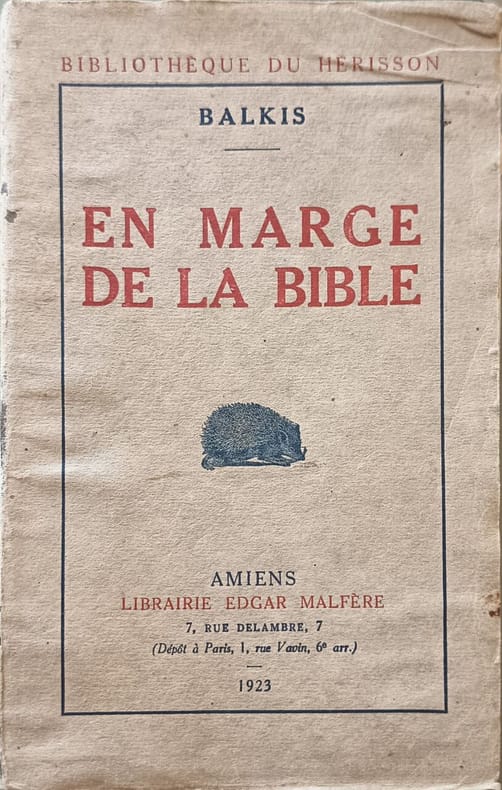
192315302Librairie Edgar Malfère 1923 198 pages in8. 1923. broché. 198 pages. Le contenu évoque brièvement la figure de Balkis la reine de Saba en mentionnant son traitement dans le Coran par rapport à la Bible mais ne fournit pas d'informations suffisantes sur le livre lui-même
1994241880Tübingen : Narr, 1994. 295 S. ; 23 cm Originalbroschur.
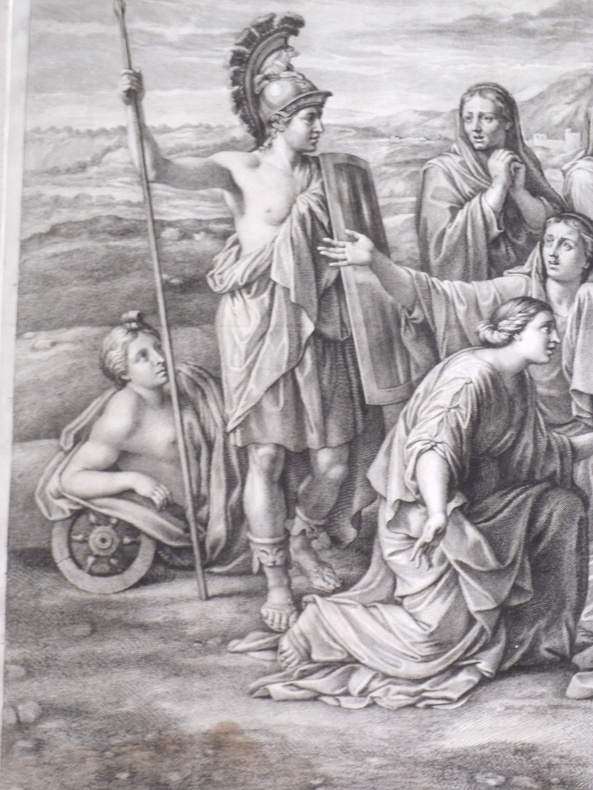
13375AUDRAN Gérard. CORIOLAN devant ROME AINSY SE DOIT FLECHIR LA COLERE ET L’ORGUEIL. CORIOLAN. Estampe gravée au burin, à l’eau forte et la pointe sèche, en deux feuilles, d’après le tableau de Nicolas POUSSIN. Format 992x663mm à la cuvette. 995x735mm .Marges courtes. Marge inférieure, et pliure, renforcées avec de pâles mouillures, surtout visibles au verso. En marge inférieure on peut lire : Caius Marcius Coriolan assiégea Rome irrité de ce que le peuple romain lui avoit refusé le consulat et l’avoit ensuite banni. I il rejeta toutes les propositions de paix qui lui furent proposées et ne se laissa fléchir qu’aux larmes de sa mère et de sa femme accompagnées des dames romaines qui lui montrèrent la fortune de Rome renversée. Nicolas POUSSIN pinxit en marge inférieure gauche gravée par AUDRAN Paris Rue St Jacques aux 2 piliers d’or, avec privilège du Roy « Alexandre vainqueur et maître du camp des perses après la bataille d’Issus, visite , accompagné seulement d’Ephestion, les princesses demeurée prisonnières. La Reine, épouse de Darius lui présente son fils. Statira et sa jeune sœur se jettent à ses pieds. Sisygalhis, mère du monarque vaincu, confuse d’avoir pris Ephestion pour Alexandre, reçoit du héros cette réponse : Non ma Mère, vous ne vous êtes pas trompée, celui-ci est un autre Alexandre. »
In-8°; pp. (16), 174, (1), frontespizio illustrato inciso su legno; nel testo ritratto e 1 xilografia a piena pagina, 15 vignette incise su legno nel testo (tra cui una curiosa immagine i un giullare che cavalca un’aragosta; suddiviso in tre parti ciascuna con il titolo in cornice xilografica architettonica, all’ultima carta marca tipografica. LEgatura in piena pergamena unghiata. Un timbro a inchiostro al verso del frontespizio, un piccolo foto di tarlo alle ultime carte.
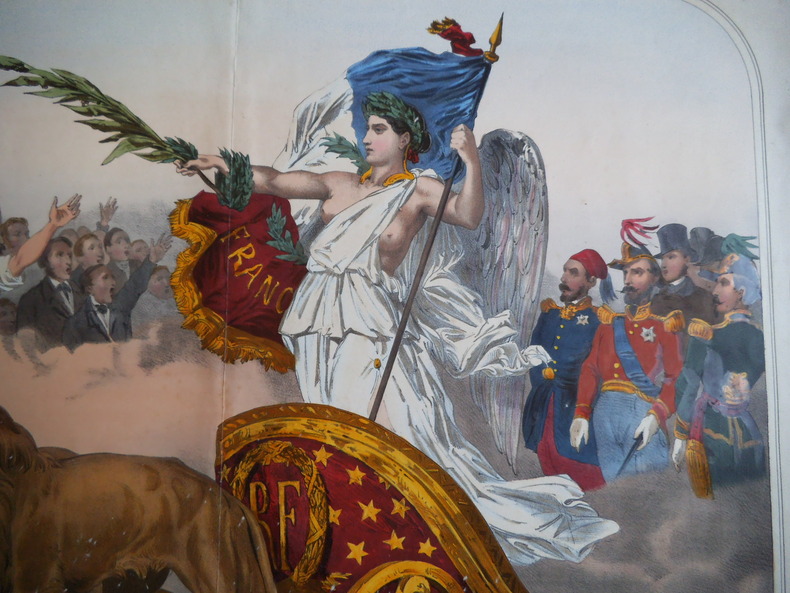
8433Elle Est acclamée par tous le Peuples.Lithographie originale en couleurs,rehaussée à la gomme arabique.Format 610x785mm et 470x610mm hors marges.Paris Vve Gosselin imp. Editeur.Vve Gadola éditeur Lyon. Une trace de pliure, petites rousseurs avec de petites déchirures réparées, en marge. Coloris frais. Peu courant.
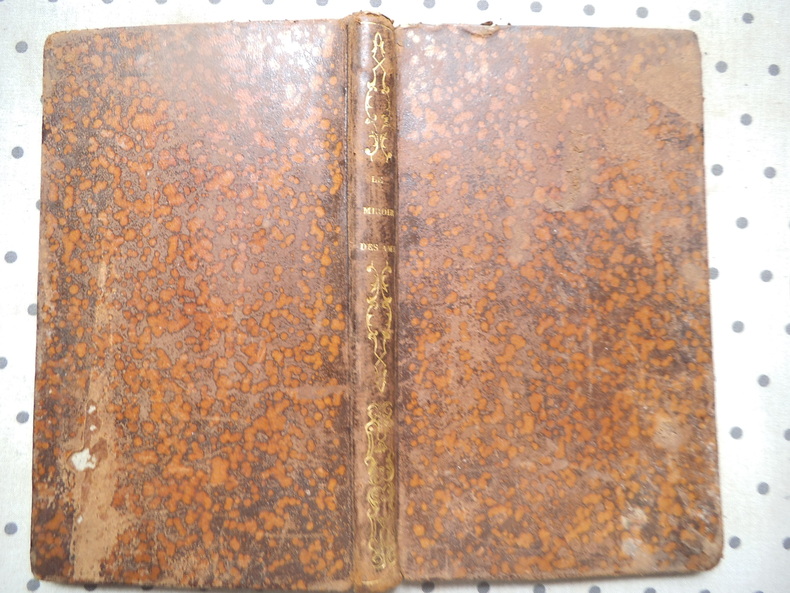
14809le miroir des âmes ou exposition des différens états des âmes par rapport à Dieu.Conformément à la réalité ou aux idées allégoriques de la foi;A l'usage de tous ceux qui désirent entièrement leur salut ou qui veulent contribuer à celui des autres.Edition revue et augmentée.In 12 plein cuir fauve raciné moucheté,titre et fers en long,filets dorés au dos roulette dorée sur coupes.Faux-titre,frontispice gravé (état malheureux d'une âme tomée dans le pêché mortel) titre,164 pages,16 planches gravées,hors texte,y compris le frontispice.Librairie catholique de Périsse frères Lyon-Paris 1843.(tache brune en marge extérieure de la page 40 à la page 109 en s'agrandissant puis en diminuant.En l 'état
024339960X.Gpaperback. Good. Access codes and supplements are not guaranteed with used items. May be an ex-library book. paperback
1334391955.Gpaperback. Good. Access codes and supplements are not guaranteed with used items. May be an ex-library book. paperback