187 résultats
Frontespizio della serie Les stations de Rome. “Les stations de Rome, suite de 10 pièces numérotées, non compris le titre. Les inscriptions de cette suite sont en français (caractères italiques) et en latin (caractères romains). Le titre de chaque pièce qui sépare l'inscription latine de l'inscription française est en italien et en gros caractères. On n'a mis ici que le titre italien et l'inscription française. Ces pièces sont de la plus belle manière de Silvestre” (cfr. Faucheux, Catalogue raisonné de toutes les estampes qui forment l'oeuvre d'Israel Silvestre). Il Silvestre, incisore e disegnatore, nasce a Nancy nel 1621. Come era consuetudine all'epoca, fece diversi viaggi in Italia per copiare i vecchi maestri e per migliorare le sue abilità con i più grandi maestri. Faucheux fissa le date di questi viaggi, il primo prima del 1640 (Israel non aveva ancora 20 anni), il secondo dal 1643 al 1644 e l'ultimo intorno al 1653. Israel portò con sé molte vedute dell'Italia, quasi tutte incise. Fino al 1659, fece altri viaggi in Francia e in Lorena, da cui trasse molti disegni e incisioni. Il suo stile fu, all'inizio, piuttosto sciolto, ma dal 1643 in poi divenne più raffinato e delicato, acquisendo accuratezza e precisione senza essere asciutto, risultando a volte simile a quello di Jacques Callot o di Stefano della Bella, con i quali ebbe rapporti di amicizia attraverso il suo zio materno e mentore, l’editore Israël Henriet. Accanto alle testimonianze per la Roma antica mostrò ben presto un grandissimo interesse per la città "moderna", divenendo uno dei precursori del vedutismo - non solo nel campo incisorio - anticipando artisti come Lievin Cruyl e Gaspar van Wittel. È praticamente impossibile fare un inventario completo delle opere di Israël Silvestre, tanto era prolifico l'artista. Ha lasciato numerosi disegni e più di mille incisioni. Tra le sue opere più belle, possiamo tuttavia menzionare le numerose e complesse “piccole” suite (composte da poche tavole) sulle piazze, le chiese e le antichità di Roma. Acquaforte, in ottimo stato di conservazione. Bibliografia L. E. Faucheux, Catalogue raisonné de toutes les estampes qui forment l'oeuvre d'Israel Silvestre: précédé d'une notice sur sa vie (1857), n. 2.0; F. Baré, Israël Silvestre et sa famille, suivi du catalogue de son oeuvre (1885), n. 806. Title page from the series Les stations de Rome. Les stations de Rome, suite of 10 numbered pieces, not including the title. The inscriptions of this suite are in French (italic characters) and in Latin (Roman characters). The title of each piece which separates the Latin inscription from the French inscription is in Italian and in large characters. Silvestre, engraver and draftsman, was born in Nancy in 1621. As was customary at the time, he made several trips to Italy to copy the old masters and to improve his skills with the greatest masters. Faucheux fixes the dates of these trips, the first before 1640 (Israel was not yet 20 years old), the second from 1643 to 1644 and the last around 1653. Israel brought with him many views of Italy, almost all of them engraved. Until 1659, he made other trips to France and Lorraine, from which he took many drawings and engravings. His style was, at the beginning, rather loose, but from 1643 onwards became more refined and delicate, acquiring accuracy and precision without being dry, resulting sometimes similar to that of Jacques Callot or Stefano della Bella, with whom he had friendly relations through his maternal uncle and mentor, the publisher Israël Henriet. Alongside the testimonies to ancient Rome, he soon showed great interest in the "modern" city, becoming one of the precursors of vedutism - not only in the field of engraving - anticipating artists such as Lievin Cruyl and Gaspar van Wittel. It is quite impossible here to make a complete inventory of Israël Silvestre's works, so prolific was the artist. He left numerous drawings and more than a thousand engravings. However, among his most beautiful works, we can mention the many complex "small" suites (composed of a few plates) on the squares, churches and antiquities of Rome. Etching, in excellent condition. Bibliografia L. E. Faucheux, Catalogue raisonné de toutes les estampes qui forment l'oeuvre d'Israel Silvestre: précédé d'une notice sur sa vie (1857), n. 2.0; F. Baré, Israël Silvestre et sa famille, suivi du catalogue de son oeuvre (1885), n. 806.
20091108991Berlin : Duncker & Humblot, 2009. 296 S. ; 24 cm kart.
0809-Bo.J. Kupferstich, von Julius Theater (1804-1870), auf aufgewalztem China. 22:22,7 cm. Sehr guter Abdruck mit vollem Rand an drei Seiten, oben auf die Plattenkante geschnitten (es handelt sich um die untere Hälfte einer Seite, auf der sich zwei Kupferstiche befanden). Das Gemälde von L. Seidler war 1831 vom Sächsischen Kunstverein angekauft worden (vgl. Boetticher Bd. II, Tl. II (Seidler), I, 13).
033-Lo.J. Kreidelithographie 1806, auf cremefarbenem Velin. 35:25 cm. Nicht ganz frisch. Literatur: Nagler 15, 12; Dussler 9; Winkler 706 (!). 7 und Abb. 17.- Aus lithographische Kunstproducte, Lieferung 9, Blatt 2.
032-Lo.J. Kreidelithographie 1806, auf cremefarbenem Velin. 35:25 cm. Mit Flecken im Oberrand. Literatur: Nagler 15, 11; Aufseesser 275 (als Schiesel, Sommer und Herbst); Dussler 8; Winkler 706 (!). 6 und Abb. 16.- Aus lithographische Kunstproducte, Lieferung 9, Blatt 1.
1918698051918. Blattmaß: 16,2 x 9,3 cm, Bildmaß: 14,8 x 8,1 cm.
1920200082Um 1920. Signiert "Walter-Cl. Schmidt". Im Stock monogrammiert "W.C / SCH". Druck auf breitrandigem faserigem Japan. 14,5 x 7,2 cm. Papier: 20,8 x 15,7 cm.
Decorativa allegoria pubblicata nell'opera di Heinrich Scherer Atlas Novus exhibens orbem terraguem per naturae opera, historiae navae acveterus monumenta, artistique geographicae leges et praecepta edita in 8 parti, stampate tra il 1702 e il 1710 a Monaco di Baviera. Heinrich Scherer, professore di matematica a Monaco di Baviera, era un gesuita devoto la cui opera sottolineava la gerarchia cattolica e la diffusione delle missioni gesuite in tutto il mondo. Il suo Atlas Novus contiene mappe di tutte le altre parti che mostravano la diffusione del cattolicesimo e delle missioni gesuite. Le 180 mappe incluse in questo lavoro sono state preparate tra il 1699 e il 1700 e sono state incise da Leonard Hecknaeur, Joseph Montelegre e Matthus Wolfgang; ogni volume è introdotto da splendidi frontespizi allegorici dagli stessi incisori. Incisione su rame, in ottimo stato di conservazione. Decorative allegoric title page by Heinrich Scherer for his Atlas Novus exhibens orbem terraguem per naturae opera, historiae navae acveterus monumenta, artistique geographicae leges et praecepta...published in eight volumes from 1702-1710 in Munich. Scherer, a devout Jesuit, produced this geographical compendium to depict the Catholic hierarchy and the spread of Jesuit missions throughout the world. The 180 maps included in this work were prepared between 1699 and 1700 and were engraved by Leonard Hecknaeur, Joseph Montelegre or Matthus Wolfgang with each volume introduced by fine allegorical frontispieces by the same engravers. Copper engraving, in very good condition. Interesting and original engraving; devoted allegorical attention to sea-going nations at a time when much of the world had been discovered and Europeans were swarming out like bees to learn details of hitherto unknown continents, taking possessions and bringing back whatever was new to them as well as not only taking blessings to the people they met on their adventures.
Decorativa allegoria pubblicata nell'opera di Heinrich Scherer Atlas Novus exhibens orbem terraguem per naturae opera, historiae navae acveterus monumenta, artistique geographicae leges et praecepta edita in 8 parti, stampate tra il 1702 e il 1710 a Monaco di Baviera. Heinrich Scherer, professore di matematica a Monaco di Baviera, era un gesuita devoto la cui opera sottolineava la gerarchia cattolica e la diffusione delle missioni gesuite in tutto il mondo. Il suo Atlas Novus contiene mappe di tutte le altre parti che mostravano la diffusione del cattolicesimo e delle missioni gesuite. Le 180 mappe incluse in questo lavoro sono state preparate tra il 1699 e il 1700 e sono state incise da Leonard Hecknaeur, Joseph Montelegre e Matthus Wolfgang; ogni volume è introdotto da splendidi frontespizi allegorici dagli stessi incisori. Incisione su rame, in ottimo stato di conservazione. Decorative allegoric title page by Heinrich Scherer for his Atlas Novus exhibens orbem terraguem per naturae opera, historiae navae acveterus monumenta, artistique geographicae leges et praecepta...published in eight volumes from 1702-1710 in Munich. Scherer, a devout Jesuit, produced this geographical compendium to depict the Catholic hierarchy and the spread of Jesuit missions throughout the world. The 180 maps included in this work were prepared between 1699 and 1700 and were engraved by Leonard Hecknaeur, Joseph Montelegre or Matthus Wolfgang with each volume introduced by fine allegorical frontispieces by the same engravers. Copper engraving, in very good condition.
I Millenni 53 - Prefazione - XXXI racconti - Ultimo lavoro dell'A. 1 21x13 cm., legatura in piena tela rossa al dorso e bianca ai piatti, cofanetto in tela con applicate pagine manoscritte, pp. XVI, 515 (2), prima edizione italiana, buone condizioni, solo piccoli segni d'uso e tempo al cofanetto. Allegata scheda editoriale.
A clean, unmarked book with a tight binding. Slight fading to full red/brown cloth boards with silver and black design. Tears and small pieces missing from dust jacket edges. 228 pages. 5 5/8"w x 8 1/4"h. Illustrated by Ludwig Heinrich Jungickel. A book about Perri and Porro, two forest squirrels, by the author of Bambi.
1659ALDR0606Amstelodami, Apud. Ioh. Ianßonium Iuniorem (Amsterdam, Jan Jansson) 1659. 12°. Gest. Titelbl., 11 nn. Bll., 831 S., 2 nn. Bll., mit 104 gestochenen Illustrationen. Pergamentband d. Zeit, mit Rückenbeschriftung von alter Hand, verfärbt und braunfleckig, Pergament entlang des hinteren Gelenkes aufgeplatzt, vorderer Innendeckel mit frischem Blatt, hinterer mit letztem bedruckten Blatt überklebt. Seiten nur wenig gebräunt, teilw. wasserrandig, einzelne tintenfleckig oder randrissig, mit etwas Wurmfraß in den Schlussblättern. Mit einem Siegelabdruck und Resten von Siegellack am Titelblatt, sowie e. Besitzvermerk von alter Hand (Jos. Sandor) auf der Rückseite des Titelblatts. Graesse 6,200. Vgl. Praz 483ff. Jöcher/Adelung 4,3 - lateinische Fassung des ursprünglich in spanischer Sprache verfassten, 1640 erstmals erschienenen 'emblematischen Fürstenspiegels' des spanischen Autors und Diplomaten Diego de Saavedra-Fajardo (1584-1648). Das über Jahrhunderte immer wieder neu aufgelegte, vielfach übersetzte Emblembuch - "Im thematischen Bereich der politischen Emblematik ist der Fürstenspiegel des spanischen Diplomaten Diego de Saavedra Fajardo ? keineswegs das erste, aber wohl doch das erfolgreichste Werk." - enthält 101 Text-Bild Kombinationen, welche die moralischen und politischen Ansprüche, die aus christlicher Sicht an einen idealtypischen Prinzen gestellt werden, veranschaulichen. Auch in dieser Ausgabe findet sich Saavedras mit 'Wien, 10 Juli ? 1640' datiertes, an den spanischen Prinzen gerichtetes, Vorwort zu seinem, nach eigenen Angaben in Intervallen auf seinen diplomatischen Reisen durch Deutschland, verfasstem Werk. (Vgl. auch Peil. Emblematische Fürstenspiegel im 17. u. 18. Jahrhundert. In: Frühmittelalterliche Studien. Jg. 20,55f.) [2 Warenabbildungen]
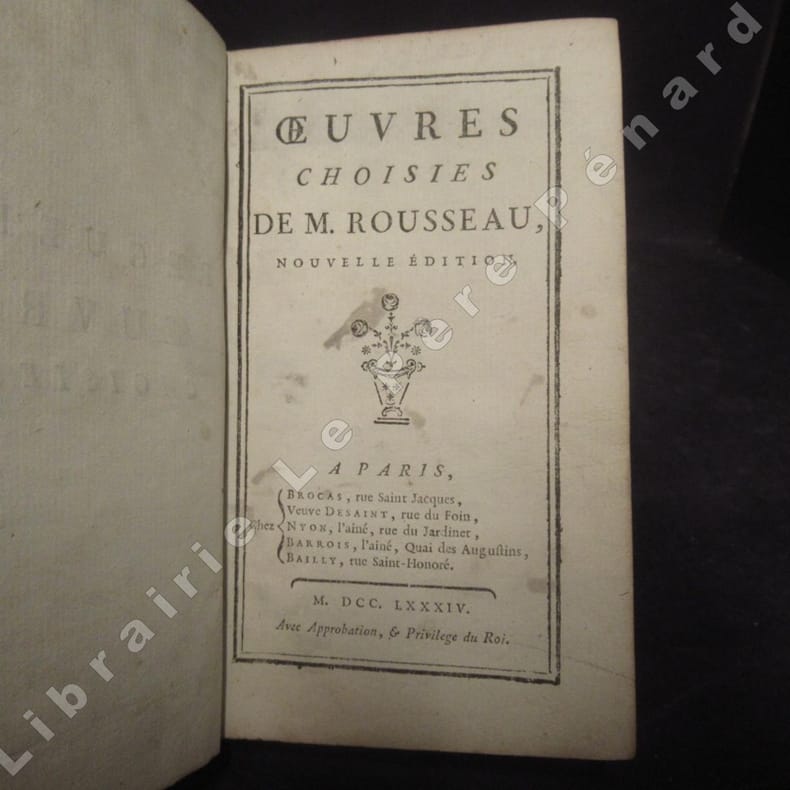
17841136421784 Nouvelle édition. A Paris, chez Brocas, Veuve Desaint, Nyon, Barrois, Bailly. Avec approbation & privilège du Roi - De l'imprimerie de la Veuve Herissant - 1784 - Petit in-12, plein veau marron, pièce de titre au dos avec fleurons dorés - 316 pages + tables et approbation royale
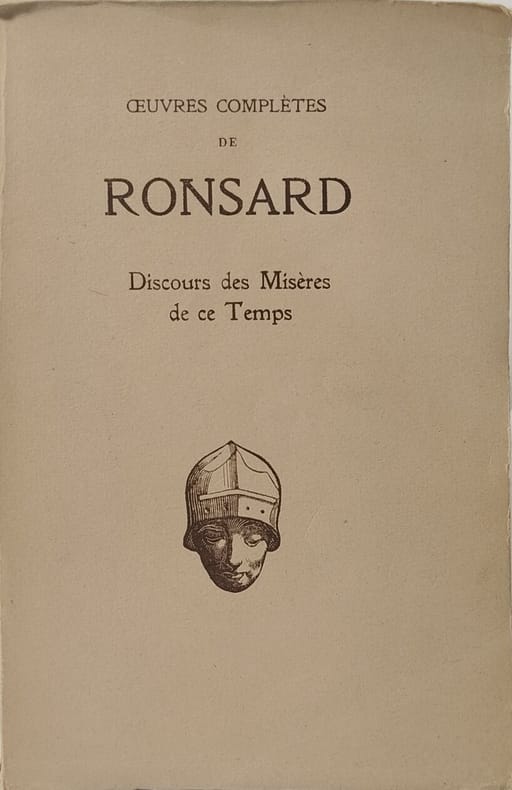
19493566Belles lettres 1949 327 pages in8. 1949. broché. 327 pages. Le 'Discours des misères de ce temps' de Ronsard est un poème engagé écrit en mai 1562 après les massacres de Vassy. Dédié à la reine mère Catherine de Médicis il dénonce par une forme allégorique les théologiens protestants et plaide pour le maintien de l'unité religieuse et nationale dans le contexte des guerres de religion
Mm 245x290 Volume in copertina rigida con sovraccoperta, custodia originale muta, 370 pagine profusamente illustrate a colori. Copia prossima al nuovo, spedizione in 24 ore dalla conferma dell'ordine.
IN-24°, PP. (2) 587-1009 (1) NUM. CONTINUA, 91 ILL. IN NERO SU TAVV. F.T., BROSS. EDIT., COP. ILL. IN NERO (LIEVI TRACCE D'USO), LEGGERISSIME BRUNITURE AI MARGINI DELLE CARTE, OTTIMO STATO (F), (REPRINT ANTICHI MANUALI HOEPLI). 468
Legatura editoriale illustrata, ottima copia. Prima edizione con 91 tavole fuori testo a fine volume. Sc. U.
196523776ABBern/Mchn., Francke Verl. 1965. 1. Aufl. 8°. 174 S., 1 Bl. OLn. m. Goldaufschr. a. Rü., Schutzumschlag m. Einriß, minimale Gebrauchsspuren, sehr gut erhalten. 1
1975024968Fonds Mercator, Anvers 1975. Leinen/Pergamin Sehr gut
17681601111768. Klarer Druck mit der vollen Darstellung auf Bütten. 15,2 x 23,6 cm. Papier: 17,5 x 25,2 cm.
<p>23 cm, in 4°, rilegatura coeva in pergamena morbida a tre nervi, titolo manoscritto al dorso ed al taglio inferiore, p. (1),(48), 648,(1). Antiporta con grande marca tipografica, grande ritratto dell'autore a tutta pagina. Oltre trecento illusrtazioni xilografiche nel testo, sempre addornate da cornice tipografica. Restauro professionale al bordo bianco esterno delle prime 9 carte, alcuni aloni marginali, più evidenti nella parte finale del volume. Piccoli antichi tratti di inchiostro al frontespizio. Titolo esteso: Nova iconologia di Cesare Ripa perugino caualier de ss. Mauritio, & Lazzaro. Nella quale si descriuono diuerse imagini di virtu, vitij, affetti, passioni humane, arti, discipline, humori, elementi, corpi celesti, prouincie d'Italia, fiumi, tutte le parti del mondo, ed' altre infinite materie. Opera vtile ad oratori, predicatori, poeti, pittori, scultori, disegnatori, e ad'ogni studioso per inuentar concetti, emblemi, ed imprese, Per diuisare qualsiuoglia apparrato Nuttiale, Funerale, Trionfale. Per rappresentar Poemi Drammatici, e per figurare co`suoi propij simboli ciò, che può cadere in pensiero humano. Ampliata vltimamente dallo stesso auttore di trecento imagini, e arricchita di molti discorsi pieni di varia eruditione; con nuoui intagli, e con molti indici copiosi. Straordinario apparato iconografico nell'ultima edizione curata dal Ripa. Esemplare in eccellenti condizioni corredato dalle freschissime llustrazioni.</p>
20051133214Göttingen : Steidl, 2005. 208 S. : überw. Ill. ; 29 cm. Originalleinen mit farb. illustr. Schutzumschlag.
17292158Regensburg, Lang, 1729. Siehe Lentner 10020; Pfister 572. - Das Blatt bildet das doppelblattgroße schöne allegorische Frontispiz, mit barockem Dekor, im Hintergrund die Ansicht von Regensburg.
0184-Bo.J. Radierung, 1811, nach Eberhard Waechter (1762-1852), auf festem Velin, 34,7:48,5 cm. Insgesamt nicht ganz frisch. Die Vorlage zu dieser Graphik bildet eine Kreidezeichnung Waechters, die im Mai 1833 auf der Kunstausstellung in Stuttgart ausgestellt und für die Verlosung angekündigt war. 1854 wurde sie auf der allgem. Kunstausstellung in München gezeigt. Literatur: Nagler 26. Vergleichsliteratur: Boetticher Bd. II, Teil II, S. 958, II. Cartons, Zeichnungen, Nr. 11; Ausst. Katalog: Allgemeine Deutsche Kunstausstellung München 1854, Nr. 445; Katalog: Die Zeichnungen und Aquarelle des 19. Jahrhunderts in der Graphischen Sammlung der Staatsgalerie Stuttgart. Bearb. von Ulrike Gauss. Stuttgart, 1976, Nr. 1584, Abb. Tafel CXCVIII. - Selten!
Acquaforte e bulino, 1729, firmata e datata in lastra in basso a sinistra.Magnifica prova, ricca di toni, impressa su carta vergata coeva, con margini, in ottimo stato di conservazione.Minerva e le scienze mettono un busto di Luigi XIV in una stanza decorata con busti scolpiti di altri uomini illustri; a destra, due personificazioni delle scienze fanno ghirlande di alloro; sopra di loro la Fama, che suona la sua tromba; tavola tratta da "Eloges des académiciens de l'Académie royale des Sciences", in "Oeuvres diverses" di Fontenelle. Etching and engraving, 1729.Lettered with production detail: 'B. Picart del. et sculp. 1729', title: 'Eloges des académiciens de l'Académie royale des Sciences', three lines of inscriptions in French, and explanatory key.Minerva and the Sciences setting a bust of Louis XIV in a room decorated with sculpted busts of other illustrious men; on the right, two personifications of Sciences are making laurel wreaths; above them flies Fame, who blows her trumpet; illustration to 'Eloges des académiciens de l'Académie royale des Sciences', in Fontenelle's 'Oeuvres diverses' (La Haye: Gosse & Neaulme, 1728-1729).A fine impression, very good condition. Dimier, Louis, Les peintres français du XVIIIe siècle, histoire des vies et catalogue des oeuvres, 1928, nn. 1500-1570.