QUIGNARD (Pascal)Livre Rare Book
8 005 résultats
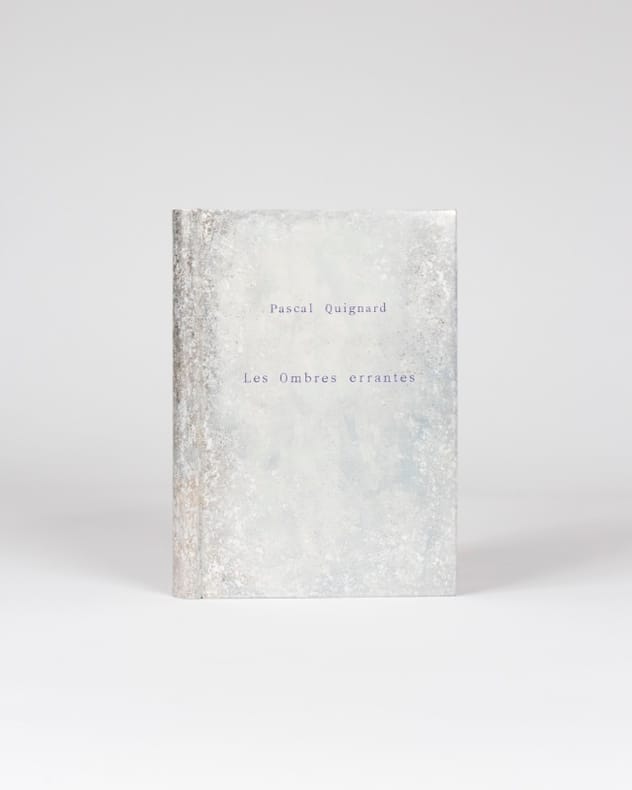
200218821Exemplaire de tête relié par Louise Bescond Paris, Grasset, (août) 2002. 1 vol. (145 x 215 mm) de 189 p. et [1] f. Veau naturel blanc estampé et teinté d'un camaïeu de bleus rehaussé d'or blanc et de palladium, titre à l'oeser bleu sombre sur le premier plat, contreplats bord à bord de papier gris perle et gardes chèvre velours bleu sombre, couvertures et dos conservés, chemise et étui (reliure signée de Louise Bescond, titr. Claude Ribal, 2019). Édition originale. Un des 50 premiers sur vélin pur fil Malmenayde (n° 15).
19372978719 illustrations de Kay Sage. Exemplaire de tête avec aquarelle originale. Florence, Edizioni del Milione, (15 décembre) 1937. 1 vol. (175 x 250 mm) de 84 p. et [2] f. Toile éditeur titrée au premier plat. Édition originale. Poèmes et 19 illustrations de Kay di San Faustino [Kay Sage] dont 1 aquarelle originale en frontispice. Un des 50 premiers exemplaires sur japon (n° 17), signé. Seul le tirage de tête comporte l’aquarelle originale signée. Envoi signé : « À André Marchand, avec mon estime et avec mon amitié. K. di San Faustino ».
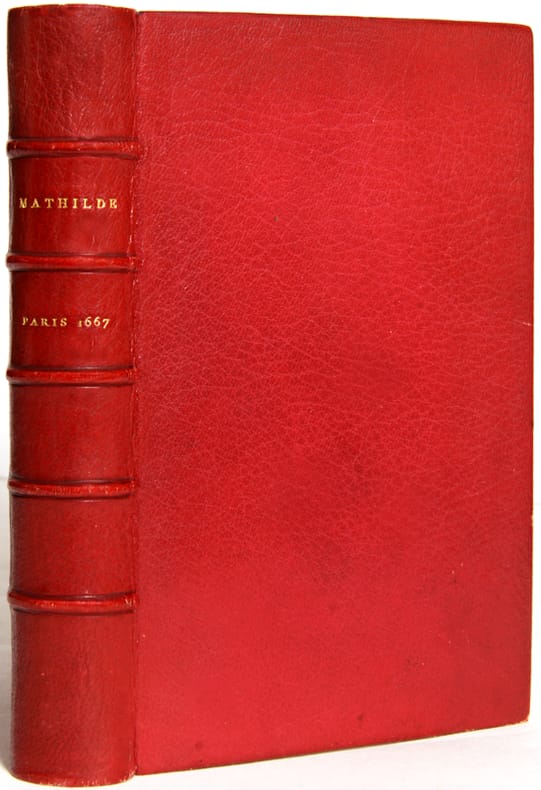
166742633Paris, Chez Edmé Martin et Français Eschart, 1667. 2 parties en 1 vol. in-12 de (4)-122 pp. 1 f. blanc, 518 pp. 1f. blanc, frontispice, maroquin janséniste rouge, dos à nerfs, dentelle intérieure, tranches dorées sur marbrure (Duru et Chambolle 1863).
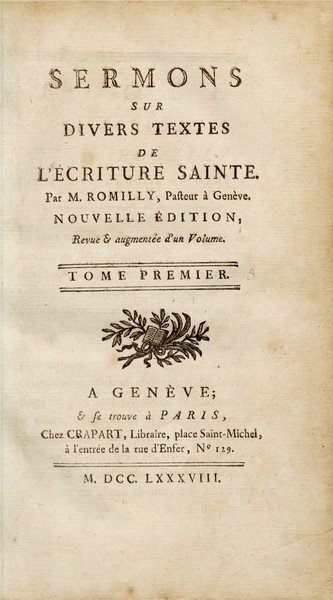
778Genève-Paris : Crapart, 1788. L'EXEMPLAIRE DE MADAME DE STAËL
1917134554Petrograd: Tsentr. Tipograf 1917. A new Russia should be built by women and men together A remarkable survival of a flyer printed by the All-Russian League of Equal Rights for Women for their political campaign for the election to the Constituent Assembly in November 1917. The League participated in elections as its own party under the number 7. In English the flyer text reads: ''Female Citizens and male citizens! The League of Equality for Women wishing that the right of women to participate in the Constituent Assembly was not only on paper expose its candidates to the Constituent Assembly. Vote for the list number 7. If you want our children not to grow up without a home and the old people to not die on the street - send women to the Constituent Assembly. In America Australia and other countries where women take part in the drafting of laws the number of schools is multiplied prisons are empty debauchery and drunkenness noticeably diminish the protection of children and the elderly is fully secured by law. Let's send women to the Constituent Assembly too. The old Russia was built only by men and the grief and misfortunes of the motherland were always shared with them by mothers wives and daughters. A new Russia should be built by women and men together! The most important Russian laws will be written in the Constituent Assembly. From the laws that will be created in the Constituent Assembly the fate and life of many generations depends not only on men but also on women and so send women to the Constituent Assembly.''. The campaign for women's political rights in Russia termed the ''women's liberation movement'' became possible only with the beginning of the revolution in 1905 when the question of the democratization of the political system arose. The oldest women's association in Russia the All-Russian Women's Mutual Charity Society established in 1895 was actively involved and new organizations were created: the Union for the Equality of Women 1905 Women's Progressive Party 1905 and the All-Russian League of Equal Rights for Women 1907. The most influential organization was the first the Union which had 48 offices in various cities across Russia and actively conducted agitation among women workers and peasants. After its disintegration the League of Equal Rights for Women became its successor. Members of the League deliberately abandoned the broad political programme and focused their attention only on suffragist demands practising agitation tours through the provinces Orel Saratov Rostov-on-Don Kremenets Tomsk Kiev Simferopol and Narva. As a result branches of the League emerged in many cities including Moscow 1910 Kharkov 1912 Tomsk 1914 and Yekaterinburg 1914. This included the establishment of the following departments: a reading room for street children with a view to preventing child prostitution; a publishing committee that printed cheap pamphlets and books on women's issues; and an editorial commission that published the proceedings of the congress. Every day reports were given on the issues of women's equality in the League's premises. After the February Revolution delegates from the League repeatedly met with the leaders of the Soviet of Workers' and Soldiers' Deputies on the issue of women's suffrage. Despite initial promises of support they refused to immediately act on granting political rights to women. In response the League organized the famous mass march on 20 March 1917 which brought together about 40000 women. To that date it was the most numerous and memorable stand by the Russian women's movement and resulted in the adoption by the Provisional Government of a decree on universal suffrage which was passed on 20 July 1917. Single-sided flyer 365 x 220 mm. In near-fine condition. unknown
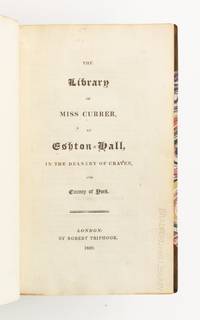
1820ST16983London: Robert Triphook 1820. ONE OF 40 COPIES PRINTED. 235 x 142 mm. 9 1/4 x 5 3/4". iii-xi 1 308 pp. lacking the first of the two title pages at front. <br/> In a very nice replica binding of honey-brown sheepskin over marbled boards raised bands ruled in gilt gilt titling. Front free endpaper INSCRIBED IN INK BY CURRER: With Miss Currer's Compliments"; small ownership perforation of the Bradford Free Library on title page and p. 99; two small ink stamps on p. 59 and 99. Front free endpaper with thinned area where indication of earlier ownership likely appeared. The boards just very lightly scuffed though probably to provide a feeling of authenticity otherwise only trivial imperfections. Apart from the signs of library ownership a very fine copy the text showing virtually no signs of use.<br/> <br/> This is a presentation copy of the first library catalogue of Frances Mary Richardson Currer an Englishwoman described by De Ricci as "England’s earliest female bibliophile" and hailed by Dibdin as "the head of all female collectors in Europe." An only child Currer 1785-1861 inherited considerable assets from both her father's and her mother's families: her relative Dorothy Richardson wrote in 1815 "She is in possession of both the Richardson and Currer estates and inherits all the taste of the former family having collected a very large and valuable library . . . in addition to what were collected by her great grandfather and great-uncle." Dibdin noted that her library at Eshton Hall in North Yorkshire was surpassed only by three collections those of Earl Spencer and the dukes of Devonshire and Buckingham. According to DNB "the library had substantial holdings in natural science topography antiquities and history together with a collection of the classics. There were rarities some early printed books a collection of Bibles and a fine gathering of illustrated books. . . . Dibdin first estimated the number of volumes at 15000 and later 18000. In 1852 Sir J. B. Burke put the number at 20000." With just 40 copies printed this first printing there was a 1933 second edition is very rarely seen on the market. Robert Triphook unknown
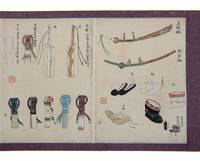
11376Scroll 418 x 5420 mm. silk brocade on outside of front endpaper inside endpaper decorated with square-cut gold flecks. Japan: late Edo.<br /> <BR> <BR> Court attire in mid-Edo Japan was a combination of Heian era 794-1185 court dress with more modern "warrior court" outfits such as hitatare ç›´åž‚ nÅshi ç›´è¡£ and kamishimo 裃 each worn according to rank setting and ritual context. Our extremely detailed scroll depicts many kinds of aristocratic and court attire and accessories worn for these official occasions. What is so remarkable about this scroll is the number of diagrams showing - like a tailor's pattern book - how the clothes were assembled. The 17 sheets all numbered and each measuring ca. 374 x 267 mm. include finely drawn images in rich color and black & white diagrams. Measurements are given.<br /> <BR> <BR> The accessories include:<br /> <BR> <BR> WOMEN'S ATTIRE. Examples of nyokan 女官 robes worn by ladies-in-waiting portrayed in rich color. Details of the motifs woven into the fabrics are shown in diagrams with explanations. The images show how the robes were to be layered when worn. Another sheet depicts the structure of karaginu å”è¡£ short wide-sleeved jackets worn as the final outermost layer of the jÅ«nihitoe åäºŒå˜ 12-layer robe the most formal court attire for noblewomen during the Heian period. Also depicted are diagrams of the parts of the hakama 袴¸ for the lower part of the woman's body. Included are notes on appropriate combinations of colors hair ornaments fans and hair styles.<br /> <BR> <BR> MEN'S ATTIRE: Five of the sheets contain diagrams of the parts of noshi ç›´è¡£ court robes of the Heian period and suikan æ°´å¹² a single-breasted over-robe with open sides worn by lower-ranking Heian courtiers along with its trousers with another sheet devoted to large diagrams of patterns woven into the trousers' fabric. Two sheets depict two types of the head ornament kanmuri å† the lacquered court cap worn by male aristocrats and officials at the Japanese imperial court shown from different aspects. The final sheet depicts the parts of various kinds of hitatare ç›´åž‚ a two-piece samurai outfit consisting of a long-sleeved jacket with open sides and matching hakama trousers.<br /> <BR> <BR> SWORDS & ARROWS. Two examples of a shirizaya 尻鞘 and an efu 衛府 traditional stylized scabbards for tachi swords. One is decorated with feathers and the other is lacquered and encrusted with fine gold ornaments. One sheet depicts the parts of ornamental arrows and quivers tsubo yanagui 壺胡簶. The following sheet shows ornamental bows with tassels attached and two further types of quivers hira yanagui 平胡簶.<br /> <BR> <BR> FOOTWARE. Examples of inner and outer boots with detailed notes of materials and measurements.<br /> <BR> <BR> BELTS. Several types of belts gyotai éšè¢‹ hirao 平緒 and sekitai 石帯. Each is decorated with embroidery mineral plaques or metalware. The belts are portrayed in different angles to reflect their complexities. Materials and measurements are given.<br /> <BR> <BR> In fine condition. A bit of worming at bottom. Each sheet bears an unidentified seal in red. unknown
1980226721980 Dessin aux feutre et gouache, signé en bas à droite à la gouache, 1981, 39 x 24 cm, encadré.
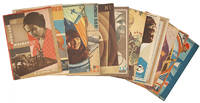
112309Moscow Ogonek 1929. . 12 issues complete run of 1929 folio 34.5 cm x 25.5 cm; profusely illustrated throughout in black and white with photos and illustrations as well as fashion illustrations in colour no.2 slightly stained no.4 minor spotting throughout and lacking the supplementary folding pattern as is often the case no.6 pp.37-40 loose no.9 faint remnant of tape repair to spine; original illustrated or photomontage wrappers a very good set.<br /> A complete run of one year of one of the major periodicals of the 1920s with striking cover designs.<br /><br />Runs of Zhenskiy zhurnal are notably scarce with only a handful of issues in institutions worldwide. The Constructivist covers were mainly designed with photomontages by Semen Semenov-Menes 1895-1982 one of the leading Soviet masters of movie poster design. Together with Stenberg brothers he created the well-known style of advertising posters for Mezhrabpom films. The journal was issued monthly between 1926 and 1930 and included short stories poetry international current affairs including scathing attacks on class enemies as well as advice on how to run a home family health needlework and recipes. Each issue also includes a section on fashion with vivid illustrations reflecting the latest 1920s style some of which is 'Slavicised' with floral embroidery.<br /> Moscow, Ogonek, 1929. unknown
In -8°, 112, 96 cc., marche ai vari frontespizi, alla fine della prima parte e sull’ultima pagina, illustrazioni nel testo, iniziali e fregi. Pergamena coeva. Il volume comprende, con numerazione continua le “Prose” divise in due parti (“Discorsi degli animali” e “Delle bellezze delle donne”, quest’ultimo con frontespizio interno); poi un altro frontespizio precede i “Ragionamenti di M. Agnolo...” con numerazione propria. Buon esemplare con le due marche editoriali alla fine dei testi, non presenti in tutte le copie. I “Ragionamenti” comprendono otto novelle e il “Discacciamento delle nuove lettere” (notevole testo, in cui Firenzuola respinge la proposta di riforma ortografica del Trissino). A fine copy with the two editorial marks at the end of texts.
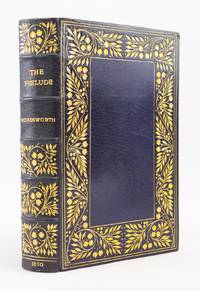
1850ST19683London: Edward Moxon 1850. FIRST EDITION. 222 x 140 mm. 8 3/4 x 5 1/2". x 374 pp. <br/> HANDSOME DARK BLUE MOROCCO GILT BY THE GUILD OF WOMEN BINDERS see below covers with frame of swirling flowering vines raised bands spine panels with similar floral decoration gilt lettering pastedowns framed by multiple gilt rules intersecting into squares at corners all edges gilt. Front pastedown with pencilled inscription attributing the binding to the Guild of Women Binders in the hand of former owner antiquarian bookseller John P. Love; front free endpaper with pencilled bibliographic information; handwritten card from Love's library catalogue laid in at front. Wise p. 35. Spine gently and evenly sunned one opening with two tiny brown marginal dots but A VERY FINE COPY with few signs of use inside or out.<br/> <br/> This is a lovely copy of one of the great autobiographies in verse offered here in a binding attributed to the Guild of Women Binders by a previous owner with extensive expertise in the field. According to DNB Wordsworth 1770-1850 began his "Prelude" in 1799 while travelling with his sister Dorothy and Samuel Coleridge in Germany using his sister's German exercise notebook to enter poetic accounts of his boyhood. These entries became the first version of his autobiographical testament a work that "is for many his most impressive poem." He completed it in 13 books in 1805 but continued to revise it throughout his lifetime adding a 14th book at the end. It was published poshumously and given its title by his wife. The Guild of Women Binders was established by bookseller Frank Karslake in 1898 to give an organizational identity to a group of women already at work binding books in various parts of Britain often in their own homes. As Tidcombe notes "because the women were generally unaware of the long history of traditional bookbinding design they produced designs that were freer and less stereotyped than those of men in the trade." Our binding is unsigned and is perhaps more conventional that other Guild works but there are elements that would lead an experienced connsoisseur like former owner John P. Love to make a confident attribution. One is the whimsical yet carefully executed spine decoration which carries over the curving floral vines from the covers. Another hint is the very slight variation in the parallel gilt rules indicating a less experienced hand. John Percival Love 1896-1974 joined the staff of the distinguished antiquarian bookseller Francis Edwards founded in 1855. Love served as Chairman of the firm from 1944 until his retirement in 1972. Like many antiquarian booksellers Love was also a collector. He built an impressive collection that was especially rich in incunabula and fine bindings. It is certainly possible that the present volume was once part of the Francis Edwards inventory and was definitively identified at that time as a Guild binding. Edward Moxon unknown
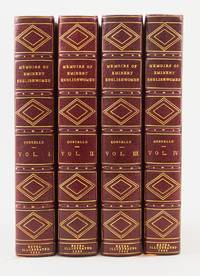
1844ST19249London: Richard Bentley 1844. FIRST EDITION. 220 x 138 mm. 8 3/4 x 5 1/2". Four volumes. <br/> HANDSOME BURGUNDY MOROCCO BY BAYNTUN stamp-signed in gilt on front turn-ins covers with triple gilt-ruled frame interlinking with a triple-gilt-ruled diamond raised bands with gilt dots gilt ruled compartments with gilt diamond shapes gilt lettering gilt-ruled turn-ins with a floral tool at each corner all edges gilt. With 18 portraits as called for four of these with hand coloring and EXTRA-ILLUSTRATED WITH AN ADDITIONAL 60 PLATES. Only the barest hint of wear to extremities spines just a shade darker than covers a handful of portraits a bit foxed but A FINE SET clean and fresh internally the bindings lustrous and the set obviously very little used.<br/> <br/> This is a very attractively bound set containing the biographies of 38 notable Englishwomen extra-illustrated with plates depicting some of the people and places integral to the subjects' lives. Covering the period from the reign of Queen Elizabeth I to the 18th century these four volumes include many women of noble birth and position such as Arabella Stuart Elizabeth Cromwell and Elizabeth Stuart Queen of Bohemia; poets and artists such as Susanna Centlivre Lady Mary Wortley Montagu and Mary Beale; and women famous for their fantastic deeds such as Jane Lane who assisted Charles II during his escape after the Battle of Worcester. Our author Louisa Stuart Costello 1799-1870 was a miniaturist poet and writer of biographies travel stories and fiction. According to DNB "her biographies of royal and noble women--which clearly traded on the popularity of similar works by Lucy Aikin the Strickland sisters and Mary Anne Everett Green--were creditable examples of this literary genre and generally involved some original research." For the present work Costello relied heavily on access to the library and papers of the duke of Devonshire whom she thanks in her introduction. In addition to 18 portraits called for in the contents several of which were drawn by Costello herself this set has been "grangerized" with 60 additional plates that further illustrate the life and times of these illustrious women. The lustrous bindings by an eminent British firm are an additional source of pleasure making a beautiful appearance on the shelf. Richard Bentley unknown
194155330Flushing NY & Beverly Hills CA: Sharlee Janet Munster Blow Raymond Blow 42-20 Kissena Blvd.; 9168 Beverly Blvd. 1941-1968. Two vols. Thick 4to. 163 mylar sleeves with 300 silver gelatin photographs sized from 2.5 x 3.5 in. up to 8 x 10 in. 35 of the photographs are signed or dedicated either to Sharlee or Ray many have photographer’s stamp on versos or embossed photographer’s stamps some have lengthy explanatory location and/or identifying annotations on versos several are sleeved in nightclub portfolio sleeves 10 colour transparency slides & 20 snapshot negatives in photo lab sleeves over 100 newspaper clippings magazine clippings articles printed certificates brochures theatre programs etc. Recent 3-ring binders with stamping on front covers. This amazing photo and ephemera archive offers an invaluable visual record of a young Flushing NY ice skater performing at Rockefeller Center with Sonja Henie’s ice shows off-Broadway cabaret and night club venue during World War II and post-War New York. Munster 1924-2016 was one of the thousands of young girls inspired to become professional ice skaters by Sonia Henie’s ice skating movies ice shows glittering costumes and production numbers. By 1941 Munster was appearing in “It Happens on Ice†which ran for 386 performances and included such ice skating performers as Dorothy Allan Jo Ann Dean Paul Castle Edwina Blades and Mary Jane Yeo. Photos in the archive show her early practice sessions as a teenager in Flushing Queens NY signed photos from Betty Atkinson Paul Castle and other stars who appeared in the production along with newspaper clippings and program. Within two years she was appearing in the Iridium Room Ice Shows which were twice nightly affairs and designed for before & after Broadway shows featuring a 20 foot square ice rink and often elaborate sets. She would perform in the “Newfangles†Ice Show at the Terrace Room alongside Carol Lynne Rudy Richards Dorothy Lewis Bob & Peggy White; “Ice Capers†at The Bowman Room in 1944 at the Biltmore Hotel; the “Circus Haze Ice Review†at the Hotel Roosevelt; and finally the long running “Hats Off to Ice†which ran for 889 performances from 1944 through 1946 and was Henie’s most popular show also represented in this collection by the souvenir Center Theatre Orchestra Seat Stub for the first performance in June 1944. The Iridium Room and other New York supper club ice shows featured live music during and after the war often featuring Freddie Miller Cab Calloway -- represented here in the archive with a signed photo showing Cab and his band dedicated to Sharlee The Harmonicats -- another signed photo all signed by the trio Gus Martel and others thriving through 1947. After a cabaret tax was imposed by the city on the supper clubs offering live entertainment hotels across New York eliminated the very popular ice skating shows. Of additional interest are the many production photos showing performance practices publicity shots while dressed in elaborate costumes the chorus lines of male and female ice skaters and the tremendous stage backdrops for such productions as Hats on Ice. Some of the photos show Sharlee Munster and her future husband Ray Blow in skates in costume along with many of their costars in these large productions. Sharlee had tremendous drive and in addition to her passion for skating and performing was inspired to become a pilot and at 18 years old began flying lessons 2-3 times a week weather permitting often working around her show and social schedule. There are photos of her at the Bendix airfield her standing beside a Piper J-3 Cub in which she had purchased a half-interest and successfully completed her first solo flight at Lime Ridge Airport in Poughquag NY August 11 1944 with Norman Sylvia as her flight instructor. She joined the Women Fliers Club and began studying and taking the tests for a commercial pilot’s rating intending to become a charter pilot after the War. Following the closing of most of the ice shows in New York Sharlee and her cousin Ray Munster became ski instructors fencing instructors and performed in ice shows at at the famed Concord Resort Hotel in the Borscht Belt part of the Catskills. In January 1948 she marries one of her fellow skaters Raymond Kenneth Blow 1924-1992 who had also appeared in many of Sonja Henie’s productions at Rockefeller Center as well as the Roxy Theatre and as a couple continued living in the family apartment on Kissena Blvd. through 1950 while Ray performed. By 1952 the young couple and their son Greg had moved to an apartment in Beverly Hills CA with photos showing the family frolicking and fishing at the California beaches visiting Palm Desert in 105 degree heat the opening of Disneyland and more. See: Laura Jacobs Sonja Henie’s Ice Age Vanity Fair Feb. 11 2014; Ryan Stevens Inside Edges in the Iridium Room Skate Guard The Ultimate Archive of Figure Skating’s Fascinating and Fabulous History July 2 2018. Sharlee Janet Munster Blow, Raymond Blow, 42-20 Kissena Blvd.; 9168 Beverly Blvd., unknown
192012840Prairie View TX 1920. 92pp. of ink manuscript plus eighteen photographs and seven ephemeral items on an additional 11pp. Original scrapbook 12.25 x 8.5 inches. Ownership inscription on front pastedown reading "Estella V. Sells Prairie View College May 17 1920." A well-used personal scrapbook with binding loose with cover nearly detached covers worn with mild staining pages toned and occasionally chipped along margins fading to ink entries along edges of pages though nearly all content legible with care. Good condition. A wonderful scrapbook compiled by Estella Sells Johnson 1897-1900 a young African American woman studying at Prairie View State Normal & Industrial College now Prairie View A & M University documenting her time there in 1919 and 1920. Johnson was born in Jasper County Texas to Watkin and Matilda Sells. She was the 1918 valedictorian of her class at the segregated Jasper High School and enrolled at Prairie View that same year through the summer of 1920. In 1920 she married Reverend Napoleon Johnson shortly thereafter giving birth to her two children. She was finally able to complete her undergraduate degree in 1936 and earned a master's degree in education in 1950. Throughout all this she continued to work in the Jasper school system in a career that lasted forty-six years until retiring in 1966. The scrapbook is accompanied by a copy of her institutionally unrecorded family-published autobiography The Responsibilities of a Christian Life published 1990 as well as a photograph of her from later in life.<br /> <br /> The eighteen photographs in the scrapbook consist of portraits of peers around campus some captioned as well as a photograph of the Prairie View band and a candid photo of the Samuel Huston College HBCU football team. Ephemera includes an alumni banquet invitation a musical program for chapel services a program for a senior class pageant a commencement day program with laid-in college song lyrics an orchestra program a commencement sermon program and a calling card. Several of the programs appear to have been trimmed possibly from larger leaflets.<br /> <br /> The scrapbook also contains forty pages of inscriptions and autographs from classmates and faculty at the school some quite detailed and heartfelt. An additional fifty-two handwritten pages meanwhile provide densely written detailed descriptions of events at the school plus personal anecdotes inside jokes poems class songs and slogans quotations by classmates and faculty as well as entries describing Estella's own feelings regarding life at school. Many of the pages contain diary-style descriptions of events at the school including banquets dances recitals and a sports meet with Bishop College. One five-page entry narrates a visit by famed African American missionary Max Yergan to the campus under the auspices of the YMCA as well as lectures and a sermon given at the same conference by Channing Heggie Tobias. Her description reads in part: "Friday night Mr. Max Yeargan Missionary to India and Africa gave a series of stereopticon Views with lectures. These views treated of the conditions existing in those countries modes of living customs and great preponderance of illiteracy. Especially interesting was his account of of his experiences and adventures in traveling. Doctors and nurses are few for the large population and consequently a large number of inhabitants die for the want of medical attention. He expressed his hope that in response to the call of a needy people there would be those in America Texas and even Prairie View who would answer willing. Mr. Yeargan is planning to return to Africa in the early fall and solicits the support of all well-wishers. Over $300 was subscribed by friends to aid him in this work."<br /> <br /> Mr. Yeargan is a wide awake young Christian worker and is giving his life to this service for the betterment of humanity. His life is in truth worthy of emulation. At the platform meeting on Saturday Mr. Channing H. Tobias International Secretary New York was presented and gave a very masterly discussion on "The Church" telling of the purpose of the Church from its early establishment and its rightful place in the World's program. He emphasized the fact that the Church was the nucleus around which all life was centered and when men would come to a realization of this then it would be that conditions would assume a normal state and mean for the reestablishment of a Christian era.<br /> <br /> Another two page entry meanwhile gives an account of the 1919 observance of National Negro Health Week held at the college: "Dr. Osborn next introduced Dr. J.M. Franklin resident physician who discussed the knowledge of medicine among Negroes and what is being done to improve the faculties for handling disease among colored people as well as increasing advantage for Negroes to acquire training in the medical profession…and laid a deal of emphasis on the fact that the time is here when people will not even patronize a doctor because he happens to be black unless he can deliver the goods."<br /> <br /> A third entry covering two pages describes a visit to campus by sociologist Franklin H. Giddings. Other pages contain an essay titled "Ideals for Girls" inspirational poetry titled "Life" and "It Can Be Done" a lost and found "Advertisement" "lost a precious lad about 4 1/2 feet tall" a heartfelt entry on receiving a gift from a "home girl" quotations from faculty "Miss Bass 'This is the biggest mess I even seen its so bad'" and more. Other humorous entries include an anecdote about accidentally locking "Miss Williams" in a room a sketch titled "this scene open with a Negro in a court room who had filed complaint against his wife for rocking him to sleep" a dialogue between "Prof Butler" and "Dean Griggs" and a humorous anecdote by "Dean Reynolds" about seeing "one of my white friends coming down the same street in a big Nash Six sitting like he had conquered the whole world" and being told "Uncle aren’t you tired of walking.why don't you run for a while." Finally a comic song titled "The Twenty-Third Psalm of the Flunkers" reflects the anxieties of college life: "The twenty-third psalm of the flunkers. The teachers are my shepherds I shall not want. The leaders me resides the classics. I fear my studies far zeroes demerits and even a ticker for home may not comfort me."<br /> <br /> OCLC locates a single printed yearbook from Prairie View that was published in 1917 with 1926 as the next recorded year. The present volume combining elements of a diary scrapbook and yearbook thus fills a gap in the history of the institution while also providing detailed personal insights of a young African woman attending college in Texas during a period of intense Jim Crow segregation. unknown
15259Women at Oxford. Archive of papers recording the great debate between the Association for promoting the Education of Women AEW at Oxford and the faculty and students who opposed their entrance. 1895-1896. Total of 50 separate documents ranging from printed single page letters through bound booklets. The majority of these documents are known to exist only in one single additional copy held by the University of Oxford; and several of the papers are not noted to be included even within Oxford's collection as per OCLC worldcat. <br/><br/> This collection of papers is ripe for scholarly research. Forming a cohesive archive of 50 documents it includes synopses of the contents and resolution of meetings of the AEW arguments concerning various aspects of the question of inclusion of women at Oxford and advice for members concerning upcoming resolutions put to vote. The AEW was founded in 1873 to gain the full educational enfranchisement of women at Oxford who had actually been attending classes in small numbers by special permission since 1866. Despite vigorous support for the cause Oxford maintained as nearly the last hold-out against coeducation among British Universities not allowing women to gain the full B.A. degree until 1920. Some documents of the archive include "The Due Recognition of Women by the University of Oxford" 1896; "A Brief History of the Proposal to Admit Women to Degrees at Cambridge in 1887-8" by Thomas Case 1896; "The Value of a Genuine Diploma"; and "The B.A. Degree for Women." Full list available upon request. Individual pages or booklets sizes vary. Some hole-punched a few corner tears light edge soiling and toning. Some stamped with circular stamp "Board of Education Library"; most with numerical markers in red to upper right corner of documents. All in good condition and clearly legible. Full of sagacity and wit this archive evidences the reasoned support of women's right to the diploma over twenty years before it was finally granted.<br/> <br/>A partial List of Publications and some OCLC Worldcat search results: "most" are held only at Oxford University and no other copies at any institutions or library worldwide. 4 items had no copies at any Liabraries as per OCLC not even Oxford. See details below<br/><br/>Oxford University Gazette Tuesday Feb 18 1896 "Memorials and Resultions with respect to the admission of women to the BA Degree laid before the Hebdomadal Council in 1895 and 1896 - OCLC: NONE <br/><br/>memorandum for the committee of council; admission of women to the B.A. degree June 4 1895 by T.H. Grose - OCLC: NONE <br/><br/>Association for the Education of Women meeting flier Clarendon Building Oxford 6thApril 1895 - OCLC: NONE <br/><br/>Report approved by the Council of the Association for the Education of Women at a Meeting held March 6 1895 - OCLC: NONE <br/><br/>A Brief History of the Proposal to Admit Women to Degrees at Cambridge in 1887-8 by Thomas Case -OCLC: 6 Total: only 1 held in US Yale 5 held UK<br/><br/> "The inferiority of the undergraduate course proposed by Resolutions 2 & 4 to the freedom of education proposed by Resolution 5 in the case of women." - March 9 1896 by An Old Liberal - OCLC: Only 1 held at Oxford<br/><br/>The due recognition of women by the University of Oxford : papers by Mrs. Johnson Warden of Merton Warden of Keble Prof. Gardner E. Armstrong A.H. Johnson L.R. Farnell Members of the University against resolutions 1 2 3 & 4 to be submitted to congregation on Tuesday March 3 at 2 o'clock Feb 7 1896 -OCLC: 2 Total 1 Oxford one Germany<br/><br/>"The value of a genuine diploma" - March 9 1896 - OCLC: only 1 Held at Oxford no others.<br/><br/>"The Question of Residence" - J. Wells 1896 - OCLC: only 1 held at Oxford<br/><br/>Resolution II. A grievance and its remedies. By CH Firth -OCLC: only 1 held at Oxford<br/><br/>A noble resolution by Z - OCLC:only 1 held at Oxford<br/><br/>Resolution 5. : "I think it will be found that their exhortations are of two sorts appropriate to these two classes." - OCLC: 1 held Oxford<br/><br/>The due recognition of women in the University. : Reasons for voting for resolution 5. -OCLC: only 1 held at Oxford <br/><br/>Mixed universities: what is the teaching of experience. By Percy Gardner - OCLC: only 1 at held Oxford<br/><br/>An Appeal by HF Pelham -OCLC:only 1 held at Oxford<br/><br/>Resolution 2. Diploma versus Degree by William Anson -OCLC: only 1 held at Oxford. unknown books
Sehr seltene französische Erstausgabe über Totentänze. Das Buch wurde von Hausieren und auf Märkten verkauft, und zählt zu den beliebtesten padogogischen Bilderbüchern seiner Zeit. Künstlerlich bedeutende Totentanz-Folge mit 60 eindrucksvollen Holzschnitten. Sehr schönes sauberes Exemplar.
177215319[], [], 1772-1777. 4 pièces en 2 volumes in-8, texte encadré, veau marbré, dos lisse orné à la grotesque, pièces de titre en maroquin rouge et de tomaison en maroquin noir, tranches rouges (reliure de l'époque).
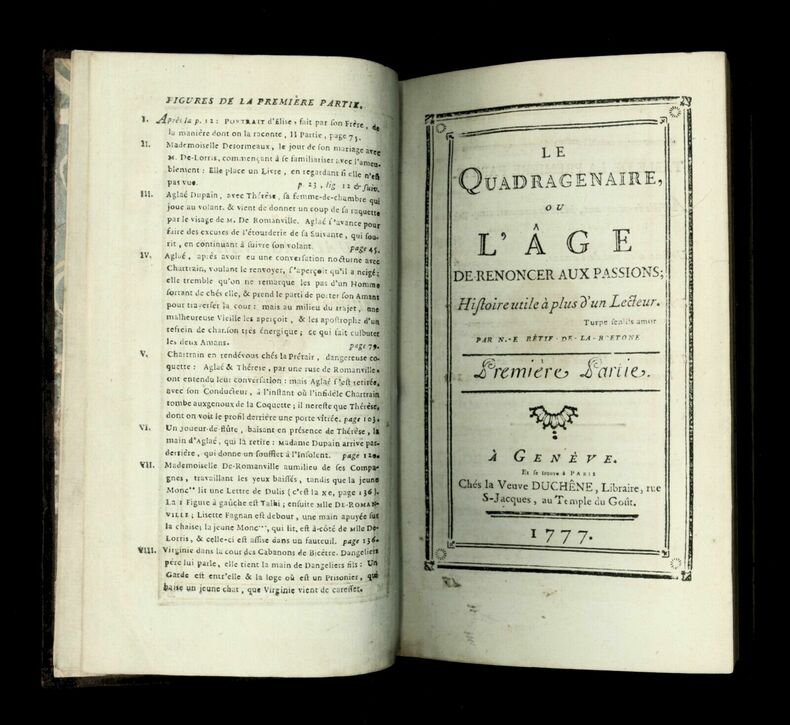
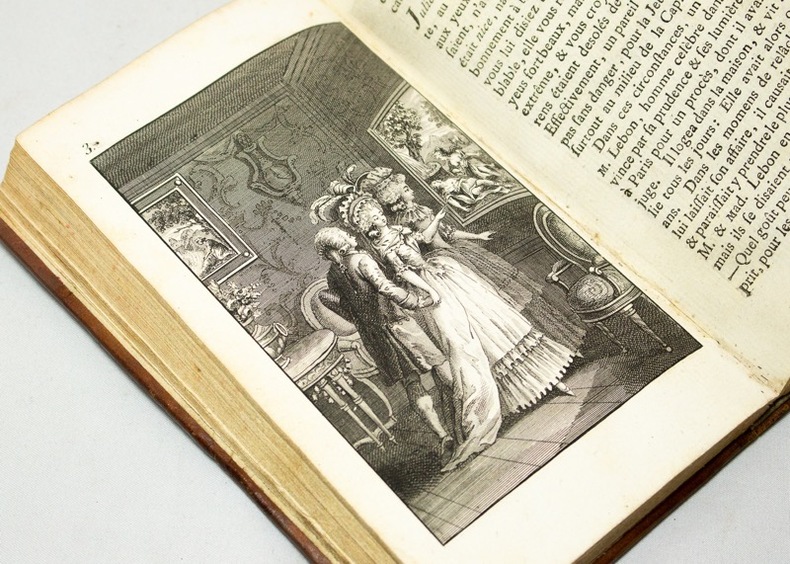
1777AMO-4489A Genève et se trouve à Paris, chés la Veuve Duchêne, 1777. 2 parties reliées en 1 volume in-12 (17,7 x 10,2 cm environ) de 244 et 244 pages (+ 6 feuillets non chiffrés). 15 figures hors-texte. Reliure de l'époque plein veau brun tacheté à l'acide, dos lisse à faux-nerfs filetés, pièces de titre en maroquin rouge, tranches rouge pâle, doublures et gardes de papier marbré. Exemplaire très frais conservé dans sa première reliure. Exemplaire bien complet des 6 feuillets de Revue des ouvrages de l'auteur qui manquent presque toujours à la fin du volume. Quelques restaurations professionnelles de qualité à la reliure (mors, coiffes et coins), petite épidermure au premier plat (coin inférieur). Les restaurations sont à peine visibles. L'ensemble est de très grande qualité. Edition originale et unique édition du premier ouvrage illustré de Rétif de la Bretonne.
1894124133Oxford: printed for the Association by the Printers to the University 6 issues with the imprint of Horace Hart; the last 5 with that of Frederick Hall 1894-1919. The state of women's education in Oxford at the height of the suffragette agitation An important set of reports published by the pioneering Association for Promoting the Higher Education of Women AEW containing a mass of information relating to the state of women's education in Oxford at the height of the suffragette agitation. The earliest report dates from 1894-95 and the latest from 1918-19 each running from October of one year to the same month of the next. The sequence is incomplete with two issues missing 1900-01 and 1910-11. The reports are scarce in any sequence. WorldCat and Library Hub record runs at the London School of Economics and the British Library. The society's papers and publications are held in the Bodleian deposited there in 1975. The question of women's suffrage and its relevance within the structures of the University of Oxford had been a topic of frequent discussion prior to the formal debate on the subject at the Oxford Union on 19 February 1880. Societies like the Oxford Women's Liberal Association OWLA and the Women's Emancipation Union plus the activism of Florence Davenport Hill who had been a founder member of the Bristol Women's Suffrage society in 1868 and had since moved to Headington paved the way for groups like the AEW and later the Oxford Women's Suffrage Society. The organization's work led to the founding of four women's colleges: Lady Margaret Hall and Somerville opened in 1879 followed by St Hugh's in 1886 and St Hilda's in 1893. St Anne's also originated as part of the AEW catering for female students who lived with private families in Oxford while attending courses run by the society. The AEW counted the activist Eleanor Smith 1823-1896 among its founding members and Annie Rogers 1856-1937 Oxford's first woman don as a secretary. Perhaps the most significant sections in these reports are those titled "General Statistics" which provide accounts of lectures attended by students tutorial arrangements results of examinations donations and subscriptions. The report of 1917-18 also provides a commentary on the "extension of the University Parliamentary Franchise to women who being British subjects and not subject to any legal incapacity have attained the age of thirty and have been admitted to and passed the final examination and kept under the conditions required of women by the University the period of residence necessary for a man to obtain a degree at Oxford. They are registered on specially favourable terms as the Act admitting them is so drafted that the fee of £1 for registration cannot be required of persons who are not graduates. The Register contains at present the names of 409 women." The AEW continued its activities until November 1920 when it dissolved itself as the university by admitting women to membership had taken responsibility for them. 23 issues octavo; comprising a total of 616 pages the issues c.20-30 pp. in length. Original printed paper wrappers sewn and wire-stitched as issued. Housed in a former library's dark purple cloth flat-back box with metal latch closure paper label to spine reading "Australian Council for Educational Research". Each issue complete with stamps shelf marks and labels of the Education Department Library latterly the Board of Education Library. Overall a scarce survival in very good condition. Shelfwear and creasing to wrappers those for the earliest issue detached; rear wrapper for the 1909-10 issue torn but no loss. hardcover
178618502A Neuchâtel, et se trouve à Paris, Chés Guillot, libraire de Monsieur, rue Saint-Jacques, vis-à-vis celle des Mathurins, 1786. 4 volumes in-12 de 272; 312; 312; 324-[16] pages, pleine basane blonde, dos lisses ornés de filets dorés, pièces de titre en veau rouge, tranches mouchetées de rouge.
1685LL 634<p><strong><em>Four Late-17th Century Pamphlets Printed by Mexican Woman Printer Jerónima Delgado</em></strong><strong>.</strong></p><p>Four pamphlets. Small quarto. Disbound.</p><p>Four scarce imprints from the press of Jerónima Delgado a 17th-century Mexican woman printer who inherited the business from her late husband Francisco Rodriguez Lupercio.</p><p>Medina who was never able to discover her real name records approximately eighty imprints bearing the name of "<em>La Viuda de Francisco Rodriguez Lupercio</em>" across her fourteen-year career which spanned from 1683 to 1696. Her shop sometimes identified in her imprint line was located at the Puente del Palacio where she produced titles concerning a variety of subject matter. The four items present here are well printed with numerous ornaments and vignettes as well as several larger woodcuts including a portrait and coats of arms. They are as follows:</p><p>1 <strong>Pimentel Juan.</strong> <em>Oracio Panegyrica o Cartilla Angelica en Glorias de el Maestro de los Angeles y Angel de los Doctores Santo Thomas de Aquino.</em> Mexico 1685. 40 pp. Three copies in OCLC at the JCB Berkeley and Indiana. Medina Mexico 1357.</p><p>2 <strong>Mendoza Ayala Juan de.</strong> <em>Impression Mysteriosa. De las Llagas de N. Redemptor en el Cuerpo del Seraphin Humano.</em> Mexico 1686. 44 pp. One copy in OCLC at the Biblioteca Nacional de Chile. Medica Mexico 1380.</p><p>3 <strong>Narvaez Don Ivan.</strong> <em>Sermon Que en la Celebridad de la Translacion del Cuerpo del Glorioso Apostol de la India S. Francisco Xavier.</em> Mexico 1694. 36 pp. with a woodcut portrait following title leaf. Three copies in U.S. institutions at the JCB Berkeley and Penn. Medina Mexico 1576.</p><p>4 <strong>Castorena y Ursua Juan Ignacio de.</strong><em> Abraham Academico en el Racional Iucio de los Doctores Es la Verdad de la Pureza la Doctrina de la Concepcion.</em> Mexico 1696. 36 pp. with large woodcut coat of arms following title leaf. Two copies in U.S. institutions at NYPL and Dayton. Medina Mexico 1632.</p> Por la Viuda de Francisco Rodriguez Lupercio
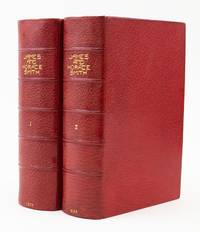
1899ST19035London: Hurst and Blackett Limited 1899. 190 x 125mm. 7 1/2 x 5". xii 128 pp.; 1 p.l. volume II title page handwritten in ink 129-312 pp. One volume expanded to two. <br/> Fine crimson crushed morocco by the Guild of Women Binders stamp-signed in gilt on front pastedown raised bands stylized gilt lettering on spines all edges gilt. With five portraits as called for and EXTRA-ILLUSTRATED WITH 264 PLATES 31 of these colored 12 folding about half of them scenes or views the rest portraits. Also containing the bookplate of David Garrick mounted on card at p. 10; an autograph letter signed from George Smart; an invoice or accounting signed by Eliza Matthews; and five other autographs mounted on heavy stock. Occasional trivial offsetting from inserted plates but A VERY FINE COPY clean and fresh internally in unworn bindings.<br/> <br/> Richly extra-illustrated with depictions of the people places and events discussed in the text this joint biography of brothers James and Horace Smith was simply and tastefully bound by members of the Guild of Women Binders. Although James 1775-1839 was a lawyer and Horace 1779-1849 a successful stockbroker both had literary aspirations and enjoyed being part of theatrical and artistic circles. Their dreams were realized when in 1812 the Drury Lane Theatre offered a £50 prize for an address to be recited on the theater's reopening following repair of fire damage. The Smiths hit on the idea of producing parodies of popular poets with James imitating Wordsworth Southey and Coleridge while Horace took on Byron Moore and Scott. Their humorous publication was an unexpected runaway hit going to seven editions in three months. According to Britannica "'Rejected Addresses' are the most widely popular parodies ever published in England and take classical rank in literature. . . . A striking feature is the absence of malice; none of the poets caricatured took offence while the imitation is so clever that both Byron and Scott are recorded to have said that they could hardly believe they had not written the addresses ascribed to them." In addition to being witty both men were kind and generous friends often helping impecunious artists. Percy Shelley and Horace became friends after competing in a sonnet-writing contest which Shelley won by producing "Ozymandias". Before leaving for Italy the poet entrusted his financial affairs to Horace of whom he said "Is it not odd that the only truly generous person I ever knew who had money enough to be generous with should be a stock-broker He writes poetry and pastoral dramas and yet knows how to make money and does make it and is still generous." The binding here was produced by the Guild of Women Binders established by bookseller Frank Karslake in 1898 to give an organizational identity to a group of women already at work binding books in various parts of Britain often in their own homes. Karslake first became interested in women binders when he visited the Victorian Era Exhibition at Earl's Court in 1897 held to celebrate the Queen's Diamond Jubilee. He was impressed with a number of bookbindings at the Jubilee exhibit prominent among them being those of Mrs. Annie MacDonald of Edinburgh and he invited the women to exhibit their work in his shop at 61 Charing Cross Road. The Guild was formed soon thereafter and operated until 1904. As Tidcombe notes "because the women were generally unaware of the long history of traditional bookbinding design they produced designs that were freer and less stereotyped than those of men in the trade." Our binding is more restrained that other Guild works but the spine lettering which juxtaposes curves and sharp angles stands out as a distinctive feature. Hurst and Blackett, Limited unknown
In 8°; cc. 39, (1). Bella bordura al frontespizio, con putti, maschere, uccelli; un capolettera inciso su legno e all’ultima pagina la bella marca tipografica incisa su legno, di Niccolò Garanta, con un delfino nel mare sotto il cielo stellato. Eleganta stampa in corsivo. Legatura ottocentesca in mezza pelle con titolo in oro al dorso. Bell’esemplare marginoso; qualche traccia d’umido che nulla toglie alla sua estetica. Il nome dell’autore è al principiio della lettera di dedica alla “sua signora”. Il traduttore dal castigliano al volgare italiano è come appare Lelio Aletiphilo che dedica l’opera a Scipione Atellano. Prima edizione italiana. La materia della novella di Juan de Flores, che nella versione originale spagnola aveva titolo La historia de Grisel y Mirabella, è una fortunata prosecuzione della Fiammetta di Boccaccio e più volte sarà ripresa nella novellistica amorosa del Rinascimento. Si tratta apparentemente dell’amore, in realtà si disquisisce sulla condizione femminile, e la trama si chiude con vendetta delle donne verso colui che le le calunniava. La traduzione dal castigliano è presumibilmente opera di Lelio Manfredi, se in lui si riconosce Lelio Aletiphilo, giurista e valente letterato ferrarese della prima metà del XVI secolo, traduttore per Isabella d’Este. “Secondo Libanori (p. 187), il M. fu dottore in legge; trascorse gran parte della sua vita a viaggiare per l'Europa, apprendendo molte lingue straniere, in particolare lo spagnolo. Mise a profitto le sue conoscenze per la corte di Mantova, traducendo dallo spagnolo romanzi cavallereschi, che destavano viva curiosità in Isabella d'Este. È probabile che al M. debba essere assegnata anche la traduzione di un altro romanzo spagnolo La historia de Grisel y Mirabella di Juan de Flores, un romanzetto in cui sono narrati i casi di due infelicissimi amanti, che fu tradotto in italiano come l'Historia di Aurelio et Isabella. Il nome del traduttore - d'invenzione o accademico - sotto cui andava l'opera era Lelio Aletiphilo, il quale celerebbe il M. secondo gli studiosi più antichi (primo fra tutti Rajna, p. 156 e nn.), mentre gli editori più recenti tendono a escluderlo” (DBI, ad vocem Manfredi). Sander 2789. Brunet II, 1303.
In-8°, (6), 350, (26), ill., legatura in pelle, con tasselli e titolo al dorso. Nacque a Roma da Lazzaro e da Diana Costa nel 1556. Di lui non possediamo notizie precise prima della sua frequentazione con Filippo Neri, iniziata, come egli stesso afferma, nel 1576; si unì poi agli oratoriani il 1° luglio 1577. A proposito della contiguità con Filippo Neri, nella Vita b. Philippi Neri (Romae 1600) il G. stesso si autodefinisce "Beati Patris nostri administer, assiduusque comes" (p. 145), e la descrizione del loro rapporto sembra abbastanza attendibile; è però soltanto negli ultimi anni di vita del santo che si può veramente parlare di un ruolo di assistenza e collaborazione quotidiana da parte del Gallonio. Precedentemente egli aveva avuto da Filippo il trattamento che questi riservava ai suoi discepoli di maggior talento. Il santo era infatti cosciente della vanità derivante dalla precocità intellettuale e cercava pertanto di procurare la mortificazione dello spirito assegnando umili incarichi a quel tipo di seguaci. Ordinava quindi al G. di chiedere l'elemosina vestito di stracci, di togliersi la tonaca per mettere in evidenza i buchi sulle maniche della tonacella davanti alle monache di Tor de' Specchi e - sono i casi più noti - gli chiedeva di cantare in piedi i versi di motivi popolari di Norcia al cospetto di visitatori illustri e alquanto divertiti. La mortificazione del G. mise davvero alla prova la sua obbedienza e la sua umiltà fino all'estremo, portandolo quasi ad abbandonare del tutto gli oratoriani. Significativamente, Filippo frenava l'inclinazione del Gallonio per la filosofia in favore dell'agiografia e della storia della Chiesa delle origini. Sebbene sia noto per la sua Vita b. Philippi Neri Florentini Congregationis oratorii fundatoris in annos digesta (Roma 1600; trad. italiana dello stesso G., ibid. 1601), quest'opera è per molti aspetti non rappresentativa del complesso della produzione del Gallonio. Peculiare dell'opera del G. era la ricerca sulla vita e le sofferenze dei protomartiri cristiani, in particolare delle sante vergini. Il suo primo libro fu l'Historia delle sante vergini romane con varie annotationi e con alcune vite brevi de' santi parenti loro e de' gloriosi martiri Papia e Mauro soldati romani. Motivata dalla traslazione delle reliquie di Papia e Mauro dalla chiesa di S. Adriano a S. Maria della Vallicella l'11 febbraio 1590 e scritta su espresso ordine di Filippo, l'opera forniva una serie di brevi vitae accompagnate da note storiche disposte secondo il giorno dell'anniversario a partire dal primo gennaio; pensato come supplemento al Martirologium di C. Baronio del 1583, il testo consentiva un ampio sguardo sui santi martiri. L'opera del Gallonio può essere vista come exemplum virtutis da fornire alle donne sia laiche che religiose. He was born in Rome to Lazarus and Diana Costa in 1556. We have no precise information about him before his acquaintance with Filippo Neri, which he began, as he himself claims, in 1576; he then joined the oratorians on 1 July 1577. Regarding the contiguity with Filippo Neri, in Vita b. Philippi Neri (Romae 1600) G. himself calls himself "Beati Patris nostra administer, assiduusque comes" (p. 145), and the description of their relationship seems quite reliable; however, it is only in the last years of the saint's life that one can truly speak of a role of daily assistance and collaboration by Gallonius. Previously he had had from Philip the treatment that he reserved for his most talented disciples. The saint was in fact aware of the vanity deriving from intellectual precocity and therefore sought to procure the mortification of the spirit by assigning humble assignments to that type of followers. He then ordered the G. to ask for alms dressed in rags, to remove his cassock to highlight the holes on the sleeves of the cassock in front of the nuns of Tor de 'Specchi and - they are the best known cases - asked him to sing on his feet the verses of popular motifs of Norcia in the presence of illustrious and somewhat amused visitors. The mortification of Gallonius really tested his obedience and his humility to the extreme, almost leading him to completely abandon the oratorians. Significantly, Filippo curbed Gallonius' inclination for philosophy in favor of hagiography and the history of the early Church. Although he is known for his Vita beati Philippi Neri Florentini Congregationis oratorii fundatoris in annos digesta (Rome 1600; Italian translation of the same G., ibid. 1601), this work is in many respects not representative of the whole Gallonius production. Peculiar to the work of Gallonius was the research on the life and sufferings of the Christian proto-martyrs, in particular of the virgins. His first book was the History of the Holy Roman Virgins with various annotations and with some short lives of their holy relatives and of the glorious martyrs Papia and Mauro Roman soldiers. Motivated by the translation of the relics of Papia and Mauro from the church of S. Adriano to S. Maria della Vallicella on 11 February 1590 and written on the express order of Filippo, the work provided a series of short vitae accompanied by historical notes arranged according to the anniversary day from 1st January; thought as a supplement to the Martirologium of C. Baronio of 1583, the text allowed a broad look at the holy martyrs. This book was intented as exemplum virtutis for nuns and for secular women.
555Paris : Nadar & Cie, 1864. UN RARE PORTRAIT PHOTOGRAPHIQUE SUR ÉMAIL INÉDIT DU GRAND NADAR