CATHERINE II DE RUSSIE (Alexiowna).Livre Rare Book

8 008 résultats
18594901London, Trübner & Co., 1859. In-8 de XVI-352 pp., veau glacé, dos lisse orné, pièce de titre en veau blond, fleuron doré sur les plats (reliure de l'époque).
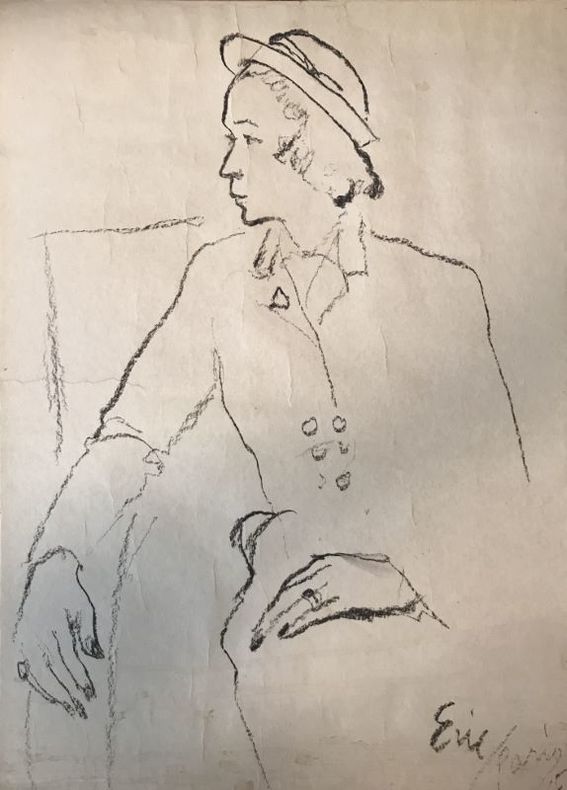
1948214661948 Dessin au fusain, signé en bas droite, 1948, 50 x 36.7 cm.
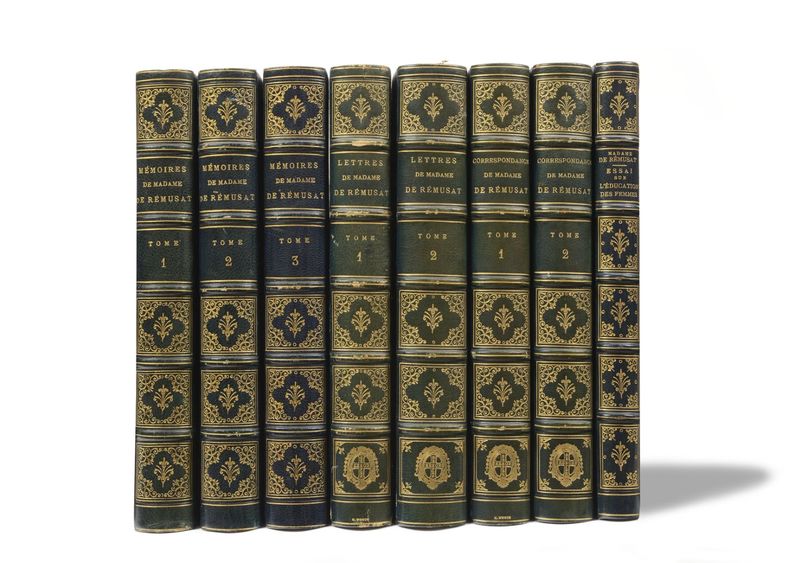
1824388 vol. in-8, demi-chagrin bleu, dos à nerfs ornés, parfois avec blason en queue.
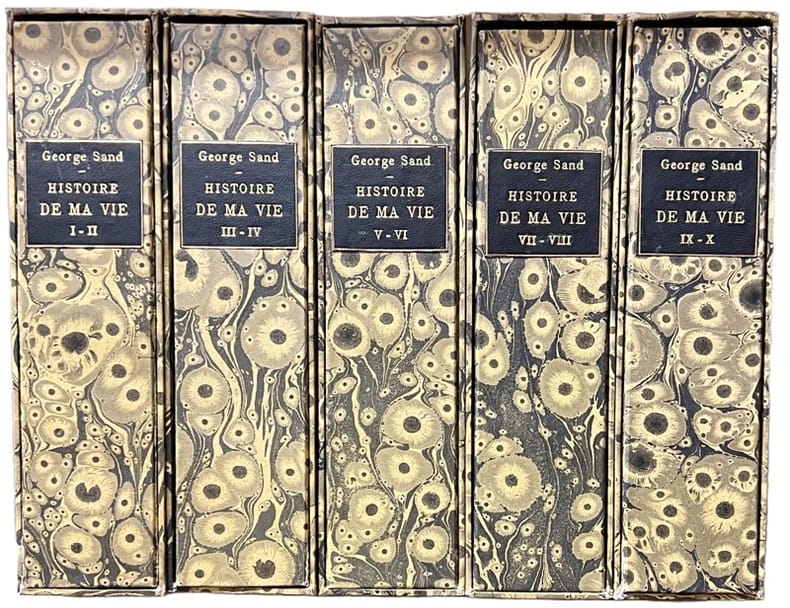
185644873Paris, Michel Lévy frères, 1856. 10 vol. in-12 brochés, couvertures vertes imprimées, étuis et chemises.
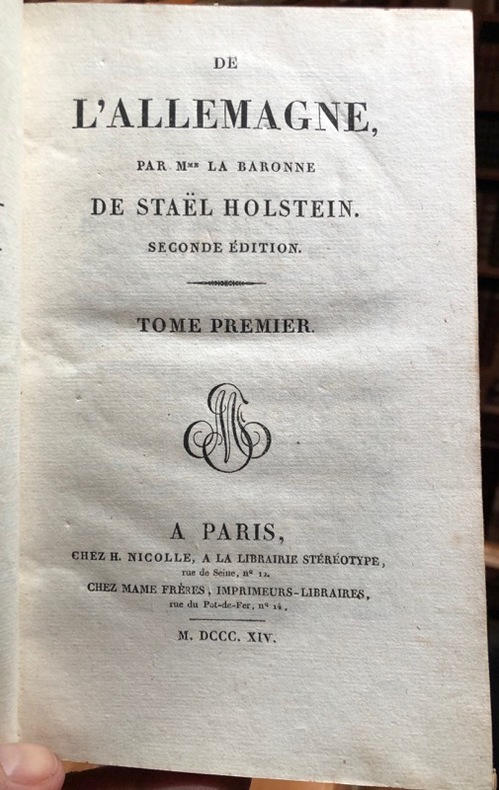
181414607A Paris, chez H. Nicolle, à la librairie Stéréotype, 1814. 3 vol. in-8 de (4)-XVI-348 pp. ; (4)-387 pp. ; (4)-415 pp., basane racinée vert, dos lisse orné, roulette dorée d'encadrement sur les plats (reliure de l'époque).
18933210176<b>FIRST EDITION.</b> <i>4to pp. viii 539 1 blank; light foxing to title and a few minor spots in places but otherwise clean throughout;</i><br /><br />in contemporary cloth spine lettered in gilt expertly recased spine and boards rather sunned back board creased along centre; with the contemporary ownership stamps of 'Hampden Borough Council' at head of title and front free endpaper; a very good copy of this important document.<br /><br />In spite of it's dour title and rather dry subject matter this is a significant work indeed a landmark publication in the history of 'votes for women': The Statutes of New Zealand fourth session of the eleventh parliament 1893 contains the first printed acknowledgement of a woman's right to vote.<br /><br />On 19 September 1893 the governor Lord Glasgow signed a new Electoral Act into law. This is found in the present work as Act 18 'An Act to amend and consolidate the Law relating to the qualification and registration of electors and the conduct of elections of members of the house of representatives' p. 35 in which it is noted that where the context of "person" is stated this 'includes woman' p. 37. As a result of this landmark legislation New Zealand became the first self-governing country in the world to grant all women the right to vote in parliamentary elections. <br /><br />'The suffrage campaign in New Zealand began as a far-flung branch of a broad late-19th-century movement for women's rights that spread through Britain and its colonies the United States and northern Europe. This movement was shaped by two main themes: equal political rights for women and a determination to use them for the moral reform of society through for example the prohibition of alcohol. <br /><br />New Zealand's pioneering suffragists were inspired both by the equal-rights arguments of philosopher John Stuart Mill and British feminists and by the missionary efforts of the American-based Women's Christian Temperance Union WCTU. A number of New Zealand's leading male politicians including John Hall Robert Stout Julius Vogel William Fox and John Balance supported women's suffrage. In 1878 1879 and 1887 bills or amendments extending the vote to women or at least female ratepayers only narrowly failed to pass in Parliament. <br /><br />Outside Parliament the movement gathered momentum from the mid-1880s especially following the establishment of a New Zealand WCTU in 1885. Skilfully led by Kate Sheppard WCTU campaigners organised a series of huge petitions to Parliament: in 1891 over 9000 signatures were gathered in 1892 almost 20000 and finally in 1893 nearly 32000 were obtained – representing almost a quarter of the adult European female population in New Zealand' see http://www.nzhistory.net.nz/politics/womens-suffrage/brief-history. <br /><br />In most other democracies - notably Britain and the United States - women did not win the right to the vote until after the First World War. Not listed separately on OCLC but found amongst various sets of the Statutes recorded. hardcover
1827AMO-2740London : Published by John and Arthur Arch, 1827 [Printed by the Philanthropic Society] 1 volume in-12 (19,7 x 11,7 cm) de (1)-66 pages. Cartonnage de l'époque plein papier gris. Étiquette de titre de l'époque imprimée (titre en long). Cartonnage miraculeusement conservé en parfait état. Intérieur très frais imprimé sur beau papier vélin de cuve. En grande partie non coupé. First edition. "It having been suggested, that a short account of the commencement, progress, and success of the measures adopted for the Reformation of Female Prisoners, would be useful, not only for the information of those who are disposed to aid and support, but also for the encouragement of those who are willing personally to labour in this deeply interesting and necessary work ; the Committee of the Ladies' British Society, established for the reformation of Female Prisoners, deem it incumbent upon them to make public the following statement : — In the year 1813, in consequence of the representations of several individuals of the Society of Friends, Mrs. Joseph Fry first visited the Prison of Newgate. In two wards and two cells, comprising about 190 superficial square yards, 300 females were at that time confined — those who had not been tried, and who are, therefore, by our laws presumed innocent, — those who had been convicted, whatever might have been the magnitude of their offence, (even though they had received sentence of death,) were associated together without distinction or classification ; and saw their friends, took charge of their children, cooked, washed, ate, drank, and slept within this limited space. It is not possible, neither would it be desirable, accurately to represent the consequences which ensued ; the atmosphere of the rooms, the ferocious manners and expressions of the women toward each other, and the abandoned conduct of all around, were wholly indescribable. The Governor himself felt it necessary to request Mrs. Fry to leave her watch before she entered amongst these wretched beings, observing, that even his presence would not prevent its being violently torn from her. [...]" (extract of the beginning of the text). Very rare. Perfect condition.
24044601Japan n.d. ca 1900-1920's. A green cloth photo album faded green leaves 23 x 39 cm. very good contains 100 cards in all: 71 hand-colored 15 color 14 b.w. cards mounted in slits provide. A very nice period collection. S C A R C E A stunning and beautiful collection of postcards mostly un- used lovely hand colored photographs from about 1900-1910 with four from the 1920's-30's. The album begins with a group of four Japanese women and a young girl under a wisteria garden another shows a woman dishing up a bowl of rice then a lovely young girl plyaing the Koto; other views show flower arrangement New Years Kimono winter scenes with women holding a large umbrellaand with a hood for head protection and another shows two girls reading a book; a girl sewing holding a baby riding a Jinrikshaw in the garden more of girls reading books doing household chores playing the Shamisen poses for New Years cleaning house making dinner and changing her Kimono with friends and hair dressing. This album shows the Japanese woman at her daily chores wearing her finest Kimono for New Years or other celebrations Zen arts of flower and tea cute poses dressed up to visit friends riding the ricksha playing music eating dancing and just about everything in her life as a daughter sister mother and wife. The black and white photos show similar poses 4-5 appear to be 1920's movie stars most in Kimono one in a Western style dress. These beautiful photo postcards show Japanese women at their best wearing stunning and elaborate Kimono with their tradition- al coiffeur holding an umbrella wearing Geta sandals. Some are studio posed others taken in a live setting. A good insight to period Japanese women and their costume and traditions. By and large a comprehensive look at Japanese womanhood a comprehensive and remarkable collection. Color scans can be sent by email. unknown
In -8°, pp. 128, cartonato. Prima e unica edizione di questo libro dedicato ai giochi, ma ricco di escursioni nel campo della matematica e delle scienze sociali: notevole per originalità l’ampio capitolo dedicato alle “minchiate”, ovvero i tarocchi toscani (arricchiti di una serie di carte rispetto ai tarocchi classici), in cui l’autore non si limita a descrivere il gioco e le sue regole, ma aggiunge delle lunghe e nutrite ‘note allegoriche’, in cui le carte e le varie situazioni di gioco vanno a comporre una parziale ma a volte non superficiale rappresentazione dell’universo. Matematico per formazione, scrittore prolifico, Francesco Saverio Brunetti da Corinaldo (n. 1693, non si conosce la data della morte) “visse quasi sempre in Roma, ove sotto i pontificati di Clemente XII, Benedetto XIV, e Clemente XIII, diede varj saggi della sua abilità” (Comolli, III, p. 43): al di là della sua attività di ricerca scientifica, è segnalata la capacità divulgatoria del B. che, come in questo caso, scrisse più di un trattato su istanza di (e dedicandolo a) una nobildonna “per facilitarne l’intelligenza” e renderlo “all’uso femminile, sull’esempio del Fontanelle, dell’Algarotti, e di tant’altri”. Nel presente trattato la parte matematica si limita in effetti ad alcuni esercizi di aritmetica, dando più spazio al discorso e, come nel caso degli scacchi, a una chiara esposizione delle regole (qui completata da un cospicuo repertorio di aperture). Comolli, Angelo, “Bibliografia storico-critica dell'architettura civile ed arti subalterne”, Roma, 1788-92 First and only edition of this book on games, with many excurtions in mathematics and social sciences: it’s remarkable the wide part dedicated to the “Minchiate”, i.e. tuscan tarots (with more cards than the classic ones): the author not only explains the game and its rules, but also adds some long ‘allegoric notes’, in which cards and game situations composes a short but not shallow representation of human types and events. Basically a scientist, Brunetti (born in 1693, death is unknown), was living in Rome, under protection of popes Clemens XII, Benedict XIV, Clemens XIII: his activity included disclosure works, as this one, in which mathematics are limited to basic arithmetics, giving more room to explanations and, as for chess, a plain exposition of rules (there’s also a nourrished openings list). See Comolli, III vol., p. 43
1988231631988 Pastel signé en bas à droite,1987, 43 x 32 cm., encadré.
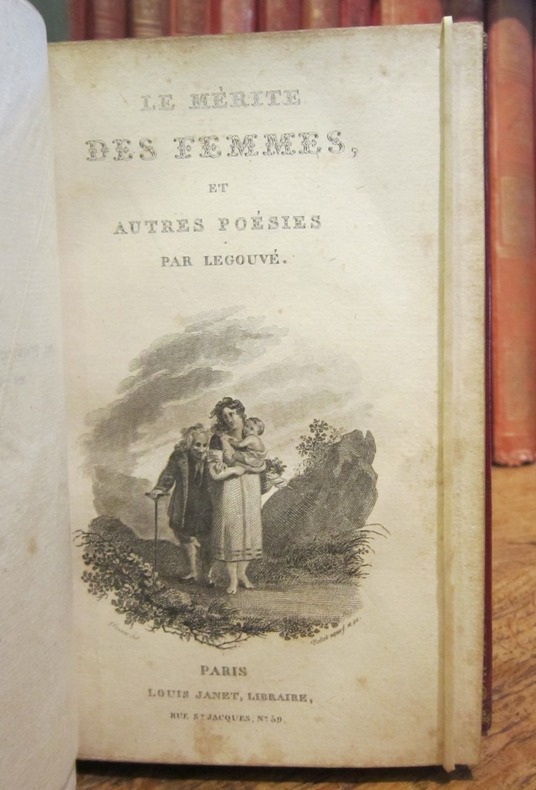
000199Paris Louis Janet, Imprimerie de Jules Didot aîné
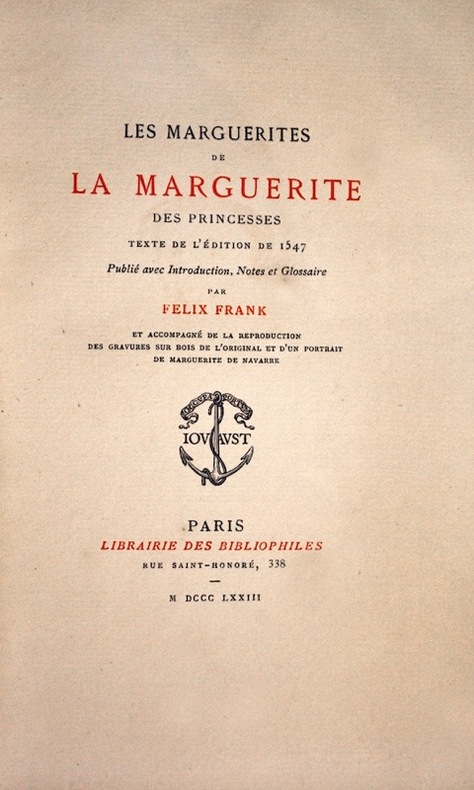
187322216Paris, Jouaust Librairie des Bibliophiles, 1873 ; quatre tomes petit in-4 ; demi-maroquin à coins vert empire, dos à cinq nerfs, caissons décorés et dorés d'un grand M couronné en alternance, entourés de petites étoiles, doubles palmettes dans les coins, dans un encadrement de doubles filets dorés, titre et tomaison dorés, filets dorés sur les plats (David) ; XCIX, (1), 160, (4) pp. ; (4), 257, (3) pp. ; (4), 250, (2) pp. ; (4), 313, (3) pp. ; portrait gravé en frontispice et 11 bois gravés.
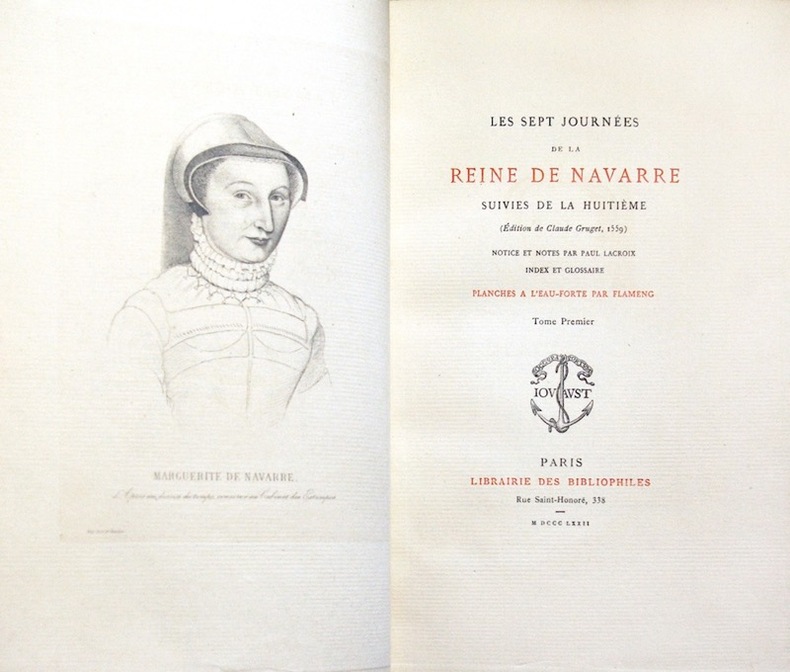
187222217Paris, Jouaust Librairie des Bibliophiles, 1872 ; quatre tomes petit in-4 ; demi-maroquin à coins bleu roi, dos à cinq nerfs, caissons décorés et dorés d'un grand M couronné ou d'une grande fleur de lys stylisée en alternance, entourés d'un semis de petites étoiles et points, palmettes dans les coins dans un encadrement de doubles filets, titre et tomaison dorés, lieu et date en queue, têtes dorées, filets dorés sur les plats (David) ; (4), LI, 160 pp. ; (4), 125, (3) blanches, 136 pp. ; (4), 84, 91 pp. ; (4), 79, (1), 56 pp. ; portrait en frontispice de Marguerite de Navarre et 8 eaux-fortes de Léopold Flameng, la dernière avec une serpente légendée. (sign. ( ) 2, a-f 4, g 2 ; 1-20 4).
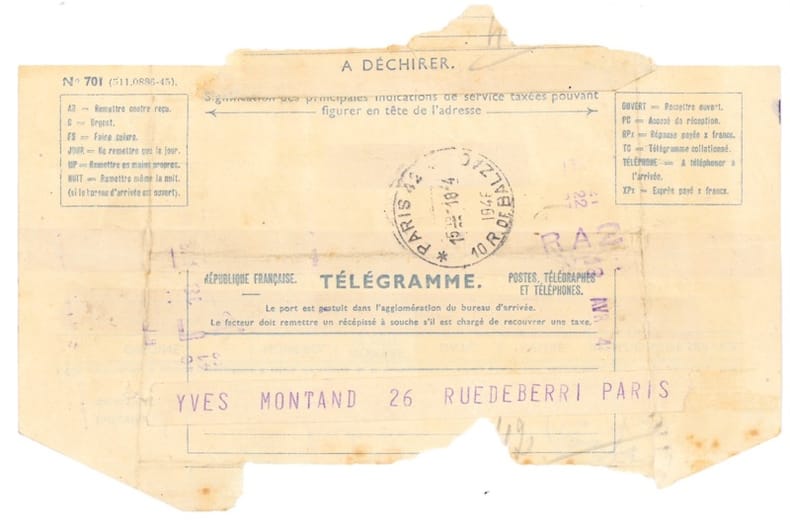
194629097Le dernier télégramme d'Édith Piaf à Yves Montand avant leur rupture Fribourg, 18 avril 1946. 1 télégramme (180 x 105 mm) avec cachet de la Poste. Le dernier télégramme de Piaf à Montand avant leur rupture définitive. Le message est adressé à « Yves Montand, 26 rue de Berri, Paris » depuis l’adresse du « 14 Fribourg en Breisgau 559 » : « ARRIVERAI EN VOITURE SAMEDI APRÈS-MIDI T’AIME = EDITH PIAF = »
1930252551930 Sculpture en bronze en bas relief, de forme ronde (Tondo) signée à la base, (1930), diamètre 25,5 cm.
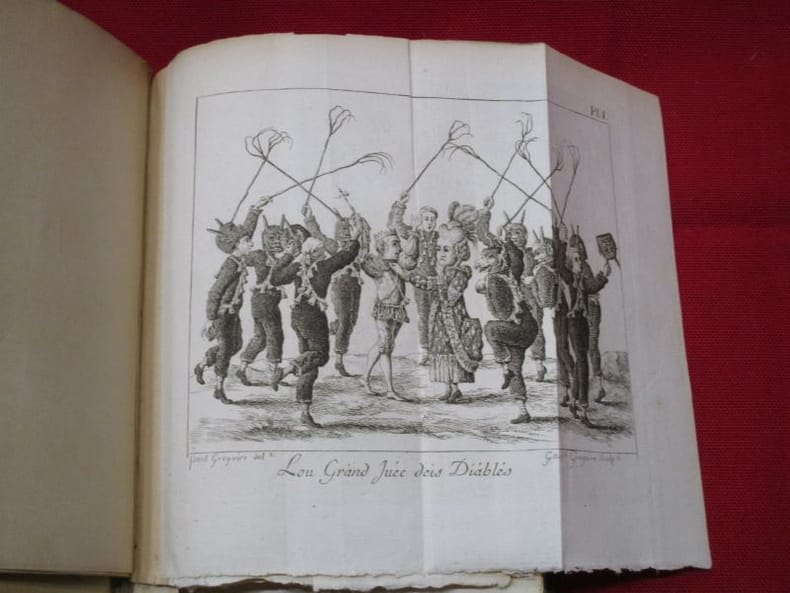
106376A Amterdam, et se trouve à Paris, chez la Veuve Duchesne, 1768 / A Padoue, 1752 / A Vienne, chez Jean-Thom. de Trattnern, Imprimeur & Libraire à la Cour, 1769, 3 textes reliés en 1 volume in-12 de 172x100x35 mm environ, 1f.blanc, 179-xij-153-xliv-224pages, 1f.blanc, plein marbré cognac, titres dorés sur dos lisse orné de caissons à fleurons et motifs dorés, coupes dorées, gardes marbrées, tranches rouges. Une coiffe ébréchée, épidermures et frottements sur le cuir, quelques rousseurs, petites restaurations sur les 2 derniers feuillets de l'ouvrage, sinon bon état. Mehmet Effendi fut ambassadeur ottoman à Paris entre 1720 et 1721. Grâce à son influence et à ses connaissances, la première imprimerie en caractères arabes en milieu musulman est ouverte par brahim Müteferrika en 1727.
Neatly signed, without inscription, by Carrie M. Best atop title page. vi, 258 pages. Colour photo portrait of Ms. Best. Many black and white reproductions of photos in text. News clipping of Ms. Best's obituary laid-in. "A woman of outstanding worth, a tenacious crusader for good and noble causes, a gracious lady who has devoted her life and her generous gifts to the betterment of the human condition. She has given hope and dignity to her own race and is an example and inspiration to all people in both word and work. Poet, journalist, informed commentator, incisive critic, Mrs. Carrie Best in the golden glow of a luminous life, continues to exert articulate leadership and thus engages our abiding admiration." - back cover. Unmarked with average wear. Binding intact. A sound copy of this important Canadian autobiography. Book
AQ30041s.i.: s.n. s.d. c.1830 Manuscript on paper. 101ff the remainder blank. Paper watermarked 1829. Contemporary red straight-grain morocco richly tooled in gilt and blind A.E.G. Rubbed spine sunned. Marbled endpapers contemporary inked gift inscription and later manuscript note on the provenance of the volume in the hand of a descendent of the original compiler to front blank fly-leaf. A late Georgian manuscript commonplace in a single legible hand comprised predominantly of texts concerning the female character marriage love and virtue. The volume contains a plethora of extracts from published authors both prose and verse including Romantic poets Byron and Wordsworth philosopher Edmund Burke Scottish presbyterian minister James Fordyce Washington Irving and Shakespeare. The manuscript opens with a seemingly original two-page composition concerning the temperament constitution and attributes of women: 'The all-powerful influence of woman - the irresistible control of her attractions - the exquisite and undefinable combination of mind and form - belong not exclusively to any rank or age or country; they are the natural characteristics of humanity all the world over:- hers is an universal empire'. The volume was presented to 'Chuff' from her affectionate 'Wills'; the mid-twentieth century note concerning provenance ascribes the compilation to 'Mr. Sims' though erroneously suggests that it was 'probably compiled.about the time of Waterloo'. . 8vo. [s.n.], [s.d., c.1830] unknown
114727Série de cinq volumes in-12 de 90 x 150 mm environ comportant 40 textes. Demi-chagrin bleu, dos à quatre nerfs portant titres et tomaisons dorés, gardes marbrées. Intérieur frais et ensemble en bon état malgré les défauts à signaler : un dos insolé, de discrets frottements sur les coins et les coiffes.
in-8. pp(1-3), 4-104. leg. piena pelle, tit. in oro. piccolissimi fori di tarlo che non toccano il testo.
1946172134René Kieffer Paris, René Kieffer, 1946. Imprimé par Steff, avril 1946. In-Folio en feuillets, sous étui éditeur. Non paginé. Faux-titre, titre et 9 pages de texte imprimées sur fond crème en regard de 9 planches en camaïeu, justification et achevé dimprimer. Couverture illustrée en noir et rouge représentant deux femmes nues enveloppées de flammes. Tirage à 350 exemplaires, celui-ci lun des 50 sur vélin de cuve avec une aquarelle (signée) et une suite en bistre (n° 39). Petits frottement à l'étui, sinon bel exemplaire bien complet. Peu courant
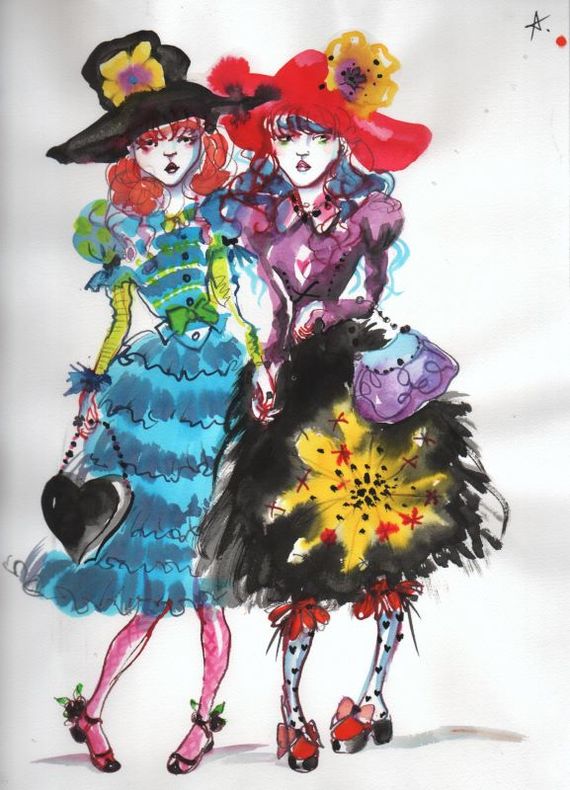
2013235852013 Aquarelle et encre sur papiers, signés en bas à droite du monogramme, 2020, deux planches au format 21 x 17.5 cm. (format à vue), 29.7 x 21 cm. (format de la feuille).
2013235102013 1 Aquarelle sur papier, signée en haut à droite, titrée et datée au verso, 2013, 28 x 21 cm., encadrée, sous Marie-Louise.
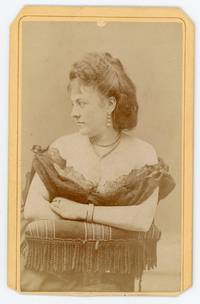
1867List309Virginia City: Sutterley and Co 1867. Albumen photograph on mount 4 x 2 ½ inches. Pauline Cushman was an actress and one of the most successful spies for the Union Army. She ingratiated herself with the Confederate army by toasting Jefferson Davis after one of her performances. She was eventually caught and sentenced to death by hanging. She was spared only due to the arrival of the Union Army. <br /> <br /> After the war she toured the country giving lectures and performances recounting her experiences as a spy. She eventually headed west marrying in 1872 in San Francisco and eventually working a range of jobs in Arizona Territory Texas and eventually back in San Francisco where she died in 1893 at age 60 from a morphine overdose. <br /> <br /> We find no record of this portrait which was taken by the Sutterley brothers James and Clement in their Virginia City Nevada studio somewhere between 1864 and 1867. The Sutterleys operated out of their studio on the Union block of Virginia City for five years before dissolving their partnership in 1867. It is likely that the portrait was taken during one of Cushman’s tours throughout the region during these years. <br /> <br /> A beautifully preserved example in very good condition with a small chip to upper margin and some fading. Though Cushman ostensibly would have sold cartes-de-visite in support of her touring few survive on the market today. Sutterley and Co unknown
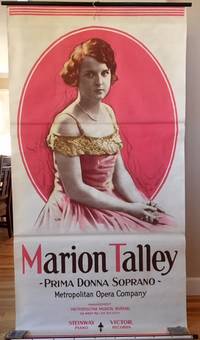
192451696New York NY; Hollywood CA; Taos NM: Underwood & Underwood Anderson Lumiere Guard Vitaphone Studios Metropolitan Music Bureau 1924-1927. Twenty seven items. With 24 photographs 3 sized 3.5 x 5.5 in.; 6 sized 5 x 7.75 in.; 1 w/ colour-tinted blue sized 7.25 x 9.5 in.; 16 sized 8 x 10 in.; many w/ annotations dating the photos in pencil some of the press photos and studio photos stamped on versos with attached newsreel information blurbs many w/ text in negative at lower corner of image; 1 very large colour lithograph poster printed on linen showing the young opera star seated and colours of pink gold and black sized 40 x 80 in. w/ wood bars at upper & lower for hanging some minor creasing from rolling but in Fine condition; and TLS from Lawrence H. Smith at Underwood & Underwood Inc. News Picture Division to Miss Marion Talley. These photographs and giant lobby poster provide splendid artifacts for the lavish attention paid to a young star at the beginning of her career during the Jazz Age. The very large poster is a beautiful example of colour lithography showing her demurely seated against a pink lozenge background with advertisements at the foot of the poster for Steinway Piano and Victor Records. Marion Talley 1906-1983 was the daughter of a telegraph operator for the Missouri Pacific Railroad and by 15 she was appearing in the Kansas City Grand Opera Company of Mignon by Abroise Thomas and quickly became a local celebrity often performing benefit concerts. She studied with music teacher Frank LaForge famed soprano composer who maintained a close relationship with the Metropolitan Opera and was placed under contract in 1925 by Giulio Gatti-Casazza at age 19 becoming the youngest principal female performer in the Met’s history to that point. Her debut performance was Feb. 17 1926 as Gilda the daughter of the title character in Verdi’s Rigoletto. The press photos show her surrounded by the many flowers she received in the 18 encores her performance on stage meeting the opera diva Ernestine Schumann-Heinck d. 1936 as well as her appearance on radio with Marguerite D’Alvarez and Giovanni Martinelli singing Home! Sweet Home!. In addition she also starred in the first Vitaphone short sound films released in 1926 with Don Juan starring John Barrymore and another Vitaphone short performing “Bella figlia dell’amore†from Rigoletto but the critics were savage criticizing her performances and her lack of appeal on camera. During this period she traveled extensively to Europe and through the southwest as evidenced by the series of photos showing her in Taos with the burros young Native American children and adults in regalia as well as her automobile. The photo of the young star by Samuel Lumiere 1878-1971 is a very nice example of his portrait work during the height of the 1920s when he was under contract to shoot celebrities for the Chicago Tribune. See: Barrios A Song in the Dark: The Birth of the Musical Film pp. 20-29; Vitaphone Marks 80th Anniversary Vitaphone News The Vitaphone Project Vol. 8 No. 1 2006; Crafton The Talkies: American Cinema’s Transition to Sound 1926-1931 1999. Underwood & Underwood, Anderson, Lumiere, Guard, Vitaphone Studios, Metropolitan Music Bureau, unknown