7 962 résultats
Abundant black and white illustrations and reproductions of photos. Features: My Fall into Germany From An Aeroplane - Part II - Lieut. Pat O'Brien was shot down and captured by the Germans but escaped and spent 72 days travelling 35 days to reach London; My Fight With An Ostrich - a schoolmaster's narrow escape; Hemmed in By Alligators - C.H. Robinson was trying to save his dog when his way was barred by alligators; Sport and War in Central Africa - two brothers go big game hunting in Africa but the end is sad - several photos of animals they killed; The Diamond Searchers - a disappointed diamond-hunter throws a bag of these valuable gems into the Thames!; In Unknown British Guiana - Part IV - A. Hyatt Verrill's explorations of these largely unknown lands and people, with photos; How I Lost My Draft - what happened when a young Lieutenant missed his train; What The Scout Overheard - a trooper in the East African Mounted Rifles sneaks into a German camp and overhears their ambush plans, thus allowing Brits to ambush the Germans, and he was awarded the D.C.M.; My Lion-Hunting Adventures - Alfred Jordan recounts his experiences; Behind the Scenes in Russia - Part IV - British War Correspondent Robert Wilton continues his account of the war on the Eastern Front and throws light on the stirring events (the Russian Revolution) which ended so tragically for the Russian Empire - presented here for the first time, with photos; Reviving An Aboriginal Festival on the Island of Mabuiag; The Land of Perfume - the countryside around Grasse, in the South of France, produces many plants used in the making of perfume - with interesting photos; Through the Caucasus on Horseback - Polish lady author M.A. Czaplicka describes her experiences in the Caucasus, the region and the strange mountain tribes, with photos; An Indian Venice - a picturesque description of the little-known 'backwaters' of Malabar; Photo of a woman in Sudan whose lips have been 'elongated into a hideous beak'; Photo-illustrated ad inside back cover for musclebound Lionel Strongfort asks "Are You Fit to become a Father?"; and more. pp. 6 [ads], [2], 92-176, 9-16 [ads]. Clean and unmarked with moderate wear. A quality vintage copy of this wonderful issue. Book
72 pages. Features: Lovely colour Coke ad inside front cover shows young lovely reclining on grass beside flower bed; One-page Singer sewing machine ad features Red Cross worker Mrs. John Collingwood Reade, and daughter Jo, of Toronto, and their identical dresses; News digest discusses events in Yugoslavia and Greece, the Battle of the Atlantic, Sinkings and Replacements, and the Axis Threat to Washington; Frigidaire fridge ad; Fellow-Canadians, It's Revolution! - war brings the greatest economic upheaval that Canada has ever known; Irish Gaps in Britain's Defence - photo-illustrated article discusses sea-bases that would help to defeat Hitler's air and u-boat piracy on Atlantic shipping, with photo of Eamon de Valera, Premier of Eire, leaving No. 10 Dowing St. after declaring his policy of 'neutrality'; Diver in Scarlet (short story); "Canada Doesn't Know There's a War On" - article with photos of bomb damage in Britain; Storm Warning (short story); The Gentle Art of Murder / Inside the Gestapo - fascinating photo-illustrated article which discusses the SD.RFSS Alarm Command and Heydrich, with photo of Rudolf Formis; A Night Call (short story); Why Not a Four-Minute Mile? - article with photos of Jack Lovelock, Glenn Cunningham, Paavo Nurmi and Peruki; Vacations in Old Quebec; Hollywood news and photos; Woodbury soap ad features photo of lovely Miss Melba Lee, daughter of Mrs. Wallace Orr of Montreal and Bermuda; Wonderful red and black Victory Bonds ad entitled "Some of the Things Your Dollars Will Buy" includes 16 photos of armaments and servicemen; Half-page Canadian Pacific photo ad for the Banff Springs Hotel; Half-page ad for the Eighth Census of Canada; Diving is Such Fun; Food, Victory, Peace; Health for Victory; Colour Ritz cracker ad; Fashion illustrations; Nice colour shredded wheat ad inside back cover; Back cover colour ad for Canada canned lobster requests help from the women of Canada to replace overseas markets lost due to the war; and more. Unmarked with moderate wear. Binding sound. A quality copy of this extraordinary wartime issue. Book
16737Album Women Education Very large book filled with handwritten memories 35 photos 18 large illustrations and mementos from a girl student in St. Louis Missouri as she graduates elementary school in 1925 proceeds through high school and begins studies at the University of Missouri. 77 handwritten inscriptions and autographs from friends classmates and teachers. Entries dated 1924-1929. "School Friendship Book." Designed and illustrated by Clara Powers Wilson. Chicago: The Reilly & Lee Co. copyright 1910. Original paper boards. 9 x 6 in. Embossed cover with image of a formal entranceway. 190 pages. Book includes space to enter information on their Class including motto colors and flowers Classmates Faculty Favorite Studies Societies "Stunts & Jokes" "Proms-Dances-Hops" Sports Holidays Reunions Kodak Snap-Shots and Commencement. Female student records her commencement from Cote Brilliante School her activities at Central High School and few mementos from the start of her college education. <br/><br/>77 handwritten notes and poems addressed to Ms. Domini. "I wish you health; I wish you wealth I wish a golden star; I wish you heaven after death; What could I wish you more" Many of the entries have a comical element. One signs off as Krazy Kat a popular very early comic strip cartoon. "Your head reminds me of a big block of wood." Others have advice on dealing with young suitors: "Do a girls dirty Do it with grace When a fellow trys sic to kiss you Slap him in the face. Your classmate Irish". "Dearest Marie If you ever get married And you hubby gets cross Pick up a rolling pin And tell him whose boss. Your friend Mounted Police." Additional 11 page book of Autographs dated 4/9/24 from when Domini was in 8th grade at Cote Brilliance. Includes 35 photos of fellow classmates; most have handwritten captions identifying the subject but one has the caption underneath: "Puzzle: Who are the girls" Final pages of the book include 18 large drawings and illustrations nine of which are hand colored full-length drawings of fashionable young women with short bobbed haircuts and wearing short knee-length dresses with captions such as "O-o-oo That 'innocent' look" and "Have you seen the Dancer of Paris" Some are signed as works by members of the Art Appreciation club while one drawing of a forlorn-looking young lady includes the caption: "Drawn by Helen Hudson in a study hall. This is all she had to do."<br/><br/>Includes an autograph letter on studying and living on campus at University of Missouri Columbia written to "Shorty" a school friend identified by photos in the album dated Jan. 31 1929. "Dearest Shorty-.We sure have missed you but I hope you have having as good a time as I am. I am about run down not bragging from business to do & scandal to tell you.Your name was called on the Varsity Hockey team and congrats to you.We are having a hike 5 mi. Sat. morning & I am one of the new hike leaders.Don't mind if I write in a hurry as I have another letter to write and gobs of studying. I didn't make my grades at all & am paralyzed so far as activities is concerned.Basketball tournament starts next week & must be at practice. I passed my Jr. English Exam & I am rid of that obstacel now. I may get thru this Univ. I don't know. I hope you get to go to school & even if you don't you can have heaps of fun. We will have a keen game Sat. rite here with Okla. & I wish u could see it.Of course I'm in a hurry as I didn't get home till 12:15 last nite & been so busy today. All of Read is getting along keen & so many changes of rooms. Write to me. Lovingly Sis."<br/><br/>Album includes many pages of memorabilia and ephemera related to athletics and school life including the Girls Athletic Association. "Every girl in the school is a member of the Girl' Athletic Association the primary purpose of which is to promote health. The organization stimulates interest in healthful outdoor and indoor activities which lasts not only as long as the girls are in school but in after life as well.each girl chooses at least one outdoor athletic activity each term.tennis hiking golf hockey and swimming. All the girls play baseball." Over 20 pasted clippings and loose cutouts of members of the basketball and football teams. Loose red felt banner "Cardinals Nat'l League Champs 1926". 7 tickets to football and baseball games and area Kennel Clubs. 33 additional press clippings and cutouts about general school topics in "Clippings and Press Notices" section. 25 clippings of jokes and funny stories pasted in Stunts & Jokes area in addition to handwritten entries. "Love me little Love me long Don't flirt be-Cause it's wrong."<br/><br/>First page shows photo of Cote Brilliante School and another building labeled Central High "My Alma Mater". Includes certificate of qualification for admittance to high school 6 high school report Cards and 1 Report Card from the1928-9 school year at College of Arts & Science at the University of Missouri Columbia. Handwritten notes detailing Commencement exercises from Cote Brilliante School on January 22 1925. 8 programs and invitations for other school events. 6 birthday Christmas and holiday cards. 3 programs for school productions. 1 blue and white ribbon. Ribbon and card for City Art Museum in St. Louis pasted in to book. 4 pasted cutouts of teachers. Owner's plate printed inside from cover. This book belongs to "Marie J. Domini 4569 Sh Ferdinand Ave. St. Louis Missouri // Graduated from Cote Brilliante School Jan. 22 1925." Cover is worn hinges loose. Very good condition. unknown books
16709Handwritten original novel. By M. L. titled"Rose A Tale in the Time of Queen Margaret." 1868. Handwritten in ink. Dedicated on first page "To my dear Father and Mother from their ever loving daughter Mary". 7 x 4.5 in. Original quarter black morocco boards. 158 Handwritten pages. Gilt detail to cover and "Rose" on spine. A remarkable original novel written by a young girl at a time when formal education was not common for girls. This story reveals an educated mind in both the realms of writing and is history as this novel is set in medieval England. "The sunny month of July had come and Edward had begun his troubled reign. A short period of quiet had begun in which the people were to enjoy a rest before fresh trouble and bloodshed should begin. The fields were filled with waving grain and the woods were fresh and green round the old castle of Dunkirk." Page 155. Light toning. Writing on some pages has faded but still legible. Very good condition.<br/><br/>The novel takes place in medieval England. "The setting sun was sending a flood of light over the hills and distant mountains and over the old castle of Dunkirk making the river Wharfe shine like gold when a little boat shot swiftly out of a turn in the river and came towards the castle. There were two men in it the older man was seated at the stern wrapt in a long dark cloak and having his hap pulled over his face so that only a pair of dark twinkling gray eyes showed below it" page 1.<br/><br/>One of the protagonists is a beautiful teenager about the same age as the author along with a cast of other characters including Lords and Dukes. "She was a most lovely girl. A quantity of dark brown hair that curled around a neck and face of most lovely form and complexion and a mouth of beautiful expression helped to form a face both sweet and lively But the most striking feature was a pair of almost black eyes fringed with long dark lashes. They were full of expression sometimes merry with laughter and again deep and thoughtful. Rose Murray was about seventeen years old at this time she was niece of the Lord of Dunkirk and having hardly any relations except him had always lived with him. Ever since she could remember those old towers had protected and sheltered her" page 8. "Rollin entered a large hall with a huge staircase on one side. Going up the stairs he passed into a passage and after numerous turning and ups and downs he opened a great door and passed into a good sized room. In the middle of this was a round table and on it were papers and books. At one end of the room was a recess with a window with a broad window slit. There was a little shelf on which were a few written books and writing materials.As Rollin entered a gentleman with a paper in his hands look up from his writing and smiling said 'Well Rollin have you had a pleasant time at London and what have you learned while you were gone of the queen's intentions and of what the Duke of York is going to do'" page 5-6.<br/><br/>The tale has adventure suspense and a happy ending. "The patched eye one seemed anxious to go on by his motions urging them to proceed. Rose watched him closely and at last saw him while his companion's backs were turned hold the lantern in such a way as to let his whole figure be distinctly seen and motion them to go back quickly it seemed so to Rose at least. She told this to her companion who was anxiously considering what should be done next" page 99. "And now for the next hour or two before the gray dawn came Lord John and Rose sat talking over all that had happened while they had been apart" page 149. unknown books
16720Women Education Commencement Memory Book from a female student at Brooklyn Heights Seminary class of 1907 filled with 17 photos 15 unique mementos and hand-written recordings of her commencement experience and school memories. "My Commencement." New York: Dodd Mead and Company 1904. Entries from 1906-1910. Original blue cloth boards. 8 x 5 in. Gilt detail to spine and front cover. 239 pages. "This book will be found to be a convenient form in which to keep a record of one's commencement and all the interesting facts connected with it including accounts of the exercises brief sketches of the teachers the classmates newspaper clippings etc. The keeping of such a record will afford a great deal of entertainment not only at the time when it is all fresh in the mind but in future years when it will serve to recall many pleasant memories which otherwise would be forgotten." Memory albums were quite popular in America at this time especially among young women at female academies who would fill out books to remember time spent together.<br/><br/>Records Antoinette Butler's social life and academic record including her studies in French German Latin Physics Chemistry Geometry History and Literature. Hand-drawn diagram of the commencement stage page 30 records of all her friend's commencement gowns "white handkerchief linen embroidered in Japan with the wisteria pattern" and "white ruffled mull dress trimmed with val lace. Made Empire with straps over the shoulders." 6 photos of classmates with entries in their own hands pasted into book. Also includes 11 photos of teachers and staff including two African-Americans identified as the Janitor and Janitress. Includes areas to enter information on the book's Owner their School the Commencement Exercises the Class Classmates and Reunions. Includes a short handwritten history of the school Brooklyn Heights Seminary. "Miss Brigham who was associated with him was a wonderful woman in every way. Every girl who was under her influence feels the uplifting force to this day and has imparted one small part of it to her children. After Miss Brigham's death in a railroad accident a Memorial hall was erected to her memory in connection with the Young Women's Christian Association.The curriculum which includes Kindergarten and one year of college work embraces almost every department of education." A note from her grandfather pasted in congratulating her on her graduation: "My darling granddaughter Antoinette - On this happy occasion that marks one of the transitional specks of your life I gladly transfer to your keeping one fo the the most precious souvenirs of the sainted grandmother whom you have only known through the loving memories of your own dear father and of the two aunties - one translated to the heavenly life - who with myself have watched with intense interest your development in to a lovely and helpful womanhood. God bless you my child! Grandfather."<br/><br/>Includes entries from several reunion gatherings around New York at venues such as the Women's University Club on Madison Square; and gatherings as they transitioned to adult lives: "This was a purpose for giving a silk stocking 'shower' for Marjorie Speers who had just announced her engagement to Gilbert Browning. She is the first one of our class to be engaged." Also pasted into book: 3 images of the school; report card; commencement invitation; commencement program; a color printed card "With Love and Devotion"; 8 newspaper clippings regarding the graduating class; the yellow silk ribbon which tied her diploma; the tulle bow which tied her commencement flowers; lovely hand-colored Class Day Program; 1 letter addressed to "My beautiful lady No longer the school girl!" handwritten speech that Butler gave during the Class Day Program. Inscribed to owner on front end page: "To miss Antoinette Reeve Butler Dec. 25 1906. Merry Christmas from Uncle Will & Aunt Hallie". Pages 139-196 197-207 adhered together due to water damage. Very good condition. unknown books
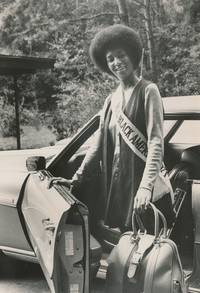
1971List3111Tallahassee Florida 1971. Single photograph measuring 6 ¼ x 9 inches. Manuscript caption verso reading “Joyce Warner Tallahassee / Miss Black America†with newspaper article affixed and stamped “SEP231971â€. Near Fine. A press photo of Joyce Warner who was crowned Miss Black America in 1971. The Miss Black America competition was founded in 1968 by entrepreneur J. Morris Anderson as a protest of Miss America’s whites-only policy; the first Miss Black America competition was held in Atlantic City New Jersey on the same day and location as that year’s Miss America.<br /> <br /> As described in the newspaper article affixed to the back of the photo Joyce Warner refused to attend subsequent Miss Black America competitions alleging that the organizers had misled her about the prizes she claimed to have never received a promised $600 scholarship $5000 cash and trips to Haiti and the Catskills and used her photograph for cosmetics advertising without her permission.<br /> <br /> The Miss Black America pageant is still active; Miss America hosted its first Black contestant Sheryl Browne in 1971. unknown
193763859London & Glasgow UK: Blackie & Son Ltd. 1937. 8vo. x 246 pp. Colour frontisp. 3 colour plates 16 photo plates 1 large folding map. Blue publisher’s cloth silver gray lettering front cover & spine double-page map edpapers w/ d.j. wraparound cover art by author 5’ price label on spine couple minor closed tears slight creasing shelfwear price cropped from front flap still NF/VG copy. First edition of this remarkable travel and scientific memoir of the noted Scottish polar explorer and botanist collecting specimens for the Royal Horticultural Society & Kew Gardens through the Aleutian Islands with stops at Kiska and Attu Kodiak Island the Pribilof Islands observations of the seals and more. These scientific voyages also included stops in Japanese-controlled Korea and China as well as stop in Russia and Japan itself. Hutchison 1889-1982 was a noted artist naturalist studied horticulture and later explored Iceland Greenland along with expeditions to Alaska and Arctic Canada collecting specimens and seeds. She was awarded the 1934 Mungo Park Medal of the Royal Scottish Geographical Society for her Arctic ventures documented in “North to the Rime-ringed Sun.†Scarce in original dustjacket. Blackie & Son, Ltd., hardcover
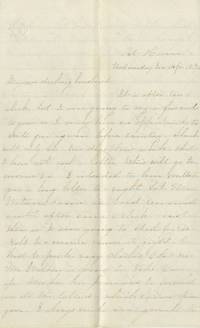
1865Cat322Sycamore DeKalb County Illinois 1865. Two autograph letters signed “Rosa†docketed on rear likely in Everell Dutton’s hand 4 and 5 pages 8 x 5 inches. Folded at center else fine. Two letters written in the final weeks of the Civil War by Rosina Adelpha Paine Dutton of Sycamore Illinois to her husband Everell Fletcher Dutton then lieutenant colonel of the 105th Illinois Infantry engaged in the closing campaigns of the war. The couple had met through their mutual friend Helen Barns Woodmanse and began an unusually close correspondence at the outset of the war at times exchanging two or three letters a day through 1863. They married in Sycamore on December 31 1863 and spent several months together in Nashville while Dutton was detailed to the Examination Board residing at Mrs. Jernigan’s boarding house before Rosina returned to Illinois and Dutton rejoined his regiment in the field. Rosa wrote a considerable amount of letters to her husband during the war some of which were collected by the Sycamore History Museum for the exhibition General Dutton’s America. <br /> <br /> The two letters here written a week apart show Rosina’s fears and the general mood in the days prior to Lincoln’s assassination with a focus on a mysterious favor done for an unsavory character. The April 2 letter reflects Rosina’s anxiety as she awaits news from the regiment:<br /> <br /> “Five hours later. I got to feeling so badly I could not write. I will now resume my chat. I know dear one you are tired of receiving dark gloomy letters from me but you must not hope for better while you remain in the army. Love you know is always strongly anxious when the loved one is absent. I would give everything we possess in the world if it would but bring you safely home. I am in hopes we will hear something definite from the Regt. tomorrow. I am so anxious and yet I tremble to hear from the Regt… O my Husband if you should be taken from me.†<br /> <br /> She searches the newspapers repeatedly—“no list of casualties in the Tribune … sent Ida after the Times … sent Winnie & Mary … for the Evening Journalâ€â€”but finds “no relief of mind.†The strain is constant: “whenever I spoke … the tears would come†and even at church “I could not keep the tears from my eyes.†She notes that the 105th “could not have been through so severe a contest without losing very many men.â€<br /> <br /> The April 12 letter is dominated by Rosina’s pointed suspicion toward a man she calls “Gerret†who appears to have entrusted Dutton with a valuable object: <br /> <br /> “Gerret said you had in your valise for him said it was worth $500.00. If I were in your place I would get rid of it if I had to burn it. I wouldn’t carry anything five miles for that miserable scamp. No one scarcely believes his story about being captured &c. They think he made his way home as best he could & I would not be at all surprised if that were the case. He has told half a doz different stories already about his capture. He ought to have learned his story before he came home and then told it. Such conflicting ones create suspicion. Father said if he were in your place he would turn it over to Government & then bid it in.â€<br /> <br /> No individual of this name appears in the rosters or known correspondence of the 105th Illinois and the tone of the letter suggests he was not a member of Dutton’s regiment. <br /> <br /> She closes: “My darling husband do come and thereby make me the happiest woman in the world . try dear one. I don’t believe but that they will accept resignation now before long. May the good Father of us all take care of you is my constant prayer. Devotedly yours for all eternity. Rose.†<br /> <br /> Overall an interesting pair of letters from a well documented and significant correspondence. unknown
187058998London: T. Nelson and Sons Pternoster Row 1870. 12mo. viii 9-160 pp. Woodcut-engraved vignette on title woodcut engraved frontisp. woodcut engraved illustrations throughout some as borders plates text illustrations. Publisher’s decorated red cloth over beveled boards gilt & black ornamental borders & lettering blue-tinted plate mounted front cover brown clay-sized endpapers a.e.g. very minor edgewear to lower corners slight bumping to rear corner still VG bright copy w/ former ownership markings on 2nd flyleaf. First edition of this second title in the “Walter†series by the author of the “Walter at the Sea-side†a popular work on marine zoology for young people. This volume explores the arboreal residents of Southern England’s New Forest first proclaimed a Royal Forest in 1079 at the time 150 acres of protected hunting lands. Inter-weaved are poetry and anecdotes of oaks chestnuts elms birches conifers cypress â€Graveyard Trees†and even describes the California Sequoia and its attributes. Mary Greg 1809-1895 worked with her husband in establishing “The Mount†where she assisted her husband Samuel Greg II 1804-1876 British industrialist and Unitarian philanthropist and lecturer on scientfic subjects to the workers of Macclesfield. She was a close friend of the poet and author Elizabeth Gaskell who often stayed with the family and was a frequent correspondent while Mary Greg wrote on natural history and religious topics. See: Marie Moss Travelling the Literary Trail The Gaskell Society Newsletter Aug. 2000 pp. 8-10. T. Nelson and Sons, Pternoster Row, hardcover
188239763Middletown 1882. Elephant folio broadside 15-7/8" x 22." Beneath the quoted title eight columns of printed women's names each column containing about one hundred names. Old folds shallow blank margin tear. Very Good.<br /> <br /> Beneath the lists of names is the announcement: "A COUNTY TEMPERANCE CONVENTION! Will be held in the large Dining Hall at FENWICK This Week SATURDAY Sept. 30 1882." Transportation instructions are printed.<br /> Not located on OCLC as of December 2023 or online sites of AAS Yale unknown
1844339536Providence Rhode Island: House of Representatives 1844. First edition. Single sheet folded to make 4 octavo pages paginated 1073 -1075. 8vo. Moderate wear and creasing to text two-inch narrow chip on spine not affecting text text is foxed and soiled else a good copy. First edition. Single sheet folded to make 4 octavo pages paginated 1073 -1075. 8vo. A scarce publication OCLC lists no holdings.<br /> <br /> Prints "Addenda No. 242: Arrests of Women- Statement by Mrs. Abbey H. Lord" about her arrest for violation of the militia law signed in type "Abbey H. Lord/ Hon. E. Burke Member of Congress." Mrs. Abby H. Lord states in part: "I send you a correct statement of the arrests of the women and leave you to do as you see fit with it. I told him that I had no one to train in his company; that we were all Dorrites.". Also prints "Addenda No. 243: Copy of an indictment against Mrs. Abbey H. Lord" signed in type by "Joseph M. Blake. Attorney General and Walter Paine Jr. Clerk." The Dorr Rebellion named for its leader Thomas W. Dorr took place in 1842. It was directed against the government of Rhode Island for its unconstitutional activities including its failure to extend voting rights enact a bill of rights or reapportion the legislature. [House of Representatives] unknown
183115782Torino: Presso la Vedova Griringbello & Comp. 1831 Publisher's pink printed wrappers a little soiled. . Small octavo. Minor chipping at spine extremities and minor foxing. A very good appealing copy entirely uncut. The text includes twenty-one letters on various subjects including confidence prudence jealousy self-love religion conviction friendship the dance conversation domestic economyetc. The final portion of the text is a guide to studies including fine arts science geography theatre poetry and novels. The author notes recommends Corneille Racine Ossian Milton Voltaire Goldoni and many others and notes that the English have produced the best novelists citing the names of Richardson Defoe Smollett Fielding Goldsmith Sir Walter Scott Ann Radcliffe and many others. He goes on to recommend three novels especially--Robinson Crusoe Tom Jones and The Vicar of Wakefield. Presso la Vedova Griringbello & Comp.,
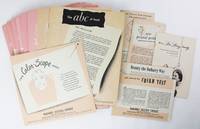
19486373New York 1948. Very good. Thirty-six parts plus twelve extra brochures. With original envelopes. Light wear. The complete six week mail order course for debutante success. First published in 1940 and re-copyrighted every subsequent year the DuBarry Success Course was originated by the Richard Hudnut Salon in New York City. It was originally designed to assist debutantes with their coming out -- and as a means to sell DuBarry cosmetics. The course focused heavily on low-calorie dieting purgatives light calisthenics and correct hair and makeup application. In addition to the six week course included here is a quick index to the course materials a "charm test" and a color-scope chart together with tissue papers to help you determine your best colors and what makeup to wear with what dress. A complete look at how to be a "correct" 1940s woman. unknown
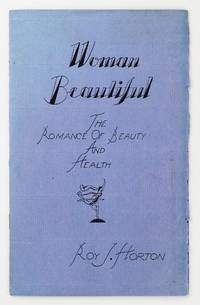
19276340Detroit 1927. Very good plus. 16pp. plus two return mail forms laid in. Original blue printed wrappers stapled. Minor wear and soiling. Lengthy brochure advertising a course for women's beauty and improvement offered by Roy J. Horton of Detroit. Horton claims his course of six months can transform a woman into a vital and beautiful -- and correctly proportioned -- Venus of virtue. Through exercise and proper diet a woman can attain "par" or 100% of her correct figure and vitality. Included here are a "Confidential Beauty and Health Questionnaire" and a letter laid in summarizing the six week course and its benefits. All achievable for just $35. Not in OCLC. unknown
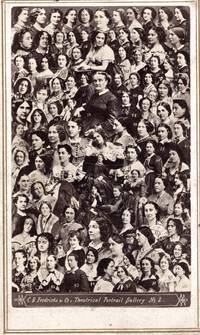
188012946New York: C.D. Fredricks & Co. Theatrical Portrait Gallery No. 2 1880. Cartes-de-visite photograph 3.5 x 2.25 inches on a slightly larger studio mount. Minor wear and dust-soiling. Very good. A charming photocollage incorporating tiny headshots of a hundred women of the American theater in the late-19th century into one CDV. Each portrait is numbered corresponding to a printed list of the names of each of the 100 women on the verso of the photograph. Taking her rightful place near the center of the photograph and pictured larger than everyone else is Charlotte Cushman 1816-1876 an international force on the stage and considered the finest American actress of her age. The image was produced by the New York photographic firm belonging to Charles DeForrest Fredricks a legendary world-hopping photographer with a fascinating story all his own to be told on another day. The photocollage was likely compiled from the legion of portraits Fredricks' studio produced for Broadway actresses over the course of more than twenty years after establishing his New York studio in 1855. C.D. Fredricks & Co. Theatrical Portrait Gallery No. 2 unknown
1983WALTER-FILM004116Vintage original 30 x 20" 76 x 51 cm. double crown poster UK. Honey Adele Bertei dir: Lizzie Borden; Cinema of Women. London: Cinema of Women 1983. Folded as issued with small tears marginal chips and signs of light handling VERY GOOD-. <br /><br /> An exceedingly scarce poster from a landmark film in 1980s LGBTQ and African American film history. ""A documentary-style feminist fiction film by Lizzie Borden that explores racism classism sexism and heterosexism in an alternative United States socialist democracy.<br /><br />"<i>The plot concerns two feminist groups in New York City each voicing their concerns to the public by pirate radio. One group led by an outspoken white lesbian Isabel Adele Bertei operates 'Radio Ragazza'. The other group led by a soft-spoken African-American Honey Honey operates 'Phoenix Radio. 'The local community is stimulated into action after a world-traveling political activist Adelaide Norris Jean Satterfield is arrested upon arriving at a New York City airport and suspiciously dies while in police custody. Also there is a Women's Army led by Hilary Hurst Hilary Hurst and advised by Zella Flo Kennedy that initially both Honey and Isabel refuse to join. This group along with Norris and the radio stations are under investigation by a callous FBI agent Ron Vawter. Their progress is tracked by three editors Becky Johnston Pat Murphy Kathryn Bigelow for a socialist newspaper who go so far they get fired</i>.<br /><br />"<i>The story involves several different women coming from different perspectives and attempts to show several examples of how sexism plays out on the street and how it can be dealt with through direct action. At one point two men attack a woman on the street and dozens of women on bicycles with whistles come to chase the men away and comfort the woman. The movie shows women despite their various differences organizing in meetings doing radio shows creating art wheatpasting putting a condom on a penis wrapping raw chicken at a processing plant etc. The film portrays a world rife with violence against women high female unemployment and government oppression. The women in the film start to come together to make a bigger impact by means that some would call terrorism</i>.<br /><br />"<i>Ultimately after both radio stations are suspiciously burned down Honey and Isabel team up and broadcast 'Phoenix Ragazza Radio' from stolen U-Haul vans. They also join the Women's Army which sends a group of terrorists to interrupt a broadcast of the President of the United States proposing that women be paid to do housework followed by bombing the antenna on top of the World Trade Center to prevent additionally destructive messages from the mainstream</i>.<br /><br />"<i>Greg Baise of the </i>Metro Times<i> called it 'an early '80s landmark of indie and queer cinema.' The film has had experienced somewhat of a renaissance after the 35mm restoration print premiered in 2016 at the Anthology Film Archives. Richard Brody of </i>The New Yorker<i> wrote 'the free ardent spontaneous creativity of Born in Flames emerges as an indispensable mode of radical change -- one that many contemporary filmmakers with political intentions have yet to assimilate.' He also wrote 'Borden's exhilarating collage-like story stages news reports documentary sequences and surveillance footage alongside tough action scenes and musical numbers; her violent vision is both ideologically complex and chilling.' Melissa Anderson of </i>The Village Voice<i> wrote 'this unruly unclassifiable film -- perhaps the sole entry in the hybrid genre of radical-lesbian-feminist sci-fi vérité -- premiered two years into the Reagan regime but its fury proves as bracing today as it was back when this country began its inexorable shift to the right</i>.'" Wikipedia books
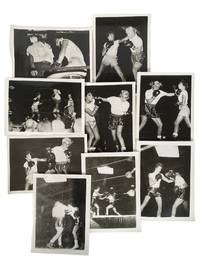
1940206121940. Unidentified photographers female boxing photograph archive late 1940s-1950s documents the emergence of organized women's boxing in the United States supporting research into gender barriers in professional sport postwar athletic culture and the early institutional recognition of female fighters. The photographs capture three central figures in mid-century women's boxing-Barbara Buttrick Phyllis Kugler and Jo-Ann Hagen-whose careers intersected in exhibition bouts and championship contests during a period when women's participation in boxing required legal and promotional negotiation. The material provides visual evidence of competitive matches and ringside moments at a time when women's boxing was only beginning to secure formal licensing in certain jurisdictions.<br /> Nine black-and-white silver gelatin photographs each approximately 5 x 7 inches depicting in-ring action and between-round scenes. Three images show a bout between Hagen and Kugler with both fighters captured mid-exchange in close quarters gloves raised and bodies angled forward in offensive and defensive stances. Five photographs document a match between Kugler and Buttrick likely connected to their 1957 championship contest in San Antonio Texas where the fighters successfully petitioned for a state boxing license for women; scenes include active exchanges as well as ring positioning under overhead lighting. One image shows Buttrick seated in her corner resting between rounds attended by seconds just outside the frame. Across the group the fighters wear standard boxing attire of the period and the ring environment-ropes canvas and audience proximity-appears consistent with mid-century professional venues.<br /> Produced during a period when women's boxing was contested both culturally and legally the archive documents early efforts to legitimize female participation in a sport historically restricted to men. Buttrick's victory in Texas marked a milestone in the recognition of women's championship boxing while Kugler's extensive bout record and Hagen's career-long rivalry with both fighters illustrate the development of a competitive circuit. All three figures were later inducted into the International Women's Boxing Hall of Fame underscoring their role in establishing the sport's foundations. Light surface wear consistent with handling with strong contrast and clear detail throughout. Overall in very good condition. unknown
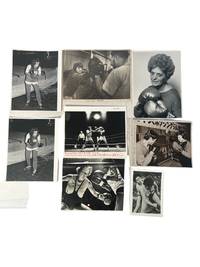
1970201881970. Women's boxing photograph archive 1974 to 1983 documents women as fighters trainers judges and sanctioned competitors during a period when boxing remained one of the most heavily gendered professional sports. The archive provides primary visual evidence of women's participation in combative athletics before women's boxing received Olympic recognition as a medal sport in 2012 and it records several forms of ring authority: women entering the ring as athletes women training male and female boxers and Eva Shain appearing as a pioneering judge. Shain became the first woman to judge a world heavyweight championship bout when she scored the 1977 Muhammad Ali and Earnie Shavers fight at Madison Square Garden placing one image in this group within the broader history of women claiming official authority in professional boxing.<br /> <br /> The archive consists of eight black-and-white silver gelatin photographs of women boxers and women in combat-sport settings circa 1970s to 1980s measuring from approximately 5 x 7 inches to 8 x 10 inches. One press photograph shows a co-ed boxing match between Sheila McGuire and Buddy DiBenedetto in a ring with a referee watching closely behind them. Another press photograph shows Eva Shain at age seventy-one wearing boxing gloves presenting her public identity through the equipment of the sport she judged. A 1983 photograph shows boxing coach Butch Fohndan training a young woman at Palmer Boxing Club in Alaska. A 1974 photograph from Japan shows Masako Takatsuki training a young male boxer; the attached press information identifies Takatsuki as a twenty-seven-year-old cosmetician and the only female boxing trainer-manager then licensed by the Japan Boxing Commission to spar and act as a second. Another action photograph shows an outdoor wrestling match between Gisa Pipa and Aggi Tillman with Tillman holding Pipa from behind. Two photographs show an unidentified woman near a boxing ring in a crouched stance with a direct combative expression suggesting training or promotional posing. The final 1975 photograph shows Sharon Allbery charging toward Zinda Foster at Seattle Center Arena in what contemporary women's boxing history sources identify as the first sanctioned female prizefight in Seattle Washington and the Pacific Northwest.<br /> <br /> The photographs are significant because they show women's boxing as a developing practice rather than a single symbolic breakthrough: fighters in sanctioned and mixed bouts a female judge associated with a heavyweight title fight a Japanese woman trainer-manager local gym instruction and women using combat poses to claim athletic presence. Their strongest research value lies in the way they document the infrastructure around women's boxing including referees licenses gyms press captions arenas and training relationships alongside images of women's physical force. Light handling wear and minor edge wear; press details present on several images; photographs remain crisp with clear ring gym and figure detail; overall very good. Concentrated women's sports photography archive documenting the contested expansion of women's boxing and combat-sport authority in the 1970s and early 1980s. unknown
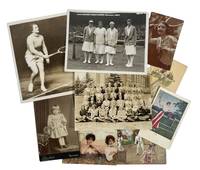
1900200841900. Women's tennis archive early 1900s to late 1930s documents female athletic participation across childhood portraiture illustrated popular culture press coverage and competitive play. The group is important for the history of women's sports because it records how women and girls were pictured entering a game that moved from elite recreation into organized competition during the late nineteenth and early twentieth centuries. The official history of Wimbledon notes that the Championships added Ladies' Singles in 1884 establishing one of the most visible formal venues for women's tennis and this archive preserves the visual culture that developed in the decades after that institutional change.<br /> <br /> The archive consists of ten visual items dated from the early 1900s to the late 1930s: three silver gelatin photographs one albumen cabinet card five brightly illustrated postcards and one real photo postcard with sizes ranging from approximately 1.75 x 2.75 inches to 6.5 x 8.5 inches. The largest press photograph dated 1933 shows Helen Jacobs in action and identifies her in the attached release as America's "outstanding woman athlete." Another press image shows four female champions standing side by side before a packed Wimbledon stadium with a newspaper article taped to the verso noting their scores. The earliest image an albumen cabinet card shows a little girl holding a small tennis racket while one illustrated postcard presents a co-ed trio on a tennis court in the early twentieth century. The remaining postcards and photographs extend the archive's range from playful and decorative representations of tennis to more direct evidence of women's organized competition. Half of the postcards bear handwritten inscriptions on the verso and two of the three press photographs retain original article clippings taped to the back.<br /> <br /> Taken together the group shows the changing public image of women's tennis from carefully posed early depictions shaped by restrictive dress codes to 1930s press photography centered on speed competition and celebrity. The official Wimbledon history also notes that equal prize money for men and women was not adopted there until 2007 a reminder that the athletic visibility seen in these images long preceded full institutional parity. Light handling wear overall with typical age toning and minor surface wear; inscriptions and verso attachments remain present; overall very good. Varied and visually engaging archive for the study of women's athletics press representation and the long development of competitive tennis culture. unknown
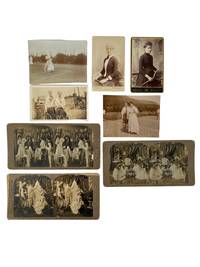
1880206021880. Unidentified photographers female tennis player photograph archive ca. 1880s-1910s documents women's participation in organized sport and recreational culture during the late nineteenth and early twentieth centuries supporting research into gender roles physical activity and educational environments for women in the Victorian and Edwardian periods. The group captures tennis as one of the few socially sanctioned athletic pursuits for women showing both formal portraiture and active play. The inclusion of seminary-based stereoviews alongside studio cartes-de-visite and outdoor scenes establishes a transatlantic visual record of how tennis intersected with women's education leisure and identity formation during a period of restricted physical and social mobility.<br /> <br /> Eight original photographs including five albumen prints and three stereoviews sepia toned ranging from approximately 2.5 x 4 inches to 3 x 4.5 inches. Two cartes-de-visite depict waist-length portraits of women holding tennis rackets dressed in late nineteenth-century attire including fitted bodices and high collars; versos bear photographer imprints for Hellis & Sons of London and George Goodman of Margate. Additional images show women engaged in doubles matches on grass courts including one action-oriented scene with players mid-swing wearing wide-brimmed hats and layered dresses. One photograph shows two young women in matching outfits possibly school uniforms standing in a yard holding rackets. The three stereoviews dated 1905 and issued by C.H. Graves of Philadelphia are captioned "A Masquerade at the Seminary Confidences" "Trying on the Costumes" and "Planning to Scare the Freshies" each depicting groups of young women in a dormitory interior; tennis rackets are visible mounted on the wall in the background linking athletic culture to residential school life. Based on the photographer and setting the images may relate to a women's seminary such as Darlington Seminary in West Chester Pennsylvania.<br /> <br /> Produced during the decades following the introduction of lawn tennis to the United States in 1874 the archive situates women's participation in sport within broader developments in leisure education and shifting norms of female physicality. The imagery documents the persistence of restrictive dress including corseted garments and long skirts even in athletic contexts underscoring the negotiation between mobility and propriety. Minor surface wear consistent with age with strong image clarity and tonal stability across prints. Overall in very good condition. unknown
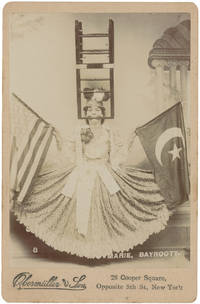
1905LIST114New York: Obermuller and Son 1905. Silver gelatin print 3 ¾ x 5 ⅜ inches on larger mount. Fine. Marie Bayrooty was the only female member of the Bayrooty Brothers Oriental Troupe who performed on the Barnum and Bailey Circus sideshow. A famous 'whirling dervish' - as members of the Mevlevi Order are known colloquially - she broke a record by whirling 2990 times in 37 minutes in 1906 per the The New York Times who described her as of Syrian descent. The Times in the typically dismissive tone of the day describe her performance as such: "Mary Bayrooty the Syrian girl who last year whirled for thirty-two minutes without cessation making something like 2240 revolutions established a new record yesterday afternoon in Barnum & Bailey's Freak Hall. She made 2990 twirls in thirty-seven minutes. This is a new world record. when the last note died and the last whirl had been achieved Marie was fresh as paint. She ran across the floor to the nearest reporter and pinned a rose on the lapel of his coat remaining until her fame had been suitably sounded. Then she sat down and gave the other freaks a chance." - New York Times April 2 1906. A fine example on a very good mount. Obermuller and Son unknown books
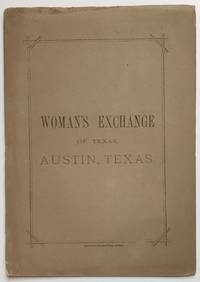
1880931Austin: Statesman Steam Print 1880. Very good. 8pp. Original tan printed wrappers. Minor soiling and wear. A rebranding of the "Woman's Art Exchange" of Texas removing the mistaken emphasis on art to encourage wider participation. "It was never intended to devote our energies to Art alone but to the encouragement of woman's handiwork of all kinds such as paintings; needle-work fancy and plain; preserves; pickles; sauces; bread and cake." Includes the association's articles of incorporation as well as the by-laws. "We now call upon the ladies of Texas to show what they can do." A handful of copies in OCLC. Statesman Steam Print unknown books
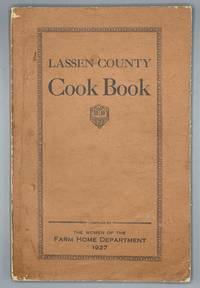
192710316Susanville California: Press of the Lassen Advocate 1927. 8.75 x 5.75" brown wrappers with black lettering 143 pp. Wear to covers wrapper and front blank pulled from staples. A rare cookbook published by the Farm Home Department of the Lassen County Farm Bureau. Includes a number of Mexican recipes chile con carne chicken chile con carne tamale pie etc as well as a recipe for Imitation Pate De Fois Gras. According to the text "In publishing our book there were two reasons uppermost in our minds. The first was a sentimental one; to collect and preserve the recipes of our good cooks. The second was to further the cause of good nutrition." To this end the last few pages print weight/height charts for girls and boys as well as a chart outlining the healthy appearance of various parts of the body. Press of the Lassen Advocate unknown
1977221171977. The WREE-View the official publication of Women for Racial and Economic Equality WREE documenting socialist feminist organizing anti-racist activism labor struggles and international solidarity campaigns during the late twentieth century. Published between 1977 and 1988 by a national women's organization affiliated with the Communist Party USA the newspaper articulated a multiracial working-class feminist politics grounded in labor activism anti-imperialism peace organizing and economic justice. The archive reflects socialist feminist political culture and grassroots organizing networks illustrating how left-wing women activists connected gender inequality to racial discrimination class exploitation militarism and global liberation struggles. Through movement reporting political essays interviews and international coverage the publication documents the operational framework of late Cold War socialist feminism while providing primary-source evidence for the study of women-led leftist activism in the United States and transnational solidarity movements during the Reagan era.<br /> <br /> The WREE-View. United States: Women for Racial and Economic Equality 1977-1988. Five issues in tabloid and digest newspaper formats printed on newsprint and illustrated throughout with black-and-white photographs activist graphics editorial cartoons and movement documentation. 1 The WREE-View. Vol. 1 No. 1. January-February 1977. Includes "Woman's Place is in the Mill" focused on labor organizing among textile workers reporting on Chilean women resisting the Pinochet dictatorship historical discussion of the "Bread and Roses" labor movement and updates from regional WREE chapters. 2 The WREE-View. Vol. 7 No. 5. September-October 1982. Centers on education access rape culture labor activism and international solidarity including reporting from the Farm Labor Organizing Committee convention and commentary by a Guyanese activist. Front-page slogan declares: "Education: A Right and Not a Privilege." 3 The WREE-View. Vol. 7 No. 6. November-December 1982. Features an interview with Ms. Carthan articles concerning Native American women described as an "invisible minority" organizing against domestic violence and critiques of nuclear energy projects in the Pacific Northwest. 4 The WREE-View. Vol. 12 No. 4. July-August 1987. Covers a women's peace march in Moscow responses to Reagan administration policies debate surrounding parental leave legislation in the United States and international reporting from Nicaragua Southern Africa and Hiroshima commemorations. 5 The WREE-View. Vol. 13 No. 5. September-October 1988. Focuses on poverty welfare rights Indigenous activism and homelessness among women. Front cover features protest imagery forming a wrench accompanied by the slogan "Wrench Reagan/Bush Out!" emphasizing electoral mobilization against conservative economic policy.<br /> <br /> The archive documents a strand of American feminist organizing that linked women's liberation directly to labor politics racial justice antiwar activism and global anti-colonial movements. Published during a period of intensified conservative backlash against organized labor welfare programs and leftist activism in the United States The WREE-View preserves the language and priorities of socialist feminist networks operating both nationally and internationally. Its sustained coverage of Black women Native women Latina activists labor organizers and liberation movements in Chile Nicaragua Afghanistan and South Africa reflects the publication's broad conception of feminist solidarity before "intersectionality" entered widespread academic and political usage. Moderate edge wear light chipping and expected toning to newsprint throughout; all issues complete and fully legible. Overall very good condition. A scarce archive of late twentieth-century socialist feminist publishing documenting multiracial working-class activism and internationalist women's movements during the Cold War era. unknown
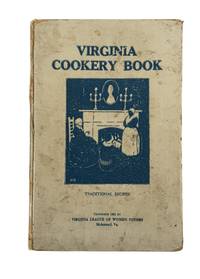
1921208321921. Suffrage Cookbook Virginia League of Women Voters. Virginia Cookery Book: Traditional Recipes. Richmond VA: Virginia League of Women Voters 1921. First edition. 192 pages. Cream illustrated boards. 9.25 x 6.5 inches. "Believing that our spirits are strengthened by well nourished bodies we have collected with care the recipes contained in this volume." The Foreword reads: "The Virginia League of Women Voters offers this book of Virginia Cookery in the hope that those who use it will find it helpful and will have the added satisfaction of knowing that by purchasing a copy they will have contributed to the fund of the League for education in good citizenship." The Virginia League of Women Voters was organized to help women attain and exercise their right to vote after the 19th Amendment which gave women the right to vote was passed in Congress in 1919. Virginia however was one of the nine southern states that opposed the amendment and refused to ratify it. Virginia women at last won the hard-fought right to vote in August 1920 when the Nineteenth Amendment became law and exercised that right soon after in the November elections. Recipes are attributed to members of the community with local advertisements giving the reader a genuine feel for the community. Pencil inscription to the front paste-down stating who the book belongs to dating Aug. 8 1929. Covers somewhat worn Three quarters of spine missing but binding is still tight. Text pages and illustrations are crisp and clean with minor foxing to blank area of some pages. Some edge wear. Overall good to very good condition. unknown